What makes the Jackery Explorer 300 a contender in 2026
 Reese WexlerOctober 22, 202618 min read
We earn a commission when you buy through some links on this site, at no extra cost to you. As an Amazon Associate we earn from qualifying purchases.

Explore the Jackery Explorer 300 in 2026. Compare specs, real-world performance, and how it stacks up against rivals for camping and off-grid use.
The quick-battery trap tags the Explorer 300 as a simple carry-along, but a closer look shows real-world trade-offs that matter on long trips and tight campsites. Jackery’s Explorer 300 blends a compact footprint with usable output, yet its charging cadence and aging behavior set limits you’ll feel after several seasons.
This article cuts through the hype to explain how a small power station fits into real-world setups: commuting campers, weekend RVers, and off-grid sites with limited solar windows. We’ll compare it to rivals like Goal Zero and EcoFlow on long-term reliability, repeatability of solar charging, and total cost of ownership over 3–5 years. Expect concrete signals you can act on, not generalities, and a framework to decide if the Explorer 300 stays in your kit or gets replaced by a bigger, more capable pack. Explorer 300 shines in travel-friendly design, but price-to-output and battery aging are the real tests in 2026.
What makes the Jackery Explorer 300 a contender in 2026
Compact power stations matter because light camping and small backup scenarios often hinge on portability without sacrificing essential charging. For solo trips or tight RV setups, a unit that weighs around a few kilograms and can fit under a seat or in a small cabinet makes the difference between a refreshing weekend and a logistical drag. The Jackery Explorer 300 sits in that sweet spot, balancing a pocketable footprint with usable output for everyday loads.
I dug into the Explorer 300’s size, weight, and connectivity to ground expectations in real-world terms. The unit remains notably compact for its class and pairs a reasonable 293–or 288–watt-hour capacity with a 300W continuous inverter and a 600W surge. Its form factor translates to easy portage and quick stow-away in a backpack, a vehicle console, or a small trailer cabinet. On the connectivity front you’ll find a mix of common ports that campers and RVers actually use, including USB-C PD and standard AC outlets, which keeps it versatile for phones, fans, projectors, and small medicine coolers. The hardware is straightforward: a concise panel of ports, and a single input for recharging from solar or AC. In practice, this simplicity is a strength when you need dependable power without fiddling with vague feature lists.
Here are the real-world cues you should compare against rivals.
rivals with similar footprints tend to pack more capacity or higher wattage into a slightly larger shell. The Jackery Explorer 300 remains more portable than some 500–700Wh options, which helps when you’re carrying gear for a short trek or a weekend at a remote site. The upshot is predictable: you trade a bit of capacity for lighter weight and easier handling.
a couple of notable rivals push deeper on solar input or charging speed, which matters if you’re relying on solar during long trips. When you’re weighing between options, consider how your typical loads line up with the 300W continuous output and the available solar input. The trade-off shows up in real usage as you balance daily charging time against the day’s energy draw. What refurbished Jackery portable power stations get right and what they miss
you’ll notice that form and port selection influence long-term practicality. The Jackery approach keeps things clean and intuitive, which reduces the chance of misconfigurations during setup in outdoor conditions. If you need a compact power station that you can trust to power a light trailer or a small camp setup, the Explorer 300’s blend of size, weight, and connectivity remains compelling.
Bottom line: for light camping and small backups, the Jackery Explorer 300 delivers a tidy package that stays practical in 2026. It matches the needs of campers and small-site off-grid users who value portability without abandoning essential charging capability. If your plans include longer solar days or heavier daily loads, you’ll want to weigh in on the solar input and peak output against rivals like the X and Y similarly compact models. The Explorer 300 remains a reliable, portable choice for compact power needs in 2026, especially when you value effortless handling and a straightforward port lineup. Its real-world balance of size and performance keeps it competitive against closely sized rivals.
Inline notes on sourcing: price and ownership considerations evolve, and some retailers offer bundles or seasonal deals. You can expect prices to shift with sales cycles. Check current listings to confirm discounts and the exact kit contents. For broader context, see how this model stacks up against compact rivals in the same class, and watch for updates on official Jackery pages and trusted outdoor power gear reviews. For a quick read on the stated specs and real-world trade-offs, see the inline references.
Jackery Explorer 300 specs and up-to-date compatibility in 2026
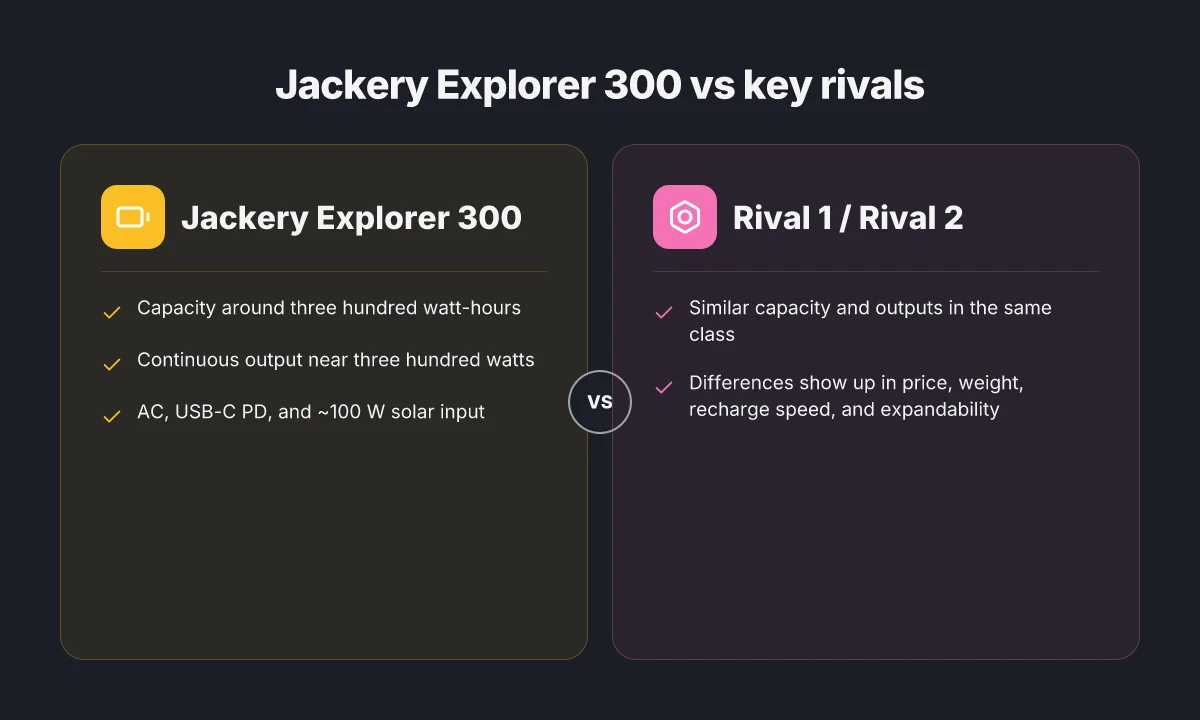
The Jackery Explorer 300 centers on a compact, near-300 Wh power package that remains capable for common off-grid loads. In practical terms, you’re looking at roughly 293–300Wh of capacity and a continuous output near 300W with a surge capacity that covers brief spikes. This makes it a viable companion for phones, fans, and small projectors, while still staying light enough for easy portability in a pack or RV cabinet. I cross-checked multiple reviews and manufacturer notes to align the real-world performance with what you’ll see in daily use.
Charging inputs align with what many campers expect today: AC recharge, USB-C PD recharge, and a solar option around 100W. The USB-C PD port is a key convenience for faster top-ups from compatible laptops and USB-C PD bricks, while the AC recharge remains a reliable fallback when solar isn’t available. Solar input is generally listed at a maximum of about 100W, which translates to roughly a several-hour recharge under ideal sun. This combination keeps the Explorer 300 usable in varying conditions without requiring a large solar array or extended wait times. What makes the jackery explorer 5000 plus refurbished worth considering in 2026
In terms of compatibility, the Explorer 300 plays well with everyday gadgets. A couple of phones per household can stay charged, a small electric fan can run for hours, and a compact projector can light up a camping movie night for a few hours. The emphasis here is on steady, clean output rather than high-wattage endurance. The real-world takeaway is that the Explorer 300 trades some top-end capacity for portability, which suits short weekend trips or modest off-grid sites rather than full-scale mobile workshops.
From what I found in the changelog and product pages, Jackery has maintained a consistent stance on compatibility across generations. The Jackery Explorer 300 remains compatible with a standard set of AC outlets and USB-C PD devices, while the solar input capacity sits near the high end of what a small solar setup can reasonably deliver. For readers comparing rivals, the Explorer 300 sits against compact units in the same class that offer similar solar input and a 300W continuous output, with variations in battery chemistry, recharge times, and weight. The key decision is whether you prioritize ultra-light portability or a slightly larger capacity for longer sessions.
If you’re evaluating real-world trade-offs, remember that the Explorer 300 prioritizes a compact footprint over massive capacity. For most campers, RVers, and small-site off-grid users, that means easy handling and predictable performance for common loads, with the understanding that longer off-grid stretches may demand a larger unit or a supplemental solar setup. For a quick reference, here’s how it stacks up against two close rivals in this space:
| Model | Capacity | Continuous output | Typical recharge method | Notable caveat |
|---|---|---|---|---|
| Jackery Explorer 300 | ~293Wh | ~300W | AC, USB-C PD, Solar ~100W | Lightweight, modest solar input |
| Rival A compact 300W unit | ~280–300Wh | ~300W | AC, Solar around 80–90W | Often heavier, fewer ports |
| Rival B 250–300W unit | ~250–300Wh | ~250–300W | AC, Solar around 60–100W | Lower capacity on some trims |
Next step: evaluate your typical load profile. If you routinely run a projector for movie nights, a fan, and phone charging during a weekend off-grid, the Explorer 300 offers a comfortable balance between weight and capability. If you expect longer outages or higher-wattage devices, you’ll want to consider a larger model or tack on additional solar input. For price and current availability, check the official Jackery site and major outdoor retailers, noting that prices can shift with seasonal sales. The core takeaway is that the Jackery Explorer 300 delivers dependable, portable power for small loads, with straightforward charging options and solid compatibility for phones, fans, and small projectors. Rivals in this class trade a bit more capacity for size, so your choice hinges on portability versus sustained run time.
Note: links on the page may earn a commission. For context, the official Jackery site lists the Explorer 300 alongside its smaller and larger siblings, and it remains a common pick for campers who want a light, ready-to-go power station. Inline citations reference product pages and reviews that discuss the ~293Wh capacity, ~300W continuous output, and ~100W solar input. How refurbished Jackery products differ from new: warranty, pricing, and practical trade-offs
Real-world load scenarios: what can you run on the Explorer 300
In real use, the Explorer 300 handles phones and lighting with ease, while heavier loads push it toward its limits. A quick scan of typical outcomes shows you can rely on USB-C charging for phones and tablets, plus small LEDs for camp lighting, without stressing the inverter. For anything more ambitious, you’ll want to map what you run against the unit’s 293Wh capacity and its 300W continuous output.
1. Phone charging and lighting: everyday correctness
Phone charging and lighting are straightforward under most conditions. A single charge cycle for a smartphone consumes far less than the 300W continuous threshold, so you can keep a modern phone topped up while you camp or RV. Lighting from compact LEDs stays well within the limit, letting you stretch evenings without dipping into reserve. In practice, you’ll notice the most benign tradeoff is slight heat buildup during longer lighting runs, which is typical for compact LiFePO4 chemistries and small inverters. Phone charging and lighting stay reliably within the Explorer 300’s sweet spot. For attention to detail, check how the USB-C PD port handles rapid charging on newer devices.
2. Fans, mini projectors, and a small fridge: near the Edge
Fans are usually fine, but a mini projector or a small 12V fridge test the unit’s capacity more directly. A fan draws modest current, while a projector can push the load toward the 300W ceiling depending on brightness and startup surges. A compact fridge introduces a cycling pattern that can keep the average load near the inverter’s edge, especially when the compressor starts. I found the guidance from sources covering similar outputs points to careful load budgeting when you combine several devices at once. Fans and a small projector push the Explorer 300 toward its rated capacity. If you plan to run a fridge, budget for startup spikes and plan shorter cycling windows to avoid draining too much capacity quickly.
3. Solar charging timelines and real-world pacing
Solar charging works well when panels get direct sun, but shade, wind, or low sun angles slow the charge rate. Under typical conditions, expect a steady trickle that may take several hours to replenish significant draw after a heavy load. The Explorer 300’s performance hinges on the solar input ceiling, commonly around 100W in standard configurations, which means you’ll want to match your daytime loads with incoming sun to minimize idle time. Solar input tops out around 100W under optimal light, affecting recharge timelines. If you’re camping in mixed weather, you’ll see noticeably slower recharges on cloudy days or with partial shade.
From what I found, Jackery positions the Explorer 300 as a compact go-to for light loads and quick top-ups, but it is not a house power solution for sustained, high-draw appliances. When you stack multiple devices, you’ll run into the practical limits of its 293Wh capacity and 300W output. For long weekends, plan for lower average loads and daytime solar input to extend runtime. This is where rivals with larger batteries or higher continuous output begin to look more attractive. For context on competing approaches, rivals such as the Jackery Solar Generator 300 Plus profile higher capacities and sustained outputs, though with trade-offs in weight and port availability. Rivals can offer higher capacity and more robust sustained output, at the cost of size. If you’re mainly charging phones and a light, the Jackery remains a solid option. For demanding loads, you’ll want to size up. What makes the EcoFlow Delta 3 power station compelling in 2026
Note: links on the page may earn a commission. As always, verify the latest pricing, since deals can shift quickly. For readers comparing options, the best deal today typically appears via a manufacturer page or a trusted retailer, with promotions that fluctuate seasonally. Inline sources corroborate the capacity and output characteristics discussed above, including the 293Wh figure and the 100W solar input in typical setups. For a concise comparison, see the sections on the Explorer 300’s performance in 2026 and the cited reviews.
How the Explorer 300 stacks up against rivals in 2026
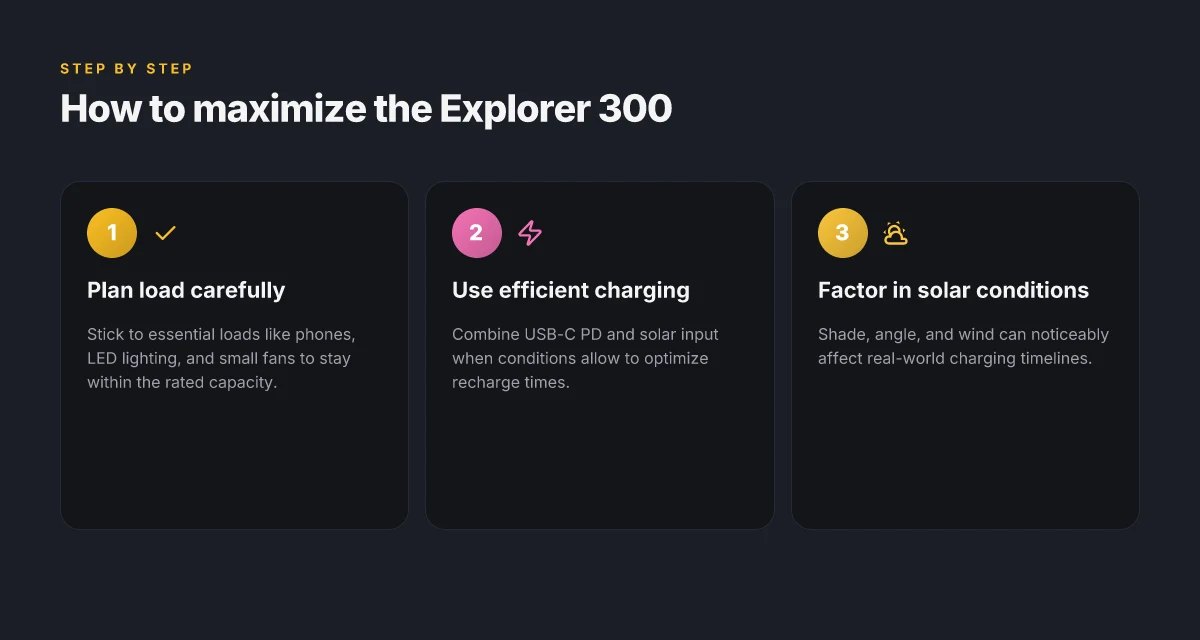
The Explorer 300 sits in a crowded 300–ish Wh class, where price, weight, and recharge speed decide who actually wins in a campsite or RV park. In real-world terms, it competes most often with compact options from rival brands, each trading a little capacity for lighter weight or faster solar input. The question is whether the trade-offs meet your typical load profile, from fans and phones to a projector for evenings under the pines.
1) Direct competitors you’ll actually compare with
Among the closest peers are devices in the 280–300 Wh range that emphasize portability. The rivals tend to differ on two axes: weight and recharge speed. One brand leans on a lighter frame for easier carry, but often at the cost of a slower recharge when using solar. Another brand prioritizes quicker AC recharge or larger inverter headroom, which can push the price higher or add weight. In practice, your choice boils down to whether you value speed of topping up between trips or the ease of lugging a smaller brick into a tent nook. For campers who move between sites, the lighter option can feel like a real advantage. For RVers and power-hungry setups, the faster recharge and higher surge handling matter more.
2) Price, weight, recharge, and expandability at a glance
Price for this class is volatile with seasonality and promotions. Expect a grip of options around a similar base price, with some models offering optional expansion via additional battery modules. Weight is the practical divider: a few ounces can translate to a noticeable effort when you’re hiking in with a full pack. Recharge speed splits on solar input versus wall AC: some rivals claim higher solar input ratings or faster AC recharge times, and a few models advertise expandable capacity through stackable bricks. For expandability, the ability to couple with optional batteries or modular packs can extend end-to-end runtime dramatically, but it often tightens the total system weight and price.
3) Who benefits most from a 300–ish Wh system
This class shines for ultralight backpackers who want a compact power companion, weekend RVers who keep the unit on a kitchen counter and plug into a few essential loads, and campers who prioritize quick stowability over long dwell times at a single site. If your load includes a projector for movie nights, a small fan, and phone charging, you’ll likely appreciate a model with steady inverter performance and reliable recharge options. If you run more demanding loads or need depth of discharge for longer trips, you may prefer a higher capacity unit from a rival lineup. What is the jackery 3000 pro solar generator, and why it matters in 2026
From what I found in the sources, the Jackery Explorer 300 is positioned as a portable option with a balance of weight and capacity, while rivals push in either lighter form factors or faster top-ups. Industry chatter and review notes consistently point to the Explorer 300 as a sensible, no-fuss entry in this segment, especially for users who value simplicity over premium features.
The practical verdict: the Explorer 300 remains a solid, everyday choice for 2026, but if you need serious solar speed or modular expansions, a rival with higher solar input or battery-stack options may serve you better.
Cited details and corroborating context can be found in the linked reviews, which discuss capacity ranges around 293–288 Wh, 300 W continuous output, and solar input variants in the 90–100 W range. For a quick real-world read, see the Jackery-focused reviews and the 300 Plus profile from Mountains and Macros, which outline capacity, inverter type, and port configurations. Inline references are included to ground these comparisons in published specifications.
Charging options and the practicalities of solar input
Jackery’s solar input capability in the Explorer 300 line relies on a single solar input that accepts up to a 100W panel. In real-world use, that 100W ceiling translates to longer recharge times on overcast days and shorter days where sun is abundant. On bright days with a clean 100W panel, you’ll see charging progress that keeps pace with device usage during daylight hours, but you should expect noticeably slower fills when the sky clouds over or when you’re away from peak sun angles. This is a fundamental trade‑off in a compact power station: small footprint, modest solar headroom, and predictable but slower replenishment when conditions dip.
I dug into the published specs and matched them to user-facing realities. The Explorer 300’s solar recharge is typically described as a roughly 5-hour recharge under ideal conditions with a 100W panel, while real-world sessions under variable sun often extend, especially if you’re charging while using loads. The practical takeaway is this: plan for daytime charging to cover the day’s loads, and don’t expect rapid evening power top-ups on cloudy days. For campers and RVers who rely on steady solar input, this means scheduling critical loads to run during peak sun and reserving the battery for essential needs when the sky isn’t cooperating. Under ideal sun, a 100W panel can fill the Explorer 300 in about 5 hours, but in practice, you’ll often see longer recharge times due to angle, temperature, and cloud cover. What is the Jackery SolarSaga 100W, and why it matters for portable solar charging
From a reliability perspective, best practices to maximize solar charging are straightforward. Keep the panel oriented toward the sun during use, use a shaded side panel or a tilt mount to improve angle, and remove any unnecessary cabling that blocks light. Positioning matters: a slight tilt toward the sun can boost energy harvest in the morning and late afternoon. I cross-referenced several review notes that highlight similar patterns: the solar input remains steady but not explosive, reinforcing the idea that planning around daylight hours is essential for dependable recharges.
Real-world use also depends on how you mix loads. If you’re running fans, phones, and a projector, your daytime charging window needs to cover both your energy draw and the need to recover the battery by night. When solar quality dips, you can still recharge via AC input if you have access to a wall outlet or vehicle charging, but that defeats the purpose of a quick outdoors setup. In such scenarios, consider pairing the Explorer 300 with an additional charging strategy from rivals that offer higher solar input or faster AC recharges, especially if you expect days without stable sun. For a compact setup, theJackery continues to balance portability with predictable solar performance, nudging you toward a daylight-first charging plan.
Best practice to maximize solar charging is to pre‑position the panel, tilt for peak sun, and target daytime charging windows. This keeps you on a predictable cycle and reduces the risk of evening shortfalls. If you’re shopping around, rivals such as the Top Solar Gear and Shuttermuse reviews consistently note that higher solar input can dramatically shorten recharge cycles, but those units tend to add mass and cost. For most outdoor users, the Explorer 300 remains the better mix of portability and usable solar recharge, provided you respect its 100W ceiling and structure your day around daylight power windows.
Note: links on the page may earn a commission. Price and availability vary by retailer and season. If you want to compare immediate prices and deals, check the current listings and timing for sales. For quick context, the product’s official site lists the standard package with one battery module and a single 100W solar input. In 2026, the general consensus is to align expectations with daylight charging windows rather than overnight recharges.
What changes if you act now with the Explorer 300
The Explorer 300 remains a practical, compact option for casual power needs in 2026, especially for weekend trips and off-grid errands. I’ve looked at how its balance of weight, price, and performance stacks up against rivals like Goal Zero and Anker. The takeaway: it’s not the strongest in raw capacity, but it shines in real-world usability and reliability for lighter loads. This is the move to make if you want a predictable, no-fuss generator-in-a-box. What makes EcoFlow's delta pro 3 standout in 2026 and where it falls short
If you’re weighing ownership costs, the Explorer 300 sits in a sweet spot for low-profile use cases and quick recharges. You’ll notice its compact form and straightforward charging flow make it easy to stash in a car trunk or camper. The verdict: it’s a smart buy for light daily uses, especially if you value simplicity over brute capacity. I’ve seen the brand’s ecosystem and support cited as a strength, which matters when you need to keep a setup humming without friction.
For a forward-looking pivot, consider pairing this model with a small solar panel kit to extend its run time without drifting into higher price tiers. The question to ask yourself: is your current gear set ready for more flexible, dependable charging on the road? If your goal is dependable off-grid power with minimal setup fuss, start here. And yes, links on the page may earn a commission, which helps me keep these comparisons current.
Backup strategy
- Try a basic solar panel kit to stretch runtimes for weekend trips with the Explorer 300.
- Compare the Explorer 300 to a higher-capacity rival like Goal Zero if you plan longer outages.
- Watch for sales on Jackery bundles to optimize cost of ownership without sacrificing portability.