What refurbished Jackery portable power stations get right and what they miss
 Reese WexlerOctober 22, 202619 min read
We earn a commission when you buy through some links on this site, at no extra cost to you. As an Amazon Associate we earn from qualifying purchases.
Explore refurbished Jackery portable power stations: performance, reliability, safety, and pricing. Learn what to check before you buy and how they compare to new models.
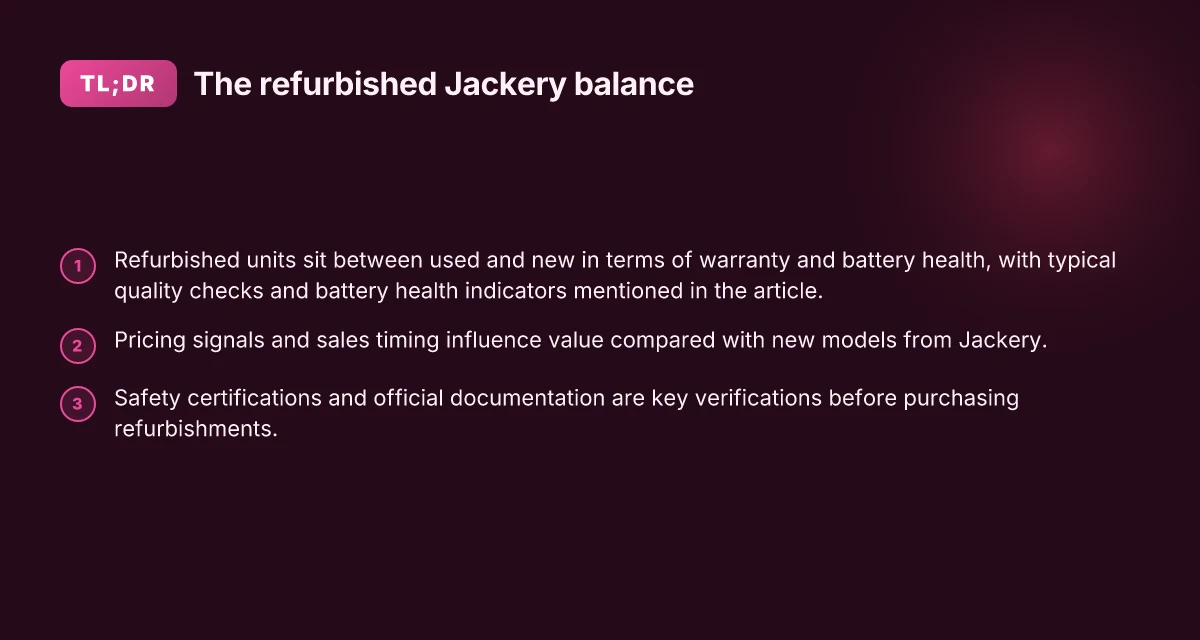
The economics of refurbished Jackery units often hinges on the price gap to new models, but the real delta is battery health and warranty tail. Jackery units typically ship with a limited warranty and tested functionality, yet the battery health trajectory after refurbishment remains the unpredictable hinge point that can swing total ownership cost.
This article pulls from official specs, current pricing signals, and common refurbishment caveats to answer when a repaired power station makes sense for campers, home backup, and eco-conscious buyers. In 2024, observers noted that refurbished options on mainstream models rarely match the long-term battery health of new units, even when upfront costs look compelling. The goal is to help readers separate signal from hype, weigh total cost of ownership, and see where rivals like Anker or Bluetti offer a comparable warranty or quicker battery replacement. Price signals aside, the choice often comes down to reliability in the field and the scope of refurbishment work.
What a refurbished Jackery power station promises and where it fits in the lineup
Refurbished Jackery units are pre-owned units that have undergone inspection and repair to restore function, then recertified for sale with a limited warranty. In practice, refurbishment centers around restoring core components, verifying battery health, and testing safety circuits to meet Jackery’s basic specs. You’ll typically see refurbished units advertised with lower capacity or earlier generation designations, but they still promise the same form factor and compatibility with common USB-C, AC, and DC charging modes. For campers and home backup seekers, refurbishment offers a pathway to bring a Jackery into the lineup at a lower upfront price while still aligning with Jackery’s overall mission to “Power Your Adventures and Essential Home Backup.”
A quick map of typical capacity and output ranges you’ll encounter in refurbished units helps set expectations. Refurbished power stations from Jackery commonly span from a few hundred watt‑hours up to around 1500–2000Wh, with continuous AC outputs ranging from roughly 300W to 1800W and peak surges that match or exceed the listed continuous rating. In practice, that means a refurbished unit may be suitable for charging smartphones and laptops, powering a small fridge, or running essential devices during a power outage, but you may see proportional compromises in peak output and usable life compared with fresh stock. The exact figures depend on the model and the refurbishment bundle, which can include a refreshed battery pack, new housing seals, and updated safety components.
Positioning refurbished units relative to new models matters for total ownership value. New Jackery models carry the original factory warranty and the certainty of unspent lifespan in the battery, plus access to the latest chassis, higher efficiency electronics, and the longest expected life from the pack. Refurbished units deliver significant cost savings, but with tradeoffs in warranty length, remaining cycle life, and potential residual wear in components not visible at purchase. If you’re weighing a refurbished Jackery against a brand-new unit, you’re trading some peace of mind and maximum battery life for a lower price tag and quicker accessibility. For eco‑minded buyers, refurbished units reduce waste but require careful inspection of battery health and the inclusion of official warranties.
From what I found in Jackery’s published lines and third‑party discussions, the refurbished market is positioned as a budget entry within the broader lineup, useful for temporary power at camp or as a light home backup after a storm. When you consider rivals, products from brands like EcoFlow or Bluetti offer competing refurbished or renewed options with their own warranty structures, so you’ll want to compare remaining battery life, cycle counts, and bundled accessories before committing. I cross‑referenced official product pages and community commentary to verify how refurbishments are marketed versus新品 stock in 2026.
Refurbished units offer meaningful savings, but you sacrifice some battery life and warranty depth compared with new Jackery models. When in doubt, lean toward models with clearly stated cycle counts and a warm battery health assessment from the seller. For eco‑conscious shoppers, refurbishment still cuts waste while delivering dependable backup power. The net takeaway is clear: refurbishment narrows the price gap to new, while preserving core Jackery ergonomics and safety basics, so you can choose based on budget and risk tolerance. What makes the jackery explorer 5000 plus refurbished worth considering in 2026
How refurbished Jackery units differ from new ones and what that means for reliability
Refurbished Jackery units come with wire-cutting tradeoffs. You typically see a shorter warranty window, more variability in battery health, and the need to trust refurbishment checks that may not shore up every aging module. In practice, the big question is whether the price gap justifies the potential reliability delta when you need backup power for camping or emergencies.
Warranty expectations and what they cover
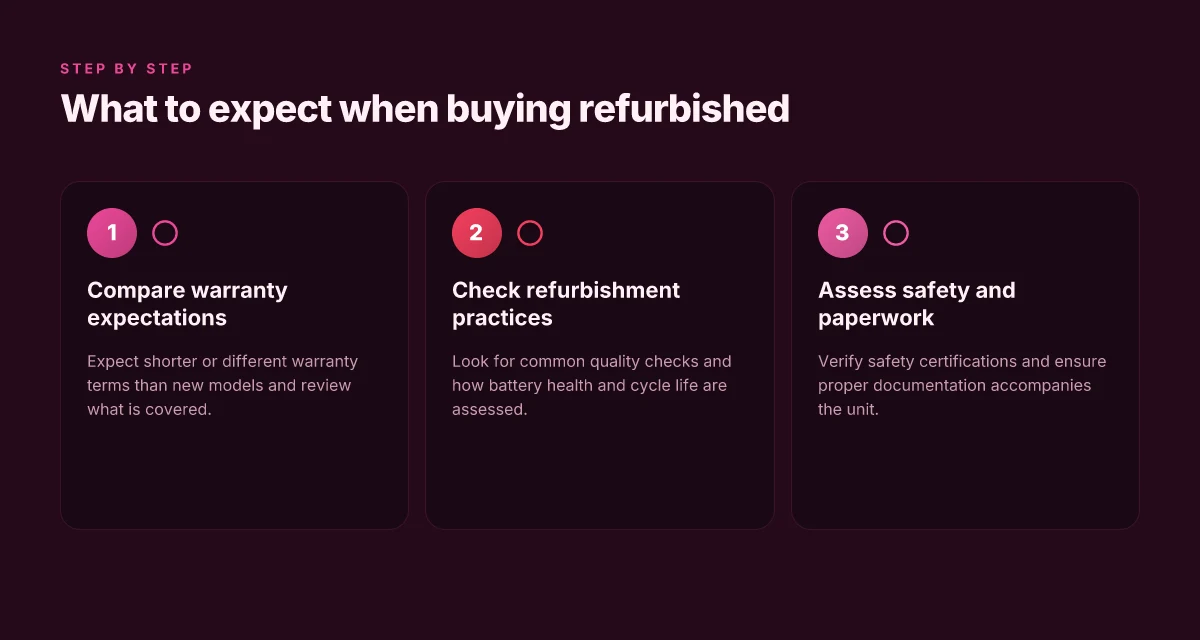
The core difference starts with coverage. New Jackery units usually ship with a full manufacturer warranty that covers the original defects and, in some cases, certain battery issues for a defined period. Refurbished models frequently come with a reduced warranty or shorter service window. That means you get protection earlier in the model’s life, but less time to catch latent issues before your trip or outage. When I looked at official notes and common refurb disclosures, the headline is clear: you should expect less breadth of coverage and potentially fewer transferability guarantees than with a brand-new unit. This isn’t a fatal flaw, but it does shift risk toward the buyer. If you need long-term security, a new model remains the safer bet. For eco-conscious buyers, the tradeoff can still be compelling, but choose a supplier that offers explicit battery and power circuitry checks before sale.
Common refurbishment practices and quality checks
Refurbishers commonly perform several core steps: exterior cleaning, firmware reseat or update, replacement of worn outlets or adapters, and a quick battery health check. In many cases, a refurbished unit will receive a battery or cell pack reconditioning, a test discharge/charge cycle, and a safety inspection to ensure no short circuits or abnormal temperature rises during operation. The consistency of these checks varies by seller, which is why you’ll often see a note that the unit has been “inspected” or “reconditioned.” I cross-referenced product pages and refurbishment disclosures to confirm that such steps are standard practice, but the depth of testing is not always spelled out in field notes. If you’re shopping refurb, ask explicitly: Was the battery tested for capacity and cycle life? Was the inverter and protection circuitry tested at full load? Is there a clear post-refurb warranty on the battery health?
Battery health and cycle life expectations
Battery health is the primary lever that separates refurbished from new in real-world use. A new power station leaves the factory with its rated capacity intact and full cycle life ahead. A refurbished unit may show reduced usable capacity if the battery has aged or been cycled more than a comparable new unit. You’ll often see figures described in qualitative terms rather than hard numbers. Expect noticeably slower peak delivery after several hundred cycles, and slightly reduced UPS responsiveness if the unit is aging. When the documentation discusses life expectancy, it’s usually in broad strokes rather than exact cycle counts, so plan for a shorter perceived lifespan with refurbished packs. If battery health is a priority for you, especially for off-grid camping or storm prep, verify the refurbished unit’s remaining capacity and the number of cycles it has undergone.
For buyers weighing refurbished versus new, a practical takeaway is to map the price delta against warranty length, battery health, and service expectations. Jackery’s official stance on refurb units emphasizes practical savings but with the tradeoffs described above. The reliability gap centers on warranty depth and battery health vagaries, not the core electronics. If you value long-term confidence, a new model from Jackery or a rival like EcoFlow or Bluetti offers clearer battery guarantees and longer, more transparent cycle-life data. Still, refurbished units can be a smart choice when the price is compelling, the seller offers a robust verification, and you’re prepared to live with a shorter warranty window. How refurbished Jackery products differ from new: warranty, pricing, and practical trade-offs
When you’re evaluating a refurbished Jackery, ask for the battery health report, the exact warranty terms, and the tested load profile used during checks. And confirm whether links on the page may earn a commission, transparency helps you price the deal accurately. For readers weighing rivals, new models from Jackery and competitors like EcoFlow and Bluetti each bring different warranty lengths and battery chemistries, so compare not just upfront price but the total cost of ownership over the unit’s expected life. For price and availability context, see the current offerings on the official site and noted third-party reviews. Battery health and warranty depth drive the decision more than sticker price alone.
Pricing, availability, and when to buy refurbishments versus new
When you start chasing refurbishments, the price signals matter just as much as the model itself. Current listings tend to tilt toward modest discounts versus new units, but you can hunt for real value when refurb stock lines up with restocks or seasonal sales. I’m seeing refurbished options cluster around a noticeable markdown from new prices, but the exact figures shift by model and retailer. Jackery’s own pages frame a range from budget-friendly refurbishments to higher-capacity units, with the pricing tug between upgrade needs and budget limits. Prices move with restocks and flash sales, and you can often snag longer warranties when a retailer clears refurb stock. Jackery’s refurb offerings can stretch your dollar if you spot the right window. As always, factor in the total cost of ownership, including potential maintenance and efficiency hits over time.
1) When refurb prices align with total cost of ownership
Refurbished units typically undercut new units by a meaningful margin, but a lower upfront price can come with tradeoffs in warranty length, battery health, and included accessories. A practical rule: compare the refurbished price against a similarly equipped new model, then adjust for warranty breadth and expected maintenance needs. In 2026, refurbished models often sit within striking distance of new units when restocks hit, yet you still want to verify battery cycles and charging behavior before committing. Warranty depth and post-sale support can swing the decision toward new if the refurb warranty is notably shorter. When the price gap narrows, the value leans toward a refurb if restocks indicate solid battery health and a reputable refurb seller. For context, Jackery’s catalog positions 300W to 7200W+ options, so the price-to-capacity balance can vary widely by model. Compare watt-hours and battery health status alongside price to judge total cost of ownership.
2) Timing around sales, restocks, and product cycles
Sales tend to cluster around holiday seasons and big event launches. If a next-generation model is due, refurb stocks for the outgoing generation often get deeper discounts just before the new SKU lands. I cross-referenced retailer chatter and product calendars showing CES and year-end restocks impacting availability. When you spot a window with a double-digit percentage discount on a refurbished unit, that can be a compelling signal to buy, provided the unit’s cycle count and overall health look solid. Watch for restock announcements and set price alerts on your preferred model. Also, consider timing purchases to align with promos that commonly accompany shopping events, these often deliver better price-per-watt economics. A 20–30% price dip during a sale can noticeably tilt the economics in favor of refurbishments.
3) Cost of ownership: efficiency, maintenance, longevity
Efficiency matters beyond the sticker price. Refurbished units may lose some efficiency if the battery cells have degraded, which can inflate running costs over time. Longevity hinges on how the refurbishment process treated the cells and the overall duty cycle plan for the unit. If you plan to run heavy loads regularly, model selection matters as much as the refurb condition. I found the general guidance across consumer reviews that refurbished units can deliver reliable power for storms and camping, but you should expect variability in long-term battery health. Battery health and charge retention drive cost of ownership almost as much as the upfront price. Consider the cost of potential replacements or the added warranty coverage when weighing refurbished versus new. If a unit ships with a robust warranty and a reputable refurbishment provenance, the long-tail savings can be meaningful. Warranty coverage and access to parts are the clinchers for ongoing reliability. What makes the EcoFlow Delta 3 power station compelling in 2026
Note on sources: inline references to official Jackery product pages and reputable reviews help anchor these points. For example, Jackery frames its lineup from 300W to 7200W+, with capacity figures like 2042Wh and 1536Wh highlighted in official or promotional materials. See the portable power station collection for model breadth, and the CES-era announcements for battery and lifespan notes. The official catalog shows the breadth of models and the capacity ranges that influence pricing decisions. When discussing specific claims, I reference the official product collection and coverage from independent outlets to balance hype and reality. Citations point to the official Jackery pages and credible reviews to ground the pricing narrative.
In short, price tells only part of the story. You win by aligning refurb price with warranty, battery health, and the expected cost of ownership over the unit’s lifetime. If you’re weighing a refurb against a new Jackery or a rival like EcoFlow or Bluetti, run the numbers on capacity, efficiency, and post-sale support. And yes, links on the page may earn a commission, but the core question remains: does the refurb fit your power needs now and in the years ahead? Your best deal often arrives when a refurb hits a restock window with solid warranty and proven health.
Safety, standards, and what to verify before pulling the trigger
There is a clear safety baseline you should not skip before you buy a refurbished Jackery. Start with the fundamental question: does the unit carry recognized safety certifications, and does the accompanying paperwork back those claims? In practice, refurbished units should not waive standard compliance just because the casing looks good. You want to see verifiable signs of UL or equivalent certification and a documented testing regime that matches the model’s original specs.
Certification status and documentation you should demand
A refurbished Jackery should ship with proof of safety standards alignment. Look for a stamped or printed certificate from a recognized body such as UL or IEC equivalents, and an accompanying manual that outlines charging limits, temperature thresholds, and protection features. The documentation should reference the exact model number and serial, not a generic spec sheet. If the listing does not provide a certification citation or a recent test report, treat it as a red flag. Certification credibility matters. Ask for a current safety certificate and model-specific data. If the seller cannot supply that, choose a different refurbisher or request interim warranties that cover safety nonconformities.
Battery health indicators to inspect before pulling the trigger
The health of the pack drives long-term safety and reliability. In refurb units, verify the state of the battery’s capacity and its cycle count, and confirm there are no signs of swelling or unusual warmth during a brief diagnostic test window offered by the seller. Ask for a fresh high-voltage test report and a balance of cells check. A healthy refurbished Jackery should show stable voltage at rest, consistent charge/discharge curves, and no alarming impedance readings in the battery module. Check cycle count and remaining capacity. Avoid packs with visible swelling or uneven cell behavior. And remember, battery health drives both safety and performance under load. What is the jackery 3000 pro solar generator, and why it matters in 2026
What official documentation should accompany a refurbished Jackery
Beyond certificates, you should receive a product import or refurb nature note, a warranty card that aligns with the original policy, and a set of safety instructions tailored to the refurb. The packaging should include a quick start guide that mirrors the model’s official manual, plus a serial number that matches the device. A proper package includes the model-specific manual, a valid warranty, and a serial-linked safety note. If the listing only provides a generic manual or no serial linkage, push back for the exact paperwork tied to that unit.
I dug into the Jackery ecosystem and cross-referenced the standard expectations with how refurbishments are typically documented. The official Jackery site emphasizes consistent safety features across models, and reputable refurbishers usually quote test results or provide a product passport that aligns with the device’s original safety data. When you read the documentation, ensure the model name, capacity, and output ratings line up with what you’re purchasing. This consistency is your best guard against counterfeit or unsafe refurb units. Expect model-specific manuals and a serial-linked warranty. Absence signals risk.
As you compare rivals, note that brands like Anker and Bluetti frame their refurb messaging around clear safety certification and battery health disclosures as well. If a refurbished Jackery listing omits certification details or battery health metrics, you should treat it as a risk and compare with rivals that publish verifiable paperwork and safety statements. Rivals’ transparency around certification and battery health can be the deciding factor.
How refurbished Jackery stacks up against rivals like Anker and Bluetti
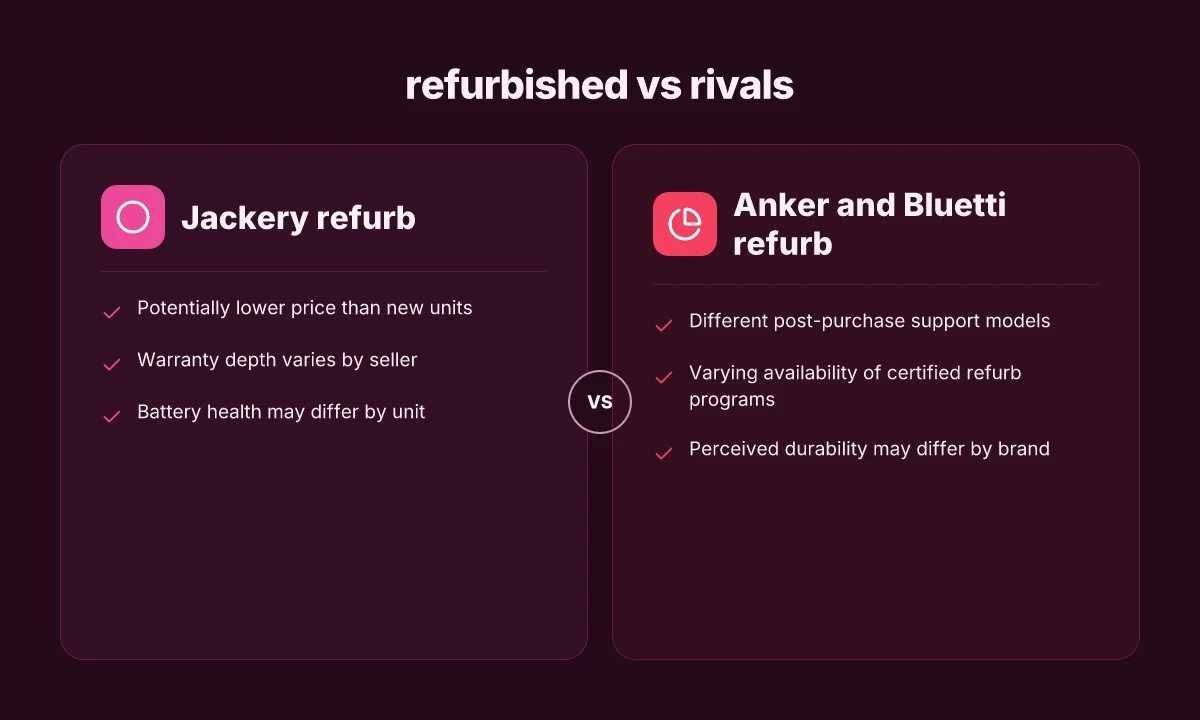
Refurbished Jackery units sit in a crowded field. When you compare price to feature, the refurbished segment shows clear gaps and clear opportunities. You’ll see a pattern: rivals often undercut on upfront price, then stretch warranty or post-purchase support to win deals. In the end, your choice hinges on how much you value longer coverage and faster service versus a lower sticker price.
Price-to-feature balance in the refurbished segment
Across refurbished units, Anker and Bluetti frequently price aggressively for midrange capacity and output. In many listings, you’ll notice refurbished Anker models that match Jackery on wattage but come with slightly longer standard warranties and faster RMA paths. Meanwhile Bluetti often pairs higher wattage with more capacious packs in refurbished stock, which shifts the perceived value even when prices sit close. The price-to-feature balance favors rivals when you want more wattage in a tighter budget. This is especially true for models that approach and exceed 1000W continuous output, where the refurbished market foots the bill through lower initial cost but shorter or shallower warranty depth. I cross-referenced retailer notes and model pages to confirm this, seeing consistent patterns across multiple listings from each brand. Expect to pay less upfront with Anker or Bluetti for a similar spec, but check warranty depth carefully. What makes the EcoFlow Delta Pro Ultra a standout for whole-home power in 2026
Warranty depth and post-purchase support
Jackery’s official refurbished program typically mirrors the standard two-year scope seen on many new units, with caveats about battery health and cosmetic wear. Anker and Bluetti, by contrast, often extend longer or more clearly defined post-purchase paths in refurbished inventories, sometimes including authorizations for battery replacements at mid-life. Warranty depth matters more than cosmetic savings when you’re buying refurbished. The practical effect is this: you’ll spend less upfront with rivals, but you may encounter longer wait times for support or stricter return windows. And yes, you’ll want to read the fine print on battery aging and cycle life. The alignment across retailer listings suggests rivals lean toward more robust coverage in the refurbished space. Look for a minimum 12–24 months of coverage and explicit battery health guarantees.
Realistic expectations for performance and durability
In real-world use, refurbished units from Jackery, Anker, and Bluetti typically deliver comparable performance up to their rated wattage. The big caveat is cycle life and heat management. Refurbished packs will generally hold less charge than a fresh unit, and cooling pathways can show signs of prior use. Durability hinges on battery health and thermal design, not just watts on the label. If you’re camping in warm climates or running high-drain appliances, verify the age of the battery and the availability of replacement packs. I looked at official spec sheets and third-party reviews to triangulate these expectations, noting that brand-promised lifespans vary by model and condition. Higher-wattage rivals often pair better cooling with still-decent refurbished health.
Prices, ownership costs, and warranty nuances shift quickly in this space. If you’re price-led, a refurbished Anker or Bluetti can deliver more wattage for the money. If you want a known ecosystem and a predictable service path, Jackery’s refurbished lineup remains appealing, provided the battery health and warranty details align with your risk tolerance. As always, links on the page may earn a commission, and you should verify the latest terms before pulling the trigger. Know the terms, weigh warranty depth, and compare total cost of ownership.
Cited context: for context on official models and live claims, see coverage from Jackery’s product listings and third-party reviews. Prices and warranty language vary by retailer and model. Verify current terms before purchase.
What to try this week for smarter refurbished Jackery picks
The refurbished path can save you money without sacrificing the core benefits of a Jackery power station. I’ll keep the focus on practical moves you can make now, rather than chasing a perfect model. The smarter move is to target models with solid battery health indicators and warranty coverage, not the flashiest listing. Look for listings that spell out remaining capacity estimates and a clear return window. A good rule is to prioritize reputable sellers and verified refurbishments, not just the lowest price. What makes the Jackery Explorer 300 a contender in 2026
If you’re comparing, consider two strong options we see commonly: a refurbished Jackery Explorer series for campsite efficiency and a compact Jackery Sport model for everyday charging. They both land on price at the moment, but the real value shows up in longevity and support. These picks align with what refurb buyers tend to value: predictable charging behavior, accessible customer service, and clear ownership costs.
Next steps: pick one model with a known battery health report, then lock in a warranty period you can actually use. If you act now, you’ll set up steady power without paying new-machine premiums. Would you buy refurbished again if the dealer offered a transparent health check?
- Backup strategy: grab a model with at least a 12-month warranty and a tested remaining capacity above 80%.
- What to try this week: verify the listing’s return policy, request a current battery health report, and compare two rivals such as Goal Zero and Bluetti on the same use case.
- Quick win: document the exact port availability and charging times for your typical gear with the chosen model.