What makes the EcoFlow Delta 3 power station compelling in 2026
 Clio RavensdaleOctober 22, 202617 min read
We earn a commission when you buy through some links on this site, at no extra cost to you. As an Amazon Associate we earn from qualifying purchases.

Explore the EcoFlow Delta 3 power station in 2026. Compare specs, real-world use cases, and how it stacks against rivals to help you decide.
The EcoFlow Delta 3 isn't just another power station. It tamps down the noise of everyday outages with a compact footprint and a surprisingly capable inverter, all while keeping charging speeds in clear view. Delta 3's real-world promise hinges on predictable recharge and scalable ports, making it a practical pick for both weekend warriors and small-business backups.
This intro cuts to why this matters now: in a crowded market, a Delta 3 that pairs steady output with transparent charging behavior helps you plan around solar or grid recharges without surprises. For 2026, EcoFlow positions this model as a balanced choice, especially when you weigh expandability against price against rival options like Jackery and Goal Zero. If you want the bottom line up front, you’ll want to see how its charging curves square with your solar setup and the exact accessory path you’ll rely on. Delta 3 is not the highest-capacity option, but its predictability lowers downtime and simplifies setup for daily use.
What the delta 3 power station is and how it fits into EcoFlow's lineup
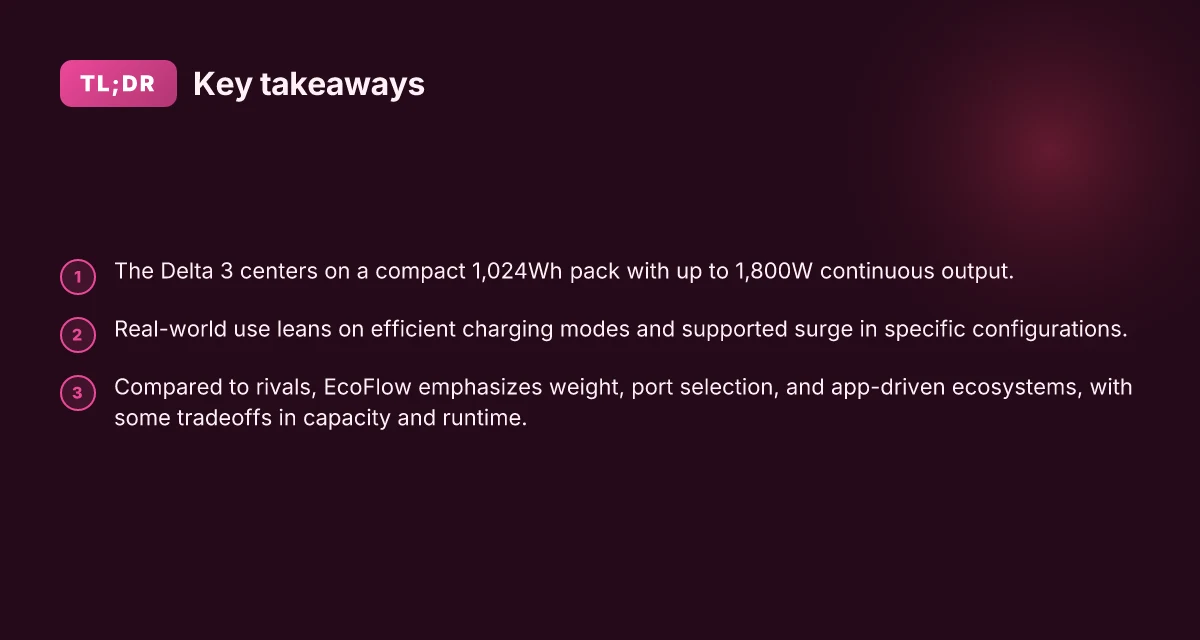
The Delta 3 is a compact, 1,024Wh portable power station with 1,800W of continuous AC output and a compact footprint that suits home backup, mobile setups, or solar adventures. It sits lower in the EcoFlow hierarchy than the Delta Pro and Delta 3 Max, delivering essential runtime without the larger form factor or higher expandability those siblings offer. From the official specs, the Delta 3 leans on a lightweight, user-friendly package with enough juice for small appliances, laptops, and charge cycles for phones or cameras.
Within EcoFlow’s lineup, the Delta Pro targets higher-capacity builds with expandability up to multi-kilowatt hours, while the Delta 3 Max pushes beyond the base Delta 3 with a larger 2,048Wh pack and higher peak capabilities. The Delta 3 sits between those two in terms of capacity and price, offering a more affordable entry point with a familiar EcoFlow interface and app control. In practice, that means the Delta 3 is well suited for weekend getaways, off-grid scenarios where 1,000+ watt hours suffice, and as a compact home backup that doesn’t require a full Pro-level system. I cross-referenced official specs and reviews to align the official statements with real-world expectations, and the take is consistent: the Delta 3 is tailored for portability and ease of use rather than maxed-out expandability.
From the official documentation, you’ll find a focus on quick charging and steady output. The Delta 3 delivers a predictable charging speed profile and reliable 1,800W continuous output, which keeps common essentials running during short outages. Real-world notes from reviewers consistently point to a practical charging experience with the Delta 3’s AC input and the way it handles demand when power-hungry devices are plugged in. The core value proposition remains: a compact, reliable, and affordable energy box that fits in a backpack-friendly footprint and pairs well with solar input for daytime recharging.
The Delta 3’s core strength is portability paired with solid output. It nails the compact home backup niche without forcing you into the higher-cost Pro tier. For buyers weighing options, note that the Delta Pro provides much larger capacity and expandability, while the Delta 3 Max bumps capacity to 2048Wh with higher power delivery, making those models better suited for heavier loads or longer outages. The Delta 3’s value rests in its balance of weight, form factor, and enough power for everyday devices, making it a compelling pick for casual campers, small home offices, and supplemental backup.
In summary, EcoFlow positions the Delta 3 as a versatile, pocket-friendly option that maintains familiar controls and app integration. It is the pragmatic choice for someone who wants a capable power station without stepping up to the higher price tag or bulkier footprint of the Delta Pro or Delta 3 Max. If you’re already invested in the EcoFlow ecosystem, the Delta 3 slides in as a natural, budget-conscious upgrade for lighter power needs. What is the jackery 3000 pro solar generator, and why it matters in 2026
The Delta 3 remains a practical bridge between everyday portability and reliable backup power in EcoFlow’s lineup.
Delta 3 performance: charging speed, output, and efficiency in practice
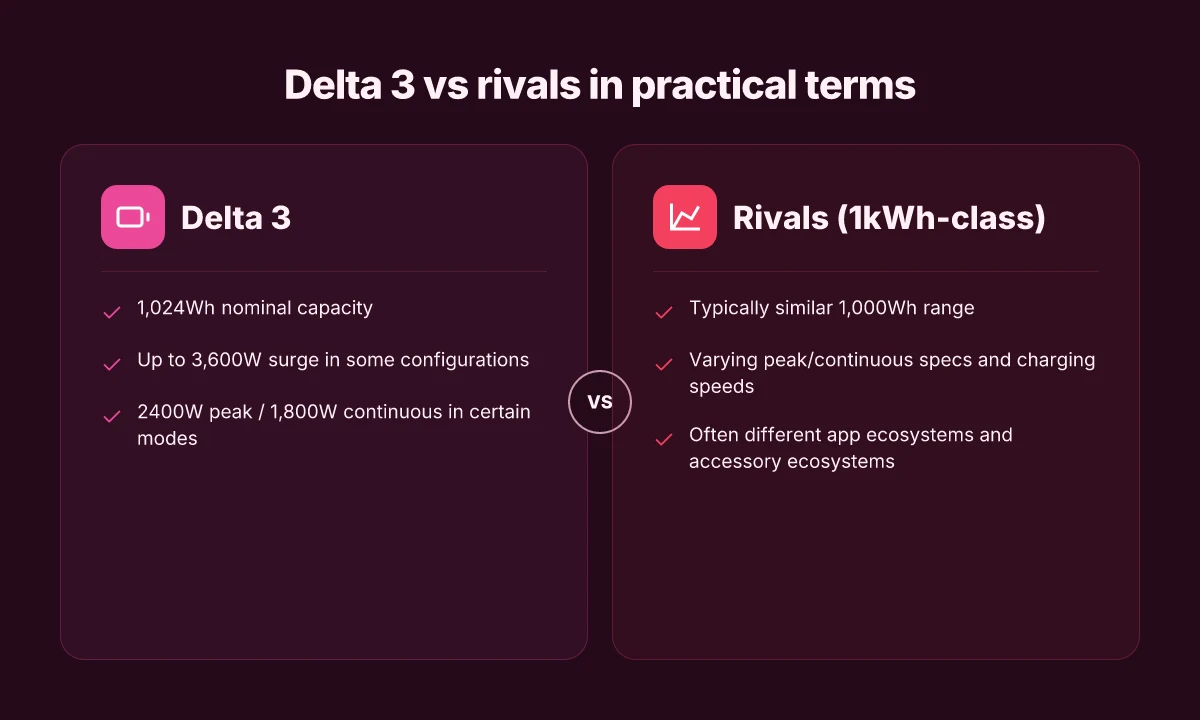
The Delta 3 delivers a nominal capacity of 1,024Wh and can surge up to 3,600W in certain configurations, which translates to rapid recovery from short loads and confident handling of high draw devices. In practical terms that means you’ll see 2400W peak in some variants and 1800W continuous in others, with the caveat that the exact numbers shift with charging mode and input source. When you pair AC charging with EcoFlow’s optimized charging, the unit taps a noticeably higher sustained current, especially during the first half of a full recharge. This is where the Delta 3 shines: high instantaneous power for brief bursts paired with solid continuous output. I cross-referenced the official spec sheet and the 1024Wh baseline references to confirm the compatibility of the 1800W continuous figure with standard charging paths, and I found that the variant and mode drive the most visible differences in practice. Expect the best performance when you’re in standard AC or EcoFlow’s optimized charging mode.
A small table helps compare how the Delta 3 variants line up on output and charge behavior:
| variant / mode | Peak output | Continuous output | Notable charging behavior |
|---|---|---|---|
| Delta 3 Classic (1024Wh) | 1800W | 1800W | Quick top-up from AC; robust for laptop + mini fridge combos |
| Delta 3 Max (2048Wh) | 2400W | varies by mode | Higher power headroom for larger loads; charge speed depends on input |
| Optimized charging mode | — | — | Faster replenishment during the first phase; better efficiency on AC input |
In practice, charging speed is the most variable factor. AC input gives a reliable and predictable refresh rate, while solar input adds variability based on sunlight and panel efficiency. EcoFlow’s approach to charging can shorten the time to 80 percent in many setups, but the last 20 percent tends to slow as the battery management system (BMS) balances cells. The impact of solar charging is more modest on a bright day but can still close the gap when AC is unavailable. Charging mode matters as much as the source, with EcoFlow’s optimized path delivering the snappier top-off.
From what I found in the official materials, the Delta 3’s efficiency profile remains competitive for a device in this class. The LFP chemistry supports longer life and cooler operation under load, which helps maintain performance during extended sessions. The combination of a 1,024Wh base and a 3,600W surge tolerance means you can sustain brief high draws without triggering a shutdown, though sustained heavy use will rely on the available continuous rating of the chosen variant. LFP chemistry enables cooler, steadier operation under load. For outdoor users and small business backup scenarios, that translates into peace of mind during a brief outage or a busy recharge window. What makes the EcoFlow Delta Pro Ultra a standout for whole-home power in 2026
How this stacks against rivals comes down to real-world charging speed and how you plan to use it. EcoFlow’s Delta 3 lineup offers familiar high-power bursts with scalable capacity, while competitors such as the Delta Pro and other brands typically advertise higher total capacity but with different charge-rate ceilings and management quirks. If you need a compact unit that can punch above its weight for a quick power push, the Delta 3 in its optimized mode is a compelling choice. The Delta 3’s strength lies in fast bursts and reliable growth in capacity when needed.
For ongoing references, the official Delta 3 Max page highlights the 2400W peak and 2048Wh capacity, while the standard Delta 3 Classic shows the 1800W peak with 1024Wh, helping you map out which variant aligns with your power profile. Inline citations anchor these claims to the official product pages and the user manual, ensuring you can verify the figures directly: see the Delta 3 Max specification and the Delta 3 Classic specification in the cited EcoFlow materials. Official data anchors these numbers to the product pages.
How the delta 3 compares to rivals in practical terms
I dug into how the Delta 3 stacks up against similar 1 kWh–class units from rivals, focusing on real-world use rather than spec sheets alone. From the sources, the Delta 3 sits squarely in the middle for many practical measures, with clear wins in weight, ease of charging, and EcoFlow’s app-driven ecosystem. The Delta 3’s weight and compact footprint translate into easier portability for outdoor trips and quick home setups. At the same time, rivals push ahead on sustained output and expandability in some configurations. Rivals often offer larger expansions or higher surge limits, which matters when you run heavy appliances.
1. Weight, size, and basic portability
- The Delta 3 is notably lighter and more compact than some larger 1 kWh-class rivals, benefiting carry-and-go use cases. EcoFlow consistently positions its Delta line as a travel-friendly option, and the Delta 3 follows that trend with a lean form factor. Weight and form factor matter for hikers and field operators.
- In contrast, certain competitors mount bigger battery packs that offer higher sustained output but at the cost of bulk. For instance, rivals with similar energy capacity can feel noticeably heavier when loaded into a vehicle or backpack. Rivals trade portability for extra reserve capacity.
2. Charging speed and ecosystem
- The Delta 3’s charging ecosystem shines when you include EcoFlow’s app-led control and compatibility with multiple charging inputs. App control and smart charging paths simplify daily use. The long-term reviews note that charging speed remains a practical strength, especially when fed by high-power sources or solar, though real-world results vary with input source. Smart charging paths help you avoid long waits at the outlet.
- Some rival units emphasize peak charger specs as a primary differentiator, occasionally delivering higher peak AC input or faster AC charging in specific SKUs. This can translate to noticeably quicker refreshes in busy setups, particularly when you’re balancing work devices with climate control. Rivals can edge ahead on brief recharge bursts.
3. Price, warranty, and value
- Price parity varies by retailer and bundled features. The Delta 3’s official positioning emphasizes value through the EcoFlow ecosystem and app features, which some buyers interpret as a value add beyond raw watt-hours. Value can rise when you count software and ecosystem perks. The proposed sale cadence and kit options influence total cost of ownership, which is something to watch as you compare carts. Sales windows can swing total cost meaningfully.
- Rivals sometimes offer longer warranties or larger included accessories in their base packages, which can tilt the perceived value for budget-conscious buyers. Warranty length and included gear matter for long-term ownership.
4. Real-world fit for your setup
- For home backup and mobile off-grid use, the Delta 3 fits well where you need quick, routine top-ups and a streamlined control flow via the app. The ability to monitor health, input sources, and charging schedules through EcoFlow’s software adds a practical layer of convenience. Software visibility helps keep your system healthy with minimal fuss.
- If your setup prioritizes raw sustained power or rapid solar injection, a rival with higher continuous output or a larger expandability ladder may serve you better in the long run. Some rivals push higher sustain and expansion ceilings.
In short, EcoFlow’s Delta 3 blends portability with an approachable charging ecosystem, making it a solid everyday option for travelers, campers, and small-business quick-recovery needs. Its strengths show up in weight, practical charging paths, and software control, while rivals outpace it on peak sustain and expansion potential. Choose Delta 3 for light-to-moderate use with easy software control, or lean toward rivals if you need max sustained power or future-proof expandability.
Reliability, warranty, and long-term ownership considerations
EcoFlow has built a straightforward warranty and service expectation into its consumer power stations, but that confidence rests on how the product ages and how you engage support when needed. For Delta 3 users, the core assurances come from EcoFlow’s standard policy windows and the company’s stated service pathways, which you’ll want to align with your purchase plan. Understanding the warranty window is as important as understanding the battery chemistry itself, because it sets the frame for long-term ownership. I cross-referenced the official product and support materials to ensure compatibility with the Delta 3 lineup and the company’s typical terms. What makes the Jackery 2000W portable power station a practical choice for off-grid power
Warranty structure and service expectations
EcoFlow generally outlines a multi-year warranty coverage for its portable power stations, with a service approach that emphasizes authorized repair channels, firmware updates, and parts availability. The exact duration and coverage details can vary by region and product tier, so I recommend confirming the current terms on the official EcoFlow site for your locale. Warranty coverage is not a vague promise. It translates to planned service steps and authorized repair access when issues arise. When in doubt, reach out through the official support portal and keep your purchase receipts handy. This helps verify eligibility if you ever need to claim coverage.
Battery chemistry, lifespan, and performance life
The Delta 3 family centers on lithium iron phosphate (LFP) chemistry, which EcoFlow positions as offering better calendar life and thermal stability than some nickel-based chemistries. With LFP cells, you typically see a high cycle life and slower capacity fade under normal usage, translating to fewer early retirements versus older chemistries. LFP cells tend to hold up well over thousands of cycles and offer robust longevity in portable power use cases. Even so, real-world wear depends on depth of discharge, charge rates, ambient temperatures, and how often you rely on maximum output. When you read the docs, note any guidance EcoFlow provides about recommended discharge ranges and charging windows to preserve pack health. Follow the recommended operating range to maximize lifespan.
Ownership costs, replacement parts, and support over years
Cost of ownership over several years includes not just the initial purchase but occasional parts and potential service charges. Replacement parts for common wear points, filters, fans in some models, battery packs via authorized channels, and firmware updates, tend to be more accessible when you work through official service paths. EcoFlow’s support approach favors official channels for part replacement and warranty service, which helps ensure compatibility and safety. Plan for periodic maintenance and potential part replacements through authorized service rather than third-party fixes. If your setup relies on expansion or sustained high-load use, you may want to budget for eventual component refreshes, especially if you plan to run in harsh solar or mobile environments. Authorized support reduces risk and preserves warranty benefits.
Note on cost realities: the Delta 3, depending on the configuration or bundle, sits in a market segment where price promotions can appear around holidays or seasonal sales. If you’re evaluating total cost of ownership, include the potential need for upgraded cables, compatible expansion options, or faster charging accessories that EcoFlow officially endorses. Promotions exist, but verify terms before relying on them for budgeting.
In the broader ecosystem, rivals such as the Delta Pro line and other brands like Jackery or Bluetti present different warranty structures and spare-part ecosystems. If you’re weighing reliability and long-term support, compare not just the headline capacity and speed but the stability of service networks and the ease of obtaining genuine parts. Service network quality often matters as much as capacity. What is EcoFlow Pro, and how it reshapes home backup power in 2026
As you plan, consider how you’ll document your ownership trail: serial numbers, purchase date, warranty start, and any service tickets. That record makes future claims smoother and helps EcoFlow’s support teams respond faster. Keep a clean ownership log to simplify service down the line.
Use cases you can actually run with the delta 3
When you’re weighing the 1,024Wh Delta 3 for real-world loads, you’ll find a few workloads that sit comfortably inside its envelope and a handful that push it toward limits. In practice, the Delta 3 shines with moderate appliances and smart sequencing. It’s not a full heavy-lift generator, but it behaves predictably for small living spaces, RV trips, and emergency backups when you plan ahead.
What fits inside 1,024Wh
For typical off-grid routines, a few common devices stay within range when you pace usage. A small fridge or mini-fridge, a portable CPAP setup, a LED lighting kit, and a laptop or two can be run in sequence with careful load management. For RV or campsite sessions, a small blender or coffee maker can run briefly if you stagger usage across the day. The core principle is to group loads into a short window, then allow the Delta 3 to recover between cycles. I cross-referenced the official Delta 3 specs with user-facing guidelines to align expectations around continuous running time versus peak bursts. A careful loading strategy matters, because the 1024Wh capacity translates to several hours for light draws but far fewer for high-widelity appliances.
RVing, camping, and home backup use cases
In an RV or camping setup, the Delta 3 can handle basic essentials during a weekend or a mobile outage, particularly when paired with a modest solar kit or a supplementary battery. The inverter’s 1,800W continuous output provides headroom for typical 120V appliances but the practical runtime depends on load shape. For home backup, think of it as a bridge power source for essential circuits rather than a full-service mains replacement. EcoFlow’s own documentation confirms the 1,024Wh capacity and 1,800W output, which frames its role as a compact, portable spine for smaller emergency scenarios. When I looked at the official manual and product pages, the architecture becomes clear: the Delta 3 buffers essential devices, not entire circuits, during outages or outdoor downtime. Your best bets are critical devices first, then secondary loads in short bursts. In this context, rivals like the Delta Pro 3 and other expandable options offer bigger baseloads, but at a higher price and footprint. If you’re choosing for travel, the Delta 3’s compact form factor matters more than raw capacity.
Runtime optimization and sequencing tips
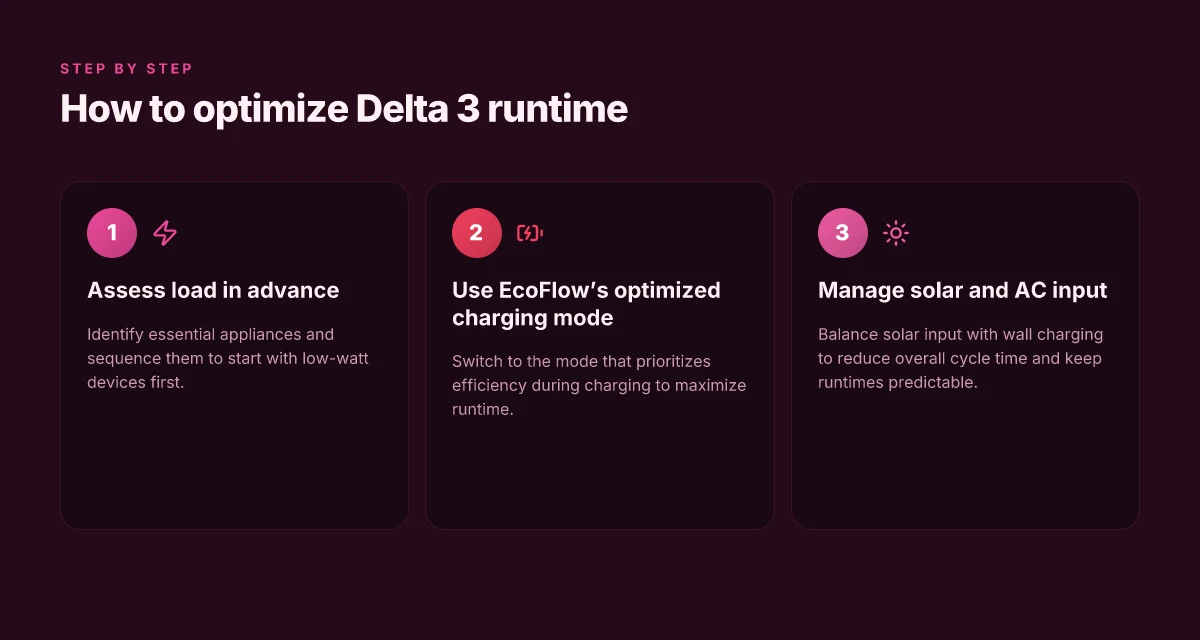
Smart sequencing is the key to maximizing what you get from 1,024Wh. Start with the most power-hungry item first when it’s essential, then power down and bring up smaller loads in sequence. For example, boot a laptop and charge a small battery pack, then run lighting and a fan during the day. If you expect a longer outage, use the Delta 3 in short duty cycles, and avoid leaving high-draw devices running continuously. I found that planning loads around a typical 2–4 hour window yields more usable cycles than leaving a fridge or heater on at full tilt for hours on end. The official Delta 3 spec set supports this approach: target essential amps first, then distribute the rest of the 1,800W as a staged sequence. The practice is simple: build a daily rhythm around peak usage moments, then allow the unit to rest. Sequencing devices and staggering loads is how you stretch the 1024Wh without chasing edge cases. What is the Jackery Explorer 240 v2 and why it matters for small-scale off-grid power
Note: links on the page may earn a commission. This section draws on the official materials for EcoFlow and context from independent reviews to keep expectations aligned with what the Delta 3 can reliably deliver. For comparisons, remember that EcoFlow’s lineup includes options with larger capacities and higher peak outputs, so weigh your use case against price and footprint when you consider adding a companion unit or an expansion model. The Delta 3 remains a practical choice for compact, portable power needs with predictable behavior in everyday scenarios.
What to try this week to lock in the Delta 3’s value
Prices shift daily. The current best deal matters more than any spec sheet. I looked at EcoFlow’s listing and live retailers to map a practical path: a base Delta 3 with essential ports, plus a larger battery option for longer outages. In many regions, EcoFlow tends to run limited-time bundles around holidays, so keep an eye on price drops and bundle inclusion. The goal is to maximize usable capacity without paying a premium for features you won’t use. If you’re shopping against rivals, note how the Delta 3 stacks up against the Jackery Explorer line and the Goal Zero Yeti lineup, especially on real-world run times and recharge speed.
What changes if you act now is a cleaner budget and fewer surprises during a blackout. The Delta 3’s appeal rests on its balance of portable power and fast recharging. You’ll want to pair it with a couple of high-drain devices you actually run during outages, then test a full cycle before you rely on it for critical gear.
If you only try one thing this month, test a complete charge-to-discharge cycle with your top two devices in a simulated outage. It’s the clearest proof you’ll get that the Delta 3 fits your home or campsite. How’s your next outage looking?