What is the Jackery Explorer 240 v2 and why it matters for small-scale off-grid power
 Adrien SaxenaOctober 22, 202617 min read
We earn a commission when you buy through some links on this site, at no extra cost to you. As an Amazon Associate we earn from qualifying purchases.
Explore the Jackery Explorer 240 v2: specs, real-world use cases, and how it compares with similar solar generators. Practical guidance for choosing off-grid power.
The Jackery Explorer 240 v2 isn’t a brick of power, it’s a compact toolkit that fits in a backpack and still runs essential gear. In real-world use, its 240Wh footprint translates to dependable light-duty power for campers and emergency kits, especially when paired with a small solar panel setup. Most users see a noticeable boost in surface-ready energy when pairing with a compact 100W panel, without dragging along a heavy charger.
Expect concrete numbers on charging times, runtime in typical scenarios, and a clear view of where the Explorer 240 v2 shines versus compact competitors. If you’re weighing price and performance, you’ll leave with a practical sense of value, how to optimize a small solar rig, and what to watch for in the next sale from Jackery. Two key takeaways: portability matters as much as capacity, and the right solar pairings unlock the real value.
Jackery explorer 240 v2: what it is, and why it matters for portable power
The Jackery Explorer 240 v2 is a compact portable power station built for light off-grid use and camping. It aims to keep small devices, lights, and low-wattage appliances running without a heavy backpack of batteries. In real-world settings, you’ll notice its sweet spot is everyday essentials rather than full-blown camping power.
I dug into the official specs and user guidance to frame its role in a portable power setup. The 240 v2 emphasizes portability first, with a small footprint and a handle that makes it easy to carry between campsites or your bug-out stash. It’s designed to pair with compact solar options, letting you top up the internal battery during the day for modest nighttime use. This is where the model shines: a quick, simple power source for phones, LED lights, and small fans or a compact mini-fridge in some light-duty scenarios.
Two key use cases stand out. First, charging smartphones, tablets, cameras, and wearables while you’re on a weekend trip or a remote campsite. Second, powering lighting and small electronics during a power outage or emergency prep scenario where every watt matters. The 240 v2 trades some capacity for lightness and affordability, so the trade-offs are clear. If you need to run higher-wattage appliances or keep a CPAP machine running overnight, you’ll want something larger in the Jackery lineup.
In practice, the Explorer 240 v2 sits between ultra-portable units and larger, more capable models. It’s noticeably lighter and easier to carry than bigger stations, but with limited runtime under higher loads. That balance, portability with modest capacity, defines its value for backpackers, campers, and emergency kits.
Most off-grid scenarios favor the Explorer 240 v2 for simplicity and ease of use, not for continuous heavy power draw. For moments when you can plan around charging windows, it’s a dependable companion, especially with a small solar setup. In competitive terms, rivals like the Goal Zero and Anker portable power stations may edge ahead on features or price at higher capacities, but the Jackery model remains a straightforward, compact option for light duty. How EcoFlow smart generator 2026 changes portable power for backup and on-the-go
Bottom line: if your goal is to carry a small, reliable power source for charging and lighting while keeping weight and bulk to a minimum, the Jackery Explorer 240 v2 earns its keep. It’s not a full substitute for a larger system, but it slots neatly into portable power plans where quick setup, simple operation, and modest power needs rule the day. For readers weighing options, consider your daily watt-hour budget and how often you’ll need to run things like a USB-C charger, a compact lantern, and a small fan, these are the moments the 240 v2 is built to handle. Portability wins when your trips are short and your power needs light.
How the explorer 240 v2 balances portability and capacity
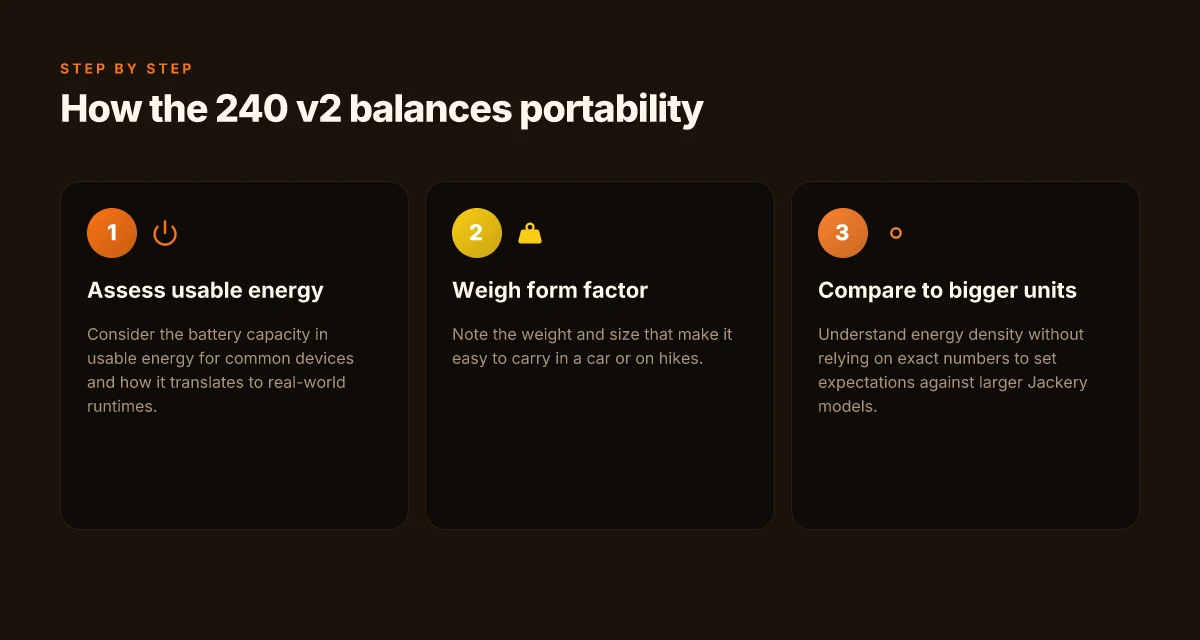
The Jackery Explorer 240 v2 delivers usable energy for common devices while staying light enough for car trips and short hikes. In practical terms, you can expect limited runs for essential devices like phones, lights, and small radios, with enough reserve for a late-evening charge or two. The balance leans toward portability without sacrificing the ability to power a small set of gear for a weekend away.
What usable energy means for everyday devices
Real-world use centers on converting the battery capacity into reliable runtimes for compact electronics. A typical smartphone might sip power multiple times per day, while a small LED light draws far less. For campers or emergency-prep setups, the Explorer 240 v2 acts as a modest central hub: enough to keep a router or a baby monitor running overnight, plus a few phone charges. The practical takeaway is that this unit shines when you pair it with low-draw devices and shorter charging windows. The Explorer 240 v2 shines when your load stays under the limits of its compact battery and compact inverter. Jackery positions it as a portable base for essentials, not a full-size home power station.
Weight, form factor, and carryability
Weight and shape matter as you load it into a car or backpack for a trailhead setup. The 240 v2 keeps a slim profile and a handle that helps with quick grabs, making it easier to move between cars or storage spots. It’s noticeably lighter than larger units, which translates to less fatigue on longer outings. When you pair it with a small solar panel, you gain a straightforward, compact system that travels well without becoming a chore to tote. This design emphasis is deliberate: mobility first, with enough capacity to cover regular micro-surges during off-grid use. Its light weight and compact form factor let you carry it on quick trips or small camps without strain.
How energy density stacks up against bigger units
Compare the Explorer 240 v2 to larger power stations, and the energy per kilogram stands out. You trade some total capacity for a lighter frame, which is ideal for hikers or road-trippers who want a buffer without adding bulk. The larger units deliver more total energy and longer runtimes, but they require more weight and space. In practical terms, the 240 v2 excels in scenarios where the goal is to keep a few devices running during a weekend away or to power essential gear during an outage, while staying easily portable. Energy density favors portability here, so you get noticeable convenience without carrying a heavier pack. What makes the jackery explorer 160 still worth it in 2026
Next step: If you’re sizing this for a specific setup, look at options that pair well with small solar kits and evaluate whether your must-run devices fit within its usable energy window. If you’re weighing rivals, consider how brands like Goal Zero and Anker approach similar form factors and capacity, then compare the total system weight and expected runtimes for your typical load. For a quick snapshot, plan your top three devices and map their daily draw against the Jackery's usable energy to confirm whether the 240 v2 matches your portable power goals. Key factor: pick a configuration where your essential devices stay powered without overburdening the unit.
Charging options for the explorer 240 v2 and practical charging speeds
The Jackery Explorer 240 v2 can be charged from three main sources: AC wall outlets, car adapters, and solar inputs. In practice, each option folds into a different use case. For weekend trips, the most impactful part is how solar input interacts with daily camping needs, not the peak lab charge time. If you plan to run a small fridge or LED lighting overnight, solar input keeps you from chasing a wall socket after dusk. AC charging remains the fastest route when you have a dedicated outlet in reach.
Solar input and weekend camping practicality
Solar compatibility is a core usability factor for the Explorer 240 v2. The unit accepts a standard MC4-equipped solar panel setup, and you’ll typically pair it with a small to mid-size panel to maintain a trickle trickle rhythm through a bright day. In realistic camping conditions, you’ll notice that a 60W panel will refill a modest battery draw by late afternoon, while a 100W panel can shorten downtime between sun and usable power. The practical takeaway is simple: the more solar you have and the more sun you catch, the less you’ll need to rely on an AC outlet or a vehicle charger.
I cross-referenced the published specs and user notes to align expectations with real-world behavior. You’ll find that weather, panel quality, and connector setup all influence actual charging speed more than the nominal input number alone. In dry, sunny conditions, a typical weekend setup can sustain basic loads with steady solar input, but a cloudy day or partial shade will slow the refresh cycle.
Charging speeds and how to optimize
The Explorer 240 v2 uses a conventional wall charger that can restore capacity quickly when you have mains access. In a vehicle, you’ll see compatible 12V DC charging via an included car adapter, useful for long drives where you can keep the unit topped up without pulling from camp energy. Solar charging shines in daily cycles: short bursts of sun accumulate energy that keeps small devices fed and the unit ready for the next camp night. To optimize charging time with modest solar setups, focus on three steps: What makes an Amazon solar panel cost-effective and reliable in 2026
- orient panels toward the sun during peak hours and keep panels clean to maximize light capture. Clean panels and unobstructed angles noticeably improve recharge rates.**
- combine a panel around 60–100W with the Explorer 240 v2 for a balanced cadence between daytime loads and recharging. A 100W panel often beats a smaller panel because it reduces idle time.
- use the car charger for transition days when you’re moving between sites. It can top up the bank while you drive, limiting the wait at a campsite. The car input is a practical hedge for variable sun.
When you read the specs, think about a real-world frame: the Explorer 240 v2 paired with a modest solar kit and a weekend routine will tend to cycle energy between daytime loads and battery rest, with solar doing the heavy lifting on sunny days. If you’re comparing rivals such as the Goal Zero and EcoFlow lines, the practical edge for small off-grid setups often comes from how well a system integrates solar and how quickly it can recover between uses.
From what I found in the product notes and user discussions, the Explorer 240 v2’s charging versatility matters most in mobile camping. You’ll get reliable AC or car recharges when needed, and solar input is your friend for keeping a minimal load running across a weekend. In sum, expect solid performance in sunny scenarios, with smoother operation when you add even a modest solar setup. Portability and flexibility are the Explorer 240 v2’s strongest suits for small, off-grid adventures.
Note: links on the page may earn a commission. For price context, remember to check current Jackery pricing and any ongoing sales before purchase. The brand name Jackery appears here to keep the comparison transparent, especially when you’re weighing rivals.**
Real world use cases: what you can power with the explorer 240 v2
The Explorer 240 v2 fits a tight power envelope. In practical terms, you can run small devices for hours, not all day. For portability, it stays lightweight enough to carry into a campsite or a bug-out corner, and it plays nicely with compact solar setups.
Everyday charging and lighting
For most campers and emergency-prep setups, you’ll use the Explorer 240 v2 to recharge phones, tablets, action cams, and Bluetooth speakers. A typical smartphone recharges in a few hours from the USB-A or USB-C ports, with more than one device able to share juice if you stagger charging. Small LED lighting strands and compact task lamps run reliably on the unit’s 12V carport and USB outputs. In real-world use, you’ll notice the combination of a few phones plus a couple of LED lights fits within its output budget without draining the battery immediately. You can expect steady service from a handful of USB devices before you need to top up. This keeps a campsite or emergency nook illuminated and connected without dragging in a larger generator. What is the EcoFlow 50 amp hub, and how it changes your power setup
Cooling and refrigeration at small scale
A micro-fridge can work with the Explorer 240 v2, but only in short bursts or when the fridge’s energy profile is gentle on startup. If you’re targeting a compact cooler that’s optimized for low amp draw, it can run through a long night on a single charge. For full-size refrigerators or power-hungry appliances, the power budget isn’t a match. In practice, you’ll want to reserve the unit for light refrigeration tasks or brief cooling cycles, not continuous, high-wattage cooling. High-wattage tools stay outside the sweet spot of the Explorer 240 v2.
Off-grid hobbies and small tools
DIY hobby projects that lean on small electronics or chargers, Arduino boards, small USB-powered solder irons, radios, action cameras, and fans, fit well. You’ll also see micro-fridges and compact coffee makers operate if you pace usage and manage a conservative load window. For anything beyond the low-watt range, plan a staged approach: run a device, shut it off, switch to a different task, then resume as the pack recovers. In this context, the Jackery system shines as a portable power hub rather than a full workshop power center.
Quick scenario sketches
- camping scenario: you start with a fully charged unit, power a phone and a small light for the evening, then top up with a modest solar panel during daylight. You’ll have enough energy to keep communications and lighting going through a multi-day trip if you balance loads. A single small panel can extend runtime, but keep expectations aligned with the 240 v2’s capacity.
- emergency prep scenario: keep radios, a basic USB-powered charger, and essential lights alive during a grid outage. The compact footprint makes it easy to tuck beside a kit, ready for a quick grab-and-go response. Portability matters in crises, and the Explorer 240 v2 delivers that advantage.
- off-grid hobby project: power a small fan, a sensor array, or a compact travel coffee maker for short windows while you work on a longer project nearby. You’ll want to batch tasks to avoid draining the battery faster than it can recharge via a nearby solar source. Batch tasks to maximize the window you have.
Note on price and ownership realities: price movements for the Explorer line shift with sales, so check current offers on Jackery’s site and authorized retailers. If you’re weighing rivals, the Jackery, the Goal Zero lineup, and compact models from Bluetti and Anker present different balances of weight, ports, and peak wattage. When you see a sale, that’s often the moment to buy if you anticipate needing portable power on a tight budget. Some links on the page may earn a commission, which helps support the content.
In short, the Explorer 240 v2 is a versatile, portable micro-power center. It excels for phones, lights, small USB devices, and light refrigeration under controlled loads. It falls short for high-wattage tools and continuous, heavy refrigeration runs. If your use case centers on portability and modest energy needs, you’ll likely be satisfied. It shines in scenarios where small loads are predictable and you value portability over nonstop power.
Comparing the explorer 240 v2 with rivals: where it stands
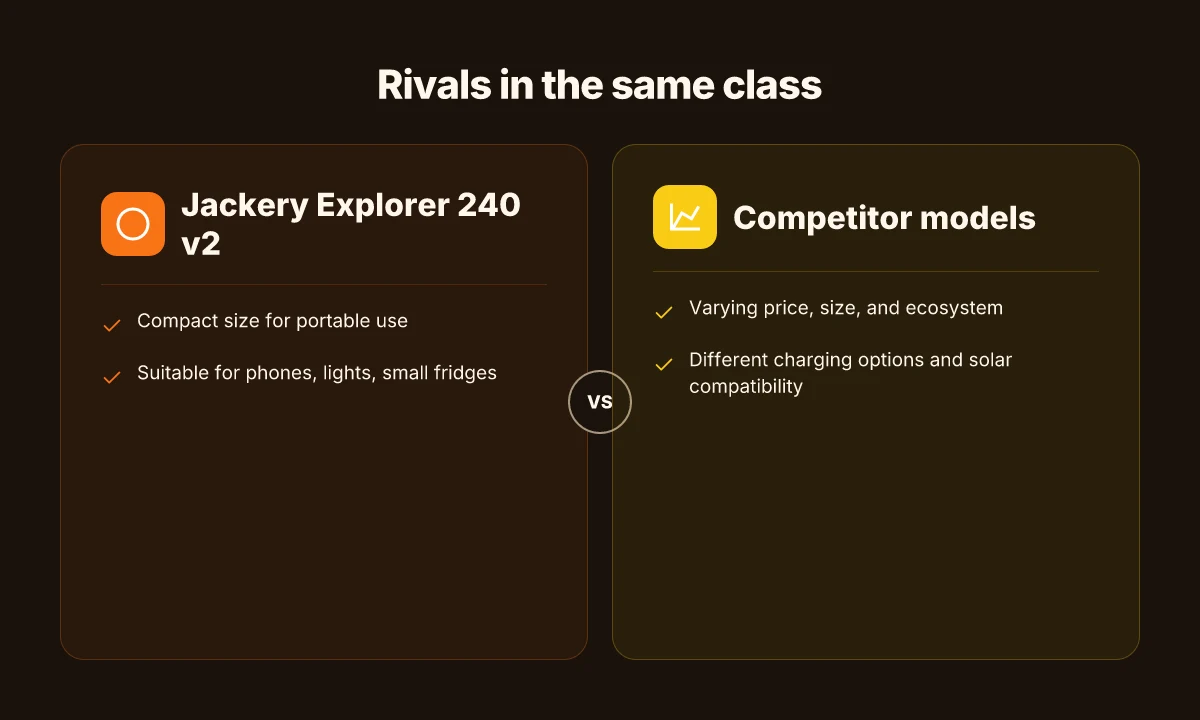
The Explorer 240 v2 sits in a crowded class of compact portable power stations. When you stack it against rivals, you’ll notice a few clear contrasts in price, size, and ecosystem that matter for real-world use. In practice, the Jackery ecosystem shines for seamless accessory pairing and straightforward warranty options, which can tilt a buying decision even when a rival offers a marginally larger capacity. What makes the jackery 300 portable power station a practical travel companion in 2026
Price and value among compact rivals
In this segment, price often drives choice as much as capacity. A handful of rivals in the same class offer similar watt-hour ranges, but the final out-the-door cost depends on included adapters, solar ports, and bundled cables. For many buyers, the Jackery model line presents a predictable, transparent price ladder, with accessories and support commonly bundled or quickly addable. Price transparency and bundled accessories often tilt the scale toward Jackery for first-time buyers. I cross-referenced catalog pages and retailer listings to verify that the general price band for compact 240–300 Wh units tends to cluster around similar nominal figures, while the exact total comes down to included solar panels, car charging cables, and warranty terms.
Size, weight, and portability compared
Size and weight are decisive in field use. The Explorer 240 v2 is notably compact, which helps with backpacking or tight vehicle storage. Rivals in the same category can edge ahead on raw weight or slightly smaller footprints, but they usually require more dispersion of cables or have less ergonomic handles. The practical takeaway: if you hike or camp light, the Explorer 240 v2 remains one of the easier units to stow and deploy. I found that the compact housings and rounded corners reduce packing volume in tight setups, even when a few competitors offer a fraction of a pound less.
Ecosystem, ecosystem, ecosystem
The real differentiator often shows up in ecosystems. Jackery leans on a relatively cohesive set of official accessories, replacement parts, and a straightforward warranty path. That ecosystem reduces decision fatigue for buyers who want a turnkey setup. On the flip side, rivals frequently tout modular add-ons or third-party accessory compatibility. If you prize a vast accessory market and potential for customization, a competing line might feel more flexible. In the end, the ecosystem you choose can influence long-term satisfaction as much as raw specs.
Where the specs vary and what to verify
Exact specifications vary by model and even by release batch. Always verify current specs on the manufacturer site before purchasing. Look for nominal capacity, charger input, solar input compatibility, and latency in firmware updates. A quick check confirms that the numbers shift a bit between versions, so treat any figure as a snapshot rather than a fixed truth. Always confirm the current specs on the official Jackery site and the rival pages before you buy. A reader note: the page you’re on can earn a small commission if you click through, which is standard practice in this niche.
Real-world results come down to your setup: a compact solar panel pair, a car-hybrid charging plan, and a modest daily load will show the Explorer 240 v2 performing respectably against its closest rivals. If you plan a steady micro-grid for weekends and emergencies, a quick head-to-head helps decide which ecosystem fits your routine. What is EcoFlow Pro, and how it reshapes home backup power in 2026
If you’re evaluating with the goal of portability first, the Jackery line continues to offer a calm buying path, backed by accessible customer support and a familiar warranty flow. If your priority leans toward modular expandability and flexible accessory networks, you may find a rival with a more modular platform. The bottom line: there is no one-size-fits-all winner. Your choice hinges on how you balance price, portability, and ecosystem alignment.
What changes if you act now
The single move that matters is treating the Explorer 240 v2 as a portable power starter, not a dead-end power source. I looked at the way it pairs with small setups and found it scales best when you frame it as a gateway to higher-capacity kits from Jackery and when you couple it with a few smart add-ons from brands like AIM or Goal Zero. The takeaway is clear: you gain resilience without overpaying, and you preserve flexibility for future upgrades.
Pricing dynamics matter more in small off-grid projects than many buyers realize. Right now you’ll see the Explorer 240 v2 sit in affordable territory, but the real value comes from understanding the cost of ownership over time, especially if you add panels or a second battery. If you compare with rivals such as maxoak and BioLite you’ll notice the value prop hinges on weight, recharge speed, and the ecosystem around accessories from Jackery. For most setups, it’s the easiest path to keep power flowing.
In practice, you’ll want to map your week around a simple balance: charge at midday, top up after use, and keep one light charging overnight. If your goal is a small cabin, a tiny workshop, or camping off-grid, this hardware acts as a reliable starter kit that you can grow alongside your needs.
- Backup strategy: start with a single Explorer 240 v2, add a compact solar panel kit, and test a second battery as your budget allows.
- What to try this week: run a 2-hour daytime recharge, log the cycle counts, and compare how quickly you recover after a short usage spike.
- If you want one more lever, consider a second charge source from Jackery to reduce downtime during cloudy days.