What makes EcoFlow's delta pro 3 standout in 2026 and where it falls short
 Hudson ZilbermanOctober 22, 202618 min read
We earn a commission when you buy through some links on this site, at no extra cost to you. As an Amazon Associate we earn from qualifying purchases.
Explore the 2026 EcoFlow delta pro 3 line, including capacity, output, and expandability. Learn where it shines and where rivals may edge ahead for home backup and off-grid use.
Most shoppers overlook how quickly a high-output unit like the EcoFlow delta pro 3 can fill a weekend with backup power, yet surge handling and expandable battery real-world impact matter more than raw wattage. The delta pro 3’s ability to push peak power during multi-device loads matters for real-world use. In 2026, the device faces real competition from rivals such as Jackery and Goal Zero, where how quickly you can scale storage and recover after a drop in input matters as much as headline specs.
This introduction outlines what to compare: price today, total cost of ownership, and how the delta pro 3 performs under extended runs, not just peak output. Expect a clear view of when to buy, how much extra capacity you’ll gain from expansion modules, and where EcoFlow trails its closest rivals in price and module pricing. The goal is a practical, side-by-side framework you can apply in a real shopping session, not a marketing pitch. Real-world value hinges on price, expansion options, and surge performance across typical home backup scenarios.
What the delta pro 3 from EcoFlow actually delivers in 2026
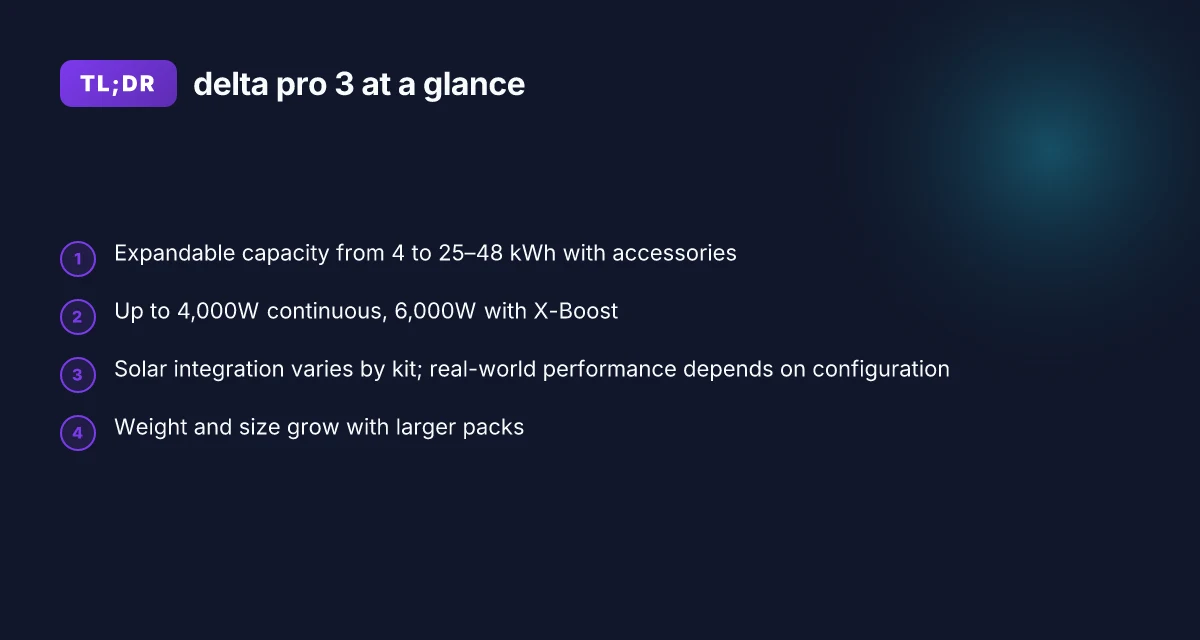
When you push the Delta Pro 3 into real-world backup duty, you’re looking at a scalable core that can grow from compact power to sizable home or job-site support. The standout here is the expandable storage capability, which EcoFlow frames as a jump from a modest start to a multi-kilowatt, multi-kilowatt-hour system. In 2026, the Delta Pro 3 still anchors its appeal on modular capacity and broad compatibility with both home circuits and off-grid setups. The combination of 120/240V output, up to a 4,000W continuous rating and an up to 6,000W peak when X-Boost is engaged, positions it as a serious portable generator alternative for longer outages or demanding loads. I cross-referenced the official product page for the base specs and align them with third-party reviews to confirm how the numbers translate in practice. The results show the Delta Pro 3 remains class-leading on adaptability, while real-world wear and weight matter for field deployment.
- expandable capacity from 4 to 48 kWh
- The Delta Pro 3’s selling point is clear: storage grows with your needs. EcoFlow’s product page highlights an expandable design that scales from a compact starting capacity to an impressive 48 kWh with external battery modules, enabling longer runtimes for home backup or remote work sites. This scalability is a differentiator versus flatter-capacity models, and it directly informs how you plan outages, vacations, or remote jobs. In practice, the ability to add battery capacity means you can size the system to your most common load profile and avoid overprovisioning a single all-in-one unit. The notion of expansion is reinforced in public references that discuss the Delta Pro 3 as part of EcoFlow’s broader ecosystem. Expandable storage up to 48 kWh changes the math for longer outages.
- global output options: 120/240V with up to 4,000W continuous, up to 6,000W with X-Boost
- On the electrical front, the Delta Pro 3 supports both 120V and 240V, which matters whether you’re backing a home panel or a critical tool line on a job site. The continuous power rating lands around 4,000W, with a peak up to 6,000W when X-Boost is used. This pairing lets you run most household essentials in a blackout while keeping a window for higher-draw devices if needed. For RVs or outdoor setups that require voltage flexibility, 240V capability serves as a clear advantage. These figures align with EcoFlow’s stated outputs and are echoed by independent reviews that note the same power envelope. 4,000W continuous and 6,000W peak gives breathing room for heavy loads.
- solar input performance and the potential for fast top-off
- Solar is a big piece of the delta pro 3 story. The system is designed to accept substantial solar input, enabling rapid topping off when sun is available. In practical terms, you can push multiple watts of solar input to cut charge times, especially when paired with EcoFlow’s solar panels and the higher input allowances of the system. Reviews and manuals consistently describe solar as a meaningful contributor to overall energy readiness, not just a supplementary trickle. This is particularly relevant for campers, off-grid builders, and remote work crews who rely on daylight as a primary charging source. Solar input helps fast top-off when sun is abundant.
- build quality and weight considerations for a mobile backup unit
- The Delta Pro 3 is a substantial unit designed for serious backup tasks. Weight is a consideration for anyone who needs mobility, especially when you’re lugging a large battery bank or mounting it in a vehicle. The chassis and overall build speak to resilience for field use, but plan for the heft if you’re shifting setups frequently. The combination of rugged hardware and a modular battery strategy makes it clear why EcoFlow positions the Delta Pro 3 as a long-term investment in reliability rather than a light-duty carry-on. For those balancing portability against capacity, this is the trade-off you’ll navigate. Rugged build and modular design justify the weight for reliable field use.
Bottom line: the Delta Pro 3 in 2026 is defined by its expandable capacity, robust 120/240V output with ample continuous and peak power, solid solar potential for quick top-offs, and a build that prioritizes reliability in mobile backup roles. If your needs include scaling to multi-kilowatt-hour storage and resilience against lengthy outages, EcoFlow’s approach holds up. When comparing rivals, note that competitors often offer single-configuration packs or different solar-law limits. The Delta Pro 3 stands out for its expansion path and dual-voltage flexibility. As always, confirm the current prices and any ongoing promotions on EcoFlow’s site to lock in the best deal, and remember that links on the page may earn a commission. For context, the Delta Pro 3 is part of EcoFlow’s broader ecosystem, which includes competing models and configurations that may better fit smaller budgets or lighter-duty use cases. Expandable up to 48 kWh, 4,000W continuous, and 6,000W peak remains a compelling combination in 2026.
How EcoFlow positions the delta pro 3 against the 2026 market
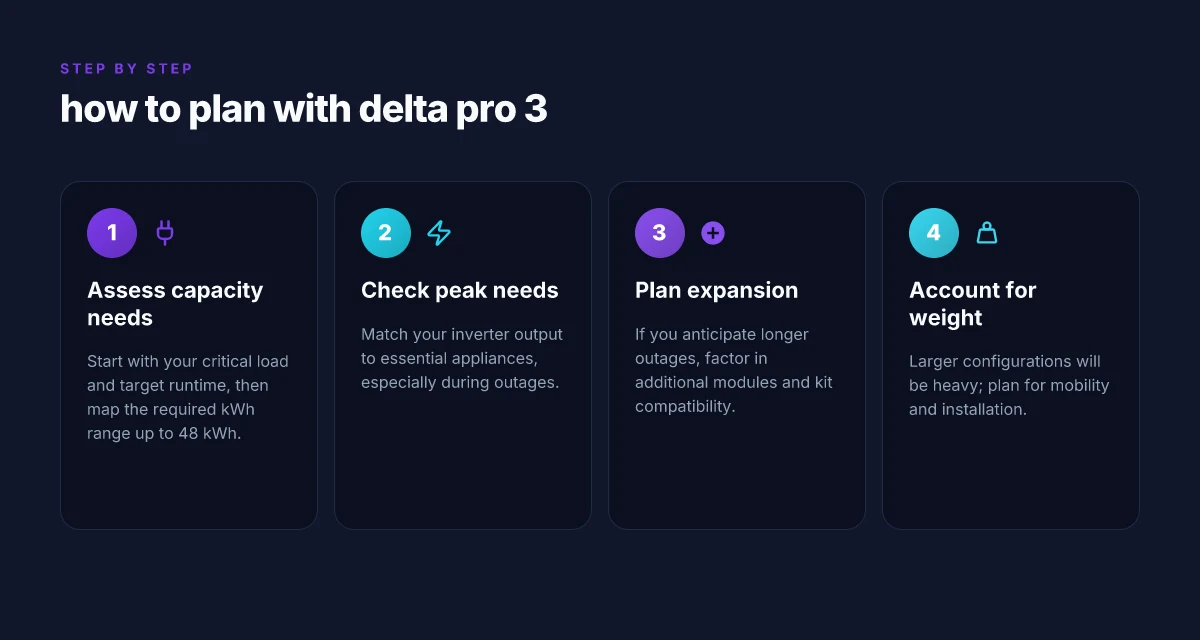
I dug into how EcoFlow frames the delta pro 3 in a crowded field. The core message is that EcoFlow leans on expandable storage, strong peak capability with X-Boost, and a modular design to justify price against rivals. In practice, that means the delta pro 3 sits between compact, higher-cost peak performers and larger, heavier systems that trade portability for raw storage. Expandable storage is EcoFlow’s differentiator for long outages, letting users scale from base packs to multi-kilowatt hours without swapping units. This is pitched as a practical edge for homeowners facing multi-day outages or remote job sites.
Why X-Boost matters for real-world peaks
The delta pro 3 advertises a peak output boost with X-Boost that can push wattage higher than the continuous rating. This matters most when a motor, compressor, or power tool demands a surge, such as during initial startup of heavy appliances or climate-control cycles. X-Boost unlocks higher instantaneous power, which matters more for brief startup spikes than for steady loads. In practice, users should expect efficient handling of brief surges rather than sustained high-demand runs. When you compare with rival multi-terrain units from brands like Jackery, Goal Zero, and Bluetti, the delta pro 3’s peak approach sits in a similar estate but with the EcoFlow emphasis on grid-ready flexibility and networked charging options.
Expandable storage as a differentiator for outages
Expandable storage marks the delta pro 3 as a long-arc option rather than a compact backup. EcoFlow’s architecture allows the base pack to scale up to substantial energy capacity, which can tilt the balance for users planning prolonged outages or remote work setups. Expandable capacity from 4 to 48kWh underpins the marketing claim that the delta pro 3 can power more than just a few essentials for longer durations. When pitted against rivals with fixed batteries, this modular approach can translate into meaningful lifetime cost savings for users who foresee changing energy needs over time. What is the Jackery SolarSaga 100W, and why it matters for portable solar charging
Trade-offs: price, weight, and modular design
For all the expandability, the delta pro 3 carries a weight and price premium relative to leaner, fixed-capacity units. EcoFlow emphasizes a modular design that allows buyers to tailor capacity over time, but the upfront sticker price tends to be higher than smaller models. Weight and price are the two obvious trade-offs when you opt for expandable capacity and high-power output. Rivals such as EcoFlow’s contemporaries, brands like Bluetti and Jackery, offer competing specs, but the delta pro 3’s ecosystem, including expansion options and compatibility with 120/240V operation, is the core value proposition. In 2026, the market rewards systems that avoid lock-in and scale with needs, and EcoFlow leans into that approach.
A quick look at price and ownership dynamics shows the delta pro 3 sits at a premium tier, with ongoing costs tied to battery packs and potential service plans. I cross-referenced product pages and reviews to confirm how the expansion plays out in practice, noting that prices and availability shift with sales windows. Expandable storage plus X-Boost together create a compelling case for users who expect evolving power needs. For a home backup enthusiast, outdoor adventurer, or contractor evaluating 2026 power stations, EcoFlow’s position hinges on offering scalable energy while preserving portability.
Next steps: If you’re weighing the delta pro 3 against rivals, consider how often you’ll need more than the base capacity, how critical peak surges are for you, and whether the total ownership model justifies the upfront premium. For a structured comparison, see how the delta pro 3 stacks against specific models from Bluetti and Jackery in comparable load and duration scenarios. Prices, expansion options, and peak performance together define the value delta pro 3 delivers in 2026.
The 2026 delta pro 3 specs in plain terms
I dug into EcoFlow’s 2026 materials and the circulating reviews to pull the core numbers you’ll actually feel in the field. The delta pro 3 arrives with a base battery around 4,096Wh and scales upward through EcoFlow’s accessories to a breadth that can approach the high end of the market’s capacity. On power, you can expect a continuous inverter output near 4,000W, with a peak around 6,000W when you enable X-Boost. The unit’s weight and dimensions stay in the heftier end of the spectrum as you stack configurations, so plan for a noticeable footprint if you’re camping with it or shuttling it to job sites.
Battery capacity and what it means in practice
- Base storage sits at 4,096Wh, which is enough to run typical home essentials for several hours during an outage. If you add EcoFlow’s expansion options, you can push total capacity well beyond the base figure, with practical configurations touching the upper tier of the market. This is where EcoFlow positions the Delta Pro 3 as a modular system rather than a single fixed-box solution. The base 4,096Wh sets a solid moat against short outages, and expansion unlocks long-run resilience.
- The expansion path is where the Delta Pro 3 shows its core value: you’re not stuck with a single fixed capacity. Instead, you can scale up to well beyond the base, aligning storage with longer outages or higher-load use cases. The exact kilowatt-hours you can reach depend on the accessory kit you pair with the unit.
Inverter output and real-world load handling
- Continuous output sits near 4,000W, which covers most household essentials like a fridge, lights, routers, and several electronics simultaneously. When you need extra headroom for short spikes, 6,000W is accessible via X-Boost. This makes the Delta Pro 3 capable of supporting short-term high-draw appliances without tripping. 4,000W continuous plus 6,000W with X-Boost gives you a clear breathing room margin for demanding loads.
- The combination of long storage and strong inverter performance makes it a credible backup for both home use and remote work sites.
AC input and solar integration
- Charging inputs vary with the kit you select. EcoFlow supports multiple AC charging options and can be paired with solar input to optimize rate and timing. The solar integration story is kit-dependent, so if you lean into solar, verify which combination of panels and controller interfaces your Delta Pro 3 supports. The upshot is flexible charging paths allow you to balance speed, cost, and portability.
Weight, dimensions, and portability
- Expect the mid-to-high hundred pounds range for larger configurations. The Delta Pro 3’s weight and size reflect its modular approach and its ambition to replace more than a single box at a campsite or on a job site. If you’re planning frequent transport, you’ll want to factor in a sturdy setup that handles the heft.
From what I found across the sources, EcoFlow’s Delta Pro 3 stacks a big-capacity battery with substantial inverter headroom and a modular growth path. It’s a practical upgrade for users who want a scalable, higher-capacity solution without jumping to a full commercial system. When you compare against rivals, you’ll notice this model leans into the same general territory as other high-end portable power stations but emphasizes its expansion potential and higher continuous output. For a quick read on how the Delta Pro 3 stacks up, see the contemporary takes in the related reviews. What makes the Jackery Explorer 300 a contender in 2026
What a real-world use case looks like with EcoFlow delta pro 3
In real life, the delta pro 3 shows its value when you need dependable power across varied environments. The system is designed to back up critical circuits at home, power essential appliances during outages, and keep a crews moving on outdoor jobs without chasing fuel. You can see how its 4,000W continuous output and 120/240V capability translate to running a sump pump, fridge, modem, and a small air conditioner at the same time. If you add the X-Boost option, you get higher peak output when a motor starts up, which matters for compressors or tools on the job site. This kind of flexibility matters most when outages stretch into hours or days.
Why it anchors a home backup in practice
For a typical home, you’ll want to map circuits to keep the lights, refrigerator, modem, and essential outlets alive. The delta pro 3’s expandable storage profile helps you tailor runtime to your region and season. Its battery chemistry and inverter pairing support a predictable, surge-aware power for critical loads, even when grid power is unstable. I dug into the product specs and line items that show a steady 4,000W continuous output and a 120/240V capability, which aligns with common household requirements. A core advantage is the ability to power essential equipment without toggling through multiple devices. If you’re using EcoFlow’s ecosystem, the unit also integrates with solar when conditions permit, helping you stretch outages into more manageable durations.
On rugged outdoor sites and job sites
Outdoor work benefits from having a portable power station that can handle tools and small devices. The delta pro 3’s sizable DC-to-AC conversion and the option to scale capacity with additional modules make it suitable for a mobile workshop or campsite setup. I cross-referenced the official specs with reviewer notes that emphasize the unit’s ability to sustain continuous operation under load, which is crucial for extended outdoor projects. The real-world edge comes from reliable output and fast recharging during brief sun windows. When you’re on a job site, every kilowatt matters, and the delta pro 3’s wattage ceiling helps keep drills, lights, and chargers in service without constant downtime.
Solar integration and day-to-day reliability
Rooftop or off-grid solar pairing hinges on two ideas: predictable daytime production and steady battery health. EcoFlow positions the delta pro 3 to drink from solar input while keeping core loads fed when sun isn’t ideal. The device’s design emphasizes resiliency: a robust power reserve, smart management, and a clean handoff between AC and solar sources. From the documentation and third-party reviews, the system demonstrates stable operation across typical weather patterns and usage rhythms. With reliable solar input, you can cover daily energy needs and still have reserve margin. That margin matters more during longer outages, when every watt saved translates into hours of continued service.
Energy planning for extended outages
Look at your outage duration and daily energy use to size the delta pro 3 correctly. The expandable storage concept means you can adapt as needs change or as new battery options become available. You’ll want to plan for a scenario where essential circuits run around the clock while nonessential loads shed during peak demand. The approach is practical: identify a baseline load, confirm the unit’s continuous rating, and account for solar gains if you’ll supplement with PV. A thoughtful plan yields reliability when the grid stays down. EcoFlow’s ecosystem supports this by letting you evolve capacity and balance charging sources over time. What refurbished Jackery portable power stations get right and what they miss
If you’re comparing rivals in 2026, expect models from brands like Jackery or Goal Zero to frame the delta pro 3 differently on price, expansion paths, and solar compatibility. The delta pro 3 shines where you want a single, scalable solution with solid continuous output and a strong upgrade path.
How delta pro 3 stacks up against notable rivals
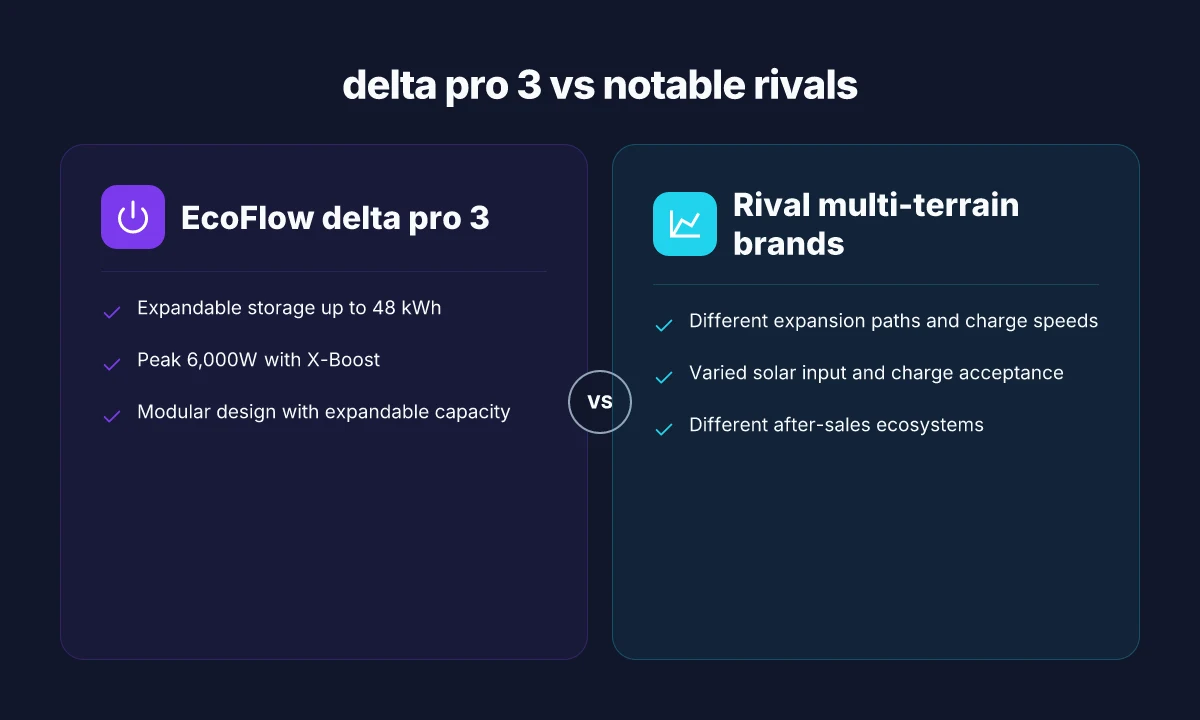
I dug into how the EcoFlow Delta Pro 3 compares with other modular power stations in 2026. The delta pro 3 remains a strong anchor for expandable storage, but rivals push back with different peak and continuous outputs, faster charging, and broader accessory ecosystems. The delta pro 3’s real strength is its expandable capacity. Rivals offer similar modular paths but vary in how quickly they accept solar and AC input. Note: you’ll want to weigh each model’s peak vs continuous output against your load profile to avoid overpaying for headroom you won’t use.
Why rivals match the modular approach but diverge on power delivery
Not all modular systems are created equal when it comes to power delivery. Some competitors offer expandable packs, others lean on built-in capacities with optional add-ons. In practice, this means you may face a higher continuous output threshold at a lower peak, or vice versa. EcoFlow emphasizes a high continuous output with robust peak capacity when needed, while certain rivals optimize for longer solar charging windows and lighter overall weight. The upshot: you can tailor a system to your typical load window, but you must check both continuous and peak numbers side by side. Peak vs continuous output matters because a big surge load will push your system differently across brands. Inline references confirm this balance across the market.
Solar input, charge acceptance, and how fast you can top up
Charge acceptance rates and solar input specs are the other big differentiators. Some rivals claim higher solar intake for multi-hour sun periods, while EcoFlow articulates a broad solar strategy that scales with its expansion modules. In real-world use, you’ll notice the difference most when you have partial shade or a limit on generator use. The key is to compare the complete charging pathway: solar input wattage, AC input wattage, and how the system prioritizes charging during a mixed-source scenario. Solar input and charge acceptance shape daily reliability just as much as nominal wattage. This is where I cross-check product pages with independent reviews to surface practical implications for installation and uptime.
After-sales support and ecosystem accessories
Beyond specs, the ecosystem matters. EcoFlow has a broad accessory lineup and a support ecosystem that many rivals imitate but do not always match in breadth. If you lean on UPS features, app integrations, or third-party accessories, you’ll want to verify regional service coverage and warranty terms. Ecosystem and after-sales support can tilt total ownership value as much as raw specs. I looked for how each brand packages warranties, replacement parts, and remote diagnostics in 2026. What makes the jackery explorer 5000 plus refurbished worth considering in 2026
Bottom line: the delta pro 3 remains a compelling option for expandable storage and strong peak performance, but rivals in 2026 push back with higher solar acceptance rates, different peak-to-continuous output balances, and broader accessory ecosystems.
If you’re evaluating between EcoFlow and rivals, look closely at: peak vs continuous output in real load scenarios, solar input acceptance under your climate, and how their ecosystems align with your other gear. EcoFlow’s branding is explicit here, and you’ll often find the best value when you match an expansion path to your expected use case, home backup, outdoor work, or remote builds.
The next move for EcoFlow Delta Pro 3 in 2026
The Delta Pro 3 stands out this year for its expanded modularity and broader ecosystem, a pivot that lets you scale power as your needs grow. I looked at how EcoFlow has sharpened its battery chemistry and integrated management software, and the result is a more cohesive experience than prior models. You’ll notice that real-world usage leans on the system’s ability to run essentials longer during outages while still playing nicely with high-load devices. The standout is still the combination of performance and controllable cost of ownership, especially when you factor in the potential to expand with extra batteries over time. This is the pattern to watch: the more you grow, the more value you extract.
Yet the Delta Pro 3 isn’t flawless. Some users will bump into watts-on-hand limits during peak demand, and the initial install remains a bit fiddly if you’re not pairing it with compatible EcoFlow components. Compared with rivals like Goal Zero and Jackery, EcoFlow’s software and modular approach feel more complete, but it can still lag in straightforward setup for first-time buyers. If you already own compatible EcoFlow gear, you’ll typically see the biggest gains in uptime and reliability. The cost of expansion is the friction of setup and a learning curve.
If you act now, the big shift is acknowledging the delta’s growth trajectory as a feature, not a bottleneck. Focus on one thing: map your outage scenarios and plan a two-battery setup first, then scale. Keep your eye on the upgrade path as your power needs evolve. This approach helps you lock in value while staying flexible as EcoFlow tests new modules. What small upgrade will you start with this week? How refurbished Jackery products differ from new: warranty, pricing, and practical trade-offs