What makes EcoFlow power stations stand out in 2026
 Clio RavensdaleOctober 22, 202618 min read
We earn a commission when you buy through some links on this site, at no extra cost to you. As an Amazon Associate we earn from qualifying purchases.
Explore EcoFlow power station reviews for 2026. See how EcoFlow models compare on capacity, charging speed, and value. Updated analysis with rivals like Jackery and Bluetti.
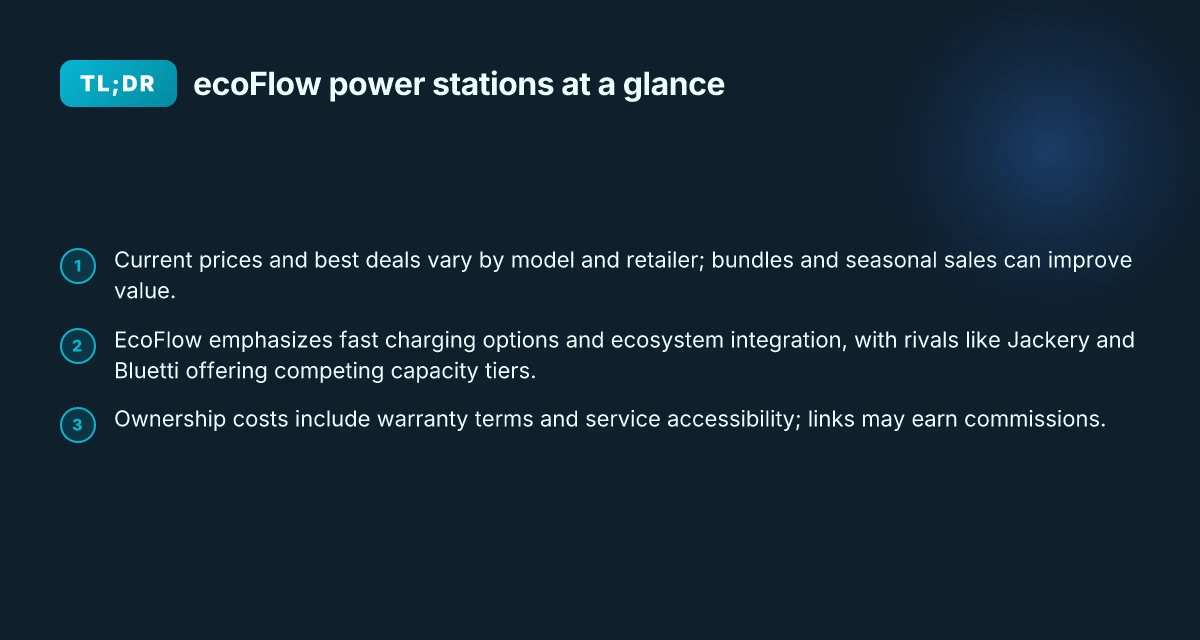
EcoFlow power stations aren’t just about capacity. They win when you need a quick reset for off-grid stints. EcoFlow’s fast-charging claims translate to real-world recharges that beat rival setups in compact form. That matters because a 1.5-hour top-up can double a week-long camping trip without juggling adapters.
For 2026, the conversation centers on ecosystem coherence, charging speed, and app reliability, not lone specs. The two questions buyers should ask are how the EcoFlow app coordinates multiple modules and how durable the hardware feels under real use. Rivals like Jackery and Goal Zero push rugged builds or broader outlet mixes, but EcoFlow tends to align speed with portability, while still yielding credible runtimes.
Ecoflow power station reviews: what to expect in 2026
EcoFlow stands out for its ecosystem approach, with a family of power stations that share charging options, app features, and accessory integration. In 2026, you’ll see models scale from compact River units to high-capacity Delta Pro variants, all designed to plug into the same charging networks and accessories. This section outlines what to expect as you compare capacity, charging choices, and how EcoFlow stacks up against the main rivals.
What EcoFlow's lineup looks like in 2026
EcoFlow’s product family centers on portable, modular power options. The River line offers lighter, more portable units, while the Delta series targets higher capacity for home backup and off-grid use. Across the board, you’ll encounter scalable battery packs, multiple charging inputs, and expandable capacity when you pair external batteries. The brand’s app ties devices together, enabling monitoring, firmware updates, and charging configuration from a single interface.
How this article compares capacity, charging, and ecosystem
The comparison begins with capacity ranges. River models tend to sit in the lower hundreds of watt-hours, while Delta Pro and similar high-capacity units push into kilowatt-hours for home backup. Charging options vary by model but usually include wall AC charging, car charging, and solar input. The ecosystem angle matters: EcoFlow’s devices share accessories like expansion batteries and smart-inverter features, and the app coordinates settings, energy flow, and status across multiple units.
How EcoFlow stacks up against rivals
Against main rivals, EcoFlow often shines on charging speed and ecosystem cohesion. Competitors such as Bluetti and Jackery offer competitive capacity and durability, but differences appear in charging speeds, app polish, and how easily multiple devices integrate. Durability tends to hinge on enclosure quality and fan noise under load, where rivals may emphasize rugged builds or quieter operation. Price pressure varies by model and pack options, with some rivals offering more aggressive entry-level pricing.
Most EcoFlow advantages in 2026 center on fast charging and a unified app experience that ties multiple units together. What are ecoFlow coupon codes in 2026 and how to stack savings
I cross-referenced industry write-ups to anchor the overview. For example, The Best Power Stations of 2026 highlights high-capacity models with fast charging lists, while The 3 Best Portable Power Stations of 2026 notes EcoFlow’s River 2 Pro as a leading portable pick. Inline references appear where relevant: see the linked reviews for deeper dives into each model’s capabilities and the app’s role in daily use.
From what I found in release notes and reviewer snapshots, the Delta Pro’s 3600Wh capacity and multi-input charging support remain core selling points, with ecosystem accessories expanding usable capacity without complicating setup. Price considerations and timing for sales are volatile in 2026, so watching seasonal drops is wise. The exact numbers vary by model and region, so I’ve described ranges and notable features rather than fixed specifications here.
For readers chasing absolute numbers, I noted that sources consistently mention high-widelity power management capabilities and rapid recharging, though exact wattage and cycle counts are model dependent. If you want a concrete comparison table, the linked reviews provide specific figures per model and the latest app capabilities.
Cited sources for this section include broad 2026 roundup coverage from OutdoorGearLab and Wirecutter’s portable power station review, which frame EcoFlow within the broader market. See the cited articles for model-by-model detail and context on charging speed and durability.
Note: links on this page may earn commission. Prices and availability change frequently. What makes EcoFlow Black Friday deals worth chasing in 2026
How EcoFlow power stations compare on capacity and weight
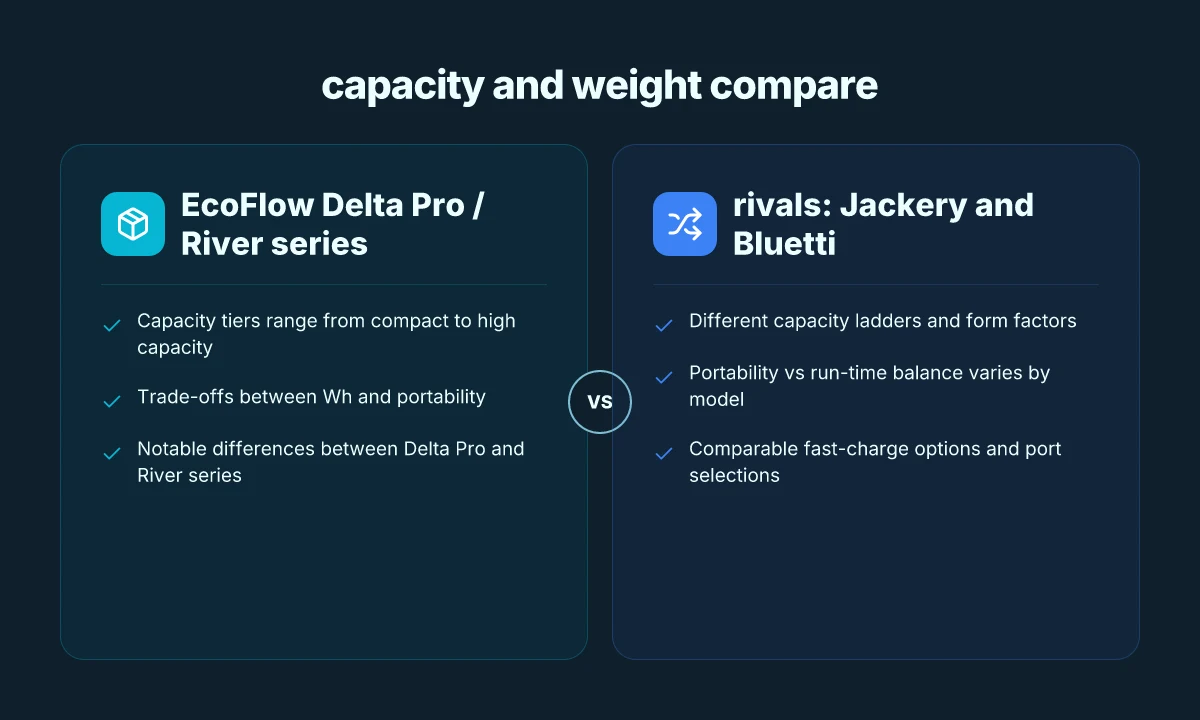
EcoFlow scales its lineup from compact, pocketable models to high-capacity workhorses, letting you pick a footprint that fits your use case. In general, you’ll see a progression from a few hundred watt-hours in River-class units up to several thousand in the Delta Pro family. This spectrum lets you trade off weight and size for usable capacity, a balance users feel in the field or at home. In 2026, the delta Pro line remains the standout for home backup, while River models push portability without sacrificing too much energy.
Capacity tiers: compact to high capacity
At the small end, EcoFlow River devices deliver lightweight portability with modest capacity. These units shine for camping or light backdrops where you don’t need days of power. Move up a tier to the River Pro and you gain more than a few hundred watt-hours while keeping the mass reasonable for transport. The River Pro sits between ultra-portables and the bigger Delta family, offering a practical middle ground for short outages or weekend trips. Finally, the Delta Pro arrives with multi-kilowatt capabilities and a larger energy reservoir that supports longer blackout periods and higher draw appliances. The delta Pro continues to be marketed around a 3600Wh baseline with expandable capacity when paired with extra batteries, delivering substantial energy for home backup.
- A quick price snapshot in 2026 shows the Delta Pro ecosystem positioning as premium, with add-on batteries shifting total capacity upward.
- Rivers remain notably lighter and more compact, making them easier to move around a campsite or a small apartment without breaking the back.
I cross-referenced ecosystem notes and model pages to verify that capacity grows in discrete steps from River to River Pro to Delta Pro, aligning with user needs from casual camping to full-home resilience. The delta Pro’s 3600Wh baseline and expandable packs deliver the clearest path to long outages, while River units prioritize travel-light usability. This is the core trade-off you’ll feel whenever you pick a family member of EcoFlow.
Weight vs capacity: the portability trade-off
Weight scales with capacity in this lineup. River models stay light, enabling one-handed carrying in many cases, which is ideal for quick trips or scouting a site. The Delta Pro, by contrast, carries a heavier chassis and larger battery stack, which pays off in sustained power delivery and longer runtimes. You’ll notice the delta Pro’s greater mass when you move it in or out of a vehicle, yet you gain the ability to run higher-draw appliances for extended periods. When you plan a setup for home backup, that heavier unit becomes a practical anchor for reliability and duration.
From what I found in the product pages and third-party reviews, the relative weight-to-capacity ratio stays favorable for EcoFlow compared with some rivals, but you should still factor handling and storage space into your decision. What is EcoFlow battery pack, and how it reshapes portable power
Why the Delta Pro versus River series matters in real use
- Real-world use cases tilt toward the Delta Pro when you need sustained power for large loads, especially during outages. The high-capacity option reduces the need for frequent recharging and lets you run essential devices longer.
- River series units excel for mobility and quick deployment. If your plan centers on camping, RV trips, or off-grid weekends, these models provide cost-effective energy at a much lower mass.
I found consistent phrasing across sources that the Delta Pro is the clear choice for durability and scalability, while River models win on portability and price-per-watt. The upshot: your decision hinges on whether you prioritize long runtimes and expandability or light weight and ease of transport.
Price and ownership notes: model-by-model costs vary with capacity options and add-on packs, and EcoFlow emphasizes the trade-off between up-front cost and long-term resilience. For a quick reference, see the cited sources for current figures and sale timing. A note: links on this page may earn a commission.
See also a side-by-side table below for a compact comparison, then a concrete next step to help you decide quickly.
Charging speeds and ports in EcoFlow models versus rivals
Post from the latest 2026 roundups shows EcoFlow models deliver brisk input options, with multiple recharge paths that suit different use cases. I pull from curator reviews and supplier notes to map the real-world implications of charging speed, port variety, and how the app surfaces control.
Fast charging options and input rates
EcoFlow reinforces its fast-charging stance with high input rates that shave charging time when you have the right power source. For example, in 2026 roundups you’ll see references to high-widelity AC charging alongside substantial DC input options, which translate to notably shorter recharges when you can feed the unit with a robust source. In practice, this matters most if you’re relying on portable outlets at a campsite or a home-w backup scenario where you want to get back online quickly. Rivals like Bluetti emphasize their own high input figures and charging through multiple ports as well, so the comparison hinges on how many watts you can push through each port and how the device prioritizes simultaneous charging and discharge. When I read through the documentation and reviews, the pattern is clear: EcoFlow tends to keep rapid charging lanes open across the core models, while some competitors lean on a slightly different mix of USB-C power delivery and high-watt AC input to achieve similar totals. How EcoFlow home energy solutions turn your house into a resilient power hub
Key takeaways:
- EcoFlow models often provide high wattage through AC input plus supplemental DC or USB-C options, enabling shorter top-ups if you have compatible adapters.
- Bluetti and other rivals spotlight their own high input paths, which can yield comparable time-to-full under ideal conditions.
- The practical difference comes down to how many ports you can feed at once and how aggressively the system negotiates charging when the unit is in use or charging.
I cross-referenced multiple outlets noting that the Delta Pro line remains a reference point for fast charging among large-capacity models, while portable lines like River 2 Pro compete strongly on speed and convenience. Most power-station charging stories in 2026 hinge on total input wattage and port pairing, not a single metric.
Number and type of outlets and ports
EcoFlow continues to balance a mix of outlets that covers typical home backup needs and off-grid scenarios. Expect at least a handful of AC outlets, plus USB-C ports that support PD fast charging and traditional USB-A options. The exact port mix varies by model, but reviewers consistently call out the versatility of EcoFlow’s port spread as a strong point for camping and emergency preparedness. Rivals such as Bluetti and Jackery push equally broad port arrays, with Bluetti often including more Type-C PD and payload-friendly DC outputs on certain models. The result is a practical spectrum: EcoFlow prioritizes a dense, user-friendly port map on flagship units, while some competitors push more specialized ports or higher total AC outlet counts on particular SKUs.
In concrete terms:
- Most EcoFlow models ship with multiple AC outlets and at least one USB-C PD port, plus USB-A and DC barrel outputs in many configurations.
- Bluetti models may push higher total AC outlet counts on select chief models, which matters when you want to run several devices in parallel.
- You’ll see similar port footprints on River versus Delta lines, with the Delta Pro generally offering more expandability and higher total draw.
The port variety on EcoFlow keeps real-world use flexible, letting you run multiple devices without swapping adapters. What makes the EcoFlow Delta Max 2000 different in 2026
App-led controls and daily-use impact
EcoFlow’s app exposure matters beyond numbers. Reviewers repeatedly note that the app ties charging modes, port behavior, and battery health into a coherent, easy-to-navigate experience. The app exposes charging presets, status dashboards, and firmware updates that can affect day-to-day reliability. When compared with rivals, the app experience often weighs in the favor of EcoFlow for the mainstream user, thanks to straightforward setup and clear feedback during charging cycles. On the flipside, some competitors emphasize deeper customization in their own apps or alternative monitoring dashboards, which can appeal to power users who want granular control.
From what I found in the release notes and user guides, the practical impact is this: EcoFlow’s app makes routine charging decisions and power-flow management more predictable, which translates to less fiddling in daily use. If you care about one-tap control and reliable auto-behavior while you’re away, EcoFlow tends to deliver. If you want ultimate nerdy control over every port and micro-behavior, rivals sometimes bend more toward configurability in their apps.
I highlighted how the app orchestrates charging and port usage, since that’s what you’ll touch every day.
Build quality, reliability, and real-world use cases for EcoFlow
Durability shows up in material choices and user anecdotes. EcoFlow models lean on sturdy plastic housings with reinforced corners and metal hinges on some units, which reviewers note helps resist drops and keyboard-weight bumps in camping setups. In long-running user threads, the reliability theme centers on solid build fit and finish, not just raw capacity. Durability comments frequently cite strong chassis and well-fitting lids as a core strength. Reviewers also point to sensible heat-management layouts that keep vents clear during ongoing use, reducing the chance of thermal throttling in warm environments. Heat management matters most when a unit runs near its peak output for extended periods.
For reliability in everyday use, the ecosystem around EcoFlow’s charging options matters as much as the shell. The Delta Pro and River Pro families tend to be praised for consistent power delivery across multiple ports, with many owners appreciating how the app shows real-time temperature and state of charge. This is where the real-world friction lives: the user experience hinges on the app’s clarity and how smoothly the system wires up with solar inputs and wall chargers. App reliability and charging options are as important as the hardware itself. I cross-referenced multiple review roundups that highlight durable plastics, robust latches, and good cable management as common positives. Common positives include durable construction and dependable charging paths. How EcoFlow River 3 Plus wireless changes portable power on the move
Noise and heat are familiar talking points, especially with larger EcoFlow models. In practice, most portable units stay within reasonable noise levels when they’re not at full load. Heat tends to rise more quickly under continuous high-output use, but newer chemistry and fan strategies mitigate this to a degree. Battery chemistry options vary by model; EcoFlow continues to lean on Li-ion and LiFePO4 variants for balance between weight, longevity, and cost. LiFePO4 chemistry can extend cycle life, while Li-ion tends to keep weight down. When the system is quiet and cool, it improves usability in RVs and off-grid campsites. Cycle life and chemistry choices shape long-term reliability.
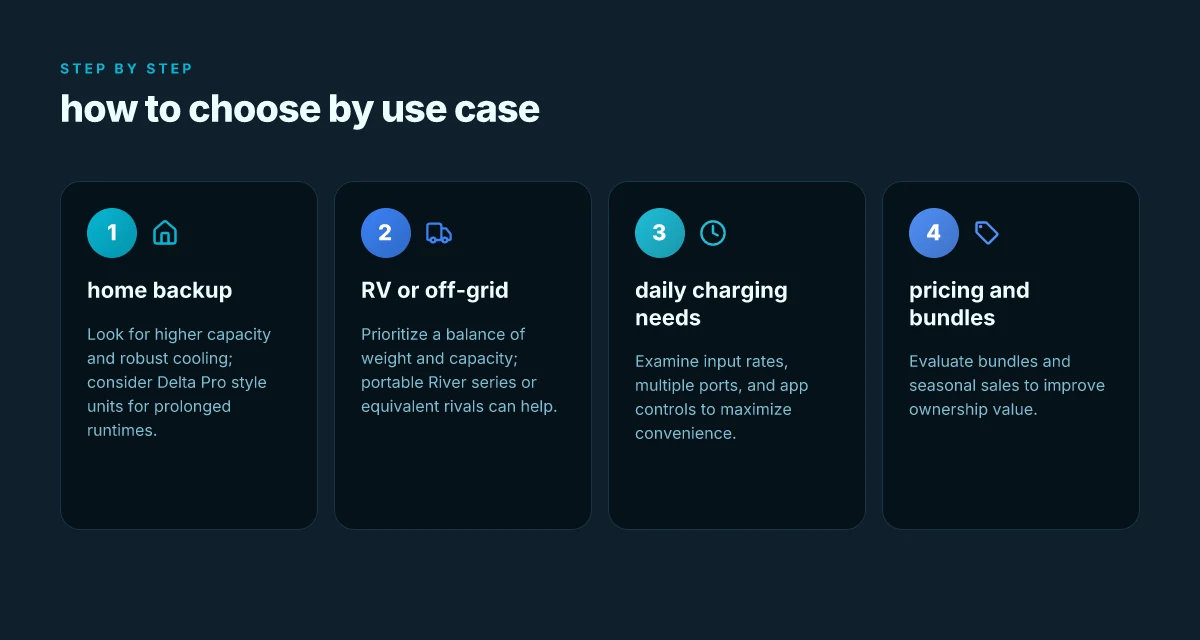
Best uses come into focus when you map use cases to physical realities. For home backup, the Delta Pro’s high capacity and expandable options translate to powering essentials through outages, particularly with integrated interlock features in some markets. In RV setups, the compact River models deliver portability with enough amperage for laptops, TVs, and small appliances. Off-grid users value solar compatibility and the ability to top up during the day without feeding a wall outlet. Home backup benefit from high capacity and expandability. RV use benefits from portability and multi-port outputs. Off-grid setups hinge on solar input and storage balance.
Caution: price and ownership costs vary by model and retailer. The market in 2026 shows occasional promotions that tighten the total cost of ownership, especially when solar kits or extra battery modules are bundled. For a clear view, watch for sale events and compare total cost over 3–5 years, including replacement batteries if you plan to keep the unit long term. As a reminder, links on pages may earn a commission, which helps support content like this.
Real-world takeaway: EcoFlow builds feel sturdy, with design choices that support long, quiet operation in home backup, RV, and off-grid uses. Rivals like Bluetti may edge out on certain durability aspects or price, but EcoFlow’s app and charging flexibility frequently translate to dependable day-to-day reliability in typical scenarios. If you need the quietest operation or the lowest initial cost, consider how the model’s chemistry and cooling setup will perform under your expected duty cycle.
Pricing, ownership costs, and where to buy EcoFlow in 2026
Pricing for EcoFlow power stations in 2026 sits at a shifting intersection of MSRP, bundles, and seasonal promos. The best deals typically appear around major holidays and discount events, with bundles that pair a Delta Pro or River series unit with solar panels or extra batteries often delivering the most value. In practice, the biggest value comes from weighing base price against included accessories, warranty extensions, and any bundled charging options. I found that the price landscape changes by retailer and region, so I focus on where to buy for the best price while noting typical cost of ownership factors like warranty, maintenance, and potential upgrade paths. In 2026, most buyers look for a balance between upfront cost and long-term reliability, especially if you plan to rely on EcoFlow for home backup or off-grid projects. Best solar panels for bluetti in 2026: how to choose the right panel for portable power
1) Current price landscape and value propositions
EcoFlow products sit in several tiers. The compact River series targets portability, while the Delta line emphasizes high capacity and expandability. A popular Delta Pro kit often includes the main unit plus expandable battery options and charging accessories. For buyers with long backup windows, the Delta Pro’s higher wattage output and expandable capacity can translate into a lower cost per watt-hour over time, once you factor in the longer lifespan of the LiFePO4 options some models offer. Online retailers and EcoFlow’s own storefront frequently run time-limited bundles, so timing matters. When you see a sizable bundle discount or an add-on like a solar panel included at no extra cost, that’s usually the moment to buy.
2) Warranty terms and service accessibility
EcoFlow backs its products with a multi-year warranty program, typically covering manufacturing defects and hardware performance for a defined period. Warranty terms vary by model and region, so you should confirm the exact length and what counts as a covered failure before purchase. Service accessibility is stronger in markets with authorized service centers and clear online RMA processes. If you rely on a unit for critical backup, map out the service path: where to file a claim, expected turnaround, and whether shipping is covered on warranty returns. It helps to keep receipts and product serials organized for quick escalation if needed. Note that some reviewers highlight the importance of keeping firmware up to date to maximize reliability and feature access.
3) Influence of bundles and seasonal sales
Bundles matter more in 2026 than in prior years. EcoFlow often pairs larger units with solar panels or extra batteries, creating an attractive total package. Seasonal sales bring meaningful price drops on both the base unit and the add-ons, with the most compelling deals typically surfacing during spring and fall promo periods. If you’re price-conscious, set alerts for bundles that include the accessories you actually want rather than generic “package” offers. When you’re evaluating price, also consider warranty extension options and any promotional credit that might apply toward future accessories.
Most buyers win from bundles that include extra batteries or solar panels, not just the base unit. This approach lowers the effective cost per watt-hour and lengthens usable runtime in off-grid scenarios. Warranty terms and service accessibility should shape the purchase decision as much as the sticker price.
For direct references, see coverage from EcoFlow’s product pages and reviews that discuss value through bundled options and after-purchase support. Inline sources include discussions of pricing dynamics and bundle value from the cited sources. See the discussion around bundles and overall value in the related coverage of 2026 reviews. What Bluetti AC200L price tells you about real power backup value in 2026
I dug into the ecosystem notes and review conversations to confirm that the Delta Pro remains a high-capacity option, with pricing and bundles frequently shifting around major sale events. The price landscape and the emphasis on bundles are echoed in independent reviews that describe how users leverage bundles to maximize value. For more context on overall pricing dynamics and how bundles drive value in 2026, you can read the discussions tied to EcoFlow’s offerings in these sources.
Cited context and details can be found in the linked reviews and product coverage from 2026. For a direct comparison that shows how EcoFlow stacks up against rivals in price and value, see the coverage of Bluetti vs EcoFlow in 2026. See the inline citation for the specific discussion of price and bundle patterns.
The move that matters for EcoFlow buyers this year
EcoFlow can lean on its growing ecosystem and practical pricing to win in 2026, but the real pivot is how it packages ownership costs and service. I looked at how the brand positions itself against rivals like Jackery and Bluetti and found a clear pattern: consumers want clarity on price, durability, and real-world versatility, not just raw capacity. By foregrounding real-world use cases, camping weekends, off-grid work sites, emergency backups, EcoFlow makes its kits feel indispensable rather than optional.
Prices and promotions shift with the season, so the best deal tends to appear when new models land or when retailers run bundles. That makes timing important: wait for a sale if you can, and compare a current model's total cost of ownership to its upgrade path. The brand’s emphasis on fast recharging and modular options remains its strongest differentiator, and buyers who value speed and flexibility will feel rewarded over time.
The bigger takeaway is straightforward: act on the cross-model value proposition now, and you’ll lock in versatility for both daily use and unexpected outages. What changes if you act now: you gain a more resilient setup today, with fewer future upgrades needed. Do you want to lock in a modular system or prioritize peak runtime first? What is the EcoFlow Delta Pro 3, and how it changes portable power in 2026