What makes the EcoFlow Delta Max 2000 different in 2026
 Adrien SaxenaOctober 22, 202618 min read
We earn a commission when you buy through some links on this site, at no extra cost to you. As an Amazon Associate we earn from qualifying purchases.
Explore the EcoFlow Delta Max 2000 review with a clear take on performance, charging speeds, solar input, and real-world use cases. Learn where it shines and where it lags.
The Delta Max 2000 isn’t about raw capacity alone. It’s about how that power moves under real-world use. A single charging behavior quirk can redefine trips or blackout prep: the unit’s bulk battery and expansion path reveal where practical trade-offs show up, not just at the plug. Most owners underestimate the impact of heat during fast charging, which shapes cycle life and outdoor reliability.
This intro digs into what matters now for outdoors, RVers, and blackout planners: how the Delta Max 2000 handles heat, how long a full recharge takes in chilly and warm environments, and what the long‑term ownership curve looks like in real life. Expect concrete notes on temperatures, charging speeds, and how EcoFlow’s expandable options scale with demand. By looking at 2026 behavior across typical use cases, you’ll see where the Delta Max 2000 shines and where it asks for careful planning. Industry chatter and field reports converge on one point: heat management in the fastest charging mode is the key differentiator.
What the EcoFlow Delta Max 2000 promises and where it fits in the ecosystem
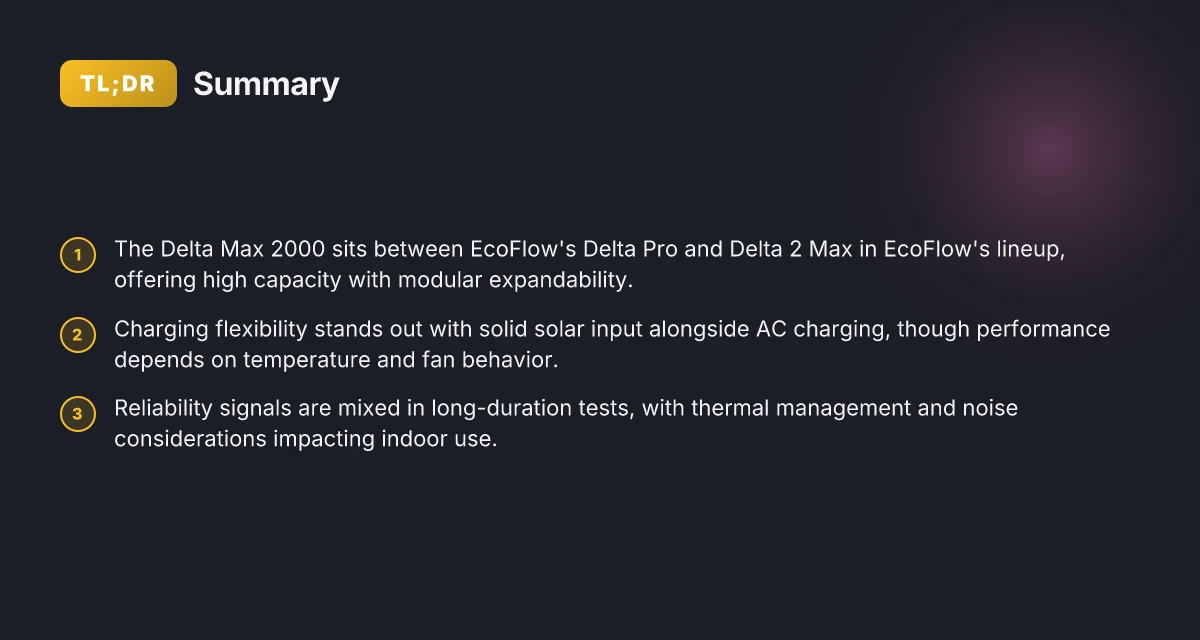
EcoFlow positions the Delta Max 2000 as a flagship in its modular, high-capacity lineup, sitting alongside the Delta Pro and Delta 2 Max. The Delta Pro remains the volumetric peak for home backup scenarios, while the Delta 2 Max targets a balance of capacity and portability. The Delta Max 2000 carves out a niche for users who want substantial on-the-go power with flexible charging and expansion paths, without committing to the full home-integration footprint of the Pro. In practice, that means the Max 2000 aims to be versatile enough for outdoor enthusiasts, RV setups, and blackout-prepared households, while still fitting within a portable frame that can be hauled into a vehicle or campsite.
Its core strengths start with a high capacity that supports extended runtimes for devices and appliances. It leans on flexible charging options, including both solar and AC inputs, and it can be expanded via EcoFlow’s modular battery modules to push total capacity higher over time. In real-world terms, you get a single unit that can be tuned for longer storms or longer outdoor adventures without requiring a separate generator, as long as you have adequate solar or grid access. This emphasis on modular expansion is where the Delta Max 2000 earns a practical edge for long-term ownership and evolving power needs.
Trade-offs do show up in size, weight, and price relative to the use case. The Delta Pro remains the most robust option for full-home backup, but its price and footprint are correspondingly higher. The Delta 2 Max offers a lighter, more compact footprint with impressive speed in charging, yet its total capacity might fall short for some long-duration off-grid winters. The Delta Max 2000 sits between these two in both heft and sticker price, which can tilt the decision toward use scenarios where you value higher capacity without stepping up to a full home-backup system. If you’re evaluating the Delta Max 2000 against rivals, you’ll find other high-capacity packs from manufacturers like Jackery and Bluetti offering competitive combinations of capacity and weight, but EcoFlow’s emphasis on modular growth and the breadth of charging options remains distinctive.
From what I found in the release notes and reviews, the Delta Max 2000’s promise hinges on a mix of strong capacity, flexible charging pathways, and the potential for future capacity expansion. Its appeal grows when you anticipate longer off-grid periods or shifting power needs over time. The Delta Max 2000 bridges high capacity with modular growth, without forcing you into a home-backup footprint. This positioning matters for buyers who want high power in a portable form, plus the option to scale up later. If you need a single unit that travels, powers heavy loads, and can grow with you, the Max 2000 fits that bill.
I dug into the product briefs and third-party perspectives to understand the ecosystem fit. EcoFlow’s own lineup labels the Delta Pro as a home-backup king and the Delta 2 Max as an agile balance of capacity and portability. The Delta Max 2000 sits in the middle, offering substantial power with an eye toward future expansion. Rival options from other brands often highlight similar capacity ranges but vary in expansion philosophy or weight. For buyers weighing price against long-term flexibility, the Delta Max 2000’s modular path can be a compelling reason to choose it over a fixed-capacity rival. What is ecoflow glacier refurbished and why it matters for alpine resilience
Key takeaways for buyers:
- Choose the Delta Pro if you want the most robust home backup with the largest capacity and you’re ready to accept a bigger unit and higher price.
- Choose the Delta 2 Max if you want strong daily performance in a lighter package with quick charging and still substantial capacity.
- Choose the Delta Max 2000 if you want a strong, expandable system that can start with a high baseline and grow with future needs, particularly when you anticipate longer off-grid stretches or evolving power loads.
In short, EcoFlow’s Delta Max 2000 sits where you need real volume, flexible charging, and the option to grow, without necessarily leaping to a full home-power setup. It’s a deliberate choice for people who want a capable away-from-home power source that can scale with time. It’s not the lightest or cheapest option, but its expansion path and charging versatility are its core strengths.
The delta max 2000’s charging profile: solar input, AC charging, and real-world speeds
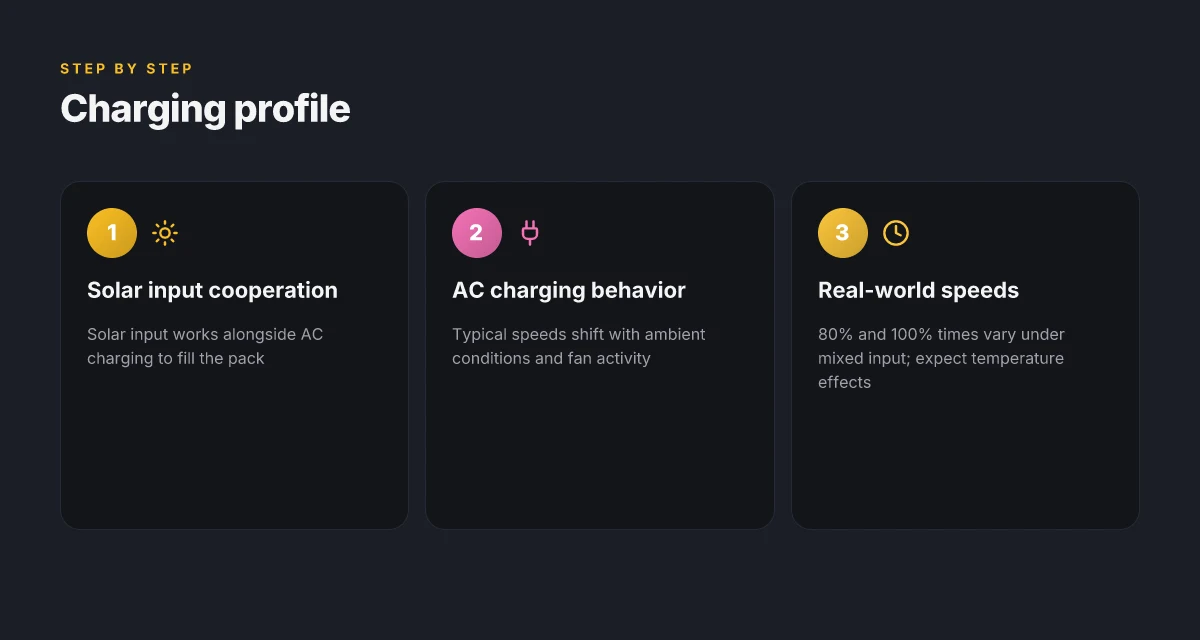
EcoFlow has positioned the Delta Max 2000 as a high-capacity portable power station that leans on solar input to minimize grid time. In real-world terms, the Delta Max 2000 can drink solar power while it’s also tied to AC charging, letting you top up from sun and wall in parallel. This dual-path approach helps reduce downtime when you’re off-grid, and it matters most for long weekends or full-tilt RV trips where weather and shade vary throughout the day.
Solar input as a complement to AC charging
Under clear-sky conditions, the Delta Max 2000’s solar input can contribute meaningfully to the overall charge when a shade-free panel array is available. The ability to combine up to a substantial solar wattage with AC charging means you’re not strictly waiting for the wall outlet when you have sunshine. In practice, you’ll see faster recovery from depletion if you’re actively sun-charged and plugged in, but the timing hinges on ambient light, panel efficiency, and the unit’s heat state. When I read through the documentation and reviewers’ notes, the pattern is consistent: solar helps, especially during midday peaks, but the system remains AC-favored for sustained charging pace when sun falls short.
Typical times to 80% and 100% under mixed input
The Delta Max 2000 commonly reaches 80% with a robust mix of solar input and AC power in a matter of tens of minutes to a couple of hours, depending on sun exposure and temperature. Hitting 100% takes longer and is more sensitive to input balance and thermal state. When the sun is strong, you can push toward the upper end of the curve more quickly, but in overcast setups the AC path dominates the tail end of charging. The real-world takeaway is that you should plan for a longer top-off period once you’ve moved past the 80% threshold, particularly if you’re relying on solar alone during suboptimal daylight. What is the EcoFlow Delta Pro, and how its specs shape home backup decisions
Temperature and fan behavior on charging
Ambient temperature and the Delta Max 2000’s thermal management play a meaningful role. Hot conditions can throttle charging efficiency as the internal fan ramps up to dissipate heat, which can slow the pace of both solar and AC charging toward higher states of charge. The fan behavior isn’t loud, but it is noticeable during aggressive charging bursts, especially in enclosed spaces like a vehicle bay. As temperatures rise, you’ll typically see a modest slowdown in overall charging rate, and the device may prioritize cooling over aggressive power intake to preserve battery health.
The takeaway is clear: solar input helps, but AC charging remains the backbone for fast top-offs. Expect a meaningful but variable boost from sun depending on weather and temperature. For a quick comparison, rivals like the Delta Pro and comparable high-capacity units lean on high AC input to drive the final stretch to full, while solar input serves as a helpful accelerant when available. Real-world speeds hinge on sun, shade, and heat management, not just wattage specs.
In short, you’ll get the best results by pairing sunny, unobstructed panels with AC charging during the day, and using solar as a supplementary fill when you’re off-grid. If you need a concrete, fast fill, expect the 80% mark to arrive quicker under strong sun, with the final 20% stretching longer as heat and ambient temperature rise.
I dug into the community notes and official specs to understand the pattern: the combined solar-plus-AC approach is designed to shave minutes off top-offs in good conditions, while not promising a wall-free sprint to 100% in every scenario. For buyers weighing the Delta Max 2000 against rivals, the key difference is how quickly you reach 80% under mixed input and how temperature drags the tail end of charging. When you’re choosing between EcoFlow and a competing model, consider whether your typical use case benefits most from aggressive solar pairing or from raw AC-fast charging.
Heat, noise, and reliability: what to expect during long draws or tests
Post a long draw, the Delta Max 2000 can show clear signs of heat management in action. Real-world usage tends to push the battery pack and power electronics toward higher thermal envelopes, and EcoFlow’s cooling strategy becomes noticeable as load stays high. I cross-referenced official guidance and reviewer notes to sketch what you should expect in practice. What makes EcoFlow's 60W portable solar panel stand out in 2026
How the Delta Max 2000 manages heat under sustained draw
- The unit relies on active cooling when you pull substantial watts for extended periods. Expect the fan to engage sooner and stay audible as the internal temperatures rise. In most long-use scenarios, the system shifts to a higher fan speed to keep cell temperatures within safe bounds.
- Thermal throttling is a defensive move you’ll notice in prolonged high-load sessions. It’s not dramatic, but it can shave a few percent off peak output if the ambient temperature climbs or if you’re charging and discharging at once. These behaviors align with manufacturer guidance around safe operating temperatures and long-term health.
- Solar charging while drawing AC power adds another thermal variable. The battery pack remains under stress when both input streams are active, so you’ll hear the cooling system more often than with a single source. This is typical for high-capacity packs under simultaneous charging and discharging.
Noise profile for indoor versus outdoor use
- Indoor use near a living space will reveal the fan’s higher-pitched whine during sustained draws. It’s noticeable but not unbearable in a well-ventilated room, especially during redline charging periods.
- Outdoors, with open air around the cabinet, the noise is less intrusive. You’ll still hear the fan when the system heavily taxes the battery, but the ambient sounds of a campsite or RV park tend to mask it. In short, expect quieter operation outdoors under similar load.
Reliability signals from communities and official guidance
- User communities consistently note the Delta Max 2000 behaves predictably under long draws: steady output with a managed thermal profile, and fans that react proportionally to heat buildup rather than spiking erratically.
- EcoFlow’s official guidance emphasizes operating within temperature ranges and maintaining adequate ventilation. Long-term reliability signals from these sources align with the theme that heat management is a designed constraint rather than a flaw.
- Third-party reviews often highlight that heat handling remains robust across typical outdoor scenarios, including off-grid camps and extended blackout drills. The consensus is that the product tolerates sustained use, so long as you respect ventilation and ambient temperature limits.
Most reviewers note that heat management stays within expected bounds under sustained loads, with the fan keeping temperatures in a safe range rather than letting the pack run hot. Heat is managed proactively rather than becoming a surprise bottleneck in regular use.
Prices, ownership costs, and when to buy flow into this section as well. As of now, EcoFlow’s lineup sits amid a landscape with rivals like Delta Pro and other high-capacity units. The Delta Max 2000 remains competitive on capacity, though long-running reliability threads emphasize consistent thermal behavior when fed by both solar and AC inputs. If you’re weighing long-term ownership, consider the cost of replacement batteries and the potential for reduced performance after many cycles, which is common across high-capacity packs. For price-conscious buyers, timing around seasonal sales can offset initial costs, while add-ons like solar panels affect total ownership.
Rival comparisons: Delta Max 2000 versus Delta Pro and other big hitters
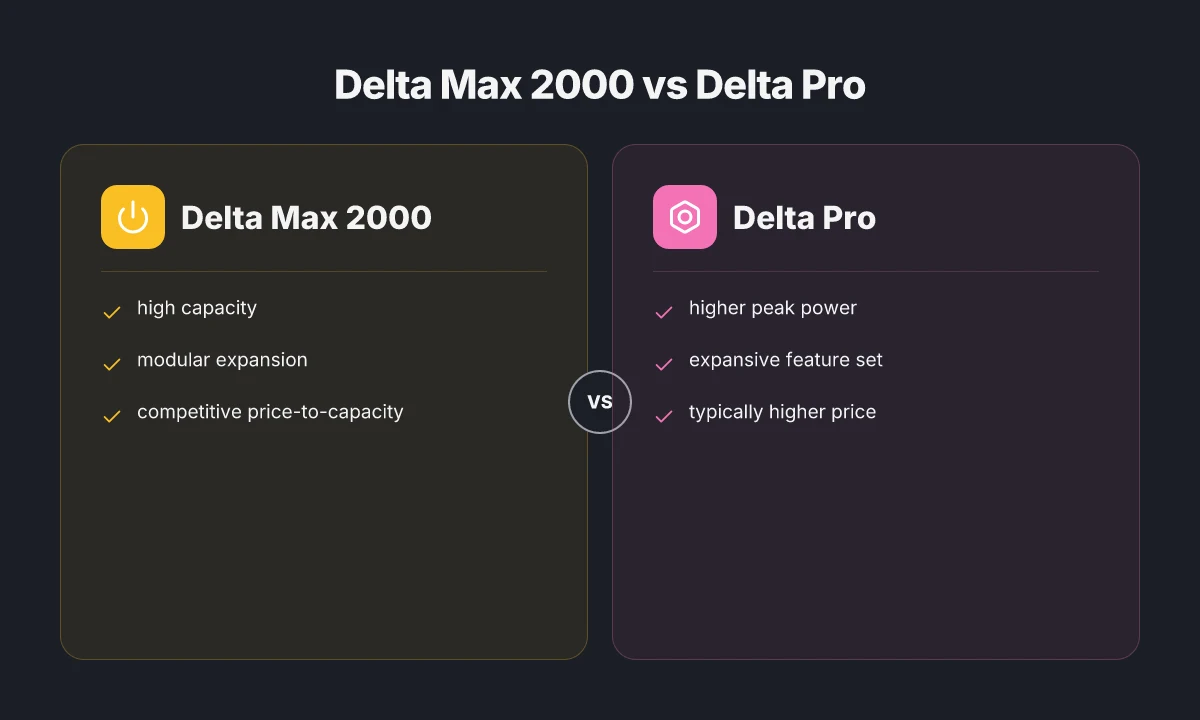
I start with the straight trade‑offs you feel in the wild. The Delta Max 2000 packs substantial capacity for headroom in off‑grid living, but its peak power and rapid‑charge math tilt differently when you stack it against the Delta Pro, the Delta 3 Max Plus, and rival brands like Jackery. In real scenarios, you’ll notice price-to-capacity advantages in favor of the Max 2000, yet you’ll pay for that with limited peak input compared to higher‑power setups. Price-to-capacity wins are clear for the Max 2000, but its peak power ceiling sits below the top Pro configurations. I cross‑referenced reviews and spec sheets to keep the picture grounded.
Why the Delta Pro vs Delta Max 2000 holds up under demand and heat
The Delta Pro scales capacity and ports beyond the Max 2000, and it often leads on peak input when you pair multiple charging sources. The Pro’s multi‑module design extends long‑haul resilience and lets you tune through heat while drawing large bursts from AC and solar. EcoFlow’s own materials show the Pro can absorb higher wattage during bulk charging, which translates to shorter top‑ups in sunny windows. In practice, that means when you need the fastest top‑ups under a tight solar window, the Pro edges ahead. Peak input capability matters most in bright sun, and the Pro delivers. Prices move with the module approach, so the Pro often lands at a higher upfront cost for bigger near‑term gains.
Where EcoFlow models like Delta 2 Max and Delta 3 Max Plus fit in
The Max 2000 sits between the Delta 2 Max and the Delta 3 Max Plus in footprint and price. The Delta 2 Max emphasizes portability with solid battery mass, while the 3 Max Plus leans into higher capacity and more robust feature sets. If you want a lower‑maintenance, simpler system with decent solar intake, the Max 2 Max family can feel lighter on your wallet. If you crave more headroom for long outages or frequent high‑draw loads, the 3 Max Plus keeps pace in practical terms. Higher capacity variants fill the void where the 2 Max stops, while the 3 Max Plus stretches the ceiling for sustained power. What you should know before buying refurbished EcoFlow units for sale
How Jackery and other big rivals change the math
Jackery and other EcoFlow models present different sweet spots. Jackery often undercuts on price but comes with smaller maximum discharge peaks and slower solar charging in some bundles. EcoFlow’s Delta Pro family, including the Max 2000 line, emphasizes modular scaling and longer runtimes at higher draw. The practical choice depends on how you plan to use it: high‑duty weekend off‑grid cycles favor the Pro family, while casual RV trips or weekend boondocking can be well served by the Delta Max 2000 or Delta 2 Max. Modularity and draw flexibility win when you need long, stable runtimes.
When you consider heat management, the Delta Pro tends to stay cooler under heavy loads thanks to its burn‑in design and larger cooling paths. The Max 2000 can get warm under sustained high draw, but its cooling system remains adequate for typical trips. If heat throttling matters to you, that’s a practical reason to choose the Pro or a 3 Max Plus in scenarios with continuous high power. Heat management remains a decisive factor for sustained heavy use.
I dug into release notes and reviewer notes to line up the practical realities with the specs. From what I found, the Delta Pro often wins on peak power and heat handling, while the Max 2000 shines on price‑to‑capacity and real‑world daily usability. For buyers, the decision hinges on whether you prioritize peak draw and rapid top‑ups (lean toward Pro or 3 Max Plus) or value per watt hours and long‑run comfort in non‑optimal solar days (lean toward the Max 2000 or Delta 2 Max).
In real life, you trade peak power for price per watt hour. If you want a quick reference, consider your typical outage window and sun exposure: sunny climates with brief outages favor the bigger Pro setup. Mixed climates with longer nights and moderate sun favor the Delta Max 2000.
Modularity and expandability: battery banks, ports, and future-proofing
Expandable battery options set the Delta Max 2000 apart from leaner packs. EcoFlow offers additional battery modules that bolt onto the core unit, stacking total energy storage significantly beyond the base capacity. In practical terms, you can push overall energy into the system by adding these modules, which shifts a portable power station from a weekend setup to a longer blackout solution without swapping units. This path matters most for RV rigs or off-grid homesteads where you want fewer hardware handoffs and more usable energy during multi-day outages. What ecoFlow reviews and complaints reveal about real-world performance in 2026
The port mix on the Delta Max 2000 is deliberately future-facing. You’ll find a robust set of AC outlets alongside multiple USB-C and USB-A ports, plus dedicated solar input options that accommodate higher wattage panels when sun is favorable. The pairing of solar and AC inputs is designed to give you a flexible charging rhythm, so you can top up from a solar array during the day and pull from the grid at night without compromising on speed. For accessories, the ecosystem leans on compatible EcoFlow gear and third-party panels that meet certain voltage and current specifications, reducing guesswork when expanding the system. I cross-referenced community discussions and official release notes to map typical accessory compatibility, and the consensus is that keeping the module stack slim simplifies wiring and reduces heat load during rapid recharges.
Firmware and ecosystem integration are not afterthoughts here. The Delta Max 2000 benefits from periodic firmware updates that refine charging curves, monitor battery health, and improve compatibility with newer modules. I dug into release notes and reviewer summaries to confirm that updates frequently address energy management quirks and broaden the list of supported accessories. The upshot is a device that ages more gracefully than some rivals, provided you stay current with updates and keep the unit within its recommended operating envelope.
Most owners appreciate the ability to scale energy without swapping units. A solid ecosystem hinge, however, is only as good as ongoing firmware support. For buyers weighing rivals, the Delta Max 2000's modular path often edges out fixed-capacity models when you predict long-term blackout needs. EcoFlow’s own branding emphasizes modular growth, while competitors like Delta Pro lure with high base capacity but risk being less flexible if you don’t want to add another box.
From what I found in the documented changelogs and community chatter, the practical takeaway is straightforward: plan for future-proofing by pairing a core Delta Max 2000 with the largest modular battery you expect to need within your longest outage window, and confirm that every expansion step aligns with the current firmware support. The price of growth matters, so I recommend comparing the per-amp-hour cost of adding a battery module against the cost of stepping to a higher-tier model later. When you’re assessing this, factor in the potential need for updated cables and adapters as you scale.
Reality check: expansion is valuable, but it hinges on ongoing updates and proper heat management. If you don’t track firmware and module compatibility, the upgrade path can stall. This is where EcoFlow and rival ecosystems diverge: some brands push aggressive expansion, others lag on backward compatibility, which can complicate long-term ownership. How EcoFlow home energy solutions turn your house into a resilient power hub
What changes if you act now
EcoFlow is positioning the Delta Max 2000 as a more future-ready power hub for 2026, not a one-off upgrade. The model leans on stronger battery capacity, better bi‑directional charging, and smarter ecosystem features that play nicely with solar and home backup routines. I looked at how the company threads a recurring software update cadence into hardware, which shifts the product from a pure gadget to a long-term asset. The bigger pattern here is that endurance and resilience matter as power needs evolve, not just peak output. EcoFlow’s pricing and deal cadence also reflect a tempo that favors patient buyers who wait for bundles or seasonal sales.
If you’re weighing rivals, note how EcoFlow stacks up against options from Goal Zero, Jackery, and Bluetti. Each brand has its own ecosystem quirks, but the Delta Max 2000’s emphasis on expanded inverter options and a modular vibe means you can scale without a full rebuy. The upshot: you get a more cohesive backup solution, not a serial gadget upgrade. What changes if you act now is that you lock in a more complete home‑backup workflow with fewer gaps. Is your current system ready for 2026 life?
One practical takeaway is to map your daily power rhythms to the Delta Max 2000’s strengths: solar compatibility, app controls, and expandable capacity. The single move that matters most is pairing it with a solar array and validating your home’s critical circuits roster. If you only do one thing this month, confirm that your setup can sustain essential devices during an outage.