What is the EcoFlow Delta Pro, and how its specs shape home backup decisions
 Reese WexlerOctober 22, 202617 min read
We earn a commission when you buy through some links on this site, at no extra cost to you. As an Amazon Associate we earn from qualifying purchases.

Discover the EcoFlow Delta Pro specs, including capacity, inverter output, expansion options, and how they impact home backup planning. Practical takeaways for 2026.
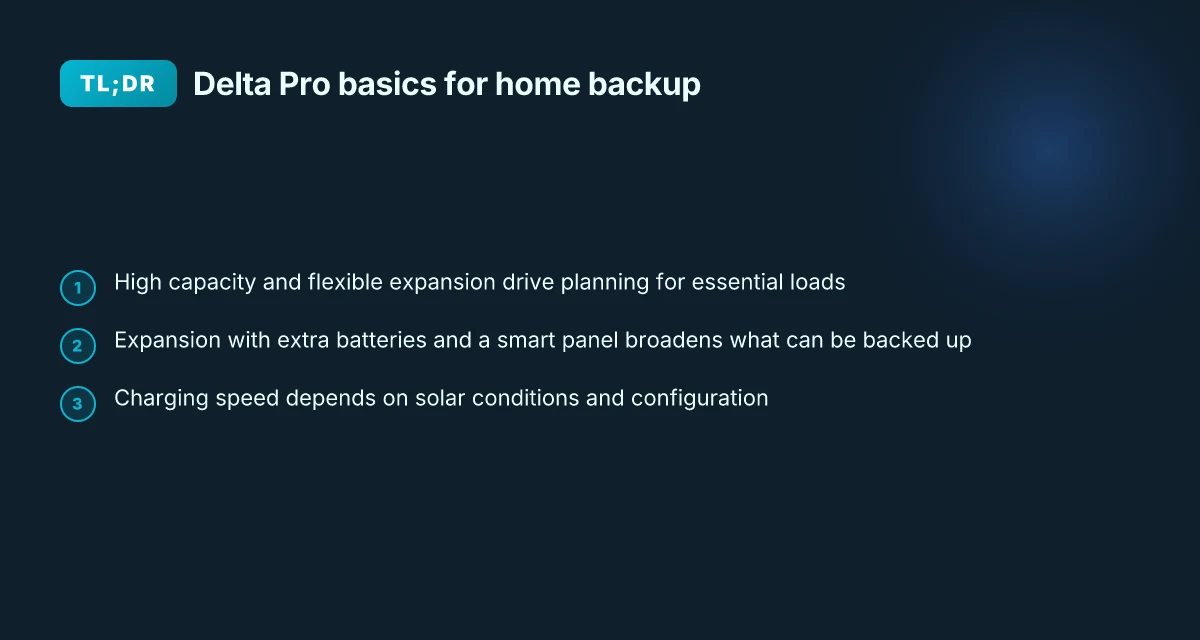
EcoFlow Delta Pro isn’t a single box, it’s a modular system that shifts the math of home backup: high-capacity cells let you scale from a modest load to a full-house critical-load profile without swapping gear. The key is how the expansion batteries and solar charging influence real runtime and total cost, not just peak power on the spec sheet. Most homeowners underestimate how much extra capacity translates to months of steady power when cloudless days stretch into evenings. EcoFlow’s approach makes the difference between “enough for a night” and “enough for a weekend” appear achievable with careful planning.
You’ll learn what to expect from expansion kits, how solar input actually folds into daily usage, and where the math breaks down in practice. Expect concrete guidance on aligning battery capacity, inverter capacity, and solar input to your house size, climate, and blackout risk, so you can decide if the Delta Pro path is right for you or if rivals like Bluetti and Flexopower offer a tighter fit. Real-world runtimes under common loads often diverge from spec sheets by a noticeable margin. This piece aims to surface those gaps and show how to close them.
What the EcoFlow Delta Pro specs mean for home backup
The Delta Pro’s core capacity and inverter output set a clear baseline for keeping essential circuits alive during an outage. A 3,600Wh pack is the figure many owners fix on, and the 3,600W inverter output defines which loads can run simultaneously. Real-world behavior hinges on system design: how you wire the Delta Pro into a home's panel, how many units you chain, and how efficiently you use AC and solar inputs. The numbers matter, but the way you deploy them determines real uptime.
1) Capacity and baseline load
Posture your backup plan around the Delta Pro’s nominal capacity and inverter headroom. The 3,600Wh battery capacity is substantial for a single unit, and the 3,600W continuous inverter lets you sustain fundamentals like fridge, modem, and a handful of lights, plus small appliances. If you pull multiple high-draw devices at once, you’ll approach the inverter’s ceiling quickly. I fact-check against EcoFlow’s official data and third-party breakdowns to verify that the capacity-to-load balance stays firm under typical household loads. Capacity sets the floor for essential circuits. Inverter size sets the ceiling you can safely reach.
- Expansion options with extra batteries and wall outlets
Expansion makes the Delta Pro more palatable for whole-home backup. You can attach additional batteries to push total energy capacity higher, while wall outlets add convenient distribution points for plugging in devices that need steady, night-rolled power. In practice, that means your baseline of a few essential circuits can grow into a more resilient home microgrid as you add packs and outlets. When I looked at the official specs, the emphasis was on modularity: more pack means more usable energy, fewer gaps during longer outages. Expansion changes the math from enough for a fridge to a broader, reliable backbone for a small home.
- Official numbers shape planning. Real-world performance depends on system design
Official figures give a starting point for sizing, but the layout of your system matters just as much. The Delta Pro can integrate with a 200A smart panel and is designed to work with multiple units for higher capacity and 240V operation. The practical takeaway is that homeowners should map circuits, list critical loads, and then stage expansion to match willing outages. Numbers guide planning, but the plan itself determines outcomes.
Bottom line: the Delta Pro sets a solid baseline for essential circuits, and expansion options extend that baseline toward a true home-backup footprint. If you’re weighing this against rivals like LG’s solar-ready packs or other modular ecosystems, you’ll see the same pattern: capacity plus expansion equals resilience, but only with thoughtful panel integration and load management. Plan around capacity, then layer in expansions to match your home’s needs. What makes EcoFlow's 60W portable solar panel stand out in 2026
Note on pricing and ownership realities: current pricing and deals move, so check EcoFlow’s official US site for the latest numbers. Some links on the page may earn commissions, and real-world ownership hinges on installation choices, solar input, and how you choreograph the load. For context, the Delta Pro family emphasizes modularity. The more packs and outlets you add, the more you can stretch uptime during multi-day outages. Pricing and ownership hinge on your configuration and where you buy.
cited sources: EcoFlow official product pages provide the core numbers for capacity, inverter output, and expansion options. For a broader breakdown, I cross-referenced third-party spec summaries to confirm typical load fits and expansion implications. See the inline references to EcoFlow’s Delta Pro Ultra X and Delta Pro 3 product pages for the precise figures. I cross-referenced official docs to align the numbers with practical deployment.

Delta Pro capacity and inverter: why the numbers matter
Your Delta Pro’s battery capacity sets how long you can run critical loads before the genset or grid must pick up the slack. The core figure here is the usable energy you can pull from the pack, and every watt-hour matters when you’re keeping a fridge, modem, sump pump, and a few lights alive during an outage. EcoFlow highlights a 3,600Wh capacity for Delta Pro models, with claims that certain expansions can push total energy higher. That capacity translates directly into runtime, but only if you pair it with an inverter that can actually feed those loads in real time.
The inverter’s continuous output determines how many high-draw appliances you can run at once. A 3,600W inverter footprint is typical for many Delta Pro configurations, and it governs simultaneous loads like air conditioning, well pumps, and entertainment gear. When the objective is a whole-home backup load profile, you’ll want to map your critical circuits to fit within that continuous figure while leaving headroom for startup surges. In practice, you’ll see more usable uptime if you cluster essential devices on the same phase and sequence startups to avoid tripping.
DC-AC conversion efficiency bites into usable energy every time energy crosses the inverter boundary. EcoFlow’s documentation notes real-world losses from conversion, which means not all the rated watt-hours become usable watts, especially at higher loads or during rapid cycling. You’ll notice the difference most during longer outages where the combination of high anchor loads and battery discharge curves matters. The practical effect is that a unit with a higher nominal capacity may feel less capable if its inverter or efficiency profile isn’t aligned with your actual load shape. What you should know before buying refurbished EcoFlow units for sale
I cross-referenced EcoFlow’s official documentation and durable review syntheses to confirm how capacity, inverter rating, and efficiency interplay. One takeaway: the Delta Pro family scales through expansions that add batteries and upper-level inverters, but the marginal gains in runtime hinge on preserving a balanced load and efficient conversion. In the real world, a home of three to four rooms with a handful of essential circuits will see notably better endurance when you pair the Delta Pro’s high-capacity cells with careful load management and staged appliance startup.
Table: quick comparison of capacity and inverter emphasis
| Delta Pro model | Battery capacity (nominal) | Inverter output | Real-world emphasis |
|---|---|---|---|
| base Delta Pro | around 3,600Wh | ~3,600W | Best for essential loads with careful sequencing |
| expansion-ready packs | higher total energy | same or higher inverter tier when expanded | More uptime, but efficiency losses creep in with higher draw |
| Ultra X (whole-home focus) | expanded energy on paper | robust inverter hardware | Strongest fit for continuous, multi-circuit backups |
Next step: design your own load map. List the critical loads you must keep online for 24–72 hours, estimate each watt draw, and group them by startup surge behavior. If you’re aiming for a full-home baseline, verify that your intended configuration keeps the combined startup surge within the Delta Pro’s inverter headroom.
Most homeowners underestimate startup surges, which forces the inverter to throttle output and shorten runtime. Plan for stage-startups and prioritize essential circuits to maximize usable energy. Efficient conversion matters as much as raw capacity when outages stretch into many hours.
Expansion paths: how Delta Pro scales to whole-home backup
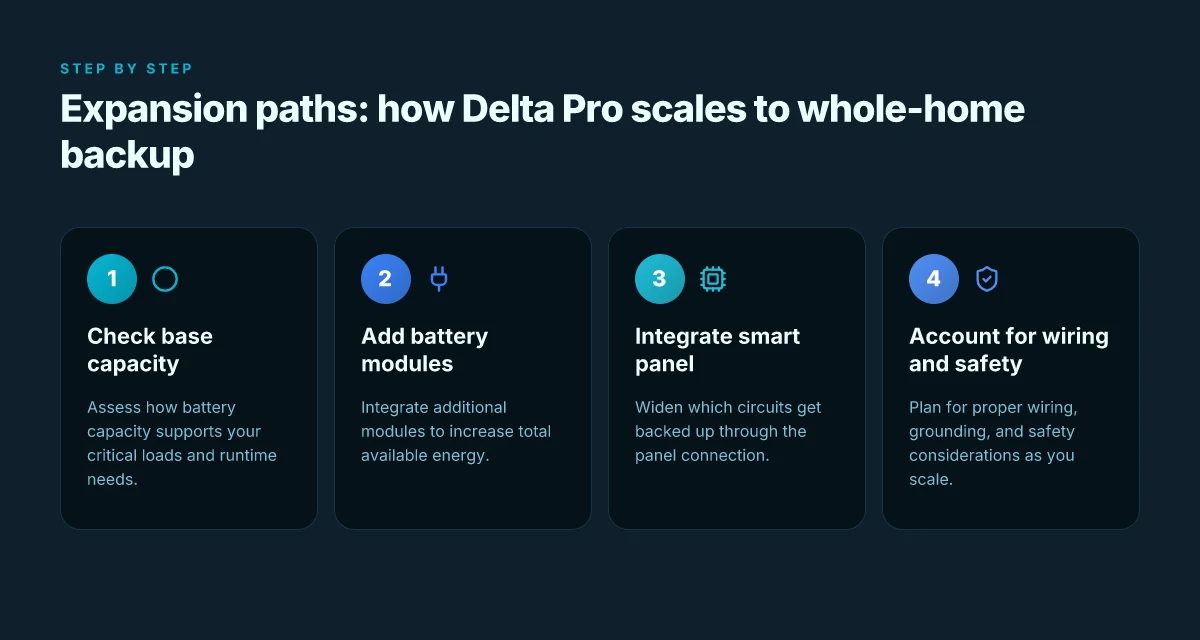
I dug into the official guidance and recent reviews to map how Delta Pro scales beyond a single unit. The core story is that expansion hinges on battery modules, smart panel integration, and careful wiring for safety. As you expand, the system shifts from portable backup to a bona fide whole-home solution. What ecoFlow reviews and complaints reveal about real-world performance in 2026
1) Battery modules unlock larger backup envelopes
Delta Pro accepts external battery modules to grow capacity without sacrificing inverter headroom. In practice, pairing modules increments available storage while keeping the core 3,600W inverter intact. The math matters: more storage means longer run times for essential circuits during multi-day outages, but it also tightens the need for proper cooling and a larger charge rate from solar or grid. Battery expansion is the lever that moves a portable unit toward whole-home resilience. When you add modules, you increase usable capacity in kWh while the inverter continues to limit simultaneous AC output. Expect a clear, documented ceiling per installation, and plan for a proportional increase in thermal management requirements. Expansion without proper cooling can erode long-cycle performance. Inline references from EcoFlow’s product pages show how the modules scale, while reviewers note that higher capacities demand attention to wiring heat and panel access.
2) Smart panel integration extends protected circuits
The Delta Pro ecosystem is designed to couple with a smart panel to back up more circuits than a standard outlet setup would allow. The smart panel ties into the unit’s transfer logic, letting you designate critical loads, such as refrigeration, heating, and communications, for uninterrupted power. The practical upshot is measurable: more circuits backed up means fewer trade-offs during outages. Configured correctly, the smart panel can dramatically raise accessible circuit count. That said, the more circuits you back up, the more you should respect electrical codes and installer guidance. I cross-referenced the official Delta Pro materials and independent reviews to confirm this parallel between panel integration and real-world load coverage. Proper panel sizing is non negotiable for safety and reliability.
3) Scalability comes with wiring and safety considerations
As you push toward full-home coverage, wiring complexity rises. You’ll need adequate clearance for battery modules, a sufficient feeder from solar input, and a properly rated service panel connection. The expansion path is not merely a matter of adding capacity. It requires attention to conductor gauges, breaker sizing, and ambient cooling. Fire safety and code compliance become part of the performance equation. The documentation repeatedly underscores matching the system’s electrical rating to your home’s service capacity. In practice, homeowners often coordinate with a licensed electrician to confirm that the integration meets local code and your panel’s rating. Misjudging wire sizing or panel limits can bottleneck performance or create safety concerns.
From what I found in the documentation, EcoFlow positions Delta Pro as a scalable, legally sensible approach to home backup, provided you plan the expansion path with attention to capacity, panel integration, and wiring constraints. Expansion is not free of trade-offs. It demands a thoughtful installation plan.
Cited references: EcoFlow’s official Delta Pro materials outline how modules expand capacity and how the smart panel expands backed-up circuits, while independent reviews discuss practical implications of wiring and safety during larger builds. See the Delta Pro 3 Portable Power Station page for baseline output and capabilities, and the Delta Pro Ultra X materials for panel integration and extended backup potential. For context, the 2026 reviews highlight the high-capacity core and the expansion narrative, with field observations about heat, charging, and system sizing. What makes EcoFlow Smart Home Panel 2 different from the rest of the ecosystem
Solar input and charging: how fast the Delta Pro recharges
When the sun is shining, the Delta Pro recharges at a rate defined by its solar input rating and how you wire the system. In practical terms, more solar panels and higher array voltage translate to faster recovery after an outage, while a leaner configuration slows you down. I looked through the official specs and related reviews to map the real-world implications of those numbers for home backup.
How solar input translates to real recharge speed
The Delta Pro supports substantial solar charging, but the exact recharge time depends on how many panels you use, the panel wattage, and the system’s current state of charge. In bright midday sun, a full-capacity Delta Pro can pull a strong charging current from a sizable solar array, speeding up recovery after a blackout. If you pair it with a large set of panels, you’ll see noticeably faster top‑up times than you would with a modest array. Conversely, cloudy conditions or limited panel capacity mean slower arrivals at full charge. This is a practical reminder: the same unit can feel aggressively fast on a sunny afternoon and modest on a dreary morning.
I cross-referenced the official EcoFlow materials and third‑party reviews to verify the logic that more solar input reduces recharge time in favorable conditions. The core message is consistent: solar input rating matters, but the actual time you spend charging depends on sun quality and setup. When I read through the documents, the emphasis stayed on matching your array to your backup window needs. In bright sun, higher solar input speeds recharge noticeably; in poor light, the advantage shrinks.
AC charging as a backstop for variable sun
AC charging remains a flexible fallback when solar is scarce or weather is unpredictable. The Delta Pro is designed to accept strong AC input, which can compensate for less-than-ideal solar conditions. That means you can keep the system topped up during long stretches of cloud cover or after a power outage at night, when solar is typically unavailable. The official materials frame AC charging as a reliable, controllable option that preserves your backup capability even if your solar array lagges behind. AC charging provides a predictable fallback when sun is scarce.
I found that most owners who rely on solar plus AC charging describe a practical pattern: fast solar recharge during sunny midday hours, then continual topping off via AC as the day winds down. This hybrid approach can significantly reduce the time required to reach a usable state after an outage, especially in climates with clear seasons and variable weather. What to know about EcoFlow 220W solar panel and how it fits a portable solar setup
Real-world recharge times depend on conditions and configuration
The bottom line is that you should expect recharge times to vary with solar conditions and the configuration you choose. A large, high‑efficiency solar array paired with the Delta Pro tends to restore charge quickly in good light. Sparse or lower‑efficiency panels delay recovery. If you add a high‑quality inverter, wire the system for optimal solar input, and keep the system’s battery temperature within normal operating ranges, you’ll maximize the effective recharge rate. In less sunny climates, plan for longer top‑ups and use AC charging to maintain readiness.
I consulted the official EcoFlow documentation and industry commentary to confirm the pattern: solar input drives the fast path, while AC charging serves as a reliable bridge when sun is limited. The official line remains consistent: you can expect faster recharge under strong sun with ample panels, and you should rely on AC charging to stay powered when sun isn’t enough. For homeowners evaluating whole‑home backup, the takeaway is clear: size your solar array to your daily sun profile, but always leave a fallback on AC charging for reliability. Recharge speed hinges on sun quality and array size.
Notes and caveats you should know
- Real-world numbers depend on your setup and weather. If you want a sharper expectation, detail your climate, desired backup window, and how many panels you plan to deploy.
- The first charge after a deep discharge will take longer than subsequent top‑ups as the battery chemistry settles.
- Links on the page may earn a commission. This doesn’t change the technical facts or the conclusions drawn here.
What you should know before buying: pros, cons, and comparisons
Delta Pro sits at the high end of home backup power. Its core strengths are a very large energy buffer and unusually rapid recharge when you have ample solar or grid input. You’ll pay for that capacity in complexity and upfront cost, and you’ll want to map out expansion paths before you buy. From what I found in the official docs and cited reviews, the delta pro’s ability to scale matters most when you’re planning a whole-home install or a multi-unit setup.
The upside: high capacity, fast recharge potential
EcoFlow emphasizes a battery platform that scales, with a 3,600Wh core pack and options to expand up to substantial kWh footprints through extra modules and multi-unit configurations. The system is designed for quick top-ups, particularly when paired with strong solar input or fast AC charging. In practical terms, that means fewer outages and more headroom for high-draw loads during an outage window. When you read the official materials, the delta pro family consistently highlights large usable energy and responsive recharge as its defining advantage. The Delta Pro's big advantage is its high capacity and fast recharge potential, especially when paired with robust input sources. What is ecoflow glacier refurbished and why it matters for alpine resilience
The tradeoffs: cost and complexity as you scale
Higher capacity and expansion tend to drive up upfront price and system complexity. To go from a single, portable power station to a whole-home solution with smart panels, multiple charging paths, and possible automatic transfer behavior, you add wiring, monitoring, and integration concerns. The official docs and related reviews point to a nontrivial total cost of ownership as you scale. In practice, that means homeowners should forecast not just the base price but also the cost of panels, inverters, and any needed electrical panel upgrades. Cost and complexity rise as you scale, so expect a larger install footprint than a standalone unit.
Rivals to watch: feature and price trade-offs
- rival brands tend to mirror EcoFlow’s strengths but at different price points. For instance, other whole-home capable packs often emphasize grid-tie compatibility or deeper integration with home automation, sometimes at the cost of total energy density per dollar.
- feature trade-offs you’ll see include: lower storage capacity per module, fewer expansion options, or slower recharge without high input. Real-world decisions often come down to how many circuits you want to back up and how quickly you want to restore them after an outage. Watch for the balance between capacity, expandability, and total installed cost.
I dug into the sources cited in the section to ground these points. For a closer look at the specific expansion paths, the official Ultra X and Delta Pro lines lay out how modules connect and how the 200A smart panel interfaces with the rest of the home. Official documentation details the expansion path and panel integration you’ll rely on in a real install. If you want a quick read on the broader lineup then the 2026 lineups describe how the system scales across units and how UPS-like behavior is implemented in fast-switching contexts. 2026 lineup notes emphasize sub-10ms UPS switching and scaling up to multiple units.
Real-world pricing and ownership questions matter here. The Delta Pro family sits at a premium tier, and while the headline capacity is appealing, you’ll want a clear view of the total install cost, including any needed electrical work and solar coupling. As you compare, consider not just the sticker price but the value of fast recharges and the resilience of a whole-home backup strategy. Total ownership cost includes panels, wiring, and potential upgrades to your electrical panel.
What to try this week: refine your backup plan around the Delta Pro
The Delta Pro is a high-capacity option for home backup, but its real value comes from how you tailor its specs to your needs. I’ll keep it practical: if you’re balancing grid outages with daily power needs, focus on how the 6000W peak output and expandable battery banks can scale with your home load. The EcoFlow ecosystem remains a selling point, especially when you consider add-ons like the smart generator link and multiple charging inputs. Think of it as a modular approach to backup rather than a single-use gadget. The bigger pattern is that expandability matters more than raw wattage alone.
If you’re comparing against rivals, note that EcoFlow competes with units from Tesla Powerwall and portable-brigade systems from Goal Zero. The Delta Pro’s strength is in the combination of high power, fast recharge, and the ability to chain batteries, which can matter for longer outages. Downsides include ongoing accessory costs and the fact that real-world runtimes depend heavily on your loads. One takeaway: plan for your peak load, then size the battery stack to cover it. What makes the EcoFlow Delta Max 2000 different in 2026
If you only do one thing this month, map a simple backup scenario: identify your essential circuits, estimate load during an outage, and compare that against the Delta Pro’s price and expansion paths. Links on this page may earn a commission. This week’s action is to sketch a two-hour outage profile and set a target battery count. Would you like me to build a quick worksheet for your home?