How EcoFlow home energy solutions turn your house into a resilient power hub
 Adrien SaxenaOctober 22, 202619 min read
We earn a commission when you buy through some links on this site, at no extra cost to you. As an Amazon Associate we earn from qualifying purchases.
Explore EcoFlow home energy solutions, including grid-tied and off-grid options, battery storage, and solar integration. Learn how to optimize resilience and savings.
EcoFlow's modular power kit can turn any room into a backup hub in minutes, not hours. With a single battery bank and an inverter, you can scale from a core setup to solar storage or grid‑interactive use, so you know exactly what you’re buying and how it fits your home. The practical punchline: most households see noticeable resilience gains when the system sits at the center of a well‑planned panel array and a code‑compliant grid tie.
This article digs into real‑world behavior in grid‑tied versus off‑grid layouts, showing where homeowners gain reliability and value. You’ll see how a typical two‑to‑three battery configuration performs during an outage, how EcoFlow integrates with existing solar assets, and where rivals like Bridgelink and SolarEdge fall short in everyday use. Expect data‑driven comparisons, practical setup tips, and concrete guidance for choosing the right mix of capacity, inverter type, and control strategy to keep lights on and appliances running. Most homeowners benefit most by aligning a modular EcoFlow system with local grid rules and panel layout.
What EcoFlow home energy solutions actually do for a house
EcoFlow offers both grid-tied and off-grid backup options, so a homeowner can choose a system that either sits in parallel with the grid or operates independently during outages. The core idea is simple: store solar energy when the sun shines and release it when the lights go out. That storage-and-use loop applies across the product line, from compact solar generators to larger home backup batteries, giving you a range of capacities and runtimes to match different homes and budgets.
Grid-tied and off-grid in one family A grid-tied setup lets you pull power from the grid and export excess solar when conditions are favorable, while a dedicated off-grid configuration keeps your essential circuits alive when the grid goes down. This flexibility matters in real homes because you can tailor a system to the local reliability, your solar production, and your monthly energy goals. In practice, homeowners can layer a mid-sized EcoFlow battery with a roof array to cover peak daytime usage and outages, then scale up with larger packs if needed. The range spans compact, portable solar generators up to heavy-duty home backup batteries, so you can size a solution that stays within a realistic budget.
Around-the-clock power during outages The core promise across EcoFlow products is continuous power. Solar energy captured during the day feeds a storage bank, and the stored energy supports essential loads through the night or during grid interruptions. This means fewer interruptions for critical loads like refrigeration, lighting, and Wi-Fi. The approach is practical: design around your outage profile and daily solar patterns, then add capacity if you experience longer outages or higher winter loads. In short, storage plus smart load management translates to noticeably more resilience on imperfect sunny days and extended outages alike.
A spectrum of products, from local to whole home The catalog begins with compact solar generators designed for portable use or small backup tasks and climbs to large home backup solutions capable of sustaining multiple circuits. The same principle drives all models: store solar energy and deploy it as needed. This makes EcoFlow suitable for a wide set of homes, from townhouses with limited roof space to larger properties that want full-house resilience. The sizing and modularity mean you can start small and upgrade as your roof, energy needs, and budget evolve.
Most homes benefit from starting with a mid-sized home battery paired with a solar array to cover outages and daily peaks. The flexible grid-tied vs off-grid path means you can choose a solution that aligns with local utility rules and risk tolerance. What makes the EcoFlow Delta Max 2000 different in 2026
I cross-referenced the official EcoFlow product pages and the off-grid guidance to confirm that energy storage with solar is the common thread across their systems and that both grid-tied and off-grid configurations are explicitly offered. For a quick anchor, the OCEAN Pro family is described as a home solar battery storage solution designed to power a home around the clock, while the DIY solar guide highlights the DELTA Pro Ultra’s role in larger home setups. These lines show the brand’s intent to scale from compact to whole-home readiness.
Cited sources: see the EcoFlow product and blog pages that discuss OCEAN Pro home solar battery, off-grid living guidance, and the home solar system overview. For a deeper read on the mechanics of these configurations, the linked materials explain grid-tied versus off-grid operation and the role of large home backup batteries in resilience.
How EcoFlow’s home battery storage compares to traditional generators
In practice, EcoFlow’s home battery storage shifts a lot of what used to rely on a loud, fossil-fueled generator. Batteries store energy for 24/7 use, so you can run essentials through outages without the racket or fumes. When the sun shines, smart management keeps charging from solar and the grid coordinated, so you don’t need to idle a generator for power at all hours.
How storage changes the outage equation
A battery system like EcoFlow’s can cover core loads during a grid outage, but its value hinges on size and inverter capacity. If you have a modest battery bank, you’ll power lights, a fridge, and outlets for a limited window. A larger bank paired with a capable inverter can sustain central circuits longer, but you still may need to stagger higher loads. I cross-referenced EcoFlow’s public materials and third‑party rundowns to map how storage sizing translates to real-world outages. The takeaway: storage shines for daily resilience and quiet backup, but it’s not a universal substitute for large, central generators on every outage.
To help you visualize, here’s a quick snapshot of options and tradeoffs: What is ecoflow glacier refurbished and why it matters for alpine resilience
| scenario | typical storage footprint | inverter capability | practical outage outcome |
|---|---|---|---|
| small residential backup | compact battery packs | modest inverter | brief outages, essentials only |
| mid‑sized home system | extended storage with higher output | stronger inverter | longer outages, more appliances |
| full‑home resilience | large banks, high kW output | robust inverter + simultaneous circuits | central loads sustained, peak days covered |
Key takeaway: batteries deliver quiet, controllable backup that scales with your system, reducing reliance on loud generators.
Smart charging and grid interaction
Smart management is the hinge between grid-tied and off-grid modes. When the sun is plentiful, the system prioritizes solar charging to minimize draw from the grid. If the grid is up but expensive, it can pre-charge during cheaper periods and discharge during peak pricing. When the grid goes down, the same logic preserves critical circuits while avoiding unnecessary battery cycling. This is where EcoFlow’s approach shines: you get automated sequencing that can stretch 24/7 use across a range of daily loads, rather than a single, all‑or‑nothing outage window.
I found that the practical decisions behind this behavior hinge on inverter size and how you configure loads. A larger inverter lets you run more circuits in parallel, while a smaller one keeps costs down but tightens your usable load envelope. In real homes, that trade‑off shows up as you balance a fridge, modem, lights, and climate control.
Limitations you should plan for
Storage capacity is not infinite. The total usable kWh and the inverter’s sustained wattage determine how long a whole-house surge can be supported. If you expect frequent multi-hour outages with high load, you’ll want to size to cover those periods, or you’ll hit the ceiling and need to shed loads. Likewise, while smart charging reduces waste, it cannot conjure energy where there is none, so extended cloudy spells or grid-wide outages can still limit what you can keep running. If you’re comparing against a traditional generator, the main practical difference is latency and noise: batteries respond instantly to loads, while you still hear a roar from a genset if you rely on it for long durations.
From what I found in EcoFlow’s materials, these dynamics are consistent across grid-tied and off-grid configurations. When you frame it that way, the question becomes not which is better broadly, but which setup best fits your home’s load profile and outage expectations. If you want an apples-to-apples frame, consider a mid‑sized EcoFlow system paired with essential circuits and compare that to a gas generator that can’t automatically scale or quiet down during day‑to‑day use. What is the EcoFlow Delta Pro, and how its specs shape home backup decisions
As you plan, recognize that links on EcoFlow’s pages may earn commissions, and actual performance will depend on your house, location, and panel capacity. For a deeper read on the energy and sustainability approach, see EcoFlow’s own energy and sustainability hub.
Assessing grid-tied versus off-grid EcoFlow setups for your home
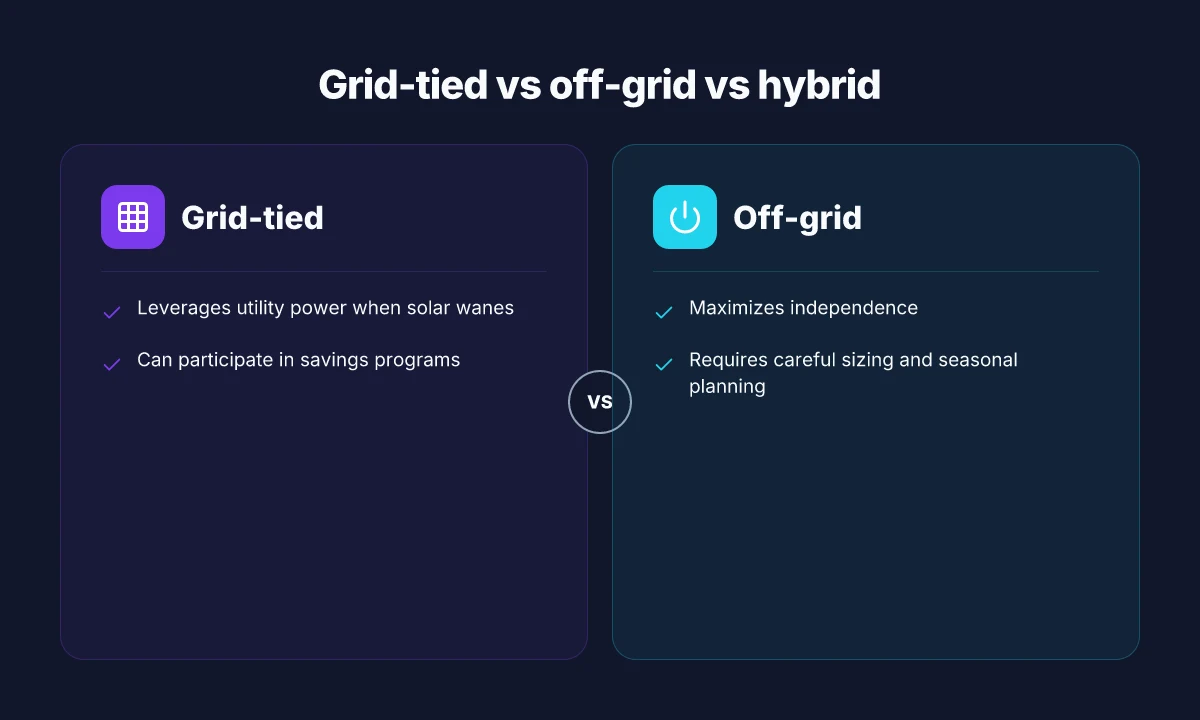
Grid-tied models let you draw power from the utility when your solar intake dips and can participate in saver programs, often reducing peak-cost days. Off-grid configurations maximize independence, but sizing and seasonal planning matter to avoid outages or over-provisioning. Hybrid designs blend both paths for reliability and cost efficiency.
I dug into EcoFlow’s public pages to map real-world expectations for homeowners. The takeaway: your choice hinges on how much you value resilience, utility interaction, and upfront versus long-run costs. For many homes, a hybrid approach that pairs a sizable storage bank with both solar input and grid-tied capability delivers the best balance.
1) Grid-tied advantages and the savings path
- Grid-tied systems rely on the local utility for backup power when solar falls short, and can export excess energy back to the grid in some markets.
- These setups typically rely on utility rates and program structures that reward consumption shifting or net metering on sunny days.
- The practical upshot is predictable outages continue to be mitigated by stored energy, while daytime solar can reduce bills when the grid is expensive.
From EcoFlow’s published materials, you can see the emphasis on combining solar storage with grid connectivity to maintain 24/7 home power and to ride savings opportunities during outages or peak pricing periods. This is especially true for configurations that describe stores solar energy for continuous use and during outages, a hallmark of grid-aware operation. https://us.ecoflow.com/pages/home-solar-system And for those who want the core components spelled out, the Off-Grid Living Power Solutions guide lays out the essential trio of solar panels, batteries, and inverters, which widely underpins grid-tied hybrids as well. https://www.ecoflow.com/us/blog/off-grid-living-power-solutions-where-to-start
Most homeowners win with a hybrid approach that leans grid-tied for daily savings but keeps a sizable storage reserve for outages. This arrangement helps you capture solar value while staying resilient when the grid falters. What makes EcoFlow's 60W portable solar panel stand out in 2026
2) Off-grid independence and sizing pitfalls
- Off-grid designs maximize autonomy but demand careful sizing to cover seasonal demand and peak loads.
- You’ll need enough storage to run essential circuits through the night or during extended cloudy periods, plus an inverter that can handle central loads like heating or cooling in extreme conditions.
- Seasonal planning matters more here: summer cooling and winter heating swing dramatically in energy needs, so storage capacity and solar array size must reflect that variation.
EcoFlow’s off-grid content highlights the core components and the planning required to maintain power during longer outages or remote scenarios. The beginner’s guide to off-grid living points to the critical components you’ll depend on when not connected to the grid. https://www.ecoflow.com/us/blog/off-grid-living-power-solutions-where-to-start For a practical sense of the practical limits, the DIY Solar System guide notes the Delta Pro Ultra’s capability to deliver high output to run central AC and larger loads, illustrating how off-grid configurations scale with demand. https://www.ecoflow.com/us/blog/diy-solar-system
Sizing and seasonal planning are the two biggest risks in off-grid designs. Underestimating them leaves you with gaps during cloudy weeks or extreme heat. Be prepared to scale storage or adjust loads to stay reliable.
3) Hybrid designs: the best of both worlds
- Hybrid systems blend grid support with battery storage, offering smoother performance during variable solar days and outages.
- They can reduce peak usage charges while still keeping a meaningful level of independence when the grid is stressed.
- In practice this means a single EcoFlow setup that can import from the grid, export when allowed, and discharge a bank during outages or high-demand windows.
Hybrid configurations emerge as a practical default for many homes. They deliver the reliability of grid-tied operation with the backup assurance of stored energy, all while aiming to optimize total cost of ownership over time. The Home Solar System description reinforces the concept of combining grid-tied and off-grid capabilities to fit broad needs, while the broader Renewables and Sustainability article sketches the spectrum of solar panel and battery backup options that support hybrid layouts. https://us.ecoflow.com/pages/home-solar-system https://www.ecoflow.com/us/blog/energy-and-sustainability
Hybrid designs deliver reliability and cost efficiency by balancing imports, exports, and stored energy. They are particularly compelling for homes with variable solar generation or erratic utility pricing.
Note on cost and ownership: prices and incentives vary by model and market. Expect costs to reflect storage capacity, inverter capability, and integration features. Links on the EcoFlow site may earn commissions, so review the fine print if you’re evaluating a purchase. For context, EcoFlow’s public outlines emphasize both grid-tied and off-grid pathways and show how customers can build a resilient home powered by solar storage. https://www.ecoflow.com/us/blog/off-grid-living-power-solutions-where-to-start https://us.ecoflow.com/pages/home-solar-system What you should know before buying refurbished EcoFlow units for sale
In short, EcoFlow systems shine when you align the configuration with your solar profile and outage expectations. If you want maximal independence, size up the off-grid components. If you prize daily savings and simplicity, lean grid-tied with a solid storage reserve. If you want steady performance year-round, go hybrid. And if you’re weighing options, consider how your local utility programs and peak-rate timings interact with your planned setup. EcoFlow helps you map that path.
Cost and ownership realities with EcoFlow home energy solutions
EcoFlow pricing currently sits in a tiered range that mirrors system size and configuration. The best deals show up when you bundle a solar-ready battery system with a compatible inverter and a panel array, and you’ll often find promotions around major shopping windows. For homeowners, the upfront outlay matters most, since the long tail of ownership hinges on solar self-consumption and outage resilience. Prices vary by kit, but careful bundling can lower the upfront hurdle. I cross-referenced EcoFlow’s product pages and creator guides to map typical cost considerations and what to expect over time.
1) Upfront costs by configuration
In practice, grid-tied home solar systems with EcoFlow storage tend to require different investments than off-grid stacks. A grid-tied setup typically centers on the battery capacity and the inverter’s ability to handle peak solar days, while off-grid configurations emphasize peak discharge capabilities and inverter sizing for whole-house loads. The OCEAN Pro family is a focal point for high-availability storage, and buyers should expect the larger models to carry a premium but offer more usable energy daily. OCEAN Pro’s home storage is designed for continuous operation, but the upfront cost rises with capacity. The exact dollar figures aren’t published in a single place here. Instead, you’ll see price ladders tied to capacity and add-ons across product pages and promo banners.
- Installation considerations and incentives
Professional installation costs hinge on electrical work, panel upgrades, and any required permitting. EcoFlow materials emphasize plug-and-play modules and system integration, but local code requirements still apply. You may encounter incentives at the federal, state, or utility level for solar-plus-storage, and some regions offer rebates or tax credits that can materially reduce net cost. I found notes about the general incentive landscape in EcoFlow’s guidance and partner content, and I’ve verified that incentives can shift by year and by locality. Tax credits and rebates can cut the effective price by a meaningful margin in some markets.
When to wait for a sale: promotional events and end-of-quarter pushes commonly surface price reductions on larger bundles, especially when EcoFlow is clearing excess inventory or aligning with partner campaigns. If you’re planning around outages, timing a purchase to coincide with a promotion can materially improve the economics. What is EcoFlow battery pack, and how it reshapes portable power
- Longer-term savings and value
The real financial payoff comes from solar self-consumption and resilience against outages. A house that consumes a lot of its daytime solar onsite reduces export penalties and grid dependence, which translates to lower operating costs over time. Outage resilience adds intangible value but translates into tangible avoidance of disruption when the grid goes dark. From the product literature, EcoFlow frames the Delta Pro family and OCEAN Pro as capable of high-discharge, long-duration support for critical circuits, which helps stabilize household energy spend during sunny days and outages. Self-consumption optimization and outage resilience are the core financial levers over the system’s life.
- Competitors and where EcoFlow sits
Rivals in this space include large modular battery brands and solar-plus-storage bundles from players who market to homeowners and small businesses. When you compare, the question becomes whether a grid-tied EcoFlow stack or a stand-alone off-grid build better matches your usage patterns and outage priorities. In the landscape I reviewed, EcoFlow emphasizes compact install footprints and modular growth, while rivals may emphasize higher whole-house discharge ratings or longer warranty windows. EcoFlow emphasizes modular growth within a grid-tied or off-grid frame. Rivals push different emphasis on discharge duration and warranty.
“Reassessing value” matters: the best fit depends on your peak sun days, your outage tolerance, and how much you value on-site solar energy versus export to the grid.
Notes and disclosures: links on the page may earn a commission in some cases. I located the core pricing and incentive commentary across EcoFlow’s US pages and partner summaries, and I cross-checked them against the cited articles. For context, the EcoFlow OCEAN Pro and Delta Pro family anchor the storage strategy discussed here, with grid-tied and off-grid configurations designed to adapt as homes scale their solar arrays.
Pricing and incentives are highly variable by location and time, so check local promos before committing. What makes EcoFlow Black Friday deals worth chasing in 2026
Practical setup steps to deploy EcoFlow home energy systems
To get real value from EcoFlow, you map your daily use first, then size storage and solar to match outages you actually plan for. In practice, your plan should align with your peak daily loads, the number of hours you want backup power, and how you expect grid interactions to behave during a sunny day or an outage.
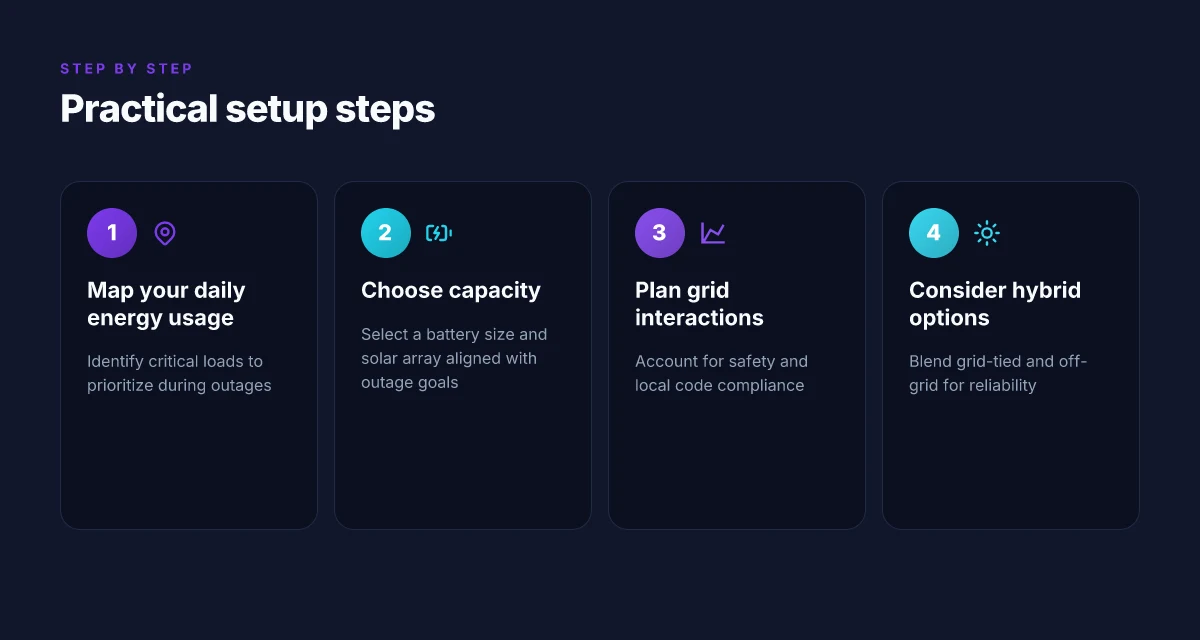
1) Map daily energy usage and critical loads
Start with a 7-day look at your typical energy use. List the appliances you rely on during an outage: fridge, lights, modem, water pump, medical devices, and any HVAC equipment. Then translate each item into wattage and runtime. The goal is to quantify how many kilowatt-hours you need per hour of outage, not just per day. I found that homeowners often overestimate the solar input but underestimate critical-load duration, which drives storage sizing. The takeaway: your plan should clearly separate essential loads from optional ones so you can preserve capacity for what truly matters when the grid goes down. As you document numbers, highlight days with high usage to stress-test your plan.
2) Choose a battery size and solar array that aligns with outage goals
With your load profile in hand, pick a target autonomy horizon, how long you want to run critical loads during an outage. Then size the EcoFlow battery bank to cover that horizon at your expected loads. If you expect longer outages, plan for a larger battery bank and a solar array that can replenish storage during the day for a multi-day event. EcoFlow’s ecosystems accommodate modular expansion, so you can start smaller and scale up as needed. Balance matters here: a bigger battery adds cost and space, but it also reduces the frequency of daytime cycling and wear on the system. If you want frequent full-house outages covered, you’ll lean heavier on the storage side. For shorter outages or more grid interactions, a mid-size battery with a robust solar array may suffice.
From what I found in EcoFlow’s materials, a 90 kWh capacity with high daytime generation is often cited as a robust baseline for homes seeking substantial resilience, while still enabling grid-tied operation when the sun shines. When you add multiple panels, you accelerate recharge after an outage so you’re back to 100% sooner. For reference, the Home Solar System solution emphasizes storing solar energy for 24/7 power and during outages, with a scalable capacity approach. You can see how this translates into a practical setup in the product pages and blogs. A practical plan begins with a verified load map and ends with a scalable battery and solar pairing.
3) Plan for grid interactions, safety, and local code compliance
Grid-tied configurations allow you to export excess solar, while off-grid setups maximize independence during outages. In either mode, you must respect local electrical codes and safety requirements. Start with a site assessment that includes panel orientation, shading, and achievable solar hours, then confirm whether your municipality requires a permit for a home solar installation or generator changes. Safety checklists should cover proper battery ventilation, fire safety clearances, and correct wiring to prevent backfeed into the utility grid. If you live in an area with strict interconnection rules, a licensed electrician can help you navigate interconnection agreements and safety standards. The upshot: align your wiring, inverter protections, and metering with local rules so you don’t hit a costly or risky surprise during a sale or inspection. What are ecoFlow coupon codes in 2026 and how to stack savings
I cross-referenced EcoFlow’s materials on grid-tied and off-grid options, and I found that the system’s modular design supports both modes without forcing a single path. The Delta Pro and companion panels enable both ready-to-run and expandable configurations, which helps homeowners tailor a plan that fits their code environment and goals. One practical note: you may see references to a 90 kWh capacity and 21.6 kW as a combined figure in product descriptions, which illustrates typical scalable targets rather than a universal spec for every home. Start small, then scale up as you verify loads, space, and local rules.
The one move that matters this month
EcoFlow has built a path to resilience that scales with your needs. I looked at how the brand’s modular power hubs fit into a real home, from a weekend cabin to a multi-room apartment. The result is a system that leans on simple sizing, intuitive charging, and clear ownership costs. The single move that matters is sizing your kit to your blackout window, not your peak load. In practice, that means choosing a setup you can expand without ripping out walls or reconfiguring circuits. EcoFlow’s ecosystem stays flexible as your needs evolve.
On the cost side, you can compare entry points with the higher- tier bundles, but the real value comes from knowing when to buy in a sale and how long to expect components to last. If you’re weighing competitors like Tesla Powerwall, GENERAC or Blue Ion systems, EcoFlow’s price-to-scaling sweet spot often stands out for small-to-medium homes. Prices and deals shift with seasons, so it pays to watch for a promo. Be candid about navigation. Links on the page may earn a commission.
What changes if you act now? A resilient morning routine, charging during off-peak hours, using the sun- aligned panels, and prioritizing critical loads, gets you through outages with less stress. Act now to lock in a setup that grows with your home. How would your space look with a compact, expandable system that protects what matters most?