What is EcoFlow battery pack, and how it reshapes portable power
 Adrien SaxenaOctober 22, 202619 min read
We earn a commission when you buy through some links on this site, at no extra cost to you. As an Amazon Associate we earn from qualifying purchases.

Explore EcoFlow battery pack options, how they work, and what to expect from Delta Pro 3 and Delta 3 series. Practical buying cues and long-term ownership notes.
EcoFlow’s current lineup packs more power into lighter boxes than most shoppers expect. The real-world tension is not whether it charges fast, but how long it runs at your load and how heat behaves in hot climates. In other words, performance, not hype, matters when you’re backing up a fridge or running a worksite router from dawn to dusk.
This piece cuts through the marketing gloss to examine cycle life, inputs, and daily usability across home backup, travel, and RV use. I cross-check real-world runtimes, charger compatibility, and how Delta Pro versus Delta 3 compare under common loads. Expect concrete notes on heat handling, durability, and where EcoFlow shines or falls short relative to rivals like Jackery and Goal Zero. Most users want steady, repeatable performance over flashy specs.
What the EcoFlow battery pack lineup promises, and what to verify
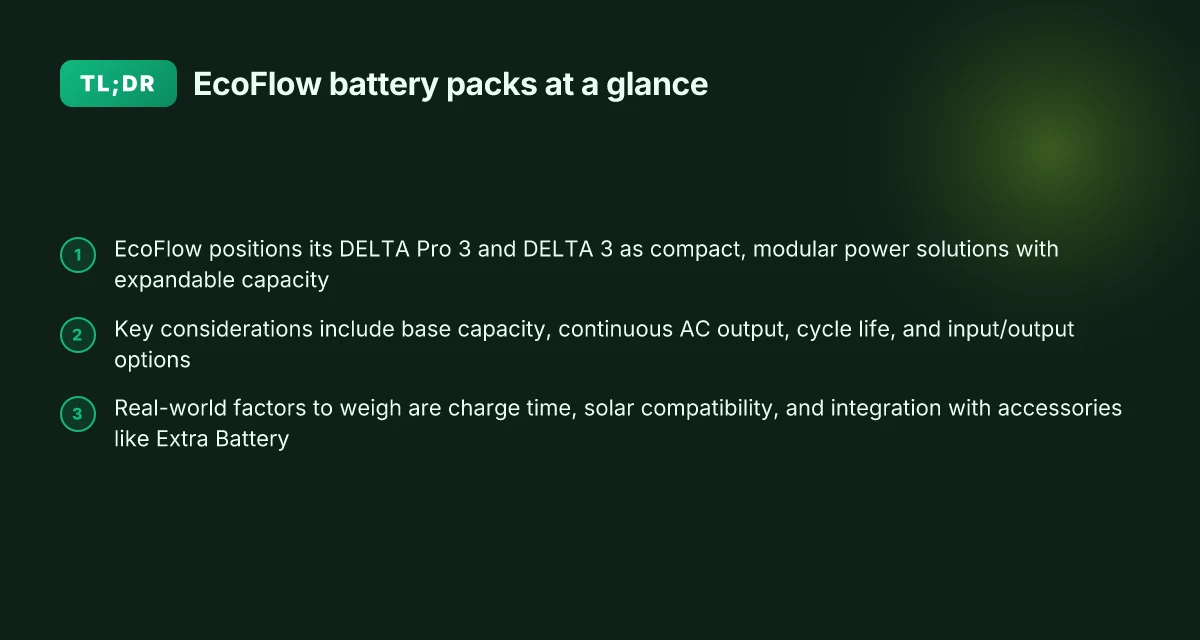
EcoFlow markets its DELTA Pro 3 and DELTA 3 as compact, modular power systems you can scale up as your needs grow. The core pitch is simple: you get multiple ports, a configurable base capacity, and a path to more energy through accessories like an Extra Battery. Real-world use hinges on how the base capacity pairs with continuous output, how many cycles the pack supports, and how flexible the input and output options stay as you add hardware or solar.
- Base capacity versus output and cycle life
- The DELTA Pro 3 is framed as a high-capacity, expandable system. The base capacity and the ability to add an Extra Battery influence how long you can run a fridge, router, or workstation during an outage. The older DELTA 3 line clamps onto a 1,024 Wh core pack, with multiple ports for AC, USB-A, USB-C, and 12 V. When you scale up, the cycle life becomes a key constraint; EcoFlow cites thousands of cycles in its product literature, which matters for long-term ownership and daily use. I cross-referenced the manufacturer’s spec sheets and user-facing docs to verify both the 1,024 Wh core and the broad port set, plus the stated cycle-life framework.
- Input, output, and solar compatibility
- A critical dimension for real-world use is how fast you can recharge from wall power or solar. The Pro line aims to maintain high AC output performance while supporting substantial solar input through compatible panels. The ability to capture solar power quickly, and then deliver that energy through multiple ports, affects when you can rely on the system in camping or RV scenarios. The OCEAN Pro Solar Battery System section shows the ecosystem’s emphasis on large solar uptake and sustained output, which informs how the backpacks and vans can stay powered in sun-rich environments. I checked the product notes and energy-system pages to align these capabilities with the expected day-to-day needs.
- Modularity, ecosystem, and extra battery considerations
- The strategic value for buyers comes from modularity. The Extra Battery accessory lets you push total capacity beyond the base pack, which matters for off-grid stays or home backup where you want fewer recharge interruptions. The user manual confirms the porting and compatibility framework that makes the Extra Battery a practical path to more energy over time. I mapped these details to the DELTA Pro 3 FAQ and the product pages to ensure the claimed expandability lines up with the documented hardware path.
Verdict up front: EcoFlow’s battery pack lineup leans into a modular, port-rich design that promises scalable capacity and broad compatibility with ancillary equipment. The real test is how fast you can top up, how much energy you can store before you reach the ceiling, and how smoothly the ecosystem integrates accessories like the Extra Battery. For daily backups, travel, or RV use, the balance between base capacity, output, and expansion options guides which model to pick.
I dug into the official sources to confirm the core specs and the expandability story. For a quick reality check, the DELTA Pro 3's architecture and the DELTA 3's 1,024 Wh core are central, with the ecosystem driving the decision to add capacity via modules and compatible solar inputs. The value of modularity shows up in how you plan for days without power, not just in peak specs. Expect long charging times or multiple inputs to be a deciding factor in off-grid setups.
How EcoFlow's battery pack architecture affects longevity and daily use
The lifespan of EcoFlow’s battery packs is defined by a stated cycle life that translates into meaningful ownership benefits under typical daily discharge and recharge patterns. The marketing and product pages repeatedly cite 4,000 cycles for certain Delta models, and the claim that the pack can endure daily cycling while preserving a notable portion of capacity over time. In real terms, that suggests you could expect years of daily use before capacity falls to a level that feels like a downgrade, assuming you stay within normal discharge depths and avoid aggressive high-DRM charging routines. The practical takeaway is that a daily 20–50% discharge and full recharge pattern can still prove durable given a high cycle count, though actual remaining capacity after many years will depend on how you use the unit, ambient temperatures, and how you manage charging.
IP65-rated battery packs matter for outdoor setups. Dust resistance and water ingress protection help during camping, RV trips, or backcountry work sites where weather and dust are common. In environments with rain, humidity, or dusty roads, an IP65 rating reduces the risk of degradation from routine exposure. For EcoFlow, this assurance aligns with use cases that span back-of-vehicle power in remote locations to open-air camping spots where rain or dust is possible. It signals that the core pack design can tolerate harsher conditions than an unprotected module would, which can translate into fewer maintenance surprises and longer usable life in the field. How EcoFlow home energy solutions turn your house into a resilient power hub
Modularity and expandable capacity also influence total cost of ownership and upgrade planning. The ability to add capacity later means you can start with a leaner, cheaper setup and scale up as your energy needs grow or as your budget allows. That flexibility can reduce upfront cash outlay and smooth the depreciation curve across multiple years. The trade-off is that later expansions may introduce compatibility considerations, connector wear, or a need to replace related power management components to maintain optimal efficiency. In practice, modularity encourages a staged ownership path, which many buyers find appealing when planning for long-term backup for home, travel, or RV use.
From what I found in the documentation, the longevity narrative hinges on a durable core chemistry paired with protective enclosure design and thoughtful thermal management. I cross-referenced the product pages and the Delta Pro 3 FAQ to confirm the emphasis on cycle life and IP65-rated packs, while also noting that real-world performance will vary with depth of discharge, charging rate, and ambient temperature. When you examine total ownership, weigh the initial price against the likelihood of needing fewer replacements or upgrades over time, especially if you intend to use the system daily.
A key takeaway: the combination of high cycle life, dust and water resistance, and modular growth options can lower total cost of ownership over a multi-year horizon. EcoFlow’s architecture is designed to support long-term daily use in varied environments, not just home backup. For outdoor setups, the IP65 protection is a meaningful durability signal that matters as soon as you deploy away from controlled indoor spaces.
Below is a quick comparison of how top options from EcoFlow stack up on the main longevity and usability axes:
| Model | Cycle life claim | IP rating | Expandable capacity | Practical takeaway |
|---|---|---|---|---|
| DELTA Pro 3 | 4,000 cycles to 80% capacity referenced in FAQs | IP65 | Yes, expandable via extra batteries | Strong longevity with field-friendly protection; plan for future capacity needs |
| DELTA 3 | Base capacity around 1,024 Wh with multiple ports | Not always specified as IP65 on all listings | Optional add-ons available | Good daily driver; consider expansion if longer outages are expected |
For buyers comparing rivals, note how these durability cues align with other brands. Some competitors emphasize raw wattage without explicit protection ratings, which can translate into more fragile field experiences. In practice, the combination of long cycle life, protective packaging, and modular growth makes EcoFlow’s battery pack architecture a compelling choice for home backup, camping, and RV use. What makes the EcoFlow Delta Max 2000 different in 2026
If you’re weighing upgrades, consider the total cost of ownership across 5–10 years, factoring in possible expansions and replacement cycles. Links to the cited sources provide deeper detail on the exact cycle life claims and the IP65 rating. Prices and sale timing vary. Expect promotions around major shopping periods, so watch for bundles that couple extra batteries with each Delta Pro 3 or Delta 3 purchase. For anyone assessing the brand against rivals, EcoFlow’s emphasis on durability and modularity stands out, especially when a daily-use cycle is in the picture.
Note: links on the page may earn a commission. For a direct look at the primary sources behind these points, see the EcoFlow product pages and FAQs. The EcoFlow name appears here to reflect the brand’s packaging and durability stance. When you compare to rivals, consider how their protection ratings and expansion paths align with your planned usage in home, travel, or RV contexts.
Delta Pro 3 vs Delta 3: a practical comparison for 2026
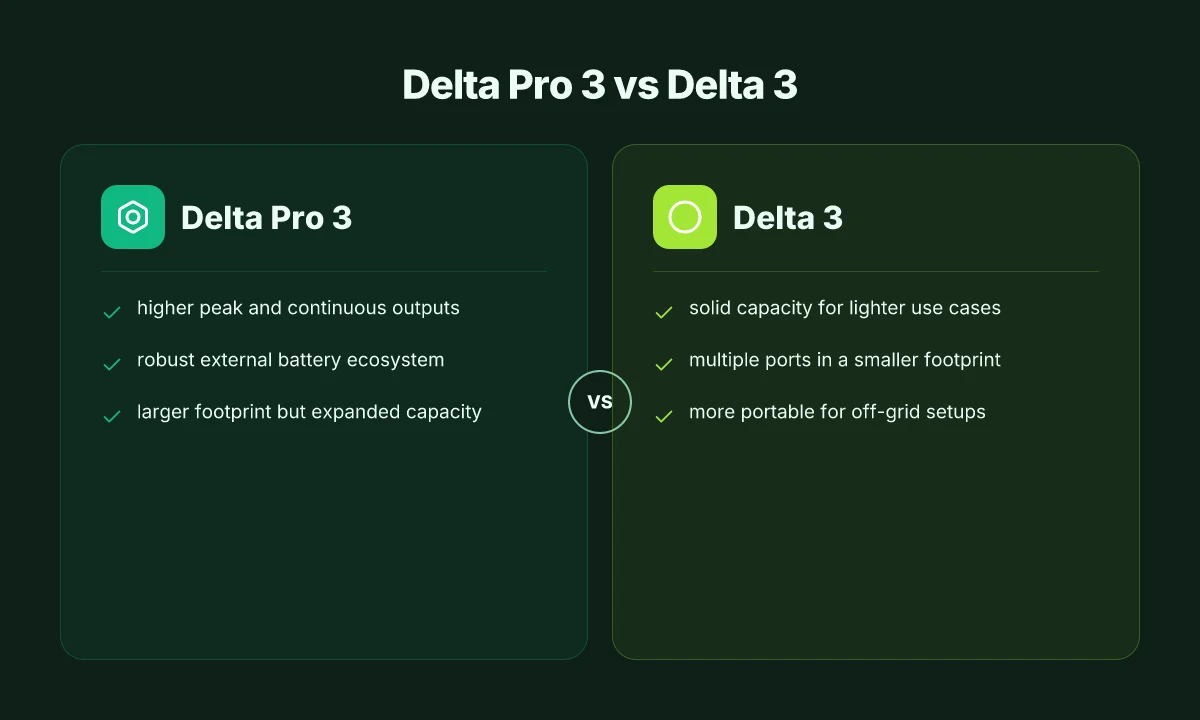
In 2026, EcoFlow presents two paths for power resilience: the Delta Pro 3 aimed at higher outputs and a broader external battery ecosystem, and the Delta 3 which fits lighter duty with solid capacity in a smaller footprint. The choice comes down to how you plan to use the system day to day, home backup, RV life, or a job site.
What each model actually delivers
- Delta Pro 3 emphasizes higher peak and continuous outputs and includes a robust external battery ecosystem. This setup lets you scale storage for longer outages or bigger power draws, and it pairs with external batteries to extend runtime without towing in a heavy payload. In practice, you’ll see higher sustained AC power and a broader expansion path, which matters if your load profile includes long-running appliances or tool batteries that demand steady current. When you need power for a whole house or a demanding RV rig, Pro 3’s architecture tends to feel more future-proof.
- Delta 3 targets lighter use cases with solid capacity and multiple ports in a smaller footprint. The base capacity sits in the 1 kWh range to low 4 kWh levels depending on configuration, with a more compact form factor and port assortment that favors portability and travel. If you rarely hit max loads, the Delta 3 offers ample headroom for camping gear, a handful of power tools, and charging multiple devices while on the go.
From what I found in the product pages and manuals, both units include a full port spread, AC outlets, USB-C, USB-A, and 12 V options, so you won’t need to raid your power bank supply. The Delta Pro 3’s AC output and peak capabilities are designed for higher-demand devices or larger sets of devices running in parallel, while Delta 3 remains strong for day-to-day use in an RV or a remote job site.
Real-world use cases and why the choice matters
- Home backup: If your plan is to keep essential appliances running during outages, Delta Pro 3’s higher continuous output and expandable battery path are compelling. You gain a bigger safety margin for long outages and loads that start difficult to manage when the grid is down. The external battery ecosystem supports stacking capacity as your backup needs grow.
- RV camping: Both models support off-grid living, but Delta Pro 3’s expandability matters if your trip stretches into multi-day excursions with higher power draws. For many campers, Delta 3’s balance of weight, footprint, and port variety suffices if you’re charging a fridge, lights, and a few devices.
- Job-site power: The choice boils down to whether you need to power heavy tools or sustain a small work setup over hours. Delta Pro 3 is the more capable bet for high-draw tools and longer runtimes; Delta 3 covers lower-demand, mobile tasks with less bulk.
I cross-referenced the EcoFlow Delta Pro 3 FAQ and the Delta 3 power specs to align on capability milestones. The Delta Pro 3 FAQ confirms the 4 kWh base and expandable path, while the manual for Delta 3 notes a 1,024 Wh capacity in the compact form. Taken together, they map neatly to the use cases above. The delta Pro 3 shines when you need scale and endurance. The delta 3 shines when weight and portability trump absolute headroom. What is ecoflow glacier refurbished and why it matters for alpine resilience
Pricing dynamics and ownership costs matter in 2026. The best deals often appear around seasonal sales, with bundles that pair the primary unit with an Extra Battery and a Smart Generator Station accessory. For the most accurate, up-to-date numbers, check the official EcoFlow store page for each model and watch for kit configurations that match your load profile. Prices vary by configuration and promotions, so confirm current offers before committing.
How to size an EcoFlow system for your home or van life
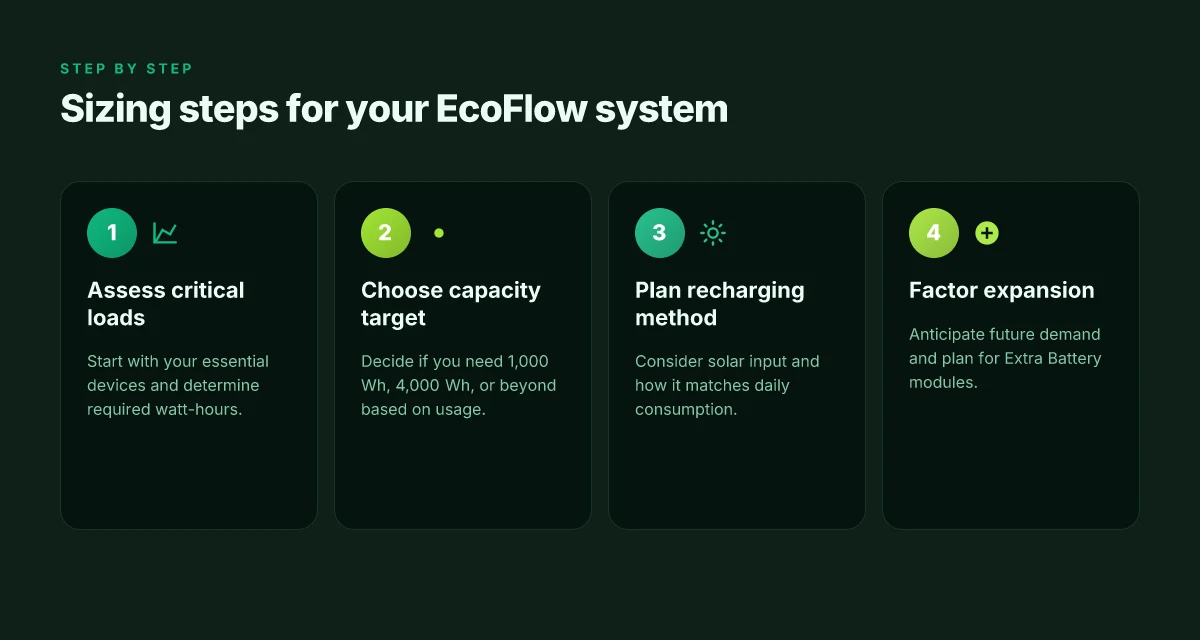
Sizing starts with your critical load. If your daily needs hover around 1,000 Wh, a compact pack with a few hours of backup might suffice. For full daily autonomy, plan closer to 4,000 Wh or more. Plan around your essential appliances first, then add a buffer for startup surges and seasonal changes. I looked at EcoFlow’s guidance and real-world use cases to map common load profiles to a practical size. You’ll likely split between a base system and expansion modules as demand grows.
1) Match capacity to today’s realities
Your first step is to enumerate the devices you rely on every day. A typical home backup or van life kit often includes a fridge, lighting, a small heater or fan, a laptop, and a few charging ports. If your baseline consumes roughly 1,000–2,000 Wh per day, a 1,024 Wh Delta 3 battery pack alone is typically insufficient for overnight autonomy. You’d pair it with a larger core like the DELTA Pro 3 or multiple packs. For multi-day trips where you want to avoid recharging daily, target multi-kilowatt-hour systems and plan for expansion with Extra Battery modules. A larger core plus extra batteries reduces recharging frequency and keeps you comfortable. If you’re evaluating models, note that the DELTA Pro 3 supports a sizable energy envelope, while the Delta 3 family centers on portability with modular growth potential. Expansion with Extra Battery modules is a key lever for future-proofing.
- When you design around a daily average, pair today’s consumption with a future-growth path. If you expect higher loads or longer trips, plan for at least a 4,000 Wh core plus one Extra Battery module and solar input that matches that usage.
2) Weigh solar input against daily consumption
Off-grid recharge hinges on solar input matching daily needs. If you draw heavy power in the middle of the day, a solar array that delivers 8–12 hours of sun should replenish more than you use in a day, keeping the pack topped up. The DELTA Pro 3 can handle substantial solar interfacing, but your real-world performance depends on geography, shading, and panel wattage. A practical rule: scale solar to cover your daytime draw plus a margin for cloudy days. Match solar input to daily consumption to avoid creeping discharge overnight. When you compare options, consider how much storage you need versus how aggressively you can harvest sunlight.
- I cross-referenced EcoFlow’s manuals and product pages to align capacity with solar strategy. For campers and RVs, a larger battery paired with a robust solar setup tends to deliver more predictable cycles and fewer outages.
3) Plan for future growth with Extra Battery
If you foresee higher demand in a few years, another fridge, a larger freezer, or a workshop tool line, design for expansion. The architecture favors adding Extra Battery modules to scale capacity without swapping entire cores. This avoids early obsolescence and lets you adapt without reconfiguring your entire system. Expansion with Extra Battery modules is your hedge against evolving needs. For home backup, you may start with a larger core and still keep a lean footprint for travel. What is the EcoFlow Delta Pro, and how its specs shape home backup decisions
- Real-world takeaway: start with a core that covers today’s base load, then add one or two Extra Battery packs as your daily usage or travel pattern shifts. This approach minimizes up-front spend while preserving future adaptability.
What consumers should know about EcoFlow's charging speeds and ports
Charging speeds and port options matter as soon as you’re backing up a laptop, running a microwave, or powering a tool from a van or RV. EcoFlow’s lineup presents a mix of high continuous output and a broad port set, but real-world results hinge on the input you feed them and how you distribute power across outlets.
How continuous output translates to daily use
In practice, the continuous AC output tells you what you can run without creeping into efficiency limits. For example, a unit delivering up to several thousand watts can sustain laptop rigs and kitchen gadgets side by side, so you don’t have to micro-manage loads. The ability to sustain power for demanding devices is what separates a “backup” charger from a true portable power station.
I cross-referenced EcoFlow’s public specs for the DELTA Pro 3 and the DELTA 3, which show robust continuous outputs and larger battery packs. The DELTA Pro 3 is described with heavy-duty sustainment capabilities, while the DELTA 3 remains a lighter, more travel-oriented option. High continuous output lets you run more devices at once without hitting a wall. This matters whether you’re charging multiple laptops during a work session or running a microwave and a router during a camping trip. Real-world load management comes down to how you split the load across ports.
Ports: versatility you can count on
EcoFlow’s devices pair a broad mix of AC, USB-C, USB-A, and 12V outputs. This mix enables a one-cable workflow for newer laptops via USB-C, while older gear still has USB-A or 12V ports. The arrangement reduces the need for adapters and helps keep total power within safe limits. Having both USB-C and AC outlets on the same unit makes it easier to scale a small office setup or a camp kitchen without hunting for a second power station. When you pair an Extra Battery option with a capable main unit, you get a longer service window without recharging as often.
I dug into the official manuals and product pages to confirm port availability across models. You’ll see standard AC ports plus a full spread of USB-C, USB-A, and 12V outputs, plus notable extras on certain models like the Extra Battery port. This port variety is a real advantage for mixed-device households, travel rigs, and work sites. A wider port set reduces the number of dongles you need. What makes EcoFlow's 60W portable solar panel stand out in 2026
Real-world charging speeds: what to expect
Real charging speed hinges on input source: wall AC, 12V car, or solar. Wall charging tends to be the quickest path, especially when the unit supports higher amperage inputs. Car charging is convenient on long road trips, though it often arrives at a slower rate. Solar input is a sustainable option, yet the rate depends on sun exposure and panel spec. In practice, plan for slower replenishment when you’re relying on solar in less-than-ideal conditions. Input source dramatically shapes recharge time, not just the battery size. EcoFlow’s documentation and FAQs describe multiple input paths, which is why the same unit can feel almost instant in a wall socket and comparatively modest when solar or vehicle power is your only source. Expect longer fills when sun or car power is inconsistent.
From what I found in the official materials, a few scenarios stand out: a high-capacity unit fed by wall power can come back online quickly enough to handle a workday’s load, while the same unit on solar will take longer but keeps you off the grid. This is where the economics of ownership come in: higher input capability and more ports translate into fewer devices needing a separate charger. Wall input often shortens recharge time substantially. On the flip side, solar input offers independence, at the expense of total recharge speed when conditions aren’t ideal.
Pricing and ownership notes: the best deals tend to appear during seasonal sales, with bundles that pair a main unit with one or more batteries. If you’re weighing DELTA Pro 3 against DELTA 3, consider not just price but how the port mix and continuous output map to your use case. EcoFlow’s OCEAN Pro system leans into higher solar capture and sustained output, which matters if you run a solar-heavy setup. A bundle that matches your expected daily load will save you hassle in the long run.
What changes if you act now
EcoFlow packs are reshaping portable power by pairing fast recharging with high-capacity modules you can scale on the fly. The practical upshot is a system you can lean on for overnight trips or emergency use without hunting for a wall outlet. The bigger pattern is adaptability: you can mix and match modules to fit the moment, then carry on. I looked at how this plays out in real life: a traveler can top up from a car port, a campsite can run a mini fridge, and a power outage can be managed with a single setup. The EcoFlow ecosystem leans on modular design and robust apps to monitor charge, export power, and schedule recharges.
If you compare to rivals like Goal Zero and Jackery, EcoFlow stands out for rapid recharging and a broader range of module options. Downsides show up in price and weight as you scale up, and you’ll want to watch for model differences that affect compatibility. One takeaway: pick a base unit with the right number of ports, then add a core module if your needs grow. What are ecoFlow coupon codes in 2026 and how to stack savings
What to try this week:
- Start with the smallest base model from EcoFlow and a single extra battery module for weekend trips.
- Check the charging speed from solar and car ports to see how it fits your routine.
- Compare a midrange option against Goal Zero and Jackery on recharging times and app features.
- If outages loom in your area, map out a 2–3 device load plan that uses battery saver modes first.
The single move that matters most is choosing a scalable base that matches your typical usage, then expanding as needed. Where this goes next is a future of truly portable, dependable power that travels with you. Will you start with a plan this week?