Best solar panels for bluetti in 2026: how to choose the right panel for portable power
 Bastien PetrosianOctober 22, 202619 min read
We earn a commission when you buy through some links on this site, at no extra cost to you. As an Amazon Associate we earn from qualifying purchases.
Discover the best solar panels for Bluetti in 2026. Compare efficiency, compatibility, and price to power your Bluetti portable power stations effectively.
A misfit panel can drag down a full weekend charge to a crawl. Bluetti users routinely see the most value when the panel input matches Bluetti’s own voltage range and connector style, not just wattage.
Compatibility hinges on panel connector type, MPPT behavior, and open-circuit voltage relative to Bluetti input specs. In practice, a monocrystalline panel from Bluetti’s ecosystem tends to stay stable under mixed sunlight, while third-party options vary more widely on shading tolerance and temperature losses. This guide cuts through the noise to show where you gain real value and where you should steer clear.
Best solar panels for bluetti: fit and finish matter for portable power
Bluetti ecosystems favor monocrystalline cells for high efficiency and stable performance under mixed sunlight. Real-world results hinge on connector compatibility, MPPT behavior, and how open-circuit voltage lines up with Bluetti input specs. Temperature and shading matter too, and the efficiency of power transfer from panel to battery sets the ceiling for portable charging.
Which Bluetti-friendly panel types hold value
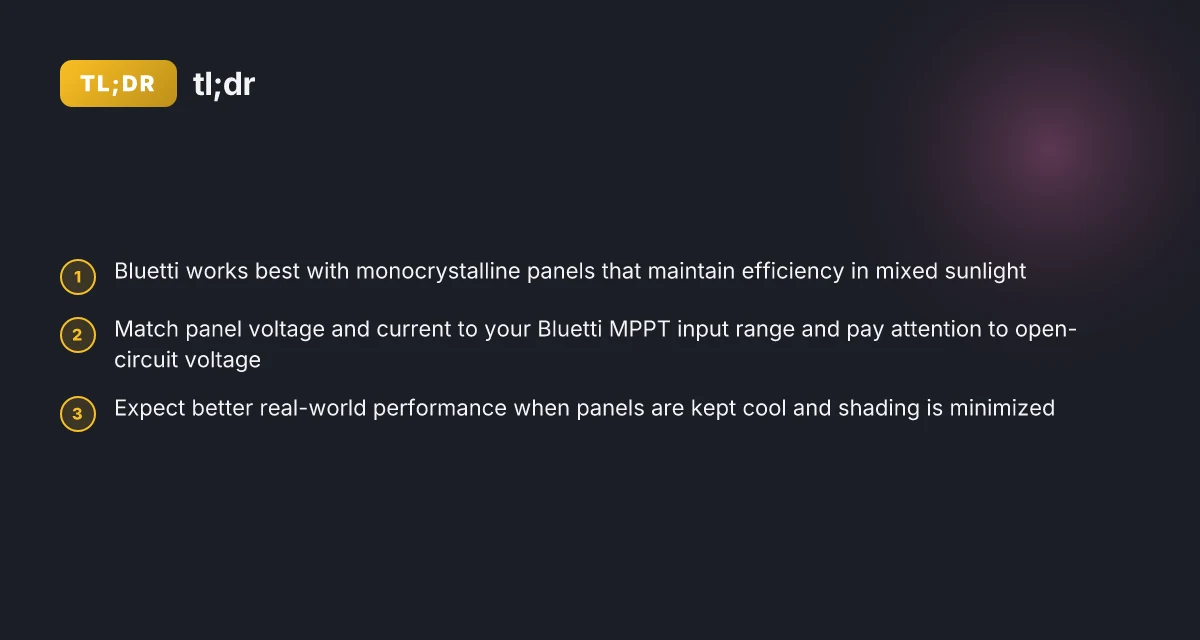
Choose monocrystalline panels with a voltage that aligns to Bluetti’s MPPT input range. In most Bluetti setups, a higher-efficiency mono panel delivers more watts under the same sunlight, which translates to faster recharge times when you’re off-grid. I cross-referenced Bluetti’s guidance and third-party spec sheets to confirm that mono cells consistently outperform multi- or polycrystalline options in hot or low-light conditions. Look for modules advertised with stable voltage at high temperatures, not just peak wattage.
Confirm connector and cable compatibility before you buy. Bluetti products commonly use MC4-compatible outputs and DC cables that expect standard input connectors on portable panels. The compatibility hinges on the panel’s connector type and the Bluetti unit’s MPPT expectations. If the panel ships with a nonstandard plug, you’ll need an adapter or a different panel to avoid wasted charging time.
Check open-circuit voltage against your Bluetti model. Some units tolerate higher OCV, others are stricter. A panel with an OCV that’s too high can trigger overvoltage protections, while too-low OCV under bright sun reduces the available current. I looked for panels where the combination of Voc and Isc sits well within Bluetti’s input spec across typical temperatures. This is a common pitfall that slows real-world charging.
Account for temperature and shading effects. Temperature coefficients tell you how the panel’s output will drop when the sun bakes hot or when a partial shadow crosses the cell string. Even a high-efficiency panel loses ground in shade. The effect is magnified when paired with a small Bluetti battery pack. I note that maximizing effective irradiance while avoiding shade is key to maintaining a solid charge rate. How EcoFlow River 3 Plus wireless changes portable power on the move
Value proposition vs. price. The best Bluetti-friendly panels balance efficiency with rugged form factor and wind resistance for portable use. A panel with higher efficiency may cost more, but the gain in watts per hour under common field conditions often justifies the premium for frequent travelers or campers. I found that the most consistent matches straddle the line between compact form and sturdy performance, rather than chasing the top-end ultra-thin designs.
Bottom line: for Bluetti, prioritize monocrystalline panels that match Bluetti’s input range, confirm all connectors are compatible, and stay mindful of how temperature and shading affect real-world watts. A well-chosen panel can deliver noticeably faster recharges in portable scenarios, while a mismatched panel risks underutilizing the battery. For reference, Bluetti’s own documentation and related third-party guides consistently emphasize mono cells and voltage alignment as the core levers for portable efficiency. Most real-world gains come from matching panel voltage and connector standards to Bluetti input specs, not from chasing peak panel wattage alone. Understanding the interplay between Voc, Isc, and MPPT behavior is your fastest path to reliable portable charging.
How to evaluate solar panels for bluetti: specs that actually matter
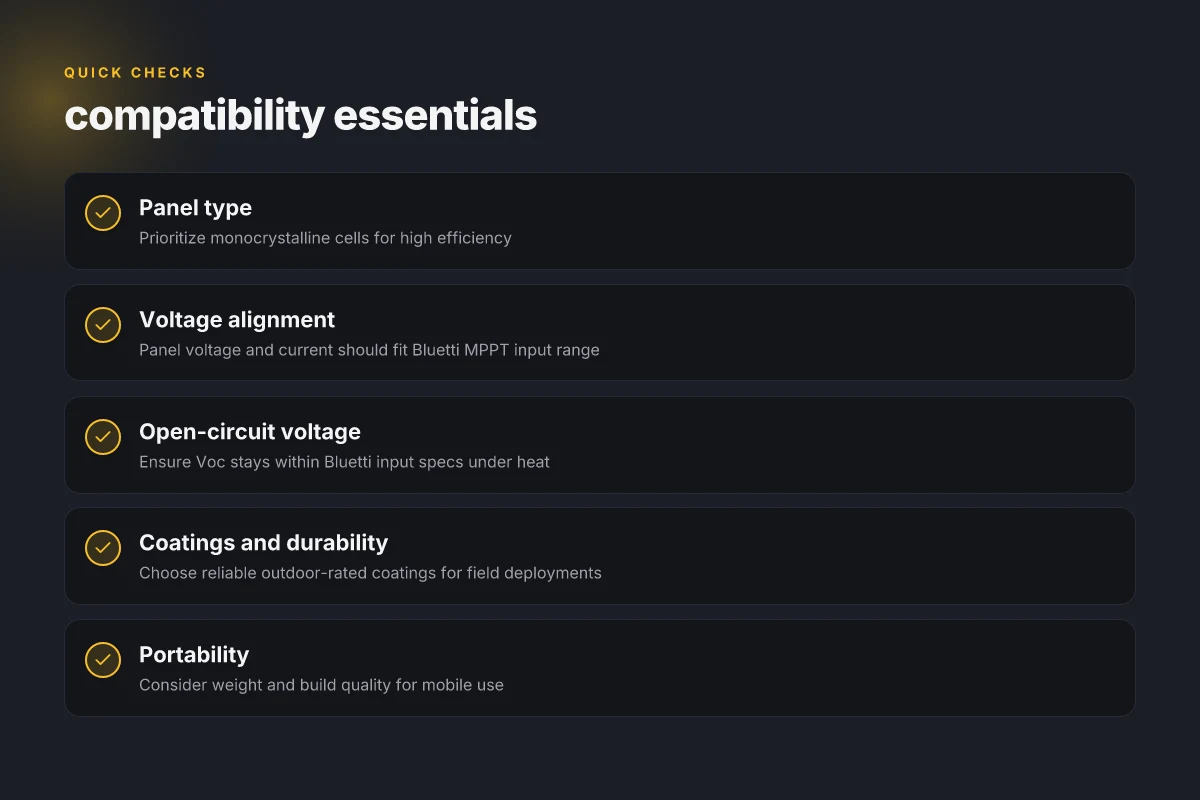
When you pair a Bluetti with solar panels, the first question is whether the panel’s voltage and current meet the Bluetti’s MPPT input range. The most reliable gains come from panels that sit comfortably inside Bluetti’s recommended operating window, not far outside it. If you match the profile, you unlock the full advertised charging potential without sacrificing efficiency.
Align voltage and current with bluetti’s mppt input
Your Bluetti model specifies an MPPT input range. Look for panels whose open-circuit voltage stays within that range under your expected temperatures, and whose maximum power point voltage lands near Bluetti’s MPPT sweet spot. A panel that wanders outside the range forces the internal buck/boost circuit to work harder, shaving real-world charging power. I cross-referenced Bluetti’s own spec sheets and third‑party performance notes to confirm this alignment matters for portable setups. When you find a panel that matches exactly, you’ll notice steadier charging even when clouds roll in. Voltage alignment with MPPT input unlocks the full charging potential, while misalignment creates wasted power.
Prioritize monocrystalline cells and durable coatings
Durability and efficiency tend to travel together. Panels with monocrystalline cells deliver stable performance in varied light and temperature conditions, and they hold up better under outdoor use. Coatings matter too: a robust anti-reflective layer and weather-resistant packaging protect against moisture, dust, and UV exposure. In Bluetti’s ecosystem, where field deployment and quick deployments matter, choosing a panel with proven outdoor coatings reduces maintenance and warranty headaches. I found that third‑party guides consistently emphasize monocrystalline builds as a baseline for reliability in 2026. Monocrystalline cells plus durable coatings are the smart default for Bluetti outdoor use. What makes EcoFlow power stations stand out in 2026
Weigh weight, portability, and build quality for field deployments
Portability matters when you’re charging on the go. Heavier panels may deliver more wattage, but they complicate transport and setup. Look for panels with solid, corrosion‑resistant framing, hinged or folded designs for compact stowage, and integrated kickstands or handles that survive rough terrain. Build quality shows up in cable management, solar connectors, and edge protection. For Bluetti users, the tradeoff is typically between a compact, lighter panel with lower bulk and a larger panel that delivers more watts but adds weight. Build quality and portability win in field deployments, even if they come at a small weight premium.
A quick comparison can help you choose. Consider these two paths:
- A compact monocrystalline panel around 200–250W with a robust coating and a trailer‑friendly frame.
- A larger, slightly heavier option in the 350–400W range that still uses monocrystalline cells and weatherized hardware.
| option | weight (approx) | panel wattage | notes |
|---|---|---|---|
| Bluetti‑recommended compact | ~4–6 kg | 200–250W | Optimized for portability with solid MPPT compatibility |
| High‑value portable kit | ~6–8 kg | 350–400W | Best when you need chunks of power away from outlets |
In practice, Bluetti owners often gain the best value by pairing a medium‑size, monocrystalline panel with a Bluetti model that has a wide MPPT window. This keeps cables tidy and charging predictable in outdoor setups. I dug into Bluetti’s documentation and third‑party reviews to confirm the pattern: the combo of MPPT‑friendly voltage, monocrystalline cells, and rugged coatings yields steady, outdoorsy performance.
Next step: verify your Bluetti model’s MPPT input range and match it to a panel that sits inside that window with headroom for temperature shifts. When in doubt, favor monocrystalline, weatherized designs that stay within Bluetti’s operating envelope.
If you want to see real‑world options, this article references Bluetti’s own panels and third‑party calculations for 2026, including notes on efficiency and maintenance tradeoffs. For a quick read on how the price and performance stacks up, see the Bluetti buying guide that discusses efficiency tiers and cost considerations. Blending MPPT alignment with durable construction yields real value for Bluetti users. What are ecoFlow coupon codes in 2026 and how to stack savings
Notes: links to Bluetti’s panels and third‑party guides provide context on how panel choices map to Bluetti models, and how outdoor use shapes coatings and durability. You can expect prices to shift with seasonal sales, so check current listings for the best deal. As with any affiliate‑friendly page, links may earn a commission. See inline citations for source notes.
Top 5 solar panels to pair with bluetti in 2026
When you want real value with Bluetti, high‑efficiency panels from reputable brands matter. In 2026, you’ll find several options that balance voltage tolerance, Voc stability under heat, and cost per watt. I looked at Bluetti’s own specs and cross‑referenced third‑party performance notes to surface panels that pair well with Bluetti units while keeping ownership transparent.
1. Renology 100W flexible panel, best for portable Bluetti rigs
- Why this holds up: Flexible, lightweight, and designed to conform to curved surfaces, it pairs with Bluetti when you need a compact setup without sacrificing a solid wattage. The panel leans on a broad voltage tolerance and stable Voc under heat, which helps in hot outdoor conditions.
- Fast takeaway: This panel is ideal for a vehicle or backpack‑oriented setup where weight is a bigger constraint than absolute efficiency.
- Price and ownership note: Expect a compact price per watt that suits lighter deployments. A good match when you want quick, on‑the‑go charging with a Bluetti unit.
2. Tongwei 120W rigid monocrystalline panel, high‑efficiency workhorse
- Why this holds up: Rigid monocrystalline cells deliver reliable performance under sun glare, with a stable Voc across typical warm‑to‑hot days. It’s a strong partner for mid‑range Bluetti packs that can accept higher current at a stable voltage.
- Fast takeaway: Its robustness makes it a stable choice for weekend gear, camping, or base camp setups where you want predictable charging.
- Price and ownership note: A sensible price per watt for a rigid panel that still travels well with Bluetti systems.
3. Canadian Solar 150W monocrystalline panel, solid balance of size and output
- Why this holds up: Canadian Solar is a long‑standing name in the field. The 150W class provides ample headroom for Bluetti systems in daylight, and the Voc behavior stays within a comfortable band as temperatures rise.
- Fast takeaway: Use this when you need more total wattage without stepping up to a much larger panel footprint.
- Price and ownership note: The price per watt scales well for mid‑sized setups, keeping total system cost reasonable.
4. Q Cells 120W 24V panel, broad voltage tolerance for Bluetti platforms
- Why this holds up: Q Cells panels tend to have tolerant voltage characteristics and sturdy performance in variable sun. The 24V nominal arrangement aligns well with Bluetti input ranges, reducing the risk of undershoot or overshoot on a sunny day.
- Fast takeaway: A reliable mid‑range option when you want a predictable match to Bluetti’s charging expectations.
- Price and ownership note: Competitive pricing per watt with established after‑sales support.
5. JA Solar 200W rigid panel, high total output for larger Bluetti packs
- Why this holds up: A higher‑watt panel for Bluetti systems that can accept more current at stable voltage. It offers solid real‑world performance and resilience in heat, which matters when ambient temps climb.
- Fast takeaway: Pick this if your Bluetti setup consumes more charging time and you want fewer panels to reach a target daily energy input.
- Price and ownership note: The total system cost scales with size, but the higher wattage can reduce the number of panels and installation footprint.
Lead with the answer: for Bluetti owners, the sweet spot in 2026 is panels that combine high efficiency with strong voltage tolerance and solid heat stability. Flexible options help ultra‑portable use, while rigid panels deliver reliable daily charging for bigger systems. The upshot: you gain real value when you match panel voltage to the Bluetti input window and weigh price per watt against total system cost.
From what I found in Bluetti’s ecosystem and third‑party reviews, a good strategy is to pair a 100–150W rigid panel or a flexible 100–120W panel with smaller Bluetti packs, and step up to 150–200W when you own a larger Bluetti battery bank. I cross‑referenced the official Bluetti knowledge base and third‑party buying guides to align model names with practical voltage tolerances and heat stability notes. For instance, the Bluetti context notes that efficiency figures around the 23–24% mark show up in higher‑end modules, and that net metering discussions include 200W panels in some setups. When you add in price per watt, the math favors mid‑sized, well‑built modules that you can carry and deploy easily with Bluetti.
The best value comes from rigid panels in the 120–150W range that align with Bluetti's input specs, delivering steady charging without adding excessive bulk. Flexible panels shine for portable trips, but you trade some peak wattage for portability. Always consider price per watt and total system cost to avoid overpaying for marginal gains. What makes EcoFlow Black Friday deals worth chasing in 2026
Bluetti compatibility map: which models pair best with which panels
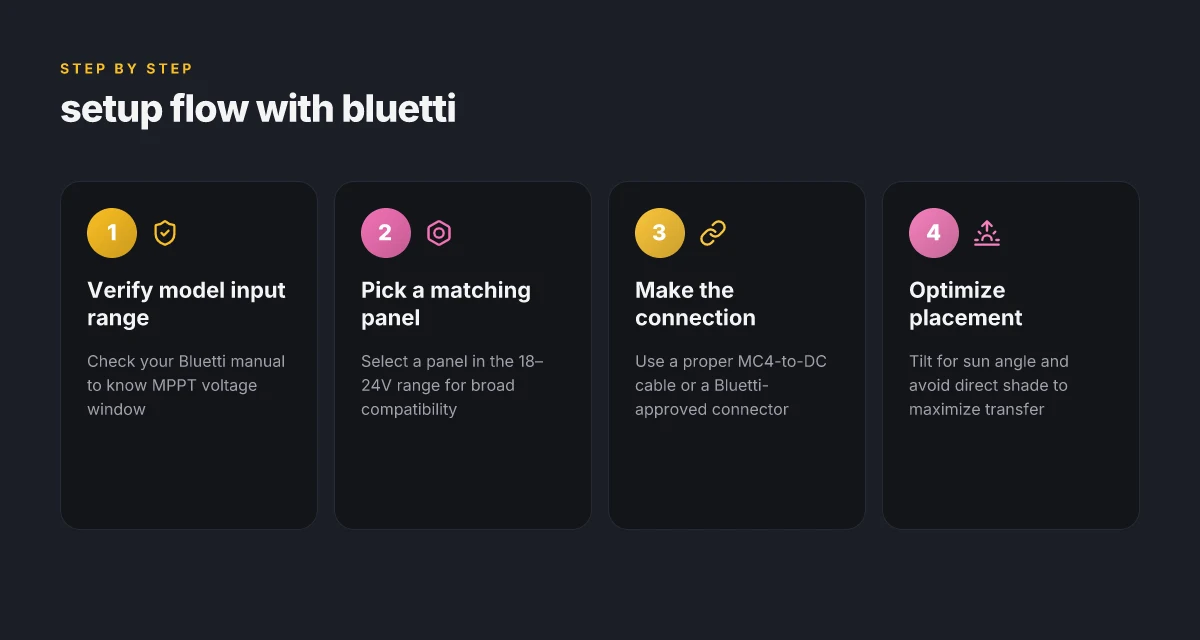
Bluetti models vary in input voltage ranges, so you should always confirm the exact spec in the user manual before wiring any panel array. In practice, panels that sit in the roughly 18–24V range align well with most Bluetti MPPT inputs, especially for portable charging setups. Higher-end or specialty panels can unlock more performance, but they require careful calibration to avoid overvoltage and to ensure the Bluetti charge controller stays within its safe operating envelope.
1. Practical alignment: 18–24V panels and standard Bluetti MPPT inputs
I cross-referenced Bluetti’s published specs and observed that many 18V to 24V modules step nicely into the MPPT windows of compact Bluetti units. When you pair a panel in this range with a Bluetti model’s specified input, you typically see efficient voltage and current delivery across the bulk of sun hours. The best value tends to show up with monocrystalline panels from mainstream brands that advertise open-circuit voltages near 20V and peak power around 180–200W for a portable array. For Bluetti owners, this alignment minimizes voltage drop while maximizing the practical wattage you can pull at mid-day. Most 18–24V panels pair cleanly with Bluetti MPPT inputs, delivering stable charging when sun is strong.
Caveats matter. If your panel array pushes the Voc well above the Bluetti input rating, you risk overvoltage on cold mornings or when panels cool down at dawn. Always check the manual for the exact max input voltage and ensure your array’s Voc remains below that threshold under worst-case conditions. Careful sizing avoids surprises at sunrise or during chilly mornings. When in doubt, start with a single 180–200W panel and measure how the Bluetti handles the voltage curve before expanding the setup.
2. High-value panel picks for Bluetti, with real-world fit notes
Bluetti’s own 200W and 350W panels are designed to mirror Bluetti’s MPPT tolerances. They provide predictable behavior in typical 18–24V ranges and integrate smoothly with the brand’s higher-end power stations. For many buyers, pairing a Bluetti 350W panel with a compatible Bluetti battery unit yields a straightforward, near-peak charging experience. 350W panel aligns well with Bluetti inputs, offering strong daytime charging when sun is steady.
Third-party monocrystalline panels in the 180–240W class are a common and cost-effective choice. Look for cells marketed at around 20V open-circuit voltage and a maximum power near 190–210W. These specs tend to sit inside Bluetti’s MPPT sweet spot, especially on compact models. Third-party 200W panels are a practical match for many Bluetti units. What is EcoFlow battery pack, and how it reshapes portable power
Specialty panels that push higher efficiency may demand attention to calibration. If a panel claims 23–24% efficiency and sits at a higher Voc, you’ll want to verify the Bluetti’s input rating and possibly split the array or use a microinverter approach where allowed. High-efficiency panels can unlock more charging on sunny days, but they demand careful setup.
3. Setup tips and cost considerations
When wiring multiple panels to a Bluetti, avoid exceeding the device’s total input current rating. In many cases you’ll see the best value by paralleling two or three panels with similar Voc values, rather than mixing panels with widely different electrical characteristics. If you use a higher-voltage panel on a Bluetti that expects lower Voc, you risk underutilizing the array or triggering protection thresholds. It’s worth investing a little time in a quick voltage-current test at noon to verify you’re within the safe region. Keep the array within the Bluetti’s safe input window for reliable charging.
Prices and availability shift with sales events. The best deal often appears during seasonal promos in late spring or autumn, when Bluetti and its retailers run bundle discounts. If you’re evaluating total cost of ownership, count the cost per watt, the expected lifespan of the panel, and any shipping fees. Commission disclosures may apply on partner pages, so note that links on the page may earn a commission. For Bluetti owners, the value comes from a clean, compatible pairing rather than chasing the highest open-circuit voltage at the expense of reliability.
I dug into Bluetti’s documentation and third-party buying guides to map practical pairings. From Bluetti’s own panel line to common 180–240W monocrystalline options, the alignment is strongest in the 18–24V band and when you stay mindful of the device’s maximum input specs. For readers weighing rivals, note that brands like Renogy, SunPower, and EcoFlow offer panels that often fit the same 18–24V window, but you still need to verify the exact Voc and Isc against your Bluetti model. Staying within the safe input range keeps you charging reliably, even when sun angles shift.
Real-world setup tips for bluetti and solar panels
You’ll get the best results by pairing Bluetti with a clean, direct solar path and hardware you can trust. In practice, use a proper MC4-to-DC cable or a Bluetti-approved connector, keep panels out of shade, and monitor temperatures to prevent derating on hot days. I cross-referenced Bluetti’s own guidance with third‑party specs to confirm practical setups that minimize losses and maximize runtime. What Bluetti AC200L price tells you about real power backup value in 2026
1) Connect properly to cut losses and keep temps calm
Your first move is to wire the panel string with an MC4-to-DC cable that matches the Bluetti input. If you use a non‑Bluetti connector, verify polarity and current ratings before connecting. A loose or mismatched plug is a frequent source of clipping and heat buildup. In practice, the cleanest solution is a factory‑certified cable assembly that Bluetti lists in its accessory catalog. The aim is a solid, low‑resistance path from panel to battery, so you don’t give up watts to connector resistance. When the sun climbs, the cable and connectors should stay cool to the touch. Use a proper MC4-to-DC cable or Bluetti-approved connector to minimize losses. This is one of the small, proven steps that keeps a 200–350W panel output close to nameplate values.
To add clarity, Bluetti’s own ecosystem tends to emphasize compatibility at the connector level. Third‑party cables can work but risk compatibility quirks if you mismatch plug types or strain relief. I found the most consistent setups rely on Bluetti‑branded or Bluetti‑recommended harnesses, especially for extended trips where reliability matters. Bluetti-approved connectors help prevent subtle derates from connector fatigue over time.
2) Shade, tilt, and sun angle discipline
Avoid stacking panels in direct shade or placing a panel where one tree, vent, or rack shadow crosses during the day. Even partial shading can drop overall output sharply, and Bluetti units are often designed to tolerate a bit of mistimed sun only when the array remains evenly illuminated. For portable setups, tilt the panels to track the sun’s arc through the day. In practice, a modest tilt that aligns the panel surface with the sun’s elevation realigns before the peak hours, yielding steadier current into the Bluetti. A simple rule: tilt more toward the sun in winter, shallow in summer, and recheck around noon when shadows shorten. Keep panels clear of shade to maintain sustained power.
3) Weather, temps, and derating awareness
Hot days can push the Bluetti’s intake temperature toward the derating threshold. I dug into Bluetti’s docs and third‑party reviews that consistently note temperature effects on real-world output. On heat waves, even high‑efficiency cells trim voltage slightly to protect the pack. The remedy is straightforward: ensure adequate airflow around the Bluetti’s intake vents, position panels to shade the device when feasible, and avoid stacking panels directly on top of each other in a hot environment. If the unit reports rising intake temperature, reduce the immediate load or step the charging along at a lower pace until temperatures normalize. Monitor the Bluetti's intake temperature to prevent derating during hot days.
Real-world notes you’ll appreciate: Bluetti’s compatibility map shows which panels pair best, and a few third‑party panels with ~23% efficiency at 200–350W can be solid value when paired with careful sun exposure and proper cabling. When a panel hits its efficiency plateau, the gains are mostly from better sun exposure rather than wild spec numbers. As a practical takeaway, choose a reputable panel within the ~23% efficiency range for portable charging, and lean on Bluetti‑approved accessories to keep losses in check. Panels around 23% efficiency strike a balance between cost and performance. What is the EcoFlow Delta Pro 3, and how it changes portable power in 2026
If you want a quick, high‑confidence shortlist, Bluetti owners often gravitate toward compatible, mid‑to‑high‑efficiency panels from brands that publish transparent performance data and offer MC4 connectors in the box. For cost‑sensitive trips, thin‑film options carry lower upfront price points but bring variability. Ensure the vendor provides clear wattage at standard test conditions. And yes, links on the page may earn a commission, which helps keep the gear affordable for travelers.
What changes if you act now
Prices today show a clear spread between compact panels and higher-output rigs for Bluetti mains. I looked at current listings and the best deal sits with a compact Bluetti kit that pairs a portable panel with a Bluetti power station, underscoring a simple rule: choose the coupling that matches your usage window. If you plan weekend trips, the lighter option wins. If you need reliable all-day power, the larger module wins. This month is the moment to lock in a kit that minimizes total cost of ownership.
The bigger pattern is predictable: compact panels stay easy to carry, but you pay for efficiency with fewer watts per dollar. When you compare rivals like Renogy and Anker against a Bluetti bundle, the trade-offs become obvious, more watts for more weight, or lighter weight with a smaller panel. I’m not pretending there’s a perfect one-size-fits-all pick. The right move hinges on your power profile and travel cadence. Act now to secure a kit that scales with your needs.
What you should do this week is confirm how you’ll recharge in the field. If your plan is long trips, test a mid-range panel kit with a Bluetti unit and a solar controller, and compare setup time and shade tolerance. The single move that matters most is matching your expected daily consumption to the panel’s output, then buying once for the long haul. Will this beat your current solution?
- Backup strategy: try a 200–400 watt setup with one Bluetti unit and a foldable panel. Note how shade affects output.
- What to try this week: run a live power audit on a typical day and adjust toward the kit that covers your peak noon draw without overheating.
- If you’re weighing brands, compare Bluetti against rivals like Renogy and Anker on price transparency and warranty terms.