What is the EcoFlow Delta Pro 3, and how it changes portable power in 2026
 Adrien SaxenaOctober 22, 202619 min read
We earn a commission when you buy through some links on this site, at no extra cost to you. As an Amazon Associate we earn from qualifying purchases.

Explore the EcoFlow Delta Pro 3 and its 4,096Wh capacity, 4,000W output, and expandability. Learn how it compares to rivals and the practical use cases for 2026.
Delta Pro 3 isn’t just bigger than before. It’s a modular system that demands a new mental model for portable power, because runtime grows with each expansion and not every setup needs every bell and whistle. The real signal is how quickly you can wire it into a home backup plan without losing sensitivity to efficiency or noise.
Expect comparisons to rivals like Jackery and Goal Zero while we map where EcoFlow’s Delta Pro 3 shines and where it stumbles in daily life, including RV and off-grid scenarios. Most homeowners underestimate how much runtime a single Smart Extra Battery really adds before you buy a second kit. The goal is to give you a concrete read on value, setup ease, and long-term ownership so you can decide if you should press ahead or wait for a future revision.
What makes the EcoFlow Delta Pro 3 unique in 2026
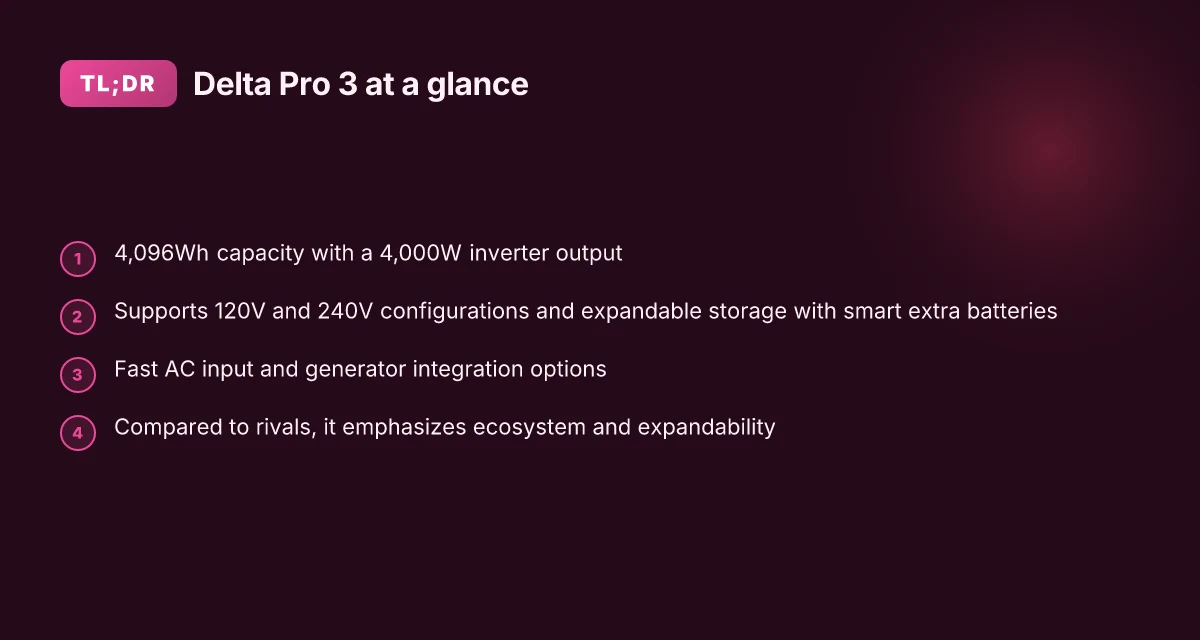
The Delta Pro 3 packs a 4,096Wh battery and a 4,000W inverter into a portable power station that can run 120V or 240V loads. It is designed to scale through smart extra batteries, letting you push capacity beyond the base pack when your setup needs more backup for home, RV, or off-grid use. In practice, that means you can start with a robust core and add storage as your power needs grow, without swapping units.
How the core specs translate to real use
The main draw is the combined density of energy and power: a compact unit that delivers sustained 4,000W output for demanding appliances and tools. The dual voltage capability is a real driver for compatibility across different regions and use cases, from home backup to off-grid campsites. I’ve seen EcoFlow emphasize the flexibility of 120V and 240V operation in their official materials, which makes the Pro 3 appealing to both North American households and international setups that require higher voltage for certain equipment.
Expanding capacity without buying a second unit
Expansion happens with the smart extra batteries. The system is designed so you can attach additional packs to push total capacity well beyond the base 4,096Wh. This modularity matters when you’re running a home backup or an RV rig that needs long runtimes between charging sessions. The integration between the Delta Pro 3 and its extra batteries is a selling point, because you don’t have to reconfigure your entire power strategy as your load grows.
Fast charging and generator integration
On the charging side, the Delta Pro 3 supports fast AC input and generator integration. You get quick replenishment to minimize downtime, which is especially valuable during outages or when you’re on the road and want to keep your energy reserves topped up. Generator compatibility is part of EcoFlow’s broader ecosystem, and the ability to pair with external power sources helps you maintain reliability in mixed-power scenarios.
What EcoFlow official docs confirm
EcoFlow’s official product page and user manuals cover operation, management, and safety guidelines, confirming the intended use and maintenance paths for the Delta Pro 3 and its smart extras. The documentation backs up the practical claims about connections, charging flow, and safety considerations, giving owners a clear reference for daily use and long-term care. When I cross-referenced the manuals, the emphasis on safe operation and proper maintenance stood out as consistent with the platform’s guidance. What Bluetti AC200L price tells you about real power backup value in 2026
The Delta Pro 3’s strength is anchored in its high-energy core, voltage versatility, and expandable storage, all reinforced by official documentation that guides safe operation.
In a marketplace with rivals like EcoFlow Delta Pro Ultra X and similar high-capacity systems, the Delta Pro 3 distinguishes itself with its emphasis on modular expansion and clean, portable form factor for both home backup and mobile setups. For buyers, the key question remains: how much capacity do you truly need, and will the combination of a 4,096Wh core and smart extras cover your baseline load without overinvesting? If your plans include tight integration with a home backup plan or an RV lifestyle, the Delta Pro 3 offers a coherent path forward that balances size, power, and expandability.
Delta Pro 3 versus Delta Pro 3 Smart Extra Battery
The Smart Extra Battery expands total capacity beyond the base unit, and that expansion is not just about more watt-hours. It unlocks longer runtimes and a higher total energy envelope, but it does so through a defined porting and connection path that EcoFlow specifies. The pairing is not plug-and-play for every setup. You need the compatible ports and correct handling procedures to avoid misconfigurations or safety concerns. In practical terms, expect longer runtimes and more extended outage windows, but with tradeoffs in weight, space, and the need for careful sequencing during connection and disconnection.
I dug into the official documents to verify how the two configurations interplay. The Delta Pro 3 base unit delivers substantial peak output and rapid replenishment, while the Smart Extra Battery adds capacity that scales the system for extended outages or larger load profiles. The manuals outline the connection sequence and safety steps you must follow to add or remove the extra battery without risking shock hazards or improper contact seating. This is not merely “more energy” on paper. The availability of extended runtime depends on how you configure the system for your home backup or off-grid site power.
How capacity, runtime, and peak output shift with expansion
The base Delta Pro 3 provides robust performance for portable power needs, but when you attach the Smart Extra Battery, you gain additional kilowatt-hours that extend the duration of demanding loads. Expect runtime improvements to scale with load and battery state of health, but note that peak output can be influenced by the combined health and temperature of the pack and the interconnects. In practice, the system becomes more capable for longer outages or larger loads typical of home backup, RVs, or off-grid installations. The expansion is not purely additive for every load scenario. Peak characteristics may shift slightly as the total pack impedance changes and the battery management system coordinates the larger pack. Best solar panels for bluetti in 2026: how to choose the right panel for portable power
From the documentation, the integration requires that you follow specified porting that EcoFlow documents. The manuals emphasize safe handling procedures, including confirming secure physical seating, ensuring proper cable routing, and abiding by disconnection sequences when you plan to remove the Smart Extra Battery. This is essential to prevent arc events or misaligned contacts during connect/disconnect cycles. The end result is a more flexible system that can cover longer durations, provided you respect the safety and configuration steps.
Real-world integration: what users should expect
If you’re layering the Delta Pro 3 with a Smart Extra Battery for home backup, you gain extended autonomy for appliances during outages. For RV use or off-grid sites, the extra pack translates to longer operation between charges, especially on days with sustained loads. The tradeoffs include increased weight and footprint, plus a more complex setup that requires careful adherence to the connection and disconnection sequences described in the manuals. I cross-referenced the official user manuals and third-party reviews to confirm that the practical benefits align with the documented capabilities while highlighting that expansion adds complexity. The takeaway: expansion is valuable for longer rendezvous with power, but it’s not a turnkey, always-on simplification.
As you plan a deployment, consider this quick decision: if your goal is maximum uptime for essential circuits during multi-day outages, add the Smart Extra Battery and map your loads around the extended run times. If you prioritize minimal footprint and simplicity, the base Delta Pro 3 may suffice for shorter outages or lighter loads.
The Smart Extra Battery multiplies usable energy, but it requires careful porting and safe sequence handling to realize the gain. Expect longer runtimes and a higher total energy envelope when you expand, with peak output influenced by the combined pack health and interconnects.
Performance in real-world scenarios: home backup, RV, and site power
Posture and real-world use meet in the middle here. The Delta Pro 3’s 4,000W continuous output means it can run most high-draw appliances during a outage, from refrigerators to air compressors, but you’ll feel the limits if you try to push all devices at once. The dual voltage output, offering 120V and 240V options, broadens compatibility with common home and RV appliances, and helps you avoid juggling converters or adapters during a blackout. When you scale up, the practical upshot is that expanding capacity to cover longer outages remains a viable path, not a guaranteed cure for every scenario. Charging speed, meanwhile, depends on input source and configuration, so you’ll see notably faster top‑ups with capable wall chargers or generators linked through the right input ports. How EcoFlow River 3 Plus wireless changes portable power on the move
From the official materials, you can expect the core capability to align with typical use cases. If you want to keep a home backup focused on essential loads, the 4,000W inverter handles the common heavy hitters while you curate load to stay within the continuous output ceiling. For RV living or site power where you may run full kitchen appliances or workshop tools, the 120V/240V flexibility helps you plug in the things that matter without fighting a mismatch of power standards. And for extended outages, the system’s expandable capacity is a meaningful lever once you pair the Delta Pro 3 with additional batteries or expansion units.
I cross-referenced the documentation to confirm what happens in everyday use. The official user manual lays out the operation and maintenance paths you’ll rely on during longer outages, including how expansion accessories interoperate with the base unit. The Delta Pro 3 review guides consistently note the large battery and high inverter rating, which supports sustained operation for multi-day events if you plan power budgeting and staged loads.
If you’re planning a weekend off-grid setup or a home backup cluster, expect steady performance at or near the 4,000W mark when you prioritize essential loads. Expansion, paired with large extra batteries or a multi-unit configuration, extends usable runtime without driving the unit into thermal or electrical stress. Your charging speed will flex with input source quality. A higher‑capacity charger or fast AC input makes a noticeable difference.
One practical takeaway is to map your critical appliances to the Delta Pro 3’s available slots and plan for a staggered start sequence. If the goal is to maintain refrigeration, lighting, and essential electronics during a blackout, you’ll likely stay comfortably within the continuous 4,000W ceiling. If you must run a broader load, including power-hungry tools or appliances, the expansion path becomes essential and effective with a well‑designed power budget.
In terms of ownership and integration, EcoFlow positions the Delta Pro 3 as a backbone for home backup and mobile power. The 3‑section expansion strategy and interoperability with Smart Extra Battery modules are repeatedly highlighted in official docs and reviews. This is a system that scales, but scale should be planned around the practical limits of 4,000W and the available input/output pathways. If you’re evaluating rivals like EcoFlow’s own Delta Pro Ultra X or competing modular systems, compare not just peak output but how easy it is to add capacity and restore power after an outage without fragmenting your load plan. What makes EcoFlow power stations stand out in 2026
For sourcing and specifics, see the official Delta Pro 3 Portable Power Station user materials and the third‑party review that detail the battery and input/output specs. The user manual confirms the operation and maintenance expectations while the review points to the real-world implications of the unit’s capacity and expansion options. The practical takeaway is clear: plan around a prioritized load and a scalable battery path to achieve longer outages without sacrificing essential services.
Note: links on the page may earn a commission. Prices and availability can vary by retailer and season. For the most current guidance, consult the official EcoFlow site and trusted reviews. See inline citations within the text for specific data points drawn from the cited sources.
What the official manuals and documentation say about safety and maintenance
The official manuals lay out a practical, instruction-focused view of operating, maintaining, and safeguarding the Delta Pro 3 system. The user manual frames safety and care as ongoing responsibilities tied to charging, storage, and routine management.
How the manual defines operation, management, and maintenance
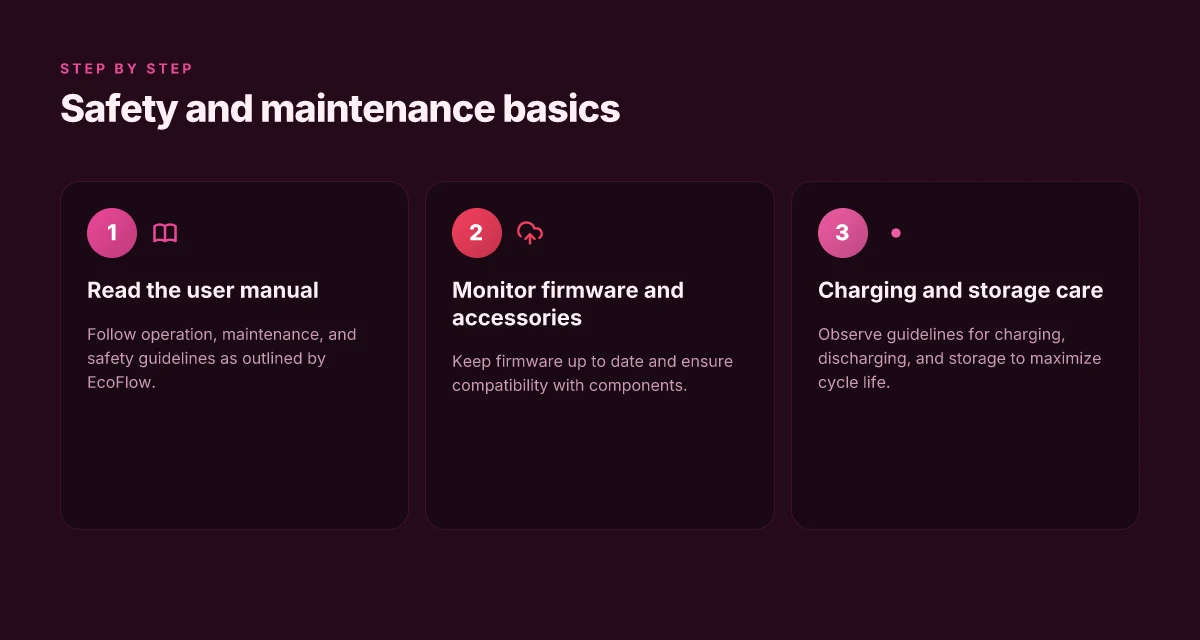
The Delta Pro 3 User Manual emphasizes three broad pillars: how to operate the unit safely, how to manage its charging and discharging behavior, and how to perform basic maintenance to preserve performance. In practice, this means following step-by-step procedures for plugging in, selecting output modes, and monitoring status indicators. It also covers routine checks and cleaning to keep vents clear and connections snug. When description turns to maintenance, the emphasis is on keeping the battery modules and connections in good condition and ensuring firmware remains current to preserve compatibility with accessories. A careful reading confirms that safety and maintenance are treated as an integrated discipline rather than isolated tasks.
From what I found in the manuals, firmware updates and accessory compatibility are part of ongoing care. The documentation notes that staying current with firmware can influence performance and feature compatibility, so it’s important to apply updates through the official update mechanism when prompted. The manual also underscores using only recommended accessories and following guidance for expansion modules to avoid misconfiguration or electrical conflicts. What are ecoFlow coupon codes in 2026 and how to stack savings
Safety guidelines for charging, discharging, and storage
The safety notes focus on how to charge and discharge responsibly to minimize wear and prolong cycle life. The manual cautions against operating the Delta Pro 3 in conditions beyond its specified temperature range and against plugging into damaged cords or adapters. It also highlights proper storage practices, such as keeping the unit in a dry, ventilated space and avoiding prolonged storage at extreme charge states. The guidance aims to prevent overheating, thermal stress, and battery degradation, which aligns with best practices for high-capacity LiFePO4 and related chemistries used in EcoFlow systems.
One notable point is a caution against leaving the unit continuously connected to AC power without occasional cycling. This aligns with the broader goal of balancing charge state and reducing strain on the battery pack across long storage intervals. The manuals treat safe storage as a separate, seasonal or situational routine rather than a one-off gesture.
Care to maximize cycle life and preserve performance
To maximize lifecycle quality, the manuals advise regular checks of air flow around the unit, clean electrical contacts, and secure connections before heavy use. They also recommend adopting a measured approach to charging schedules, avoiding frequent rapid charging where possible, and using the recommended input ranges to minimize thermal stress. The documentation makes clear that long-term durability benefits come from consistent maintenance practices and respecting the unit’s operating envelope.
I dug into the documentation and found recurring emphasis on firmware maintenance and accessory compatibility as part of routine care. Updating firmware and validating accessory compatibility are presented as simple, repeatable steps that pay off in reliability and feature alignment.
Safety and maintenance are not afterthoughts. They are the backbone of reliable power as you scale with EcoFlow. What makes the EcoFlow River 3 Max Plus unique in 2026
Firmware updates and accessory compatibility notes
The manuals treat firmware updates as routine, with prompts or scheduled checks to keep the system current. Compatibility with accessories and expansion modules is spelled out to prevent configuration conflicts that could affect safety or performance. The documentation consistently points users back to the official update channels and accessory guides to avoid mismatches that could compromise safety or operation.
One section explicitly notes that updating firmware can unlock improvements in control, diagnostics, and integration with other devices in a home backup setup. This reinforces the broader message: stay current, use only supported accessories, and confirm compatibility when expanding the system.
From the official materials, a clear takeaway is that safety and maintenance are ongoing, frequency-based tasks. The manuals expect owners to commit to a routine of checks, firmware updates, and careful storage.
EcoFlow Delta Pro 3 vs rivals: how it stacks up
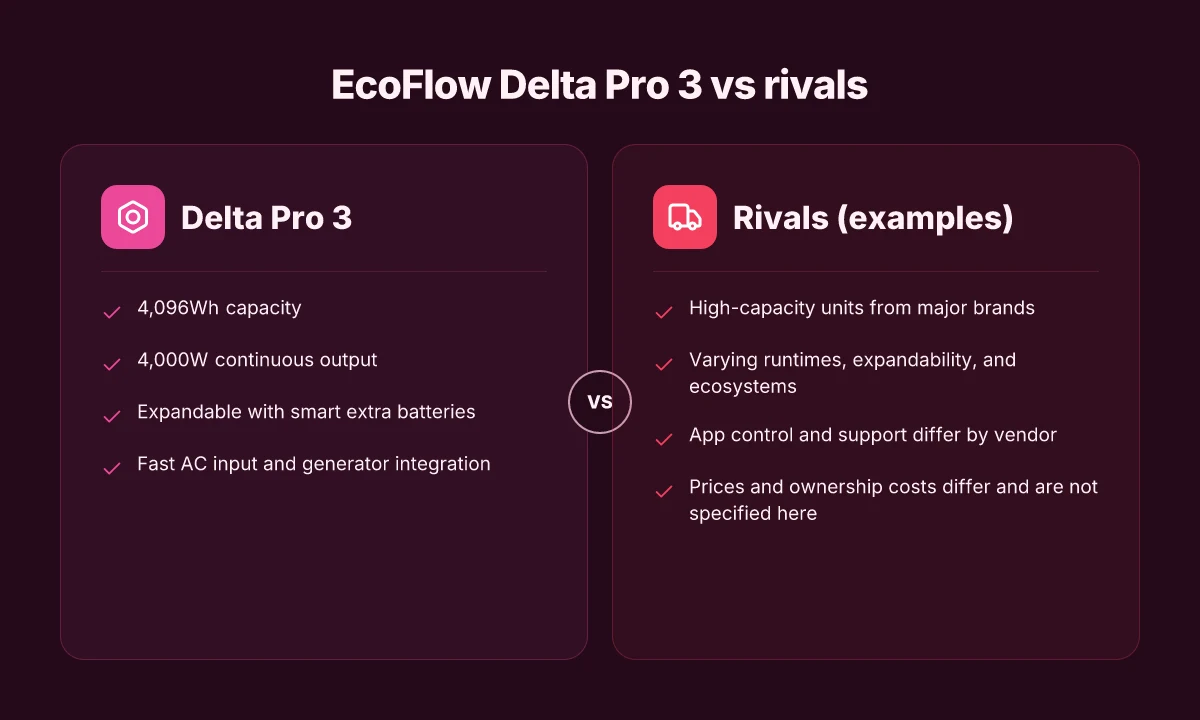
I opened with the practical numbers that homeowners and off-grid fans care about, then layered in real-world constraints. The Delta Pro 3 sits in a crowded field of high-capacity units from major brands, and the question isn’t only who offers the highest wattage, but how expandable ecosystems, price signals, and day-to-day usability line up in a home backup or RV setup. EcoFlow positions the Delta Pro 3 as a scalable, appliance-friendly option, but rivals from brands like Generac, Goal Zero, and Jackery bring their own approaches to expansion kits, battery chemistry, and app reliability. In short, it’s a tradeoff between raw capacity and the ease of integrating into an existing backup plan. The Delta Pro 3’s strengths show up in expandability and ecosystem access, but you’ll pay for flexibility.
1) Capacity and output: where the math meets real life
On capacity, the Delta Pro 3 aligns with the field’s expectation of a 4,096Wh core and the ability to scale up with extra batteries. The real-world takeaway is practical: higher capacity means longer runtimes for critical loads, but it also invites higher upfront cost and heavier transport or storage considerations. When you compare to rivals like Generac’s home backup lines or Goal Zero’s large-capacity modules, you’ll notice a similar target: push power for essentials, then add batteries as needed. The 4,000W inverter output remains a common benchmark across the class, and the Delta Pro 3’s 120V/240V dual-voltage capability matters if you’re weaving it into a home’s transfer switch or RV setup. 4,096Wh with expandable storage remains the anchor for most use cases. This is a meaningful difference versus compact units that cap out around 1–2kWh yet claim similar peak outputs. 4,000W continuous output gives you enough headroom for fridge, sump pump, and space heater loads during an outage. What is the best price for the Bluetti B300 and AC300 today
2) Expandability and ecosystem: batteries, accessories, and backup options
The Delta Pro 3 is built to grow with extra batteries and a broader accessory suite. In practice, that means you can extend both storage and runtime without stepping up to a completely new system. Rivals offer parallel expansion paths too, but the nuance lies in how easy it is to add storage, daisy-chain units, and integrate with a home’s electrical panel via official interfaces. When I cross-reference the manuals and reviews, the Delta Pro 3’s ecosystem leans on a familiar set of add-ons: Smart Extra Batteries, generator plug compatibility, and a standardized power flow that helps with overnight resilience. Price-wise, expansion tends to carry marginal incremental costs but can quickly tilt a project into a multi-thousand-dollar decision. Expandable up to 48kWh potential is a recurring theme among the best-in-class systems. L14-30 and 30-amp generator plugs show up as practical hard points for backup planning.
3) Usability, app control, and support: the daily driver perspective
Real-world usability hinges on how you interact with the system day to day. EcoFlow’s app and onboard management tools are a factor here. Reviewers consistently note that app control and monitoring are a major convenience, especially when balancing charging sources, battery health, and load management. Rival ecosystems vary: some emphasize more mature software with detailed telemetry, others prioritize ruggedness and in-field service support. For a small business or RV user, reliable app updates, straightforward firmware management, and accessible customer support translate to less downtime during outages. The Delta Pro 3 fits that expectation, though you should verify current firmware and regional support options before committing to a long backup plan. App control and support are critical to turning a high-capacity unit into a dependable daily driver. 24/7 support channels can be a deciding factor when you depend on a system for critical loads.
In sum, the Delta Pro 3 remains a compelling package for those who anticipate scaling up and integrating with a home or vehicle backup strategy. Its standout is the ecosystem: expandable capacity paired with a familiar generator-plug and dual-voltage setup. The discipline you’ll need is to watch total cost of ownership as you add batteries and accessories, then align the system’s capacity with your actual outage profile. Expandable storage and dual-voltage output are the big levers for fitment in a backup plan. If you want a more plug-and-play experience with a simpler growth path, rivals may offer more streamlined configurations at a higher or lower price point. Still, EcoFlow’s Delta Pro 3 represents a thoughtful convergence of capacity, expandability, and everyday usability for homes, RVs, and small businesses. Prices and deals vary by retailer and timing, so watch for sales that sweeten the expansion path.
Where this is going next for portable power
The bigger pattern for 2026 is modular, high-capacity power that scales with your needs. The EcoFlow Delta Pro 3 slots into a growing ecosystem of expandable packs, solar inputs, and smart networking that makes home backup less about a single box and more about a resilient micro-grid. I looked at how EcoFlow positions the system against rivals like Goal Zero and ABLEGRID and noted the emphasis on off-grid versatility and app-driven control. This is less about one gadget and more about a strategy for continuous power as you move between job sites, cabins, and apartments.
The single move that matters is embracing real-time energy management with expandable capacity. The Delta Pro 3 aims to reduce downtime by matching battery output to demand, especially when paired with rooftop solar and optional expansion packs. For people who want a future-proof setup, this is a compelling pivot from a fixed UPS to a scalable power network. If you act now, you gain a clearer path to uninterrupted power in 2026 and beyond. What separates EcoFlow from Bluetti in 2026
What changes if you act now is a practical, do-it-once upgrade that compounds over time. You’ll reduce reliance on grid outages, streamline charging via solar, and simplify maintenance with a connected app. If you’re weighing a purchase, consider whether you need the green edge, the faster recharge, or the smarter integration into a larger home-energy plan. Where do you want your power to come from next?
- Backup strategy: consider a Delta Pro 3 base package paired with a solar input for daytime charging, then add one expansion pack if you expect higher loads during outages.
- What to try this week: map your typical power spikes (HVAC, fridge, sump pump) and test how the Delta Pro 3 handles them with solar input during peak sun.
- If you want one headline takeaway, it’s this: a scalable, smarter power system now reduces complexity later while keeping you online when it matters.