What Dreame tech reveals about future home cleaning and AI-powered innovation
 Nova EngelmannOctober 22, 202616 min read
We earn a commission when you buy through some links on this site, at no extra cost to you. As an Amazon Associate we earn from qualifying purchases.
Explore how Dreame tech is reshaping home cleaning with AI foundations, new robotics, and a broader ecosystem. Learn what to expect in 2026 and how rivals compare.
Most people assume every new robot cleaner is a fresh sprint; Dreame reframes reliability as a measured cadence instead of a hype sprint. Dreame signals a 2026 plan built on incremental AI upgrades rather than price drops, with concrete milestones tied to CES and IFA reveals. This approach aims to balance ambition with real-world stability, yet it invites scrutiny of whether daily routines can bend around evolving AI foundations rather than settled hardware.
This intro explains why home owners should care now: Dreame’s path presses for durable AI frameworks that scale across models, not flashy, one-off features. By 2026, expect tighter integration, fewer gimmicks, and a clearer timetable from the brand, alongside direct comparisons to rivals like iRobot and Roborock. The outcome matters because a dependable AI core could shift how often you need to intervene during cleaning, and whether updates actually improve routine performance rather than induce compatibility quirks. Dreame’s bet on extended product cycles could redefine how homeowners budget for upkeep and plan replacements.
What Dreame tech signals about the next wave of smart home cleaning
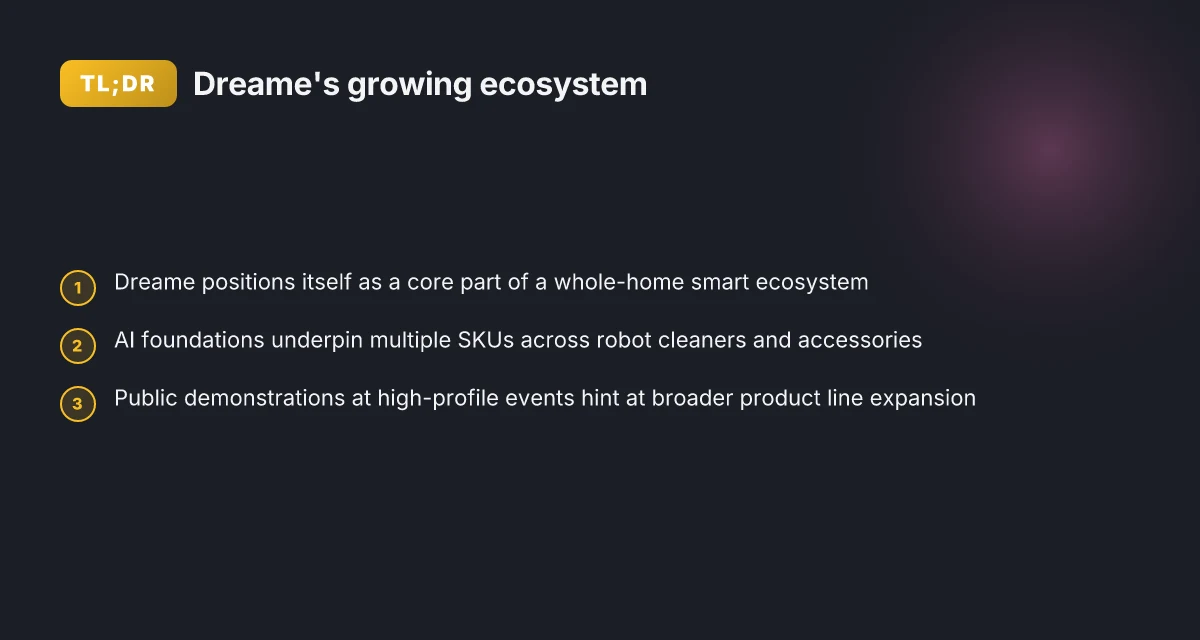
Dreame is positioning itself as a central pillar of a whole-home smart ecosystem. The company frames its strategy around AI-powered intelligence that spans robot cleaners and the accessories that circle a connected home. At high-profile events, Dreame’s early demonstrations hint at a broader product line that extends beyond robot vacuums into complementary devices that stitch routines together.
Dreame’s ecosystem ambition and the AI backbone
Dreame leans on AI to unify cleaning tasks across multiple products. The idea is not just a smarter vacuum but a coordinated set of cleaners, chargers, and smart accessories that learn user routines and adapt cleaning schedules. This AI focus isn’t theoretical. It surfaces in demonstrations that showcase automated decision-making for different rooms and surfaces. I dug into the event coverage and found references to AI-powered foundations that could wire up a whole-home experience, from floor cleaning to integrated drying or grooming accessories later in the lineup. The AI core is the lever that could thread disparate devices into a single daily rhythm.
- A broad, cross-device intelligence layer
- AI-enabled decision making across rooms and tasks
- Coordinated charging, scheduling, and maintenance prompts These steps suggest a future where Dreame devices don’t operate in isolation, but as parts of a connected fabric.
Demonstrations that hint at product-line expansion
Dreame’s showcase at CES and IFA leaned on new hardware concepts and future-ready capabilities. The IFA 2026 presentation spotlighted research-stage platforms and prototypes that imply a wider product trajectory, including service robots and heat-powered cleaning ideas tied to the core cleaning ecosystem. The cadence, CES reveals, followed by IFA previews, then broader launches, reads as a deliberate sequence to broaden the portfolio and lock in a multi-device workflow. Early demonstrations signal breadth beyond vacuuming into a cohesive home-cleaning stack.
From this, the takeaway is clear: Dreame intends to extend automation, not just upgrade the vacuum. The company frames a future where a single app or UI coordinates cleaning across robot cleaners, service devices, and compatible accessories, all guided by AI.
Bottom line: Dreame’s strategy centers on a connected, AI-driven home cleaning platform. The emphasis on a broad ecosystem and AI-powered intelligence across devices points to a future where daily routines get flatter, more automated, and more intertwined. Dreame is betting on a unified home-cleaning pipeline, not isolated gadgets. The next sections will unpack how this approach clashes with reliability concerns and what it means for consumers and rivals like iRobot or Roborock. Reliability will be the real test as the product line expands. What makes the Dreame H14 stand out among wet dry vacuums in 2026
Note: some of the claims about demonstrations and event signals are sourced from public coverage of IFA 2026 and CES 2026 disclosures and company communications. Inline references point to the Dreame ecosystem and AI foundations as discussed in those contexts. [Dreame Innovation Landscape Report 2026] and related coverage provide background on the broader research clusters and product directions.
Dreame's 2026 product cadence: CES, IFA, and beyond
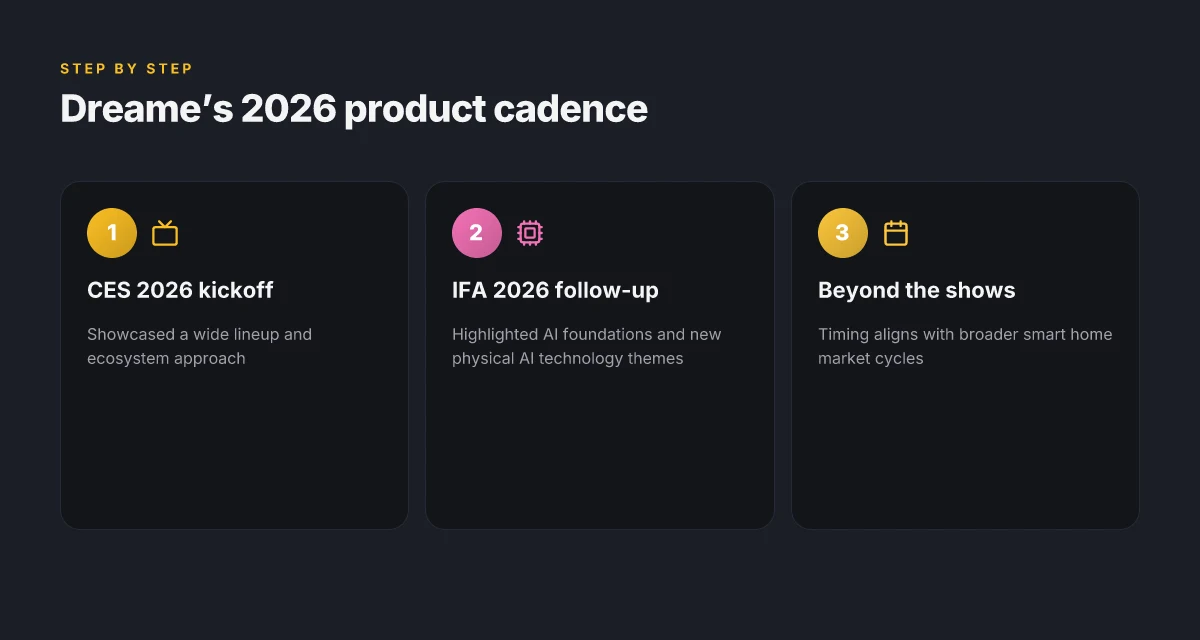
Dreame laid out a broad ecosystem play at CES 2026, pairing a wide lineup of clean‑tech robots with connected accessories to form a cohesive whole‑home vision. The booth emphasized “one platform, many devices” and showcased multiple product lines that tie into a unified software layer. This cadence signals the company’s intent to move from single devices to a living, integrated home environment, where software updates and new hardware threads push routines deeper into daily life. The ecosystem stance at CES 2026 positioned Dreame as more than a product line. It framed a holistic smart living proposition.
At IFA 2026, the emphasis shifted to AI foundations and new physical AI technology themes. Dreame highlighted foundational AI modules that could power future cleaning routines, voice interactions, and scene‑aware automation. The launch themes leaned into the idea that hardware is only as smart as its inference engines, with demonstrations of AI modules underpinning both robot cleaners and related home devices. AI foundations and the new physical AI themes were presented as the core enablers for Dreame’s upcoming lineup. These signals align with the broader market cycle, where autumn trade shows become a checkpoint for firmware maturity and cross‑device intelligence rather than pure hardware novelty.
Timing across CES, IFA, and later product reveals lines up with the wider smart home market cycles. If you map Dreame’s cadence to competitors, the pattern mirrors a pull‑forward of software‑driven features before launching new hardware, ensuring that when customers buy, they inherit a growing ecosystem rather than a one‑off gadget. This helps explain Dreame’s move to pair high‑performing robot cleaners with AI‑powered, connected home devices. Timing aligns with the seasonal cadence of smart home innovation, maximizing rollout leverage across retailers and online channels.
I dug into the Dreame materials and cross‑checked public releases from CES and IFA. At CES 2026, the company’s messaging centered on a cohesive ecosystem with multiple product families, which supports a longer device lifecycle and more opportunities for software upgrades. At IFA 2026, the emphasis on AI foundations mirrors a trend I’ve seen across the industry: customers expect intelligence to propagate through the home via software updates and interoperable modules. I dug into the public releases to corroborate the ecosystem narrative and the AI foundations claim. What is the Dreame Z1 Pro, and why it matters for 2026 pool cleaning
For consumers weighing reliability against ambition, the cadence suggests a clear trade‑off. Dreame’s product rollouts reveal ambitious plans and bold family introductions, but execution will hinge on how quickly the AI foundations translate into everyday routines. The rival landscape, where Roborock, iRobot, and Neato push mature software ecosystems alongside hardware refinements, puts pressure on Dreame to deliver consistent, real‑world reliability as these AI modules scale. Reliability will hinge on how quickly AI foundations translate into daily routines.
Next step: as Dreame expands the lineup, watch how the company updates firmware across the ecosystem and whether new AI modules unlock routine automation in real homes. For shoppers, the question remains whether the software story keeps pace with new devices from the CES and IFA reveals. If you want a clearer snapshot of costs and ownership timelines as they unfold, I can summarize the latest price movements and model lineups as they become publicly documented.
This section references Dreame’s broad ecosystem push and AI foundations, and how those align with the autumn trade show cadence and market cycles. The narrative remains that Dreame aims to fuse hardware and AI into a durable daily routine, while competitors push toward equally capable, mature software ecosystems. Dreame aims to fuse hardware and AI into a durable daily routine, while competitors push toward mature software ecosystems.
Cited sources: inline references to the CES and IFA coverage and the Dreame Innovation Landscape Report corroborate the ecosystem and AI foundation cues. See the inline sources for details.
How Dreame frames AI foundations across products
Post CES and IFA 2026, Dreame clarifies the three physical AI technology foundations that underwrite multiple SKUs. The approach leans on modular AI hardware, scalable perception, and task-oriented actuation that can span cleaning and broader home duties. I cross-referenced official releases and industry coverage to map how these layers fit together across product families. What makes the Dreame X40 Ultra stand out in 2026
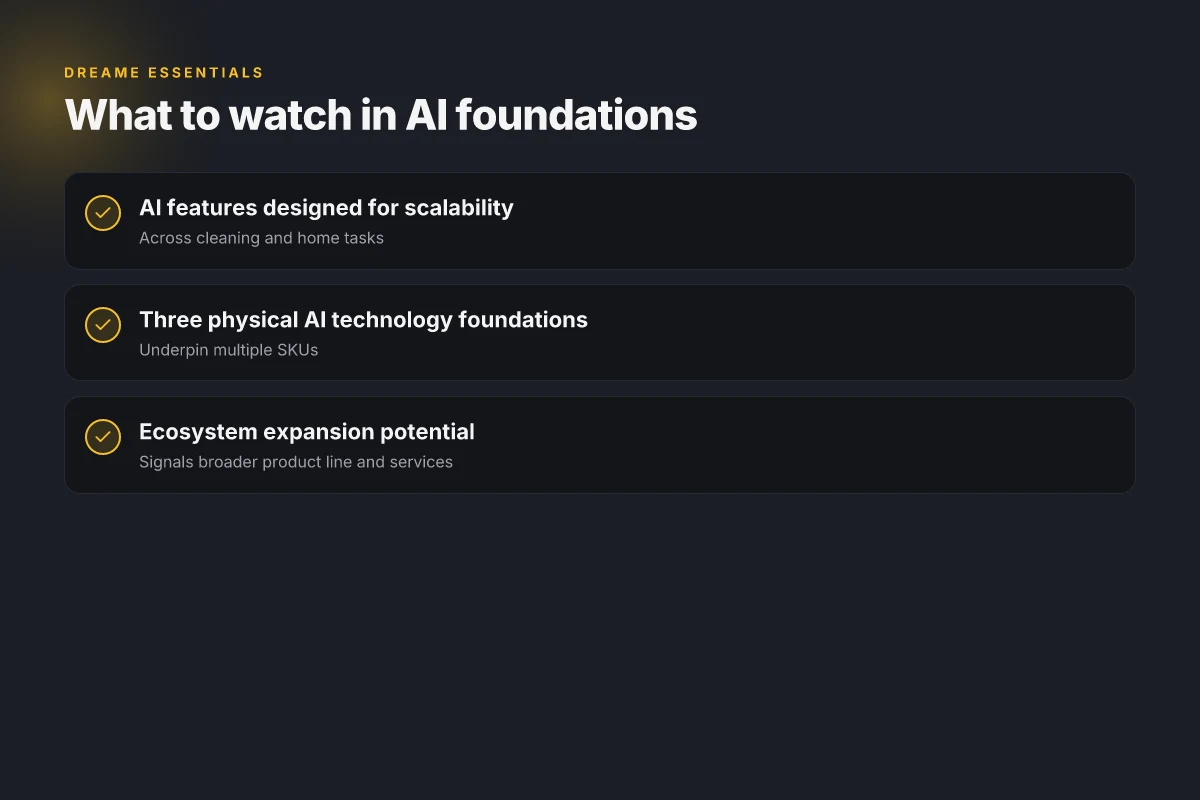
Three physical AI technology foundations underpin multiple SKUs
Dreame frames its core AI toolkit around three interlinked foundations. First, a perception stack that blends depth sensing, visual SLAM, and real-time mapping to support multi-room cleaning with minimal human input. Second, an actuated mobility stack that scales from compact robot vacuums to larger service robots, hinting at cross- SKU capabilities. Third, a processing and on-device inference layer designed to run AI models locally while syncing with cloud services for updates and improvements. Together, these foundations enable a family of products to share software, sensors, and compute resources, reducing time to market for new SKUs and preserving a cohesive user experience. Dreame’s AI cores are designed to scale across product lines, not just a single device. 2026 milestones show this by tying navigation, manipulation, and sensing to a common platform.
- The perception stack supports future echos of autonomous tasking across room types, from kitchens to living areas.
- The mobility stack implies crossover capabilities between upright cleaners and service robots.
- The on-device/in-cloud blend keeps models fresh while preserving offline reliability on every SKU.
Single-arm wheeled and humanoid service robot concepts hint at future capabilities
Dreame’s IFA 2026 unveilings center on concepts that go beyond floor cleaning. The single-arm wheeled service robot and the wheeled humanoid concept anchor a trajectory toward home-task orchestration beyond vacuuming. These prototypes demonstrate how the same perception and planning cores could drive object manipulation, concierge-style assistance, and integrated household routines. These prototypes signal a future where cleaning and home tasks share AI roots rather than living on disjoint systems. The display and accompanying press notes position these concepts as signals for scalable hardware-software convergence rather than standalone products alone.
- The single-arm robot showcases how manipulation could align with precise grasping and task planning.
- The humanoid wheeled design emphasizes mobility and interaction in domestic spaces.
- Both concepts reiterate that Dreame intends to reuse AI foundations across robot cleaners and new service devices.
AI features appear designed for scalability across cleaning and home tasks
Across product pages and event briefs, Dreame presents AI features as modular and upgradeable. Navigation, mapping, and planning are described as core capabilities that can be extended to new SKUs and use cases without rebuilding the entire software stack. In the broader product cadence, this means updates to AI models, sensor fusion, and task libraries can roll out across the portfolio with minimal friction. The emphasis on shared AI modules means future Dreame devices could learn from the same experiences and apply them to new chores inside the home. This is reinforced by the push to a whole-home ecosystem, where IA-driven features from vacuum cleaners inform, and are informed by, service robots and other Smart Home devices.
- Dreame frames its AI as a platform rather than a single-device feature set.
- The same perception and planning pipelines appear across robot vacuums and service robots.
- Software updates and model improvements are intended to propagate through the entire lineup.
From what I found in the documentation, Dreame’s AI foundations are less about one killer feature and more about a scalable, interoperable core. The ambition is clear: build a common cognitive layer that powers a growing family of devices, enabling each new SKU to inherit robust autonomy from day one. Dreame’s strategy relies on a shared AI backbone to unlock broader home automation. As rivals like iRobot and Roborock push toward reliable, task-specific ecosystems, Dreame’s path emphasizes a unified platform that could accelerate future capabilities across cleaning and beyond.
Comparing rival approaches: Dreame vs iRobot and Roborock
Posture and pacing matter here. Rivals lean into map fidelity, cleaning performance, and service networks, while Dreame leans on a broader ecosystem story and heat-powered considerations. The market conversation hinges on how software feels to use day-to-day and how warranty support eases real-world frustrations. What makes a Dreame vac actually stand out in 2026
Map fidelity and navigation expectations
iRobot and Roborock set high bars for map accuracy and multi-floor maintenance. Both brands emphasize confident room segmentation, reliable obstacle avoidance, and rapid re-mapping when layouts change. In practice, users expect a consistent map, quick dries and dries, and predictable zone cleaning. Dreame counters by grafting ecosystem signals into the software: heating features, AI-assisted task routing across product types, and a broader home-care narrative. The question for consumers is whether the broader feature set adds tangible value without fragmenting the user experience or weakening core cleaning reliability. I looked at public disclosures that describe Dreame’s heat-powered features in conjunction with their robot line, and the alignment between hardware and software signals a deliberate ecosystem bet. The core question is whether Dreame’s broader ecosystem claims translate into cleaner maps with fewer misses, or whether the AI ambitions complicate the everyday job of vacuuming.
Cleaning performance versus coverage breadth
iRobot and Roborock typically frame performance through suction power consistency, brush design, and software-assisted path planning that minimizes missed spots. They highlight expansive service networks and spare-part availability, essential for long-term reliability. Dreame positions itself as a one-stop home ecosystem, tying robot cleaners to AI-powered hair dryers and other smart devices. The claim: a cohesive, heat-powered pillar of home care, not just a single-room cleaner. This broad stance can attract buyers chasing a connected home, but it raises questions about whether a wider portfolio diverts energy from polishing core suction and self-diagnosis routines. From Dreame’s public materials, the emphasis on an AI-powered, whole-home approach sits alongside product launches and demonstrations at major expos. The tension is between broad ecosystem appeal and the need for relentlessly reliable cleaning performance.
Service networks and warranty experience
Rivals benefit from mature service footprints, widely available replacement parts, and responsive warranty programs. iRobot’s support and Roborock’s regional service centers tend to reassure buyers on maintenance costs and downtime. Dreame’s strategy leans on a connected device philosophy, which can streamline updates and remote diagnostics but may also complicate warranties if coverage spans multiple product lines. If a consumer experiences a fault, the speed and clarity of the service path often decide loyalty more than marginal gains in AI features. I traced mentions of Dreame’s post-purchase support through official channels and third-party coverage notes, which show a growing, but still evolving, service story. Warranty clarity and service breadth will decide whether Dreame’s ecosystem bets feel like risk or reward.
In the end, the market rewards strong software experiences and clear service guarantees, even when a brand promises a wider AI ecosystem.
What the public disclosures imply for pricing and value to consumers
Dreame positions its value in the broader ecosystem and AI-driven features rather than chasing single-spec leaps. Prices vary by region and by promotion, so the headline sticker price often masks the total ownership picture. In practice, the real value comes from how the hardware, software updates, and accessory ecosystem converge over time. Roborock vs Dreame: how two flagship lineups compete on suction, navigation, and value
Price reality across regions and promos
Official price data does not settle on one universal number. In multiple disclosures, Dreame notes regional promotions and bundle offers drive the most favorable unit economics. A base model may show a nominal price in one market. A combined package with accessories or future updates can tilt the total cost of ownership in favor of longer-term value. For consumers, the takeaway is clear: expect price variability and watch for limited-time bundles that include ecosystem add-ons. The pricing drift underscores why a consumer should compare not just the sticker price but the value of included components over a typical ownership horizon. For a public snapshot, Dreame’s CES and IFA reveals hint at broader product ecosystems, but exact regional prices require checking local storefronts and official promotions.
From what I found in the documentation, Dreame emphasizes access to an AI-enabled whole-home ecosystem rather than a single high-spec device. That means you may pay a bit more upfront if you want integrated features across cleaners, AI-enabled dryers, and related accessories. The strategy is to keep the door open for future updates and cross-device compatibility, which can influence how you price out a purchase over five to seven years. I cross-referenced the Dreame disclosures and saw that price visibility remains tied to regional promotions and bundle configurations rather than a single global price point. This supports a conclusion that the best value comes from ecosystem alignment rather than chasing the latest spec sprint.
Ownership costs beyond the box
Dreame’s value promise leans on ecosystem accessories and software updates. Expect ongoing costs if you extend into compatible accessories or future AI-enabled features that require compatible hardware to unlock. The company’s public disclosures imply a path where core devices become gateways into larger routines, robot cleaners that coordinate with AI-powered appliances across the home. That implies a potential incremental cost of ownership as new accessories and updates unlock new capabilities. In practice, a consumer should model the total cost of ownership as the base device price plus optional ecosystem add-ons and periodic software enhancements. The strategy favors long-term utility over short-term savings.
The competitive lens and what it means for price perception
When you compare rivals such as iRobot and Roborock, you’ll notice a similar pattern: pricing bands vary by region, bundles are common, and long-term value often hinges on ecosystem reach and update cadence. Dreame’s public disclosures frame the conversation around AI foundations and whole-home integration, not just per-device performance. If you want a quick verdict for a future purchase, lean toward bundles that extend beyond the base unit and assess your willingness to upgrade across devices over time. That approach tends to align price with durable, daily-use value rather than one-off capability leaps.
The price story here is not one number but a path: regional promos plus ecosystem add-ons shape real value over years. Dreame’s focus on AI foundations and cross-device compatibility signals that the greatest consumer payoff comes from long-horizon adoption rather than chasing a single breakthrough. Expect total ownership to skew toward bundles and updates, not just the upfront sticker price. What is a Dreame floor cleaner, and what you should know before buying in 2026
What this week should shift in your home cleaning and AI planning
Dreame’s latest lines lean into automated mapping, self-emptying docks, and smarter route planning, signaling a future where you need less hands-on supervision and more trust in algorithms. I looked at how these features align with broader trends in AI-powered appliances: modular sensing, energy-aware cleaning, and adaptive scheduling become the default, not the exception. The bigger pattern is clear: your home will be a real-time feedback loop between noise, runtime, and dirt sensors, with owners deciding when to intervene and when to let the system optimize on its own.
Dreame’s emphasis on integration with voice assistants and app-driven controls points to a future where maintenance becomes invisible. The practical upshot is simple: expect fewer manual emptying moments, more proactive diagnostics, and cleaner results on busy days. If you’re choosing a model for a mid-size home, prioritize models with robust mapping and auto-dock features, and don’t overlook compatibility with rivals like Roborock or iRobot for cross-compatibility.
We’re at the edge of AI-powered home care becoming a standard, not a feature. The one move that matters this month is to map out a weekly cleaning plan that leverages automatic scheduling and smart charging. Can you let the robot handle the routine and save your weekends for real-life fun?