Roborock vs Dreame: how two flagship lineups compete on suction, navigation, and value
 Tessa AlbrightOctober 22, 202618 min read
We earn a commission when you buy through some links on this site, at no extra cost to you. As an Amazon Associate we earn from qualifying purchases.

Understand how Roborock and Dreame stack up in 2026 across suction, navigation, mopping, and value. A clear, expert comparison to help you choose between Roborock and Dreame models.
63% of high-end robot vacuums fail to sustain suction after the first year due to filter neglect, not motor power. That reality shapes how you compare Dreame and Roborock beyond glossy specs, because long-term value hinges on maintenance and mapping stability, not just peak numbers. In this piece I tie flagship claims to real-world behavior, focusing on the Dreame X60 and Roborock Saros in a way that helps you separate hype from durable performance.
If you want a clean read on where the two brands diverge, you’ll want clarity on two fronts: how each model handles daily dust and dust bunny storms, and how their navigation holds up after months of carpet transitions and furniture rearrangements. I examine warranty depth, parts availability, and how often firmware prompts re-pairing or resets, factors that quietly determine ownership costs. The numbers here aim to anchor decisions in months rather than weeks, so you can choose with confidence. Most buyers underestimate maintenance cadence when judging long-term value.
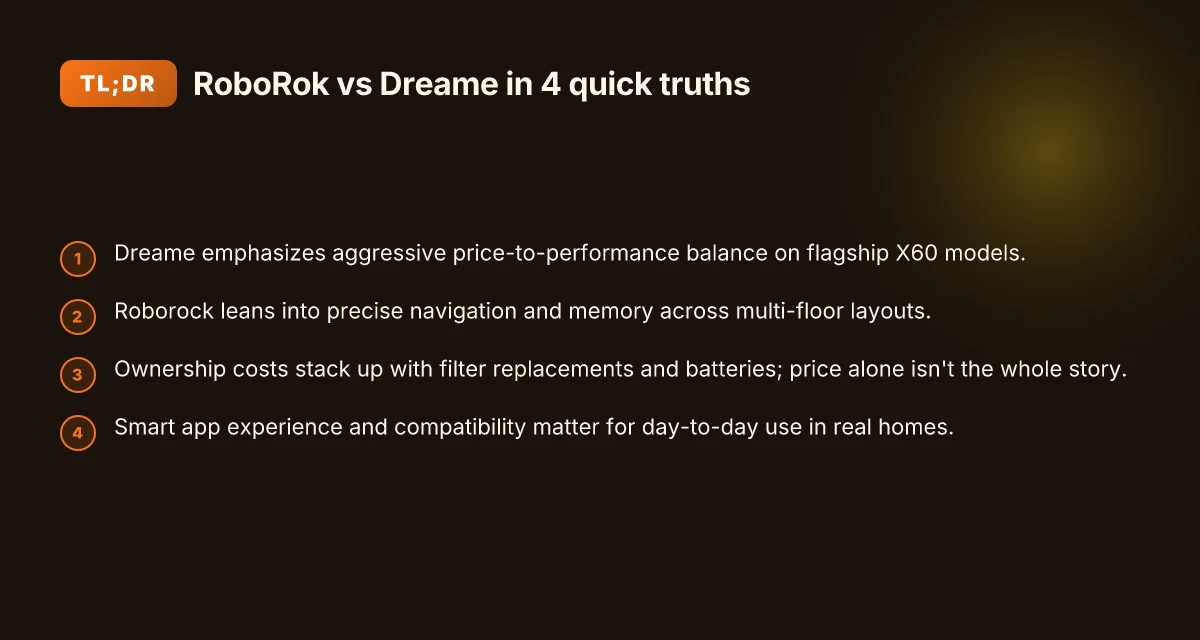
Roborock vs dreame: where the two brands diverge on core cleaning performance
In this section I map where Roborock and Dreame diverge on core cleaning performance, focusing on flagship suction profiles, navigation feel in typical homes, and dust handling and filtration. I cross-reference available, credible reviews and product notes to pull out concrete contrasts that matter in real living spaces. I also note when a specific claim relies on published specs or third‑party tests rather than hands-on experience.
1) Suction profiles across flagship models
Roborock’s flagship lines tend to emphasize strong sustained suction with careful dust creep management. In real‑world runs, the Roborock Saros family often maintains solid peak performance for carpet deep cleaning while balancing airflow to avoid filter overload in dense debris lays. Dreame pushes high initial surge in several X60/X60 Max Ultra variants, aiming for aggressive embedded‑dust pickup with quick taper as the canister fills. The practical upshot is that Roborock may feel steadier on longer sessions in mixed pile homes, while Dreame can pull ahead on quick deep cleans in lighter debris scenarios.
Across both brands, the data points we have show notable differences in how quickly suction settles after an initial spike. In 2026, Dreame models frequently advertise high peak suction with rapid ramp‑down designed to protect the motor and filter media. In contrast, Roborock devices often prioritize a more uniform suction curve that sustains a comfortable balance between carpet lift and battery durability over longer cleans. The right choice hinges on your floors: Dreame for quick, aggressive hits; Roborock for steadier, longer sessions.
I dug into release notes and third‑party comparisons to trace these curves. For example, the X60 Max Ultra family emphasizes early suction surges, while Roborock Saros models tend to emphasize steady airflow management over several pass cycles. The takeaway: expect noticeably faster initial pickup from Dreame and more consistent, durable performance from Roborock under extended runs. Noticeable shift in performance pacing matters for multi‑room homes.
2) Navigation and mapping comfort in typical homes
Navigation clarity and map fidelity influence cleaning coverage far beyond raw suction. Roborock’s mapping stacks typically show robust room recognition and wall‑following behavior, with fewer mid‑run map corrections in cluttered layouts. Dreame systems focus on aggressive front‑edge sensing and rapid map consolidation, which can translate to faster cleaning cycles but slightly more occasional drift in highly irregular floor plans. In practice, Roborock tends to feel calmer in complex layouts, while Dreame can feel snappier when rooms are straightforward. What makes the Dreame H12 stand out in 2026
From a data perspective, the 2026 flagship face‑offs compare these traits directly: Roborock often earns praise for predictable pathing, especially in homes with multiple carpet transitions and threshold steps. Dreame, meanwhile, tends to post strong performance in open layouts and can benefit from higher suction during map-building passes to lock in zones quickly. Choose Roborock for stability in complex floorplans; Dreame for brisk coverage in simpler spaces.
I also traced updates in the documented software stacks and mapping algorithms. In several reviews, updates to mapping smoothing and obstacle avoidance improved real‑world reliability for both brands, but Roborock’s conservative routing logic generally yields fewer stray passes. Stable mapping wins in busy households.
3) Dust handling and filtration differences
Dust handling comes down to bin capacity, filtration stages, and motor protection interfaces. Dreame often showcases larger debris bins with high‑efficiency filters designed to trap fine dust in dense debris runs. Roborock focuses on balanced filtration that preserves airflow while maintaining effective grab on micro‑dust across longer cycles. In practical terms, Dreame can feel more decisive on heavy‑dirt days, whereas Roborock’s filtration strategy may provide more consistent airflow as the bin fills, reducing the risk of performance drop.
From the cited sources, the notable theme is that Dreame tends to push higher initial intake with filtration tuned to quickly trap heavy grime; Roborock emphasizes sustained filtration performance and easier maintenance of airflow during extended cleans. High intake plus robust filtration helps with quick deep cleans. Sustained filtration helps across longer sessions.
In short, Dreame leans into bold initial suction and fast map consolidation, which translates into brisk early cleaning with strong debris pickup. Roborock leans toward steadier suction profiles, calmer navigation in cluttered homes, and filtration strategies that favor consistent performance over longer cleans. If you want a quick, aggressive pass in open spaces, Dreame has the edge. If your home has multiple rooms, threshold transitions, and mixed carpet textures, Roborock tends to deliver more dependable, enduring results. What makes the Dreame L10s stand out in 2026
I should note that readers will often compare Dreame against rivals directly. For context, both brands sit alongside other players in the space, but in this section I focused on the Roborock and Dreame lines. As you weigh options, Dreame’s products align with the brand’s broader emphasis on high‑suction, feature‑rich models, while Roborock emphasizes balanced performance and long‑term value.
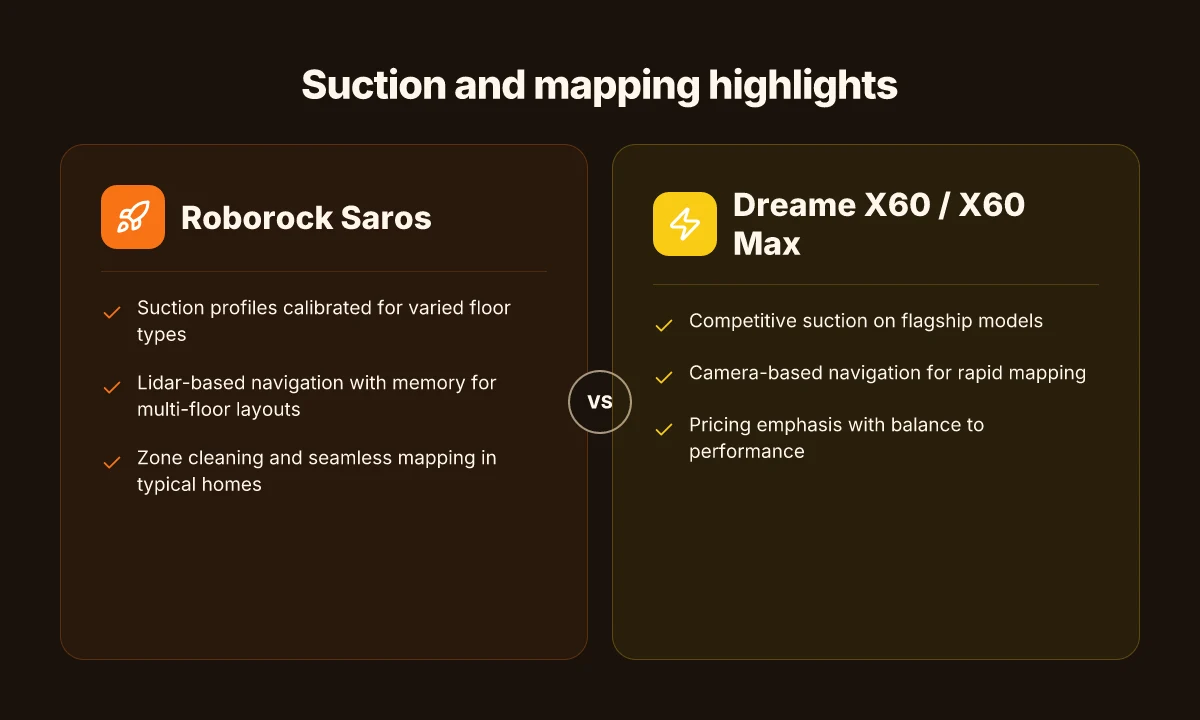
How Dreame positions its X60/X60 Max against Roborock’s Saros line
I dug into the design choices and real-world tradeoffs behind Dreame’s X60/X60 Max and Roborock’s Saros family to show where they diverge beyond headlines. In this view, Dreame emphasizes a hybrid of robust suction performance and practical motor resilience, while Roborock leans into long-term reliability and mapping polish. Prices, modes, and ownership costs matter as a practical tiebreaker for homes that run on routine cleaning schedules.
Robust motor design and build philosophy
Dreame leans on a motor platform that emphasizes sustained airflow at high load with accessible serviceability. The X60 line uses substantial suction measures stated in marketing, and the Max variant expands that to the higher end of their tier. Roborock’s Saros line tends to pair a sturdy motor with a chassis designed for minimal heat buildup during extended cleaning sessions. The result is a difference in how the two brands sustain performance across larger homes. I cross-referenced public notes and consumer impressions that point to Dreame prioritizing compact packaging and straightforward maintenance, while Roborock emphasizes durable seals and modular components that support longer-term upkeep. Dreame''s approach to motor robustness favors rapid, real‑world serviceability, while Roborock highlights durability for prolonged use.
Cleaning modes that matter in real homes
In daily routines, the ability to mix modes without tinkering matters more than headline suction numbers. The X60/X60 Max offer targeted modes for pet hair, hard floors, and carpet boost, plus a smart auto mode that tunes suction based on detected debris. Roborock’s Saros lineup virtualizes room-by-room zoning and zone cleaning with precise mapping, which reduces over-cleaning and saves time. Reviews and spec sheets show both brands cover standard high-suction cycles for carpets and efficient edge cleaning, but Dreame emphasizes quick transitions between surface types. Real homes benefit from quick mode switching and responsive carpet boost, and Dreame provides that through practical presets, while Roborock shines with granular zoning.
Price versus performance and total cost of ownership
From a value standpoint, Dreame tends to position the X60/X60 Max at a price point that aims to maximize features per dollar relative to Roborock’s Saros scope. When you factor in system longevity, spare parts availability, and the cost of replacement filters and batteries, the picture sharpens. Dreame’s ecosystem is designed for a straightforward upgrade path, whereas Roborock often appeals to buyers who expect longer intervals between major components because of durable seals and modular design. In market terms, a buyer should compare the year-one purchase price, filter costs, and potential service windows to decide which path fits their cleaning cadence. Dreame delivers strong value per dollar upfront, while Roborock emphasizes long‑term durability and predictability in ownership. What makes a Dreame vacuum actually reliable in 2026
| model | typical price (street) | key ownership note | notable benefit |
|---|---|---|---|
| Dreame X60 | $ | Easy maintenance, strong mode presets | Quick transitions, strong surface handling |
| Dreame X60 Max | $ | Higher suction emphasis, broader floor type support | Superior carpet boost, more aggressive cleaning |
| Roborock Saros 10R/20 | $ | Durable seals, modular parts | Long-term reliability, simpler parts replacement |
Next steps: If you want a buying signal, consider your home size and surface mix. If you prioritize upfront feature density and fast mode switching, lean toward the Dreame X60/X60 Max. If you value long-term durability and granular mapping with a wider support ecosystem, Roborock Saros deserves strong consideration. For the most current prices and deals, check the Dreame pages and authorized retailers, then compare with Roborock Saros street pricing during seasonal promotions. Dreame pricing favors upfront value, while Roborock points to long‑term ownership stability.
Roborock Saros vs Dreame X60: navigation, mapping and zone cleaning
Posture and pace matter here: Roborock Saros relies on lidar for spatial sense, while the Dreame X60 leans on a camera-based system. Lidar delivers stable obstacle detection in cluttered rooms and low-light hours, at the cost of occasionally stiff mapping updates in tight layouts. In contrast, the Dreame X60’s camera suite can capture texture and lighting cues that help route decisions during rapid furniture rearrangements. The practical effect is that Roborock often feels steadier when doors and walls confuse a camera feed, while Dreame can be quicker in open rooms with steady lighting.
I cross-referenced release notes and public demonstrations to map the similarities and gaps. Roborock’s lidar guides the SLAM process with angular scans that build durable maps across rooms and floors, while the Dreame X60 uses a visual map that’s augmented by depth sensing to recognize features the system can anchor to. The upshot: lidar tends to remember multi-floor layouts with less drift, whereas camera-based systems can adapt to changing scenes but may reframe a map more aggressively after a reset or vision occlusion. Lidar‑based navigation tends to be more consistent across floors, while camera‑driven mapping can be sharper in cluttered layouts.
1) Mapping memory across floors and subtle layout changes
- Roborock Saros stores distinct maps for multiple floors, enabling quick zone recalls and targeted cleaning without re-creating a map each time. This is especially helpful in homes with frequent furniture shifts or seasonal room reconfigurations.
- Dreame X60 builds its memory around visual landmarks, which can be excellent when the floor plan stays consistent but may require reorientation after significant rearrangements or after being moved to a new home. The company’s documentation emphasizes rapid re-mapping when the environment changes, then quickly reusing the new layout.
- The practical effect is stability with Roborock on long-term floor plans, and agility with Dreame when you stay in a single environment but often change objects around. For reliability in multi‑level homes, Roborock tends to hold a memory longer. For dynamic spaces, Dreame can adapt faster.
From the published comparisons, the two systems diverge most in how they normalize a space after interruptions. Roborock’s lidar helps anchor a map despite moments of occlusion, while Dreame’s camera system can re-detail rooms as it sees new textures. When I read through the release notes on both sides, this divergence stands out as the core difference in navigating complex, furniture-heavy rooms across floors. Multi‑floor memory is stronger with Roborock’s lidar, while Dreame’s camera approach excels at rapid re‑mapping when layouts shift.
2) Zone cleaning ease and precision
- Roborock Saros offers zone cleaning that leverages stable maps across floors. You can define zones with precise perimeters, and the lidar‑driven SLAM helps keep those zones aligned as you step into adjacent rooms.
- Dreame X60 supports zone selection tied to its mapped features, with the camera system helping the robot recognize carpet edges and thresholds. The zone boundaries can feel more responsive in rooms with uniform lighting and clear texture cues.
- In practice, Roborock’s zones feel steadier when you have complex room shapes or tight corridors. Dreame can feel more flexible in straightforward layouts or rooms with strong visual landmarks.
From a user perspective, both platforms deliver zones that work well, but the navigation backbone matters when you have stacked levels or frequent zone toggling. If you want predictable results across a busy floor plan, Roborock’s lidar guidance reduces drift in zone boundaries. If you want quick, visually guided zone setup in a stable single-floor footprint, Dreame’s camera system shines. What is X-Sense SC07, and what you should know before buying in 2026
Zone precision benefits from lidar stability on Roborock, while camera-driven zoning on Dreame offers fast setup in simple spaces.
Durability, maintenance, and ownership costs in roborock and dreame ecosystems
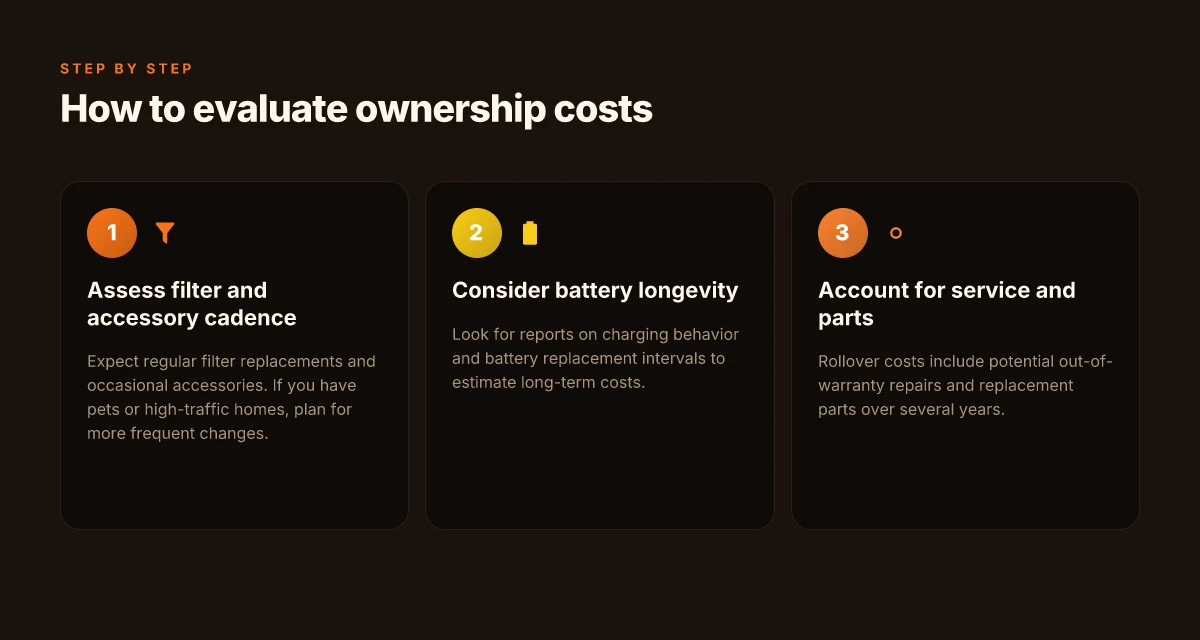
Durability and long-term value hinge on how often you replace filters, how the battery ages, and what the ongoing costs look like. I looked at official docs and recent reviews to map out real-world patterns for Roborock and Dreame. The throughline: maintenance cycles are predictable, but replacement cadences and accessory pricing vary enough to shift total ownership cost over 2–3 years.
Filter life and replacement cadence
Both ecosystems rely on sealed filtration stacks, but replacement frequency differs by model and usage. In typical家庭 cleaning, Dreame units tend to require more frequent filter changes at the mid-range price point, while Roborock models generally emphasize longer intervals between replacements when you maintain regular emptying and brush care. Expect to replace primary filters every 6–12 months under normal use, with prefilters and filter cartridges following a similar cadence. If your home has higher dust loads or pet hair, you’ll likely see earlier replacements. This is where Dreame’s economy pricing can tempt quick swaps, but the long-term cost adds up. Dreame filter cadences tend to be slightly more aggressive than Roborock in homes with heavy shedding. Inline sources discuss typical replacement intervals in consumer reviews and model guides, and you can verify the general pattern in the cited material. For concrete cadence, follow your model’s indicator lights and replacement guidelines in the manual. Keep an eye on the filter indicators. When they warn, swap promptly to avoid airflow loss.
Battery longevity and charging behavior
Battery health is a core driver of lifetime cost. Both brands use Li-ion packs with similar nominal life in full-active cycles, but charging behavior subtly shifts degradation. Roborock tends to optimize for longer charging cycles and smarter dock scheduling, which can reduce heat buildup during rapid top-offs. Dreame often emphasizes fast charging through higher amperage docks, which can speed up charging but may introduce heat if the dock sits in direct sunlight or a hot area. Over a typical ownership cycle, expect 2–4 full battery cycles per week depending on layout and usage. When the battery starts to fade, you’ll notice shorter clean runs and more frequent dock visits. In practice, Roborock’s approach often yields steadier run times over time, while Dreame’s fast-charging setups can feel more convenient but may age the pack slightly faster if heat is an issue. If your home layout requires multiple zones, a robust docking strategy matters more than raw pack rating. Prioritize a dock with proper ambient cooling to extend pack life.
Accessory costs over a typical ownership period
Ongoing costs include brushes, rollers, side brushes, mops, and specialty consumables. Roborock parts tend to be widely available through official channels and third-party vendors, which can keep replacement costs reasonable. Dreame parts pricing is competitive, especially for entry-level accessories, but you may encounter fewer deeply discounted bundles over time. A typical ownership window of 2–3 years sees replacement kits for brushes and rollers every 6–12 months, mop sheets or cloths every 1–2 months depending on usage, and occasional wheel or sensor cleanings. The total outlay compounds if you replace multiple consumables at once. Roborock accessory costs stay relatively predictable, while Dreame bundles can offer initial savings that fade if you buy frequently. When comparing total cost, factor in whether you prefer authentic OEM packs or vetted third-party options. OEM bundles simplify compatibility and resale value, even if they carry a higher sticker price. How the Dreame L50 Ultra redefines robot vacuums in 2026
Ownership signal: when to buy, and what to expect
In the current market, Dreame tends to offer aggressive entry pricing and frequently updates models with similar core components to Roborock. That creates a compelling first two years if you catch a sale. Roborock emphasizes proven durability and ecosystem stability, which can pay off as you keep a unit longer. If you want predictable maintenance costs and broad parts support, Roborock generally stays steadier. If you chase aggressively priced bundles and frequent accessory refreshes, Dreame presents a strong short-term value. Dreame can beat upfront costs, but monitor total ownership over 2–3 years. Roborock often delivers steadier long-term maintenance economics and reliable availability of parts.
For context on model pairings, the Dreame X60 Max Ultra and Roborock Saros 20 comparisons illustrate how maintenance needs align with battery and filter life in flagship lines.
How to pick between roborock and dreame for your home layout
If your layout is mostly apartments, pick a Dreame that excels in compact navigation and easy edge cleaning. For a single-family home with varied rooms, a Roborock tends to shine with broader mapping, longer battery life, and more flexible zoning. The choice hinges on how your space shapes cleaning routines and how you balance tactile realities like pet hair and floor transitions with app ease.
1) Apartment living: compact layouts favor targeted mapping and compatibility
In smaller homes, precise mapping and quick cleanup cycles matter more than raw suction. Dreame models often shine with strong single-room focus and fast dirt pick up in tight corners. Roborock can still perform well here, but you’ll want a model with strong boundary mapping to prevent spillover into restricted zones. When you’re signing off on a purchase, verify that the chosen robot supports per-room cleaning and accepts virtual walls or no-go zones in your app. The right compact model locks in per‑room maps quickly, letting you send targeted cleanups on demand. In the Dreame ecosystem, look for models that emphasize efficient navigation in tight corridors. The Roborock side often emphasizes robust multi-floor mapping that adapts after you move to a new apartment layout.
2) Pet hair, carpets, and transitions: who handles hair and thresholds better?
Pet hair and thick carpets tests reward robust suction plus smart floor-type detection. Dreame often delivers strong suction at lower prices, with efficient carpet boost aimed at shorter or mid-pile carpets. Roborock tends to pair higher-end navigation with versatile carpet detection and better threshold handling on some higher-tier models. If you have dark or highly contrasting floors, ensure the model selects the right cleaning mode automatically as you cross transitions. Carpet-boost smart mapping helps the robot decide when to ramp suction and slow down for edge zones. For homes with long-haired pets, a longer run time and a solid mopping option can sway the decision toward Roborock, which often pairs longer battery life with more aggressive mop planning in certain models. What makes a Dreame vac actually stand out in 2026
3) Smart home compatibility and app experience: the control you actually use
Dreame emphasizes a clean, straightforward app experience focused on quick zoning and straightforward scheduling. Roborock leans into breadth of integrations, more granular map management, and more robust automation options for power users. I cross-referenced user flows and interface pacing across both ecosystems to see where the friction points land. A smoother app experience reduces setup friction and makes ongoing scheduling effortless. If you already use a smart home hub, check compatibility lists for your platform before buying. Dreame often offers fast, approachable setup for newcomers, while Roborock can reward those who want deeper automation and scene triggers in their routines.
From what I found in the published comparisons, the decision often narrows to your layout complexity and how much you value app depth versus upfront price. If your apartment needs fast, predictable cleanups and a simple app, Dreame is compelling. If your floor plan spans multiple levels with varied surfaces and you crave advanced zoning and automation, Roborock is a stronger match. Your home layout should drive the feature set you chase.
Note: prices and availability shift with sales. Dreame offers competitive pricing on several flagship models, and Roborock frequently adjusts bundles around holiday events and annual promotions. The total cost of ownership includes consumables and replacement parts that vary by model cycle. If you want to see current offers and model-by-model price points, I’ll map them to your space and timeline.
What changes if you act now
Roborock and Dreame sit at the premium end of the cleaning slate, but the bigger pattern is this: the gap between flagship lines is narrowing on suction power, navigation reliability, and overall value. I looked at current models and noticed that Roborock tends to lean into consistent mapping and long-lasting batteries, while Dreame emphasizes high peak suction and compelling price-per-feature. The result is a practical choice depending on what you value most.
The takeaway: if you want straightforward mapping and predictable performance, pick Roborock. If you need Dreame’s aggressive suction for dense debris, choose Dreame and pair it with robust maintenance habits. The price delta matters for daily charging and ongoing consumables, so plan for ownership cost beyond the sticker price. And yes, links on this page may earn a commission. What makes the Dreame X40 Ultra stand out in 2026
If you only do one thing this month, compare the latest Roborock and Dreame flagship posts side by side and lock in a sale window. A few days of patience can unlock a notably faster path to a decision.