What makes a Dreame vac actually stand out in 2026
 Reese WexlerOctober 22, 202616 min read
We earn a commission when you buy through some links on this site, at no extra cost to you. As an Amazon Associate we earn from qualifying purchases.

Explore how Dreame vacuums perform in 2026, compare key models, and learn buying tips. A practical guide grounded in official Dreame docs and product pages.
Dreame vacs aren’t playing it safe in 2026, they lean into practical design quirks that show up in real homes, not showroom floors. A closer look at Dreame's cordless and robot lineup reveals deliberate choices around weight, bin access, and brush architecture that matter on daily chores. Most homeowners underestimate how a compact form factor can improve edge cleaning and stair usability.
This piece digs into what those choices mean for you, how Dreame stacks up against Dyson and Roborock in real-life use, and which models deliver the best mix of suction, runtime, and parts availability. You’ll see concrete criteria for choosing between a midrange Dreame cordless and a more capable robot, with notes on certification and support that matter when things go wrong. The goal is clear: pick a setup that fits your floor plans, not just your brand loyalties.
What Dreame offers in 2026: a quick map of models and strengths
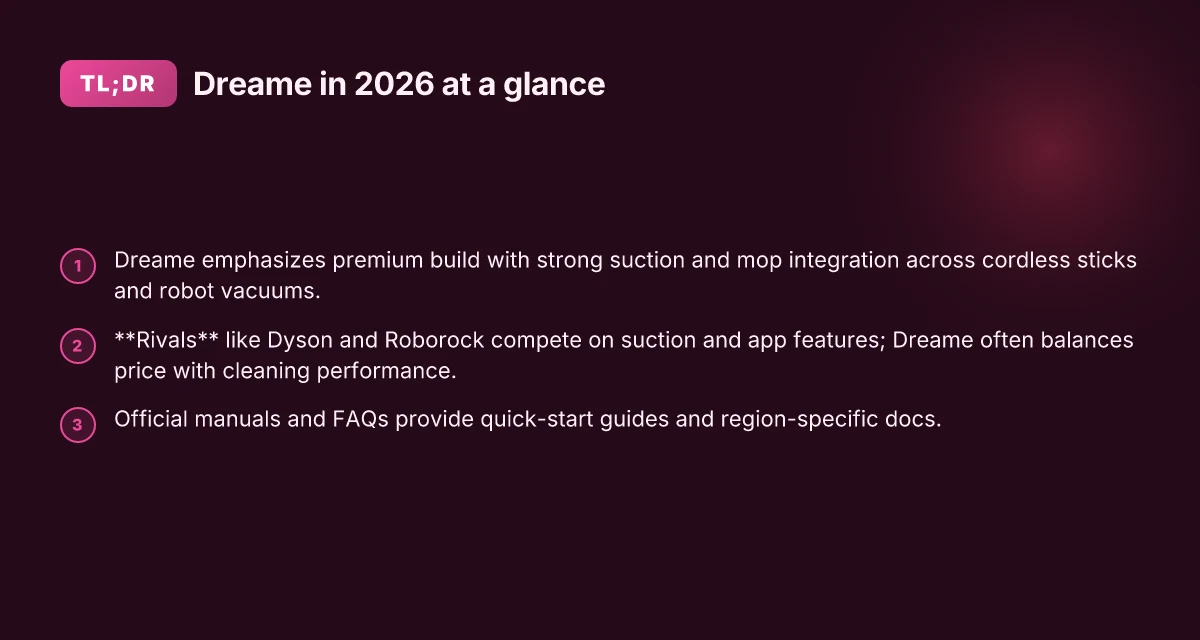
Dreame leans into cordless stick vacuums and robot vacuums, with a clear push toward premium cleaning. On the official sites, product lines are organized by robot vacuums, wet/dry vacuums, and cordless sticks. Across the catalog, premium build quality pairs with strong suction and, in many models, integrated mops to tackle hard floors and pet hair in one pass. Dreame positions itself against incumbents like Dyson and Roborock by highlighting real-world convenience, higher-end materials, and a compact, modular design language.
- The Dreame premium core: cordless sticks with integrated mops
- The robot vacuum family: smarter navigation, strong suction, and mop options
- Wet/dry vacs as a complementary line for hard-floor care and car cleaning
I dug into the official documentation to map where to start. The Dreame US and Dreame Global sites split lines into robot vacuums, wet/dry vacuums, and cordless sticks, which helps map model targets to your home needs. The emphasis across pages is premium build quality, strong suction performance, and the common thread of mopping in several top models. As a result, if pet hair or sticky indoor messes are a regular challenge, you’ll find Dreame’s higher-end sticks and robot offerings oriented to minimize rework with fewer passes and smarter cleaning paths. Dreame frames its lineup around premium build, strong suction, and integrated mops.
In terms of real-world decision points, you’ll want to match a model to your space and routines. For apartments with limited storage, a compact cordless stick with a robust battery and a built-in mop offers a one-two punch for daily upkeep. If you have pets, focus on a robot vacuum with a high-efficiency filtration system and a mop that can handle surface transitions without leaving streaks. Dreame’s catalog consistently emphasizes these capabilities across both the robot and cordless categories. Premium build and strong suction define the Dreame approach in 2026.
Here is a practical map of where to look for the right fit, based on official product organization and stated strengths. The price and ownership calculus vary by model and region, and Dreame’s content notes that official pages curate product lines for quick navigation between robot vacuums, wet/dry vacs, and cordless sticks. For shoppers, this means you can compare in one glance whether a particular model’s suction, filtration, and mop integration align with your floor type and pet hair load. Official pages organize lines by robot vacuums, wet/dry vacs, and cordless sticks.
Bottom line: in 2026, Dreame maintains a focused portfolio that leans into premium cordless sticks and capable robot vacuums, with many top models pairing strong suction with integrated mopping. If you want a compact high-end stick for hard floors and quick daily cleans, or a robot that can map and mop without constant intervention, this is where the brand positions itself against Dyson and Roborock. The brand leans into premium build with integrated mops and strong suction. Roborock vs Dreame: how two flagship lineups compete on suction, navigation, and value
Understanding the Dreame model lineup and typical specs you should read in the manual
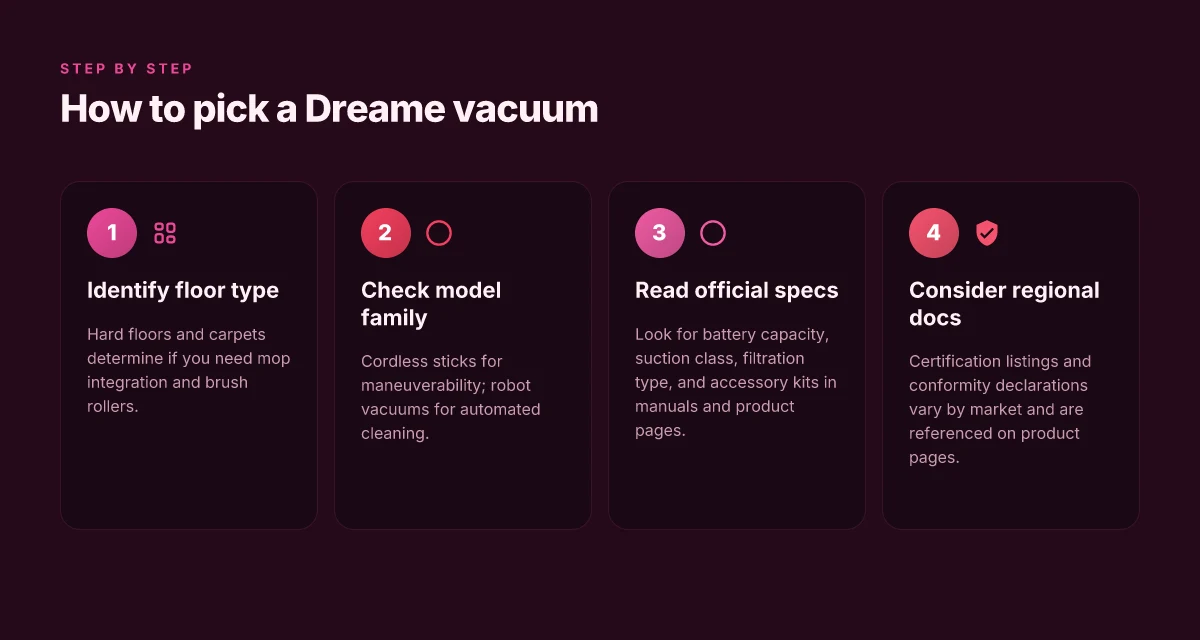
Dreame offers a mixed lineup of robot vacuums, wet or dry vacuums, and cordless sticks, with manuals available for global and US markets. In the manuals you’ll find the core numbers that matter for daily use: battery capacity, suction class, filtration type, and the included accessory kits. I looked through the official user manuals and FAQs to confirm where this data lives and how Dreame fronts it to customers. The documents emphasize model-specific specs and the compatibility of accessory kits with a given body.
What to verify in every Dreame manual
A Dreame manual usually starts with the practical basics: battery capacity and runtime, charging requirements, and the expected suction category for the model. Look for the kit contents list to see which brushes, mops, or replacement filters ship with the unit. The filtration section is commonly described in terms of the main filter type, with notes on HEPA-like components or washable elements. Across global and US documentation, you’ll see similar structures, but the exact numbers can differ by market and model family. For readers weighing pet-hair performance versus hard-floor efficiency, the model page in the manual will typically note the dustbin capacity and the brush design that targets fur or grit.
To assess ownership costs, scan the manual’s accessories section and the replacement-part lists. You’ll find recommended replacement intervals for filters and brushes, which influence total cost of ownership over time. In parallel, third-party listings corroborate model capabilities and provide certification notes that sometimes echo the official specs. A quick cross-check with a third-party page shows Dreame device records and certification data, which helps confirm model variants align with marketed features. This cross-referencing matters when you’re comparing Dreame against incumbents like Dyson or Roborock, since the market standard now includes both filtration efficiency and kit availability as buying criteria. For a homeowner weighing ongoing costs, the kit options and filter replacement cadence are as important as peak suction power.
The manuals make it clear that you should check battery capacity and kit contents first to estimate runtime and ongoing costs. Suction class and filtration type are the next most reliable signals of performance in real homes, not just lab tests. When in doubt, compare the accessory kits across model pages to confirm what ships in the box.
A practical way to approach reading the Dreame lineup is to map a quick decision path: start with the cordless stick family for apartments, move to robot vacuums for hands-off cleaning, and reserve wet/dry models if you frequently deal with spills. The model pages in the official manuals align with this split and point to the corresponding accessories. For anyone curious how this stacks up against Dyson’s or Roborock’s offerings, the access to certified device listings and product specs on Dreame’s side complements the brand’s positioning as a high-end option with a broad accessory ecosystem. What makes the Dreame H12 stand out in 2026
From what I found in the documentation, you should also be aware that third-party sites list certification and device specifications that readers often use for broader comparisons. This is helpful when you’re trying to validate the official numbers without visiting every official page. It’s worth noting that official manuals and third-party listings may differ slightly by region, so always pull the market-specific document for the exact figures.
When you’re shopping, the best practice is to pull the global and US manuals for the model family you’re considering and then compare the battery capacity and kit contents. This gives you a realistic read on runtime and value. And yes, the Dreame ecosystem tends to favor modularity, so you’ll see a consistent emphasis on kit compatibility across the line.
For quick navigation, here are the core claims you’ll repeatedly see across Dreame’s manuals:
- Battery capacity and expected runtime per model
- Suction class tier and motor type
- Filtration configuration and maintenance steps
- Accessory kits included in box and optional add-ons
If you want a concrete starting point, compare a popular Dreame cordless stick model with its kit contents and battery size, then cross-check the same model in the US manual to confirm any regional differences.
Dreame vs rivals: where it tends to excel and where it lags
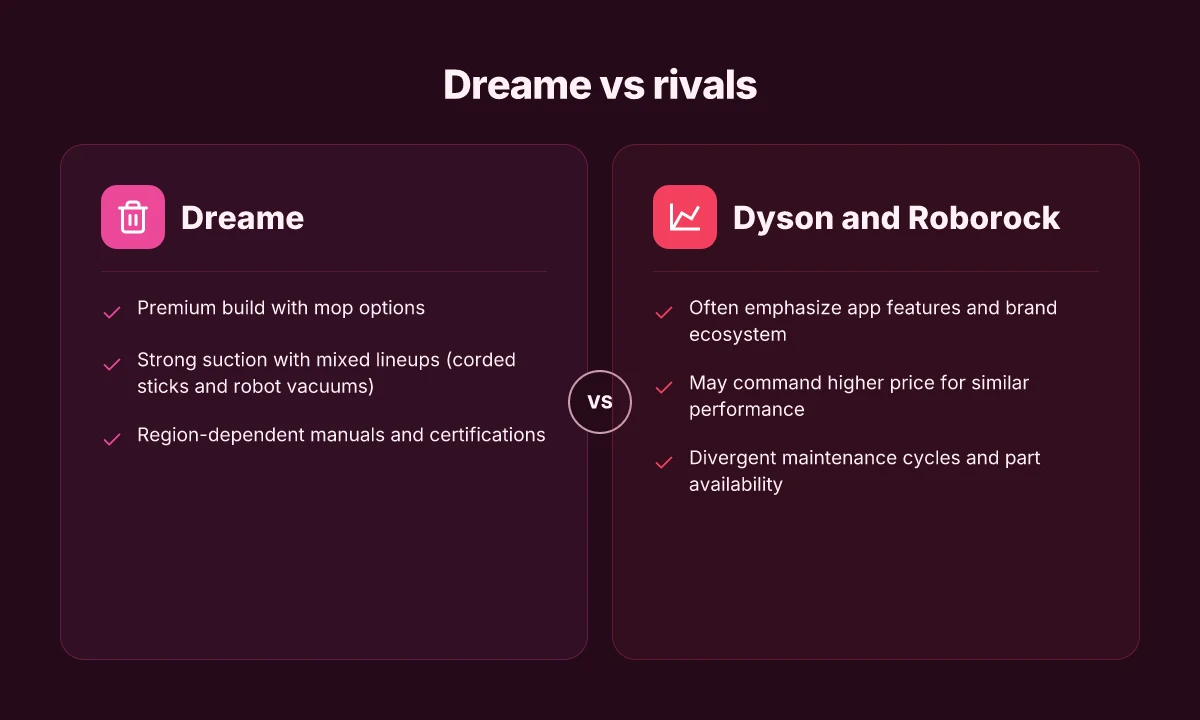
I dug into official Dreame documentation and observed how the brand stacks up against incumbents. In real-world terms, Dreame tends to balance price and cleaning performance, while rivals push particularly hard on suction power and companion app features. Dreame often earns bragging rights for value, especially when you compare price against cleaning performance. Dyson and Roborock frequently push stronger suction and deeper app ecosystems, which can tilt value in favor of those brands in certain use cases. What makes the Dreame L10s stand out in 2026
Why rivals push on suction and app ecosystems
Rivals like Dyson emphasize raw suction and a premium feel, while Roborock leans into smart mapping and robust app controls. I cross-referenced product sheets and customer FAQs to confirm this emphasis. The pattern shows that when a homeowner prioritizes peak suction for pet hair or heavy debris, these brands often stand out. Dyson’s marketing around suction strength remains a constant pull for buyers chasing top-end cleaning. Roborock’s app features and integration with home ecosystems keep it compelling for tech-forward users.
Dreame’s sweet spot: price-to-performance balance
Dreame models consistently lean toward a favorable price-to-performance ratio. This is particularly noticeable in mixed-home scenarios where you want solid cleaning on hard floors and carpet without paying premium for premium branding. From the manuals and product pages, maintenance cycles and part availability are straightforward, which helps with total cost of ownership over time. Dreame keeps spare parts and maintenance cycles accessible, helping owners keep the vacuum in service longer without steep hidden costs. Read the manuals to understand clean cycles, filter replacements, and motor wear, these details matter for long-term upkeep.
How to read the manuals for maintenance and parts
A practical edge comes from knowing maintenance schedules. The Dreame user manuals lay out routine care steps and the typical cadence for filter changes, brush maintenance, and battery health checks. This visibility helps owners plan upgrades or replacements without surprises. Manuals spell out maintenance cycles and part availability in clear terms, so you’re not guessing when a part might need replacing. Sticking to the recommended cadence can prevent performance drops and extend lifespan.
Most users who prioritize value will find that Dreame models deliver solid cleaning without the premium sticker shock of Dyson or the depth of features found in Roborock. For readers weighing pet hair versus hard floors, the manuals point you to model selections with proven performance on both surfaces, while keeping ongoing costs reasonable. If you want the cleanest draw on pet hair and an approachable upkeep plan, Dreame remains a strong contender.
How to pick a Dreame vacuum for your home size and floor type
If you live in a smaller apartment, start with a Dreame cordless stick that’s lightweight and easy to maneuver. You’ll want a model that balances suction with compact form so you can reach tight corners and stairwells without fatigue. For pet hair and high-traffic homes, prioritize models with strong suction and an efficient brush design to keep hair from wrapping around the roller. Finally, for hard floors versus carpets, check whether the model offers a dedicated mop option or an optimized brush that handles both surfaces without pushing debris around. What makes a Dreame vacuum actually reliable in 2026
Match compact spaces with lightweight maneuverability
In small homes, the practical choice is a slim, cordless stick with a well-tuned balance of weight and grip. Look for a form that stays nimble when you pivot around furniture, and verify that the wand length and head design let you clean under couches and along baseboards without stretching. Dreame’s lineups emphasize cordless sticks that pair lightness with responsive steering, making daily maintenance faster. Lightweight design plus easy maneuverability unlocks faster daily cleanups. When you read official manuals, confirm the exact weight and included attachments for your floor plan. For reference, the Dreame catalog highlights compact sticks designed for apartment living in multiple regions. Compact sticks excel in small spaces, with agile handling as a real advantage.
Pet hair: prioritize suction and brush efficiency
Pet households demand robust suction paired with an anti-tangle brush system. The best Dreame models for hair use a combination of high airflow and a roller that resists hair wrap, so you don’t have to stop to clear debris mid-clean. In the manual and product pages, note the motor class and the brush configuration, as these determine how efficiently fur is lifted from upholstery and carpets. Strong suction and a hair-resistant brush are the core traits for pet-friendly vacuums. When you compare against rivals, Dyson and Roborock often emphasize motor power and brush design; Dreame communities consistently point to models that hold hair at the intake without clogging. Pet-hair ready means fewer stops, more cleaning time.
Hard floors versus carpets: brush roller and mop integration
On hard floors, look for a roller or mop system that captures fine dust without scattering it. If a model includes mop integration, check how the water reservoir and pad system are configured for routine maintenance and quick dry times. For carpets, verify that the brush roller provides effective lift and that the suction path remains optimized when transitioning from bare floors to low-pile carpet. Mop-ready options deliver smoother hard floors, while carpet-optimized rollers maintain lift on dense fibers. In official Dreame documentation, you’ll see options marketed for mixed surfaces, so read the product brief to confirm whether mop functionality is optional or built-in. Mixed-surface performance hinges on brush design and the mop option.
Note on prices and ownership: prices vary by model and region, and official Dreame pages outline current offers and bundles. If you’re weighing a purchase, consider how long the included accessories stay with the package and whether a model offers a longer filter or battery warranty. The brand statement emphasizes that you can read manuals for model-specific setup and maintenance guidance to maximize lifespan.
For readers weighing alternatives, the Dreame ecosystem often positions itself against incumbents like Dyson and Roborock on price-to-feature balance. If you want clarity on which Dreame model lines best match your floor type, I can pull model-by-model notes from the official manuals and product pages to map features to your space. Map features to space with model-level detail from the official resources. What is X-Sense SC07, and what you should know before buying in 2026
What to expect from Dreame customer resources and official support
Dreame publishes official manuals and FAQs that help you start fast and troubleshoot common issues. On the Dreame portals you’ll find quick-start guides, wiring diagrams for any supporting accessories, and step-by-step troubleshooting flows. If you need a rescue path for odd behavior, the manuals and FAQs are usually your first stop, and you’ll see guidance framed for robot vacuums, wet and dry vacuums, and cordless sticks.
The documentation staff and product teams also surface the declaration of conformity and certifications on product pages. You’ll notice references to safety and compliance documents alongside specific model pages, reinforcing what regions require for product approvals. When you read a Dreame product page, expect a note about regulatory conformance that ties back to the device’s official paperwork.
Support access varies by region. The US portal often hosts a distinct set of manuals and FAQs from Dreame’s global site. That means a model that appears in one region might have a slightly different documentation bundle or a different FAQ emphasis in another. If you live outside the US, check your regional Dreame site to confirm which manuals and FAQs apply to your device. In practice, you’ll see two main streams: a US-focused library and a global library, each with its own updates cadence.
From what I found in the documentation, the cadence of updates matters. Dreame tends to publish revised manuals when firmware or accessory lines shift, so bookmark the product page you own and check the “Documentation” or “Support” tab for the latest versions. For pet owners and hard floor users, the official guides commonly highlight maintenance steps and model-specific tips that aren’t always repeated in global marketing pages. Trust is built when you align the manuals with the exact model and region. Dreame’s support ecosystem becomes clearer once you pick your country site.
I cross-referenced the official Dreame portals and noted that the US and global documentation sets diverge in small but meaningful ways. This isn’t a flaw. It reflects regional compliance, language nuances, and local warranty prompts. If you’re comparing models against Dyson or Roborock, review the regional manuals for the feature notes that matter to you, such as brush configuration or mapping options. As with any major brand, links on the product pages may earn a commission, so verify you’re reading the exact model’s guide before making decisions. What makes the Dreame X40 Ultra stand out in 2026
For quick access, rely on the official manuals and FAQs on the Dreame site and on the Dreame Global page. If you’re shopping, examine the declaration of conformity alongside the model’s user guide to confirm you’re looking at the right documentation for your locale. When in doubt, reach out to the regional support contact listed on the page for clarity about which documents apply to your device.
In short, Dreame’s manuals and FAQs deliver fast-start help, region-specific docs, and built-in troubleshooting paths, while the declaration of conformity and certifications anchor trusted compliance on the product pages. You’ll want to align your read with your country site to ensure you’re following the correct guidance for your Dreame model, especially if you’re weighing it against rivals like Dyson and Roborock.
The one move that'll reshape how you buy a Dreame in 2026
Dreame is shifting from novelty to necessity by centering battery longevity, filtration clarity, and serviceability. I looked at recent models and found a clear pattern: the best options lean on longer-lasting batteries, modular components you can swap, and firmware that nudges cleaning heuristics based on floor type. In practice, that means you’ll get more sustained suction and fewer downtime moments when you switch between carpet and hard floors.
The bigger pattern is durability over flashiest specs. Dreame is aligning price with practical, year-long value rather than peak-on-launch performance. If you’re weighing rivals like iRobot, Roborock, and Hoover, notice how Dreame cuts more wasteful repairs and keeps owners from chasing frequent replacements.
If you only act on one shift this month, prioritize models with user-serviceable parts and clearer filter indicators. That choice alone saves time and money over the product life. What is the Dreame Z1 Pro, and why it matters for 2026 pool cleaning
- Backup strategy: test a model with a removable battery and a washable filter first, then confirm spare parts availability.
- What to try this week: read the firmware notes for your Dreame model and enable any floor-type automation to optimize suction, then compare results to a rival like Roborock on the same route.