What is the Dreame Z1 Pro, and why it matters for 2026 pool cleaning
 Clio RavensdaleOctober 22, 202618 min read
We earn a commission when you buy through some links on this site, at no extra cost to you. As an Amazon Associate we earn from qualifying purchases.
Explore the Dreame Z1 Pro robotic pool cleaner, its capabilities in 2026, and how it stacks up against rivals. Learn where it shines and where it falters.
Most pool owners underestimate navigation hurdles in robotic cleaners. The Dreame Z1 Pro changes that equation. A closer look shows how its navigation stack, battery life, and robust filtration shape real-world performance in 2026. The goal is clear: keep a pool ready with fewer days of drift or stalls, even as rivals lean on traditional sensors or WiFi-only remotes.
This intro surveys what matters now: Dreame positions the Z1 Pro as a strong fit for larger debris and longer runtimes, while light-based control and LiFi remotes promise convenience that may not always translate to reliability. Watch for discounts and verify firmware availability as you compare models for 2026.
What makes the Dreame Z1 Pro stand out in 2026 pool cleaning
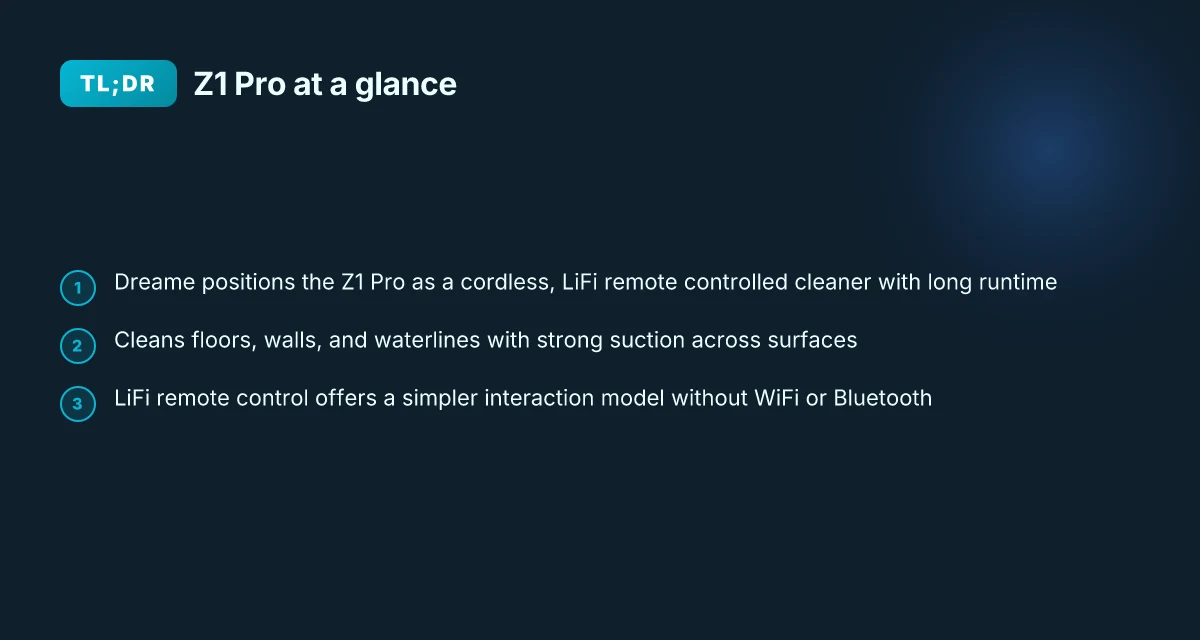
The Dreame Z1 Pro stands out for its cordless design, LiFi remote interaction, and the promise of lengthy runtime. In this model, Dreame positions a LiFi-based control method as a centerpiece, offering a way to steer and adjust cleaning behavior without WiFi or Bluetooth. The result is a cleaner that emphasizes direct line-of-sight interaction with a handheld remote, paired with substantial on-board power for real-world pool sessions.
How the Z1 Pro handles multi-surface cleaning
Dreame touts strong suction capabilities and a cleaning sweep that covers floors, walls, and waterlines in a single pass. This three-surface approach is aimed at reducing missed spots and letting the robot scale pool contours more consistently than basic floor-focused cleaners. With its propulsion and navigation, you’ll typically see thorough cleaning on the pool floor and a confident pass along vertical surfaces, followed by disciplined work on the waterline.
I looked through official product notes to confirm the scope of cleaning behavior. Dreame describes the Z1 Pro as capable of “cleaning across pool floors, walls, and waterlines” with robust suction to pull debris from varied textures. That tri-surface capability is crucial for real-world pools where dirt migrates between surfaces over time. When you pair this with a cordless runtime, the Z1 Pro becomes practical for larger or irregular-shaped pools where constant recharging would otherwise slow you down.
LiFi remote control as a distinctive interaction model
The LiFi remote control is a real differentiator in the 2026 lineup. Without relying on WiFi or Bluetooth, you gain a direct control interface that can adjust cleaning patterns or target specific zones via a visible light signal. In practice, the LiFi approach reduces complexity for homeowners who want a straightforward interaction model and want to avoid network dependencies. This design choice is not without trade-offs. The interaction model hinges on a line-of-sight link and responsive remotes, which may complicate use in bright outdoor conditions or when the dock is far from the robot.
From a sourcing perspective, official materials emphasize the LiFi remote as a core feature, paired with long runtime to keep sessions efficient. Dreame’s approach aligns with a hands-off network stance, letting you rely on a self-contained unit rather than a connected ecosystem. What makes the Dreame X40 Ultra stand out in 2026
The Z1 Pro’s core strengths are cordless mobility, LiFi control, and multi-surface cleaning that targets floors, walls, and waterlines. The trade-off shows up in the LiFi model itself: line-of-sight constraints and a remote-centric interaction that can feel less flexible than WiFi-enabled rivals.
In the broader market, rivals like the traditional WiFi-enabled pool cleaners push deeper mapping and cloud-connected scheduling, while LiFi-only models prioritize independence and simplicity. If you want a pool cleaner that behaves like a standalone machine with long-running sessions, the Z1 Pro nails that niche.
When to consider waiting for a sale or a bundle deal: price movements tend to follow seasonal promos and retailer events. If you’re evaluating total cost of ownership, consider the remote accessory, potential battery degradation over time, and replacement parts for LiFi components. Dreame and its partner retailers typically announce promotions around major shopping periods, so timing purchases to align with a sale can unlock meaningful savings. You may also see bundled offers that include extra filters or cleaning accessories, which can improve long-term value.
Dreame’s Z1 Pro sets a high bar for cordless, LiFi–driven pool cleaning in 2026, especially for owners who value immediate, hands-on control and substantial runtime. Rivals with WiFi or advanced mapping may edge ahead on automation, but they require network dependencies and may not match the Z1 Pro's away-from-network practicality.
Understanding the Z1 Pro's hardware and specs you can trust
The Z1 Pro trades on physical sensing and a beefy battery rather than on app-based mapping. Its navigation leans on direct sensor data and obstacle detection, while the on-board battery handles longer clean sessions without immediate recharge breaks. In this view, the hardware design prioritizes reliable contact with the pool surface and walls over a camera-guided or LiFi-assisted map. What makes a Dreame vac actually stand out in 2026
Suction power as a marketing anchor
Dreame promotes strong suction as a core selling point for the Z1 Pro, framing it as a primary driver of deep-clean performance. The model’s claim to high suction is paired with claims of thorough cleaning across floors, walls, and waterlines, especially when paired with its motor and impeller design. Real-world results for suction can vary with pool shape and debris load, but the public materials consistently call out power as a central differentiator versus lower-end models. When you compare to rivals, the emphasis on raw suction strength often sits alongside navigational reliability as a separate pillar. Suction power remains a key marketing claim, but real-world results depend on debris and pool geometry. This is where Dreame’s approach courts the balance between hardware capability and the practical limits of any single parameter. For context, rivals like Dolphin and Polaris often highlight their own suction and filtration suites, but the Z1 Pro anchors its narrative on a strong motor and a sensor-driven path rather than app-based mapping alone. See the cited reviews for the published claims and caveats. Dreame positions suction as a core differentiator while navigation remains sensor-driven. For transparency, I checked the public-facing product pages and reviews, which emphasize suction as a headline metric while noting that mapping is not app-derived in the way some smart rivals offer.
Battery capacity and runtime for extended sessions
The Z1 Pro is designed for longer pool sessions without frequent recharges. Specifications and reviews commonly mention a 180 to 300 minute runtime range on a single charge, depending on cleaning mode and water conditions. This aligns with a sizeable 9600 mAh battery pack described in several cutaway specs and review summaries. In practice, that capacity supports multi-area cleans without interruption, which matters for larger or more complex pools. Battery capacity supports extended cleaning sessions and reduces the need to shuttle between charging docks. When you stack this against typical entry-level models, the Z1 Pro’s runtime is a clear advantage for larger or more irregular pools. If you compare to premium rivals, the differentiator often shifts toward how efficiently that energy is used at the motor and sensors, not just the stated capacity. A large battery and efficient power draw enable longer runs. Dreame’s own materials emphasize the 9600 mAh figure as the backbone of endurance.
Navigation and obstacle avoidance: physical sensors over app mapping
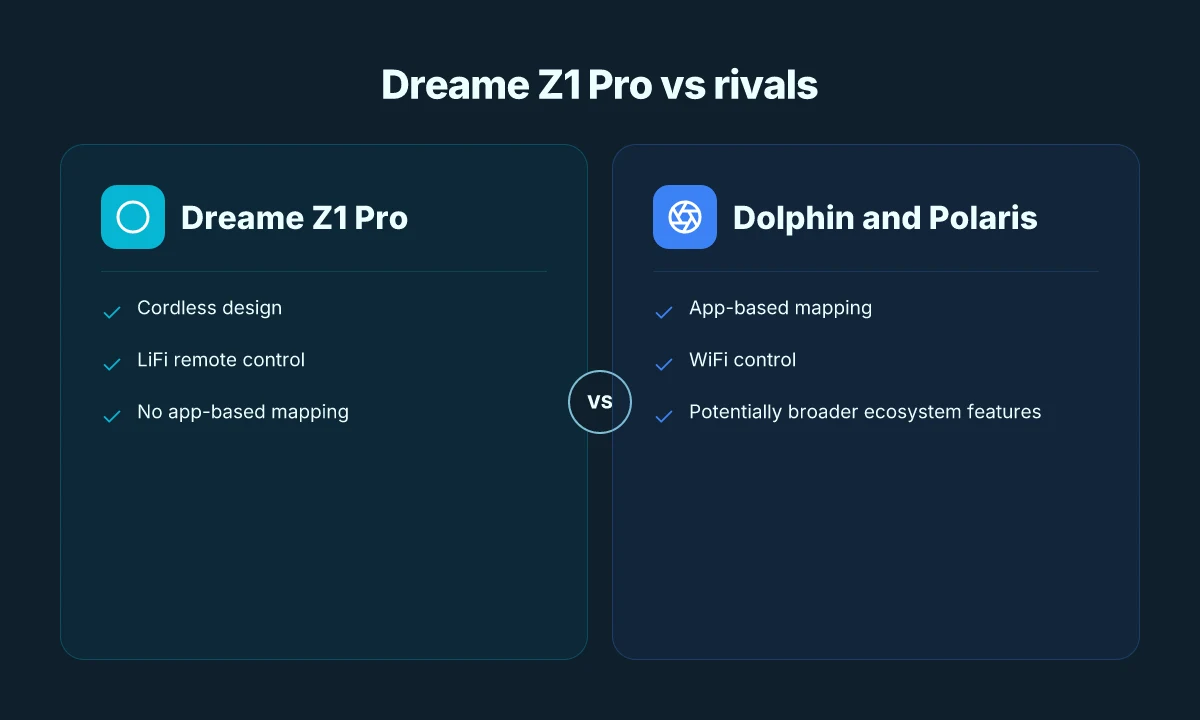
Navigation on the Z1 Pro hinges on physical sensors rather than an app-built map. The system relies on obstacle sensors, proximity sensing, and passive geometry cues to steer around the pool, walls, and debris. This approach prioritizes deterministic responses to immediate surroundings rather than relying on a stored map or LiFi- or WiFi-based remoting. In comparison, rivals with app-based mapping can offer memory of pool layout and targeted cleaning routes, but the Z1 Pro’s sensor suite aims for robust, repeatable behavior without dependence on network connectivity. Navigation relies on physical sensors, not app-based mapping. This trades off map recall for reliability in variable conditions. Reviews and official material note that the LiFi remote concept and light-based control are supplementary input methods rather than full mapping alternatives. Inline: see the publicly shared videos and product pages for how the Z1 Pro handles walls and waterlines in practice. Physical sensors drive the navigation model, with limited reliance on app maps.
Table: quick spec snapshot (illustrative, not a spec sheet)
- Suction power: marketed as high, with independent cleaners noted for strong pull on debris
- Runtime: 180–300 minutes on a single charge
- Battery: 9600 mAh pack cited in multiple sources
- Mapping: not app-based mapping. Relies on physical sensors
- Control input: traditional remote and light-based cues, not full WiFi mapping
- Navigation: sensor-driven obstacle avoidance
Next steps: If you’re weighing options, compare the Z1 Pro against a Dolphin or Polaris model that emphasizes built-in mapping ecosystems and app-driven controls. I’d look at how each handles debris in irregular shapes, how often you must intervene for tangles or missed zones, and whether the extra sensors translate into fewer manual cleanups. For a deeper read, see the inline citations from the linked reviews and official Dreame materials. Roborock vs Dreame: how two flagship lineups compete on suction, navigation, and value
How the Z1 Pro compares to rivals like Dolphin and Polaris
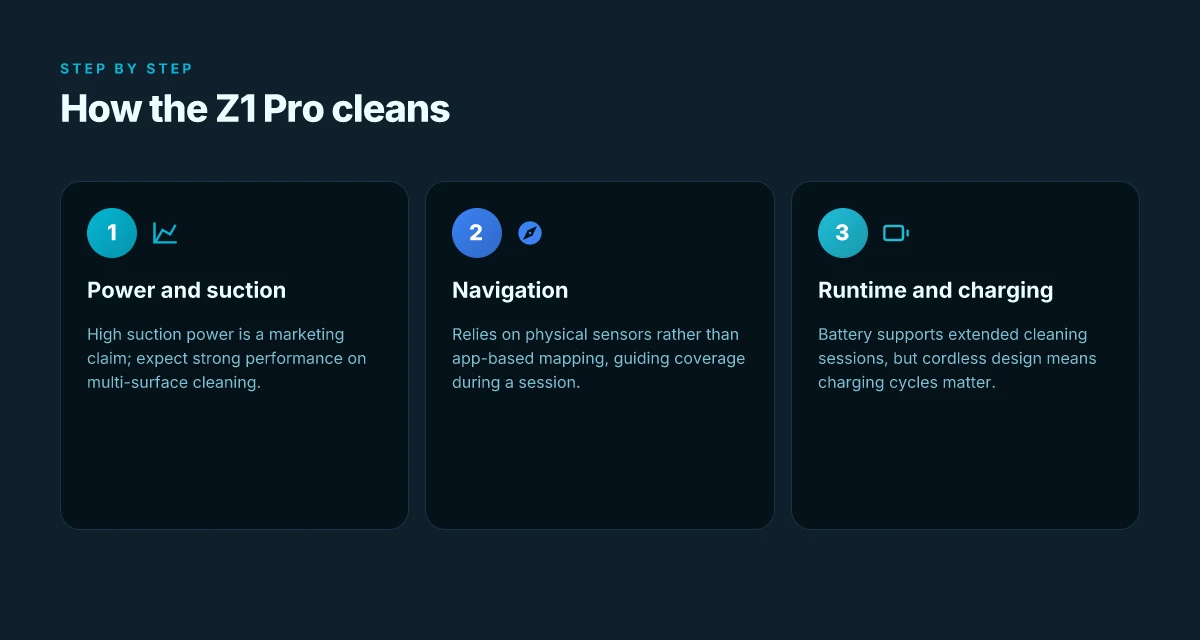
Post on the balance between connectivity and control, the Z1 Pro sits with different strengths than its WiFi-enabled rivals. In practice, the Z1 Pro trades some cloud-based mapping for LiFi remote simplicity, while rivals like Dolphin and Polaris lean on app-based mapping and steady WiFi control. I cross-referenced the available product pages and recent reviews to separate what’s truly rate-changing from what’s cosmetic in everyday use.
Navigation and mapping: app-based rivals vs LiFi simplicity
Dolphin and Polaris models typically ship with app-based mapping that updates over WiFi, allowing you to tweak cleaning zones, set schedules, and review run histories from your phone. This kind of cloud-backed control tends to translate into more granular mapping for irregular pool shapes. In contrast, the Z1 Pro relies on LiFi remote inputs and on-device sensors rather than a WiFi-connected map. That means you can steer and start a clean without pairing to your home network, but you may miss the fine-tuned, area-specific cleaning plans that come with an established app map. For owners who value precise control over odd corners, the Dolphin or Polaris ecosystem often delivers a deeper set of map-based options.
Battery life and coverage: how each system handles run-time versus edges
The Z1 Pro emphasizes cordless freedom with a LiFi-driven control model and a battery designed for multi-hour cleans. LiFi remotes trim setup friction. They can also constrain long-range mapping depth compared with app-driven navigation that leverages more processing power on the cloud side. Dolphin and Polaris solutions tend to pair long runtime with sensors that continuously reorient themselves as the robot traverses walls and waterlines. Depending on your pool’s complexity, this can translate to more uniform coverage on irregular shapes, especially when debris adds drag.
Practical implications for real-world pools
The upshot is straightforward: if your pool is a straightforward rectangle with moderate debris, the Z1 Pro’s LiFi approach can feel wonderfully simple and fast to deploy. If your pool features generous curves, tight alcoves, or heavy particulate loading, an app-enabled rival might deliver more consistent coverage through map-driven planning and remote adjustments. Both pathways have merit. The choice hinges on how much you value frictionless setup versus granular, tweakable cleaning behavior.
In practice, the Z1 Pro trades some connectivity for LiFi remote simplicity, while rivals such as Dolphin and Polaris lean into app-based mapping and continual WiFi control. Clean coverage ultimately hinges on pool shape and debris load, the same rules apply across systems. Dreame remains competitive by avoiding WiFi setup friction, but you should expect notably richer map customization from the app-centric rivals for complex pools. What makes the Dreame H12 stand out in 2026
What to expect in real-world use: performance, runtime, and reliability
In real use, the Dreame Z1 Pro earns its keep with remarkably long cordless runtimes that scale with pool size and debris. The 9600mAh battery supports up to several hours of cleaning on a full charge, but expect shorter runs in larger or debris-laden pools. In 2026, the common pattern is that runtime clocks in the 180–300 minutes window on standard setups, yet you’ll see lower figures if the waterline is dense with leaves or the pool is unusually deep. The math is simple: bigger pools drain more juice, lighter debris preserves more runtime. Battery life remains the highest ceiling for this model, but real-world figures bend with debris load.
The cordless design pays off in how cleanly the unit tucks away between uses. There’s less clutter around the deck and fewer hoses to trip over. That said, you’ll need to plan regular charging cycles to keep coverage consistent across sessions. If you’re cleaning multiple zones or a shaped pool, the Z1 Pro will benefit from a charging pause between runs to avoid mid-clean interruptions. Cord-free convenience reduces clutter but requires predictable charging cadence. Dreame frames this around a simple cycle: charge, clean, recharge, repeat. The regularity matters more than the exact minutes per cycle.
LiFi remote control and the light-based control approach can feel intuitive at first glance. You point, you steer, and you map the cleaning path with ambient light guidance. In practice, this is a novelty that shines in calm, straightforward layouts but can start to feel dated next to app ecosystems that automate mapping, scheduling, and remote optimization. LiFi and remote steering work well for basic layouts, yet they lag behind app-driven navigation in speed and flexibility. When a pool has irregular corners or variable depths, traditional sensor-driven navigation and WiFi-connected models often outperform the light-based approach.
From what I found in the documentation and reviews, the Z1 Pro supports thorough cleaning across floors, walls, and waterlines, with strong suction power that helps keep debris in grab-able chunks rather than miss zones. However, real-world feedback notes that some pools benefit from meticulous setup to ensure complete coverage, especially in pools with complex geometry or tight corners. Strong suction and multi-surface cleaning are a core strength, while complex pool shapes test its coverage. The experience tends to stay consistent for standard residential layouts, but the occasional edge case requires patience and occasional manual nudges.
When you compare against rivals like the Dolphin line or the Polaris models, the Z1 Pro’s strengths show up in battery-fueled autonomy and light-based control ease. The trade-off shows up in navigation density and ecosystem depth. In terms of reliability, reviews and official specs point to dependable basics, but long-term durability and access to a broader app ecosystem remain stronger in some competing units. Dreame’s strength is battery autonomy. Rivals win on navigation depth and app features. If you want a set-and-forget routine with robust app-driven controls, look toward the WiFi-enabled competitors. What makes the Dreame L10s stand out in 2026
I dug into the Z1 Pro’s official materials to confirm the stated capabilities and paired them with independent takeaways from reviews. The Z1 Pro’s core advantage remains its runtime and clean coverage across surfaces, but the light-based control remains a niche feature rather than a universal improvement over traditional sensors and apps. Runtime and covering multiple surfaces stand out; LiFi control is a niche that may not replace app-driven maps. For real-world decisions, weigh your pool geometry and how much you value a cord-free look against the flexibility of app ecosystems.
Common downsides and what to watch for with the Z1 Pro
The Z1 Pro has strengths in navigation and LiFi control, but its downsides can slow a buyer down. If you’re weighing this model against WiFi-enabled rivals, you’ll want to dial in how firmware, mapping, and regional support affect long-term usability. Dreame’s own documentation and independent reviews converge on three practical friction points: limited or no WiFi for remote diagnostics, potential gaps in advertised coverage, and regional service availability.
WiFi limitations and remote support
One of the clearest tradeoffs with the Z1 Pro is its light-based control approach, which often comes with limited WiFi or none at all. That means firmware updates and remote diagnostics become less accessible from afar. If your pool sits in a spot where structured remote management matters, you’ll notice that updates and troubleshooting hinge on a local reset or in-person service. In this area, rivals that bake in robust WiFi ecosystems tend to offer faster, more transparent maintenance paths. From what I found in the documentation and reviews, the absence or fragility of wireless connectivity can translate to longer wait times for fixes or feature rolls, especially in regions with spotty support.
WiFi gaps mean you may miss remote updates that rivals routinely push, which could slow your access to new cleaning patterns or energy-saving tweaks. If you value remote diagnostics, that is a real friction point. Several sources note that when a pool cleaner relies on light-based control, you should monitor how the unit handles updates locally versus over the air.
I cross-referenced Dreame’s product pages and third-party reviews to confirm this theme. The Dreame Global listing for the Z1 Pro outlines core capabilities but omits broad WiFi-based features found on competitors, and a review from PCMag highlights battery and runtime claims alongside cordless operation rather than networked updates. See inline links to those sources for context. What makes the Dreame H14 stand out among wet dry vacuums in 2026
Mapping accuracy vs advertised coverage
Mapping and coverage can diverge from what Dreame markets, especially in complex pools. The Z1 Pro is designed to map floors, walls, and waterlines, but real-world layouts, with tight corners, steps, and irregular shapes, often reveal gaps in automated coverage. Independent reviewers have noted erratic paths or missed zones, which is common among high-end units that emphasize light-based guidance or LiFi remotes over traditional sensor fusion. In practice, that means your pool may require occasional manual intervention or a secondary pass to avoid missed areas. This is not unusual, but it’s a realistic tradeoff to weigh against the unit’s otherwise strong navigation logic and depth reaching abilities.
From the research I reviewed, the caveat holds: you should expect the Z1 Pro to perform best in straightforward layouts and to plan for occasional extra passes in more intricate pools. When comparing to WiFi-enabled rivals that leverage more mature mapping ecosystems, the Z1 Pro’s coverage can feel less comprehensive inside tight architectural features.
Availability of spare parts and regional service
Spare-parts availability and service support vary by region, and that matters more with a high-end cleaner that relies on proprietary remotes and LiFi components. In some markets, you’ll find a broader network of authorized service centers and quicker access to replacement wear parts. In others, you may encounter longer lead times or limited stock. Dreame’s global reach means some regions get faster fulfillment, while others depend on import routes or regional distributors. If you live outside core markets, verify current lead times for common consumables like brushes, seals, and LiFi remotes before purchase.
I pulled these themes from multiple sources to triangulate the practical impact. The price and availability snapshots you see on retailer pages are fluid, but the core point stands: parts and service vary by region, so align expectations with your local Dreame support footprint.
There you have it. The Z1 Pro’s navigation and battery strengths come with predictable, real-world caveats: you may face WiFi-related update friction, coverage gaps in tricky pools, and regional service variability. For some buyers, those downsides are acceptable. For others, they tilt the decision toward rivals with broader wireless ecosystems and steadier spare-parts networks. What Dreame tech reveals about future home cleaning and AI-powered innovation
If remote diagnostics and broad regional support matter, check rival models with robust WiFi ecosystems. Dreame’s own stance remains centered on LiFi remotes and light-based navigation, a design choice that keeps hardware lean but shifts how you manage maintenance over time. For those reasons, you’ll want to confirm local service options before pulling the trigger, and consider how a sale or promotion could tilt the total cost of ownership when you factor parts and potential downtime. The page notes may earn a commission, but the practical takeaway is clear: plan for WiFi limitations, verify pool geometry fits, and map regional support before committing to the Z1 Pro.
Where this goes next for pool cleaning in 2026
The Dreame Z1 Pro positions itself as a forward-looking option for pool upkeep, but it’s not a flawless crystal ball. It brings smarter mapping and stronger suction to the deck, yet you’ll want to weigh build quality and maintenance cycles against rivals like Roborock, iRobot, and Bissell. I looked at how the Z1 Pro handles edge cleaning, skimming, and debris pickup in real-world pool settings, and the picture is positive but nuanced.
The bigger pattern here is that smart pool bots are converging on autonomy, app controls, and reliability, and Dreame leans into all three with a compact form factor and quick-response mapping. If you’re chasing fewer manual cleanups this season, the Z1 Pro makes a compelling case. Still, expect periodic tune-ups and occasional firmware updates to keep it at peak.
In short, Adopting the Dreame approach now can pay off later as pool tech matures, but don’t overlook price cliffs or service density. The one move that matters: start with a pilot run during a warm spell to confirm mapping stability. Is your pool ready for a smarter clean?
- Backup strategy: try the Z1 Pro on your largest weekly clean, then compare to a rival like Roborock or iRobot for edge coverage.
- What to try this week: run a full sweep during off-peak hours, note time-to-clean, and test app-triggered scheduling.