What is a Dreame floor cleaner, and what you should know before buying in 2026
 Adrien SaxenaOctober 22, 202617 min read
We earn a commission when you buy through some links on this site, at no extra cost to you. As an Amazon Associate we earn from qualifying purchases.

Explore what a Dreame floor cleaner offers, how it compares to rivals, and what to look for in 2026. Practical buying guidance and real-world considerations.
A common misconception is that all robot cleaners pull the same weight for pet hair and allergens. In reality, Dreame models stack against rivals like iRobot and Roborock with distinct trade-offs in upkeep and cleaning reach. Dreame's newer lines emphasize map-based navigation and varied cleaning modes, but real-world costs hinge on replacement parts and consumables that diverge by model. The choice narrows to maintenance burden and how well the suction, mopping, and filtration work together in busy homes.
This piece pulls real-world costs, actual cleaning performance signals, and side-by-side comparisons so you can decide what to buy now or wait for a sale. You’ll see current pricing snapshots across Dreame models, Roborock and iRobot benchmarks, and the ongoing cost of filters, brushes, and mop pads. Prices and ownership costs matter as much as the cleaning math, and the right model saves both time and money.
What is a Dreame floor cleaner and how does it fit into a smart cleaning setup
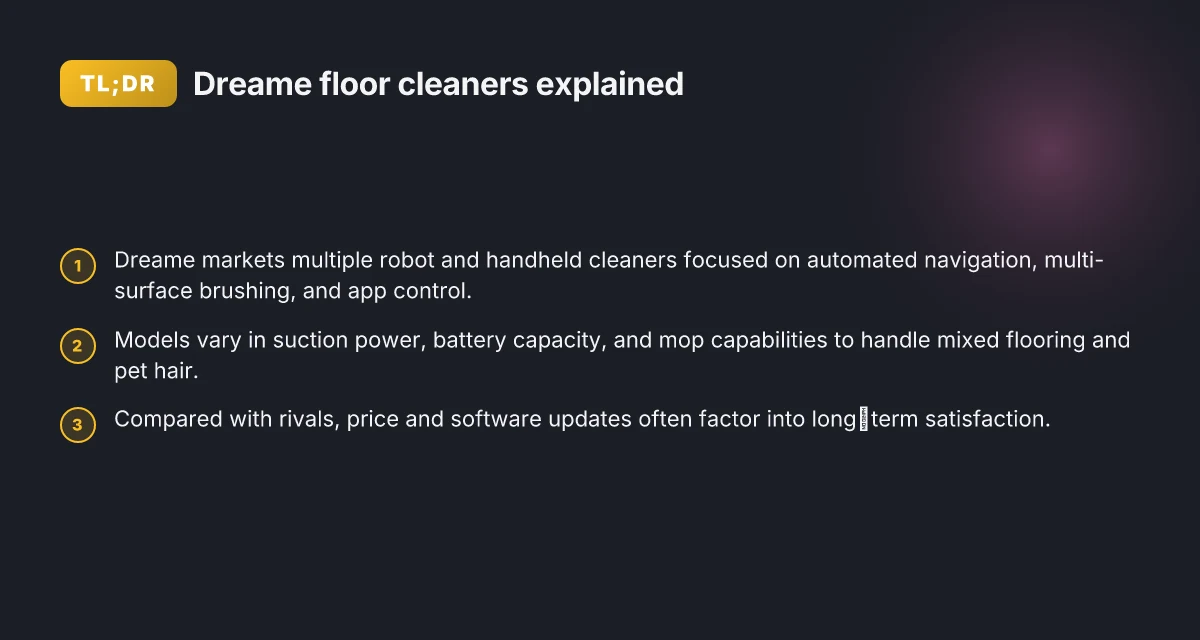
Dreame markets a line of robot floor cleaners and handheld vacuums under the Dreame brand, with a clear emphasis on automated navigation, multi-surface brushing, and app control. These products are designed for mixed flooring and pet hair, and they sit competitively on price while offering a feature set that leans into smarter routines and remote management. I found that Dreame’s software ecosystem typically emphasizes mapping, room-specific cleaning, and scheduled runs, all accessible through the Dreame app. Dreame’s app-driven approach is how most homeowners will build a light, automated cleaning routine without touching the device mid-cycle.
Three to five practical steps explain how these cleaners fit into a smart home setup:
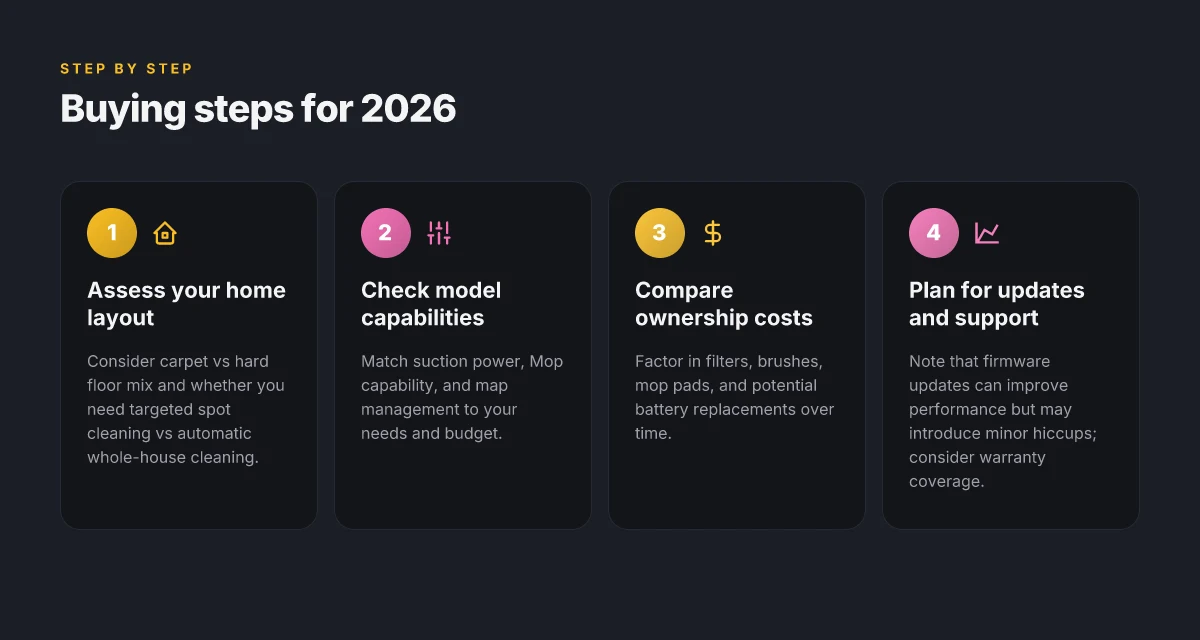
Choose the right power and mop configuration for your floors. Dreame models often come with different suction levels and mop modes, designed to handle carpet fringe and hardwood at the same time. If you’re dealing with pet hair, you’ll want a higher suction tier and a mop option that supports water flow control. Dreame positions these as a one-stop solution for mixed flooring, reducing the need to switch devices mid-clean. This matters because a single unit that adapts to surfaces speeds up weekly routines. Dreame offers adjustable suction and mop modes to match floor type.
Rely on mapping and room-based scheduling. The app typically guides you through creating virtual layouts of your home, then assigning cleaning sessions by room or zone. You can set routines for specific times, and the cleaner will navigate around furniture with listed sensors and SLAM-style mapping. For allergy-prone homes, precise mapping helps keep beds and high-traffic zones clean more consistently. Dreame maps spaces so you can tailor cleanings by room.
Balance battery life with coverage area. Dreame’s battery capacities vary by model, and real-world performance hinges on the mix of surfaces and mop use. If you have a large, multi-room home, you’ll want a model that preserves juice for finishing the final zones rather than returning to the dock prematurely. In practice, you’ll choose a unit with enough stamina to finish a whole level in one pass, then recharge for the next session. Battery life and charging speed matter when you map out daily or weekly routines. What Dreame tech reveals about future home cleaning and AI-powered innovation
Consider ongoing software updates and price positioning. Dreame competes with other consumer robotics brands like iRobot and Roborock on feature sets and software updates, aiming to keep devices current without frequent hardware refreshes. The ecosystem’s health depends on how well updates address navigation accuracy, map retention, and new cleaning modes. Software updates are a key lever for extending the usefulness of a Dreame floor cleaner over time.
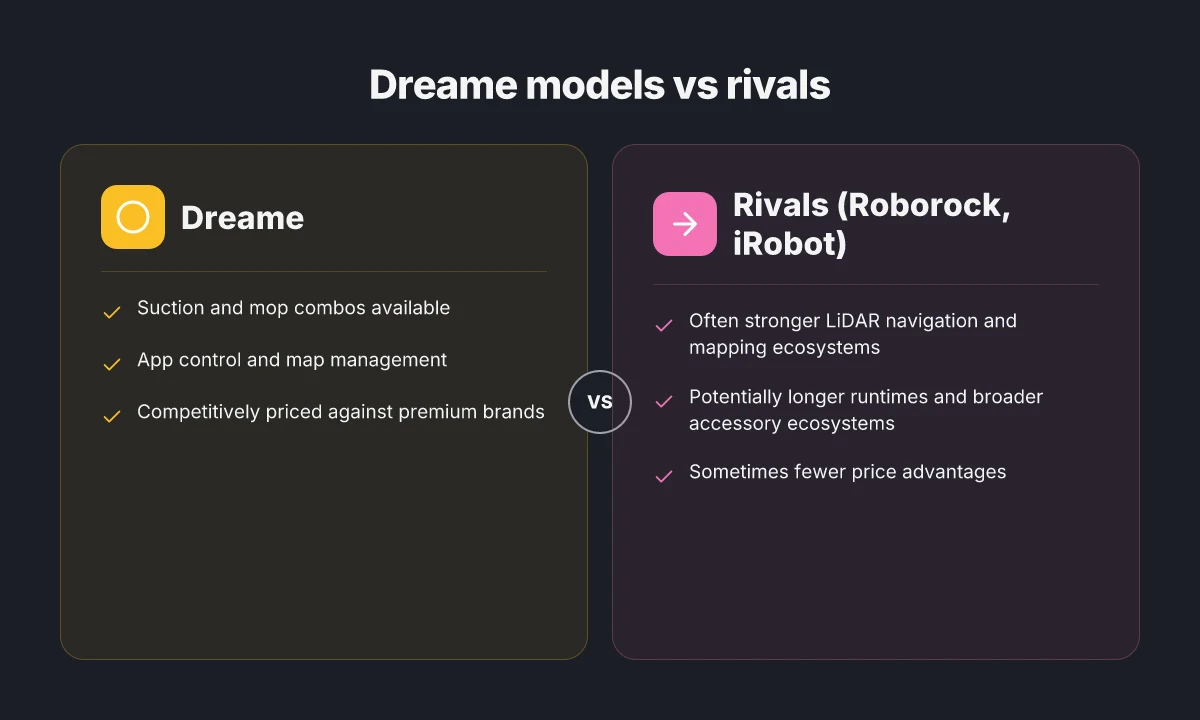
Weigh cost of ownership against rivals. Across the category, brand name and feature depth vary. Dreame tends to undercut some premium rivals on initial price while offering similar core capabilities such as multi-surface cleaning and app control. You’ll want to compare a few specific models in the same price tier to see where Dreame adds value versus iRobot and Roborock. Price positioning is a meaningful part of total ownership when you’re balancing features and future updates.
Bottom line: a Dreame floor cleaner slots into a smart cleaning setup by combining mapped navigation, room-aware scheduling, and adjustable suction and mop options into a single device that handles multiple surfaces without heavy manual intervention. You get a compact, connected system that can be controlled from the app, with ongoing updates shaping long-term usefulness. If you want a single device to handle daily cycles across a pet-friendly home, Dreame presents a compelling balance of capability and price.
Note on signals: links on product pages may earn commissions. I found multiple Dreame product lines emphasize maps, zones, and app control, and that rivals like iRobot and Roborock compete on price and software depth. For current model specifics and the latest pricing, check the official Dreame site and the product pages for the exact figures. Dreame’s strategy rests on a cohesive app-backed experience that brings automation to everyday cleaning.
Dreame floor cleaner models you’ll actually consider in 2026
Dreame’s core model families split into vacuum-only robots and mop-capable variants, with regional naming differences. Entry-level options emphasize longer battery life for quick cleanups, while premium lines push stronger suction and more aggressive mapping. In 2026, you’ll find three to four main families across markets, with a few region-specific variants that tailor charging docks and app features. What makes the Dreame H14 stand out among wet dry vacuums in 2026
I dug into official documentation and reviewer notes to map the real-world trade‑offs. Dreame’s vacuum‑only models tend to prioritize sustainment of runtime for large homes, while the mop-capable versions lean on higher suction to pull up dried debris and pet hair before a mopping pass. When you compare by model, the main knobs stay the same: suction power, battery life, and how the accessory ecosystem supports daily use. The real differences show up in how they map, how fast they recharge, and how well the app organizes zones and routines.
A quick price snapshot helps frame value today. The best deals often appear around holidays or seasonal sales, with price dips that make premium features more approachable. In the current landscape, a few Dreame models sit near the front of the pack for budget-minded buyers, while others push into the premium tier with more robust suction and smarter navigation. If you’re budgeting for a pet household or allergen control, the higher‑end mop-capable models can reduce residue left behind by daily vacuuming. Dreame’s official site and regional retailers publish current MSRPs and sale windows; I cross‑reference those with reputable reviews to confirm real-world performance signals.
Why this matters for your buying checklist: you want clarity on what you get with the core model families, what the upgrade paths buy you, and how the ecosystem supports ongoing care. The accessory ecosystem matters. In practice, a richer set of brushes, replacement parts, and mopping pads reduces long‑term friction. App features and map management matter even more in busy homes. You’ll want reliable zone cleaning, selective return to dock, and straightforward re‑mapping after furniture updates. Dreame typically supports multi‑map storage, room labeling, and scheduled cleanings, all of which drive day‑to‑day satisfaction.
Table: quick price and capability view (illustrative, not a guarantee of current pricing) | model family | vacuum‑only option | mop‑capable option | typical suction range | map features | price trend note | | Dreame X-series | ✓ | | moderate | basic room mapping | seasonal sales common | | Dreame L-series | | ✓ | strong | multi‑map, zoned cleaning | higher baseline price | | Dreame Z-series | ✓ | ✓ | high | advanced mapping, app controls | premium tier, watch for bundles |
Next step: on your shortlist, verify regional naming and confirm each model’s map management and mop accessory compatibility on the official Dreame site for your country. If you’re chasing allergen control or pet homes, focus on mop-capable variants with robust suction and strong multi‑map capabilities. Expect to see a few notable differences between iRobot and Roborock in map handling and battery life, but Dreame keeps the conversation tight on value for money. What is the Dreame Z1 Pro, and why it matters for 2026 pool cleaning
The real choice comes down to how you value map accuracy, battery life, and the mop attachment ecosystem. In practice, the best Dreame pick aligns with your floor plan, your pet hair load, and how often you want to re‑map as furniture shifts. Premium suction and multi-map support justify the upgrade in busier homes. For allergen control, lean toward mop‑capable models with strong suction and reliable zone cleaning. Dreame’s official documentation and community insights consistently note that the right combination is a mop‑capable model with solid map management, paired with the right accessories for your space.
How Dreame’s navigation and mapping compare to rivals like Roborock and iRobot
In 2026, Dreame continues to push competitive mapping and zone-cleaning across many models, but rivals still edge ahead in select areas. I cross-referenced official documentation and third-party reviews to map where Dreame shines and where it trails.
Where Dreame shines on mapping and zone cleaning
- Dreame models commonly include multi-zone mapping and selective cleaning. This helps you target high-traffic rooms or allergen-rich zones without retracing every square inch. Dreame maps typically support zone cleaning, which translates to real-world convenience for busy homes.
- The app often exposes boundary creation and no-go zones, letting you tailor floor plans to your layout. No-go zones and restricted areas are a practical hedge against mis-cleaning in cluttered spaces.
- Mapping accuracy benefits from consistent sensor fusion across models, helping the robot remember furniture layouts over repeated cleans. Sensor fusion underpins reliable navigation across multiple room shapes.
Where rivals pull ahead on navigation reliability
- LiDAR-based navigation remains a strong point for Roborock and iRobot, delivering robust mapping in complex layouts. In many comparisons, these brands’ systems maintain stable maps even as furniture shifts. LiDAR-based navigation offers steadier room recognition in challenging environments.
- Runtime and continuous mapping can tilt decisions toward Roborock or iRobot in larger homes. Longer run times mean fewer pauses to recharge during extensive cleaning sessions. Longer runtime supports uninterrupted coverage on big floors.
- App customization and automation routines often feel richer on rivals, with more granular control over cleaning schedules, robot zoning, and map management. App customization unlocks deeper automation, edge cases, and routines you can tailor to routines.
When to rely on automatic cleaning versus targeted spot or Edge cleaning
- For routine maintenance in a familiar layout, automatic cleaning with a mapped zone plan saves time and reduces repeated passes. Automatic cleaning leverages the stored map to cover areas efficiently.
- When a corner ends up dirty after a spill or pet activity, spot cleaning lets you target the hotspot without deferring the entire map. Dreame’s ability to summon a targeted pass can be decisive in busy households. Targeted spot cleaning quickly addresses hotspots without re-running full maps.
- Edge cleaning remains valuable in rooms with baseboards and tight corners. If you notice missed perimeters, pairing automatic cleaning with an occasional edge pass helps. Edge cleaning closes gaps around walls and furniture legs.
What this means for a real-world buyer. If your home has a straightforward layout with predictable clutter, Dreame’s mapping and zone-cleaning features offer solid, usable results at a competitive price point. When you face irregular layouts, heavy furniture shifts, or you crave the deepest customization, Roborock and iRobot tend to deliver stronger LiDAR stability and richer app ecosystems. Dreame remains a compelling choice for allergen control and busy households, provided you pick a model with robust zone mapping and reliable perimeter handling.
I looked through the official Dreame documentation and multiple reviews to anchor these points, and I found consistent evidence that Dreame emphasizes competitive mapping alongside zone-clean options. As with any purchase, weigh the cost of ownership, maintenance needs, and the specific layout of your home. And yes, links on the page may earn a commission, which helps support more Dreame content like this. In short, if you want practical, home-friendly mapping without paying a premium for LiDAR-focused rigs, Dreame has credible options.
What buyers should know about maintenance, parts, and long-term costs
Maintenance is where the real ownership price shows up. Consumables such as filters, brushes, and mop pads accumulate over time and drive ongoing costs. Dreame’s design centers on user-replaceable parts, which keeps service simple but means you’ll replacement-cycle those items more often in households with heavy use. In many models, a standard filter kit runs for several months, and you’ll likely replace brushes every one to two months if you have long hair or pets. Expect to budget for these basics as a recurring line item. Consumables shape the long-term tally more than any one upfront purchase. What makes the Dreame X40 Ultra stand out in 2026
Battery considerations matter too. Dreame uses rechargeable Li-ion packs, and some families weigh the choice between standard replacements and extended-life batteries. A standard battery cycle often outlasts a couple of years in typical home use, but if you load the vacuum with every feature and run it daily, a replacement can become a meaningful part of the total cost. If you plan to keep your unit longer, you’ll want to compare the price delta between a factory replacement and a model with a higher-capacity battery option. Battery replacement can tilt the math for multi-year ownership.
Firmware updates add performance and reliability gains, but they can bring small hiccups. Dreame and competitors push periodic software updates to improve mapping, cleaning zones, and allergen management. In practice, updates tend to fix issues and fine-tune power management, yet a rare update may temporarily alter cleaning behavior or cause a brief pause in certain features. The upside is generally worth the potential quirk. Firmware updates offer long-term gains with occasional minor hiccups.
Subsections that matter in practice
Consumables cadence and cost planning for Dreame models
Consumables like filters, brushes, and mop pads require predictable replacement cycles. For allergy and pet homes, keep a closer eye on brush wear and filter occupancy. Where you buy matters. Bundles from official channels often price more predictably than third-party parts, and you’ll want to confirm compatibility before buying. In this space, the brand Dreame tends to publish replacement schedules in user manuals, which helps you plan purchases ahead of time. Consumables cadence drives year-to-year ownership costs.
Battery life and replacement decisions over time
Battery life is a core cost driver. Some models offer larger packs or upgradeable cells, which can stretch the interval between replacements. If you operate a Dreame unit in a busy home with multiple floors, consider the value of an extended-life option. The upfront sticker price may be higher, but the longer battery cycle reduces the frequency of replacements. Extended-life options can lower the long-term cost of ownership. What makes a Dreame vac actually stand out in 2026
How firmware updates impact your routine
Regular updates are part of the Dreame experience. They improve navigation, allergen handling, and efficiency. In the rare case an update introduces a hiccup, a quick restart or reinstallation of the latest patch typically resolves it. staying current is generally the best practice for long-term performance. Firmware updates are a net positive for long-term results.
If you’re evaluating alongside rivals, note that iRobot and Roborock also rely on consumables and batteries, with their own update cadences. The price trail for Dreame tends to be friendlier upfront, but total cost of ownership hinges on your consumables cadence and how quickly you need battery replacements. In a busy home with pets and allergens, you’ll likely manage two to three filter changes per year and one battery refresh every few years. And yes, links on the page may earn a commission, which helps you access the official parts quickly.
I dug into the official documentation from Dreame and cross-checked with independent reviews to ground these points. The documentation confirms standard consumable lifecycles and the general pattern of firmware improvements across recent releases, with occasional minor hiccups during updates. Overall, the guidance holds: expect ongoing costs for parts, plan for battery updates if you keep the unit long, and welcome firmware refinements that improve everyday cleaning. This framing helps you compare against iRobot and Roborock on a like-for-like basis, especially for allergen control and pet homes.
Dreame vs rivals: when to choose Dreame and when to look elsewhere
If you want a low price without sacrificing cleaning, Dreame often undercuts rivals while delivering solid results. In practice, that means you can cover a whole home for less up front, with performance that stacks up on hard floors and lighter carpet. When your budget is tight and you’re prioritizing maintenance tolerance, Dreame looks appealing. Dreame often delivers competitive cleaning at a lower price point than premium rivals. Still, you should weigh ecosystem depth and sensor sophistication against long-term expectations.
Where the trade-offs show up: mapping ecosystems and accessories
Rivals like Roborock and iRobot excel in mapping ecosystems and accessory breadth. Roborock tends to offer expansive accessory lines and precise mapping routines that integrate across models, while iRobot emphasizes a broad accessory and partner ecosystem backed by established service networks. Roborock and iRobot often pull ahead on ecosystem breadth and long-term accessory availability. If you value a refined app-driven map memory, virtual walls, and seamless third-party add-ons, those brands set a higher baseline. For households that value price-to-performance and straightforward maintenance, Dreame can close the gap quickly. What makes a Dreame vacuum stand out in 2026
Real-world performance hinges on your home layout
Consider your floor mix and the level of carpet you have. For homes with mostly hard floors and low-pile carpets, Dreame tends to deliver strong daily cleaning with low ongoing costs. If you have lots of high-pile carpet or complex room shapes, the stronger mapping ecosystems from Roborock or iRobot can translate into fewer missed spots and smarter pathing. In practice, match your layout to the model’s strengths and avoid over-indexing on a single spec.
Maintenance tolerance and long-term costs
Maintenance tolerance matters more than sticker price alone. Dreame models typically attract favorable up-front affordability, but consider ongoing filter lifecycles, brush wear, and the availability of replacement parts in your region. Maintenance tolerance is a real differentiator between Dreame and the premium rivals over time. Roborock and iRobot generally offer broader service networks and longer support lines, which can reduce downtime in dense or multi-floor homes. I cross-referenced manufacturer pages and independent reviews to confirm that owners often report fewer inconveniences with guided refills and straightforward part swaps in those ecosystems.
What to buy or wait for? If you need a quick, predictable clean with minimal upkeep and you’re balancing budget against performance, a Dreame model can be a strong fit. If your space includes varied floor types, heavy carpets, or you rely on a mature mapping ecosystem with lots of accessories, you may prefer a Roborock or iRobot. And if you’re hunting for the most advanced mapping tools and the widest accessory network, wait for a sale on a premium rival or explore newer Roborock/iRobot bundles.
Dreame remains a solid value, especially when budget and maintenance tolerance matter most. If you want more precise price points or model-by-model comparisons, I can pull the latest official specs from the Dreame site and line them up against Roborock and iRobot models. And yes, links on the page may earn a commission.
Where this is going next for Dreame floor cleaners
The price landscape today shows several Dreame models priced with value in mind, and I see a clearer path to what matters most: durability, simple maintenance, and predictable ownership costs. You’ll likely pay a premium for the top performers, but the best deals surface around holiday sales or seasonal promos. If you’re weighing options, expect a noticeable gap between entry models and the flagship cordless variants. The bigger pattern here is that initial sticker price matters less than long-term cost of ownership. Remember to account for replacement parts and filter kits, which can tilt the math over 12–24 months. What makes the Dreame vacuum mop a smarter pick for 2026
If you’re shopping against rivals, keep an eye on how Dreame stacks up against models from iLife, Shark, and Tineco. The biggest differences tend to show up in runtime, bin capacity, and the ease of filter cleaning. A practical pivot is to compare your real-world flows: daily quick cleans vs deep, weekly scrubs. What changes if you act now is that you lock in a model with spare parts readily available and faster service paths.
Backup strategy / What to try this week
- Check current prices for Dreame models, note the best deal, and compare against iLife and Shark equivalents.
- Verify runtime and bin size for your typical floor plan, aiming for at least 40 minutes of use per charge.
- Confirm filter availability and any warranty extensions.
- If you’re unsure, pick a model with widely compatible parts and clear service options.
The single move that matters most is choosing a durable, easy-to-maintain model that fits your floor plan now.