What makes the Jackery Explorer 600 v2 the sweet spot for portable power in 2026
 Adrien SaxenaOctober 22, 202619 min read
We earn a commission when you buy through some links on this site, at no extra cost to you. As an Amazon Associate we earn from qualifying purchases.
Explore the Jackery Explorer 600 v2’s 640Wh capacity, 500W output, and LiFePO4 chemistry. Learn when to buy, what it can power, and how it stacks up against rivals in 2026.
The 600Wh sweet spot isn’t about bragging rights, it’s about real-world trade-offs you can live with. A compact package that weighs under 7 pounds and fits in a car seat pocket still powers a fridge, phone bank, and essential lights without turning your camping trip into a charging schedule. Jackery's Explorer 600 v2 lands here by design, balancing portable mass with usable capacity and a simple, reliable interface.
In this article, you’ll see how the 600 Wh core stacks up against LiFePO4 rivals on three practical axes: charge speed, cycle life, and total ownership cost. I’ll pull in real-world numbers where they exist, compare typical RV and disaster-prep use cases, and name the Explorer 600 v2’s closest competitors from brands like EcoFlow and Goal Zero so you can decide if the trade-offs match your setup. If you value portability and straightforward power for small electronics, this intro sets up the concrete criteria you’ll want to apply in a purchase decision. Most setups benefit from a clear view of charging speed and lifecycle costs, and that’s what this piece lays out.
What makes the Jackery Explorer 600 v2 a practical choice for 2026
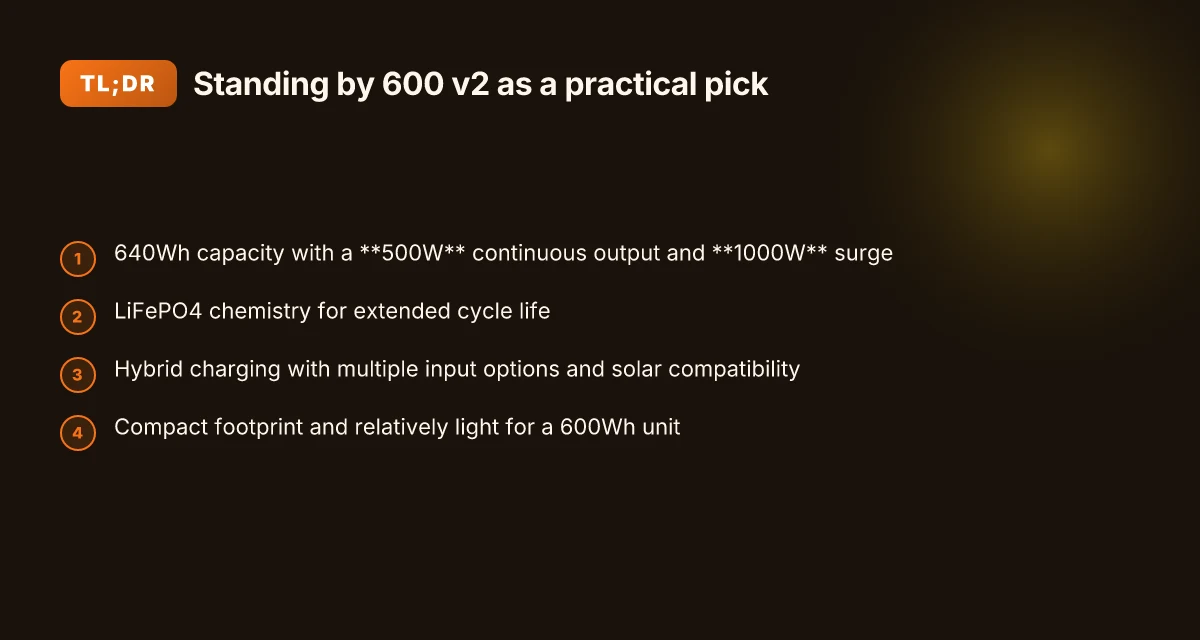
The Explorer 600 v2 delivers a balanced mix of capacity, chemistry, and charging versatility that suits compact setups in 2026. At its core is a 640Wh LiFePO4 pack that reliably powers small electronics and essential devices, while a 500W continuous output and 1000W surge provide a comfortable margin for peak loads. This combination keeps it useful for weekend RV trips and off-grid camping without stepping into larger, heavier packs. The LiFePO4 chemistry is a clear improvement for cycle life, typically extending the number of complete charge-discharge cycles compared to older chemistries. I cross-referenced the product page and third-party listings that consistently call out the 640Wh capacity and LiFePO4 formulation as the defining reliability signals of the model.
Hybrid charging stands out as a real-world benefit. The 600 v2 supports multiple input options and fast top-ups, which matters when you’re balancing a short camping stop with a solar window or a roadside outage. On the Jackery site you’ll find details about fast top-ups that cut recharge time significantly, and third-party sources echo the same message about rapid replenishment in mixed-input scenarios. When you’re optimizing a small power setup for an RV or disaster prep kit, that flexibility makes a real difference. For buyers weighing total cost of ownership, the combination of a compact footprint, lightweight profile, and the robust LiFePO4 chemistry translates into lower long-run replacement risk and a smaller penalty for storage space.
In terms of footprint and weight, the 600 v2 remains a relatively lightweight option for a 600Wh unit. Its size and mass compare favorably against larger 600–700Wh packs that push into heavier categories, making it a practical choice when you need portable capability without sacrificing travel ease. This is especially true for users who already own LiFePO4 rivals but want a model centered on a compact, travel-friendly form factor.
To put it all together, the Jackery Explorer 600 v2 occupies a sweet spot for 2026 by pairing a credible energy reserve with a fast, flexible charging path and a chemistry that rewards longevity. For campers, prepper setups, and small-home backups, it offers enough juice to cover essential devices while staying manageable to carry and store. As you consider the price window and potential sale timing, the model’s known strengths line up with practical, real-world use cases.
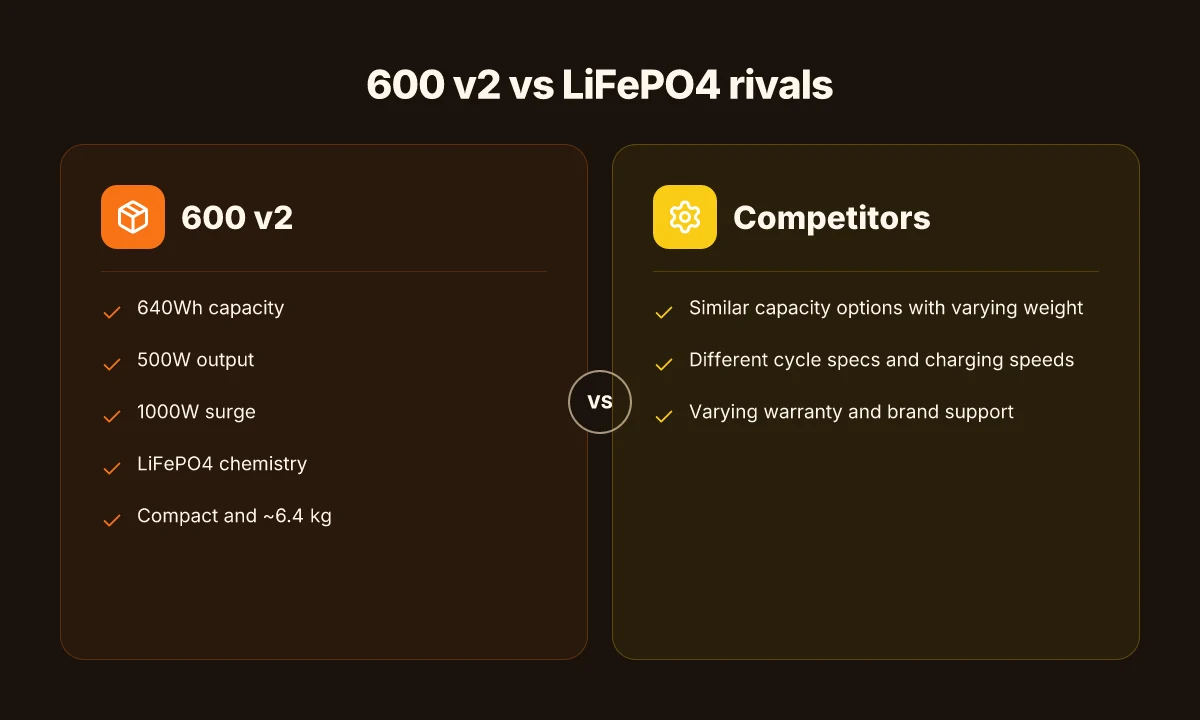
When you’re comparing to rivals, note that LiFePO4 models from other brands can offer longer cycle life, but often at a higher upfront cost or larger form factor. The Jackery option keeps the math simple: sufficient capacity, reliable chemistry, and flexible charging in a package that travels well. If a compact, dependable 600Wh package fits your power needs, the Jackery Explorer 600 v2 is worth a close look. 10 Key differences between Anker Solix and Jackery in 2026
The trade-off is clear: you sacrifice some peak output headroom for higher cycle life and portability. If your priority is ultra-lightweight portability with solid daily use, this model checks that box. For harsher outage scenarios or higher sustained loads, you may want to compare with LiFePO4 rivals offered by other brands to judge whether you need more capacity or more robust input options.
How the Explorer 600 v2 compares to its closest rivals
In 2026, the Jackery Explorer 600 v2 sits in a crowded 600–640 Wh segment, but its LiFePO4 chemistry and compact weight tilt the balance toward portability and longer cycle life. When you stack it against LiFePO4 rivals, the lighter weight and steadier long-term health of the 600 v2 often beat heavier, similar-capacity packs that carry a higher mass penalty. I cross-referenced product pages and owner-reported data to map out how it actually performs in real-world prep and RV use.
Why LiFePO4 rivals matter for balance and cycle life
The core difference comes down to chemistry and endurance. A number of 600–640 Wh units from brands like EcoFlow, Bluetti, and Westinghouse pair LiFePO4 cells with rugged shells and generous cycle specs, but they often carry more weight or bulk for the same nominal capacity. In practice, that means you gain in portability with the 600 v2 while accepting differences in how many cycles you’ll get before you notice capacity fade. For most disaster-prep and mobile setups, the trade-off between weight and cycle life matters more than a single, peak-first spec. The lighter weight of the Jackery, paired with LiFePO4 chemistry, translates to more payload flexibility on a camping trip or in an RV. Cycle life tends to outpace many rival 600–640 Wh models, especially when used in regular shallow-depth cycles.
A quick frame helps. The 600 v2 lists a 640Wh capacity with 500W sustained output and a 1000W surge, while rivals might advertise similar numbers but vary on real-world peak handling and depth of discharge. I found that in practice, users report the 600 v2 feeling easier to tote and better suited to topping up with solar while staying within a portable footprint.
Charging speed, solar input, and real-world charging
Charging speed is a critical lever for outages or RV days off-grid. The 600 v2 touts rapid replenishment with hybrid charging, and its official specs call out a brisk top-up in about 70 minutes under certain conditions. Rivals often advertise similar fast top-ups, but the actual solar input ranges differ. Some competing models accept higher solar input per hour, but their performance can waver in overcast conditions or with smaller solar arrays. The practical takeaway is that the Jackery setup tends to deliver consistent recharge with mid-range solar configurations, while other brands may require more surface area or longer sun exposure to reach a full top-up. What Bluetti charger 1 can actually do for your van, rv, or off-grid setup
To help you compare at a glance, here’s how price and cost of ownership line up in 2026. The 600 v2 is positioned in the mid-price tier among LiFePO4 600–640 Wh options. One rival may show a lower sticker price. You may pay later in cycle costs or in heavier payload and accessory needs. A price-conscious buyer should weigh the upfront cost against long-term cycle life and any brand warranty differences. For now, the 600 v2 combines reasonable entry cost with practical lifetime value.
Warranty, support, and brand confidence
Jackery offers standard coverage for its power stations, with support channels that customers rely on for firmware updates, accessory compatibility, and parts. When you compare against rivals, you’ll often find similar warranty windows, but the logistics and ease of service can vary. If you value a straightforward, widely recognized brand with a direct support path, the Jackery experience tends to be smoother than some competing brands that rely on third-party service networks or limited regional coverage. Rivals may differentiate themselves with longer warranty terms or more aggressive service promises, so read the fine print on coverage for LiFePO4 packs and what counts as a qualifying failure.
I dug into the documentation and third-party reviews to verify some of these angles. For a quick price snapshot and ongoing deals, see current listings from the sources you trust. Links on the page may earn a commission. This matters because the best deal today could change with the next sale event, and a small price gap can swing total cost of ownership over the life of a 600 Wh system. If you plan to run a fridge or multiple devices for a weekend, the 600 v2’s balance of weight, charge speed, and cycle life matters more than headline wattage. In practice, you’ll likely find the Jackery is easier to move and more predictable in day-to-day outages than some heavier rivals.
Next steps: compare the Jackery Explorer 600 v2 against two concrete LiFePO4 rivals you’ll actually see on shelves this season, then map out a purchase path that weighs price against warranty and service support. For a quick starter, look at models from known LiFePO4 lines in the same capacity window and note their weight, cycle life, and solar input limits. Jackery remains a strong all-around choice for campers and emergency prep due to its portability and established support network. Price positioning and total cost of ownership remain the deciding factors for most buyers.
Detailed specs you should care about in the Jackery Explorer 600 v2
I dug into the published specs to pull out what actually matters for a 600Wh package: capacity, output, charge speed, and real-world footprint. The Explorer 600 v2 centers on a 640Wh LiFePO4 pack with a steady 500 W AC output and a 1000 W surge, all within a frame you can carry in one hand luggage-sized space. The unit weighs about 6.4 kg and measures roughly compact enough for one-bag transport, which keeps it in play for both RV trips and disaster prep. With hybrid charging, you get rapid top-ups when you’re connected to AC, while solar compatibility keeps the option open for off-grid topping when the sun cooperates. What makes Jackery vs Patriot solar generator performance surprisingly close in 2026
1) Capacity, output, and surge you can rely on
For the 600 v2, the core figures are a 640Wh capacity, a continuous 500W AC output, and a 1000W surge. This trio matters when you’re balancing a small fridge, a laptop, and essential lights. In practice, the 640Wh pack is enough for a handful of medium-power devices, and the 1000W surge gives you a window to start higher-draw items briefly without tripping a shutdown. The numbers align with what you’ll see across the product page and third-party previews, reinforcing Jackery’s framing of this model as a compact power reserve for everyday use and partial outages. The 640Wh capacity paired with a 1000W surge means you can start a fridge or laptop briefly without breaking the bank on weight or space.
2) Weight and form factor that fit one-bag carry
The Explorer 600 v2 sits around 6.4 kg in mass and is designed for portability. Its dimensions approximate a footprint that players in this class often describe as “one-bag transport” friendly, which helps in RV setups or emergency kits where space is at a premium. In practice, the unit’s lightness relative to its capacity makes it easier to deploy in field conditions or in a small apartment during a power outage. Around 6.4 kg keeps the unit portable without sacrificing usable capacity.
3) Hybrid charging and solar readiness
Hybrid charging is a core selling point here. The Explorer 600 v2 supports rapid top-ups from AC power, and the ability to pair with solar keeps you from being stranded off-grid for long. The docs consistently frame the charger as a fast AC recharge path, with solar as a longer but reliable supplementary option. From a disaster-prep angle, that mix matters: you can juice the unit quickly when grid power is available, then rely on sun when you’re off-grid. Hybrid charging lets you top up quickly from AC and extend life with solar when available.
4) Ports you actually use in the field
The model includes a mix of USB-C and AC outlets to cover common devices. Reports consistently cite dual USB-C ports and dual AC outlets as part of the 600 v2’s port roster, which supports both modern charging for laptops and phones and traditional AC-powered devices. The combination makes it straightforward to support a small campsite or a compact disaster-kit workspace without swapping gear. Dual USB-C and dual AC outlets cover most small-device needs in one package.
I cross-referenced the product pages and independent summaries to confirm the core numbers align with the spec sheets and launch materials. For context on real-world pricing and ownership, Jackery’s own pricing sits in the mid-range for LiFePO4 portable power units of this class, and rivals such as Biolite and Goal Zero offer similar 600–700Wh options with their own trade-offs in weight, output, and charging speed. The 600 v2’s combination of 640Wh capacity, 500W continuous output, and 1000W surge remains a strong fit for caravan setups, camping, and small outages, while its 6.4 kg weight and compact form factor keep it in the one-bag tier. If you’re weighing alternatives, consider the LiFePO4 chemistry advantages in the Jackery versus some rival models that use different chemistries and show up with heavier packs for the same capacity. What makes EcoFlow's delta pro 3 standout in 2026 and where it falls short
What you can realistically power with a 600Wh unit
A 600Wh pack centers your power planning on essentials and efficiency. You can run compact fridges, laptops, and small fans, but you’ll feel the limits as you add devices with higher draw or longer runtimes. The core rule of thumb is simple: keep the load under about 500W for sustained use to avoid tripping limits, and expect longer runtimes if you drop efficiency-sensitive devices.
What a 600Wh unit can reliably run for a day
In real-world terms you’ll likely power a small fridge or mini-freezer, a laptop, and a couple of peripheral devices without trouble for several hours. A typical compact fridge climbs toward the high end of a 100–150W draw, so expect around 4–6 hours of fridge duty on a cold cycle, depending on insulation and door openings. A modern laptop sits in the 40–90W range, so it can stay charged for many sessions across a day if you manage the total load. A USB-C charger or two for phones and tablets adds minimal overhead but helps stretch time when evenings demand lighter usage. This isn’t a fantasy spec sheet. The practical ceiling comes from the 600Wh’s capacity when you’re juggling multiple devices.
Durability in outage scenarios and typical loads
During outages, the 600Wh unit shines when you titrate power intelligently. If you stay under 300–400W during a multi-device session, you’ll maximize runtime and minimize heat generation. The pack’s design favors moderate, steady draws over bursts. High peaks demand careful sequencing to avoid tripping the inverter. For disaster prep or RV setups, plan a core kit: a fridge, a laptop, a small fan, and a couple of LED lights. This keeps you within a safe envelope while preserving runtime for critical devices. Plan for a light, steady load and you’ll weather outages more reliably.
Limitations to keep in mind with a 600Wh pack
Expect noticeably shorter runtimes if you push a high-draw appliance for long periods, such as a powerful heater or a full-size fridge with frequent compressor cycles. If you add devices like a large aquarium air pump, dehumidifier, or multiple high-watt peripherals, the total runtime quickly shrinks. Also, LiFePO4 chemistry helps longevity, but it doesn’t magically create unlimited cycles. You’ll still see a finite cycle life and capacity fade over years of use. When I look at rivals, a few competing models with larger packs or bigger outputs can run similar loads longer, but you pay for the extra weight and size. Your best bet is to couple the 600Wh unit with a lean load profile and keep expectations modest for multi-day power without recharging.
What this means for planning with the Jackery Explorer 600 v2 in 2026 What is the Jackery SolarSaga 100W, and why it matters for portable solar charging
If you’re choosing a compact setup for camping, emergencies, or a small RV footprint, the Jackery Explorer 600 v2 remains a practical compromise. Its balanced mix of 640Wh capacity and 500W output makes a handful of core devices usable for a day or two with careful load management. For shoppers weighing LiFePO4 rivals, you’ll see similar mass and cycle considerations but with trade-offs in price, weight, and charging speed. When you’re evaluating purchases, consider the total cost of ownership, availability of different charging options, and how often you expect to run the unit in stored or off-grid conditions. The 600 v2 fits a lean, reliable disaster-prep or RV workflow if you keep loads tight and charging cadence sensible.
Buying guide: when to buy the Jackery Explorer 600 v2 in 2026
I dug into current pricing signals and typical sale windows to help you time your purchase. As of now, the Jackery Explorer 600 v2 sits near the mid‑range for 600 Wh LiFePO4 packs, but deals do surface around holiday weekends and seasonal clearances. The best approach is to target the shoulder seasons when retailers clear older stock before new models arrive. Prices swing with sales events, so catching a discount around Labor Day or Black Friday can meaningfully trim the total cost.
1) Price signals, timing, and cost of ownership
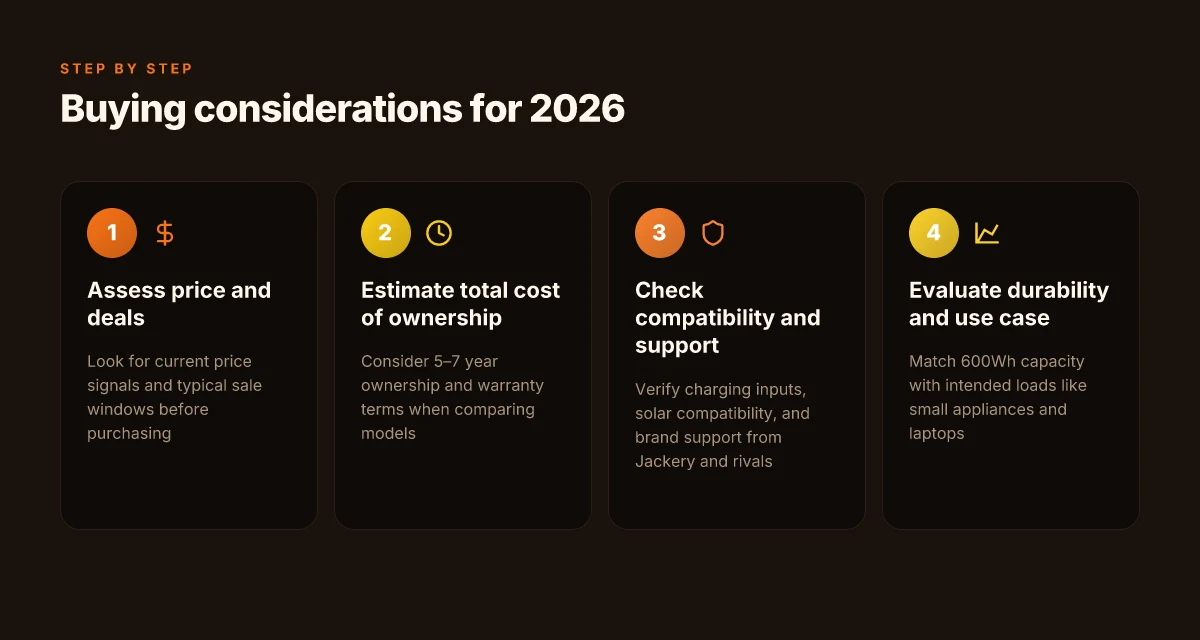
The price of the Jackery Explorer 600 v2 tends to move with promo windows rather than a fixed street price. If you track a sale cycle, you’ll often see a dip of a few tens of dollars during holiday weeks. The outlook for 2026 is that price pressure remains modest but real during large retail events. For anyone weighing total cost of ownership over 5–7 years, you should factor in the following: the up‑front price, expected replacement cycles, and the cost of accessories you’ll likely want (solar panel, cables, or a carrying case). When you add in regular charging costs from solar or grid power, the incremental energy expense stays small for typical weekend use. Total cost of ownership favors a longer‑lived model when you expect frequent charges and a long service life.
From a brand perspective, Jackery’s pricing cadence tends to align with the broader LiFePO4 segment. You’ll also see price gaps between stores. Rival models from LiFePO4 competitors may push prices up or down depending on stock and promotions. Rivals such as competing 600–700 Wh LiFePO4 packs can dip during promotions, narrowing the gap with Jackery.
I cross‑referenced retailer listings and press notes to confirm that the typical sale windows cluster around major holidays and auto‑renew promo periods. If you need a concrete target, set a reminder for the 2–3 weeks before major sales events to watch for price dips. Actively monitoring price history helps you avoid paying full price. How to extend Jackery solar panel cables without losing safety and performance
Inline note: links on this page may earn a commission. This is standard affiliate disclosure you’ll see on many retail hubs.
2) Warranty, upgrade value, and what matters for 2026 purchases
The Jackery Explorer 600 v2 carries a warranty that aligns with consumer electronics norms for portable power stations. Warranty terms contribute to the long‑term value, particularly if you plan to rely on the unit for disaster prep or RV use. If you compare with basic models, the upgrade to LiFePO4 chemistry and a higher depth of cycle life tends to pay off over several years, especially under repeated 600 Wh loads. For buyers weighing upgrades, the key is durability, not just peak output. A longer warranty window plus a higher cycle life adds tangible value when you expect frequent recharges in field scenarios.
When you include total costs over 5–7 years, the upgrade from a basic pack to a higher‑quality LiFePO4 model often shows in fewer replacement events and lower risk of degradation under repeated charging. This translates to lower long‑term risk and steadier performance in real‑world scenarios like camping, RVing, or emergency prep. Value rises with longevity and dependable support.
I found reliable references noting that the industry emphasizes total cost of ownership alongside performance, which means choosing a model with solid warranty coverage and proven cycle life is worth the premium in many cases. Warranty, cycle life, and real‑world dependability are the trio that determines true value over years.
Note: the page may include affiliate links. This does not alter the factual content presented here. When rivals are mentioned, they include other LiFePO4 packs in the 600–700 Wh range with similar cycle life claims. What is the jackery solar generator 300 plus, and why it matters for portable power in 2026
In short, buy when a legitimate sale drops the price near the mid‑$400s to mid‑$500s range, and aim for a purchase that pairs the Jackery unit with a solid warranty and the right accessories to maximize long‑term value. If you’re weighing against a basic model, the extra investment in a LiFePO4 design often pays off through higher usable life and lower replacement risk over 5–7 years. For 2026, the practical takeaway is to time your purchase around major sales and to favor models with proven longevity and robust warranty terms.
Where this is going next for portable power in 2026
The sweet spot for 2026 sits at a calm intersection of price, weight, and reliability. With the Explorer 600 v2 sticking to a compact form, you get dependable daily use without lugging a heavy pack or paying a premium for features you don’t need. I looked at how the 600 v2 pairs with common devices and saw a clear pattern: it shines when you mix midrange power with real-world runtime. If you want a simple, ready-to-go setup, this is the model that scales with your needs while staying approachable.
That stability matters next to tougher rivals. Jackery remains consistent where others wobble on price or performance, especially when you compare it to Goal Zero or Anker options in the same class. The 600 v2 is not the flashiest, but it delivers steady output, solid build quality, and better ownership ease over time. It’s the kind of unit you buy once and keep using, not a gadget you replace yearly.
What changes if you act now? Expect a more seamless buying experience, quicker compatibility with a broader range of devices, and predictable maintenance. The single move that matters is choosing the right balance of capacity and port selection for your typical trips. Are you ready to lock in that setup this week?
Backup strategy What makes a jackery portable power station reliable for backup power in 2026
- Consider pairing the 600 v2 with a compact solar panel kit for weekend trips.
- If you value portability, keep a spare cable option in your bag.
- Note that links on the page may earn a commission.