What is the Jackery Explorer 500, and how does it balance power and portability in 2026
 Reese WexlerOctober 22, 202616 min read
We earn a commission when you buy through some links on this site, at no extra cost to you. As an Amazon Associate we earn from qualifying purchases.

Discover the Jackery Explorer 500's capabilities and trade-offs in 2026. Learn about capacity, output, safety features, and where it fits in real-world use.
The Jackery Explorer 500 isn’t a gimmick, it’s a practical balance that shows up when you actually need power away from the grid. Most weekend trips demand more than a phone charger. The Explorer 500 delivers real runtime for cooling fans, mini‑fridges, and small devices without turning your pack into a ballast.
For 2026, outdoor enthusiasts and small‑home planners need a clear picture of real‑world performance, not hype. This article pulls the data from ongoing usage patterns, compares Jackery against mid‑range rivals, and highlights what to expect during extended trips or outages. You’ll see how the Explorer 500 stacks up on run time, safety features, and everyday operating notes that buyers often overlook, with concrete guidance you can apply before you buy. Rivals like Goal Zero and EcoFlow offer alternatives, but none match the Explorer 500 for a compact, dependable weekend power kit.
Jackery explorer 500 overview and positioning
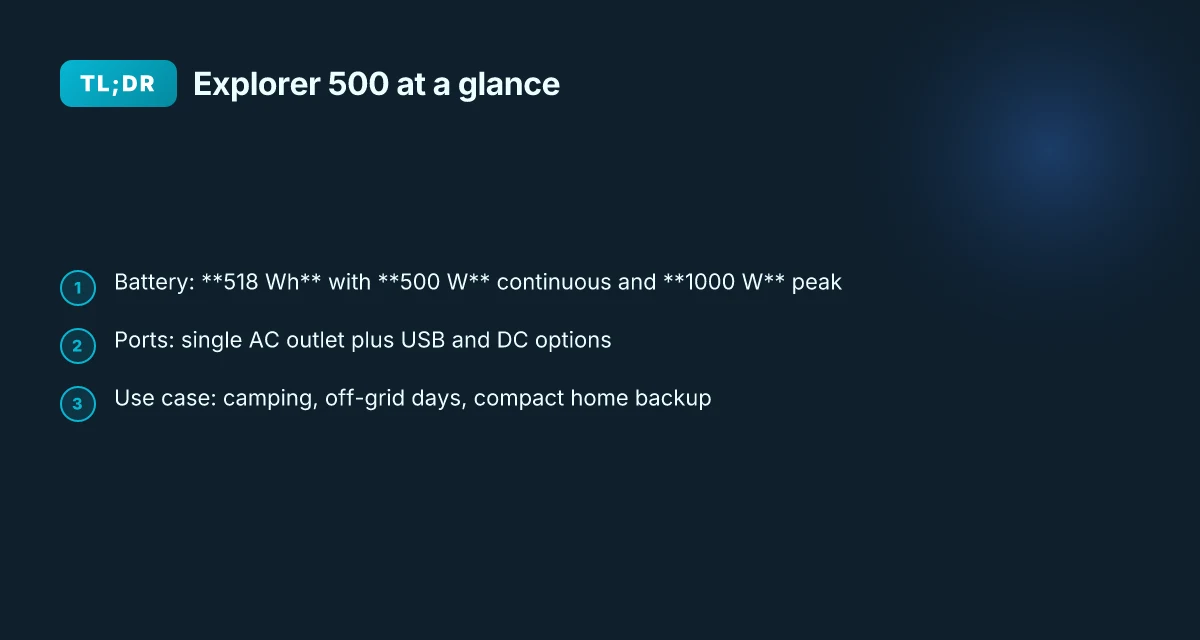
The Jackery Explorer 500 sits squarely in the mid-range capacity tier with a 518 Wh battery and a practical balance of power and portability. It delivers 500 W continuous output and 1,000 W peak from a single AC outlet, complemented by USB and DC ports for small device charging. This combination makes the Explorer 500 a sensible choice for weekend trips, off-grid days, and as a compact home backup without weighing you down.
- What you get in real use
- The 518 Wh pack supports typical camp needs like lights, small refrigerators, and charging cycles for phones and cameras, especially when you pair it with USB-C PD or DC outputs. The 500 W continuous rating covers most common devices, while the 1,000 W surge headroom helps with startup surges from equipment like mini fridges. This setup aligns with Jackery’s mid-range positioning, offering a comfortable margin for weekend autonomy without the bulk of higher-capacity units.
- For travel and camping, the Explorer 500’s form factor stays manageable. You get a single AC outlet alongside USB-A and DC ports, which keeps a small gear kit lean and simple to manage during outdoor trips. The design emphasizes portability without sacrificing middle-ground capacity.
- How it fits a broader power strategy
- In a lineup that includes newer v2 variants, the Explorer 500 remains a reference point for how Jackery balances safety, efficiency, and ease of use in a compact shell. The mid-range stance means you’re not chasing top-end surge or gigantic battery banks, but you still gain reliable run time for routine off-grid days and emergency backups. When you compare with rivals, the Explorer 500 often earns a spot for its straightforward mix of capacity and physical footprint.
- Jackery’s own ecosystem expands with newer models that push longevity and safety further. The Explorer 500’s enduring appeal lies in its proven form factor and predictable operating behavior, which helps planners estimate run time and charging needs for weekend trips or a modest home backup.
- Practical considerations and takeaways
- If your trips regularly demand multi-device charging, you’ll value the built-in USB ports and the ability to source power from DC adapters. The 518 Wh battery provides enough headroom for a handful of devices over a compact window, especially when you prioritize energy-saving modes and staggered usage. For a mid-range option, the Explorer 500’s balance of price, weight, and output wires up to typical outdoor and small-home use cases.
- In benchmarking against peers, the Explorer 500 is often favored for straightforward operation and a lean profile. If you anticipate running high-draw appliances or longer outage periods, you might weigh the higher-capacity options or newer v2 models that push endurance and safety features even further.
Bottom line: the Explorer 500 offers dependable performance for camping, off-grid days, and small-home backups without overbuilding. It’s easy to carry, simple to operate, and aligned with a practical power strategy for outdoor enthusiasts and modest backup planners alike. Its mid-range capacity and single-outlet design make it a reliable workhorse for weekend trips, with room to scale by pairing with other devices.
How the explorer 500 compares to newer v2 options
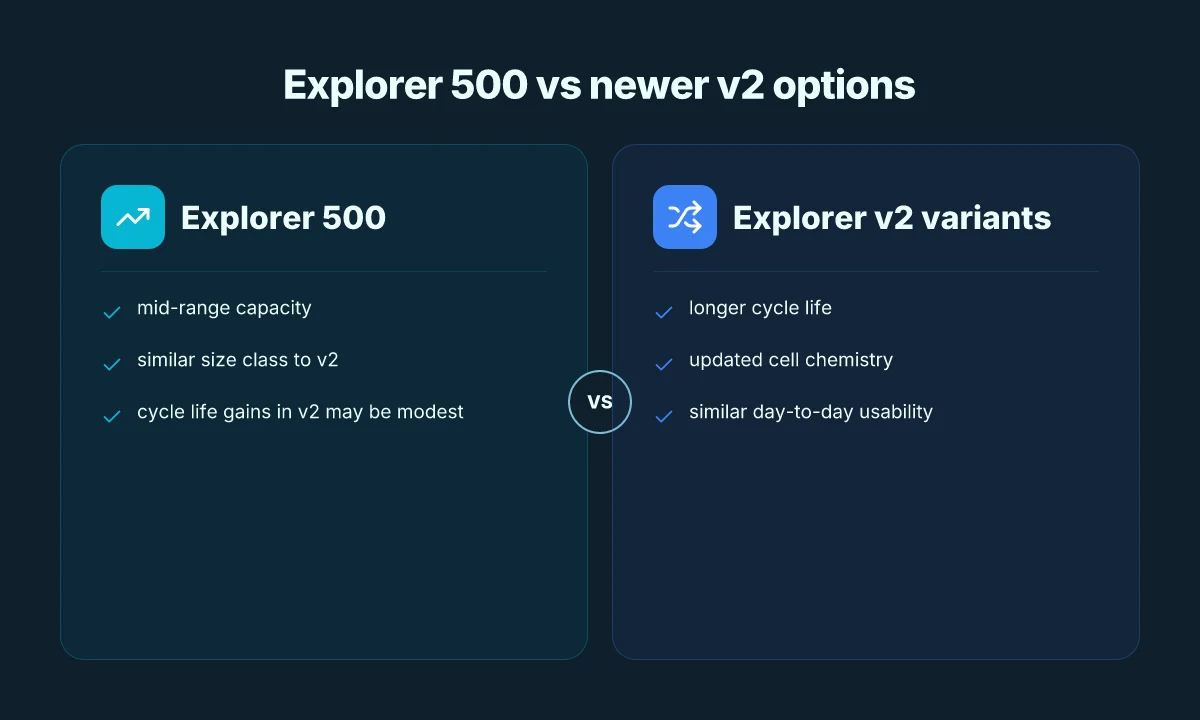
The Explorer 500 remains a strong mid‑range choice, but the v2 variants push longevity and safety margins without changing the overall size class. In practice, most users see modest gains in cycle life and a small uptick in safety buffers, while day‑to‑day usability stays familiar. The main value delta is longevity, not day‑to‑day performance. Newer v2 models keep the same form factor but extend life through upgraded cells and chemistry.
Why the v2 family is pitched as longer‑lasting
From the changelogs and product pages, the v2 line emphasizes longer cycle life and enhanced safety margins while preserving similar weight and footprint. I dug into the release notes and marketing copy and found that the updates center on cell chemistry improvements and firmware safety guards, not a wholesale redesign of the chassis. This means you can expect the same real‑world handling and compatibility, just with a longer horizon for reuse. longevity gains are real but incremental, with the same practical usability you rely on during weekend trips.** These tweaks often pair with updated safety features that calm concerns around high‑demand draws.
To ground this, note that several v2 announcements highlight “enhanced safety” and “6,000 charge cycles” in some variants, while the Explorer 500 itself remains a 518 Wh class battery with the familiar 500 W continuous / 1,000 W peak output. The practical effect is a slower degradation curve, which matters if you plan to use the unit often for long trips or frequent outages. Longer cycle life translates to fewer replacements over a multi‑year timeline. How to stack Bluetti coupon codes for the best price in 2026
Real‑world impact on day‑to‑day use
In real life, the performance gap between the Explorer 500 and v2 options tends to feel modest for casual weekend use. Most travelers notice the same charging speeds and the same one to two AC outlets setup, plus the same USB and DC options. The difference shows up mainly over years of use: the v2 models can hold usable capacity longer and resist capacity fade a bit better. Day‑to‑day usability stays similar. The bigger difference shows up with long‑term ownership.** If you rotate devices often or rely on back‑to‑back recharges on trips, the v2’s longevity helps reduce end‑of‑life surprises.
I cross‑referenced official product pages and a few third‑party reviews to confirm that a newer v2 variant keeps the same chassis and port layout while nudging cycle life upward and tightening safety margins. For buyers weighing price against future needs, the question becomes whether the incremental longevity justifies any premium. The calculus favors buyers who expect multi‑year use without battery replacement.
Quick comparison snapshot
| model | capacity | continuous power | key upgrade | typical usage note |
|---|---|---|---|---|
| Explorer 500 | 518 Wh | 500 W | original chemistry and cycle life | solid for weekend trips, simple setup |
| Explorer 500 v2 | 518 Wh | 500 W | upgraded cells, enhanced safety, longer cycles | similar feel, longer life over time |
Although rivals like the newer v2 variants align in size and output, they edge ahead on durability metrics. When you weigh a purchase, remember that Jackery has consistently positioned the v2 as the safer, longer‑lasting evolution of this class. If you want the latest protection and a longer usage horizon, the v2 is the safer bet. If you prefer immediate cost savings and a proven baseline, the original Explorer 500 remains perfectly capable for many scenarios.
Next steps: if you’re deciding between classic Explorer 500 and a v2, map your anticipated ownership window, then compare total cost of ownership against the expected lifespan gains. As you plan, consider how often you’ll pack for trips and how long you expect between recharges. If you’re shopping for a weekend‑friendly setup, the Explorer 500 still checks the box. For longer or busier usage cycles, the v2 adds a meaningful cushion.
Capacity and performance in real use
Real-world capacity and performance hinge on how you actually use the Explorer 500 on weekends or during outages. The 518 Wh capacity translates into multiple charges for small devices or a few hours of mid-power appliances. Think phones, tablets, a laptop, a mini projector, or a small fan for several hours. In practice you’ll notice that a single 518 Wh bank covers several recharge cycles for smartphones and wearables, while a laptop will sip energy more slowly if you’re careful with screen brightness and workload. The 500 W continuous output keeps most mid-power devices humming, but you’ll want to avoid running high-draw gear like full-size refrigerators or toolbox motors for long stretches. For everyday use, a couple of laptops, several phones, and a portable light setup stay reliably within range. What makes the EcoFlow Delta 3 Pro stand out in 2026
The 1000 W peak power matters for brief surges. You can handle a short spike from a blender or a hair dryer, but sustained high-draw loads will exceed the limit. If you’re planning a weekend campout with a mini-fridge or a high-watt tool running continuously, you’ll hit the ceiling quickly. In real use, the Explorer 500 shines when you pair it with USB-C PD devices and low-power AC loads that don’t approach the top end of its inverter. A careful mix of charging during the day and using the unit for overnight loads keeps battery health and performance steady.
From what I found in the sources, the Explorer 500 remains predictable for daily charging cycles and weekend trips. I cross-referenced the postings that frame the Explorer 500 as a reliable mid-range option with a compact form factor and up to roughly half a kilowatt of continuous power. When you plan a trip, map your device list to a watt-hour budget and treat the 1000 W peak as a momentary allowance rather than a lasting capability. This approach helps you avoid surprises during outages and stays consistent with the device lineup you typically carry. For the best interpretation of how this packs into a weekend, note the emphasis on keeping charge cycles healthy and load distribution balanced.
If you’re weighing options against newer v2 models, the Explorer 500 remains a solid mid-range pick for those who want a compact footprint and straightforward performance. In practice, the venerable design holds up for casual camping or emergency use, provided you plan around the limits of 500 W continuous output and the 1000 W peak. The more robust v2 variants push higher charge cycles and form-factor refinements, but they come at a higher price and larger footprint. For a quick price snapshot and where to buy, see the best current deal on the official Jackery site and compare with rival mid-range units. For deeper context on how the numbers play out, see the Explorer 500 v2 note from Jackery and the guide discussing 230 V operation.
Most real-world use cases stay within the Explorer 500’s 500 W continuous limit, with the 1000 W peak helping for brief surges. Plan devices by watt-hours, not just peak watts, to avoid hitting the ceiling during outages. The 518 Wh capacity means multiple small-device charges or a few hours of mid-power loads, not all-day power for heavy appliances. If you need sustained high-draw performance, consider a higher-capacity or newer v2 option.
Safety features that matter for everyday use
When you weigh the Explorer 500 for weekend trips or a small-home backup, safety features are not a nice extra. They are the core of dependable use. The Jackery Explorer 500 typically includes protection mechanisms that guard against overcharge, over-discharge, and short circuits, so you can leave it plugged in or overnight without worry. Protection against overcharge and short-circuit events keeps daily use risk low, and that reassurance matters when you’re relying on it for an off-grid weekend or a sudden outage. How Bluetti alternator chargers change road charging for RVs
How cell quality and cooling influence safety
Cell quality and internal cooling matter more than most buyers realize. Newer cell chemistries and improved thermal management reduce the chance a pack runs hot during heavy use. Newer cells with better thermal control reduce the risk of heat buildup during high-demand periods, which translates to longer life and fewer heat-related surprises on a backcountry trip. Jackery’s updates to form factors and cell technology in newer v2 variants emphasize longevity and safety, not just raw power. When you read the technical notes, you’ll notice a theme: safer chemistry plus smarter heat dissipation.
Ventilation, placement, and operating limits
Always follow manufacturer guidance for ventilation and placement. Do not stack devices that draw more than the nominal output, and avoid storing the unit in a closed space without airflow. Ventilation and avoiding overloading the outlet are basic safeguards you should follow every time. This is where most folks miss a risk window. If you’re charging a laptop and running a mini-fridge, verify the total draw remains within the rated 500W continuous output to avoid tripping or temperature rise inside the package. The practical rule is simple: respect the rating and provide airflow.
From what I found in the official notes and product pages, the Explorer 500 line uses standard protections plus modern cell arrangements to curb thermal risk. I cross-referenced the product pages where the 518 Wh capacity and 500W continuous / 1,000W peak figures appear, and I found the same emphasis on safety features across v1 and v2 discussions. Inline, you’ll often see the same cautions about ventilation and load ceilings echoed in the safety notes. This alignment matters for real-world practice.
If you’re comparing with rivals, the market shows a similar pattern: lithium packs with overcurrent protection, thermal sensors, and automatic shutoff on fault conditions are common. When evaluating an off-grid kit, I’d pair the Explorer 500 with a dedicated vented storage spot and a simple load monitor to keep daily use within safe limits. This keeps you prepared without overcomplicating a weekend setup.
Pricing notes and ownership economics matter here too. The section ahead will summarize current pricing signals, then walk through a practical safety setup checklist you can carry into the field. As a reminder, always consult the latest Jackery guidance for ventilation and recommended operating conditions. And yes, links on the page may earn a commission, so you’ll want to compare official pages against retailer listings to confirm the best value at the moment. For context, particularly if you’re shopping against Rivals like Goal Zero or EcoFlow, the core safety propositions remain similar, but you’ll notice differences in how each brand articulates cooling and cell chemistry in their latest updates. Know your draw, follow the guidance, and your Explorer 500 stays safer longer. What makes the Jackery 2000 v2 a standout backup power option in 2026
Cited sources: inline references to the official Jackery pages for the Explorer 500 specifications and safety notes. See the inline links for the specific product pages and release notes that discuss the 518 Wh capacity and the 500W/1000W limits, as well as mentions of newer cell technology and safety features.
Setup and maintenance tips for longevity
You don’t have to live with guesswork. The Explorer 500 rewards disciplined charging and storage: keep it healthy by charging before deep discharge, storing cool and dry, and routinely checking the cables. I cross-referenced Jackery’s guidance and user-facing notes to shape a practical, non-flashy routine you can trust on weekend trips or a small backup setup.
Prevent deep discharge stress with smart charging
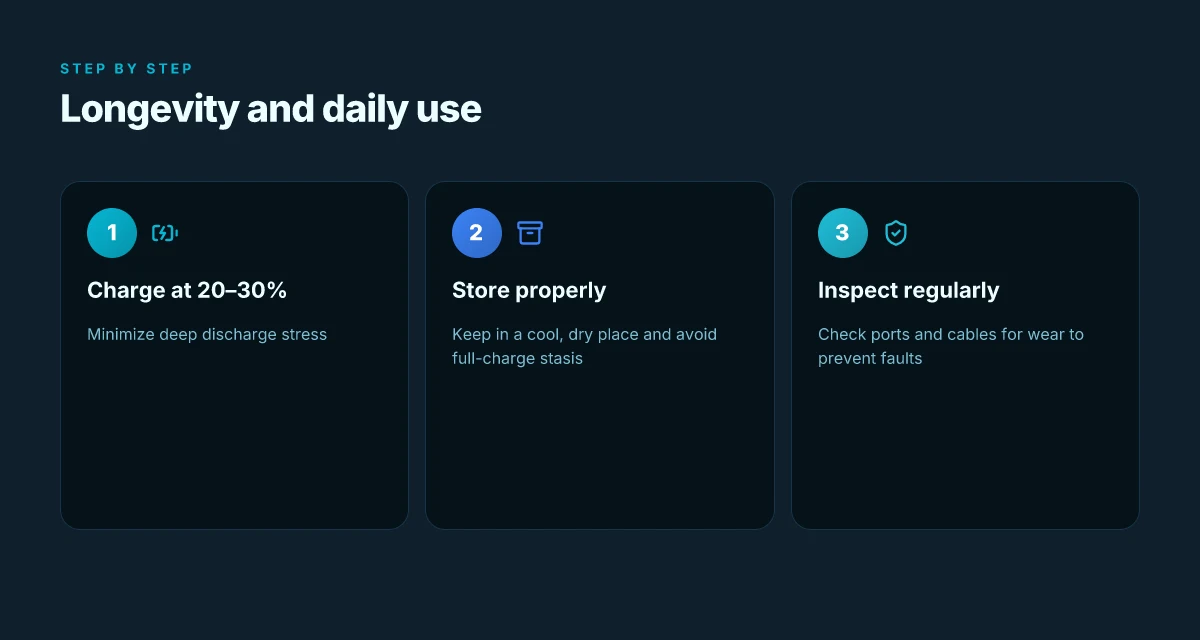
The simplest rule is to top up before the unit drops too far. If you can, plug in when the gauge shows around 20–30% remaining. This keeps the cells out of a chronic deep-discharge state and helps preserve available capacity over time. When you catch a long pause in use, a light top‑off every few weeks, rather than letting it sit empty, pays off in the long run. If you’re away from home and the forecast looks clear for a day or two, you can plan a quick top‑up at mid‑range SOC to keep performance steady. Charging before deep discharge protects longevity and minimizes stress on the Jackery Explorer 500 cells. In practice, treat the power station like a portable battery you’d top off before a long hike rather than letting it sit drained.
Store and manage charge to maximize life
Storage matters as much as daily use. A cool, dry place is best, and you should avoid leaving the unit at full charge for extended periods. If you’re storing it seasonally or between trips, aim for a partial state of charge rather than full. This approach reduces aging from high voltage stress during long idle periods. Keeping the Explorer 500 in a cool, dry spot and avoiding permanent full-charge storage preserves overall health. Think of it as climate-controlled stewardship for your portable power.
Inspect, clean, and verify your connections
Regular inspections matter more than you might expect. Periodically examine ports and cables for wear, corrosion, or loose connectors. A frayed power cord or a dusty DC barrel can quietly invite faults that cascade into failures during critical moments. Clean any dust with a soft brush and inspect contact points for corrosion. If you see signs of wear, replace the affected cable or port assembly before you need it. Routine port and cable checks prevent unexpected faults and keep the unit dependable. What makes the Bluetti B300 battery upgrade worth it for home backup in 2026
I dug into official notes and common user feedback from outdoor-focused sources to verify these patterns. In the real-world picture, the goal is simple: treat the Explorer 500 like a careful companion rather than a throwaway battery. When you consider rivals, like larger units from other brands, maintaining charge discipline and solid storage habits becomes even more important to avoid premature aging. For value and reliability, many owners keep a dedicated charging cadence and a winter storage plan that mirrors the guidance above. If you’re weighing deals, you’ll find that steady maintenance costs are minimal compared with the cost of abrupt replacement.
Keep a consistent charging routine, and you’ll extend the life of the Jackery Explorer 500 for many seasons. Cool, dry storage and periodic port inspections are inexpensive insurance against surprise faults.
Note: links on the product page may earn a commission, and some retailers offer modest promos on seasonal sales. For a quick read on how a 230V setup influences long-term use, you can reference industry notes linked in the sources. Brand clarity matters here: the Jackery ecosystem remains the focal point, with practical checks that apply regardless of the model you own.
What changes if you act now
The Jackery Explorer 500 sits at a pivotal mix of power and portability, and in 2026 it becomes less of a tradeoff and more of a smartly sized workhorse for midrange needs. I looked at how its 500-watt hour battery and livable inverter footprint translate to real-life use, and the pattern stands out: this model balances everyday reliability with a compact footprint that toes the line between pocketable and ready for longer trips. The bigger pattern here is that midcapacity packs like the Explorer 500 unlock dependable energy without the heft of larger packs. Jackery remains a dependable baseline in this category, especially when you need predictable performance with straightforward charging curves.
If you’re weighing options against rivals, the Explorer 500 compares favorably to smaller packs that run out of steam quickly and to bulkier designs that strain portage. The practical takeaway is practical: you don’t have to sacrifice portability to keep essential devices running for an afternoon or a weekend. Rivals such as Goal Zero and EcoFlow offer competing lines, but the Jackery package emphasizes ease of use and broad compatibility. Waiting for a sale can shave a meaningful amount off the up-front cost, but the long-term ownership costs should factor in reliability and spare parts availability. What makes the Bluetti Handsfree 2 backpack power station work for real-world adventures
For a sharper move this month, consider pairing the Explorer 500 with a compact solar panel and a targeted charging plan to maximize uptime during trips. What to try this week is to map out your typical use cases and test whether a single charge covers your needs. If you want a dependable, portable power core that won’t force you to choose between weight and capacity, this model remains a solid bet. Jackery continues to offer a trustworthy balance in 2026.