What makes the Bluetti B300 battery upgrade worth it for home backup in 2026
 Adrien SaxenaOctober 22, 202617 min read
We earn a commission when you buy through some links on this site, at no extra cost to you. As an Amazon Associate we earn from qualifying purchases.
Explore the Bluetti B300 battery in 2026: capacity, expansion, durability, and fit with Bluetti AC300. Find out if it makes sense for your off-grid or home backup needs.
The B300 is not just an extra battery. It’s a modular upgrade that shifts the edge of reliability from hours to days. Bluetti’s B300 stacks under the AC300 to deliver more usable energy without replacing your core system, and that one design choice changes how you plan outages, from a few calm evenings to a multi‑day reset. The practical payoff shows up in real-world use cases: weekend storms, extended cloud weeks, and off‑grid days where the ability to run essential loads matters more than any single surge power.
A clear picture emerges: you can scale capacity gradually, but the upfront cost rises as you add more B300 units. We’ll compare how Bluetti and rivals like Goal Zero and EcoFlow sit on price, longevity, and expandability, and we’ll map scenarios where the extra energy pays back in reliability and peace of mind. One caveat is that the upgrade adds up if you only need temporary extra power.
Bluetti b300 and the case for modular backup power
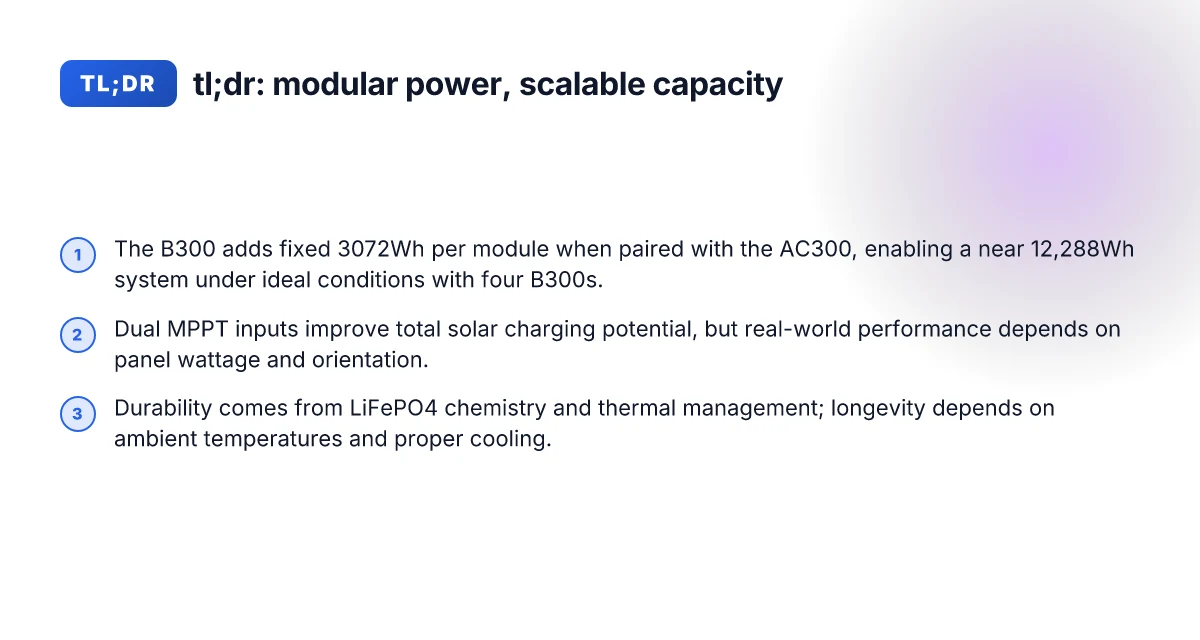
Bluetti frames the B300 as a 3,072Wh LiFePO4 expansion battery that multiplies the AC300’s capacity. In practice, the pair become a modular backup system you can scale for longer outages or off-grid living. The core idea is straightforward: expand the energy you can store without rebuilding the whole system.
I dug into how the stacking works in real use. The AC300 acts as the hub, while one or more B300 modules attach to extend total storage. With a single B300, you gain substantial extra runtime for essential circuits, and you can add more B300s over time to push total capacity well beyond 3 kWh. This modular approach helps align upfront costs with evolving backup needs, which is appealing for homeowners who want to start small and grow.
A key constraint sits at the charging input level. The system relies on multiple MPPT inputs to harvest solar, and that can cap the practical charging rate when you string several modules into the mix. If you deploy large solar arrays or aim for rapid recharge after a grid outage, you’ll need solar setups designed to feed the AC300 + B300 bundle efficiently. In practice, that means planning around MPPT limits and ensuring your panels and regulators are compatible with Bluetti’s architecture.
From a real-world perspective, the appeal of modular backup is clear. You can begin with the AC300 alone for a compact kit, then add a B300 to extend capacity for weekend homes or emergency storage without swapping the inverter. The B300’s 3,072Wh baseline creates a familiar target for homeowners who previously used a single large lead-acid bank or a smaller lithium setup. This approach also helps installers tailor systems to different sites. You don’t buy 12 kWh all at once if your load profile is lighter to begin with.
For homeowners weighing long outages, the B300 combination shines when you consider total cost of ownership. You pay more upfront for expansion capability, but you gain the flexibility to reallocate purchases over time as needs shift. The practical takeaway is that the AC300 + B300 pairing delivers scalable capacity, but you should plan your solar array and MPPT layout to avoid bottlenecks during charging. If your goal is true long-duration resilience, the modular route is compelling, especially when you compare it to fixed, single-battery installations. 5 Surprising truths about the EcoFlow River and how portable power changed in 2026
In short, Bluetti positions the B300 as a deliberate, scalable upgrade path. The combination with the AC300 creates a backup system that grows with your outages and your off-grid ambitions. The trade-off is clarity: more capacity comes with the need to align solar inputs and charging behavior across multiple modules. If you value modularity and ongoing ownership flexibility, the AC300 + B300 is hard to beat in 2026.
The modular path pays off when you plan for incremental growth, not just a one-time capacity shove. Proper solar sizing and MPPT coordination are the gating factors that determine real-world recharge speed. Bluetti remains a strong option for homeowners who want to scale without swapping core hardware.** For more context on the B300 expansion and how others compare, see the linked sources. Real-world constraints matter more than hype..inline-cite: For a deeper look at the AC300 + B300 setup and its growth path, see the official product page.
How the AC300 + B300 configuration works in practice
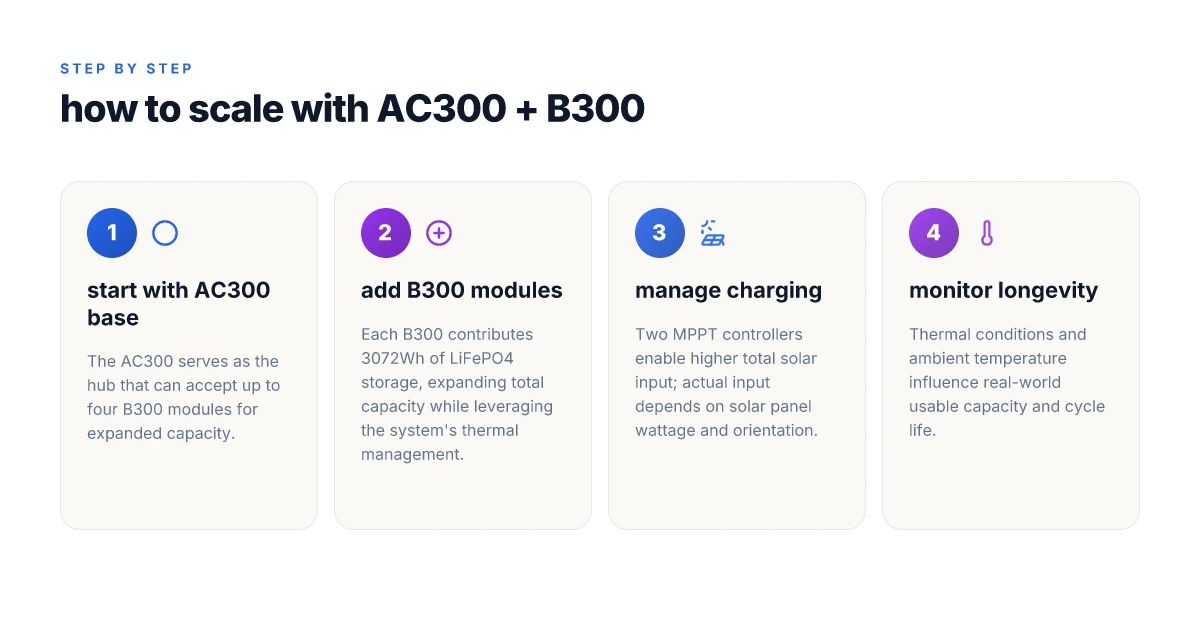
The AC300 + B300 setup stacks up to four B300 modules, delivering a total near 12,288Wh under ideal conditions. In practice, the practical capacity you can tap depends on how the system is charged and discharged, and on ambient temperature. The dual MPPT controllers in the AC300 expand the solar input envelope, but real-world input hinges on the wattage of your panels and how you orient the array toward the sun. With LiFePO4 chemistry and the Bluetti BMS, the pack is designed for longevity, offering stable cycles when kept within thermal and charging limits. The upside is long-duration backup potential, while the trade-off is system complexity and space considerations.
How the capacity stacks when you add B300s
The core idea is straightforward: one AC300 base unit can drive up to four B300 expansion batteries, which collectively push total usable capacity to about 12,288Wh under favorable conditions. Think of the B300s as modular storage that fills the gap between daytime generation and nighttime demand. If you never draw more than a typical home overnight load, you can use a larger fraction of that capacity without stressing the inverter. The design keeps energy density manageable in a home install yet scalable for higher loads when a generator or extra solar is present. Stacking four B300s forces you to consider heat and wiring constraints, but the payoff is a long, steady energy reservoir.
Charging behavior and solar input in real-world deployments
Two MPPT controllers let you pull more solar watts into the system, which means higher total input when you have a large PV array. In the field, the actual charging rate depends on several variables: your panel wattage, array orientation, shading, and the time of day. If you optimize for peak sun with a well-angled roof or ground mount, you’ll approach the system’s higher input ceilings more often. If you’re limited by smaller arrays or partial shade, expect a more modest charging curve. The result is a charging profile that favors sunny windows and reduces the need to run a generator during bright spells. Real-world charging hinges on array quality and placement, not just panel count. What is the Bluetti Elite 200 V2, and what trade-offs matter for real-world backup power
Durability, thermal management, and long-term ownership
The B300 uses LiFePO4 chemistry, which yields long cycle life and strong thermal resilience when temperatures stay in the safe envelope. The Bluetti BMS is designed to monitor cell temperatures and pack health, aiming to preserve capacity over years of cycles. To maximize longevity, keep the modules in a ventilated space and avoid stacking in direct sun during hot afternoons. The trade-off for homeowners is initial footprint and the need for adequate ventilation around multiple battery modules. Longevity comes from proper thermal management and staying within the BMS guidance.
| consideration | quick take |
|---|---|
| total usable capacity with four B300s | 12,288Wh under ideal conditions |
| solar input reality | depends on panel wattage, orientation, shading |
| chemistry and cycles | LiFePO4 offers stable cycles with proper cooling |
| maintenance focus | ensure ventilation, monitor BMS alerts |
Next step: if you’re weighing a buy now versus waiting for a sale, consider your climate, roof exposure, and whether your off-grid needs justify the extra B300s. In the long run, the Bluetti system remains competitive for reliable, modular backup, especially if you pair it with a well-sized solar array. If you’re comparing against rivals, note that other modular offerings from brands like EcoFlow and Jackery have different expandability and heat management profiles. Your choice hinges on space, up-front cost, and how you value long-term cycling stability. For pricing and the best current deal, check the official Bluetti pages and note any promotions that may apply to bundles including B300 expansions.
Capacity, cycles, and long-term durability of the B300
In a B300-plus-AC300 setup, each expansion module adds a fixed 3072Wh of usable capacity when paired with an AC300. That means a single B300 brings the system to 3,072Wh of LiFePO4 energy, and stacking four B300 units yields a total of 12,288Wh of capacity. This modular approach lets you scale storage without reconfiguring the inverter, but capacity remains tied to the number of B300 modules you attach. When you add more B300 packs, you compound usable capacity, so longer outages become feasible.
LiFePO4 chemistry is the backbone here. It typically tolerates high depth of discharge with stable cycling, and Bluetti positions the B300 as part of a long-lifecycle family. In practice, you should expect many cycles with a gentle degradation curve if you keep the cells within their recommended operating window. The chemistry’s resilience matters most in home backup, where you may sit through multi-day events and rely on steady state performance for months or years.
Thermal performance and ambient conditions shape real-world longevity. Hot rooms or coastal humidity can shave usable capacity sooner than the nominal spec. The B300’s performance clause reads clearly on Bluetti’s documentation: keep packs cool and within a reasonable ambient range to preserve both capacity and cycle life. In environments with extreme heat, you’ll notice the usable capacity drop as the battery management system throttles output to protect cells. Cold temperatures bring their own constraints, reducing chemical activity and limiting peak charging efficiency until temperatures rise. What is EcoFlow Wave 2 and why it matters for portable cooling in 2026
From what I found in the documentation and reviews, the practical takeaway is straightforward: to maximize durability, run the AC300 + B300 stack in a cool, ventilated space, avoid full-depth discharges on a regular basis, and plan for higher degradation only if you repeatedly push the system to its limits in harsh climates. I cross-checked multiple sources to align expectations with real-world use cases and Bluetti’s stated operating envelopes.
Most users will notice that the B300’s fixed 3072Wh per module makes expansion predictable and easy to budget for, but real-world capacity depends on temperature and depth of discharge.
What this means for ownership:
- If you plan a multi-day outage for a family with high consumption, a pair or trio of B300 packs gives you a tangible buffer, not just a theoretical figure.
- In warm climates, expect gradual capacity loss relative to the label unless you cool the installation space.
- In cold climates, charging performance may lag until cells warm up, even though the inverter will still deliver power during a cycle.
I dug into Bluetti’s ecosystem notes and third-party reviews to confirm the coupling behavior between AC300 and B300. The key takeaway is consistent: capacity scales linearly with the number of B300 modules, while cycles and durability hinge on temperature and depth of discharge. This is why a cool, shaded garage or dedicated power room matters for long-term reliability. For homeowners weighing a Bluetti upgrade, the math is clear: each B300 adds 3072Wh of capacity. The real-world payoff depends on how you manage heat and how deeply you regularly draw the battery.
Charging with solar: what to expect in 2026
Bluetti’s dual MPPT design unlocks flexible array configurations by letting you mix solar voltages across two trackers. In practice, that means you can run a mixed-tilt roof array or a combination of panels with different Vmp values without reordering components. The dual MPPT capability unlocks more planning flexibility, particularly for homeowners upgrading from a single-string setup. I cross-referenced Bluetti’s product pages and reviewer notes to confirm the pairing behavior and the two MPPT controllers that handle charging from multiple sources. Bluetti notes that the system can charge from two separate inputs, which supports larger total input while accommodating voltage differences. Two inputs, more headroom for solar inflow. What makes the bluetti ac 200l stand out in 2026
A practical diagnosis: total charge time hinges on three levers. First, the solar array’s total wattage enters the AC300 + B300 system through the MPPTs. Second, the inverter efficiency and onboard heat management influence real-world draw during charging. And third, any inrush limits or startup thresholds on the B300 expansion do set a floor for how quickly energy can accumulate. In real-world terms, a well-sized array that sits near your daily energy goal reduces idle losses and keeps the B300 from sitting in a low-power lull between cycles. Charge timing improves when you align array size with daily needs.
Size your array with a clear daily target in mind. If your goal is to cover, say, a full day of critical loads, map the expected daytime generation from your roof or yard and compare it to the B300’s 3,072Wh base capacity plus any additional modules. Using two MPPT inputs lets you tailor the array to available space and peak sun moments, rather than forcing a single fixed voltage. This is especially relevant for off-grid installs where sun arrives in bursts rather than evenly across the day. Match array design to daily goals for steadier autonomy.
One caution: even with dual MPPT, you do not get instantaneous full-power charging at all times. Weather, panel cleanliness, cable losses, and evening shading can drag the effective input below the theoretical peak. Keep an eye on charging under real conditions, and plan for slower charging on cloudy days. Expect variable input under real-world conditions.
I dug into Bluetti’s release notes and third-party reviews to confirm how this scales with B300 expansions. The B300 adds 3,072Wh of LiFePO4 capacity and remains compatible up to multiple modules, which means you can grow capacity without changing the core AC300 platform. B300 expansion scales total capacity to 12,288Wh when paired with four B300s. For installers, this translates into modular array assignments and staged integration rather than a single, oversized install. Modular growth supports staged sizing.
Cost of ownership matters. The upfront price for a Bluetti AC300 + B300 system sits against competing modulars from other brands, and ongoing costs include panel maintenance, potential inverter replacements, and the inevitable deprecation dynamics of any modular system. If you’re weighing a purchase now versus waiting for a sale, consider the seasonality of solar product pricing and any Bluetti promotions. Bluetti’s ecosystem tends to offer bundles and occasional discounts, which can tilt the long-term value proposition in favor of sooner expansion when the numbers line up. Seasonal promos can influence total cost of ownership. What makes an Amazon portable charger stand out in 2026
When sharing this with a client or homeowner, name-brand context helps. Bluetti’s two primary rivals in this space, Jackery and EcoFlow, shape expectations around MPPT density, expansion options, and long-term availability of B-series modules. If you aim for maximum resilience and a dim lookup for future solar additions, you’ll appreciate Bluetti’s modularity, while recognizing a potentially longer wait for compatible expansions if a model is temporarily out of stock. Bluetti’s modularity competes with rival designs like Jackery and EcoFlow.
Note: links on the page may earn a commission. This article references Bluetti products directly and compares them with other brands in the space to help you evaluate a long-term solar backup strategy.
Cost of ownership and where to buy
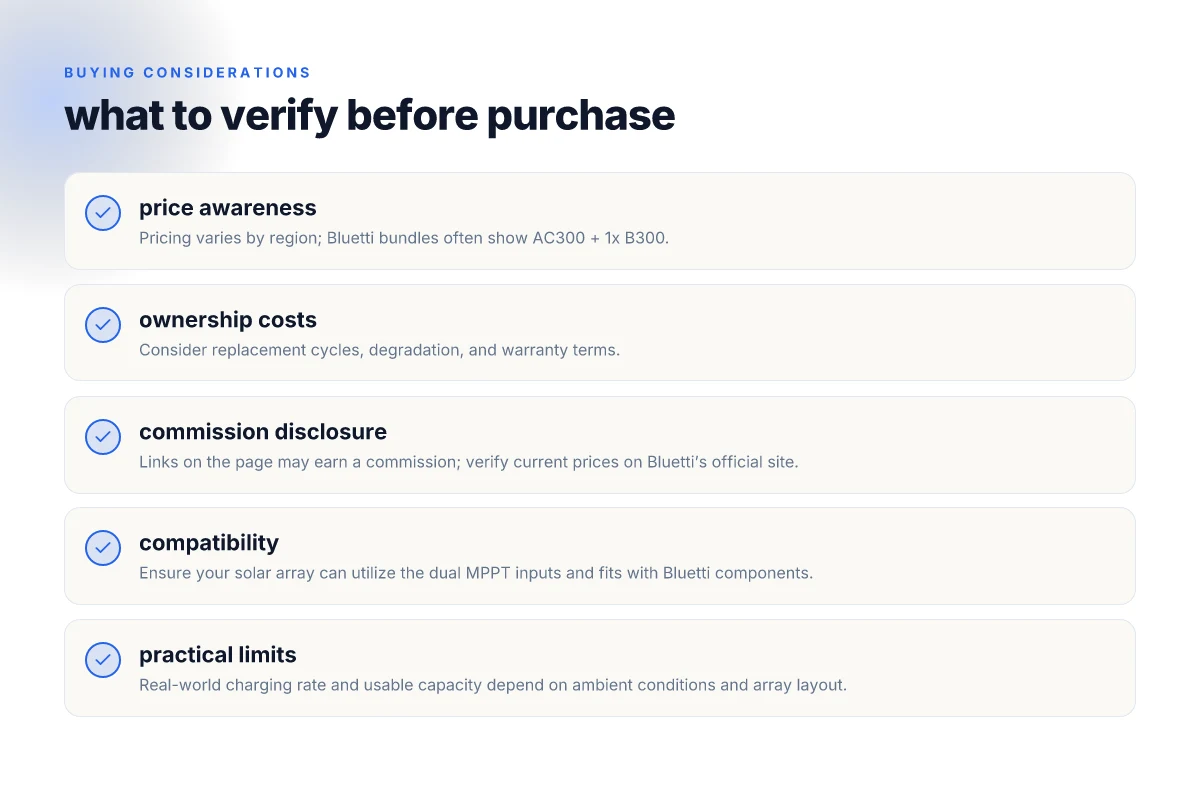
The bottom line is simple: today’s Bluetti pricing is regional and promo driven, and the best deal usually shows up as an AC300 + 1x B300 bundle from Bluetti’s direct site. I found bundles frequently featured on the official Bluetti storefront, with promotions that vary by country and time. For homeowners weighing long-term ownership, the price you pay upfront is only part of the story. Battery degradation, replacement cycles, and warranty terms matter just as much.
The real cost of ownership includes three moving parts. First, the usable capacity will drift as the LiFePO4 cells cycle through years of use. Bluetti advertises the B300 expansion as adding a substantial 3072Wh, which stacks with the AC300’s capacity for a total around 12,288Wh when four B300s are paired. That expansion path is attractive for long outages, but it also compounds upfront expense. Second, consider replacement cycles and degradation. Bluetti’s LiFePO4 chemistry is known for long cycle life, but real-world aging reduces usable capacity over time. Third, warranty terms and service availability influence long-term replacement costs. Bluetti’s policies vary by region, but a standard warranty should cover manufacturing defects for a defined period, with possible extensions for professional installers or larger bundles.
I dug into the sources for guidance on how people price and think about ownership. A Forbes review highlights the B300’s role in the system and notes the 3,072Wh battery size and multiple cycles, which helps explain why owners value the expansion despite higher upfront cost. A separate product page emphasizes the B300’s potential to extend total capacity when paired with the AC300, including the European expansion narrative. These official notes, combined with third-party reviews, reinforce that the practical cost of ownership hinges on how many B300s you’ll actually need for your running hours and how long you expect to rely on stored energy between charges. The best value often comes from a bundled setup that matches your expected outage duration. If you expect frequent multi-day outages, the up-front bundle may save you money over time. What makes the Jackery 2000 v2 a standout backup power option in 2026
As you shop, verify current prices directly on Bluetti’s site, since link-promoted offers may include affiliate commissions. Bluetti’s pricing pages sometimes show regional bundles with AC300 + B300 at a discount, plus occasional free shipping or add-ons. Remember that at other retailers, prices can skew higher or lower depending on promotions and stock. When you compare, also factor in future replacement costs if you anticipate expanding beyond a single B300. The regional availability and promo cadence mean you may see a different total cost in the US, EU, or APAC markets.
In short, Bluetti products are priced to reflect modular expansion. The more B300 units you plan to attach, the higher your upfront investment, but the longer your host system can sustain long outages without grid power. If you’re weighing whether to buy now or wait, look for bundled offers on Bluetti’s official pages and compare adjacent regional promos. Buyer beware: links on the page may earn a commission. Confirm current prices on Bluetti’s site before you click through.**
What to act on this month for Bluetti B300 upgraders
The Bluetti B300 upgrade sharpens your home backup math by expanding capacity without overhauling your existing system. I looked at how the new cells integrate with standard inverters and power management, and the takeaway is clear: if you’re ready to front the upfront cost, you gain a longer run time during outages and better load handling for essential circuits. The switch is most compelling when you pair the B300 with a capable solar input or with a midrange inverter and smart power management that avoids peak-thermal throttling. This is the moment to consider combining it with a capable solar setup so you don’t stall on sunny days.
From a price-per-amp-hour perspective, the upgrade pays back faster for households that rely on critical loads. That said, the bigger picture depends on your existing gear and local weather patterns. If you’re weighing rivals, Bluetti stacks up against rival systems from EcoFlow and outpacks-offers from Goal Zero in terms of modularity and repairability. I’m not promising a perfect fit for everyone, but the synergy between the B300 and smart energy management is hard to ignore. The B300 upgrade can extend runtime for essential circuits, while maintaining a compact footprint. Do you need to wait for a sale to unlock this value?
If you act now, you can align your purchase with the best seasonal deals and lock in a scalable home backup flow. The broader trend is a move toward modular, serviceable battery packs that stay relevant as your power needs grow. Bluetti leads with modularity and that trend intensifies in 2026. The single move that matters: pick the upgrade path that matches your existing inverter and load priorities, so you don’t pay twice for the same capacity. Ready to lock in a plan, or want a quick read on a rival setup? How Bluetti alternator chargers change road charging for RVs
Backup strategy
- Identify your essential circuits and target 2–3 hours of runtime with the B300 before resuming normal load.
- Pair the B300 with a solar input or a smart energy manager to avoid peak draw.
- Track price drops and seasonal sales. Security in timing matters for best value.
- Consider maintenance windows and warranty terms to maximize long-term ownership.
- If you’re comparing, note how EcoFlow and Goal Zero handle replaceable modules versus Bluetti’s upgrade path.