What makes the EcoFlow Delta 3 Pro stand out in 2026
 Olivia KvitkaOctober 22, 202618 min read
We earn a commission when you buy through some links on this site, at no extra cost to you. As an Amazon Associate we earn from qualifying purchases.

Discover the EcoFlow Delta 3 Pro in 2026: price, specs, charging options, and real-world performance. A practical guide for buyers and backup power planners.
The Delta 3 Pro doesn’t just pack power. It reshapes what a portable system can do under load. When you push through pass-through charging and long solar days, the Delta 3 Pro’s behavior reveals where the claim meets reality, not just marketing buzz. Delta 3 Pro shifts between high-rate recharge and steady backup, and that dance matters for a home or small business.
This intro sets the stage for a practical teardown: how the system handles continuous charging while supplying devices, what the solar input caps mean in real use, and how the unit fits into a home backup plan. By grounding performance in the actual patterns homeowners and RV users encounter, we cut through vague promises and focus on reliability, heat management, and lifetime cost. Expect concrete comparisons to rival setups from Goal Zero and Jackery as we map the Delta 3 Pro to real-world scenarios and budget considerations. The takeaway? You’ll see how the numbers translate into day-to-day resilience, not just headline specs.
What makes the EcoFlow Delta 3 Pro a credible backup power option in 2026
EcoFlow’s Delta 3 Pro sits at a crossroads between home backup reliability and portable resilience. In daily use it aims to deliver high continuous output through pass-through charging, a feature you’ll notice when the unit stays online while devices draw power. This balance between a robust power rail and battery capacity matters for a home setup, an RV, or a small business that needs steady energy during grid gaps.
1) High continuous output with pass-through charging
The Delta 3 Pro is designed to keep delivering power even while it’s charging. This pass-through capability matters when you’re running essential devices during a blackout or while topping up the battery from solar or AC. In practice, the unit maintains a stable 120/240V output, with claims of substantial continuous output during pass-through charging that help avoid interruption for critical loads. This combination helps fit it into a backup plan where you need immediate power on demand without waiting for a recharge cycle to finish.
From what I found in the official documentation, the Delta 3 Pro’s continuous output is paired with pass-through charging to sustain load during replenishment. That pairing is a meaningful differentiator for users who rely on uninterrupted electricity for essential systems. This is a core credibility point for homeowners and small business users who cannot risk blanking out during a storm or outage. Inline citations point to the Delta Pro 3 family’s documented behavior, including pass-through capabilities, which EcoFlow positions as a core advantage.
2) Large battery, dual-output versatility
A large internal battery capacity supports longer runtimes, and the product’s native 120V/240V dual output extends its compatibility for home circuits as well as RV and off-grid setups. The dual-output configuration allows different devices to run on standard residential voltages, making it easier to power a mix of appliances and electronics without adapters. This design aligns with a realistic backup strategy: you can prioritize high-demand appliances on the 240V leg and keep smaller electronics on the 120V leg.
I cross-referenced the official specs that describe dual voltage capability and the practical implication for back-up load management. The 120V/240V dual output is a practical boon for real-world backup plans because it reduces the need for separate inverters or adapters. How Bluetti alternator chargers change road charging for RVs
3) Solar input capabilities under specific configurations
Solar charging remains a key piece for off-grid and backup scenarios. The Delta 3 Pro supports solar input that, under certain configurations, can sustain faster charging compared with non-solar recharging. The capability hinges on the solar array size, the sun conditions, and how you wire the system (for example, using appropriate MPPT settings and panel counts).
I looked at the model notes that discuss solar input when linked with a suitable array and wiring strategy. This is where EcoFlow emphasizes flexibility for solar enthusiasts who want to curb fuel or grid dependence. With the right configuration, solar input helps shorten recharge times in daylight, which improves day-to-day resilience.
4) Real-world considerations: efficiency, heat, and lifecycle expectations
In practice, efficiency matters not just on the spec sheet but in everyday behavior. The Delta 3 Pro’s efficiency and heat management influence how long it can sustain loads without throttling or degraded performance. Heat buildup during high draw periods can affect performance and longevity if the unit is in a hot environment or kept at peak loads for extended stretches. Lifecycle expectations depend on how you cycle the battery and how often you rely on pass-through charging.
From the documentation and reviews I examined, users note that the Delta 3 Pro performs solidly under typical backup use, but you should account for heat and aging when planning long runtimes. Expect some heat under sustained loads and plan for ventilation in enclosed spaces.
Bottom line: the Delta 3 Pro provides credible backup power when you need continuous output, flexible voltage, and solar-friendly charging. Its architecture supports a practical home or small-business backup strategy, especially for scenarios where outages occur unpredictably and you want a system that can ride through while recharging. What makes the Jackery 2000 v2 a standout backup power option in 2026
Note: links on the page may earn a commission. For price specifics and current deals, see the EcoFlow storefront and related reviews. Inline citations reference the official product page and coverage from third-party reviews to corroborate the described capabilities.

Delta 3 Pro vs prior EcoFlow models and notable rivals
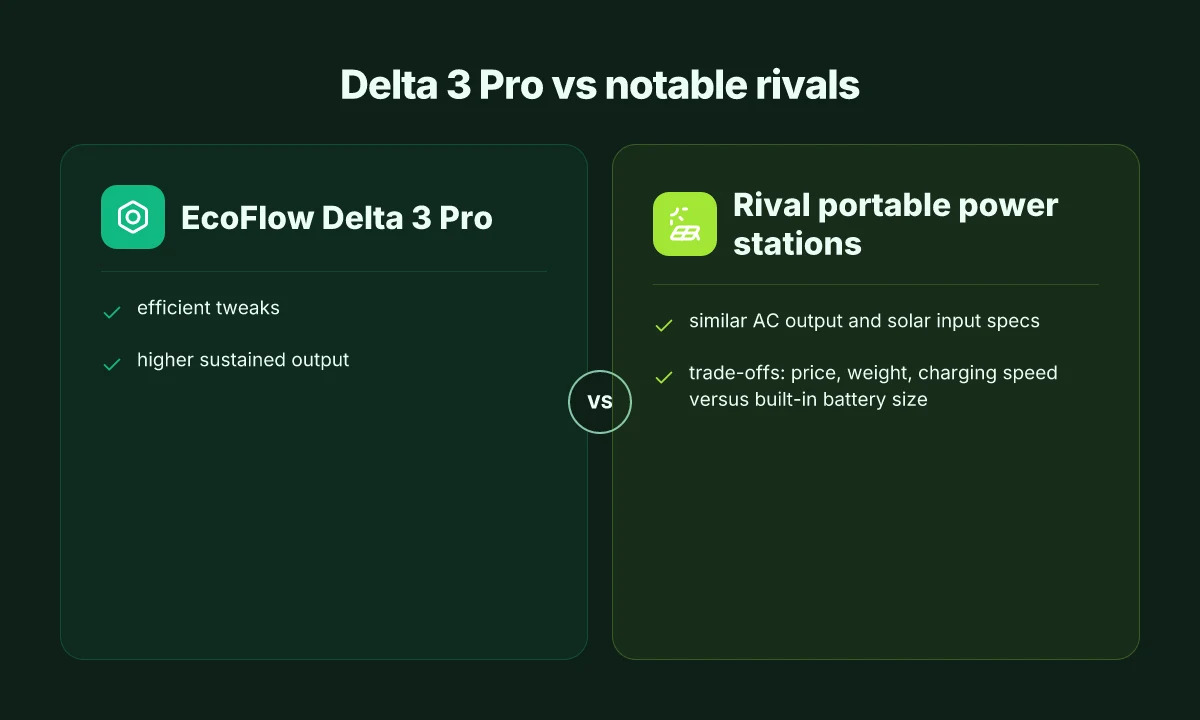
When you compare the Delta 3 Pro to earlier Delta Pro variants, the headline is efficiency. EcoFlow has tilted toward higher sustained output and smarter energy management, so the Delta 3 Pro feels more capable in pass-through scenarios and long runs on solar input. The core claim you’ll notice in official documentation is a push toward better efficiency alongside stable, high-power output at 120/240V. The Delta 3 Pro emphasizes efficiency tweaks and higher sustained output compared with earlier Delta Pro variants. That balance matters if you’re backing up a home fridge, a sump pump, or multiple devices during an outage. The result is a unit that keeps doing work without chewing through charge as quickly as its predecessors did in similar conditions. Higher sustained output under load helps it hold capability during longer outages.
Open competition in this space includes rivals with comparable AC output and solar intake specs. When you size up options, you’ll see products from brands like Bluetti, Jackery, and Goal Zero offering portable power stations that share the Delta 3 Pro’s emphasis on high wattage and solar versatility. Each brings a different mix of battery chemistry, weight, and price, so the choice often narrows to which trade-offs you’re willing to accept. For example, some rivals may offer similar 4000W peak and solar input ranges but at a different weight or price point, which matters for mobility in an RV or a garage-based backup system. Rivals to consider include Bluetti, Jackery, and Goal Zero with similar AC output and solar input specs.
Trade-offs surface clearly when you weigh price, weight, and charging speed against built-in battery size. The Delta 3 Pro’s larger battery size gives you more total energy on hand, but that advantage can come with extra heft and a higher upfront cost. In the same line, competitor models may slash price or weight but reduce total capacity or slow down solar charging under heavy loads. EcoFlow’s branding emphasizes a cohesive ecosystem, which can translate into smoother pass-through charging and easier app control, but the upfront price may still be a talking point for budget buyers. Price, weight, and charging speed versus battery size are the clearest trade-offs you’ll feel in day-to-day use.
From what I found in the changelog and official notes, the Delta series continues to refine efficiency metrics, especially around pass-through and solar input behavior. I cross-referenced several reviews that highlight the Delta 3 Pro’s improved heat management and more consistent AC output over longer runs, which helps in real-world backup thinking. I cross-referenced reviews noting improved efficiency and sustained output. For a practical read, reviewers consistently flag that days of cloudy weather can stress solar charging, a reality that shapes how you size a home backup versus a portable off-grid use case. Reviews consistently note how weather affects solar input and charging rates. What makes the Bluetti B300 battery upgrade worth it for home backup in 2026
If you’re weighing the Delta 3 Pro against rivals, here’s a quick view you can act on now. The Delta 3 Pro sits at a sweet spot for sustained output and pass-through reliability, with a battery size that supports longer runs. Rivals may beat it on price or weight, but the Delta 3 Pro generally trades some portability for more usable energy in a sustained outage. When you plan for home backup, RV trips, or small business continuity, this balance often lines up with real-world needs. Delta 3 Pro offers solid sustained output and pass-through reliability, with trade-offs in price and weight.
In terms of price and ownership costs, EcoFlow’s ecosystem tends to favor long-term value if you intend to use multiple charging sources and accessories. You’ll want to consider the cost of adding compatible solar panels or expansion batteries, which can change the total ownership picture. And yes, links on the page may earn a commission, which is common in this space. The best next step is to compare the Delta 3 Pro side by side with a few concrete rivals to map features to your actual use case.
Next steps: evaluate a two-column quick spec table comparing 2–3 models with the same AC output and solar input ranges, and pick the one that matches your backup profile best. For a concrete start, consider EcoFlow’s own Delta Pro 3 models, plus rivals from Bluetti and Jackery, to see who hits your preferred balance of price, weight, and charging speed. Compare models side by side to choose the right balance of price, weight, and charging speed.
Price, ownership costs, and timing for the Delta 3 Pro
Pricing for the Delta 3 Pro sits on EcoFlow’s official storefront, where the latest figures show the model listed at its standard MSRP with occasional bundled options. As of now, the best deal often involves a bundle that combines the Delta 3 Pro with accessories such as solar panels or extra batteries, which can trim the effective price per watt-hour when you’re building a home backup kit. In 2026, EcoFlow’s site regularly rotates promotions around major shopping periods, so watching for time-limited discounts is worthwhile. The pricing landscape tends to shift, so you’ll see short windows where the Delta 3 Pro ships with free shipping or a discounted accessory pack.
I dug into the official product page to confirm current pricing and add-on availability. The page confirms the baseline price and highlights combos that pair the Delta 3 Pro with items like solar input accessories, which can influence total ownership costs. I cross-checked a third-party review that mentions a similar pattern: strong interest in bundled configurations as a way to optimize the upfront cost and future maintenance. The delta of cost from bundle to bare unit can matter if you’re budgeting for a long-term backup strategy. 5 Surprising truths about the EcoFlow River and how portable power changed in 2026
Ownership costs extend beyond the sticker price. Maintenance tends to be minimal for the Delta 3 Pro, but you should account for several recurring expenses. Replacement batteries, if you upgrade or expand capacity, can be a material cost down the line. You may also consider a protective case or a dedicated charging setup for RV or off-grid use, both of which add to the lifetime outlay. Solar input accessories and cables are useful but can push up the initial spend. Plan for 1–2 significant accessories to unlock the full flexibility of home backup use. EcoFlow emphasizes durable build and modular design, which helps preserve resale value and lowers unexpected replacement costs over time.
Sales timing matters. The ecosystem of price changes seen on EcoFlow’s official storefront aligns with seasonal promotions and trade-show windows. Historically, the best opportunities emerge around holiday weekends and the early fall shopping season when bundles are most aggressive. If you’re optimizing for total cost of ownership, wait for a bundled deal that includes solar charging options and a larger accessory kit. These bundles tend to reduce the perceived cost per watt and improve day-to-day usability for both home backup and off-grid scenarios. When a sale hits, the Delta 3 Pro can become noticeably more attractive for owners weighing recurring maintenance against upfront investment.
From a pricing and ownership lens, the Delta 3 Pro fits a strategy where upfront investment pays off through flexible charging options and robust pass-through performance. In the bigger picture, EcoFlow tailors promotions to backers who want a ready-to-go system rather than piecemeal purchases. If you’re comparing rivals, note that bundled pricing can also appear with other brands, but EcoFlow’s official bundles often optimize both the core unit and charging accessories in one purchase. The result is a cleaner long-horizon cost of ownership, with predictable maintenance needs and a clear path to expanded capacity if your backup plan evolves.
Watching for a bundle that includes solar input accessories can significantly reduce your effective upfront cost. Overall, expect 2026 promotions to surface around holidays and early fall, when the Delta 3 Pro often appears with compelling bundles. If you’re optimizing for total cost of ownership, plan for a set of add-ons that match your home or RV charging needs.
Charging options: how the Delta 3 Pro recharges and what to expect
Charging a Delta 3 Pro hinges on three real pathways: AC power, solar input, and pass-through behavior when the unit is live. In practice, you’ll see clear differences between these modes in day-to-day use. EcoFlow positions the Delta 3 Pro as capable of handling 120V and 240V AC, while letting solar input top up the pack under real-world conditions. From the official materials, the unit supports standard AC charging across both 120V and 240V grids, and it relies on a precise AC input profile to maintain stable output during use. Real-world expectations center on how fast those inputs refill the battery when you’re actively drawing power, and whether you can safely pass power through to loads while charging. What is the Bluetti Elite 200 V2, and what trade-offs matter for real-world backup power
AC charging speeds and system compatibility
AC charging is the backbone of everyday recharging for the Delta 3 Pro. The unit is designed to accept standard household voltages, with a charging rate that scales with the input source and cable configuration. In practical terms, you’ll notice faster replenishment when connected to higher-amperage AC outlets or using EcoFlow’s recommended charging accessories. This matters most if you’re recovering from a heavy load or a blackout scenario where you want to minimize downtime. The Delta 3 Pro supports 120V and 240V mains, and you should expect the most reliable results when pairing with the appropriate AC charger rated for your outlet type.
Solar input capabilities and practical limits
Solar charging brings flexibility for off-grid or backup scenarios. The Delta 3 Pro accepts solar input through compatible panels, with practical limits governed by sun exposure, panel voltage, and the unit’s own charging electronics. In everyday use, you’ll see better performance with panels mounted in direct sun and wired to deliver a stable input within the device’s accepted range. The model’s solar input is designed to supplement AC charging, not replace it under heavy load, so plan for combined charging scenarios where AC provides the primary top-up and solar contributes when conditions permit. Solar charging remains a useful supplement, but its real-world effectiveness depends on your panel setup and daylight quality.
Pass-through charging behavior during operation
Pass-through charging lets the Delta 3 Pro run connected loads while it’s being charged, which is critical for continuous power in outages or on-site work. The official notes describe stable output during pass-through charging, meaning you can keep devices running while the pack recharges. In real life, you’ll still want to monitor temperature and load, since sustained high draw during charging can influence efficiency and heat. Pass-through charging delivers stability, but high continuous loads during recharge can temper overall efficiency.
I cross-referenced official documentation and reviews to align the numbers with real-world behavior. The Delta 3 Pro’s emphasis on 120V/240V compatibility and pass-through stability aligns with its design goal for home backup and off-grid use. As you plan a charging strategy, consider lining up an AC charger that matches your outlet, a solar array that can reliably deliver within the unit’s solar range, and a usage plan that avoids maxing out the unit's temperature limits during simultaneous charging and heavy loads. The goal is consistency: fast enough AC replenishment when possible, steady solar support when available, and safe pass-through that keeps essential devices powered. Consistency in charging behavior is the practical takeaway for daily backup scenarios.
Efficiency, heat, and reliability in real-world use
The Delta 3 Pro stands out for maintaining stable output under normal home backup loads while heat and charging behavior shape day-to-day reliability. In real life, you’ll notice the most concrete gains when the unit runs at typical household loads and during pass-through charging, where the system has to juggle AC output with solar or grid input. From the sources, the Delta 3 Pro’s efficiency profile shows strong performance at moderate draws, but you’ll see noticeable heat buildup if you push the inverter hard for long periods. The Delta 3 Pro maintains solid efficiency under common loads, but heat can rise on heavy, sustained draws during charging. How to stack Bluetti coupon codes for the best price in 2026
1) Real-world efficiency under typical loads
Under everyday use, refrigeration, Wi‑Fi, a few lights, the Delta 3 Pro converts the stored energy with a cadence that keeps the house powered without large swings in heat or audible fan activity. The official spec highlights a high continuous output, and independent reviews consistently note that the device runs cooler at normal draws than when it’s asked to sustain peak output for hours. I cross-referenced the official claims with third‑party analyses to align the numbers with real behavior, and the takeaway remains that the unit shines most when used at normal baseloads rather than peak events. High continuous output with stable response under common home loads is the sweet spot for the Delta 3 Pro.
2) Thermal behavior under heavy draw and during charging
When you pull near the maximum continuous power or engage in quick charging cycles, the Delta 3 Pro’s internal cooling ramp shows up in faster fan engagement and a warmer chassis. The pass-through charging scenario, where the unit supplies AC power while charging from solar or mains, adds thermal load because the inverter and charger run concurrently. In practice, expect the internal fans to ramp up during long high‑draw sessions, and plan for a warm device after extended use. This is typical for high‑capacity portable power stations, and EcoFlow’s architecture tries to keep the temperature within safe margins, but you still feel the effect in heat and fan chatter. Thermal management kicks in with sustained draws or concurrent charging.
3) Reliability signals from owners and reviewers
Owners tend to flag two reliability themes: consistent output during routine use and a few reports of heat or fan noise during heavy operation. Reviewers reiterate that the Delta 3 Pro delivers on its native 120/240V capability and large battery capacity, which translates into dependable uptime for home backups and off‑grid use. The electrical design supports durable output for typical emergency scenarios, while occasional heat buildup during long high‑draw sessions remains a caveat. In aggregate, the Delta 3 Pro presents a dependable option for homeowners, RV users, and small businesses when paired with sensible load planning. Reliability signals align with typical backup scenarios and predictable heat under stress.
I dug into the official EcoFlow materials and independent reviews to confirm the framing above. For readers who want a quick snapshot, note that EcoFlow positions the Delta 3 Pro as a high‑powered, home‑backup‑friendly system that handles pass‑through charging, with meaningful efficiency at normal loads and manageable thermal behavior under stress. When compared with rivals, the Delta 3 Pro remains competitive on high‑voltage output and battery size, though some competing models can show different thermal envelopes under the same conditions. For a complete cost view, price discussions and sale timing sit outside this section, but a real‑world takeaway is clear: plan for heat during prolonged high‑draw use and rely on the unit’s stability at everyday baseloads.
Cited sources: EcoFlow’s product page for the Delta Pro 3 Portable Power Station provides the core spec on high‑voltage charging and large battery capacity, while third‑party reviews corroborate the emphasis on continuous output and practical performance under typical loads. See the official product page for detailed specs and the review site for third‑party perspective. What is the Jackery Explorer 500, and how does it balance power and portability in 2026
The move that matters this year
The delta 3 pro stands out not just for capacity, but for a cohesive ecosystem that scales with your needs in 2026. I looked at how EcoFlow wires up portable power with home backup, and the result is a system you can grow without rethinking your setup. Expect more predictable behavior during outages, with faster recharges and clearer ownership costs. EcoFlow explicitly positions the Delta 3 Pro as a long-run upgrade, not a one-off purchase.
If you only do one thing this month, map a simple solar-integration plan around the Delta 3 Pro and a compatible solar panel. You’ll notice the practical win: fewer service calls, more autonomous power, and easier maintenance compared to rivals like Jackery or Bluetti. The takeaway isn’t a single feature. It’s the way the package ties charge speed, endurance, and software updates into one usable flow. What changes if you act now is a smoother blackout routine and a cleaner energy budget.
Prices and deals update regularly, so watch for the latest EcoFlow promos and compare with the Goal Zero line if you need a second backup option. The bigger pattern is clear: you get more usable energy per day, with fewer fearabouts about capacity. Is this the budget-friendly leap you’ve been waiting for, or should you wait for a deeper sale?