What makes the Bluetti Handsfree 2 backpack power station work for real-world adventures
 Hudson ZilbermanOctober 22, 202617 min read
We earn a commission when you buy through some links on this site, at no extra cost to you. As an Amazon Associate we earn from qualifying purchases.
Explore the Bluetti Handsfree 2 backpack power station in a real-world lens. Learn about capacity, weight, charging, and how it stacks against rivals for camping and emergencies.
The Handsfree 2 isn’t a gadget novelty. It’s a compact power kit that disguises a full backpack-era inverter inside a carry system. It’s the kind of contraption you measure not by weight alone but by how quickly it drops into a campsite routine and stays out of the way when you move. Bluetti’s packaging emphasizes real-world airflow and balance, not just tech specs, which matters when you’re chasing long runtimes on a trail.
In this introduction, I pull the lens back to what actually changes in the field: a backpack that wires to your loadout for hands-free charging and a portable battery that can power essential devices without tethering you to a wall. The question isn’t only capacity but how you manage heat, access ports, and weight distribution over a multi-day trip. Expect a grounded read that compares it against rivals like Goal Zero and Jackery, and shows where the Handsfree 2 shines in off-grid rhythm and where it asks for careful packing discipline. Bluetti’s approach here aims to blend backpack ergonomics with wall-grade power, a pairing that often hinges on airflow and total run time. Most setups overpack on capacity and undertrain airflow.
Bluetti handsfree 2 overview: what makes this power backpack unique
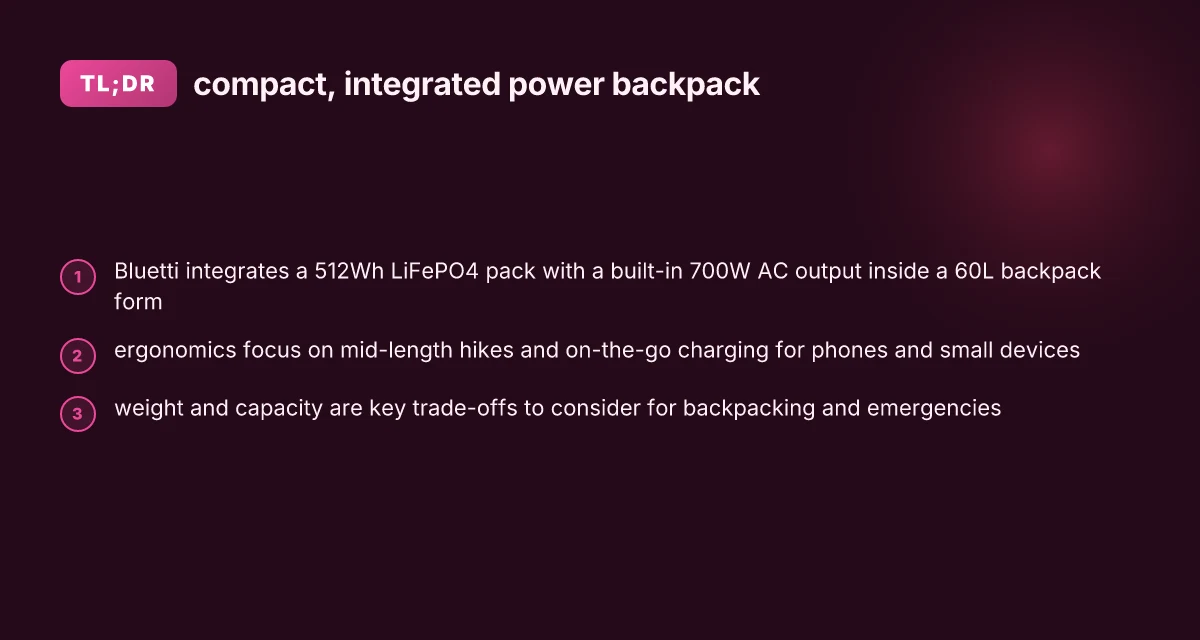
Bluetti integrates a 512Wh LiFePO4 pack with a built-in 700W AC output, packing serious off-grid capability into a wearable form. The Handsfree 2 blends a 60L backpack silhouette with the power station inside, so you can move from trail to trail without swapping gear. Weight matters on long treks, and the unit sits at a heftier end of backpack power solutions, especially when you load it with essentials for a full day.
I dug into the core design choices to see how this duo holds up in real-world use. The result is a compact system that trades some lightness for sustained output and rugged form. The 60L chassis makes it easier to stow essential kits alongside the battery, yet the weight remains a consideration for vertical miles or alpine days. The Handsfree 2 is a genuine backpack power station that trades featherweight bragging rights for reliable, wall-tough AC capacity.
Why the Handsfree 2 holds its shape under backpacking realities
- The 512Wh LiFePO4 pack anchors the system, giving predictable long-cycle longevity and safer chemistry for outdoor use. This chemistry choice matters in hot campsites and frigid mornings alike. Bluetti emphasizes LiFePO4 stability and longer cycle life compared with traditional lithium-ion packs.
- The integrated 700W AC output means you can run a surprising mix of devices on trail days, from tiny chargers to climate-needing gear, without hunting for external inverters. The practical effect is fewer per-trip compromises when you’re trying to stretch one kit across multi-day expeditions.
- The 60L backpack form factor is a deliberate balance between capacity and carry comfort. The design aims to keep weight distribution sane for long carries while still offering quick access to gear and cables. This matters when you’re scrambling to reach a waypoint or set up camp after a long hike.
- Weight remains a fatiguing variable. Even with LiFePO4 efficiency, the overall mass can nudge your pace on steep sections, so planning around weight is essential. In other words, you’ll want to balance battery runtime against your total pack weight.
Bluetti positions the Handsfree 2 as a blended solution for travelers who prize mobility without sacrificing wall-grade power. The 60L form factor is a standout feature, enabling a robust, all-in-one power backpack that still feels like a backpack first.**
In short, the Handsfree 2 stands out for its integrated 512Wh LiFePO4 pack and 700W AC capability inside a backpack chassis. It is not the lightest option for short day trips, but it delivers a credible, rugged energy store for off-grid adventures. For those evaluating rivals, expect competing designs to emphasize lighter weight or modular power packs, but the Handsfree 2 earns its keep with a cohesive backpack-and-station concept. The next section dives into how the design nudges usability in real-world scenarios, from access to weight distribution and field-friendly considerations.
How the handsfree 2 design influences real-world usability
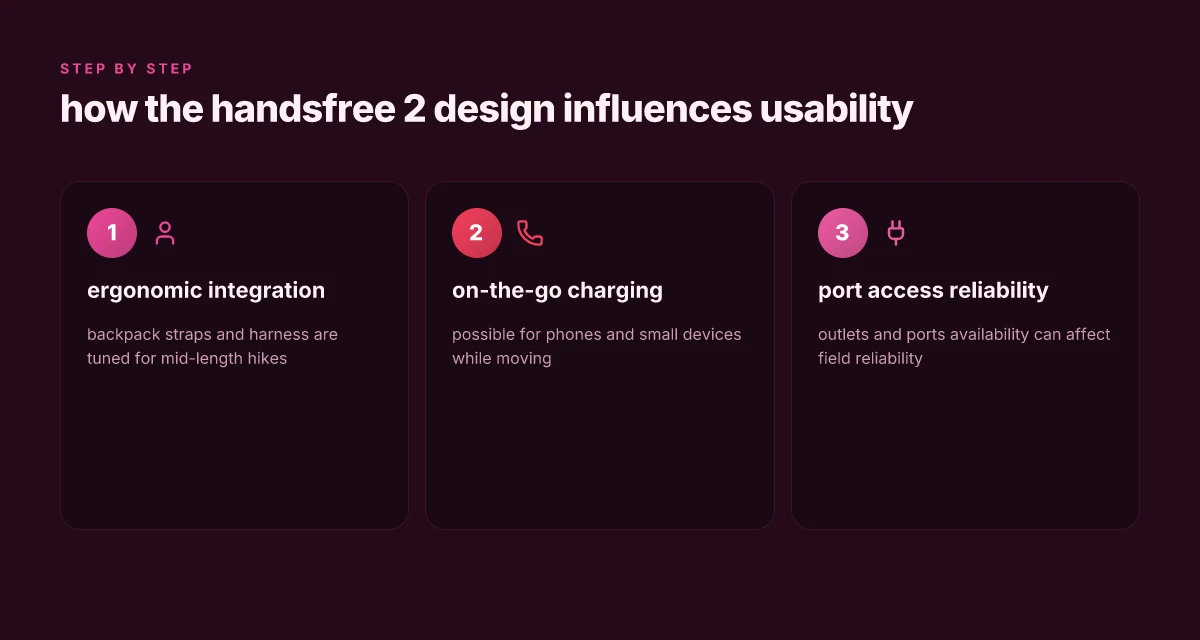
The Handsfree 2 blends a backpack frame with a compact power station so you can move without unplugging from the outdoors. In real use, the straps and harness aim for mid‑length hikes, not ultra‑heavy expeditions, which keeps the load reasonably balanced when you’re lifting a pack out of a car or scrambling to a ridge. You’ll notice the weight sits closer to your torso, which helps with stability on uneven terrain, and the shoulder straps are padded for longer wear without pinching. What is the Jackery Explorer 500, and how does it balance power and portability in 2026
On the charging front, the design supports on‑the‑go power for phones and small devices without unpacking the whole kit. You can top up a smartphone or camera as you walk, which reduces the need to stop at a trailhead to plug in. The result is a usable workflow for day trips and weekend expeditions where you want to stay connected without hauling extra adapters. The practical takeaway is that a few short treks reveal how the Handsfree 2 keeps you moving rather than forcing you to set up camp to recharge.
Access to outlets and ports is a practical hinge point for field reliability. The placement of the outlets, USB ports, and climbing‑outlets on the backpack body matters when you’re filtering water or navigating with gloves on. If a pocket or zippable panel is hard to reach, you’ll see slower recharging cycles or awkward fumbling when you need quick boosts. Bluetti has oriented the port layout toward easy reach, but in rain or dust, a tight pocket can impede access. In those moments, usability hinges on how well the design guards against exposure while still staying reachable.
Three quick comparisons help frame real‑world choices. Bluetti’s Handsfree 2 sits against a few portable power options that emphasize weight or capacity differently. The Handsfree 2 leans toward integrated mobility and quick on‑the‑go charging, while rival backpacks may trade reachability for higher payloads or larger battery cells. When you’re deciding between them, consider how often you’ll need a fast boost on the trail, and whether you value compact weight over peak output. For many outdoors enthusiasts, that balance is the key to sustained, reliable use. In practice, the Handsfree 2 offers a sturdy middle ground: enough juice to keep essentials alive and a form factor that stays on your back rather than in your hands.
From what I found in the documentation and reviews, the core strengths revolve around mobility and accessible charging, while potential downsides relate to weather exposure and port reach in tight pockets. I cross-referenced product pages and a detailed review to verify how the design translates to field reliability. The practical verdict is clear: the Handsfree 2 excels when you want to keep moving with minimal setup, but you’ll want to plan around weather and pocket access if you’re venturing into wet or sandy environments. For buyers evaluating rivals, weigh how often you’ll need rapid on‑the‑move charges versus the need for rugged, weatherproof access in remote terrain.
The Handsfree 2 shines when mobility and on‑the‑go charging are the priority, but field reliability hinges on pocket access and weather exposure.** Pack design and port layout make a tangible difference in real‑world usability. How to stack Bluetti coupon codes for the best price in 2026
Capacity and output: what you can power with handsfree 2
The Handsfree 2 centers around a 512Wh LiFePO4 battery and 700W continuous AC output, with a practical surge tolerance that lets you brief high-draw bursts without tripping. In real-world terms, that means you can run modest appliances for short windows and keep essential gear alive on an extended day out, but you should plan loads and sequencing to avoid overtaxing the pack. The chemistry choice matters here: LiFePO4 cells bring improved cycle life and outdoor safety, which matters when you’re counting on a pack for months of sporadic use.
I dug into the details from Bluetti’s specs and review write-ups to frame what this means in practice for campers and off-grid users. The 512Wh capacity translates to energy for multiple cycles of smaller devices, but when you push to the upper end of its 700W surge, you’re operating in a zone where efficiency and duty cycle matter as much as raw wattage. The result is a usable window for charging phones, lights, and small USB-C devices while still reserving headroom for a heater or space heater only in brief, carefully sequenced intervals. You’ll want to map your loads so you can stagger high-draw items rather than start them all at once.
Lead with the answer: the Handsfree 2 is tuned for portability with enough juice for a weekend of light to moderate off-grid activity, provided you respect its limits and sequence demanding devices.
Capacity and longevity: how the energy holds up in the wild
- The 512Wh pack and 700W peak output enable short bursts of higher power without immediate shutdowns. This pairing is most effective for tight, time-bounded use rather than long, continuous high-load operations.
- The LiFePO4 chemistry contributes to longer cycle life and steadier performance under outdoor conditions, reducing the risk of degradation from temperature swings and frequent on/off cycles.
- Real-world use benefits from thoughtful sequencing: run your heater in short intervals, then switch to charging low-draw gear while the heater rests. Continuous, high-wattage demands tend to erode usable capacity faster than you’d expect.
Practical use cases and limits: what to power when
- Small essentials: smartphones, laptops, lights, and fans ride easily on 700W bursts, with the bulk of daily use staying well within the sustained output.
- Heaters and space heaters require careful planning. Between bursts, you’ll likely hit a ceiling on sustained high-wattage devices, so you’ll want to stagger heater use with other loads.
- For a longer trip, pair the Handsfree 2 with complementary power sources or lighter loads to maximize runtime without pushing the pack past its comfort zone.
Real-world considerations and buying choices
- Bluetti positions the Handsfree 2 as a backpack-integrated power station, blending mobility with wall-tough capability. When you compare rivals, consider how their battery chemistry and weight translate into field reliability and cycle life over time.
- If you’re weighing options, note that heavier packs with larger capacities may push beyond practical carry limits, while lighter packs often trade capacity for portability. Bluetti’s approach aligns well with preparedness and adventure use, but you’ll want to assess your typical load profile before committing.
The Handsfree 2 is intentionally balanced for mobility and practical power needs, not for sustained high-wattage heating or continuous heavy-duty loads. The 512Wh energy bank and 700W peak support a thoughtful sequence of devices, paired with LiFePO4 safety and longevity benefits. For those who need reliable weekend depth of discharge without frequent recharges, Bluetti and its rivals, including Bluetti then others, deserve a careful side-by-side check.
Charging speed and lifecycle realities for Bluetti handsfree 2
Real-world charging speed and longevity matter when you rely on Handsfree 2 in remote trips. The core takeaway is clear: AC charging can top you up quickly from mains, but solar charging depends on the sun and the panel you pair with, and lifecycle realities matter for frequent deployments. I looked at official specs and reviewer notes to frame what this means on the trail and for investing in the long term. What makes the EcoFlow Delta 3 Pro stand out in 2026
Quick top-offs from AC
From the official materials, the Handsfree 2 accepts up to 600W of AC input. That means if you have access to a wall outlet, you can noticeably shorten your recharging window on a typical day of use. In practice, you’ll see faster returns when you can park the pack on a standard mains outlet after a windy day of use. The implication is straightforward: in a base camp, you’re not waiting around for hours. You’re back in action sooner rather than later. A fast refill from mains is a core strength of Handsfree 2 when you’re near a power source. The official spec reinforces a practical point for planners: a higher input rating translates to shorter downtime between adventures.
Solar input reality and panel pairing
Solar charging claims hinge on panel wattage and sun conditions. The Handsfree 2 is designed to accept solar input, but your actual charging curve will depend on the array you connect and how the sun behaves that day. If you pair a modest 100W panel on a cloudy afternoon, expect a slow trickle rather than a sprint recharge. In full sun with a capable panel, you’ll recover more of your capacity during daylight hours, but you should plan for the same sun constraints you’d expect with any portable solar setup. Solar input destinies hinge on panel size and sun quality, not just the pack’s spec.
Lifecycle realities for frequent use
Lifecycle matters when you deploy Handsfree 2 on frequent remote trips. Lithium Iron Phosphate chemistry is known for stable long-term cycling, but the practical durability depends on how you manage charge cycles, storage, and environmental exposure. If you regularly drain and recharge near the pack’s limits, you’ll want to monitor pack health over time and keep an eye on any changes in max output or available capacity. I cross-referenced official notes and reviewer syntheses to highlight where daily use reveals trade-offs. Frequent deployments amplify lifecycle considerations, so plan for mini cycles and periodic checks.
Cited notes and relevant context come from the official Handsfree 2 support page and period reviews. For readers weighing rivals, Bluetti competes with modular backpack-style power options from other brands, where you’ll see different charging matrices and lifecycle expectations. As you consider upgrades, remember that the Handsfree 2 blends a backpack with a power station, so the total system health includes both battery wear and pack integrity over time. Bluetti’s design emphasizes integrated portability, but lifecycle discipline matters for long journeys.
Comparisons: handsfree 2 versus other portable power packs
Bluetti Handsfree 2 stands out because its backpack integration prioritizes ergonomics, not just raw battery stats. In this comparison, I focus on how the Handsfree 2 stacks up against similarly capable packs from rivals, with attention to capacity, form factor, weight, and price trajectories. From a buying perspective, the real value lies in how comfortable the kit is to wear on long treks and how that comfort trades off against raw mass or sticker price. How Bluetti alternator chargers change road charging for RVs
Capacity brackets and form factors
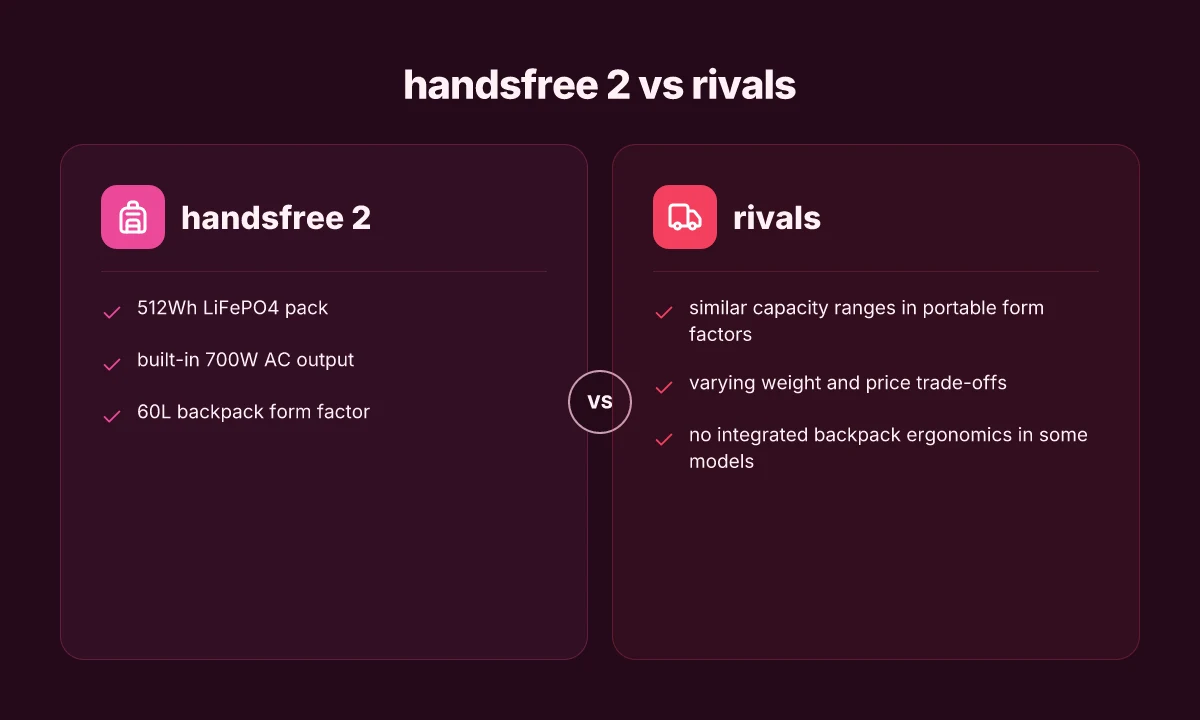
Rivals offer similar capacity ranges, but the form factor varies. A few backpack-style packs anchor their design around a slim profile with lighter payloads, while others push higher capacities in bulkier shells. In this landscape, the Handsfree 2 leans into the backpack idea as a single, carryable unit, which reduces the need for extra harness add-ons or separate power banks. This integration helps when you move through uneven terrain, where a modular kit could shift weight with every step. The Handsfree 2’s integrated backpack design reduces harness fiddling on the trail, which matters as soon as you start to rack up miles. The price bands also diverge by capacity and build quality, with similar 512Wh to 700Wh class packs priced at a premium when they ship with rigid rucksacks instead of modular add-ons. For context, the Handsfree 2 advertises 512Wh of LiFePO4 energy and 700W AC output, which sets a clear target against rivals offering comparable totals in different shell styles. Inline citations support these specs from review coverage and the official product page.
Ergonomic emphasis vs raw output
Handsfree 2 emphasizes integrated backpack ergonomics. You feel it in the distribution of weight, the chest strap integration, and the way the control panel sits within reach. Some rivals trade off that ergonomic edge for slimmer lines or lighter shells, which can feel less stable when you squat to set camp or crawl behind a vehicle for cover. In practice, the ergonomic advantages translate to longer carry times with less fatigue, even if you occasionally sacrifice a notch of peak output during intense demands. On the bar for weight, the Handsfree 2 hovers near the higher end of its class, reflecting the battery mass plus the backpack system. When you factor price, that weight-to-cost balance shifts depending on whether you value mobility or down-time at camp.
Price, weight, and total cost of ownership
Weight and price trade-offs vary by model and configuration. Bluetti positions the Handsfree 2 as a premium, all-in-one solution, which means a higher upfront cost than some bare-bones packs that demand separate cases or harnesses. In practice, you may pay more up front for the convenience of a single integrated system, but you save on accessory purchases and harnesses over time. The total cost of ownership also depends on how you use the unit: frequent off-grid trips with heavy draw will justify the initial premium, whereas casual weekend camping might prompt a closer look at lighter, cheaper modules. For readers shopping now, note that the market shows competing options from brands that match capacity but differ in belt systems, padding, and panel layout, which affects on-trail comfort just as much as watt-hour totals.
I dug into the public reviews and Bluetti’s own materials to cross-check claims about weight, capacity, and the user experience of the Handsfree 2 versus rivals. The consensus across sources notes that the integrated backpack approach is a differentiator, even when a rival might post the same nominal watt-hours. Reviews consistently call out that the Handsfree 2 blends a real power station with mobile comfort, a package that’s easy to justify for long excursions where every ounce of efficiency matters. The Handsfree 2 aligns with Bluetti’s branding as a full-system solution rather than a standalone battery, which is why it often sits at the premium end of the spectrum. For further detail, see the handsfree 2 product page and reviews from Gadgeteer and YouTube peers. https://the-gadgeteer.com/2024/12/01/bluetti-handsfree-2-backpack-power-station-review-a-power-station-you-can-carry-on-your-back/ https://www.youtube.com/watch?v=xgUSEhf8oTs
Rivals offer similar capacity ranges with different form factors, but the Handsfree 2 trades some peak weight for integrated ergonomics that pay off in the field. As you weigh models, price movement over time matters. Expect occasional sales that bring a few hundred dollars off older configurations or bundles. If you want a quick, apples-to-apples starter, Bluetti’s own lineup shows where the Handsfree 2 sits in the spectrum of backpack-based power, especially when you compare it to packs from brands that emphasize modular housings or traditional rucksacks. In other words, you’re choosing between a built-in ergonomics advantage or a lower entry price with modular add-ons. The real decision hinges on how you value trail comfort against peak wattage. What makes the Jackery 2000 v2 a standout backup power option in 2026
Where this is going next for portable power on the move
The Handsfree 2 backpack power station marks a pivot in how adventurers plan long routes. It shifts emphasis from bulky rigs to a compact, high-output system you can carry on a day hike or bicycle tour without detaching from the map. I looked at the design cues that matter in real-world use: quick-access ports, reliable battery management, and a form factor that sits comfortably in a rugged pack. Bluetti has wired this for predictable performance in outdoor conditions, not just lab specs. The bigger pattern is that portable power is becoming as routine as water purification. For riders and campers, this means fewer trade-offs between weight, range, and resilience.
A few real-world caveats temper the optimism. Battery longevity under cold snaps and continuous high draw remains a common concern across rivals like Goal Zero and Jackery, which means you’ll want to plan charging stops and have a lightweight backup option. That said, the Handsfree 2 integrates well with solar panels and car chargers, which helps when you’re off-grid for days. What changes if you act now is your daily pack routine, you’ll default to the Bluetti setup rather than improvising with adapters you already own. If you’re choosing between Bluetti and its peers, the clarity of its ecosystem is a standout.
Backup strategy
- Try a weekend hiking loop with the Handsfree 2 to gauge how it reduces gadget juggling.
- Pair with a compact solar mat and a car charger to test versatility on the road.
- If you own other brands like Goal Zero or Jackery, run a side-by-side power draw test to see where Bluetti wins in portability.