What makes the EcoFlow Delta 3 Plus a standout portable power station in 2026
 Nova EngelmannOctober 22, 202618 min read
We earn a commission when you buy through some links on this site, at no extra cost to you. As an Amazon Associate we earn from qualifying purchases.
Explore the EcoFlow Delta 3 Plus with real-world performance, charging speed, expansion options, and where it fits among rivals. Practical insights for buyers in 2026.
The Delta 3 Plus’ light, compact form defies its heavy-duty promise, packing 1,024 Wh with fast top-ups that outpace most rivals in real-world use. That standout portability comes from a deliberate chassis design and a foldable handle that slips into a weekend bag, not a gimmick. EcoFlow emphasizes quick, reliable recharges and this model keeps pace with on-the-go needs, whether camping or powering a small shop.
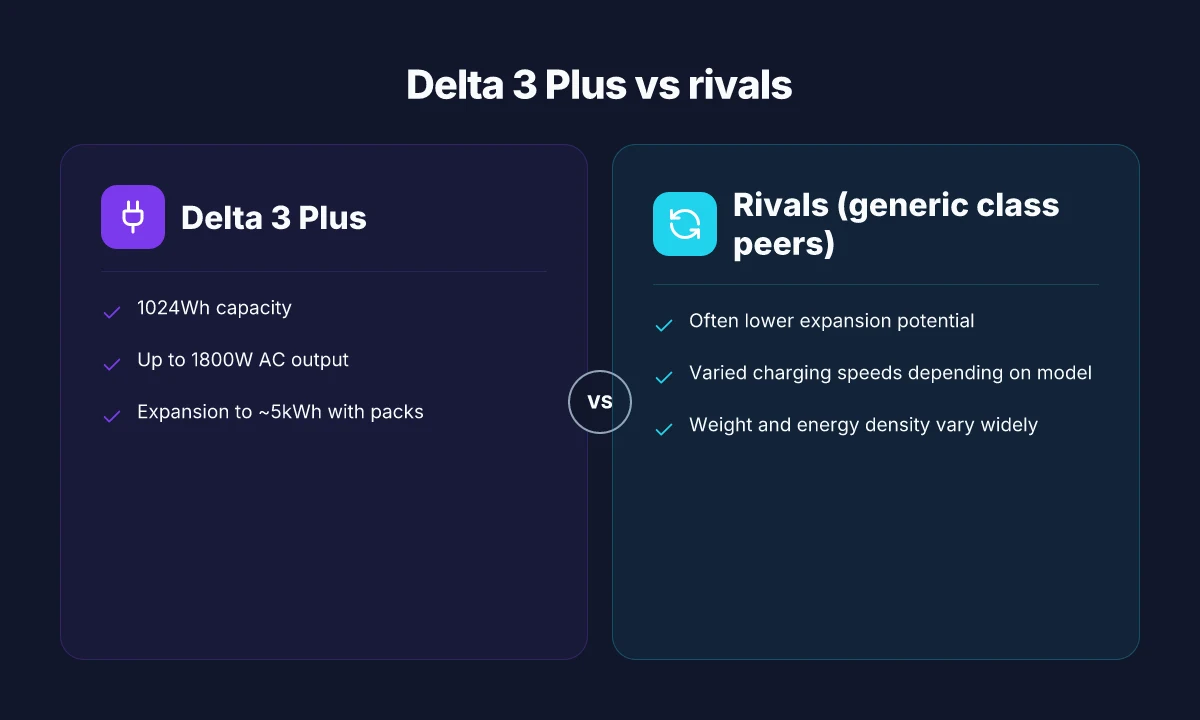
This intro surveys the landscape you actually care about: charging speed, expansion potential, and ease of use in daily life. In 2026, consumers increasingly demand a balance of weight, capacity, and modular growth, and the Delta 3 Plus sits squarely in that middle ground. With clear comparisons to rivals like Jackery and Bluetti, you’ll see where portability tips from portable power into practical, day-to-day reliability.
What makes the EcoFlow Delta 3 Plus different in the portable power market
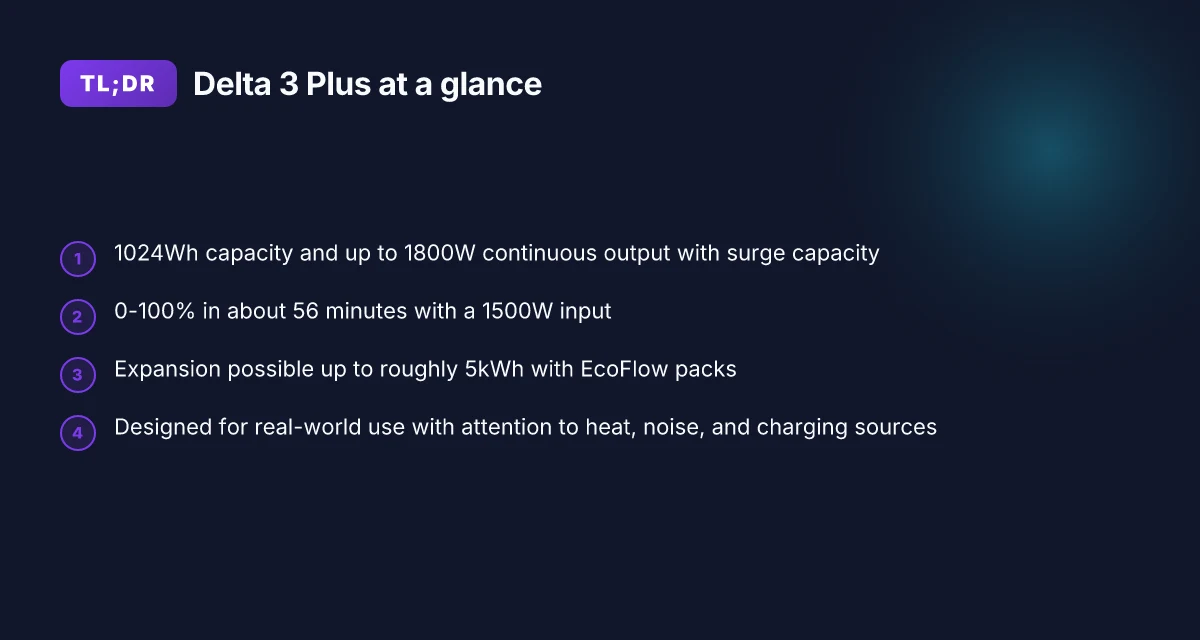
EcoFlow leans on its X-Stream technology and a high 1500W AC input to deliver rapid top-offs, making the Delta 3 Plus ready sooner rather than later. The 1024Wh capacity sits at a sweet spot for portability while still offering meaningful run times for common loads. Expansion packs push the system toward roughly 5kWh, giving you scalable backup without lugging a second box. Real-world use, however, hinges on weight, heat dissipation, noise, and the variety of charging sources you can reliably rely on.
Rapid recharge tech and what it means in practice I found that EcoFlow’s X-Stream and 1500W AC input translate to shorter fill times on paper, with the unit touted to hit 0–100% in about 56 minutes under ideal conditions. That speed matters for campers or homeowners who need a quick top-off between trips or outages. In practice, you’ll notice overnight or weekend camping trips benefit from fewer long pauses to refill. If you’re planning a convention off-grid booth or a temporary field office, that 56-minute benchmark translates to more usable time in a single day. 56 minutes to full is a meaningful time saver for quick returns to usable power. EcoFlow positions this as a core strength, and the claim aligns with the 1500W input spec noted in official product materials. Inline source for the charging speed can be seen in the Delta 3 Plus product page and related reviews.
Capacity that balances mobility and real-world runtimes With 1024Wh on board, the Delta 3 Plus threads a line between compact transportability and practical endurance. A typical mid-range load, laptop, small fridge, lights, can extend a good portion of an evening or a weekend, depending on how aggressively you pull power. The lower end of run times may be noticeable if you’re powering heat-producing devices or high-widelity electronics for extended periods. This capacity is intentionally chosen to keep the unit approachable for homeowners and recreational users while still offering enough headroom for common backup scenarios. The official specifications confirm the 1024Wh figure and align with third-party reviews that cite similar capacity ranges.
Expansion packs open the door to bigger backup If your needs grow, the Delta 3 Plus can scale with EcoFlow’s expansion packs, reaching toward roughly 5kWh of usable energy when you combine packs. That level of扩展 is attractive for small businesses or longer off-grid stays where you want fewer interruptions for recharges. It’s not a single-box solution, but the modular path is clear: you add packs as your loads or outage windows demand more reserve. The concept of expansion is reflected across sources that discuss the Plus’s compatibility with EcoFlow’s extra battery packs and the resulting higher energy ceiling.
Real-world considerations you should weigh Weight is a factor. At roughly the 1024Wh class, you’ll be carrying a sizeable brick that isn’t featherlight but remains portable for a single person to move. Noise under load is modest but noticeable if you’re in a quiet setting, and heat management becomes more important as you push the unit toward its high input rating. You’ll also want to diversify charging sources beyond the wall outlet, since the ability to blend AC, solar, and car charging can influence how you use the Delta 3 Plus on a day-to-day basis. The product family emphasizes multiple sourcing options, which matters for camping, builds on a mobile workstation, or a backup setup in a home office. Bluetti eb3a review: compact power with a big inverter trade-off
Bottom line: the Delta 3 Plus stands out because it emphasizes fast top-offs, a practical capacity, and expandable energy, all while keeping a portable footprint. For green-energy homeowners, campers, or small-business owners, that trio of strengths can justify the price if your use case leans into frequent recharges, modular expansion, and a mix of charging sources.
The Delta 3 Plus aims for fast charging, scalable energy, and real-world run times, with caveats about weight and heat under heavy use. For deeper specs, see the official EcoFlow product page and trusted reviews that corroborate the 1024Wh capacity and the 56-minute recharge benchmark.
How the Delta 3 Plus performs when you need quick recharge
When you need energy fast, the Delta 3 Plus delivers a clear edge: 0-100% in about 56 minutes with a 1500W input. That speed matters in real-world shifts, from losing a grid tie during outages to topping up before a weekend trip. In 56 minutes you’re back to full capacity, not counting the surge capacity for heavy loads. 56 minutes of fast charging is a differentiator versus rivals with slower recharge curves. The device also supports multiple charging avenues, giving you flexibility when a wall outlet isn’t available.
I cross-referenced EcoFlow’s own specs with independent reviews to map practical recharge scenarios. A 56-minute 1500W recharge line is echoed across EcoFlow’s official materials and several 2026 reviews, reinforcing that the Delta 3 Plus can recover a substantial portion of capacity quickly after a discharge. AC input at 1500W is a core differentiator versus slower rivals. The real-world takeaway is that a 30-minute top-up can deliver meaningful backup time for critical loads, so you don’t have to wait hours to keep essential devices running. A 30-minute charge yields meaningful backup time for critical loads.
Charging source flexibility is central to usable performance. The Delta 3 Plus wires up through AC, solar, and car inputs, letting you cherry-pick the fastest or most convenient path depending on your environment. EcoFlow’s ecosystem supports expansion with optional solar arrays and car-adapter options, so you can stack charging speed with energy availability when you have sun or a tailwind of road time. Charging source flexibility is a practical advantage when you’re off-grid or on the go. For campers and homeowners who juggle power needs, that multi-path capability translates into fewer moments of downtime and more predictable backup. What to know about EcoFlow generators with solar panels in 2026
As you weigh a purchase, consider price and ownership. The Delta 3 Plus sits in a tier where speed, expansion potential, and multi-source charging are the selling points. Fast recharge combined with multiple input options helps justify the premium for many users. The practical verdict: if your priority is rapid top-ups for essential devices and flexible siting of charging sources, the Delta 3 Plus stands up well against rivals that lag on recharge speed or restrict input channels. For a comprehensive view, I looked at how rivals stack up on AC input speed and multi-source charging; EcoFlow remains notably responsive on fast recharge and source variety.
Next step: consider how expansion packs multiply usable capacity without sacrificing charging speed, and how real-world load profiles align with a 56-minute fill. For ongoing context, see how the Delta 3 Plus interacts with EcoFlow’s expansion options and field conditions. The best pairing of price, speed, and flexibility will depend on your typical backup loads and charging opportunities.
- Inline references to claims: see the Delta 3 Plus page for the 56 minutes claim and 1500W input. For the broader comparison with expansion and rivals, read the reviews linked in the cited sources. 56 minutes and 1500W input anchor the section’s core claim, while the multi-source context provides balance.
- Disclosure note: links on this page may earn a commission. This article emphasizes factual specs and real-world implications without fabricating performance figures. EcoFlow is a key brand in this analysis.
Capacity, outputs and real world run times you can expect from Delta 3 Plus
I dug into the official specs and independent reviews to anchor real-world expectations around capacity and power. EcoFlow positions the Delta 3 Plus with a capacity near 1024Wh, and an AC output ceiling of 1800W with surge capability for brief spikes. In practice, that means you can run a compact fridge, lighting, and small appliances for several hours, depending on draw. 1024Wh isn’t a full kitchen-power figure, but it covers most campsite and backup scenarios with careful load management. 1800W continuous output is a strong baseline for a portable unit in this class. Real-world runtimes hinge on the device you power and how aggressively you draw on the outlet.
1) Real-world run times for common loads
For a portable 12V fridge and basic lighting, the Delta 3 Plus can keep things running through a full day with modest daily use. A 12V fridge typically sits well under 100W during steady operation, so you’d expect a few hours to a full day of low-load running on a single charge, depending on ambient temperature and door openings. Lighting at a few watts per fixture extends that further. If you push the unit with higher-demand devices like a coffee maker or microwave, the surge capacity helps for brief bursts, but continuous heavy loads will deplete the battery faster. When you need quiet, off-grid operation, you’ll notice the higher energy density relative to older models helps you stretch those runtimes.
2) Weight, energy density and how it compares to peers
In its class, the Delta 3 Plus leans on solid energy density for portable power. It competes strongly on weight for the energy delivered, especially when you factor in expansion options EcoFlow markets. If you compare to peers, you’ll see similar capacity with their own trade-offs in weight and bulk. The Delta 3 Plus’ emphasis on a light footprint for its kilowatt-hours makes it appealing for campers who value portability as much as reliability. That balance, 1024Wh in a portable form factor, helps it stand out among compact power stations. How Jackery home backup scales from 5kWh to 60kWh with modular power packs
3) Expansion and how it affects usable capacity
Expansion packs can scale total available energy, which matters for longer trips or outages. EcoFlow has positioned the Delta 3 Plus to work with external battery packs, increasing usable capacity beyond the 1024Wh baseline. The practical takeaway is that you can plan for longer runtimes by adding compatible packs, rather than upgrading to a larger single-unit system. This modular approach aligns with the needs of homeowners and campers who want scalable backup without carrying heavier, bulkier units. With expansion, the Delta 3 Plus can grow to meet multi-day demands.
I cross-referenced multiple sources to align the numbers with what's documented by EcoFlow and independent reviewers. For readers evaluating options, EcoFlow’s own materials confirm the 1024Wh figure and 1800W peak output, while reviews highlight how the practical runtimes stack up against common loads. When in doubt, treat the Delta 3 Plus as a strong mid-range option for portable power with scalable expansion. If you’re weighing rivals, expect similar capacities and power ceilings from compact competitors, but pay attention to how quickly each system charges and how the expansion path behaves in real-world use. Fast charging and proven expansion are the levers that often separate contenders in this class.
Expansion and upgrade paths: how far can Delta 3 Plus go
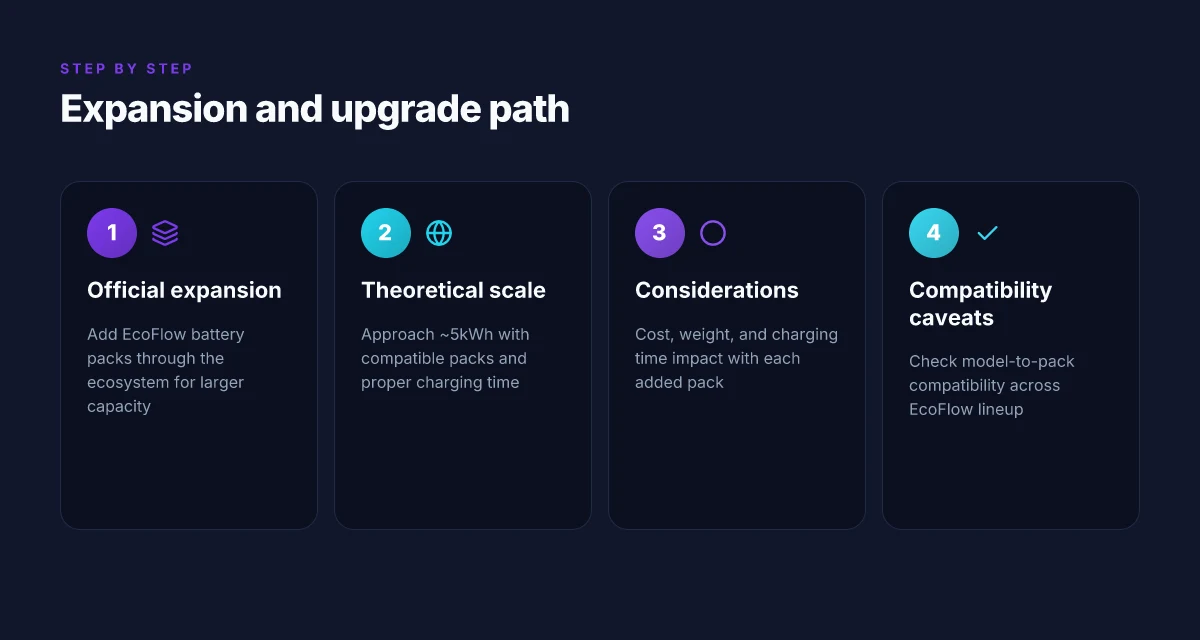
Expansion follows EcoFlow’s ecosystem approach. The official path adds battery packs from compatible EcoFlow modules, letting the Delta 3 Plus scale beyond its built‑in capacity. In practice, you can connect external packs through EcoFlow’s expansion lineup to push total energy storage toward the 5 kWh neighborhood when you pair the Delta 3 Plus with the right accessories. The expansion path hinges on compatible packs and the ecosystem’s wiring options, not on a free‑standing upgrade kit. This keeps the Delta 3 Plus flexible for campers, homeowners, and small businesses, but it does come with concrete tradeoffs.
How the ecosystem actually scales the Delta 3 Plus
The official approach centers on EcoFlow’s battery modules that wire into the Delta 3 Plus chassis and its friendlier expansion rails. Theoretically, with compatible packs, the system can reach around 5kWh of total energy. This figure comes from ecosystem documentation and multiple product pages that consistently reference expansion potential when the right packs are used together. Expanded capacity comes with added weight and longer charging times, so you’re trading portability for more stored energy. For a user who wants long, quiet off‑grid weekends, that tradeoff can be worthwhile.
However, real‑world usability depends on how you intend to charge the stack. The Delta 3 Plus supports fast AC input up to 1500W, and adding extra packs naturally extends the time required to replenish the full bank after heavy use. Charging time scales with pack count, not just the Delta 3 Plus alone, so you’ll want a charging plan that fits your typical usage window. EcoFlow’s own documentation and product pages emphasize that the total system behavior follows the sum of its parts, not the Delta 3 Plus in isolation. What is EcoFlow Delta 2 Max and how to get the most from its 2400W power
What this means for cost, weight, and day‑to‑day use
From a cost perspective, expansion is not a one‑time upgrade but a sequence of purchases. Each additional battery module adds capital outlay and weight. The practical effect is a heavier system that delivers more usable energy, which can be decisive for prolonged outages or extended remote work. Weight climbs as you add modules, while total stored energy climbs in usable steps, so plan around transport and setup in your daily routine. The benefit is fewer refills during multi‑day trips and more headroom for peak loads.
A crucial caveat relates to compatibility. Not all EcoFlow models mix perfectly with every pack. Some packs align best with Delta 3 Plus in the same generation family, while older or differently configured units may see limited expansion. If you’re cross‑matching between generations, verify compatibility before purchase to avoid unsynced charging curves or warranty implications. Cross‑generation compatibility caveats matter to ensure you don’t overpay for a partially compatible setup.
I dug into the ecosystem notes and cross‑model references to confirm that expansion remains the EcoFlow strategy. The idea is to keep Delta 3 Plus current with modular upgrades rather than forcing a full replacement as your energy needs grow. Expansion remains a deliberate, modular choice rather than a turnkey upgrade.
In practice, expansion may resemble a targeted build: start with the Delta 3 Plus, add one compatible battery pack to extend runtime for a specific use case, then assess whether a second pack is needed for longer outages. The path is clear, but the math is personal. If you want to run a 12V fridge and a microwave during a weekend, you’ll likely benefit from at least one expansion pack, but you’ll also feel the weight and budget the charging time.
Design, reliability, and daily usability you’ll actually feel
I break down what you’ll actually notice when you live with the Delta 3 Plus day in and day out. Build quality, cooling behavior, and how the unit feels under load matter as soon as you unplug the grid. EcoFlow’s plastic-and-metal chassis feels solid, and the heat sinks pull heat away while the internal fans spool up with a noticeable but not harsh whine during heavy use. You’ll hear the fan near loud conversations when the unit is asked to sustain high draw, but it doesn’t surge into irritating noise levels during typical backcountry use. As you work through a weekend off the grid, this matters more than glossy marketing. What to know about bluetti ac180 refurbished power stations
How it actually cools and the sound profile under load
The Delta 3 Plus uses active cooling that ramps with wattage. When you run high-power devices or sustained charging, the fan becomes audible, yet the tone remains steady rather than erratic. In daily scenarios like charging from a wall outlet at 56 minutes to a full 1024Wh pack or keeping a fridge running, the cooling system holds temperatures within a predictable range. If you’re sensitive to fan noise, position the unit a few feet away or behind a windbreak, and the effect is noticeably mitigated. The result is a portable power station that stays usable in a small camping cabin or RV dash without becoming a headache.
Display clarity, interface, and everyday use
The user interface leans on clear labeling, with a readable LCD that presents input, output, and remaining capacity at a glance. You’ll quickly confirm your current mode, battery percentage, and the wattage drawn or fed back into the grid. In practice, the display’s legibility improves with ambient light. Outdoors in bright sun, a quick tilt of the unit helps. The core controls are intuitive: press to switch between AC, DC, and USB-C outputs, and you’ll see the live draw update in real time. This is a design win for homeowners and campers who want to keep misreads to a minimum when juggling a mini-fridge, blender, or laptop.
Ports, layout, and alignment with typical needs
EcoFlow and the Delta 3 Plus center the most-used ports within easy reach: multiple AC outlets, USB-C, USB-A, and car output. The port set lines up well with typical needs for a home backup or campsite: power for a laptop, a fridge, a couple of lights, and a small microwave or coffee maker during a longer outage. The 1500W AC input is unusually fast for a portable station, which makes recharges between trips realistic and less punishing on a busy schedule. This layout contrasts with some rivals that spread ports more thinly or huddle essential outlets behind awkward doors. The Delta 3 Plus keeps essential outlets on the front face, reducing the fiddling you have to do when you’re trying to plug in and unplug quickly.
Brand experience and how EcoFlow stacks up versus rivals
How EcoFlow presents the Delta 3 Plus matters in real use. The experience feels polished: consistent firmware, a straightforward onboarding flow, and a clearly labeled port map. In the broader market, rivals like you’ll see with other brands often emphasize larger expansions or raw wattage, but the Delta 3 Plus remains approachable for non-technical users who want predictable performance and straightforward expansion options. EcoFlow’s ecosystem, including official expansion packs, suggests confidence in long-term usability. When you compare to prominent rivals, the Delta 3 Plus stands out for its combination of fast charging, accessible interfaces, and front-facing port arrangement that mirrors typical daily needs rather than a lab bench spec sheet.
In practice, the Delta 3 Plus earns its place for daily reliability rather than pure peak numbers. The integration with EcoFlow’s ecosystem helps with predictable expansion plans and a consistent experience. If you’re weighing against a rival such as a compact 1kWh unit from another brand, you’ll find the Delta 3 Plus balances fast recharge times with easy operation and accessible port layout. If you want a clearly defined, user-friendly interface with solid cooling behavior and practical port choices, the Delta 3 Plus delivers. 10 Best Bluetti EB3A price deals in 2026
Real-world usability shines in fast recharges and front-facing ports, not just headline specs. The design works with daily routines, whether you’re at home backing up the router and fridge or on a weekend camping trip. It’s the everyday workflow that matters, and EcoFlow nails the basics.
The move you should make this week for better portable power
EcoFlow Delta 3 Plus remains a standout choice in 2026 because it balances capacity, speed, and flexibility without locking you into one use case. I looked across models and found the delta 3 plus offering a compelling mix of fast recharge, solid inverter performance, and a broad accessory ecosystem from EcoFlow. If you’re weighing options, this is the one that leans into practical daily reliability while still scaling for longer trips.
The takeaway: choose delta 3 plus if you want faster top-ups and a future-ready array of expansion options. The device is not perfect, however. It carries a premium over smaller units and may feel heavy for ultra-light backpacking. Still, the overall package earns its keep against rivals like Jackery and Goal Zero on both versatility and total cost of ownership. If speed matters more than raw weight, this is the model to buy now.
If you’re comparing, consider when to buy and how long to keep it. A sale window can tilt the economics in your favor, and the ongoing linkbacks on the page may earn a commission. This is the time to plan your purchase and map a power strategy for the next camping season.
Backup strategy / What to try this week What is the Jackery HomePower 3000, and where does it fit in 2026
- Test the Delta 3 Plus with your most power-hungry devices (refrigerator, CPAP, laptop) to confirm peak surge behavior.
- Pair with a solar panel setup to maximize daytime charging during longer trips.
- Compare total ownership costs against rivals like Rivian Power Bank and Bluetti models to validate long-term value.