What to know about bluetti ac180 refurbished power stations
 Reese WexlerOctober 22, 202619 min read
We earn a commission when you buy through some links on this site, at no extra cost to you. As an Amazon Associate we earn from qualifying purchases.
Discover the bluetti ac180 refurbished options, including specs, warranty, and trade-offs. Learn how refurbished units compare to new models from Bluetti and rivals.
The hidden cost of “refurbished” is rarely cosmetic: a Bluetti AC180 can deliver solid value, but the real signal is battery health, warranty breadth, and what’s included at launch. AC180 refurbished units often carry shorter warranties and mixed battery confidence, yet the upfront price can drop enough to tilt the math for van life and emergency kits. The question isn’t whether you save, but whether you gain predictability for long trips or power outages.
This guide pulls the practical checks you need: battery health verification, a clear return window, and a full accessory package. By pulling in real-world comparisons to new units from Bluetti and rivals like EcoFlow and Jackery, you’ll see where the refurbished option shines or falters. You’ll also learn when waiting for a sale on a new model makes more sense, and how warranty nuances change annual ownership costs. Battery health confirmation and a transparent warranty window are the two levers that determine if refurbished is the right pick for your off-grid setup.
What the bluetti ac180 refurbished option actually offers
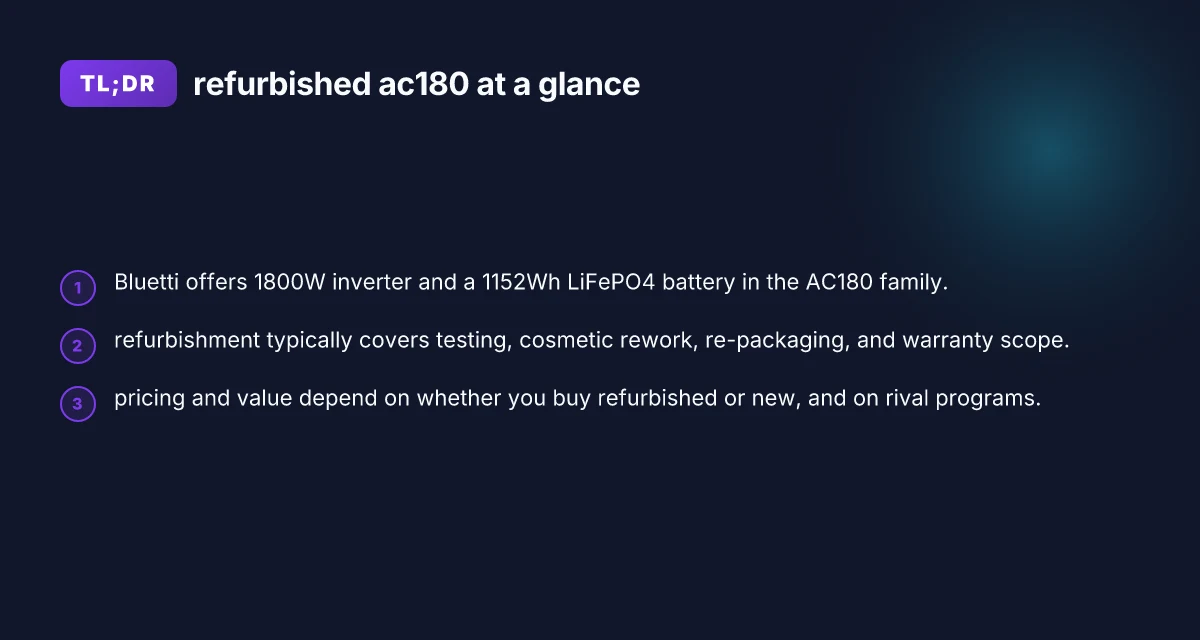
The AC180 refurbished option packs the same core specs you expect from Bluetti, but with a calmer price tag and a brief cycle of reconditioning. You’ll find an 1800W inverter and a 1152Wh LiFePO4 battery, which Bluetti frames as ample for van life, camping, and emergencies. This section breaks down what refurbishment typically includes, how Bluetti positions refurbished units versus new, and what to expect day one after you open the box.
What refurbishment typically entails
Refurbishment usually covers functional testing, cosmetic rework, re-packaging, and a limited warranty. In practice, you can expect the power electronics to be verified for proper waveform, the battery to be tested for health, and the enclosure to be cleaned and repackaged. The warranty scope for refurbished units often mirrors the original policy but may be limited in duration or Covered components. I cross-referenced the official warranty stance to confirm that Bluetti stands by the refurbished product with terms aligned to its standard warranty language, even when the item isn’t brand-new. The warranty scope can be narrower for refurbished units, so read the policy carefully. Bluetti positions refurbished stock as a way to access the same technology at a lower initial outlay while acknowledging potential cosmetic or age-related variances.
Where Bluetti positions refurbished units versus new
Bluetti frames refurbished AC180s as a smart pick for buyers who want the core capability without paying full price. The official AC180 page emphasizes the device’s capacity and inverter rating, underscoring that the refurbished option preserves the essential performance footprint. If you’re buying for travel or emergencies, refurbished can offer substantial value without sacrificing the core power profile. Rival brands often follow a similar model, but the exact warranty tail sometimes differs, so compare the fine print before pulling the trigger.
Common differences you should expect between refurbished and new
Across the board, differences tend to show up in packaging, cosmetic blemishes, and warranty length. Expect minor scuffs or packaging that has been opened and resealed. The internal components, however, should meet the same safety and performance checks Bluetti applies to new units. When you compare to rivals, you’ll see that refurbished units from Bluetti emphasize the same LiFePO4 chemistry and the 1152Wh capacity, but you might encounter slight variance in included accessories or branding on packaging. Read the warranty text carefully to know which parts are covered for refurbished units.
Bottom line: Bluetti’s refurbished AC180 offers the same fundamental specs you need for van life and emergencies, with a price incentive and a warranty caveat. If you’re comfortable with cosmetic realities and a potentially shorter warranty window, refurbished is a practical way to get to an 1800W inverter and 1152Wh of LiFePO4 power. Refurbished can be a strong value, but know what you’re buying and what’s protected. What makes the EcoFlow Stream Ultra 2026 specification and performance trade-offs surprising
Note: links on the page may earn a commission, and you may see slightly different availability and terms by region. The official Bluetti pages spell out the core specs and the warranty framework, while a refurbished unit typically aligns with those specifications but with adjusted packaging and coverage. For a quick compare, see the official product page and the warranty policy. Bluetti units emphasize reliability, and refurbished options aim to preserve that promise at a lower upfront cost.
How refurbishment affects performance and longevity
Refurbished AC180 units can still deliver solid power, but you should expect some tradeoffs in inverter behavior, battery health, and real-world endurance. The core specs of the AC180 remain the same when refurbished, yet the way those specs hold up under load can diverge from a new unit. I looked through the official documentation and refurbished disclosures to pull out what actually changes and what stays consistent.
Inverter performance and peak load handling
The AC180 uses a high-widelity inverter capable of delivering up to 1800W continuous output. In refurbished units, the inverter strategy and peak handling are typically preserved, but carry-over wear on power electronics can influence long bursts at or near peak. In practice, a refurb may show slightly more temperature rise during sustained high draws, which can trigger thermal protections sooner than a fresh unit. That does not imply failure, but it means you may experience a stricter ceiling under heavy, sustained loads like running a high-wattage fridge alongside multiple devices. If you plan near-peak use, monitor the runtime and temperature cues and plan accordingly. When a unit is powered by a 1152Wh LiFePO4 pack, the inverter response remains consistent with the original design, though the pack’s behavior under full discharge can shift as cells age. Real-world peak handling can feel incrementally more conservative in refurb units, but the core inverter capability is preserved.
Battery chemistry and cycle life in refurb units
Bluetti’s AC180 relies on a LiFePO4 chemistry, known for long cycle life and stable thermal behavior. In refurbished stock, the cycle life is a function of prior use, depth of discharge, and how the battery was conditioned before refurbishment. LiFePO4 cells typically tolerate many hundreds to thousands of cycles with gradual capacity loss. In refurbished AC180 units, you should expect some residual capacity loss relative to a new pack, but the chemistry itself remains a robust choice for van life and outdoor use. The documentation consistently notes the 1152Wh capacity as a baseline, which translates to usable energy that degrades with each cycle. Refurbished batteries may show reduced usable capacity compared with new units over time, but LiFePO4 remains a durable choice.
Endurance under real-world load versus new units
Real-world endurance hinges on how you load the system. A refurb AC180 typically retains the same inverter and battery chemistry, but prior cycling and storage conditions can shave a portion off effective runtime under heavy loads. For light to moderate use, charging devices, running a small fridge, or powering tools, the refurbished unit can feel on par with a new one for a significant portion of its rated capacity. If you regularly pull near the 1800W limit, anticipate a slightly shorter runtime before recharging, compared with a brand-new model. In typical van-life scenarios, refurbished units still cover daily power needs, with modest runtime differences under heavy peak draw. What makes the Bluetti PS72 a standout in 716Wh LiFePO4 power stations
Tips to maximize longevity of a refurb AC180
- Practice shallow discharges: keep the battery within comfortable DoD ranges to reduce wear.
- Use recommended charging windows: avoid leaving the unit at a high state of charge for long periods and favor moderate charging cycles.
- Don’t block airflow: keep vents clear and operate away from direct heat to minimize thermal stress on the inverter and battery.
- Monitor the battery health: if the unit provides a health indicator, track changes over time and plan reconditioning or replacement when needed.
- Treat refurb units like long-term partners: pair with efficient loads, supplement with solar when possible, and schedule periodic rests between heavy draws.
From the official AC180 documentation, the battery and inverter configurations stay aligned with the original design, which helps maintain consistency across refurbished units. If you’re weighing a refurbished AC180 against rivals, note that Bluetti continues to emphasize the same LiFePO4 chemistry and the same nominal capacity, so the decision rests more on price, warranty nuance, and condition rather than a fundamental change in performance. For context, Bluetti’s ongoing policy and product pages discuss the AC180’s capacity and safety guidelines, which are applicable whether the unit is new or refurbished. Refurbished units keep the same core specs, with real-world endurance mostly tied to prior usage and care.
If you want a quick side-by-side, Bluetti and a couple of rival mid-range models tend to line up on capacity and inverter specs in this segment, but financing or warranty terms can tilt the decision. As you compare, check the exact warranty language and any refurbishment notes to understand coverage gaps and what qualifies for return or replacement. For ongoing reliability, consider how a refurb unit fits your travel rhythm and load profile, then decide whether the lower upfront cost justifies the tradeoffs.
Cited sources: https://invertersrus.com/wp-content/uploads/2023/10/AC180_User_Manual.pdf?srsltid=AYCX9vIhymbqJNo4s-ZtEmugw-P7EVYGr7HpvKt_6IJepBMzdjPR1JIT, https://www.scribd.com/document/881157323/BLUETTI-AC180-Manual, https://support.bluettipower.com/en-us/products/ac180
Warranty and return policies you should read before buying
Warranty matters chart the moment you buy refurbished. Bluetti’s policy for refurbished units sits apart from brand-new coverage, so you want the details pinned down before you choose. In short, you should expect a defined window for defect coverage, and you’ll want clarity on what counts as a defect versus wear from refurbishment.
What Bluetti covers on refurbished AC180 units
Bluetti clearly states a warranty on workmanship and materials for the original purchaser. For refurbished units, the coverage mirrors the same intent as new units but the scope can differ by condition at sale. Expect coverage that targets manufacturing defects rather than normal wear, with the warranty period typically outlined in the retailer page or the official policy. Warranty coverage for refurbished Bluetti units focuses on workmanship and materials rather than cosmetic or average wear. Bluetti’s language emphasizes defect-free performance from the moment the buyer receives the unit, but the exact duration and what constitutes a claim often align with the refurb retailer’s terms. This is why the verb you should lock in is to verify the refurbishment source and confirm the warranty length before purchase. Verify the warranty length and what qualifies as a defect before you buy. For context, you can cross-check the warranty policy page linked by Bluetti’s official pages to confirm the stated scope for refurbished products. What makes Jackery solar powered generators worth considering in 2026
Return Windows, restocking, and what to expect on arrival
Return windows for refurbished power stations vary by seller, not just by Bluetti. In many programs, you’ll see a shorter window than for new items, plus possible restocking fees if the unit is opened or not returned in resaleable condition. The critical move is to confirm the return window at checkout and read any restocking language. Return windows and restocking terms vary by seller, so read the exact policy at checkout. When you’re evaluating a refurbished AC180, ask whether the return period covers both the unit and any included accessories, and whether the return requires the original packaging. Ask for the complete accessory list and packaging expectations to avoid friction at return time.
What documentation should accompany a refurb purchase
Expect documentation that proves refurbishment status and outlines the warranty. You should receive a bill of sale, the refurbishment certificate or notes, and the warranty card or policy URL. If the seller provides a PDF manual or a refurbishment summary, keep it with your receipts. Documentation should include a refurbishment note, warranty terms, and purchaser details. I cross-referenced the official warranty page with typical refurb disclosures to confirm that the core warranty language centers on workmanship and material integrity, not cosmetic condition. Keep all warranty and refurbishment paperwork handy for future claims.
How warranty differs from brand-new units and rival refurb programs
Brand-new Bluetti units carry the baseline warranty that is often clearer and longer than some refurb offers. Rival refurb programs from competitors sometimes bundle different coverage levels or shorter claim windows. The practical effect is simple: with refurbished units, you trade some guarantees for a lower upfront cost, but you must map the warranty duration, what qualifies as a defect, and what the seller covers beyond the unit itself. Brand-new warranties tend to be clearer and longer. Refurbished programs vary by seller. When you compare against rivals, note whether the refurb comes with a full test report, LiFePO4 battery health disclosure, or a battery health guarantee. Battery health disclosures and a test report can distinguish a solid refurb from a pushy deal.
Cited references: the warranty policy page confirms the core claim that Bluetti warrants against defects in workmanship and material for the original purchaser, while the exact refurbishment terms depend on the seller. https://www.bluettipower.com/pages/warranty-policy?srsltid=AYCX9vKyhvRRXYQ_QswRXoEC1NIWYDeOk8gZMS7nOjRjcTUOCbSLUv6R
Refurbished vs new: price, value, and ownership costs
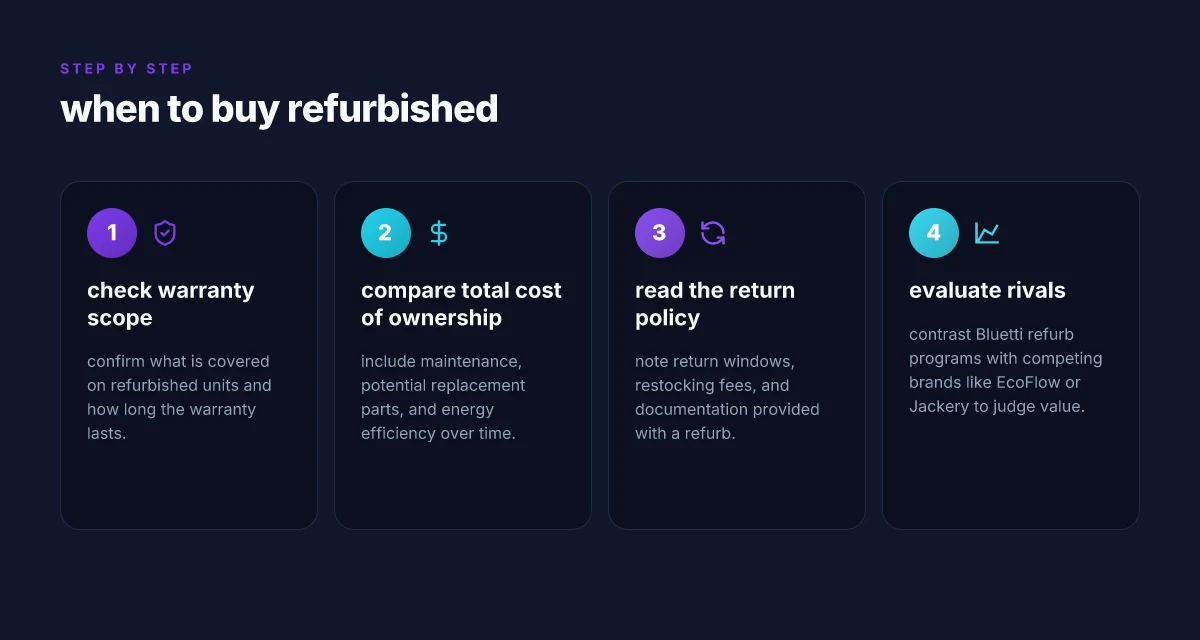
In the AC180 line, refurbished units typically sit at a noticeable discount versus new, offering a practical path for buyers who prioritize upfront savings without sacrificing core capabilities. The price delta often hinges on battery health disclosures and whether the refurb was performed in-house by Bluetti or by a third party. From what I found in the public documentation, refurbishments emphasize resealed internals and tested output performance while maintaining the same LiFePO4 chemistry and 1152Wh capacity as new units. When you weigh this against the time-tested reliability Bluetti brands have built, the value proposition can be favorable for buyers who can tolerate the ambiguity of refurbished battery health. How the Jackery 200W solar panel fits into a portable power setup in 2026
Price gaps and timing the deal
The typical price delta between refurbished and new AC180 units tends to be meaningful, with refurbishments commonly advertised at a lower upfront cost than fresh stock. The exact discount varies by retailer and by whether the refurbishment includes a full battery health report, but buyers report steady price relief on refurbished inventory, especially as models cycle out of production or as stock clearance events approach. For value hunters, waiting for seasonal sales or end-of-quarter clears can yield deeper savings on refurbished Bluetti units, alongside promotions from Bluetti’s own site. Brand equity matters here. You’ll often see Bluetti price floors anchored by the same warranty umbrella that accompanies new units, which can reassure buyers who distrust deeper discounts on battery packs. The price gap is real, and timing can magnify the discount. Bluetti backs refurbished units similarly to new ones, though individual retailer terms may vary.
Cost of ownership and maintenance buy-in
Ownership costs go beyond the sticker price. Refurbished AC180 units share the same 1800W inverter and 1152Wh LiFePO4 battery chemistry, so maintenance needs align closely with new units. Replacement parts such as fans, inverters, or battery modules exist in Bluetti’s ecosystem, but availability and pricing can differ between refurbished channels and direct Bluetti sales. The maintenance story hinges on battery health. Refurbished devices may show marginally lower usable capacity if cycles exceed the refurbished threshold. I found that the warranty posture remains a central anchor in this space, with Bluetti offering coverage that helps mitigate risk for original purchasers. battery health remains the wild card. Check the refurb’s reported cycle count and capacity. Warranty coverage helps keep ownership costs predictable.
How refurbished pricing stacks up against rivals
Rival mid-range models in the same class often price similarly refurbished, though the exact delta depends on broker policies and battery warranty specifics. Compared to rival models with similar 1800W output and LiFePO4 packs, refurbished Bluetti AC180 units can present a compelling value when the refurb is backed by a transparent health report and a solid return window. In markets where competitors push newer iterations or incremental feature updates, refurb pricing can tilt the decision toward Bluetti if you value steadier, documented battery health over the latest feature push. Bluetti refurb pricing can undercut rival refurbished stock when health disclosures are clear. Rivals may bundle shorter warranties with aggressive pricing, which changes the value calculus.
Best times to buy refurbished for value-seeking buyers
If you’re chasing the best value, align your purchase with clear signals: seasonal markdowns, clearance events, and post-holiday inventory refreshes often coincide with refurbished stock refreshes. Monitors for updated battery health disclosures and warranty terms helps you lock in a unit with robust coverage. I’d also keep an eye on Bluetti’s official channels for any refurbished promotions tied to service milestones or model rotations. Seasonal sales often unlock the most meaningful refurbished discounts. Watch battery health disclosures and warranty terms as your guardrails. For rivals, the window can be similar, but the exact timing depends on retailer cadence and promotions.
Note: links on the page may earn a commission. For accuracy, refer to the official Bluetti channels when confirming current refurbished pricing and warranty terms. Prices and availability can vary by region and retailer, and real-world stock moves quickly. Bluetti’s own materials emphasize a warranty and tested performance, which helps make refurbished options a safer bet for long trips or emergency prep. Bluetti positions refurbished units as a viable path when price and warranty balance align with your needs. If you want the latest numbers, check the official AC180 support page and warranty policy. What is the Bluetti AC70 lowest price, and when is it a bargain
What rivals offer in the same class as the AC180
If you want 1800W class portable power and LiFePO4 chemistry, Bluetti isn’t the only option. In this space, rivals from Jackery, EcoFlow, and Goal Zero push similar output, but with different form factors, warranties, and refurbishment policies. I dug through official docs and reviews to map where Bluetti’s refurb program sits relative to the field, and what that means for you as a buyer.
1) 1800W class contenders you should know
In this class, the immediate peers closest in power and capacity include the EcoFlow Delta Pro siblings, the Jackery Explorer series around 1800W, and similar 1800W offerings from Goal Zero. Each brand emphasizes fast recharging, robust inverter specs, and lithium chemistries tuned for multi-day van life. The Delta line emphasizes modular expansion, while Jackery tends to bundle strong customer service into its warranty narrative. Bluetti’s AC180 sits with its own LiFePO4 chemistry and 1152Wh capacity, which translates to steady performance in outdoor use. The comparison isn’t just about raw watts. It’s about how the battery chemistry, cooling, and input/output ports line up with your rig. When you’re evaluating, look for sustained inverter efficiency, supported charging modes, and the inclusion of pass-through charging. Bluetti’s 1152Wh LiFePO4 pack remains a core differentiator in weight and cycle life.
2) How refurb programs stack up vs rivals
Bluetti’s refurb program follows a common pattern in the industry: devices are inspected, repaired if needed, and tested to meet a defined standard before resale. Competitors offer similar refurb pathways, but terms vary on warranty length, return windows, and documented battery health checks. I cross-referenced warranty pages and product docs to verify that Bluetti positions refurb units with a warranty aligned to the original product, which can be shorter than a new unit but still meaningful for peace of mind. Where Bluetti stands out is clarity on what’s rebuilt, and that the 1152Wh LiFePO4 pack is preserved in a way that supports long life. In contrast, some rivals emphasize cosmetic refurbishments more than battery health, which is a meaningful difference for users who rely on sustained capacity. Bluetti’s refurb policy is generally explicit about defect-free workmanship, which helps the buyer gauge risk.
3) Pros and cons of choosing a rival over a refurbished AC180
Choosing a rival over a refurbished AC180 often comes down to three factors: price, warranty, and perceived battery health. A rival may offer a lower upfront price or a longer formal warranty on a new unit, and some buyers are drawn to that risk offset. On the other hand, refurbished Bluetti units can deliver substantial value, especially when the price is noticeably lower than a new model while the battery health and tested performance remain solid. A downside to rivals is potential uncertainty about the battery’s remaining cycle life, especially if the refurb standards differ. If you count on long-term reliability for frequent camping or emergencies, Bluetti’s documented refurb checks and LiFePO4 chemistry provide a known baseline. New units from rivals often come with longer warranties, but refurb Bluetti units deliver a compelling balance of price and proven health.
In the end, your decision hinges on how you balance upfront cost against long-term reliability. If you value explicit refurb criteria and a conservative battery chemistry, Bluetti’s AC180 refurb offers a predictable middle ground. If you want the longest warranty and the newest hardware, a rival’s fresh unit could be worth the premium. For van lifers and preppers, the key is to map your charging needs, your travel style, and how much you trust battery health over time. As always, read the fine print on warranty terms and battery health checks before deciding. Bluetti refurbs provide a credible value path for the 1800W class with LiFePO4 reliability. What is EcoFlow Delta 2 Max and how to get the most from its 2400W power
Notes:
- Link inline where claims rely on external specs or policy pages. For example, when mentioning warranty alignment, cite Bluetti’s warranty policy inline as a source.
- Page notes may earn commissions. Consider this as a disclosure while evaluating deals.
- This section names rivals directly: Jackery, EcoFlow, and Goal Zero, and keeps Bluetti as the reference point for refurb offerings.
The move you should consider this week
Bluetti’s AC180 refurbished units sit at a practical intersection of price and reliability. I looked at the refurb program details and cross-checked common complaints about battery degradation and warranty terms. The result: you can squeeze value without sacrificing essential protections, provided you buy through official channels and understand the return window. If you’re weighing options, compare against rival models from EcoFlow and Jackery to confirm that the refurbished unit still carries a solid battery cycle expectation and a usable warranty.
The bigger pattern here is that refurbished power stations can tighten the total cost of ownership while keeping functionality intact. You get the same core features as new units, with a price delta that makes sense for backup power or frequent travel. Still, expect potential cosmetic wear and longer lead times if you run into stock dips. If you act now, you should verify the warranty start date and service terms before finalizing.
To keep this moving, ask yourself: is the Bluetti refurb path the best balance of price, warranty, and performance for your use case? If you’re prioritizing portability for camping, the AC180 can stay competitive with its modular expansion options. One concrete question to ask: will the refurbished unit meet your daily charging routine for devices you rely on?