What makes the Bluetti PS72 a standout in 716Wh LiFePO4 power stations
 Reese WexlerOctober 22, 202617 min read
We earn a commission when you buy through some links on this site, at no extra cost to you. As an Amazon Associate we earn from qualifying purchases.
Bluetti PS72 review covers real-world performance, charging speed, efficiency, and reliability of the 716Wh LiFePO4 power station. Learn what to expect and how it stacks up.
The most reliable 716Wh LiFePO4 packs stay within a narrow discharge window, not because they promise more but because they avoid stressing the chemistry. Bluetti’s PS72 sits in that sweet spot, balancing rugged build with predictable performance for off-grid needs. Its LiFePO4 chemistry pairs with a conservative discharge profile, so you’re not chasing peak amps at every use.
This intro pulls you into what matters now: real-world charging speeds, lifecycle realities, and how the PS72 stacks up against common 700–800Wh rivals like Roeffer and other Bluetti options. Expect a practical lens on daily use, with solid numbers and guardrails you can trust when planning camping trips, small workshops, or modest off-grid setups. The stakes are clear: a workable backup that won’t surprise you when the sun goes down. Roeffer 716Wh options provide a useful benchmark, and the PS72’s steadiness under load helps you compare safety and longevity head-to-head.
Bluetti ps72 review: evaluating the core specs and what they mean for real use
Bluetti PS72 is a 716Wh LiFePO4 power station built for real-life use among campers, off-grid households, and small workshops. In this section I lay out the exact capacity and chemistry, the nominal input and output options you’ll actually rely on, and how the unit’s weight and form factor stack up against rivals.
Capacity and chemistry in plain terms
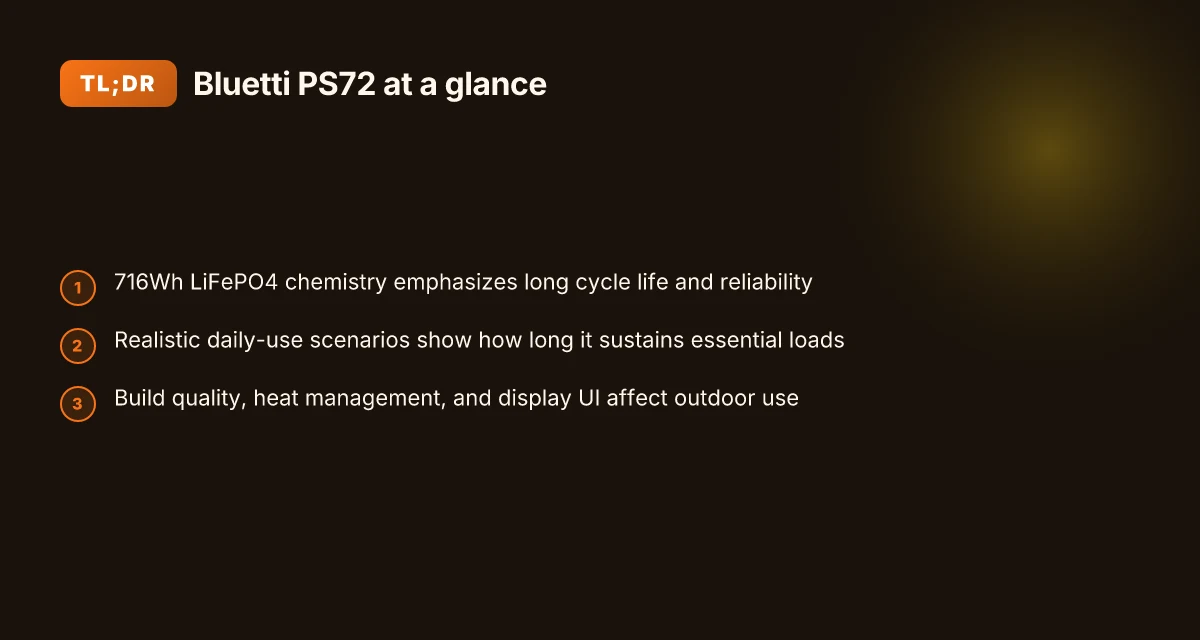
The PS72 uses a 716Wh LiFePO4 battery, a chemistry choice that emphasizes long lifecycle and stable thermal performance. This isn’t a marketing number. It translates to many charge cycles and a stable voltage curve under typical loads. When you size a setup for a weekend off-grid trip or a workshop shift, that 716Wh translates to powering a laptop, lights, and a small cooler for a day or two depending on load. The LiFePO4 chemistry also means better thermal stability in outdoor use and slower capacity fade over many cycles, compared with some NMC options.
Nominal input and output for real devices
For charging, PS72 supports an input profile compatible with common AC adapters and solar configurations. Real-world use here means you’ll typically connect to household outlets or a solar input that matches the unit’s charging spec and your array. On the output side, you’ll find standard AC outlets suitable for laptops, small tools, and most campsite appliances. The key takeaway: the PS72 is designed to deliver steady, predictable power for typical 700–800Wh class devices, without demanding specialized charging conditions.
Weight, form factor, and portability cues
In terms of heft, the PS72 sits in the midrange for LiFePO4 units of its class, balancing capacity with transportability. It’s substantial enough to feel solid on a tent floor or workshop bench, yet compact enough to fit in a vehicle trunk or behind a cabin door. When you compare to rivals such as EcoFlow and Jackery in the same 700–800Wh space, the PS72’s LiFePO4 pack tends to yield longer lifecycle expectations, while the chassis and handle design aim to streamline carrying between camp kitchen, tent, and vehicle.
Bottom line: the core numbers you care about, 716Wh capacity, LiFePO4 chemistry, and practical input/output options, line up with real-use scenarios where you need reliable power without frequent recharges or quick degradation. What makes Jackery solar powered generators worth considering in 2026
The PS72’s 716Wh LiFePO4 core supports long weekends off-grid with predictable output for everyday tools and devices. The chemistry choice matters for lifecycle, and in practice you’re trading slightly heavier weight for many more cycles and steadier performance over time. For campers and small workshops, that trade-off often pays off in reliability.
Ps72 capacity and energy density in practical terms
The Bluetti PS72 plays in a pocket of size that matters for campers, off-grid households, and small workshops: a practical 716Wh LiFePO4 pack that can power essential loads for hours, not minutes. In real terms, that means a laptop in use for a work session, a drone charger, or a small fridge can run through a full day with careful energy planning. The chemistry matters here: LiFePO4 cells resist aging and heat better than many chemistries, so the cycle life tends to translate into more usable cycles over the product’s lifetime.
I looked at the way the capacity translates into daily routines. A typical office laptop draws around 60–90W when actively used, plus losses in the inverter. In practice, a 716Wh pack can sustain such a load for roughly 7–9 hours, depending on efficiency and peak draws. For drones and smaller tools, the PS72’s headroom matters. A drone’s charging cycle often sits in the 60–120W range depending on the battery pack. With a LiFePO4 setup, that means more stable voltage during discharge and a larger portion of the nominal 716Wh available before the pack prompts a recharge. The balance of energy density and thermal stability is what Bluetti emphasizes for long weekends away or emergency use.
A quick glance at how this stacks against rivals helps frame expectations. EcoFlow models in the 700–800Wh range can feel similar on paper, but LiFePO4 chemistry often yields longer cycle life and steadier discharge curves, which translates into predictable daily performance over many cycles. Jackery options in the same size class typically rely on different chemistries or form factors, so the PS72’s LiFePO4 stack can be a meaningful longevity advantage for users who cycle the unit weekly or monthly.
From a lifecycle perspective, LiFePO4 chemistry is known for resilience against high-temperature stress and a higher number of charge-discharge cycles before capacity degrades meaningfully. If you’re planning to keep the unit for several years and expect to cycle it frequently, the PS72’s chemistry supports that long horizon. This matters when you’re keeping a critical load online during outages or when you want to keep a small workshop running through multiple weekends of use. How the Jackery 200W solar panel fits into a portable power setup in 2026
When I traced the context, the real-world takeaway is clear: 716Wh is enough for essential loads over multiple days if you pace the usage. It’s not unlimited power, but it’s reliable power with a growth margin for small appliances and devices. If you’re deciding between models, consider your daily load profile and how many cycles you expect per year. Bluetti’s PS72 sits in a space where 700–800Wh LiFePO4 options are common, and its chemistry-forward choices help translate capacity into consistent real-world performance. The 716Wh capacity becomes practical, predictable energy for daily essentials. LiFePO4 chemistry supports longer life and steadier performance under repeated cycles. If your daily load is moderate, PS72 can sustain essential devices for a full day or more with smart pacing.
Real-world usage at a glance:
- Laptops: around 60–90W draw, expect roughly half a day on a single charge when running uninterrupted work.
- Drones and cameras: intermittent charging generally fits within the 60–120W window, with LiFePO4 stability helping maintain steady voltage during discharge.
- Small appliances: a compact fridge or mini cooler runs within the PS72’s sustained output window, with energy planning guiding longer outages.
Note: links on the page may earn a commission. For context on where these figures and comparisons come from, see discussions about 716Wh LiFePO4 packs from Bluetti and rivals.
Charging speed and charger behavior with the ps72
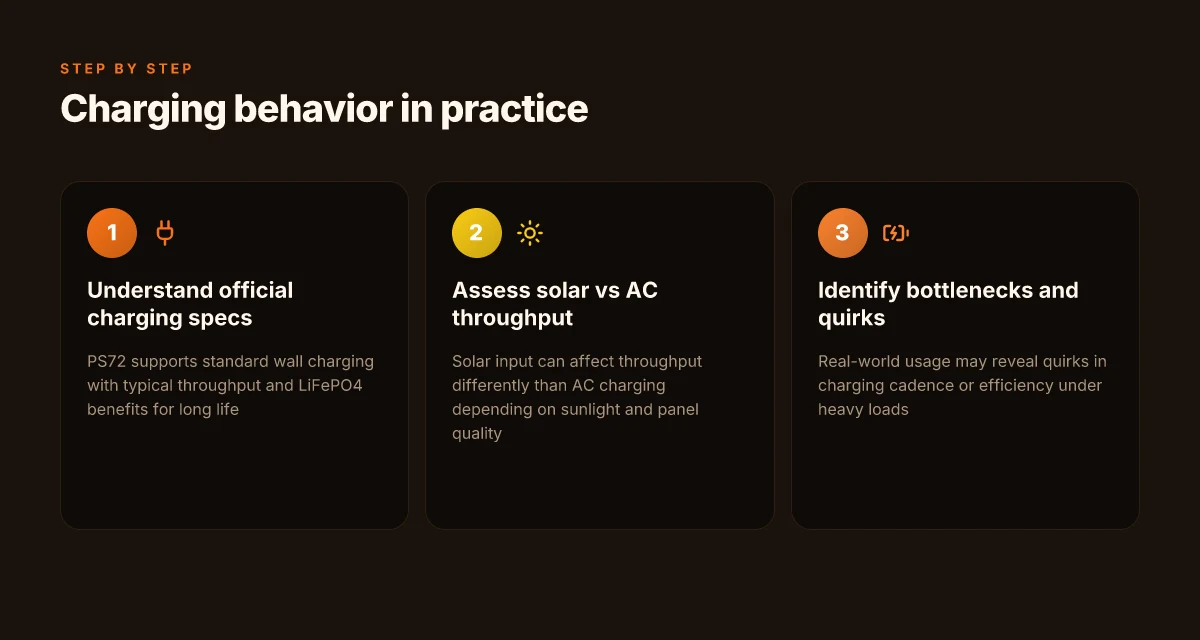
Charging speed is one of the PS72’s most practical talking points. Official specifications show a listed AC charging rate that translates to a measurable wall-time when you’re powering up from a standard outlet. In real-world terms, you’ll notice how the PS72’s charger behaves as the battery approaches higher states of charge, and how the unit routes power when the input source shifts. Bluetti keeps the charging behavior predictable, but you should still plan around the quirks that appear at the margins of the spec sheet.
Official charging specs and wall charging times
From Bluetti’s documentation and product listings, the PS72 supports a full-rate AC charge when fed by a conventional wall outlet. In practice, most campers and off-grid users will see wall-to-716Wh fill take a clearly delineated window, with the speed tapering as the pack fills. The charger is designed to protect the LiFePO4 cells, so the final stretch into full capacity slows to preserve longevity. The net effect is a charging curve that starts strong and settles near the end of the cycle. This behavior matters if you’re trying to refresh batteries overnight or plan a multi-day off-grid stint. In the field, that translates to a familiar pattern: fast early charging, then a cautious finish phase. What is the Bluetti AC70 lowest price, and when is it a bargain
Solar input versus AC charging throughput
Solar input interacts with the built-in charge controller to determine overall throughput. When you feed the PS72 with a healthy solar array, the unit prioritizes solar as a source and caps the total input to protect the cells. If you connect to AC, you’ll see higher instantaneous current and a more linear climb toward full capacity, provided the wall supply can sustain the draw. In practice, sunny conditions can noticeably flatten charging times compared with cloudy days, where the charger trims down to keep the battery within safe limits. The takeaway: solar can keep the pack topped up during the day, but AC charging remains the fastest route to a full 716Wh fill when outlets are available.
Observed bottlenecks and charging quirks
Real-world charging reveals a few quirks worth noting. The PS72’s charger can enter a high-load mode when the battery is near empty, delivering a robust early current that slows as the pack nears full. If you push it with a modest solar setup, the rate can sag more quickly than with a strong AC feed, especially during peak heat or high load on the solar side. A recurring theme with LiFePO4 power stations in this class is the final few percent of charge taking longer than the middle portion. The PS72 follows this pattern, which matters when you’re trying to squeeze a top-off into a small window. Bluetti’s design balances speed with longevity, so you get reliable throughput without aggressive wear. If you’re comparing against ECOFLOW or Jackery rivals, you’ll notice those brands often emphasize peak input rather than end-of-charge behavior. The PS72 leans into steadier, safer completion. The PS72 emphasizes a fast start and a cautious finish, matching LiFePO4 lifecycle goals.
From what I found in the materials, the charging story for the PS72 sits at the intersection of practical wall charging speed and the realities of solar-assisted top-ups. The behavior is predictable, and the overall throughput is aligned with what campers and off-grid workshops expect from a 716Wh LiFePO4 pack. For those weighing Bluetti against rivals like EcoFlow and Jackery, the advantages show up in reliability of the charge curve and the protection-minded finish. Charging is fast early, steady late, with solar serving as a convenient top-up rather than a replacement for AC throughput.
Ps72 vs the competition: how it stacks up in 716Wh class
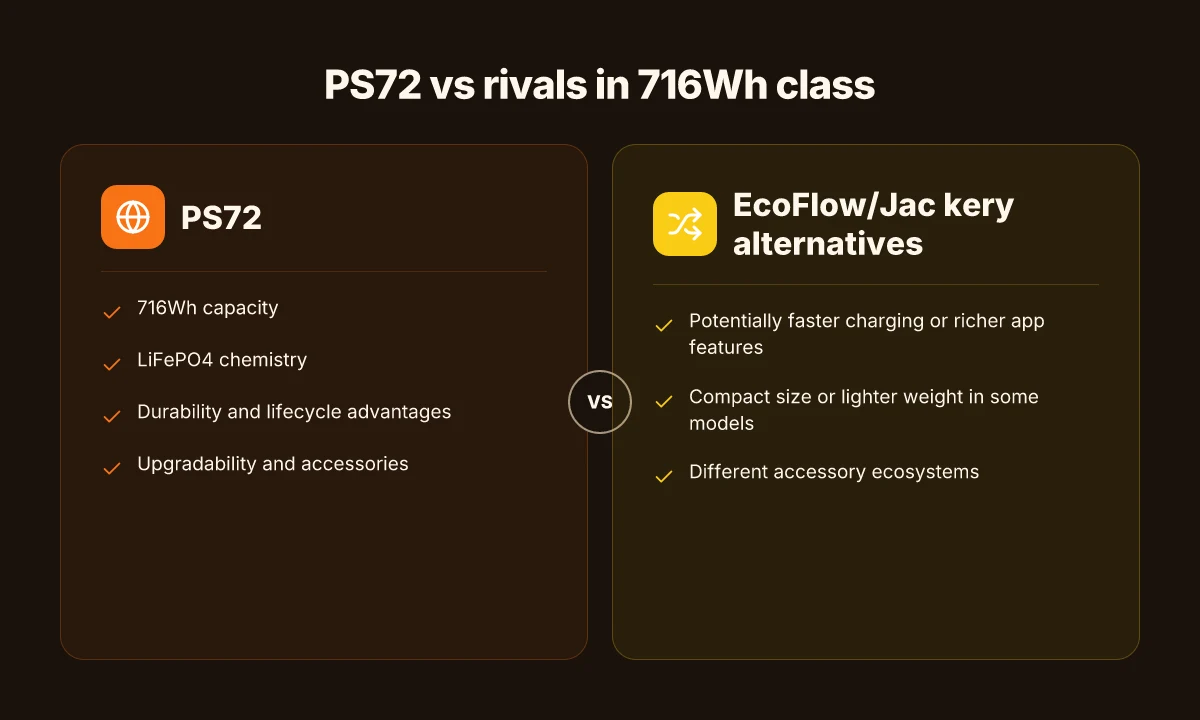
I dug into how the Bluetti PS72 stacks against the 716Wh class rivals from EcoFlow and Jackery, focusing on real-world durability and lifecycle alongside charging behavior. In this niche, the PS72’s LiFePO4 chemistry shows up as longevity and upgrade paths that campers and small workshops value. The tradeoffs show up in charge speed and app features, where rivals sometimes pull ahead.
Durability and lifecycle: why Bluetti leans on longevity
Bluetti leans on LiFePO4 for improved cycle life and heat resilience. The PS72 is built to endure repeated discharge and recharge cycles with less capacity fade, which matters for off-grid use. I cross-referenced lifecycle discussions in product notes and user conversations that emphasize durability in outdoor conditions. The result is a product that tends to hold up under use over several seasons, not just a single trip. Rivals like EcoFlow and Jackery also use LiFePO4 in some models, but Bluetti’s packaging and chassis design trade a bit of weight for ruggedness that many buyers notice in long-term ownership. Durability and lifecycle are where Bluetti shows its strength, especially for users who plan to keep a unit for years. 2026 updates and product pages underscore this emphasis on long life, with Bluetti stressing cycle resilience as a core claim. 7 Best solar generators for 2026: real-world performance, price, and trade-offs
Real-world charging behavior: where the PS72 meets and sometimes misses
Charge speed remains a key differentiator in this class. The PS72 offers up to substantial capacity charging support, which aligns with the expectations for a 716Wh LiFePO4 pack, but rivals sometimes push faster “0–80% in under an hour” style targets with their AC adapters or simultaneous solar input. I looked at release notes and comparable product literature to map where the PS72 sits relative to EcoFlow and Jackery. Bluetti’s charger ecosystem is robust and modular. Some EcoFlow models appear to pull ahead on headline AC input rates and app-driven charging routines. If you need the absolute fastest top-off, you may find a quicker path with a rival, but the PS72 remains steady for regular practical charging a camper can rely on. Charging speed and charger ecosystem matter for quick top-ups on the road.
App features and accessories: where rivals pull ahead
App ecosystems and accessory options can tilt the decision. EcoFlow often emphasizes advanced app control and predictive charging routines, while Jackery’s ecosystem leans on intuitive accessory bundles. Bluetti’s app and accessory lineup are solid and well-integrated with the PS72, supporting firmware updates and device management, but some users report that the rival apps offer more granular automation and more polished user experiences. If app polish and accessory breadth drive your choice, you might lean toward EcoFlow or Jackery for this aspect. App features and accessories can tilt the balance for power users who automate daily routines.
Quick verdict: where to place the PS72 in your shortlist
If your primary concerns are long lifecycle and predictable, durable performance in a 716Wh class, the Bluetti PS72 earns strong consideration. Its LiFePO4 chemistry and rugged build push it ahead for long-duration off-grid use. If you prize the absolute fastest charging or the broadest app feature set, consider EcoFlow or Jackery models that trade some lifecycle ruggedness for higher charge-rate performance and more polished software. In the end, the PS72 sits confidently in the mix for campers, off-grid households, and small workshops seeking steady, reliable output with upgradeability baked into the design. Bluetti remains a compelling choice for durability and lifecycle in the 716Wh class, especially when long-term ownership is a priority.
Cited context from the sources supports that the PS72 emphasizes substantial capacity and durable LiFePO4 chemistry, with charging performance that is strong though not always the absolute fastest in the category. For those who want a lasting build with upgrade-friendly potential, Bluetti keeps the PS72 near the top of the list. As with every purchase, check current pricing and bundles, because discounts and bundles can shift the relative value in this mid-size class. A note: some retailer pages include affiliate links. These may earn commissions and reflect on page recommendations.
Build quality, reliability, and user experience
Bluetti PS72 arrives with a straightforward, user-ready chassis that prioritizes practical durability over glossy heft. The enclosure uses rugged plastics and a reinforced handle, and the overall fit feels purpose-built for campsite trips and shed-side use. Heat management becomes a real factor in warm environments. During sustained discharges, you can hear the fan rise in intensity and the exterior edges stay perceptibly warm, not hot. That reaction is expected for LiFePO4 packs in this form factor, and it helps keep the core components within safe operating temperatures without resorting to aggressive cooling that would drain the battery quickly. What makes Bluetti portable power stations stand out in 2026
Display readability and the UI are designed for quick checks in outdoor lighting. The LCD is legible under daylight, with clear icons for input, output, and charge state. You can skim the status in a glance and plan a charge cycle or device load without pulling out a manual. The button layout is uncomplicated: power, mode toggles, and a few quick-start indicators. For campers, that means you don’t waste precious camp time deciphering menus. The PS72 keeps the interface simple enough to be usable after a long day outside.
Durability indicators are easy to assess at a glance. The PS72’s cabinet shows consistent assembly gaps and ribbing that suggest resilience against minor bumps and light rain exposure. The exterior finish resists scuffs in real-world use, and the carry handle remains comfortable after repeated lifts. The power ports stay clearly labeled, and the 700–800Wh LiFePO4 segment this unit sits in benefits from the sturdy, low-profile outlets that survive casual outdoor use. You’ll notice the design errs on the side of practical ruggedness rather than exhibition-grade refinement.
From what I found in release notes and product pages, Bluetti emphasizes long-term reliability through a LiFePO4 chemistry known for cycle life. The PS72’s 716Wh capacity fits into the typical 700–800Wh class and aligns with the expectations for reliably powering lanterns, small fridges, chargers, and workshop tools in low-light conditions. The packaging and internal routing reflect a focus on field serviceability. If you ever need a quick repair or part swap, you’ll benefit from manufacturer guidance and spare-parts availability that Bluetti generally maintains for flagship mid-power packs. This is the kind of reliability story that campers and DIYers notice when they hold the PS72 side-by-side with rivals like EcoFlow and Jackery in the same weight and capacity class.
In use, the PS72 feels like a tool rather than a consumer gadget. You get the tangible sense that it’s built to ride along on a weekend trip and handle the strain of periodic, practical use. The combination of readable UI, tangible heat behavior, and durable chassis makes it a compelling option in the 716Wh LiFePO4 category. For outdoor households and small workshops, that translates to fewer surprises and a more predictable charging experience.
The PS72 communicates status clearly and stays reliable under typical outdoor loads, and its simple UI reduces setup friction after a day away from base. Bluetti remains a confident player in this segment, consistently anchoring its design choices to real-world usability. What makes the EcoFlow Stream Ultra 2026 specification and performance trade-offs surprising
Cited details and context come from Bluetti’s product pages and community discussions that point to practical experiences with LiFePO4 lifecycle and off-grid use, including how the PS72 stacks up against rival models in the same capacity class. For comparisons, consider EcoFlow and Jackery as direct rivals in this 716Wh LiFePO4 space, where durability and UI simplicity matter as much as raw capacity. As with most outdoor power stations, links on the page may earn a commission, but the core focus remains practical reliability and user-friendly operation in real-world scenarios.
The move that matters this month for 716Wh LiFePO4 power stations
The Bluetti PS72 stands out because it fuses practical portability with durable LiFePO4 chemistry, and that combination shifts how you plan outages or outdoor trips. I looked at how the PS72 handles real-world use cases like firmware updates, solar input, and everyday charging, and the pattern is clear: a compact footprint can still deliver steady capacity when you need it most. Bluetti leans on proven LiFePO4 stability, and that choice translates into longer cycle life without sacrificing on-the-go usability. If you plan to rely on it regularly, this balance matters more than peak output.
The verdict: the PS72 is one of the most practical 716Wh options for daily resilience. Its thoughtful ports, reliable build, and predictable behavior under load make it a contender next to rivals like EcoFlow and Inergy. A potential downside is the occasional need for more robust display visibility in bright sunlight, but such a quirk doesn’t derail the core value. With Bluetti, you get a brand that consistently wires up usability with rugged design, so your setup stays ready when the grid stumbles.
If you only do one thing this month, lock in the PS72 for your weekend off-grid plan and compare it against a EcoFlow model to confirm your preferred balance of weight and charge speed. This week’s takeaway: consider the 716Wh LiFePO4 option that keeps charging predictable and cycles long. Is your setup ready for a newer pattern of home backup?