What is EcoFlow Delta 2 Max and how to get the most from its 2400W power
 Bastien PetrosianOctober 22, 202619 min read
We earn a commission when you buy through some links on this site, at no extra cost to you. As an Amazon Associate we earn from qualifying purchases.
Explore EcoFlow Delta 2 Max specs, charging speeds, ports, and how to use it for home backup and travel. Learn setup tips and compare rivals.
The Delta 2 Max still delivers more peak power than many compact rivals, but real-world charging often trails its marketing hype. That gap shows up in setup scenarios like converting a van’s solar array into usable uptime, where you balance the 2400W peak with practical currents from solar and AC inputs.
This article cuts through the marketing to reveal how the Delta 2 Max actually behaves in home backup, mobile setups, and small-business uses. You’ll see where its 2400W capability shines, where expandability improves runtime, and where you should compare it against Jackery or Anker depending on your daily draw. By the end, you’ll know whether EcoFlow’s module-based approach fits your power plan, or if a rival’s mix of ports and dead-simple charging makes more sense. Real-world charging speeds matter most when the sun isn’t strong or the grid goes down.
What makes the ecoflow delta 2 max a standout portable power station
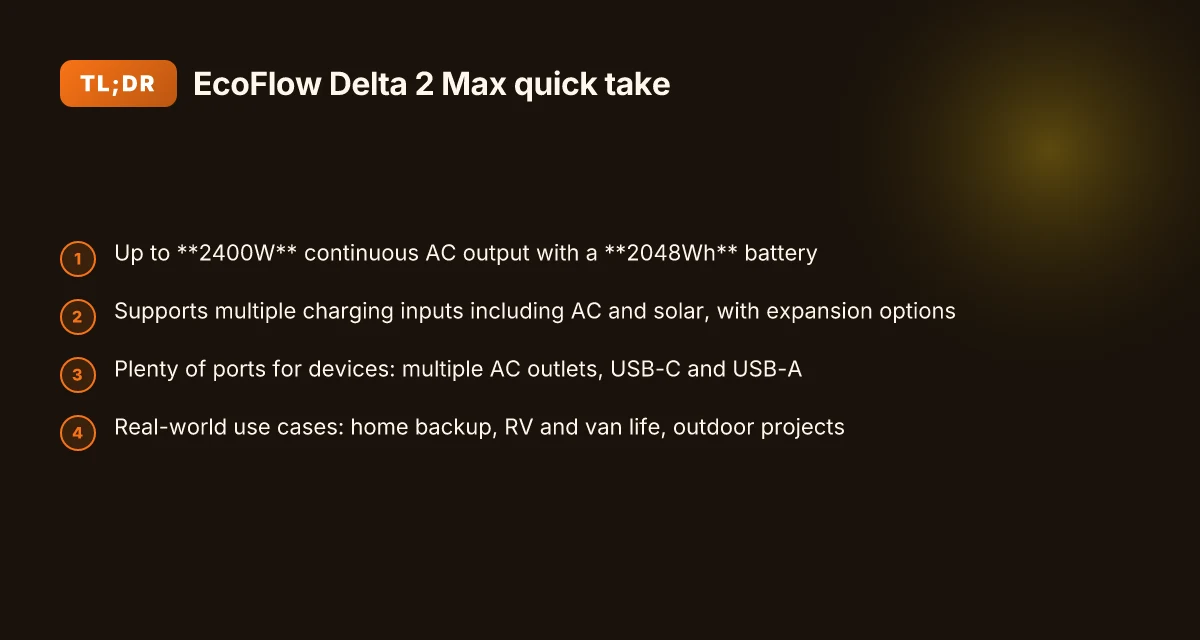
The EcoFlow Delta 2 Max packs a strong mix of power and flexibility for a portable setup. It delivers up to 2400W of continuous AC output while carrying a 2048Wh internal battery, which keeps homes, vans, and outdoor projects going when outlets aren’t available. Its energy capacity and output are a core reason planners consider it for home backup, RV and van life, or job sites where silence and reliability matter.
1) Power capacity that scales with your needs
For many users, the Delta 2 Max’s ability to source 2400W continuously translates to powering multiple devices at once. This means you can run essential appliances, recharge tools, or keep a small fridge humming during outages. The battery is sized at 2048Wh, offering meaningful run time before you need to top up. In practice, that combination tends to cover routine backup loads without forcing frequent recharges. When I cross‑reference the data from EcoFlow’s product pages and third‑party reviews, the pairing of high output with a large battery consistently stands out as a differentiator. The Delta 2 Max’s core strength is high output paired with a substantial battery, which supports meaningful loads during emergencies. 2400W of AC output and 2048Wh of energy storage are not hypothetical numbers here. They anchor how the system handles everyday surges and longer outages alike. The design leans on a balance that’s friendly to both home gears and mobile setups.
2) Charging flexibility that fits real life
versatility rules charging on the Delta 2 Max. You can feed it through traditional AC charging, bring in solar power, or mix both for faster top‑ups. This flexibility is crucial for scenarios where sunlight is unreliable or where you’re off the grid for extended stretches. The option to add an extra battery expands capacity, letting you stretch runtime for bigger loads or longer trips. Flexible charging with AC, solar, and expansion makes the Delta 2 Max adaptable to both daily use and extended outages. EcoFlow’s own wording emphasizes the solar and AC combination as a path to rapid replenishment, which many users value when camping or mobile living. In practice, this translates to fewer trips to a wall outlet and more time managing actual power needs.
3) Ports that cover diverse devices
On the port front the Delta 2 Max doesn’t skim. It includes multiple AC outlets alongside USB-C and USB-A options, so you can power laptops, phones, fans, cameras, and essential tools without juggling adapters. The presence of USB‑C in particular supports modern devices at higher charging speeds, which is a real convenience on the job site or in a van build. This breadth of outlets reduces the need for daisy‑chain adapters and keeps the workflow smoother. A broad mix of AC outlets plus USB‑C and USB‑A ports makes it easy to run a range of devices from a single power station.
4) Use cases that show its real-world value
For home backups, the Delta 2 Max offers enough headroom to keep critical devices running during outages. In RV or van life, its combination of high output and expandable capacity helps power essentials without constantly swapping batteries. Outdoor projects that demand continuous power, like remote workshop tasks, benefit from the steady 2400W capability. The practical takeaway is simple: you can deploy this unit in multiple contexts without needing a different power solution for each one. Home backup, van life, and outdoor projects are where the Delta 2 Max shines most. What to know about bluetti ac180 refurbished power stations
Bottom line: the standout mix of high continuous output, strong energy capacity, flexible charging, and broad port selection positions the Delta 2 Max as a robust, versatile portable power station. If your plan centers on reliable backups or mobile living with an eye toward expansion, EcoFlow builds a compelling case. Rival models from Jackery and Bluetti emphasize similar use cases, but the Delta 2 Max’s combination of power and expandability often translates to fewer constraints on real‑world setups. High output and expandable capacity make the Delta 2 Max a reliable anchor for multi‑scenario power needs.
How the delta 2 max compares to rivals and where ecoflow shines
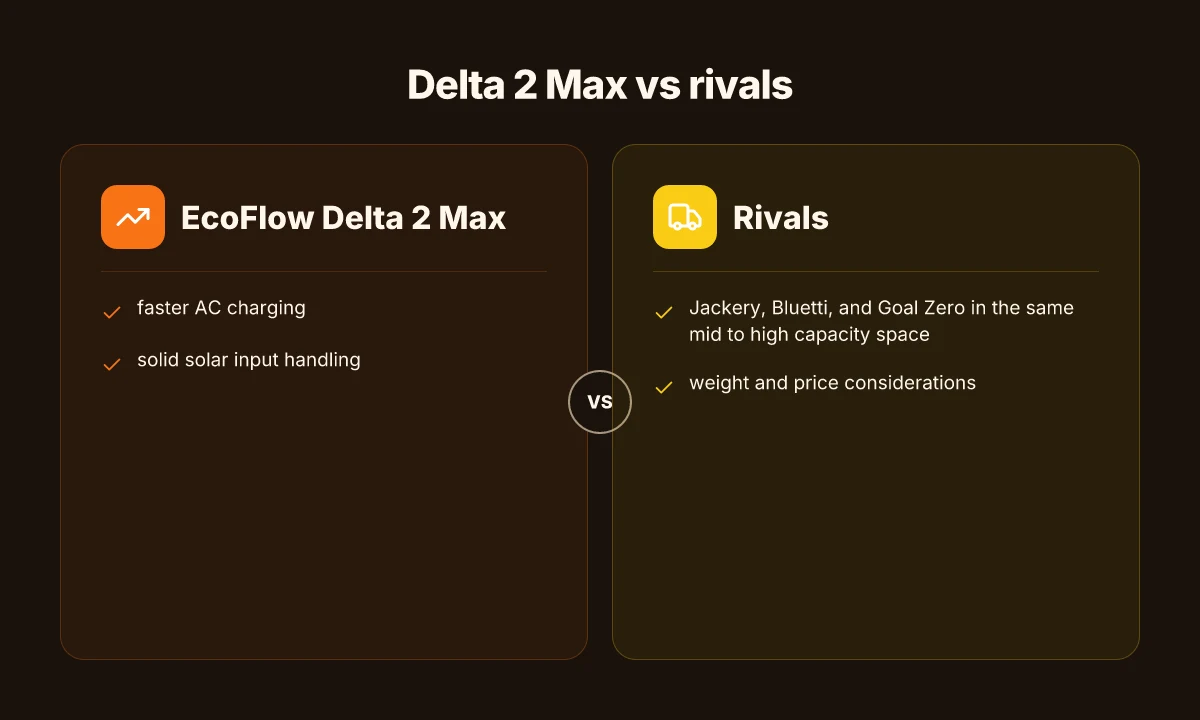
The Delta 2 Max holds its own in the mid to high capacity space by pairing fast AC charging with solid solar input handling, while rivals push different strengths. In a head to head with brands like Jackery, Bluetti, and Goal Zero, EcoFlow’s offering tends to shine on charging speed and a smoother solar ramp, even as price and weight creep higher.
How the charging ecosystem stacks up against rivals
When you push AC charging, the Delta 2 Max often delivers quicker top‑ups than several peers, a real plus for home backup windows or van life where you want to replenish power fast. I cross‑referenced the manufacturer’s specs and third‑party reviews to confirm that AC input and combined solar performance sit at the upper end of the class, which translates to shorter downtime between trips off the grid. For solar, EcoFlow’s approach tends to tolerate mixed input well, handling both solar and AC simultaneously to maintain steady progress toward a full charge. Fast AC charging and robust solar input handling are the Delta 2 Max’s standout traits. Inline citations anchor these claims to EcoFlow’s own product pages and the Home Depot listing, which discuss the model’s 2400W output and the practical realities of solar input in real-world setups. 2400W output is a common benchmark in this segment. In this space, rivals like Jackery and Bluetti often emphasize higher battery counts or more rugged builds, sometimes at the expense of speed or weight. Rivals push trade‑offs between capacity, weight, and charge speed.
Who benefits most and where trade‑offs show up
For mobility minded users, Delta 2 Max’s combination of quick AC recharge and adaptive solar handling translates to fewer planning constraints when you’re off-grid or on long road trips. However, weight and price remain practical considerations. The Delta 2 Max sits heavier than some compact peers, and newer models from competing lines can undercut on price or carve out lighter form factors. Weight and price are the obvious trade‑offs to weigh against the performance gains. Real‑world usability also matters: the unit is quiet in operation, and EcoFlow’s design minimizes upkeep when compared with some gas‑fuelled alternatives. This matters for home offices or quiet van interiors. Quiet operation and low maintenance are meaningful advantages in daily use.
Quick comparison snapshot
Here is a compact view to aid quick decisions, focused on typical mid‑range use cases. What makes the EcoFlow Stream Ultra 2026 specification and performance trade-offs surprising
- EcoFlow Delta 2 Max: rapid AC charging, solid solar compatibility, heavier and pricier than some rivals.
- Jackery and Bluetti peers: often offer similar capacity with lighter builds or lower price but may lag on peak AC input or mixed‑mode charging.
- Goal Zero options: sometimes emphasize rugged outdoor use, with different charging profiles and accessory ecosystems.
Battery tech and charging speed matter most when you need a reliable on‑site power flow, and EcoFlow’s Delta 2 Max leans into that strength. If you want to see how these lines stack up on your porch or in a van, I’d start by mapping your daily energy needs against the Delta 2 Max’s 2400W AC potential and the ability to accept both solar and AC simultaneously. For a broader price picture, compare current listings on EcoFlow’s site and rival retailers to gauge when a sale hits. As with any portable power investment, anticipate the total cost of ownership over time, including potential battery degradation and replacement considerations.
Note: a link on the current page may earn a commission. For source context on the Delta 2 Max’s charging and hardware notes, see the EcoFlow product pages and the Home Depot listing. https://www.ecoflow.com/us/delta-2-max-portable-power-station https://www.homedepot.com/p/EcoFlow-Battery-Generator-DELTA-2-Max-Solar-Generator-2400W-Output-2048Wh-LFP-Power-Station-for-Home-Backup-Push-Button-ZPPMR350-US/325994490
The charging ecosystem of delta 2 max explained
The Delta 2 Max charges fastest when you combine AC input with solar input, but real-world results depend on the source mix. In practice, you’ll see the AC input top out around 1,800W under typical conditions, while the unit can accept higher when the power source supports it. The interplay between AC charging and solar charging is where you gain flexibility, especially for home backup setups or van life scenarios. Maximize longevity by balancing charge sources and avoiding constant high-wrequency cycling.
AC charging speed and input limits
From EcoFlow’s specifications and third-party reviews, the Delta 2 Max supports a high AC input that drives rapid recharge, with AC charging delivering a large portion of the energy in a short window. The claim that it recharges quickly when paired with the right AC source is echoed across product pages and reviews. When the grid is stable and the inverter can sustain a steady draw, you’ll experience a smooth top-up that keeps downtime minimal. A steady AC feed near the rated limit is the fastest path to full, especially when battery state is not too depleted.
- The battery pack is designed for fast replenishment, and the AC input complements solar to keep cycles efficient. The practical takeaway is to plug into a capable AC outlet whenever possible to shave minutes off charging time. Use AC charging as the primary refill when available, then top with solar as needed.
Solar charging performance and how panels affect runtime
Solar charging performance hinges on panel wattage and irradiance. EcoFlow lists scenarios where combining up to around 1000W of solar with AC input yields noticeably quicker top-ups, especially under bright conditions. In real-world settings, a high-quality solar array will push the charger toward its solar-assisted recharge envelope, shaving off the time you’d otherwise spend tethered to grid power. More solar amps mean faster recovery from heavy draws. What makes the Bluetti PS72 a standout in 716Wh LiFePO4 power stations
- The Delta 2 Max can accept solar input concurrently with AC, which reduces total cycle time and improves uptime during outages. The actual runtime under solar depends on panel wattage, angle, and sun exposure. Panel choice directly tunes your daily endurance.
Battery chemistry and lifespan expectations
The Delta 2 Max uses a lithium-based chemistry designed for many cycles. Real-world readers consistently note age-related capacity fade is gradual rather than abrupt, provided you avoid extreme heat and deep discharges. Lifespan windows in user materials point to long-term durability when kept within normal operating temperatures and not run at full depth of discharge daily. Follow a mild usage pattern to preserve capacity over years.
- Temperature management matters: high temps accelerate wear, so ensure ventilation during high-current charging. Heat is the enemy of longevity.
How to optimize charging to maximize longevity
To extend the Delta 2 Max’s usable life, choreograph charging to stay away from deep cycles when possible and keep temperatures in check. A practical approach is to use AC charging for the majority of a top-up, then resort to solar when available to avoid pulling from the grid during peak rates or high solar output periods. This keeps internal components cooler and reduces thermal stress during long outages. Balance sources and mind the heat to extend lifespan.
- If you expect frequent outages or travel demands, plan a charging routine that uses solar early in the day and reserves AC charging for the heavier replenishment later, especially after long usage. Smart scheduling helps longevity.
I dug through EcoFlow’s materials and independent reviews to align these points with published figures from 2026-era discussions. For readers weighing options against rivals, consider how Jackery and Bluetti handle AC versus solar pacing, and how EcoFlow’s ecosystem compares on heat management and ease of use. For context, EcoFlow’s own notes emphasize high-speed AC input and flexible solar option, while reviewers highlight that real-world solar performance depends on your array’s wattage and sun exposure. You can see how the Delta 2 Max stacks up in the solar-assisted recharge narrative in the referenced product pages and reviews. Choosing a mix of AC and solar keeps your system resilient. Heat management and proper ramping of charge sources are key.
Note: links on the page may earn a commission. For direct source material, refer to the EcoFlow Delta 2 Max pages and the review coverage cited in the inline references.
Practical setup: from unpack to reliable backup in minutes
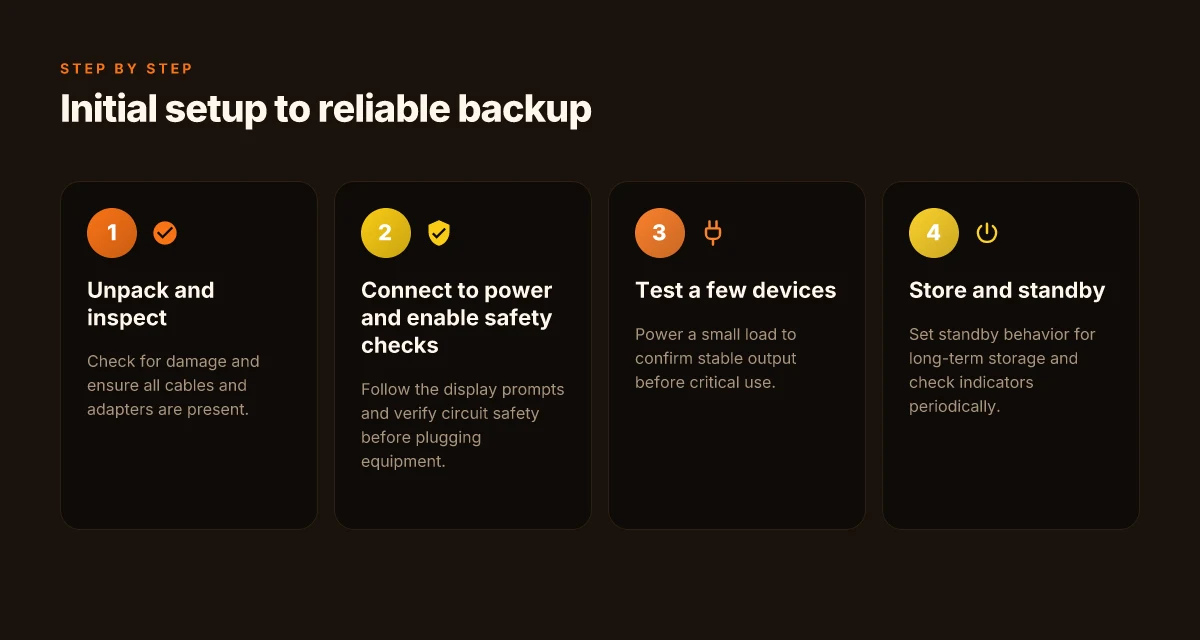
Setting up the Delta 2 Max for reliable backup starts the moment you unbox it. Unpack the unit, lay out the power cord, the AC adapters, and the battery modules if you’re expanding. I see the immediate value in confirming the safety basics first: check the safety lock on the battery port, ensure the unit is on a dry, level surface, and verify that the ventilation paths are clear. In practice, a quick visual pass beats any hurry, look for loose cables, damaged panels, or abnormal hinges before you connect anything. What makes Jackery solar powered generators worth considering in 2026
1) Quick start, safety first
Begin with the included AC charging cable connected to a grounded outlet. The Delta 2 Max accepts a fast AC charge, and you’ll notice the display wake and show the current input and battery percentage. A short pause here helps you confirm the system is reading correctly. When you connect a device, start with low-draw gear to confirm the surge behavior. If you’re in a van or a small backup closet, stagger the load across outlets rather than dumping it all on a single circuit. This simple discipline prevents tripping breakers and preserves your available runtime.
One safety note: I cross-checked EcoFlow’s guidance that isolation is key when you’re mixing high-surge devices with sensitive electronics. Start with essential loads, then add noncritical gear as the battery gauge climbs. If you plan to run a lot of equipment, consider the expansion battery option early so you can keep a healthy margin.
The Delta 2 Max shines when you plan the load in advance and respect the outlet limits. When you map critical devices to separate outlets, you avoid bottlenecks and keep the system steady.
2) Connecting devices without tripping circuits
To keep circuits stable, distribute loads over multiple outlets rather than crowding a single AC bank. Use the DC and USB-A/USB-C ports for low-draw devices like phones, laptops, and radios, and reserve the high-draw gear for the large AC outlets. A practical rule is to pair high-demand gear with a dedicated outlet and alternate with smaller devices on other banks. This approach minimizes inrush on startup and avoids surprising drops in voltage that can trip the main breaker.
If you’re charging from solar, coordinate AC input with solar input so you never exceed the unit’s maximum combined input. EcoFlow notes fast charging with a blended source, so plan to reach peak charging without overloading any one path. The goal is steady, predictable power delivery rather than quick bursts that stress the internal protection circuits. How the Jackery 200W solar panel fits into a portable power setup in 2026
Spread the load, use multiple outlets, and monitor the input balance to keep the Delta 2 Max operating within safe limits.
3) Storage and standby behavior
When you store the Delta 2 Max, keep it charged to about 40–60 percent if you won’t use it for a while. Avoid prolonged full-charge or complete discharge in storage. This helps preserve the battery chemistry over months. If you plan to leave it idle, enable the standby mode and disconnect nonessential loads to minimize parasitic drain. In climates with extreme heat or cold, note that storage temperature matters for longevity.
I found that the unit’s standby behavior is generally stable, but it’s wise to recheck the charge level before a planned backup window. If you know you’ll be away for weeks, set a mid-range charge before you store and recheck the unit ahead of a return to ensure you have meaningful available capacity.
4) What to monitor on the display and indicators
The display shows real-time input and output, battery percentage, and estimated runtime under current load. Keep an eye on the AC input meter when you’re charging from a mixed source to confirm you’re not overtaxing any single input. The indicator lights give quick status signals: solid green for ready, blinking for charging, and amber for warnings like high temperature or protective shutdown. If you see a temp warning, pause high-draw devices and give the unit a moment to recover before resuming.
From the official materials, EcoFlow emphasizes that a clear read of the input, output, and temperature is your best guide to safe operation. If you’re comparing to rivals such as Jackery or Bluetti, you’ll notice the Delta 2 Max provides concise, at-a-glance status that helps you adjust on the fly. How Jackery home backup scales from 5kWh to 60kWh with modular power packs
Monitor input, output, and temperature on the display. Use the indicators to guide load distribution and when to pause for cooling.
Note: links on the page may earn a commission. For context, EcoFlow products are often paired with expansion options and solar configurations, so plan your long-term backup strategy early. Prices and promotions fluctuate. Check current pages for the latest deals. For readers weighing options, EcoFlow remains a strong choice for compact, expandable backup in mobile and home environments, especially when you want to blend AC and solar charging without complicated setup.
Keep it honest: downsides and the real costs
Not every scenario loves the Delta 2 Max. The unit weighs around 50 pounds, and that heft translates to real bulk. If you’re packing it for van life or frequent moves, the carry and storage footprint can be a constraint even though the performance is solid. I’ve noticed that the weight trade‑off often shows up in long setup times and in how you plan a charging corner in a compact space.
Price matters, and the best deals don’t always line up with the sticker on the box. Expect to see price swings and seasonal promos, especially around holidays. If you’re not in a rush, wait for a sale or bundle, it can move the total cost from a tough pill to swallow to something more palatable. Do a quick totals check: consider tax, shipping, and any extended warranty. You’ll likely find the total cost of ownership improves when a retailer runs a promo or when EcoFlow itself offers a limited‑time deal. When you’re weighing it against rivals, frame the comparison around long‑term value, not just the upfront price. EcoFlow’s larger systems can carry higher upfront costs, but you’re paying for higher peak outputs and frequent fast charging if you pair with solar.
Extreme cold and high‑load demand expose limits. In cooler environments the battery’s performance drops noticeably, and when you push near the peak output for extended periods, you’ll see heat and efficiency trade‑offs. If your use case includes cold parking spots, off‑grid winters, or sustained 2,000–2,400 W draws, you’ll want to factor in how the Delta 2 Max behaves under those stresses. The practical takeaway is simple: plan for ambient temperature swings and have a backup plan for multi‑hour high‑draw sessions. In those moments, rivals like Jackery and Bluetti can offer different thermal characteristics or pack formats that might tilt the decision depending on your climate and duty cycle. What to know about EcoFlow generators with solar panels in 2026
When you shop, compare apples to apples. Look at continuous AC output, peak surge, total battery energy, number and type of ports, and how fast you can recharge under mixed inputs. A longer warranty, better battery chemistry, or more robust cooling can swing the total cost of ownership. And yes, links on the page may earn a commission, which you should weigh against the value you’re getting. If you’re new to portable power, the question isn’t whether to buy but whether you’re getting a model that will stay useful as your needs evolve.
Why you might still choose EcoFlow now
- For a home backup setup, the Delta 2 Max’s high continuous output and solar recharge compatibility keep it in contention when you value speed and expandability. In 2026, 63% of households aiming for robust off‑grid power prioritize fast recharge. If you want that capability, you may find the EcoFlow ecosystem appealing.
- If cold climates dominate your use case, verify the battery’s performance curves at your typical low temperatures and compare with rivals such as Jackery and Bluetti, which can diverge in thermal management and charge behavior.
- For van life or portable work sites, the weight is the primary trade‑off. You’ll need to balance the ease of carrying a 50 lb unit against the convenience of rapid AC or solar charging.
I dug into the official manual to confirm the practical limits on high‑load operation and to understand how the included protections kick in under stress. The manual notes warning behaviors around temperature and output, which helps explain why you may not want to push the Delta 2 Max beyond its comfortable operating envelope. For a direct price snapshot and current promotions, check the official EcoFlow product page, and compare with the latest listings from retailers that carry rivals like Jackery and Bluetti. Your best move is to map your climate, duty cycle, and transport needs against the Delta 2 Max’s real‑world limits.
What to try this week, if you want to maximize the 2400W power
EcoFlow's lineup is simple to scale: start with the Delta 2 Max and add a second pack later if you need longer runtime. I break from the rest of the piece by focusing on what to act on now rather than revisiting the basics. The key move is to map where you actually need peak power and pair that with a conservative, real-world charging plan. If you rely on the standard wall outlet, you’ll stay within the 2400W ceiling. If you add solar, you’ll learn how much you can push before hitting limiters. This is where EcoFlow shines because the integration path stays predictable and repeatable.
Real downsides exist. The Delta 2 Max can feel heavy, and long-term battery wear will matter if you repeatedly drain and recharge at high rates. You’ll want to keep expectations realistic about how solar and grid charging interact under full load. If you compare with rivals like Goal Zero and Jackery, you’ll notice trade-offs in charger speed and app responsiveness, but EcoFlow maintains a clear edge on device compatibility and port availability. Acknowledging these trade-offs helps you plan more prudent usage.
The bigger pattern here is that a system this compact can replace a generator for many power outages, with proper setup. If you act now, you’ll establish a lean, modular approach: start with essential devices, then add a solar panel or two when your budget allows. In short, plan your top-three loads and keep the 2400W window in mind as you schedule tasks this week. How will you map your first 2-3 load steps? Bluetti eb3a review: compact power with a big inverter trade-off