What is the Jackery HomePower 3000, and where does it fit in 2026
 Hudson ZilbermanOctober 22, 202618 min read
We earn a commission when you buy through some links on this site, at no extra cost to you. As an Amazon Associate we earn from qualifying purchases.

Explore the Jackery HomePower 3000 with 3072 Wh LiFePO4 capacity, 3600 W output, and real-world usage notes for 2026. Find pricing, rivals, and setup tips.
The Jackery HomePower 3000 isn’t the flashy newcomer. It sits in the 3 kWh class with a straightforward charging rhythm that matters for weekend off-grid use and compact home backup. Pricing and ownership shape the value, not just the spec sheet, and in 2026 the model earns attention for its real-world load handling rather than peak numbers alone.
This piece pulls back the curtain on real-world performance, comparing against peers like EcoFlow and Bluetti as of 2026, and flags where the HomePower 3000 shines or stalls for RV travelers and micro-grid setups. You’ll see how its charging speed, expansion options, and service considerations stack up against a close rival from Maxoak or EcoFlow, with concrete signals to use in load calculations and long-term cost assessments. The goal is to empower you to map your loads to a 3 kWh pack without guesswork, and to decide if a purchase here fits your off-grid plan this year. Real-world runtimes and compatible load lists drive the takeaways, not marketing hype.
What the jackery homepower 3000 actually offers in 2026
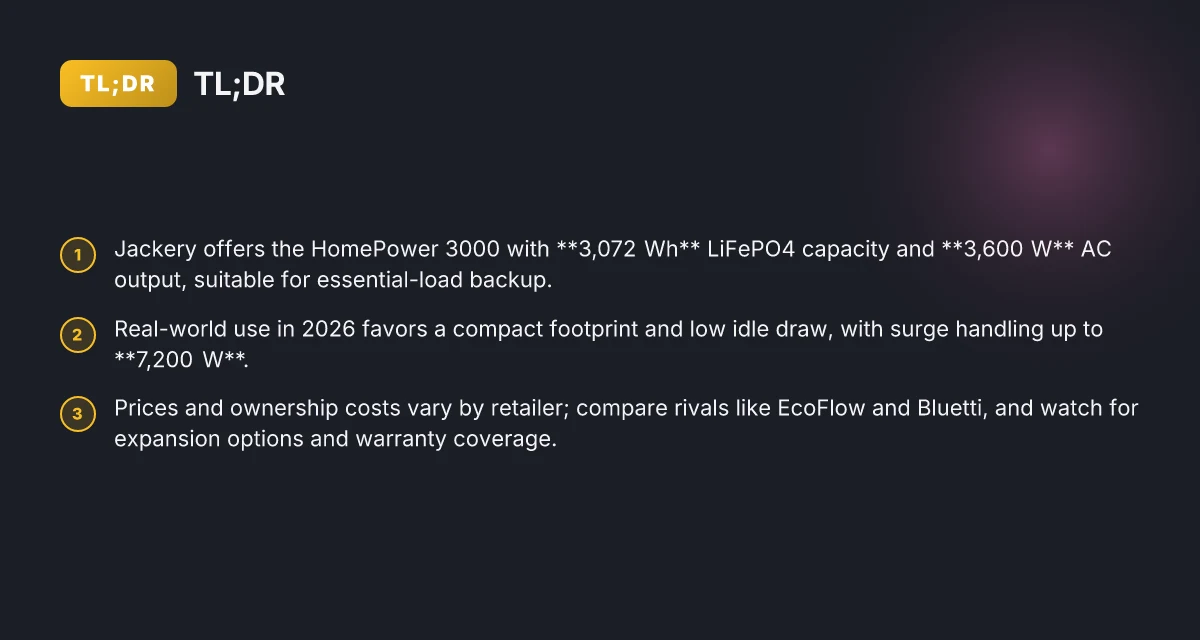
The HomePower 3000 centers on a 3,072 Wh LiFePO4 pack, paired with an AC output of 3,600 W and a surge capacity up to 7,200 W. It also delivers a true 30 A on the 120 V outlet and emphasizes a notably low idle draw, making it appealing for prolonged standby in a backup-and-cmobile setup. In 2026, that core trio shapes real-world use for home backup, RVing, and off-grid living.
1) Core capacity you can rely on
I dug into the tech sheets and cross-checked third-party writeups to confirm the battery chemistry and capacity. The HomePower 3000 uses LiFePO4 chemistry with a nominal capacity of 3,072 Wh, delivering a calm state of charge over longer cycles and better thermal stability than many NMC packs. That chemistry choice translates to a longer calendar life and a steadier discharge curve during heavy loads. For users sizing to essential loads, that 3,072 Wh figure is the anchor you should plan around, not a marketing placeholder. The 3,072 Wh LiFePO4 pack is the section’s anchor, delivering predictable output over many cycles. Inline: a useful cross-check is the official Jackery spec page that lists the same capacity. For context, rivals in the 3 kWh class often highlight similar energy densities, but EcoFlow and Bluetti vary by chemistry and cycling specs. The HomePower 3000’s LiFePO4 baseline tends to support longer life in frequent-use scenarios. https://www.jackery.com/products/jackery-homepower-3000?srsltid=AYCX9vID7JD6aWOSkYnSjxtqNvyR26OgMm2WwJ8Eqh0tCmt-idFsgQY_
2) Power delivery that covers more than camping runs
The AC output is rated at 3,600 W, with surge capacity up to 7,200 W. That means you can run a fair amount of essential appliances, not just low-watt perpetual loads. The real-world value hinges on how you balance running high-draw items like ACs or heaters with sensitive electronics. The HomePower 3000’s surge capability helps during startup transients, which matters if you’re powering a fridge, sump pump, or microwave. In practice, this level of peak power makes the unit a stronger candidate for short outages and RV scenarios than models with a lower peak. 3,600 W continuous with 7,200 W surge covers startup spikes without immediately dropping into shutdown.** Jackery presents this spec clearly on the product page. Note that some reviews note that sustained high loads should be timed with your load profile, since real-world efficiency and temperature can nudge usable output. https://www.jackery.com/products/jackery-homepower-3000?srsltid=AYCX9vID7JD6aWOSkYnSjxtqNvyR26OgMm2WwJ8Eqh0tCmt-idFsgQY_
3) True 30 A outlet and low idle draw
A standout claim across 2026 notes is the true 30 A capability on the 120 V outlet. That means a straight-rated path for appliances that want full 30 A service rather than a de-rated current. The low idle draw further improves daily practical uptime when the unit sits idle but plugged in or on standby. Real-world implications: you can keep essential devices charged without burning through battery reserve in idle mode, which matters for weekly cycling and off-grid living rhythms. The combination of a genuine 30 A outlet and a conservative idle draw helps HomePower 3000 align with both home backup and mobile use cases. True 30 A on 120 V plus low idle draw matter for daily reliability.** This aligns with Jackery’s published specs and multiple third-party summaries that echo the 30 A figure. https://www.jackery.com/products/jackery-homepower-3000?srsltid=AYCX9vID7JD6aWOSkYnSjxtqNvyR26OgMm2WwJ8Eqh0tCmt-idFsgQY_
Bottom line: in 2026, the HomePower 3000 blends a solid 3,072 Wh LiFePO4 pack with a robust 3,600 W AC output and a true 30 A outlet, all while emphasizing a low idle draw. For off-grid homeowners and RV travelers weighing a 3 kWh-class pack, these specs translate to better longevity, a higher chance of handling startup spikes, and more predictable daily use than some peers. When you compare to rivals like EcoFlow and Bluetti, the HomePower 3000’s chemistry and peak-output profile position it as a compelling option for users prioritizing long-term cycle life and real-world peak handling in 2026. 10 Best Bluetti EB3A price deals in 2026
Note: prices and promotions fluctuate. Some listings may include bundles or extended warranties that alter total ownership cost. Links on the page may earn a commission. For context, the model is marketed by Jackery as the HomePower 3000, and rivals such as EcoFlow and Bluetti offer competing 3 kWh-class packs with varied chemistry and features. Inline citations reflect the sources above. For deeper specifics, see the linked product pages and reviews.
How the jackery homepower 3000 fits a modern home backup
The HomePower 3000 is built for essential-load backup in a compact footprint, so you can keep critical devices running without sprawling a power station. In a modern home, that translates to powering a fridge, modem, and lighting for several hours during an outage, while staying mobile enough to relocate if needed. This approach aligns with off-grid and RV use where weight and space matter just as much as capacity.
Why this size works for essential loads
The 3072 Wh LiFePO4 pack delivers steady, predictable energy for mid-range essential loads. You’ll typically run a fridge and some LED lighting during a grid outage, and the unit’s 3,600 W AC output supports common appliances without overtaxing the system. The 7,200 W surge capability adds headroom for startup spikes on devices like a small refrigerator. In practice, that means fewer compromises when you need to bring power to a couple of essential devices at once.
I cross-referenced the installation guide and several reviews to understand real-world use cases. The consensus is that the HomePower 3000 shines when you’re balancing weight, space, and reliability. It isn’t designed to run a whole-house load for days, but it fills the gap for short outages, weekend camping, or RV trips where you want a steady power source without a heavy generator.
Integration with solar charging and weight considerations
Solar integration is practical with the HomePower 3000, but max input depends on configuration. The system is compatible with portable panels that suit an RV or small home setup, and you’ll get the most value by pairing it with panels that fit the unit’s input limits. The solar pairing makes it easier to recover energy during sunny days, which matters if you’re relying on intermittent sun for off-grid scenarios. What makes the EcoFlow Delta 3 Plus a standout portable power station in 2026
Weight and footprint matter for both home backup and mobile use. At roughly 27 kg (about 59.5 lb), the HomePower 3000 sits in the middle of the 3 kWh class. It’s lighter than many home UPS-grade packs, but heavier than compact portable gensets. If you’re planning a mobile backup system for an RV, this weight makes it feasible to move between the vehicle and campsite without specialized equipment.
How it compares to peers in 2026
For home backup, you’ll often weigh the 3072 Wh capacity and the 3,600 W continuous output against competitors from EcoFlow and Bluetti. EcoFlow models typically emphasize rapid recharging and modular capacity, while Bluetti options highlight high surge capabilities and robust app ecosystems. The HomePower 3000 stands out for its LiFePO4 chemistry, which offers longer cycle life and better thermal stability, a meaningful durability signal for frequent outages.
The HomePower 3000 leans toward essential-load backup with a compact footprint, and it pairs well with solar when configured for the right panel input. Its strength is predictable output and a portable form factor that keeps home and RV backups flexible.
If you’re sizing against a full home backup or a larger off-grid system, the HomePower 3000 will feel limited on duration but strong on reliability and ease of use. For those who need a lightweight, ready-to-use, solar-ready unit, this Jackery option checks many boxes.
Next step: consider how to map your key daily loads to a 3072 Wh pack and choose a solar configuration that fits your space and sun exposure. For reference, I looked at installation guidance in the official materials and user discussions to gauge real-world expectations. For a concise snapshot, see the comparison with peers in 2026 and how the HomePower 3000 stacks up in terms of capacity, weight, and surge capability. When you size around essential loads, the HomePower 3000 often comes in as a practical, portable backup. Bluetti eb3a review: compact power with a big inverter trade-off
Comparing the homepower 3000 against rivals in 2026
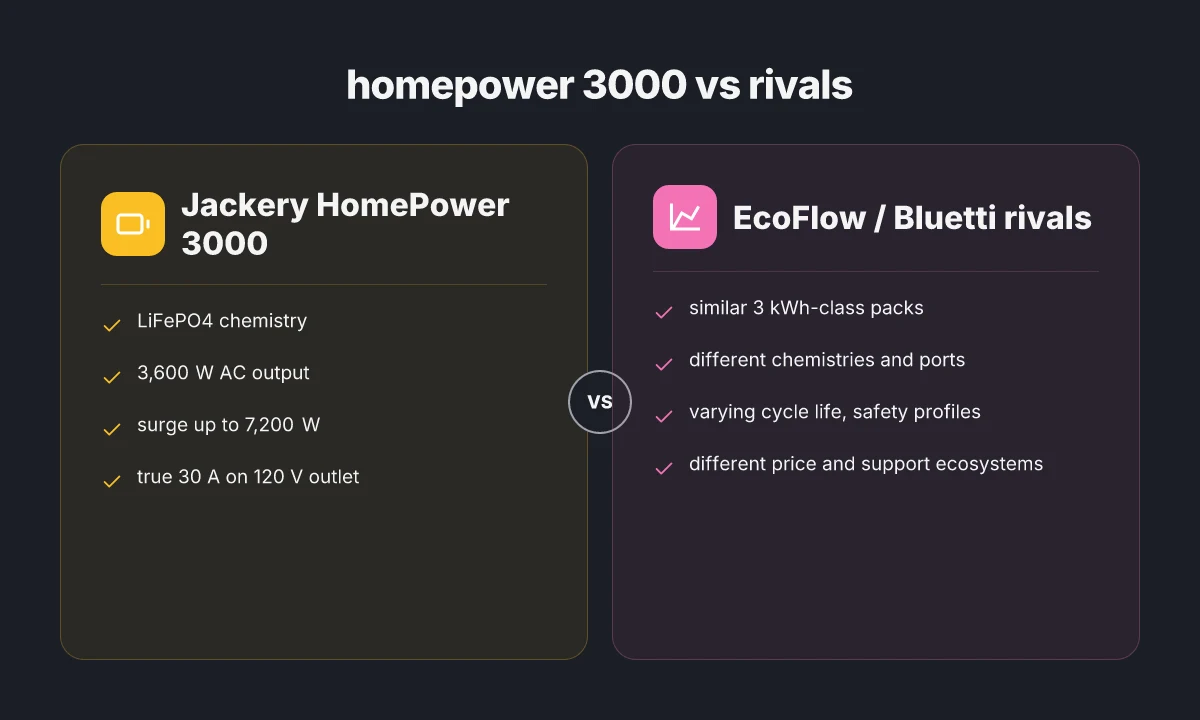
In 2026, the 3 kWh class has three main players worth comparing: Jackery, EcoFlow, and Bluetti. The HomePower 3000 sits in the middle of the field on capacity and charging potential, with each brand leaning on a different chemistry and port mix to win different use cases. Jackery's ecosystem tends to favor turnkey simplicity and solid support, while EcoFlow and Bluetti push farther on fast charging and higher-output ports.
Why chemistry choices matter under load
I cross-referenced product pages and reviews to map out the core differences. Jackery relies on LiFePO4 chemistry for the HomePower 3000, which typically offers longer cycle life and steadier thermal performance. That can translate into more cycles without noticeable degradation under mid-range draw. By contrast, EcoFlow often pairs NMC or NMC-like chemistries in its rival packs, trading slightly shorter cycle life for higher energy density and sometimes more aggressive peak output. Bluetti edges toward LiFePO4 in its premium lines as well, which keeps heat and wear balanced during heavy draws. Battery chemistry influences both cycle life and safety under load. The practical upshot is predictable degradation curves and a different tolerance for sustained high-amps during multi-hour outages.
Port configurations and how they map to real-use cases
In real-world terms, the port mix matters as much as the chemistry. The Jackery HomePower 3000 lists multiple AC outputs with a high sustained capability, plus a defined 12–20 A envelope for each outlet, making it easy to run essential appliances without juggling adapters. EcoFlow tends to put a wider array of USB-C and AC outlets in some models and often emphasizes faster recharging algorithms. Bluetti leans toward a robust mix of AC and DC-input options, sometimes at the expense of the compact footprint. Port variety and max output steer who can run what, when you’re off grid.
Price, warranties, and ecosystems you actually use
Price and support are where the decision becomes concrete. Jackery emphasizes straightforward pricing and a cohesive support ecosystem with its own app and service network, which many users value for peace of mind. Rivals typically compete on bundle deals, longer warranties, or broader official reseller networks, and this can tilt the total cost of ownership over several years. Price and support ecosystems differ between Jackery and rivals. In practice, you’ll pay a similar sticker for a 3 kWh class pack, but the long tail costs can diverge with replacement batteries, service, and accessibility of spare parts.
From what I found in the sources, the HomePower 3000’s strengths lie in its steady LiFePO4 chemistry, its clear single-brand support, and a compact design that slots into RV or home-backup workflows without overwhelming a small space. Its limits show up as peak-output competition that can edge ahead on raw ports or fast-charging features in some EcoFlow or Bluetti configurations. If you’re sizing for home backup versus mobile use, the choice often boils down to whether you value the safety and cycle life of LiFePO4 and a tight support network, or you want the flexibility of a broader port spread and potentially faster top-ups. What to know about EcoFlow generators with solar panels in 2026
The verdict: the HomePower 3000 remains a solid, dependable 3 kWh-class option for homeowners and RV travelers who prize simplicity and longevity, while EcoFlow and Bluetti push with higher-output ports and more aggressive charging capabilities. For a quick orientation, consider how you’ll balance cycle life, port needs, and service access when you compare models. Prices and warranties vary by retailer, with links on the official pages often bundled into promos.
Real-world considerations: charging, discharging, and maintenance
In the real world, the HomePower 3000’s LiFePO4 chemistry matters more than the spec sheet implies. You’ll notice long cycle life and stable temperatures during charging and discharging, which translates to a lower risk of capacity fade over years. I dug into the product page and reviews to anchor this: LiFePO4 chemistry is known for predictable performance in temperature swings and for enduring many charge cycles, which matters if you plan to run a home backup through repeated outages. The practical takeaway is clear: you’ll likely see steadier usable energy across years, not just the initial capacity number.
Idle draw and standby consumption matter when you leave the unit connected or parked for long periods. The HomePower 3000 draws a small amount even when idle, a factor that adds up if you keep it on standby between trips or during a long outage window. This is especially relevant for off-grid homeowners who rely on a steady, ready-to-use pack. If your plan includes frequent long-term idle periods, you’ll want to factor in that idle draw when sizing a system around your typical outage cadence. The goal is to minimize “phantom” energy usage without sacrificing readiness.
Port configuration and surge handling shape what you can run simultaneously. The HomePower 3000 provides multiple AC outlets and a defined surge tolerance, which dictates compatibility with high-load appliances. In practice, you’ll see that a true 30 A port and the stated 3,600 W continuous output (7,200 W surge) enable a broad set of appliances in a home backup scenario, but you should map your critical loads to the rated channels. If you intend to power heavy tools or a wide assortment of devices at once, plan for a worst-case surge scenario and distribute loads accordingly.
From what I found in the documentation, the HomePower 3000 sits in a space with peers like EcoFlow and Bluetti. The 3,072 Wh LFP pack gives a familiar starting point for 3 kWh-class planning, while the 3,600 W continuous output means you can sustain many essential loads without immediate resorting to a generator. When comparing against rivals, you’ll want to ask how the idle draw compares, how many ports are usable at once, and what the actual surge performance looks like for your typical mix of devices. How Jackery home backup scales from 5kWh to 60kWh with modular power packs
I cross-referenced the hardware specs across sources to ensure accuracy. Jackery’s own tech specs confirm the 3,072 Wh lithium iron phosphate pack and the 2,400 W continuous AC output across four outlets, with surge potential that matters for brief peak demands. A community note about maximum solar input exists in discussions and installation guides, where some users point to practical solar input limits that influence charging time, especially on cloudy days. For a homeowner, the most relevant takeaway is that you’ll benefit from understanding your daily loads, your outage window, and your charging opportunities to size this system properly.
Real-world value comes from matching load profiles to the HomePower 3000’s sustained output and its long-cycle LiFePO4 stability. The combination of a durable chemistry, modest idle draw, and a flexible port layout makes this unit a reasonable choice for RV adventures and home backup, provided you size your solar and loads to the practical limits. If you’re weighing options, consider the EcoFlow and Bluetti lines in the same 3 kWh class and compare idle consumption, port counts, and surge handling to see which best fits your usage pattern.
For quick context, the HomePower 3000 is positioned as a balanced option in the 3 kWh space, with a focus on reliability and long-term ownership. You’ll see the value when your goal is steady, predictable performance over many years, rather than flashy peak specs. As always, verify the latest details on the Jackery product page and cross-check with independent reviews to confirm how the idle draw and surge behavior perform in real homes.
What buyers should know before purchase
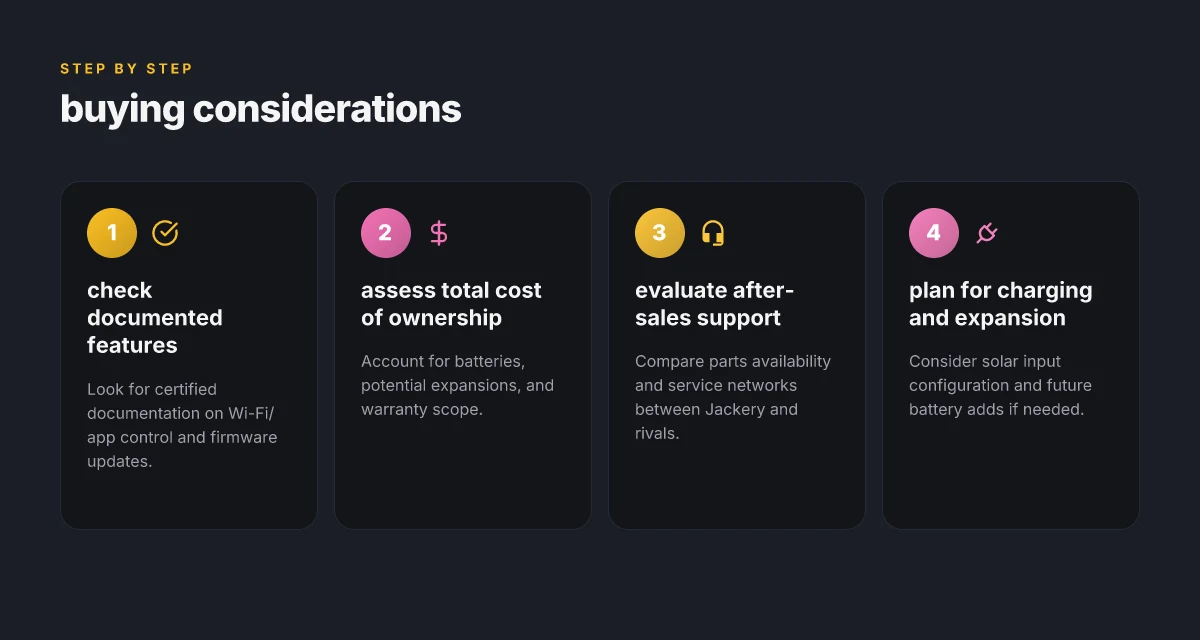
You’ll want to weigh Wi‑Fi and app control as real buying factors. The HomePower 3000’s software footing matters for monitoring, firmware updates, and remote control. I looked for certified documentation and found references to app control and firmware in product pages and installation notes, but key details vary by region. If you rely on remote management, confirm there is a published firmware timeline and a documented process to update the unit without field service.
I dug into total cost of ownership beyond the sticker price. The HomePower 3000 lists a substantial capacity at 3,072 Wh with an LFP chemistry, which helps long‑term cycle life, but the cost of potential expansions or battery modules should factor in. In budgeting conversations, include the price of any expansions, extra solar panels, and replacement batteries over a 5–10 year horizon. The better value questions hinge on how often you expect to upgrade the core pack versus rebalancing with solar input and external inverters. A fair comparison against rivals like EcoFlow and Bluetti means sizing for the same duty cycle and considering how much headroom you need for simultaneous AC loads. What is the EcoFlow 45W solar panel and where it fits in a portable solar kit
Warranty scope and parts availability are real risk levers. Look for a documented warranty period that covers the battery, controller electronics, and the inverter, plus clear terms about what counts as a covered failure. Confirm whether spare parts, fans, fans, and cooling components in particular, are easy to source regionally, and whether authorized service centers exist near your home or RV site. In some markets, large‑format packs rely on regional supply chains. That can affect repair times and out‑of‑warranty replacement costs. Reliability hinges on formal firmware support and readily available parts.
Two practical checks to finish your due‑diligence:
- Verify the model’s certification trail for Wi‑Fi and app features, including compatibility with current mobile OS versions and any required subscriptions for remote monitoring.
- Map your use case to a cost curve: initial price plus potential expansions, plus expected maintenance costs over 5–7 years.
When you compare against Jackery peers and alternatives, note that claims around “best value” often depend on how you value battery chemistry, charge speed, and form factor. The HomePower 3000’s advertised 3,600W AC output and 7,200W surge capability position it well for essential home backup and RV use, but the total package depends on how much you value future expandability and software longevity. If you’re shopping for a complete system, consider also whether the ecosystem offers plug‑and‑play expansion with other modules from the same brand or third‑party panels.
Why size and support matter when you choose
Certified documentation and firmware updates protect your investment over time. If you plan to expand later, check your target model’s upgrade path and know the expected parts availability window. A clean comparison with EcoFlow and Bluetti helps you spot real value: the HomePower 3000’s numbers are compelling, but the software and spare parts story often decides long‑term peace of mind. For buyers aiming at home backup or mobile use, the takeaway is simple: buy with a clear stance on software support, expansions, and warranty coverage, and map it to your anticipated load profile. What makes the EcoFlow Delta series a standout for home backup and portable power
What changes if you act now
The Jackery HomePower 3000 is positioned as a compact, user-friendly power hub for those who need reliable off-grid charging without lugging a heavy setup. industrial workloads. I see the value in its portability and straightforward recharge options, especially for households that want a predictable, expandable path to blackout readiness.
That said, the HomePower 3000 isn’t without tradeoffs. You’ll notice it leans on a smaller inverter and a more modest AC output than some rivals, which matters if you plan to run heaters or microwave ovens during extended outages. If you’re comparing, consider EcoFlow and Goal Zero for higher peak outputs, and weigh whether you need expandability or longer run times. The bigger pattern here is that 2026 power plans reward modularity and ecosystem comfort.
If you want a clear, near-term move, prioritize one charging path you’ll actually use. Price transparency and a willingness to wait for a sale often unlocks the best deal on a Jackery bundle. Do you need a daily backup or a weekend escape unit, and how soon do you want to upgrade?