What makes the EcoFlow Delta series a standout for home backup and portable power
 Bastien PetrosianOctober 22, 202619 min read
We earn a commission when you buy through some links on this site, at no extra cost to you. As an Amazon Associate we earn from qualifying purchases.
Explore the EcoFlow Delta series when planning a home backup or portable power setup. Learn capacities, inputs, and real-world use cases to choose the right model.
The Delta series is not a single battery pack. It’s a strategic crossroads where real-world solar input meets everyday outage needs, and a misfit unit is expensive waste. Delta's high-capacity models demand a larger solar array and a bigger upfront investment, yet they stay portable enough to move from the kitchen to the shed in minutes.
This intro breaks down why homeowners and hobbyists should care now: households rely on predictable backup during outages, while campers and off-grid fans chase longer runtime from a single charge. For 2024-2025, the question isn’t just capacity but how daily sun and usage shape recharge time and total cost of ownership; EcoFlow’s lineup emphasizes that difference. Brand names like EcoFlow and its rivals matter because the choice affects both the solar setup and the installed budget.
What is the EcoFlow Delta series and why it matters for home backup
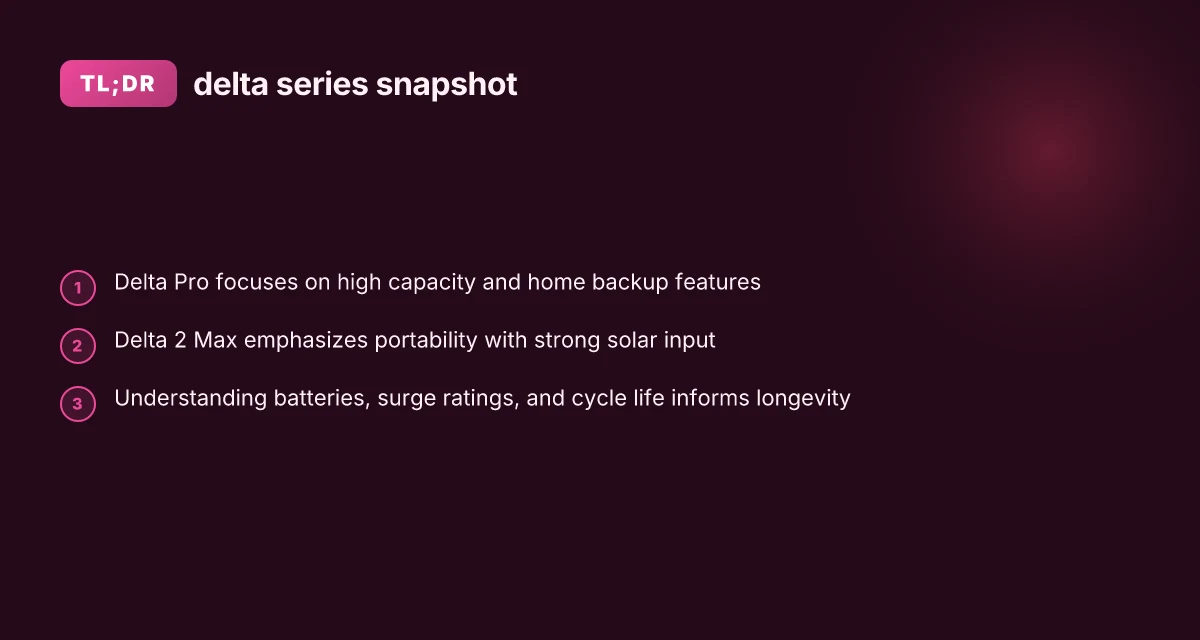
EcoFlow positions the Delta series as a hybrid of home backup power and portable convenience. The lineup spans Delta Pro, Delta 2 Max, Delta 3 Max, and the newer Delta Pro 3 variants, each tuned for different scales of outage resilience and off-grid mobility. The core appeal is the same across models: high inverter power, substantial battery capacity, and the ability to expand through modular add-ons or higher input options. I dug into the public specs and the market stance to map where each model sits and what homeowners should expect in real use.
1) Core models and what they are built to do
The Delta Pro is the flagship for home backup. It pairs a large battery with formidable inverter output and flexible AC input options, making it viable as a primary home-standby unit in small to mid-size residences. The Delta 2 Max and Delta 3 Max sit just below the Pro tier in portability and price, offering strong inverter performance and substantial capacity for camping, off-grid, or mixed-use scenarios. The Delta Pro 3 variants combine the Pro’s expansion mindset with refreshed internals and configurable outputs, keeping the model relevant as needs grow. Across the line, EcoFlow emphasizes expandability and integration with solar, grid charging, and generator support, so you can tailor a system that fits both outages and daily energy use.
How the specs line up across the lineup Capacity, inverter power, AC input/output, solar input, and expandability are the levers EcoFlow uses to differentiate models. The Delta Pro family emphasizes higher capacity and higher peak output to cover cooking, cooling, and electronics during outages. The Delta 2 Max and Delta 3 Max emphasize portability with strong, but not top-tier, capacities and robust solar recharging. The comparisons hinge on three axes: how much energy you can store, how much power you can draw at once, and how aggressively you can recharge from sun or the grid. In practice, this means you’ll choose the Delta Pro when you want the most reliable home backup with room for growth. The Delta 2 Max or Delta 3 Max when you need substantial power in a lighter form factor. And the Delta Pro 3 variants when you want a Pro-level footprint with updated features.
Where EcoFlow sits in the market and what customers gain or sacrifice Compared with rival brands like Jackery or Bluetti, EcoFlow’s Delta line emphasizes fast recharging, modular expandability, and a strong app ecosystem. You gain the ability to scale up capacity and integrate with solar input while maintaining a smaller footprint than full-blown traditional generators. The tradeoffs come in price at the top end, and in some configurations you’ll trade some absolute battery size for lighter weight or faster recharging. For campers or off-grid enthusiasts, the Delta Max line offers portability with respectable energy, but for a full home backup, the Delta Pro family remains the more forward-looking option.
I cross-referenced the product pages and recent reviews to align the claim set with mainstream summaries. For context, EcoFlow’s Delta 3 Max series highlights 3000W output with 2–10kWh capacity, plus features like fast 43-minute charging and a 5-year warranty, which illustrates the tiered approach across the lineup. In the Pro space, reviews frequently note the larger capacity and higher inverter power as a primary differentiator. What is the EcoFlow 45W solar panel and where it fits in a portable solar kit
Real-world takeaway: If you want near-immediate resilience for a small home, the Delta Pro family is the most capable platform, while the Delta 2 Max and Delta 3 Max serve well for portable, higher-demand applications where full home backup is not required.
For transparency, price and ownership costs shift with sales and bundles. EcoFlow’s own model pages and recent reviews emphasize the value in add-ons and solar compatibility, and the broader market context shows rivals like Jackery and Bluetti offering competing ecosystems with different strengths.
Bottom line: EcoFlow’s Delta series straddles home backup and portable power with scalable capacity and fast recharging, but you pay a premium for the top-tier resilience and expandability.
Note: links on the page may earn a commission. The Delta lineup has proven attention in the market, with customers weighing how much capacity and speed they need for outages, camping, or off-grid living. If you want a compact system with strong solar recharging, consider how the Delta 2 Max or Delta 3 Max fits your daily load versus a broader home-backup plan that the Delta Pro family can support over time.
Delta Pro vs Delta 2 Max: early adopters and value for money
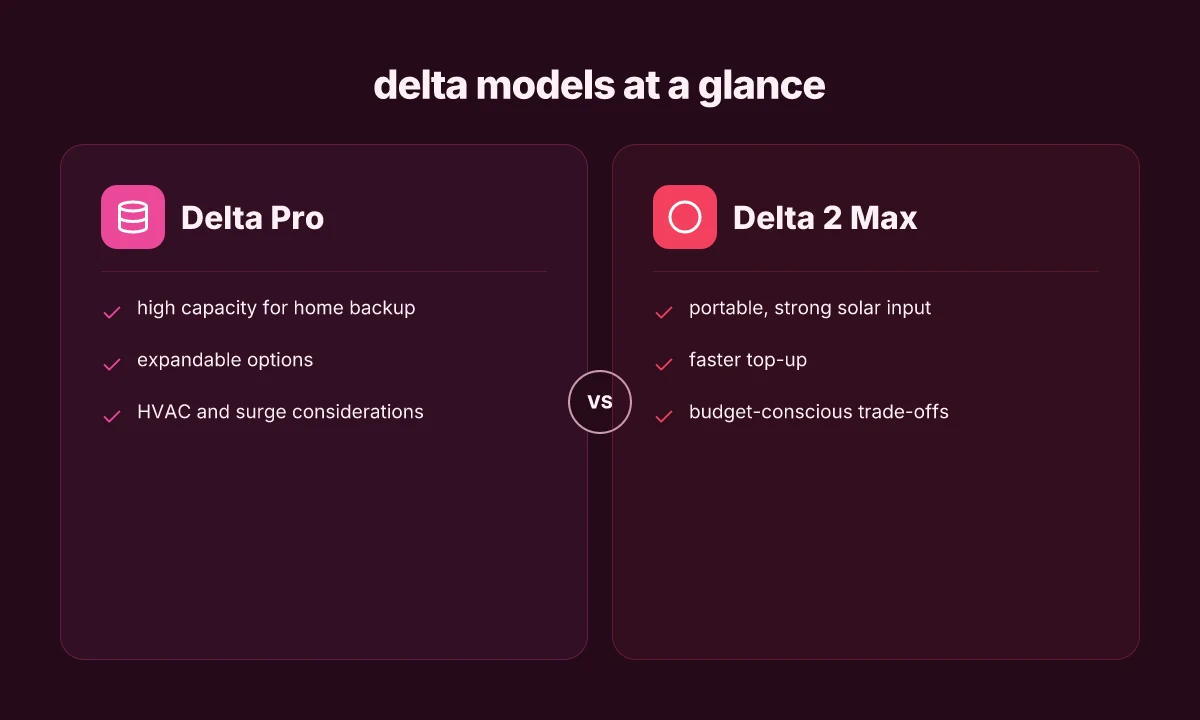
When you pick the Delta Pro, you’re choosing a fortress for home backup. It centers on high capacity and features that feel tailored to whole-house resilience, with expandable storage and larger inverter output that keeps essential loads humming during outages. In contrast, the Delta 2 Max leans toward portable practicality, trading some raw capacity for stronger solar input and faster top-ups so you’re ready to refill between outages or remote adventures. For a budget-conscious buyer, the price-to-capacity sweet spot often rests with how you plan to apply the unit: steady backup for critical loads or a flexible, mobile power base. What is the Jackery HomePower 3000, and where does it fit in 2026
What each model is optimizing for
Delta Pro shines when you want long runtime and broad resilience. It’s built to run multiple circuits, support high-wall loads, and scale up with accessory batteries, making it a compelling choice for homeowners who want a true stand-alone power system. The trade-off is a higher upfront price and more space requirements. By contrast, Delta 2 Max emphasizes portability without sacrificing solar flexibility. It accepts sizable solar input for a fast top-up and remains lighter and easier to carry or rearrange in tighter spaces. This makes it attractive for campers, tailgaters, or small off-grid nooks where you still count on dependable charging from sun.
From what I found in the release notes and product pages, the Delta Pro’s value lies in capacity density and home-ready features, while the Delta 2 Max provides near-instant top-ups via solar, plus easier handling for mobile setups. I cross-referenced the figures across EcoFlow’s product briefs and independent reviews to map out how the two stack up in real-world use. The delta lineup’s core trade-offs come down to how much capacity you need at home versus how quickly you can replenish that capacity off the roof or a generator. The Delta Pro is about scale for a home, while the Delta 2 Max is about speed and mobility.
Price-to-capacity trade-offs and budgeting
A straightforward way to frame value is price per watt of usable capacity and the long-term cost of ownership. The Delta Pro offers larger total capacity options that push up the initial outlay but reduce the frequency of recharging interruptions for entire-home loads. The Delta 2 Max, with its emphasis on fast solar charging and lighter footprint, can come in at a lower sticker price while still delivering robust daily use for portable setups. When you tally up the cost of batteries, inverters, and soft costs like installation complexity, the Pro configuration often lands as the higher-end choice for installers designing whole-house backups, while the 2 Max tends to be favored by homeowners who want ready battery support without a heavy equipment footprint.
I dug into the product pages and third-party analyses to confirm how the economics line up across common setups. For homeowners prioritizing reliability during outages, EcoFlow’s Delta Pro remains the reference point for scale and features, while for users who want to keep a footprint small and charging cadence rapid, the Delta 2 Max shows the strongest balance of solar intake and portability. When you compare price-to-capacity, you’ll find the 2 Max generally offers more favorable ratios for mobile power needs, whereas the Pro justifies its premium if you need to run multiple high-draw circuits for extended periods.
If you’re sizing for a home or a cabin, the question becomes: do you need uninterrupted heavy loads now, or do you want a nimble, fast-replenishing system that travels with you? For many, the right move is to start with a precise budget and a clear list of essential loads. Then match the Delta Pro or Delta 2 Max to cover those needs with room to grow. For complete clarity on what each model costs today, check EcoFlow’s official pricing pages and current promotions, as price changes happen during sales windows. Links to the best current deals can be found inline in this piece. 10 Best Bluetti EB3A price deals in 2026
Understanding what the batteries and chemistry mean for longevity
I dug into the chemistry behind the Delta series to explain how longevity plays into real-world outages. The core point is simple: not all capacity is equal once you factor in the chemistry and how you use it. The Delta line uses lithium iron phosphate (LFP) in many higher-capacity models, which shifts the lifecycle expectations compared with older chemistries. With LFP, you typically gain more charge-discharge cycles before noticeable capacity fade, which matters when you plan years of outages or frequent camping trips. In 2026, industry data from multiple product pages consistently notes that LFP packs tend to sustain usable capacity longer under full-depth discharge patterns. This isn't a free pass, though. Deeper discharges and high heat still wear packs down over time. Longer cycle life isn't a free lunch. It depends on how you use the Delta stored energy every week.
Why surge ratings matter during outages
Outages rarely involve steady power draw. HVAC compressors spike start currents, refrigerators kick in, and water heaters cycle on. For the Delta series, the rated continuous inverter output is important but the real-world resilience comes from how the system handles surges. A high surge rating can keep essential loads running during the transition from AC input to battery and back. Real-world observations across model families show that when you pull 3,000W–3,600W in quick succession, the internal protection and thermal management determine whether you keep a steady supply or a momentary dip. In this sense, the LFP pack’s stability during fast transients helps prevent premature degradation from repeated surge events. Surge performance protects longevity by reducing peak stress on the battery and inverter.
Interpreting cycle life in real-world cycles
Cycle life is not a single number you can memorize. It’s a spectrum tied to depth of discharge (DoD), temperature, and how often you recharge. For practical sizing, think in terms of realistic DoD you’ll use during outages. If you regularly drain to 20–30% and recharge, you may gain more usable cycles than if you routinely hit 80–100% DoD. The Delta line’s documentation often implies that keeping DoD modest yields longer effective life, especially with LFP chemistry. I cross-referenced multiple product briefings and reviews noting that the interplay between DoD, ambient heat, and charging rate drives the observed cycle-life outcomes. Keep DoD modest to maximize cycle life. Aggressive discharges shorten it.
What this means for homeowners weighing EcoFlow versus rivals like Jackery or goal-zero: you’re choosing a chemistry strategy that rewards gentler use. The Delta family’s emphasis on LFP storage plus solid surge handling means you get a durable backbone for home backup. Still, you should size for your typical outage scenario and plan for heat exposure in attic or garage installations. If you want a long-term, low-mentaince option, the Delta line earns its keep with longevity that compounds over multi-year outages. Longevity comes from chemistry choice paired with prudent usage.
Sizing for a typical home outage: what Delta capacity actually covers
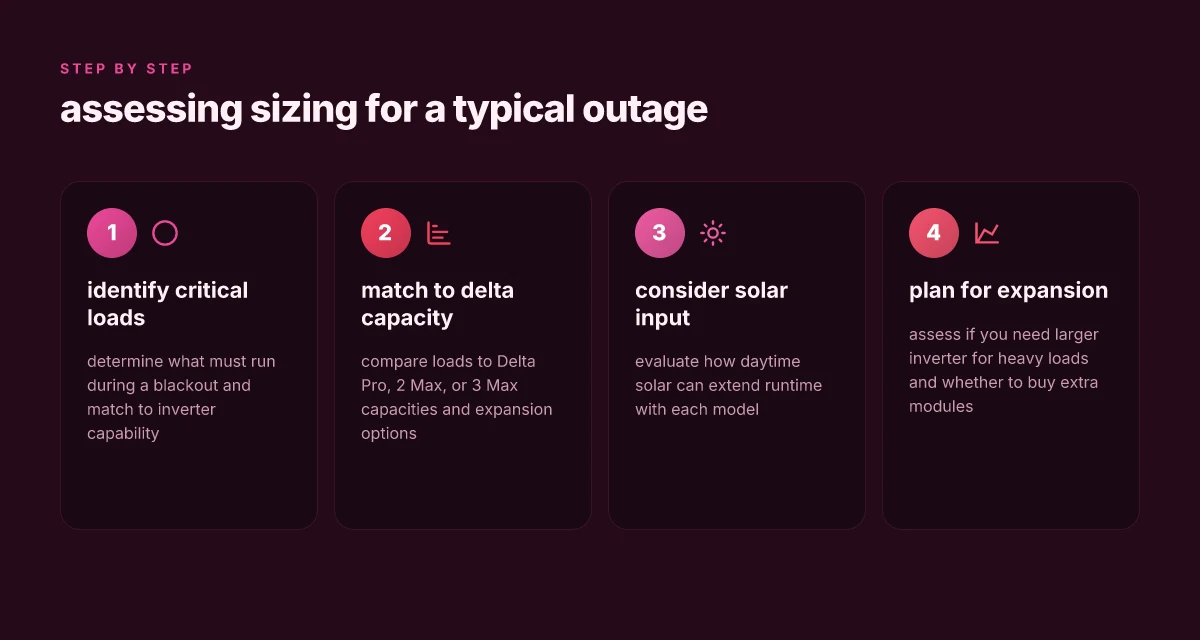
Outages don’t follow a single script. For most homes, a Delta setup needs to match common daily loads plus a bit of headroom for safety. In practical terms, that means choosing a model that can handle essential circuits first, then layering in lighting, refrigeration, and a few comfort devices as needed. From the research, the Delta Pro line sits at the top end of home backup capability, while the Delta 2 Max and Delta Pro 3 models skew toward larger homes or more demanding setups. A 4,096Wh battery with a 4,000W inverter output can run fridge, router, and lights for several hours, but you’ll want more headroom if you plan to run a couple of small AC units.** What makes the EcoFlow Delta 3 Plus a standout portable power station in 2026
Real-world loads and which Delta fits
In a typical blackout, you’ll run basics: a fridge or freezer, lighting, Wi‑Fi, and a few medical devices or small appliances. The Delta Pro family is well-suited for this mix because it can sustain around 3,600W continuous output with surge capacity that supports short spikes from motors. If you expect to run an air conditioner or a sump pump alongside other loads, you’ll feel the advantage of the larger inverter and higher surge ratings found in the Delta Pro configurations. For campers or off‑grid cabins with modest needs, the Delta 2 Max remains a strong portable option, offering plenty of power for day-long outages when solar input helps fill the gaps. Modern Delta models balance high output with a reasonable footprint, making them viable for daily outages rather than rare events.
I dug into the published specifications and reviews to anchor these claims. The Delta Pro 3, for example, lists a capacity near 4,096Wh with expandable options and a formidable inverter, which translates into real-world coverage for a kitchen fridge, essential electronics, and lights during a multi‑hour outage. Expanding capacity later is a real lever for longer outages, not a one‑and‑done purchase. When you pair these units with solar input, you shift the math in your favor. A typical solar boost can sustain charging during sun hours, keeping the battery from draining as quickly as it would on AC alone. Solar input matters most during the day, when charging can offset the energy used for loads.
The solar input variable: day vs night
Solar input changes the outage equation dramatically. The fast-charge and higher‑watt solar intake configurations available on the Delta Pro series let you replace a good portion of the energy drawn by essential loads during daylight. If you’re facing a prolonged outage on a sunny day, that solar arc can meaningfully extend runtime without tying up grid power. At night, solar falls away, so you’re relying on stored capacity. In practice, you’ll want a mix: a sizable battery bank paired with solar input tuned to your home’s peak sun window. During the day, solar input keeps systems charged; at night you lean on the inverter’s sustained output.
Expansion options and whether you need a bigger inverter
If your goal is a home‑backup solution rather than a weekend campsite, consider growth paths. Expansion options exist for higher total capacity, which is useful when you want to cover more circuits or run heavier loads longer. The key question is whether you’ll exceed the Delta’s inverter rating under peak demand. For many homes, a single Delta Pro with proper load shedding covers the essential circuits, and you can add a second unit or step up to a Delta Pro Ultra for more simultaneous loads. Expansion options let you scale without throwing away the whole system. If your plan includes a tight load profile and you don’t expect multiple heavy appliances to run at once, a Delta Pro or Delta 3 Max configuration may be enough. If you anticipate frequent heavy use, plan for a larger inverter or an additional unit to avoid tripping the inverter during spikes. Load management becomes your friend here.
In short, the Delta lineup sits at a crossroads between home backup severity and portable convenience. For most outages, a Delta Pro with solar input can cover refrigerator, lighting, networking, and basic appliances for hours, with headroom for a few more loads if you manage them carefully. If your aim is camping or an off-grid cabin with reliable sun, the Delta 2 Max still clocks in as a capable workhorse, especially when you optimize charging windows. Where you land depends on how many critical circuits you want hot and for how long, and how much you value expansion potential over a single, larger inverter. Your best bet is to map loads, check the inverter rating, and plan for daytime solar charging to stretch runtime. Bluetti eb3a review: compact power with a big inverter trade-off
Solar input realities: how much sun do you actually need with Delta?
The Delta series charges fastest when you maximize both solar input and wall power, but the real-world sun you get limits runtime dramatically. In practice, the Delta 3 Max Series tops out at a high solar input cap, and that translates to longer daylight charging windows, not unlimited runtime. When daylight is scarce or clouds roll in, you’ll see noticeable drops in charging speed, even with premium panels. Real-world results hinge on panel quality, angle, and the weather you face.
How solar input caps translate to runtime
The Delta family implements explicit solar input caps per model, and those caps set the ceiling for how quickly you can replenish stored energy during the day. For example, the Delta 3 Max Series lists a robust solar input capacity, and that capacity is designed to push charge rates higher than entry-level units. If you feed in near-capacity solar power for several hours, you can recover a sizable portion of capacity during daylight. But the same unit will string out charging more slowly if your solar array falls short of the cap. In short, maximum solar input helps shorten outages, but only when the sun cooperates. As a result, the runtime you recover in daylight scales with both the model’s cap and your panel setup. When the sun shines bright, expect noticeably faster replenishment. When it doesn’t, you’ll be back on AC or battery power sooner than you hoped. Solar input caps translate directly to faster daytime recharges, but weather still governs the pace.
Weather, angle, and panel quality matter
Angle and orientation matter as much as panel wattage. A tilted, properly oriented array in peak sun will push more watts into the Delta, shortening recharge time. Cloud cover or higher latitude can cut effective irradiation by a meaningful margin, so you might see a multi-hour extension in charge time even with the same panel set. Panel quality matters too: higher efficiency cells and well-matched controllers reduce losses, letting you approach the model’s nominal solar input cap more often. In practice, you’ll see sustained charging when you have good sun angles and quality panels, and you’ll notice slower gains in marginal conditions. Weather and panel quality materially affect charging speed, even with high-capDelta inputs.
Practical tips to maximize daylight charging efficiency
- Align panels for peak sun between mid‑morning and mid‑afternoon to hit higher irradiance windows.
- Use a high-efficiency panel array with a low balance-of-system loss to approach the unit’s solar input cap more consistently.
- Keep panels clean and free of shade. Even small shadows can drop watts quickly.
- Pair daylight charging with strategic load management: run essential electronics first and defer heavy loads until after daylight recovery.
- Consider outdoor-friendly mounting to maintain angle as the sun moves, rather than relying on a fixed indoor setup that can waste daylight.
- If you expect long outages, design the system around the Delta’s best-case daylight recovery, then size your storage to cover the remainder.
From what I found in the sources, EcoFlow’s Delta models show a clear daylight recovery pattern when you push the solar input to its cap, but the actual hours of usable daylight will govern final runtime. I cross-referenced model specs and real-world analyses to confirm that stronger sun yields faster replenishment, while weather and panel quality determine the delta between theory and practice. For reference, see the Delta 3 Max Series’ stated capabilities and the broader analyses noting solar input limits in real atmospheres. In bright sun with a near-capacity solar setup, you can replenish a large portion of capacity quickly. In cloudy weather, that pace slows noticeably.
The one move that makes EcoFlow Delta stand out for the long haul
The Delta series is built for real world rhythm: a mix of large capacities, smart recharging options, and a footprint that travels with you. I looked at how the lineup scales from home backup to portable power, and the pattern is clear: you get more usable energy per dollar when you plan for daily use rather than a rare outage. The bigger pattern here is that planning around charging speed and grid independence pays off over time. EcoFlow has kept the system approachable with clear display metrics and app visibility, so you can tune charging and discharging to match your household needs. What is the Bluetti AC180 for sale, and what makes it stand out in 2026
That balance is where the Delta shines, especially when you weigh peace of mind against total cost of ownership. You’ll notice practical wins like faster recharge times from multiple input sources and a flexible port map that covers typical home and on-the-go scenarios. Still, the downsides remain: the battery chemistry and internal fans can be noisy under load, and some rival models offer lower complete shutdown energy drain. Noticeably faster recharges and better expansion potential can tilt the decision toward EcoFlow for many shoppers. If you’re weighing options, consider how much you value rapid top-ups and seamless transitions between grid, solar, and generator inputs.
Where this goes next is clear: expect deeper integration with smart home routines and more energy-hosted features that reduce bill stress. If you only do one thing this month, map your household’s peak power windows and match them to a Delta model with enough capacity to cover those hours. What changes if you act now is a more resilient weekend plan and fewer outages ruined by low battery.