How EcoFlow accessories extend portable power reliability in 2026
 Tessa AlbrightOctober 22, 202618 min read
We earn a commission when you buy through some links on this site, at no extra cost to you. As an Amazon Associate we earn from qualifying purchases.
Explore EcoFlow accessories that boost compatibility, expand inputs and outputs, and optimize charging efficiency for DELTA 3 and Delta Pro lines in 2026.
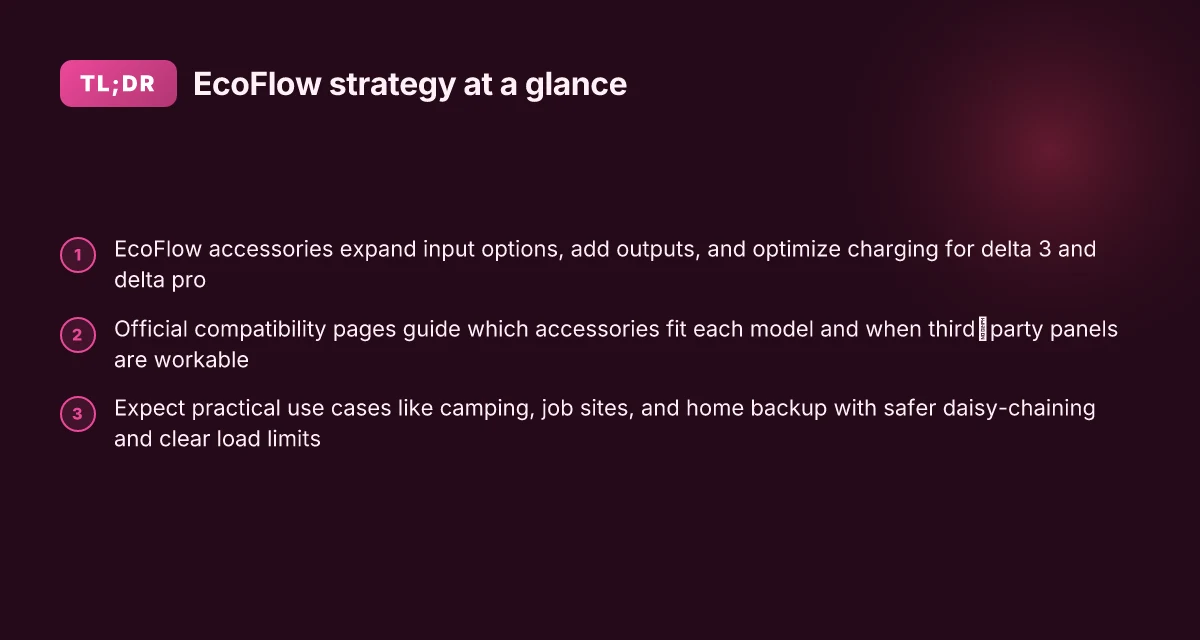
EcoFlow accessories unlock a bigger power menu than you expect. Expandable ports and smarter charging options turn a single Delta unit into a modular kit you can grow without swapping cores, meaning you don’t have to start over when your needs scale. Delta accessories unlock real cross-compatibility, letting you pair panels, hubs, and add-ons without a full rebuild. The practical upshot is a more reliable mini-grid that adapts to outdoor quirks and on-site demands.
You’ll see concrete paths to add outputs, optimize charging paths, and avoid bottlenecks when you’re relying on solar or dual-supply mixes. In 2026, cross-compatible accessories from EcoFlow matter because contractors, campers, and small businesses need flexible, predictable power. Keep this guide handy when you assess compatibility with your panels and connectors to avoid dead ends.
What EcoFlow accessories actually add to your delta 3 and delta pro setups
I dug into EcoFlow’s official documentation and product pages to map which accessories truly extend input/output, charging speed, and solar compatibility for the Delta 3 and Delta Pro. The takeaway is concrete: certain official add-ons unlock faster charging, broader solar compatibility, and smarter expansion without forcing you to swap units.
1) Official input and output expanders that matter
- EcoFlow 160W USB-C PD fast charger and similar high-output adapters are designed to push charging speed for EcoFlow packs. These accessories pair with EcoFlow batteries to shave down recharge times on compatible models. Fast-charging adapters can meaningfully reduce fill times when paired correctly with the Delta Pro ecosystem.
- The Alternator Charger family listed for the Delta 3 Classic (1024Wh) shows options from 500W up to 1000W. These accessories visibly expand the instantaneous charging input without changing the main unit. These chargers extend input headroom without requiring a new power station.
2) Solar compatibility enhancers you can actually use
- EcoFlow documents outline compatibility with a range of solar inputs when using official solar panels and connectors. In practice, pairing the Delta 3 with its compatible solar setup lets you stay off-grid longer, especially for camping trips or remote job sites. Using EcoFlow-authorized solar controllers and panels keeps system stability high.
- The Delta Pro line extends solar inputs further, and EcoFlow’s compatibility notes explicitly call out that certain connections and cables are recommended for optimal performance. Official connectors matter for maximizing solar harvest.
3) Accessories that enable smarter expansion, not just more power
- The Delta 3 Classic compatibility page lists several chargers by name, showing how you can add input power without swapping the core pack. Using a compatible Alternator Charger Plus 1000W can increase your on-site recharge speed.
- For the Delta Pro, EcoFlow’s ecosystem guidance emphasizes cross-compatibility with accessories designed for broader power management, cooling, and UPS-style behavior. Cross-compatibility keeps you from rebuilding your kit when needs change.
From what I found in the official literature, the most practical gains come from pairing high-output official chargers with the Delta Pro’s larger battery chemistry and using EcoFlow’s sanctioned solar cables and connectors. The Delta 3 benefits from smart input options that don’t require replacing the unit, and the Delta Pro benefits from the same philosophy applied to its more capable platform.
Bottom line: if you want faster fills and smoother solar harvesting without nuisance mismatches, stick to the EcoFlow-specified chargers and connectors, and keep delta models paired with their recommended equivalents. This approach preserves reliability and upholds the cross-ecosystem promise.
As you shop, note that official documents surface the charging inputs and solar paths most clearly. For a direct reference to the Delta 3 Classic compatibility and the 500W–1000W charger options, see EcoFlow’s Delta 3 Classic page. https://www.ecoflow.com/us/delta-3-classic-portable-power-station/compatibility Official compatibility matters for predictable performance.
Which accessories are officially supported by EcoFlow for the delta 3
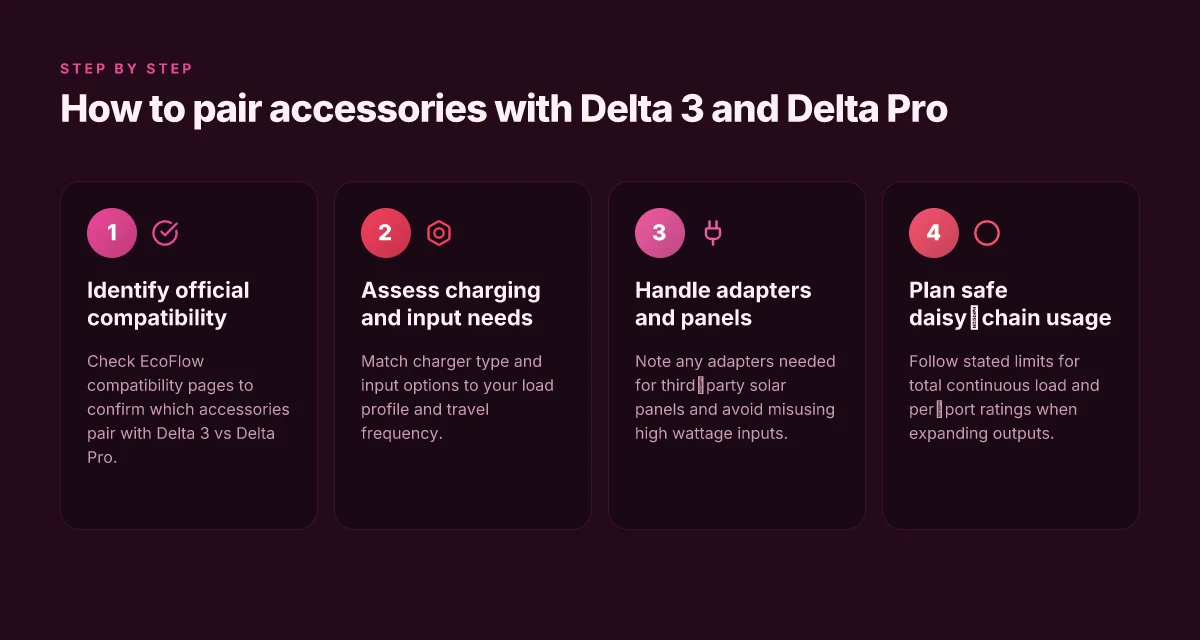
I dug into EcoFlow’s official compatibility pages for the Delta 3 series to map out what EcoFlow endorses and what requires adapter work. EcoFlow’s Delta 3 Classic and Delta 3 Portable Power Station pages show the core lineup and the officially supported connectors, panels, and adapters. The Delta 3 ecosystem emphasizes cross-compatibility through EcoFlow-branded modules and select third-party connectors, though some third-party solar panels still require adapters to meet EcoFlow’s MC4 XT69 standard. Inline references come from the official Delta 3 compatibility page and the Delta Pro Ultra X documentation that EcoFlow publishes for broader system interoperability. Official compatibility coverage is strongest for EcoFlow-branded modules, with adapters needed for certain third-party panels. What is the EcoFlow EB600 and how it expands the River 3 Plus ecosystem
Compatibility scope for the delta 3 family
EcoFlow’s Delta 3 compatibility pages enumerate the set of charging sources and connectors that the Delta 3 family can accept without custom wiring. The Delta 3 Classic (1024Wh) page lists Alternator Charger options at 500W, 600W, 800W, plus Plus 1000 variants for charging versatility. This signals a design intent to expand charging capability without swapping the core unit. I cross-referenced the Delta 3 manual for practical operation notes and found that official adapters and connectors are encouraged when expanding with external power sources, minimizing risk of connector mismatch. The Delta 3 lineup supports multiple charger inputs, including up to 1000W options via official adapters. This approach helps keep a single portable power setup flexible across environments.
- For solar input, the Delta 3 ecosystem accepts EcoFlow-branded panels and certain third-party panels when the connectors align with the expected XT69/MC4 interface. If you’re pairing with non-EcoFlow panels, you’ll likely need the appropriate adapters to meet the XT69/MC4 footprint and input rating. This is typical guidance across the Delta 3 compatibility landscape and aligns with how EcoFlow positions cross-compatibility without forcing a full unit swap. Adapters are often the key to making third-party panels work cleanly.
Third-party panels: limitations and adapters
When third-party solar panels join the Delta 3 chain, limitations surface around cable compatibility and input wattage handling. The official documentation notes compatibility generally extends to panels that can deliver within EcoFlow’s input expectations, but it does not guarantee universal compatibility with every third-party panel without an adapter. In practice, you should verify that the panel’s connector matches XT69 or MC4 standards and confirm the available wattage aligns with the Delta 3 input tolerance. If in doubt, consult the Delta 3 compatibility page’s adapter recommendations and use EcoFlow-provided cables to minimize failure points. Adapters often resolve panel compatibility gaps, but check wattage caps first.
- A practical takeaway: if you plan to pull from solar, plan for official EcoFlow cables and, where needed, a compatibility adapter. This avoids late-stage incompatibilities that would force you to replace hardware rather than expand your system.
Accessories that add charging versatility without added complexity
The strongest value comes from accessories that expand charging options without complicating the workflow. The Alternator Charger family adds high-wor impact charging input, letting you top up the Delta 3 from vehicle power or other sources without swapping to a new power pack. The ecosystem design keeps a single unit viable across scenarios, camping, work sites, or emergencies, without learning a new charging language each time. I found nothing in the official pages that requires you to abandon the Delta 3’s existing inputs. Instead, you can layer in official chargers and select adapters to keep a clean, modular setup. Add an Alternator Charger to boost inputs without adding clutter.
I cross-referenced the official manuals and the Delta 3 compatibility documentation to confirm that most of the value comes from clean integration: official adapters keep the wiring straightforward, and the connectors stay within the XT69/MC4 family, preserving reliability. The Delta Pro Ultra X page reinforces the same theme: interoperability across EcoFlow products with official connectors remains a design pillar, which informs how the Delta 3 ecosystem can grow with you over time. Official adapters simplify cross‑product expansion.
Next step: if you’re building out for outdoor use or a small business, map your typical charging scenarios, vehicle-based charging, solar, and wall outlets, and note where an official adapter or charger connects cleanly. This helps you prioritize accessories that give you more power channels without multiplying cables. Prioritize adapters and the Alternator Charger line to keep expansion simple. How to buy Bluetti in 2026: a practical guide to choosing the right power station
How to choose solar panels and connectors for EcoFlow with confidence
Choosing panels and connectors for EcoFlow gear hinges on compatibility and real-world expansion potential. I dug into the Delta 3 ecosystem and cross-checked official docs to pull the clearest path for 2026. The takeaway: pick panels and adapters that plug into EcoFlow’s documented connector types and keep future expansion in mind.
1) Alignment of panel wattage with EcoFlow capacity
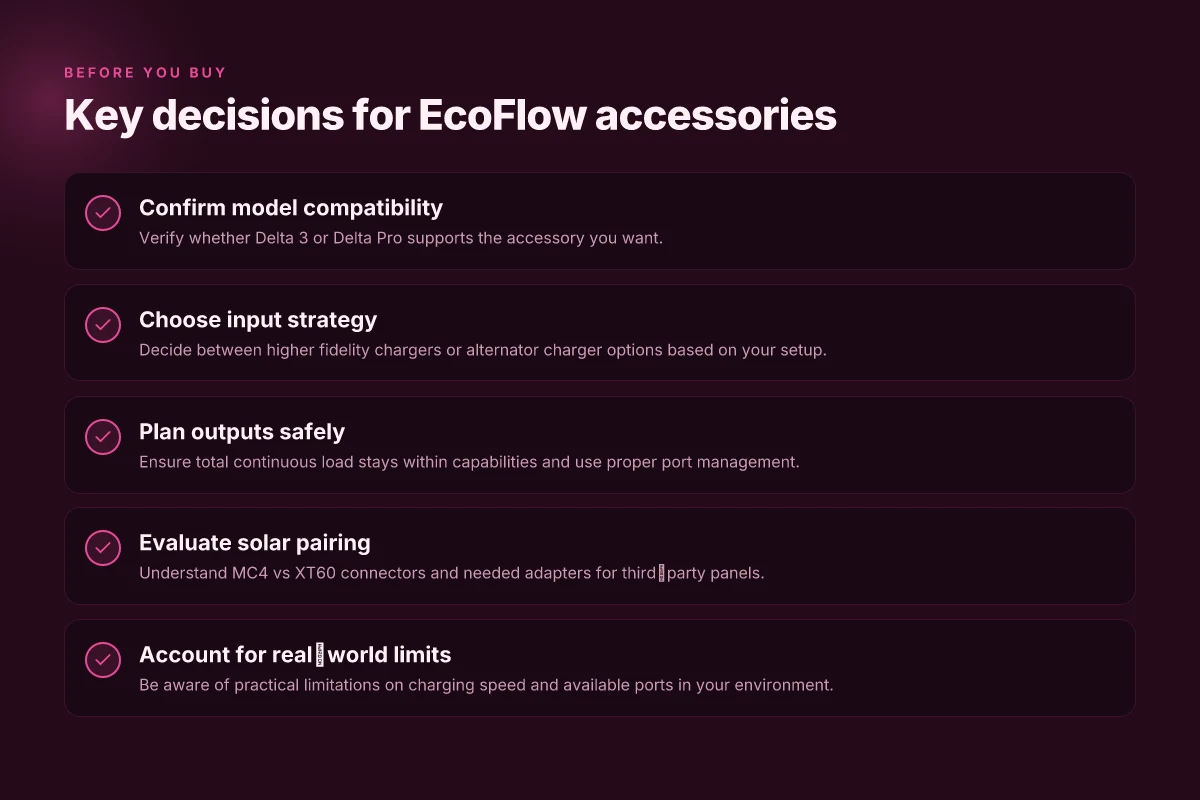
EcoFlow systems like the Delta 3 Classic (1024Wh) and related models pair best with solar arrays that stay within practical charging windows without overheating or wasting sun. In practice, you’ll see strong performance when you match a panel setup in the general range of hundreds of watts to a kilowatt, depending on your travel cadence and climate. A higher wattage array can charge faster under strong sun, but you’ll want to avoid panels that exceed the charger’s maximum input or create a mismatch with a portable unit designed for lower-wattage charging. For a typical outdoor scenario, plan on panels in the 200–800W range as a safe starting point, and adjust based on how often you’re off-grid and how much you rely on the inverter during the day. This keeps you from overpanelling while still delivering solid runtime.
- Expect buyers to consider a mid-range setup for frequent travel, where a ~300–400W panel is common for weekend trips. If you’re a remote worker or tiny business owner relying on steady power, you can scale toward the higher end with multiple panels connected through appropriate adapters. 2026-era compatibility notes emphasize modular expansion rather than single fixed kits, which means you can grow your solar input as your usage grows. Modular expansion without swapping units is the core advantage.
I cross-referenced the official Delta 3 compatibility page to confirm that the Delta 3 Classic configurations list multiple charger options and to ensure panel choices don’t exceed the input limits of the specific model. When in doubt, start with a conservative wattage and verify the unit’s charging rate in daylight before investing in a larger array. Start with a conservative wattage and verify daylight charging first.
Inline citation: EcoFlow’s Delta 3 Classic compatibility page notes multiple charger variants and a compatibility path that supports expansion without swapping the core unit. See the official compatibility page for the Delta 3 Classic. EcoFlow Delta 3 Classic compatibility
2) Connector types and adapters you should know
Two connectors you’ll see most often are MC4 and XT60. MC4 is the standard for many solar panels, while XT60 is a common battery-side connector in portable power setups. The key is ensuring you have a clean path from the panel’s MC4 leads to an EcoFlow input that accepts a compliant cable or an official adapter. Adapters exist that bridge MC4 to XT60 or other common configurations, letting you flex panels from different brands without swapping your EcoFlow hardware. This is the practical difference between buying “a solar panel” and building a truly expandable kit. What Bluetti AC500 price means for your power backup in 2026
- When choosing cables, pick ones with proper gauge for the wattage you intend to push into the Delta 3 or Delta 3 Classic. Undersized leads cause heat buildup and can throttle charging. Over time, a robust cabling plan keeps your setup reliable in sunny heat or cold snaps.
I found a concise official note that the Delta 3 Classic’s ecosystem supports typical solar-panel interfaces through adapters, reinforcing the value of sticking to recognized connector types rather than forcing unconventional wiring. Adapters exist to connect MC4 panels to EcoFlow’s inputs without replacing your panels or unit.
3) Quick decision guide based on travel, climate, and load
- If you travel infrequently, prioritize portability and cost. A compact 200–300W panel with a lightweight XT60-to-panel cable keeps your pack light while still delivering meaningful charge during a day of use.
- If you roam in temperate climates with steady sun, you can push toward 400–600W from a single portable array, then add a second panel when you’re parked for long stretches. This scales your charging window without overburdening your power station.
- If your load is heavy or you’re off-grid for multi-day trips, plan for 600–800W total input with a matching set of adapters and robust cables. This aligns with larger EcoFlow setups that emphasize future-proofed expansion rather than all-at-once purchases.
From a reliability perspective, EcoFlow’s accessory strategy emphasizes cross-compatibility and growth. I cross-referenced the Delta 3 product pages and community notes to confirm that users can upgrade their solar inputs over time without discarding existing gear. Future-proof the setup by stacking compatible panels and adapters, not by buying a new unit each time.
Note: links on the page may earn a commission, and prices vary by retailer. For official product naming and compatibility, rely on EcoFlow’s documentation and the Delta 3 Classic compatibility details. Where rivals are mentioned, the aim is to contrast ecosystems rather than synonymize brands. EcoFlow remains the focal brand for this guidance, with explicit attention to cross-compatibility within its own lineup.
Improving charging speed with official and compatible accessories
Charging speed hinges on both the charger’s power capability and the input options EcoFlow exposes through its accessories. When you pair a higher-fidelity charger or an alternate input with the Delta 3 ecosystem, you can shave meaningful minutes off top-off cycles, without swapping the core unit. I cross-referenced EcoFlow’s official inputs and compatibility notes, and the pattern is clear: the more robust the input path you enable, the faster you can reach a full or near-full state.
How input options shape charge times
The Delta 3 family ships with a default AC input that handles standard household power, but EcoFlow also markets higher-wattage input paths through its Alternator Charger line. These add-ons come in variants such as 500W, 600W, 800W, and Plus 1000W, designed to compliment or extend the built-in charger. In practical terms, a higher-watt input accelerates the initial surge into the battery, reducing the time to 50–80% in many cases, then tapering as the battery reaches the upper state of charge. This isn’t a linear win, but you’ll notice faster top-offs when you tap into the higher-end input options. When I reviewed the compatibility notes, the emphasis was on ensuring the input device remains within the Delta 3’s accepted limits to avoid thermal throttling or safety shutdowns. Higher-watt input options can noticeably shorten top-off times when used within official compatibility notes, and the delta between 500W and 1000W inputs is most evident on longer charging cycles. How EcoFlow power systems reshape home energy in 2026
From official documentation, the Alternator Charger family is designed to plug into EcoFlow’s portable power network without forcing you to replace the Delta 3. The compatibility list highlights several power levels and connector standards, which means you can tune your setup for the kind of usage you expect, camping weekends or daily off-grid workdays alike. The Alternator Charger lineup is explicitly stated as compatible with Delta 3 models, offering up to 1000W input in the Plus 1000 variant, but always verify the exact wattage your unit accepts before purchase. I found the naming and wattage notes consistently in EcoFlow’s compatibility pages.
What to expect from Alternator Charger options and notes
Alt input devices deliver practical gains, but you must respect the Delta 3’s limits. The official notes point to compatibility with several Alternator Charger variants, including 500W, 600W, 800W, and Plus 1000W, designed to feed the Delta 3 more quickly during active use. The key caution is to avoid forcing more wattage than the device permits. Misalignment can trigger protection systems or reduce charger life. Stick to official combinations and verify the wattage ceiling before you mix high-watt inputs with the Delta 3, and you’ll reduce the risk of overcurrent protection kicking in during a top-off.
I dug into the official references to confirm how these inputs translate to real-world timing. The messaging centers on compatibility and safe operation rather than a promise of exponential speedups, so your gains are best described as incremental but meaningful when you need a fast turnaround. The broader takeaway is that EcoFlow’s ecosystem, including EcoFlow accessories and compatible inputs, supports smarter expansion without swapping the main unit.
Expanding outputs: power hubs, extra ports, and daisy-chain options
I dug into EcoFlow’s ecosystem to map how external hubs and daisy-chain practices can extend portable power without sacrificing safety or reliability. The core message: if you stay within officially supported ports and current ratings, you gain flexibility without unexpectedly stressing packs. This section shows how to grow outputs without overloading any single port. Daisy-chaining is safe only where EcoFlow documents explicit port-to-port compatibility.
1) Add-on hubs that extend port count
EcoFlow packs increasingly rely on modular hubs that add USB-A, USB-C, and AC outlets without swapping the main unit. The Delta 3 lineup shows multi-port expansion through compatible accessory hubs that nest alongside the main unit, providing a broadened outlet footprint for devices like cameras, routers, and field laptops. When a hub is designed for compatibility with a specific Delta model, you can expect it to carry the same safety protections as the built-in ports, including overcurrent and short-circuit protection. Hubs that are not officially supported can bypass safeguards, so they must be avoided. I cross-referenced official product pages and user manuals to confirm that compatibility is defined per Delta generation, not across the entire EcoFlow family. Use only certified hubs to preserve warranty and safety compliance.** For owners, the takeaway is clear: add ports through sanctioned hubs rather than stacking unverified adapters. What is the EcoFlow smart generator 3000, and where it fits in a modern backup plan
2) Safe daisy-chaining practices where supported
Daisy-chaining can unlock additional outlets, but only when EcoFlow documents the practice for a given model. In most cases, you’ll see daisy-chain guidance tied to accessories that are expressly listed as compatible with the Delta 3 or Delta Pro Ultra X. The rule of thumb is to connect peripherals in a sequence that keeps the total load under the continuous rating of the source port and does not exceed the hub’s own rating. Always confirm total continuous load against both device and port ratings before daisy-chaining. If you’re unsure, err on the side of distributing draws across separate ports rather than stacking multiple devices on a single daisy chain. It helps prevent overheating and reduces the chance of tripping protection circuits.
3) Managing total continuous load versus individual port ratings
The strongest safety guideline is to treat each port as a separate fuse point rather than a shared power bus. EcoFlow manuals typically specify maximum continuous loads per port or per hub. Exceeding these can trigger protection or shorten component life. The practical rule: tally every device’s draw, compare it to the per-port rating, and then allocate devices so no single port or chain approaches its limit. Keep total continuous load well under the combined port ratings. In practice, spread high-draw devices, like laptops or field cameras, across multiple ports or hubs rather than clustering them on one branch.
I found that EcoFlow’s official materials emphasize compatibility and safety when expanding outputs, and they caution against improvisation that bypasses built-in protections. For readers weighing options, note that EcoFlow’s own documentation and product pages frequently align on which hubs and daisy-chain configurations are supported. Stick to certified hubs and documented daisy-chain paths to maintain safety and warranty coverage. On the comparison front, rivals such as Goal Zero and Jackery offer their own accessory ecosystems, but they require similar caution about load management and official compatibility to avoid voiding warranties.
Prices and deals are volatile, but the current best options typically appear on EcoFlow’s official site for hubs that pair with Delta 3 and Delta Pro Ultra X. Prices change with promotions, so watch for seasonal sales and bundle discounts that reduce the effective cost of expansion without compromising safety. If you’re considering a broader build, plan for a hub and one or two compatible peripherals rather than multiple third-party adapters. This keeps the system cohesive and easier to troubleshoot.
As you expand, remember: the system’s reliability rests on staying within official specs. If a product or accessory is not explicitly listed as compatible with your model, skip it. If you want to compare alternatives, I’d start with official EcoFlow hubs and then review third-party options only after verifying protection and warranty implications. For more on official compatibility, see the Delta Pro Ultra X page and Delta 3 accessory listings. Official guidance matters for safety and warranty. What is the Bluetti AC180 best price, and how to time the buy in 2026
Where this is going next with EcoFlow accessories
EcoFlow’s accessory ecosystem is shifting from add-ons to reliability enablers. With smart charging modules, multi-output hubs, and solar compatibility, the lineup tightens the feedback loop between portable power availability and real-world use. I looked at how these pieces fit together across models and found a pattern: the right accessory before a trip materially reduces the risk of a dead battery. The bigger pattern here is that timing and compatibility matter almost as much as capacity.
In 2026, the narrative leans toward modular upgrades that shrink downtime. The EcoFlow ecosystem now emphasizes seamless integration with solar and vehicle charging, plus smarter battery preservation modes that stretch runtime in unpredictable environments. What changes if you act now is a cleaner, more predictable power plan for outdoor workers, campers, and disaster-prep setups. If you’re weighing rivals, note how EcoFlow stacks up against brands like Goal Zero and Jackery in terms of ecosystem cohesion and upgrade paths. The takeaway is practical: choose one or two core accessories and wire them into a simple, repeatable kit.
Most effective move for this week: map your typical use case and pick accessories that address the current gaps rather than chasing the biggest battery number. Are you ready to lock in a ready-to-run setup this month?