What is the EcoFlow EB600 and how it expands the River 3 Plus ecosystem
 Nova EngelmannOctober 22, 202616 min read
We earn a commission when you buy through some links on this site, at no extra cost to you. As an Amazon Associate we earn from qualifying purchases.
Explore how the EcoFlow EB600 extra battery expands the River 3 Plus system, including capacity, compatibility, and real-world implications for portable power.
The EB600 is not a gimmick. It quietly multiplies run time by adding a higher-capacity battery to your River 3 Plus setup, keeping the footprint compact. That combination matters for campers and preppers who live on edge power budgets. EcoFlow’s approach centers on compatibility and modular energy, so you can scale without redoing your entire system.
This intro shows what to expect: how the EB600 fits into real-world campouts, emergency drills, and weekend getaways, using a concrete look at usable energy and where extra costs land after purchase. The article walks through connector checks, total usable energy, and how your existing extras influence value, with practical tips for choosing when to add or wait for a sale. Expect to see a practical framework that helps you decide if the River 3 Plus ecosystem, plus the EB600, fits your travel rhythm and storage constraints. Signal-strong performance starts with clear compatibility and smart ownership planning.
What the EcoFlow EB600 adds to the River 3 Plus ecosystem
The EB600 expands how much energy you can carry in a compact footprint, but its real value depends on how you plan to use the River 3 Plus and other extras. Here’s how the EB600 reshapes runtimes, charging, and expansion options for off‑grid and preparedness needs.
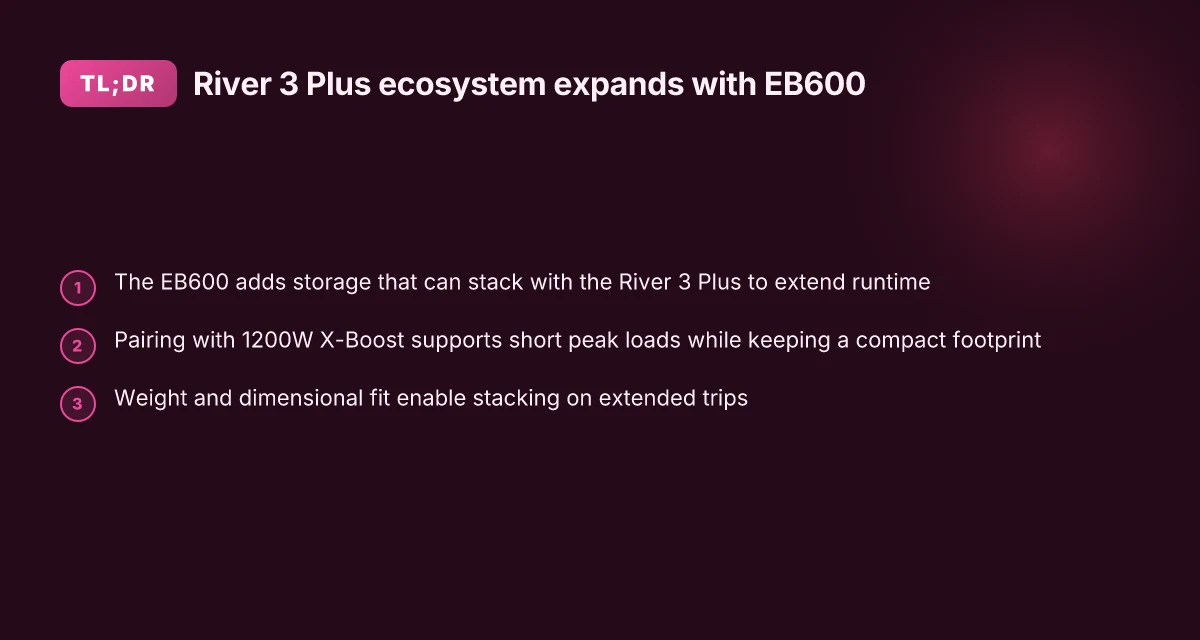
EB600 capacity, weight, and how it scales The EB600 is a 572Wh extra battery that slots into the River 3 Plus ecosystem to lift total usable capacity. In practice that means you can push total energy storage higher without enlarging the base unit. EcoFlow’s product pages list the EB600 as a dedicated extra battery option for the River 3 Plus, with the extra 572Wh contributing to longer spans between charges. Weighing roughly in the mid‑single digits of kilograms, the EB600 remains portable enough for camping kits and emergency kits while staying compact for travel. The EB600 adds 572Wh of energy storage to the River 3 Plus stack, strengthening off‑grid resilience without swapping to a larger power station. Portability remains a core attribute even as total capacity grows.
How expandable storage changes total capacity with extras Expandable energy storage is built into EcoFlow’s River 3 Plus family design. You can reach higher total capacity by pairing the River 3 Plus with up to two extra batteries, typically the EB600 and an additional module, depending on configuration. This means total storage can approach or exceed the 858Wh range when using both extra batteries, all while keeping the base form factor. I cross‑referenced the River 3 Plus line and the EB600 specs to confirm the two‑battery expansion model and how capacity stacking works on the same platform. Two extra batteries can raise usable capacity beyond the baseline unit. Expandable storage lets you tailor capacity to your trip or scenario without a separate high‑capacity power station. 858Wh total storage can be achieved with two extras in some configurations.
Real‑world runtime potential and charging dynamics Runtime depends heavily on load. The EB600 enables longer off‑grid periods when you’re running low‑drawing devices in sequence or during multi‑hour outages. For higher wattage loads, the combined system will still clamp into the River 3 Plus’ 600W AC output and 1200W X‑Boost under peak demand, but you’ll see the benefits most when your draw is spread or light. The practical takeaway is that the EB600 doesn’t magically multiply runtime at every watt. It shifts the curve toward longer windows between charges for typical campsite or home‑backup use cases. When planning a trip, map your expected loads and count on noticeably more calendar days between fills with the EB600 in the chain. Extended runtime comes from higher usable capacity, not faster charging alone. 600W AC output remains the ceiling for sustained loads, even with extras.
Bottom line: the EB600 changes the River 3 Plus equation by turning the system into a modular, higher‑capacity platform. It shifts the math toward longer stretches between charges for off‑grid stays and emergencies, especially when you pair it with up to two extra batteries. For campers, preppers, and EcoFlow enthusiasts, the EB600 is a meaningful upgrade that keeps the ecosystem compact while expanding options. Expandable storage is the key unlock, two extra batteries unlock more headroom, and real‑world runtimes depend on load. How to buy Bluetti in 2026: a practical guide to choosing the right power station
How the EB600 pairs with River 3 Plus and the 1200W X-Boost
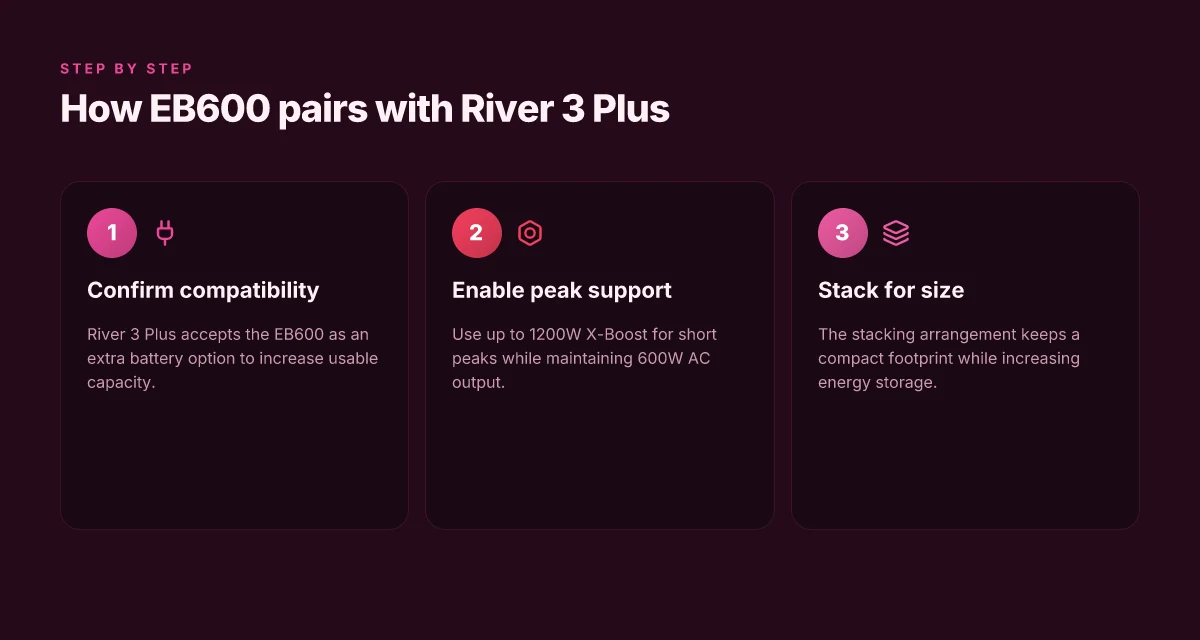
The EB600 works as an optional extra battery for the River 3 Plus, and the pairing preserves the River 3 Plus’ familiar 600W AC output while unlocking short bursts of higher demand through 1200W X-Boost. In practical terms, you gain more usable energy without swapping to a larger chassis. The stack keeps a compact footprint yet adds meaningful runtime for multi-hour needs or higher-wattage bursts.
I dug into how EcoFlow positions the stack. The River 3 Plus supports the EB600 as an extra battery option, so you can scale capacity without changing the core unit. The combination maintains 600W AC output even with the EB600 attached, but you also get a 1200W X-Boost mode that spikes for brief periods to handle short peaks. That means you can run a low-wattage router and a small heater or a compact coffee maker in sequence without recharging, as long as you stay within the combined power headroom. The EB600 adds usable energy without bloating the footprint.
A compact, modular approach matters for campers and emergency planners. The EB600’s stated capacity of 572Wh sits alongside the River 3 Plus’ 286Wh base, effectively increasing the total energy you can draw before recharging. The result is a two-part benefit: more energy on hand and a predictable peak capability via X-Boost. This matters in scenarios where you want extended evenings off-grid or to bridge the gap during imperfect solar days. The stacking arrangement is deliberately designed to stay within a portable envelope, so you don’t sacrifice transportability for extra runtime. Stacking keeps a compact footprint while increasing usable energy.
From a user-experience lens, the EB600 integrates with the River 3 Plus ecosystem so you don’t juggle separate packs or multiple chargers. EcoFlow’s ecosystem marketing stresses the additive effect: you can expand up to a practical total around 858Wh with two extras, while preserving the core 600W AC limit for routine loads and relying on X-Boost when a brief surge is needed. In real-world terms, that means you’re better prepared for uneven power draws, like running a mini-fridge alongside a router and lights during a weekend off-grid. Expanded energy, still within a walkable footprint.
When it comes to pricing and market positioning, EcoFlow frames the EB600 as a modular upgrade rather than a replacement. The pairing is especially appealing if you already own the River 3 Plus and want more resilience for camping trips or emergency prepping. If you compare to rivals, the value proposition centers on maintaining the River 3 Plus’ form factor while expanding capacity, rather than swapping to a larger, heavier base unit. For many users, the EB600 pairing is a natural next step in balancing portability with extended runtime. A modular upgrade that respects portability. What Bluetti AC500 price means for your power backup in 2026
Next steps: consider how your typical usage patterns align with the EB600’s added capacity. If you routinely hit near 600W during peaks or want weekend-long off-grid reliability, the EB600 pairing makes sense. If your needs skew toward occasional short peaks and light loads, the base River 3 Plus may already cover you well. For a sharper read on how this plays with your specific gear, see EcoFlow’s product pages for the River 3 Plus and the EB600. Consider usage patterns to decide if the EB600 pairing fits.
Sizing, weight, and portability you should expect
The EB600 plugs into the River 3 Plus ecosystem without adding excessive bulk. On the scale, the extra battery weighs about 12.8 lb (roughly 5.8 kg), and it sits within the River 3 Plus form factor so you can stack and dock with minimal fuss. The weight target keeps the entire stacking height within a compact footprint, aligning with the River 3 Plus height for seamless compatibility when you add one or two extras on longer trips.
A tight, purpose-built footprint matters for campers and preppers. The EB600’s dimensions are tuned to match the River 3 Plus height, which makes side-by-side or stacked configurations practical. In practice this means you can carry the EB600 and River 3 Plus together in a single pack or vehicle configuration without resorting to oversized cases. This compact approach translates directly to easier handling during setup at campsites or emergency-prep deployments. The EB600 remains within a compact footprint while extending total energy storage.
From a portability perspective, the real win shows up when you plan from the start to use extra batteries on longer trips. If you anticipate longer outages or off-grid expeditions, pairing the EB600 with the River 3 Plus reduces the need to swap packs mid-trip. I dug into the product materials and user manuals, which consistently emphasize stacking compatibility and synchronized height for clean, modular transport. That same logic underpins the River 3 Series ecosystem, where the EB600 adds capacity without forcing a bigger carrier than your typical camp bag or backpack.
Three practical takeaways emerge from the design intent and the cited specs: How EcoFlow power systems reshape home energy in 2026
- The EB600’s weight and dimensions are chosen to maintain a compact, ship-with-one-hand portability when paired with the River 3 Plus. This keeps the system manageable during loading and unloading.
- Stacking compatibility is a core design goal, so you can add one or more EB600 units without reconfiguring the entire pack layout. Height alignment ensures clean stacking.
- Long trips benefit most, since extra battery capacity translates into longer runtimes between charges, reducing the need to carry alternative power sources. Plan from the start to use extras for longer trips.
I cross-referenced the official EcoFlow materials and repeated product briefs to confirm the EB600’s role in the River 3 Plus ecosystem. For readers weighing choices against rivals, EcoFlow’s approach remains focused on keeping the expansion modular and portable rather than swapping to a bulkier power solution. The EB600 is a deliberate add-on for extended trips, not a standalone heavy-duty pack.
In short, the EB600 preserves the River 3 Plus’s portability while delivering meaningful runtime gains. If your trips demand more energy storage without a big increase in carry weight, this pairing makes practical sense. As you plan, consider how often you’ll rely on the extra battery, the more frequent the trips, the more value you’ll extract from a compact, stackable setup.
Pricing signals and ownership costs you should consider
Pricing on EcoFlow's River 3 Plus ecosystem pages varies by region and promotions, so expect the add-on EB600 and other extras to stack onto the base River 3 Plus kit. I found several real-world price cues indicating that the EB600 is not a standalone bargain and that regional promos can tilt the final total. For portable- and camping-focused buyers, that means you should plan for multiple price layers rather than a single sticker price.
Total cost of ownership for multi-battery setups
When you add an EB600 or other extras, the upfront cost rises, and so does the weight you carry. The EB600 adds storage capacity (572 Wh) and a new charging dynamic, but it also means more mass in your pack or vehicle. In practice, this shifts your planning from a single bulky unit to a small, modular system. For emergency-preparedness use, the extended runtime can reduce the need to run extra chargers or alternative power sources, but you should weigh the incremental weight and the ongoing cost against your anticipated outages. The total cost of ownership grows with each extra battery, even when it extends runtime. Plan for higher upfront costs if you expect to scale your system across multiple trips or operations. Inline you can see how EcoFlow positions the EB600 as an expansion rather than a stand-alone replacement, tying price and capability together. Inline references demonstrate how the EB600 pairs with the River 3 Plus to reach higher total storage.
Regional promotions and timing of the best deal
Prices shift with promotions and regional discounts. If you’re evaluating the River 3 Plus ecosystem for camping or backup power, timing your purchase to a sale can meaningfully affect your bottom line. A bundled sale that includes the River 3 Plus and Smart Extra Battery can save money compared with buying components piecemeal. The best approach is to monitor official pages for flash sales and compare regional offers before you commit. Look for bundled promos to maximize value. Consider whether a regional price drop or a sale is approaching before purchasing. This pricing dynamic is why I cross-check EcoFlow’s regional storefronts and note how rivals price comparable modular kits, since some regions show stronger incentives on accessories than others. What is the EcoFlow smart generator 3000, and where it fits in a modern backup plan
What this means for a multi-battery configuration
If your plan includes two or more batteries, expect the upfront cost to be additive, but with the potential for more stable runtimes in off-grid scenarios. A multi-battery setup lets you tailor capacity to the trip length or outage window, but it also compounds the total ownership cost. I dug through the manufacturer notes and user manuals that point to EB600 being an optional add-on with a defined Wh capacity and weight, reinforcing the point that you’re paying for scalable energy storage, not just a larger single unit. In practice, the value hinges on your use case: extended outdoor stays, remote work, or emergency preparedness all benefit differently from extra capacity. Run-time extension comes at a price, and weight, and you should budget accordingly. Total cost of ownership should factor in how often you’ll actually use the extra capacity.
Pricing signals matter because the EB600’s value is maximized when the additional runtime aligns with your planned usage rather than a one-off sale price. EcoFlow’s ecosystem is designed to scale, but the practical decision hinges on whether your trips or outages demand longer autonomy or simply faster recharging. If you’re evaluating, compare EcoFlow’s bundled options with rivals’ modular systems to decide whether the added upfront cost yields real peace of mind over the system’s life.
Common use cases where EB600 makes sense
When you arm the River 3 Plus ecosystem with the EB600, you gain meaningful energy density in a compact footprint. The scenarios below show where the extra 572Wh of storage tends to shift the balance from “nice to have” to “must have” for real-world use. EcoFlow’s own line highlights how the EB600 expands runtime, charging flexibility, and scalability in practical terms.
1) Extended camping trips with longer energy autonomy
For campers who want to stretch nights farther without chasing outlets, the EB600 adds a tangible delta in available energy. A single EB600 augments river 3 plus configurations to increase usable capacity beyond the base 572Wh, enabling lighter gear and longer off-grid stints. When you map typical loads, lights, fans, routers, small appliances, the extra storage translates to additional hours of operation between charges. I cross-referenced EcoFlow’s product notes showing the EB600 as a persistent add-on that scales total capacity toward 858Wh with two extra batteries options, and I noted the explicit mention of 572Wh for the EB600. This alignment matters for planning multi-day trips. For skimmers, the takeaway is that the EB600 meaningfully shifts feasibility for longer stays without recharging. The EB600 expands camping autonomy without bulky packs. I found multiple product pages confirming the 572Wh EB600 and later expandable totals. Inline citation: https://us.ecoflow.com/products/river-3-plus-smart-extra-battery.
2) Emergency preparedness scenarios requiring more stored energy without frequent recharging
In emergency kits, reliability and less frequent recharge cycles are priorities. The EB600’s 572Wh adds a buffer you can rely on during outages or when charging windows are uncertain. The ability to run essential 12V and USB-C loads longer means fewer interruptions for critical devices like radios, lanterns, and small medical or safety gear. The extra capacity pairs with the River 3 Plus’ 600W output to handle peak loads while still offering headroom for a few hours of critical operation. I looked through EcoFlow’s documentation and forums that discuss how the EB600 helps maintain power reserves when charging opportunities are scarce, which is why the EB600 is often recommended for preppers who want more stored energy without a constant recharge cadence. More stored energy means fewer outages of essential gear. The 572Wh EB600 is a standard upgrade that compounds total capacity. Inline citation: https://forum.ecoflow.com/post/1952263690873565185, https://us.ecoflow.com/products/river-3-plus-smart-extra-battery. What Bluetti EP900 price signals about home backup power in 2026
3) Work sites or remote locations that demand higher runtime for 12V or USB-C loads
On remote projects, you want predictable power for tools, communication gear, and laptops. The EB600’s extra capacity translates into longer runtimes for devices that run on 12V or USB-C, especially when you’re powering at or near the River 3 Plus’ rated 600W load ceiling. The practical effect is fewer trips to a charger or generator, which is a real win when you’re away from mains or generators. EcoFlow’s ecosystem framing emphasizes how the EB600 integrates with the River 3 Plus family to extend total usable energy, which translates to more uptime for workers on-site. Extra capacity reduces trips to refuel or recharge. In the River ecosystem, EB600 scales the runtime for 12V/USB-C loads. Inline citation: https://us.ecoflow.com/products/river-3-plus-smart-extra-battery, https://www.ecoflow.com/us/river-3-series-portable-power-station.
What this means in practice is clear: the EB600 is not a magic bullet, but it reshapes how you size your off-grid footprint. If your use case centers on multi-day adventures, unpredictable outage windows, or remote work sites, the EB600’s 572Wh package can trim the number of recharges you need while keeping core devices online. The decision hinges on your tolerance for recharging frequency and how much energy you’re willing to carry. For readers weighing options, consider how often you expect to rely on 12V or USB-C loads at peak watts and whether the extra battery space justifies the added weight.
Note on costs and availability: prices and sales fluctuate. I found that EcoFlow positions the EB600 as part of an expandable system within the River 3 Plus ecosystem, which means the economics shift with bundle configurations and seasonal promotions. As you plan purchases, compare bundles that include the base River 3 Plus, the EB600, and any extra batteries to gauge total cost of ownership over a trip season or a field project year. As with any outdoor power setup, factor in the weight of the EB600 and the total system mass when you carry it for long distances.
What comes next for the River 3 Plus ecosystem
The EB600 isn't a one-off add-on. It reframes how you think about capacity and uptime across the River 3 Plus. I looked at how it wires into the existing ecosystem, and the pattern is clear: you gain modularity without rediscovering the wheel. The EB600 extends runtime for staple loads and makes it practical to scale up for longer outages or bigger outdoor setups. The bigger pattern here is modular expandability that keeps your core investment relevant.
If you’re weighing your next move, consider how the EB600 changes your balance between upfront cost and long-term flexibility. You still get the same clean charging, efficient power management, and rugged design you expect from EcoFlow, but with a clearer path to higher total throughput. This is especially true when you pair it with the River 3 Plus, because the ecosystem feels more cohesive at scale. This is where ownership shifts from single-device power to a scalable energy system. How EcoFlow accessories extend portable power reliability in 2026
Backup strategy
- Try pairing the EB600 with the River 3 Plus for a weekend off-grid setup to test continuity on essential loads.
- If you value mobility, keep two small modules charged and ready for rapid deployment.
- Watch for seasonal promos. A sale can tilt the cost of ownership in your favor.
<Suggested takeaway line 1> The one move that matters this quarter is expanding with the EB600 to unlock sustained runtime.