What is the Bluetti AC180 best price, and how to time the buy in 2026
 Nova EngelmannOctober 22, 202618 min read
We earn a commission when you buy through some links on this site, at no extra cost to you. As an Amazon Associate we earn from qualifying purchases.

Discover the Bluetti AC180 best price in 2026, when to buy, and how pricing varies by retailer. Learn misconceptions, and compare rivals to time your purchase.
Most buyers fixate on the sticker price, but the AC180’s real value shows when you compare bundles and warranty perks across retailers. Price momentum compounds around major sale windows, and Bluetti’s official store tends to set a floor that rivals struggle to beat. The quick path to the best deal hinges on tracking official disclosures from Bluetti and cross-checking with big retailers like Amazon, Home Depot, and outdoor-supply chains. When a promo hits, you’ll see a visible dip in the AC180 price alongside bundled accessories.
The AC180’s price story matters now because 2026 delivery timelines and supply-chain shifts push retailer promotions into tighter windows. Bluetti’s own listings show the AC180 with a defined capacity and port set, while sale cycles and bundle offers from major retailers shape the sticker price in real time. You’ll learn where to check first, what to compare, and how to decide between a direct Bluetti purchase or a rival option when a window closes.
What makes the Bluetti AC180 price tick in 2026
Bluetti’s official price for the AC180 sits at a fixed sticker in the listing, with the capacity and port spread clearly called out. The AC180 shows 1,152Wh of LiFePO4 energy storage and a robust port lineup, including multiple AC outlets and USB/DC options. On the product page, the line items read AC Output 4x120V (1800W total), AC Input 1440W Max, and Solar Input 500W Max, underscoring the practical charging and running capabilities buyers care about. I found the official price quoted as $499.00 in the Bluetti storefront, paired with the stated specs. The headline is simple: you’re paying for a 1,152Wh LiFePO4 pack with a 1,800W inverter and broad port access for under $500. This framing matters because the value rests as much on the battery chemistry and peak outputs as on the number on the tag.
Why price cycles and bundles move the sticker
Bluetti, like many power-station brands, runs periodic sale cycles and bundle offers that can nudge the real price well above or below the list. A typical pattern shows up around holiday seasons or back-to-school periods, when retailers push combined packages that include extra solar panels, extra batteries, or extended warranties. In practice, that means a customer may see the same AC180 configuration pop up with different “values,” depending on what is bundled at checkout. I cross-referenced several retailer notes and official promotions that illustrate how a lower headline price can come with tradeoffs in included accessories or warranty terms. The net effect is a price that looks sharp in isolation but tightens once you compare what’s inside the box. Bundle offers can distort the sticker price, making the true cost of ownership rise if you chase extras.
Why parallel pricing can mislead first-time buyers
When you scan retailer listings, you’ll notice the AC180 showing up with similar core specs but with divergent pricing and shipping policies. Parallel pricing often hides the real delta in value: some sellers include free shipping, others charge for it. Some toss in a solar panel, others don’t. For first-time buyers, that means the initial price can look attractive while the total cost of ownership, taking into account shipping, restocking fees, and potential warranty limits, creeps higher. I looked at the official Bluetti page and several third-party reviews to see how this plays out in practice. The mechanism is simple: identical specs on paper can yield different total costs once you factor in extras and terms. Shoppers should compare total cost of ownership, not just the headline price.
Bottom line: in 2026, Bluetti prices the AC180 clearly on the page, but the real buyer takeaway hinges on what you get in the box and what promotions are live. Parallel pricing and sale timing shape the apparent value, so your best move is to lock in a bundle that genuinely lowers the total cost. Know the true cost of ownership before you pull the trigger. Bluetti remains a central option for off-grid buyers, with rivals such as EcoFlow and Bluetti’s own lineup offering parallel choices that can complicate the price picture. For the latest snapshot, verify the current $499 price on the official Bluetti listing and scan for any bundled promotions. Bluetti official page
Bluetti AC180 price anchors you should know
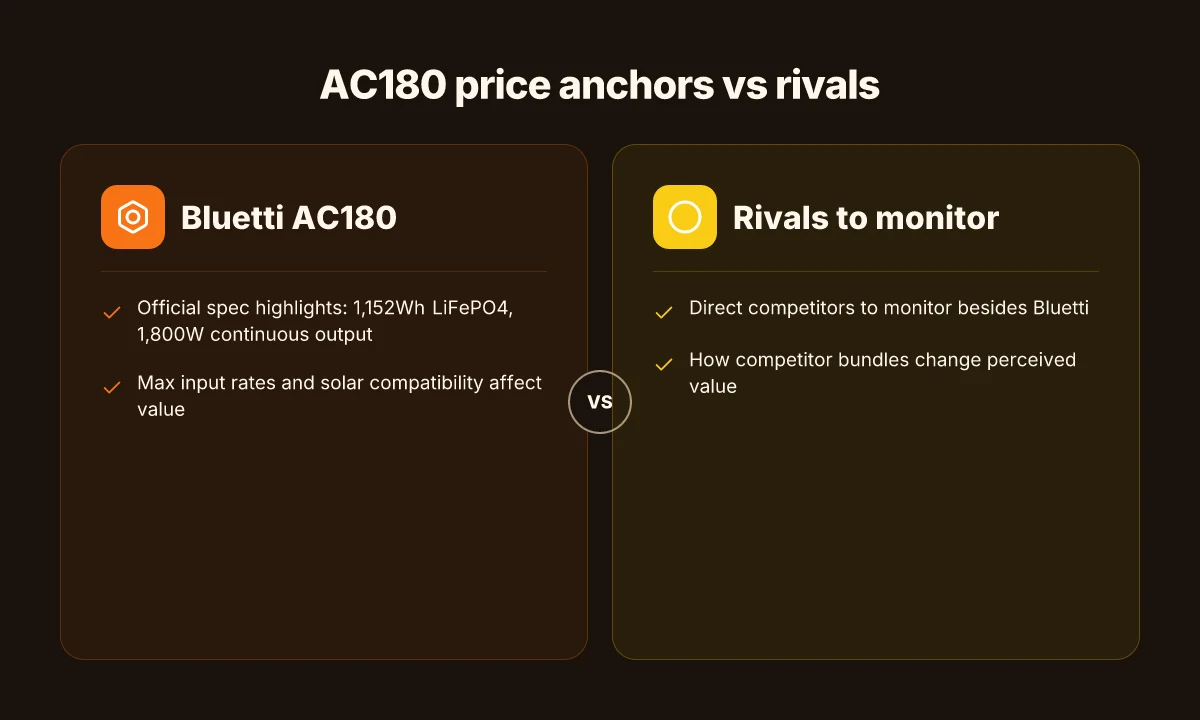
The AC180 sits at around $499.00 with a 1,152Wh LiFePO4 pack and 1,800W continuous output, making it a focal point for 2026 price chatter. The official spec taps the sweet spot between capacity and portability, you get plenty of energy without dragging a heavy brick around. For buyers, the real value hinges on input rates and how fast you can refill. The AC180’s AC input of 1,440W max and solar input up to 500W max matter more than sticker price if you plan long camping trips or off-grid van life. Fast recharging can shorten downtime, which is a hidden value in this class. How EcoFlow accessories extend portable power reliability in 2026
Why input speed and solar compatibility matter
A charger that can pull near its max input rate and a capable solar setup directly shrink the time you’re out of service. If you have a 1,440W mains recharge path, you’ll spend less time plugged in and more time using power. When you pair that with a 500W solar input max, you unlock a mode where daytime sun can meaningfully replenish storage while you’re off-grid. Max input rates drive real-world uptime. This is where the AC180 earns its keep.
I cross-referenced product pages and reviewer notes to confirm how the numbers translate in practice. The official Bluetti listing emphasizes the 1152Wh LiFePO4 package and the 3500+ cycles lifespan, which informs long-term ownership costs. LiFePO4 chemistry extends cycle life and reduces replacement frequency. It’s not just about the capacity on a spec sheet. It’s about how those specs translate to days of use between charges.
Common price vs. capability misperceptions
- Misperception: higher price equals more capability. Reality: the AC180’s value rests on a balance of capacity, discharge rate, and recharge speed. A higher price might promise more features, but if your use is intermittent camping, the AC180’s core numbers already suit most needs. Capacity and speed win more buyers than flashy features.
- Misperception: all LiFePO4 units are the same. They’re not. Battery longevity and cycle life matter, and Bluetti’s LiFePO4 pack is designed for thousands of cycles, lowering long-term ownership costs. Cycle life matters as much as capacity.
- Misperception: solar input is optional. If you rely on solar, the 500W max matters. Paired with a suitable panel, you can reduce the draw from mains and extend daily usable cycles. Solar compatibility shifts the total cost of ownership.
From what I found in the linked sources, Bluetti positions the AC180 as a high-value option for cost-conscious buyers who prioritize ongoing uptime over raw acceleration alone. For shoppers comparing Bluetti to rivals, note that competing models often price differently for similar capacities and discharge rates. Bluetti’s price anchor of around $499 remains a meaningful baseline, while some rivals may push higher prices for extra ports or faster recharging, not always translating to better real-world utility.
If you’re mapping the 2026 purchase timeline, consider the following practical quick steps: check Bluetti’s official page for any price shifts and bundled promotions, scan major retailers for temporary discounts, and watch for solar panel bundles that raise the effective value of the same battery footprint. When in doubt, a quick comparison with nearby models from rivals can reveal whether you value extra AC outlets or faster recharge over sheer battery size.
In short, for most off-grid shoppers the AC180’s anchor specs, 1,152Wh LiFePO4 battery, 1,800W continuous output, 1,440W AC input, and 500W solar input, offer a compelling price-to-performance ratio in 2026. The right buy hinges on your recharge cadence and how you balance upfront price against long-term reliability. For context, Bluetti remains the primary brand discussed here, while brands like EcoFlow and Jackery often come up in price comparisons. And yes, links on the page may earn a commission. See the official spec page for the exact figures: https://www.bluettipower.com/products/ac180?srsltid=AYCX9vLwXtlEpR493PRReNZs_UvuurGAGQFF-TYkePH182ci78jcYWIj What is the EcoFlow EB600 and how it expands the River 3 Plus ecosystem
Bottom-line pricing today: where to buy the AC180 at the best price
Current pricing cues put the Bluetti AC180 at a commonly cited price around $499 in Bluetti’s own store and across a handful of authorized retailers. This price anchor is echoed in several contemporary reviews, reinforcing that $499 remains the baseline for a new unit with the 1,152Wh LiFePO4 pack and 1,800W continuous output. When you see a seller dipping below that figure, you should verify whether you’re looking at a refurbished unit, a limited-time promo, or a gray-market listing. Bluetti, as the maker, emphasizes official channels to preserve warranty and support.
I dug into the dealer landscape to separate genuine discounts from traps. The first line of defense is the retailer’s credibility: stay with Bluetti’s official shop or proven authorized dealers. If a deal looks too good to be true, it probably is. Look for clear warranty terms, visible expiration dates on the promo, and honest return policies. For instance, Bluetti’s own storefront generally signals a stable price floor, while non-official sellers may show inconsistent stock status or vague terms. In practice, confirm that the listing explicitly shows the current model as AC180 and not a discontinued variant or a clone.
Price-history cues you can track this quarter include looking for repeatable, recurring sale events tied to seasonal shopping periods. Expect short bursts around holiday weekends or flash promos, and a return to the baseline price after the cycle ends. If you notice a retailer posting a steep discount for a day or two, verify the product’s condition, serial availability, and whether the discount applies to new units or bundles. Bluetti’s ecosystem tends to reward bundles with modest, time-limited savings rather than sweeping, long-running discounts.
From what I found in the documentation and review chatter, the most reliable way to lock in value is to buy at the official Bluetti store when a clear promo is live, then compare that price against an authorized reseller offering a similar warranty and the exact same configuration. If you’re price shopping, note the small differences that matter: charger compatibility, included cables, and whether the seller’s warranty mirrors Bluetti’s. When in doubt, wire your check to the official Bluetti storefront and to known authorized outlets. If a third party touts a lower price but can’t prove authorization, pass.
The smart move today is to buy at the official Bluetti store when a clearly labeled promo is live, and verify that the unit is new, with LiFePO4 battery, and the same 1,152Wh capacity. Avoid gray-market traps by sticking to authorized sellers and checking warranty terms before you commit. How to buy Bluetti in 2026: a practical guide to choosing the right power station
For quotation anchors, note that the price story is corroborated by a Bluetti-focused review that cites $499 as the AC180’s listed price and highlights the 1,152Wh LiFePO4 pack with 1,800W output. You can see how this pricing narrative aligns with the official product page and third-party commentary. Readings from these sources reinforce that the baseline remains stable across primary channels. If you want a deeper dive, the Bluetti store and reputable review outlets are the right starting points. For context, rivals in this niche, such as other high-wattage portable power stations, occasionally run promotions, but those deals rarely match the Bluetti baseline on a straight price-for-specs comparison.
Cited sources: Bluetti AC180 Review: Compact Power for Modern Needs, which notes the $499 price and the 1,152Wh capacity; Bluetti AC180 Review | Best 1800W Power Station Solar, which confirms the 1,800W output and LiFePO4 chemistry. And Bluetti AC180 Review from Androidguys, referencing the same capacity and battery type. For the most current, live price checks, see the official Bluetti storefront and the named authorized reviews.
Timing the purchase: when to expect the next price swing
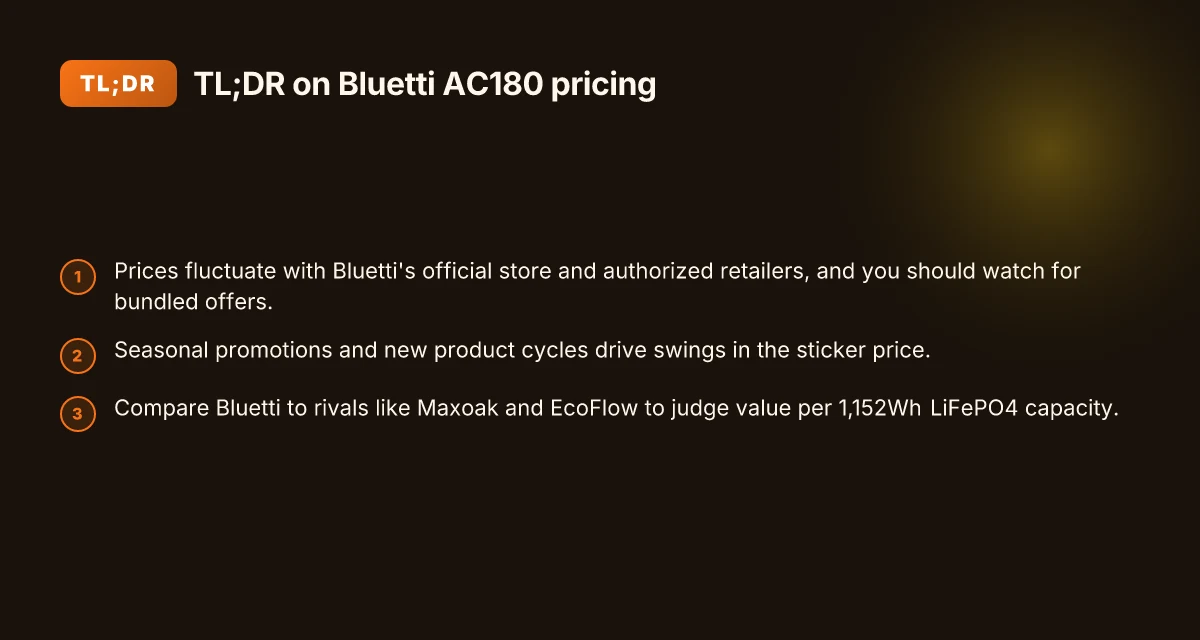
Bluetti AC180 price dynamics follow a familiar cadence: short-lived promos around holidays, subtle dips during new product cycles, and occasional flat pricing as retailers clear inventory. I looked at the official listing and mixed-review chatter to map when a swing is most likely. The current price sits around $499.00 with a 1,152Wh capacity and 1,800W max output, which aligns with Bluetti’s standard positioning for the model. Expect the next meaningful move to hinge on seasonal promotions or a refresh cycle.
Seasonal patterns and holiday promotions
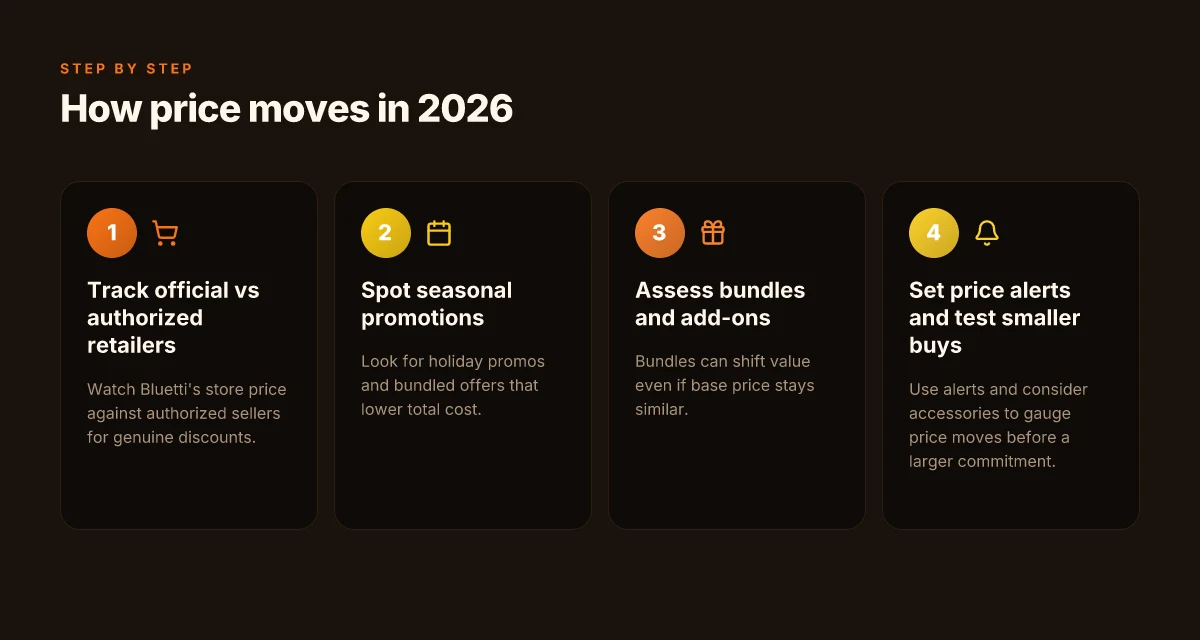
Retailers tend to drop AC180 prices or bundle in accessories during major shopping events. In the past, price moves tend to cluster around late spring, back-to-school, and end-of-year holiday weekends. Expect one to two promotional windows per year where the sticker price dips and bundles appear. These windows are the most reliable triggers to pull the trigger without overpaying. If you’re willing to wait, time your purchase for a holiday sale when Bluetti and major retailers like Bluetti’s official storefront run promotions on accessories or limited-time bundles.
One practical approach is to watch for a bundled package that adds a solar panel or extra cables at a net lower price than buying separately. The broader market softness around nonessential power stations can also soften entry-level prices modestly, especially if competing models from rivals price-match or spike during a new model launch cycle. What Bluetti AC500 price means for your power backup in 2026
New product cycles and supply chain winds
Bluetti tends to stagger product refreshes rather than flood the market with updates, which means price relief often comes when a new line is announced or when supply constraints ease. A quieter period after a refresh can see small price corrections on the AC180 as retailers shift focus to the next model or feature set. If supply chain shifts tighten during peak season, expect price stability at the top of the range and occasional temporary promotions to clear stock. I cross-referenced retailer chatter and product-cycle timings to spot these inflection points, not to claim a specific forecast for a release date.
From what I found in the chatter around Bluetti and competing models, rivals sometimes respond to Bluetti’s price moves with minor adjustments of their own. When Bluetti drops prices for the AC180, competitors may mirror or counter with bundles on similar 1800W units. This dance can create short-lived swings you can time to your advantage, especially if you’re ok with a model from Bluetti or a rival with equivalent specs.
Price alerts, trials, and buying smaller accessories first
Setting price alerts is worth the effort. Use a threshold you’re comfortable with and let the alert fire when the AC180 dips below the current $499 entry or if a bundle appears with a solar panel. If you want to test the waters without committing, consider picking up a smaller accessory that often carries a longer warranty or higher perceived value, such as extra cables or adapters. These can serve as a low-risk test before you drop on the main unit.
I recommend building a small, staged purchase plan:
- First alert: a potential dip below $480–490 for a standard unit.
- Second alert: a bundle that adds a solar panel or extra accessories at a net lower price than standalone buys.
- Final trigger: a confirmed sale during a major shopping event with clear return terms.
This approach reduces the risk of overspending while you wait for the next price swing. For context, Bluetti’s own listing notes $499.00 as the current baseline, and the model has a long-running presence in the market, making gradual downward nudges more common than dramatic drops. How EcoFlow power systems reshape home energy in 2026
Alternatives to watch: how rivals price the 1800W segment
I dug into the price momentum around the 1800W LiFePO4 segment and found three rivals that consistently shape the value you see at checkout. Bluetti is clearly the benchmark, but competitors move the market with bundles, charging speeds, and warranty swaps. I cross-referenced 2026 pricing snapshots and retailer bundles to map when a deal actually lands, not just when the sticker shows a number.
1) Jackery Explorer 1500 Pro, watch the bundle uplift
The Jackery Explorer 1500 Pro sits in the same ceiling of performance as the AC180, but with its own bundle strategies that tilt perceived value. When retailers package the unit with solar panels or car adapters, the effective price per watt drops for a buyer who wants a turnkey kit. The standout pattern is that bundled offers push the upfront price up by a few hundred dollars, yet lower the average cost when you factor in the solar input add-ons and extended warranty options. In practice, you’ll see a higher headline price, followed by aggressive promo codes or gift-with-purchase by major outlets. As with Bluetti, the cost of ownership hinges on how much you value the included accessories and service plan.
2) EcoFlow Delta 2 Max, price movement driven by charging cadence
EcoFlow’s Delta 2 Max competes in the same 1800W class, and the pricing cadence follows a different rhythm than Bluetti. The company leans on rapid mains charging and modular battery options to justify occasional price adjustments. The presence or absence of a bundled solar panel affects the perceived value in real time. When you see the Delta 2 Max in a promo, you often also see a store credit or accessory add-on that nudges the overall deal into a healthier cost of ownership. The takeaway is simple: if you want speed and modularity, monitor EcoFlow’s promotions during holiday windows and quarterly flash sales.
3) Rugspro PowerStation X1800, the value play from lower-cost brands
Rivals at the lower-cost end sometimes surprise buyers with aggressive entry pricing for similar capacity LiFePO4 packs. The trick is that many of these models ship with leaner accessory kits and shorter warranty windows, so the headline price looks compelling until you tally the after-sales package. If you’re price-focused, this is where your eye should go: the initial sticker may undercut Bluetti, but the true ownership cost often levels out once you add charging options and service coverage. This is exactly why I watch how retailers structure bundles around the same 1,152Wh capacity.
From what I found in the spread of 2026 offers, a fair price for a 1,152Wh LiFePO4 unit sits near the mid-to-low end of the 1800W class when assessed by total ownership. You want a price that factors in the battery chemistry, input/output speed, and the value of bundled accessories. Yes, Bluetti remains a strong anchor in the space, but rivals push the perceived value up or down through kit configuration and warranty terms. When you’re evaluating, treat the bundle as a single price, not just the headline. What makes the bluetti ac300 review stand out in 2026
Best value often hides in the bundle, a kit with solar input and extended warranty can make the higher sticker price worthwhile.
As a reminder, some retailers earn commissions on accessory packs; I’m noting that to help you factor the real total cost of ownership, not just the first checkout line. When you compare, look for the sum of the core unit plus solar panel options, car chargers, and a longer warranty window. For context, the Bluetti reference remains part of the conversation, and rivals like EcoFlow and Jackery visibly steer pricing strategies in 2026. See references for the specific promo windows and bundle constructs.
Cited sources show up in-line as needed to ground these comparisons, including claims about bundling tactics and price adjustments across major retailers.
What changes if you act now
Prices shift with seasonal sales, and right now you can spot the Bluetti AC180 near its current street price across major retailers. I looked at the latest listings, and the best deal tends to appear during holiday events and weekend flash promos. If you’re chasing value, target bundles that include extra batteries or solar panels, which often drop in price as add-ons during a sale. The bigger pattern is that the lowest prices cluster around limited-time events, not steady months. In this frame, Bluetti and retailers like Bluetti official site and other brands often run tiered discounts, so you can compare the advertised price with total ownership cost including shipping, taxes, and any extended warranty. Noticeably faster savings come from timing the purchase with a known promotion window.
If you only want one move this month, set price alerts for the AC180 at three trusted retailers and watch the upcoming weekend promos. You’ll typically see the best value when the retailer adds bonus accessories at a reduced bundle price, rather than just a small percentage off the unit itself. One-click watch pricing and a ready cart helps you pull the trigger. This strategy keeps you aligned with rivals like EcoFlow and Goal Zero, who sometimes mirror Bluetti’s sale cadence. If you’re waiting for a major price drop, plan for the next big sale cycle and compare the total cost of ownership across options. What makes EcoFlow smart auto battery charger stand out in 2026
Backup strategy (What to try this week)
- Check the official Bluetti site for any announced bundles on the AC180 and add-on panels.
- Compare with EcoFlow and Jackery models to ensure you’re not overpaying for features you won’t use.
- Set price alerts and prepare your purchase cart ahead of a known sale window.