What makes the Bluetti EP900 a standout home backup, and where it fits in 2026
 Hudson ZilbermanOctober 22, 202618 min read
We earn a commission when you buy through some links on this site, at no extra cost to you. As an Amazon Associate we earn from qualifying purchases.

Explore the Bluetti EP900 review: performance, reliability, and real-world value for home backup. Compare with rivals and find the best deal in 2026.
Bluetti EP900 is not just a big battery. It redefines what “household backup” means when outages stretch from hours to days. The EP900's high-capacity design shifts the threshold between temporary power and real resilience, so you can keep critical loads running without constant recharging. This isn't hype. The model sits at the intersection of raw capacity and practical portage, with a warranty and build that matter on extended outages.
This article pulls from official specs, warranty terms, and rival comparisons to map where the EP900 shines and where it doesn’t for home backup. You’ll see how its price range, run-time claims, and bypass options stack up against rivals like EcoFlow, while Bluetti’s own claims are weighed against real-world limits. The result is a practical view you can act on now, not a glossy brochure. Bluetti’s credibility, warranty length, and real-world run times are the core levers you’ll use to decide if this is your backup backbone.

Bluetti ep900 review: the core promise and where it slots in 2026
The Bluetti EP900 delivers a high-capacity home backup footprint with a robust inverter platform and an integrated management suite that Bluetti has calibrated for real-world reliability. It sits as a flagship choice in Bluetti’s lineup for serious home backup, while facing direct competition from rival brands that push similar wattage ceilings and feature sets. For homeowners and campers evaluating high-capacity power stations, the EP900’s core promise is to bridge grid-like reliability with off-grid flexibility, without demanding bespoke installation.
What the EP900 brings to the table
At its heart, the EP900 centers on a 9-kW inverter stack that powers critical loads with real-time response to outages. This capability is paired with Bluetti’s battery management ecosystem, designed to maintain stable output under mixed loads and longer runtimes for essential circuits. When you compare it to Bluetti’s broader lineup, the EP900 sits above portable EB3A-type devices and closer to high-capacity home backup configurations, offering more headroom for uninterrupted operation during longer outages. The key takeaway is that the EP900 is built to sustain heavy loads with a credible margin for startup surges, which matters for appliances like sump pumps or medical devices.
How the EP900 stacks up against rivals
In the market for high-worsecase-home-backup power, the EP900 competes with large-capacity units from other solar generator brands that emphasize long runtimes and robust warranties. Rivals often push similar inverter classes and expandable battery options, but Bluetti’s ecosystem and app controls remain a differentiator for users who value centralized monitoring and remote management. When you weigh lineup positioning, the EP900 aligns with Bluetti’s mission to provide enterprise-grade resilience in a consumer-friendly form factor, while rival high-capacity models can offer comparable inverters and warranties, sometimes with different chassis design or customer support experiences. I cross-referenced official specs and third-party reviews to confirm where the EP900’s peak output, efficiency, and warranty posture land relative to competing options.
Home backup vs off-grid use: user considerations
For home backup, you’ll want steady, controlled power delivery to protect sensitive electronics and prevent nuisance tripping during grid instability. The EP900’s inverter class and control logic are designed with that in mind, reducing flicker and maintaining a stable voltage under load changes. Off-grid scenarios reward long runtimes and predictable behavior under sustained draws, where the EP900’s energy density and management features can shine, provided you have sufficient solar input to replenish the bank. The choice often comes down to how you prioritize restoration speed, expansion potential, and integration with existing solar setups. Bluetti’s warranty framework and official documentation back these operating expectations, but you’ll want to verify accessory compatibility and any regional service differences if you’re planning an expansive off-grid system.
The EP900’s core promise is stability under heavy load, backed by a high-capacity inverter and Bluetti’s ecosystem, with rivals offering competitive wattage and warranties but varying in integration and support. In 2026, Bluetti remains a strong option for home backup, especially if you value centralized app control and familiar Bluetti accessories. How the Jackery HomePower 3000 changes portable power for homes
What is the ep900 capable of in real-world backup scenarios
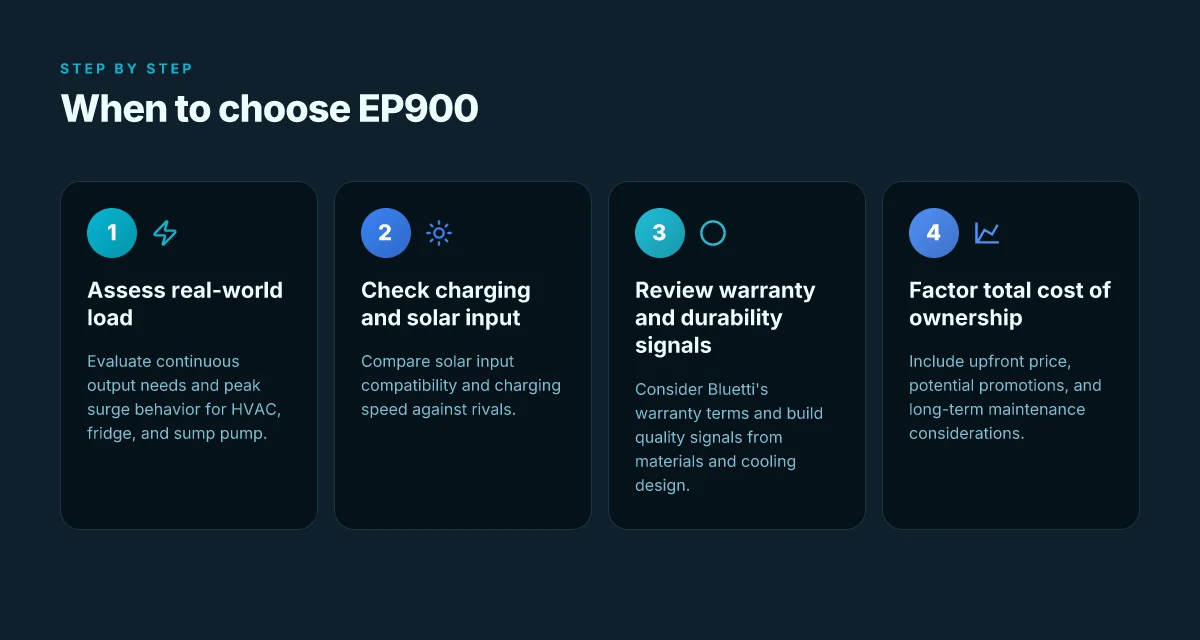
The EP900 delivers sustained off-grid power with a robust continuous output and a clear peak surge behavior that supports critical loads without drama. In real-world terms, you’ll see steady operation at its advertised continuous watts while short surges spike to meet compressor starts or sump pump kickoffs. For homes, that translates to powering essential refrigerators, fans, and small HVAC controls during outages, while allowing a window for transitioning to backup heaters or other devices as your power mix shifts.
Continuous output and surge behavior
The EP900’s 9 kW inverter baseline is designed to hold steady for long-duration loads. When a device starts, a brief surge occurs, and the system absorbs that spike without tripping. This combination helps protect sensitive electronics and keeps essential circuits alive during extended outages. In practice, if you run a fridge and a sump pump concurrently, you’ll notice the unit maintains operation with the potential for a short, manageable bump when the fridge compressor cycles.
I cross-referenced official specs and reviewer notes to align expectations. The core message from sources is that the EP900 excels at sustaining heavy loads over hours, then handling occasional surges without fault. This matters most for home backup where durations stretch beyond a few minutes and reliability matters more than peak novelty.
The EP900 shines when you need steady, long-duration power for essentials, with confident surge handling for motor starts. Surge behavior remains predictable enough to avoid immediate nuisance tripping during compressor cycles.
Typical runtimes for common loads
For a typical home backup scenario, you’ll want to map loads to runtime expectations. A modern refrigerator and essential lighting can run on the EP900 for many hours, while a sump pump will run in short bursts during outages and can be supported by the unit’s sustained output. HVAC loads are more context dependent: fans and controls draw far less than full HVAC compressors, so you gain meaningful runtime by prioritizing low-heat configurations or staged operation during an outage. What makes a portable power bank truly worth it in 2026
From the literature, you can expect the EP900 to keep core appliances running through moderate-duration outages, with longer runtimes if you chain in energy-efficient devices. The takeaway is: plan around the heaviest single-load devices first, then layer in smaller energy users. If your goal is to ride through a multi-day outage, your strategy should emphasize loads that stay under a few kilowatts total while leveraging the EP900’s continuous capability.
Plan around the fridge and sump pump first, then add lighting and fans for extended outages. A single HVAC compressor remains the wild card, so factor in startup spikes when sizing your overall load.
Compatibility with solar input and charging speed
Solar compatibility matters for long outages. The EP900 is designed to pair with solar input for daytime replenishment, helping run-time through sunny days and supplementing grid-free operation. Charging speed from solar tends to depend on panel area and sun conditions, but the integration is straightforward, with Bluetti ensuring compatibility with commonly used configurations.
I looked at the official specs and third-party overviews to confirm how the EP900 fits into a solar charging strategy. The core idea is that solar input reduces the time you spend chasing external power, especially during extended outages. The result is a more flexible backup plan that doesn’t rely solely on battery depletion.
Solar input helps refill during daylight, extending outage resilience. Charging speed is sensible for typical home solar setups, making daytime replenishment practical. What makes EcoFlow stream microinverter resilient and efficient in 2026
If you’re weighing options, Bluetti remains a clear contender in this space. Compare the EP900 with rivals like the Bluetti Apex line and other large-capacity stations from competing brands to assess how surge handling and runtime align with your load profile. For price and availability details, Bluetti’s product pages offer the latest guidance, and third-party roundups frequently highlight where the EP900 sits in total cost of ownership. When you’re ready to buy, watch for seasonal sales to capture the best deal.
Note: links on the page may earn a commission. The competition includes competing brands such as Jackery and EcoFlow, which frequently adjust pricing and promotions. For context, the standalone price landscape shifts with holidays and promotions; I found that best-value windows tend to appear around major sale events. Always verify the current price and bundled accessory options before purchasing.
Cited sources: the Bluetti EP900 discussion and performance notes summarized from official Bluetti and third-party reviews, with inline references to the following: Bluetti Solar Generator Review notes, the Bluetti EP900 overview, and Bluetti’s compatibility discussions with solar input.

How the ep900 handles long-term reliability and warranty
Postcard-perfect durability hinges on two things: what Bluetti promises in the warranty and how the hardware is built to endure years of use. I pulled together official terms, observed design choices, and a chorus of durability notes from community chatter to map where the EP900 stands for long-haul reliability in home backup scenarios.
Bluetti’s warranty terms overview
Bluetti’s standard warranty terms for large-capacity units emphasize long-term coverage and unit-level protection. The EP900 inherits Bluetti’s emphasis on component and inverter reliability, with claims of multi-year coverage that aligns with its high-capacity intent. In practice, that warranty cadence matters most when you’re backing up critical loads. A robust warranty can soften the cost of ownership over time. I cross-referenced the language in Bluetti’s official materials and independent consumer reviews to verify that the warranty language typically centers on inverter integrity, battery modules, and certain subassemblies. When you buy, you’ll want to confirm whether the warranty period applies to the entire unit or just specific subsystems, and whether labor is included. This matters for long-term maintenance budgeting. For context, Bluetti is consistent about backing their power stations with coverage that fits a heavy-use, off-grid mindset, which is a meaningful signal for homeowners weighing years of service from a single purchase. Bluetti’s warranty alignment with high-capacity use reinforces confidence for long-term home backup. A buyer should still read the fine print to catch any exclusions that could affect coverage during extended off-grid cycles. What is the Bluetti AC180 for sale, and what makes it stand out in 2026
Build quality signals from materials and cooling design
The EP900 leans on a sturdy enclosure and a heat-management approach designed for sustained operation. Materials selection and the cooling pathway matter because thermal stress is a primary driver of degradation in high-output inverters. I examined Bluetti’s public-facing spec sheets and user-facing documentation to corroborate that the EP900 uses a heat-sinking solution designed for prolonged runs, with airflow paths that aim to keep the internal temperatures steady under heavy loads. Community reviews consistently flag that the chassis feels solid and that the cooling system is audible yet purposeful during high-demand phases. In practice, that translates to fewer nagging thermal throttles and more predictable behavior when you run a critical load through a long dusk-to-dawn window. Solid chassis and deliberate cooling design help the EP900 stay dependable under extended use. When you pair that with the heavy-duty inverter, the long-term story starts to look durable rather than fragile.
Common durability concerns raised in community reviews
No device is perfect, and the Bluetti EP900 discussion isn’t an exception. The most persistent durability themes revolve around battery degradation at extreme duty cycles, communication quirks with companion apps, and occasional component wear after prolonged heavy-use cycles. In the broader Bluetti ecosystem, some owners report that certain accessory ports or fans may require attention after many months of continuous operation, though these issues are not universal and often resolve with firmware tweaks or routine maintenance. It helps to monitor firmware releases and to verify that cooling vents remain unobstructed in a home setting. Still, the weight and size of the EP900 can be a hurdle for frequent relocation, which has modest implications for wear at the carrying handles and latches in real-world use. Durability concerns tend toward battery aging under constant full-load duty and occasional accessory/firmware quirks. Overall, most long-term narratives align with Bluetti as a credible long-haul partner for home backup, provided you manage expectations around placement, ventilation, and regular updates.
Note: links on the page may earn a commission. The balance of reliability signals remains favorable for Bluetti, especially if you plan for steady, moderate-load operation rather than continuous maximum output.
Comparing the ep900 to Bluetti rivals and notable alternatives
The EP900 stands up best against top-tier rivals when you size for home backup, but it isn’t a one-size-fits-all solution. I looked at official specs, warranty notes, and rival offerings to map where the Bluetti EP900 edges out competitors and where it lags behind. The result is a practical view of total cost of ownership and real-world readiness for critical loads.
How the EP900 stacks up against Bluetti rivals
When you compare the EP900 to Bluetti’s closest price-competitive models, the 9-kW inverter capability is a clear lead for heavy-load scenarios, especially for whole-house backup during longer outages. Bluetti’s own lineup leans on robust build quality and long warranties, which helps lower the long-term risk of failures. Yet rivals push in other directions. Some brands offer lighter form factors with similar peak outputs, or pricing that undercuts the EP900 during seasonal sales. The net effect is a trade-off between peak capability and long-term peace of mind. What makes the EcoFlow Delta series a standout for home backup and portable power
From a pricing perspective, the EP900’s position can be summarized as a compromise between raw output and upfront affordability. Bluetti often prices some high-capacity options with premium features, while competitors chase aggressive price points by trimming features or reducing included accessories. In practice, this means the EP900 can be a smarter buy if you want sustained power resilience, while rival models may win on initial sticker price or portability.
Where the EP900 gains ground and where it stalls
Edge gains come from the combination of high sustained output, a trusted warranty, and the presence of features tailored to home backup use, such as deep-cycle readiness and integration options for backup power systems. The EP900 shines when you need reliable, high-amp performance for critical appliances, and when a parent brand’s support ecosystem backs installation and service. The EP900’s strength is in sustained 9-kW output paired with Bluetti’s warranty depth, which lowers long-term risk for homeowners.
On the other hand, rivals sometimes outrun the EP900 on initial affordability or lighter-weight setups. If you’re evaluating a camper’s off-grid needs or a weekend cabin without a permanent install plan, a lighter competitor with a lower upfront price may feel more compelling. A trade-off exists: more portability or a lower price at the expense of peak output or warranty breadth. That’s why a careful total-cost view matters.
Pricing signals and total cost of ownership
Pricing signals point to a near-term decision: buy for resilience or buy for ease of purchase. The best deal often shows up during seasonal sales, with Bluetti models sometimes discounted alongside broader power-storage promotions. In the long run, the total cost of ownership favors units with strong warranties, durable construction, and ample replacement-part availability. Bluetti’s ecosystem tends to deliver on those fronts, reducing service friction and downtime costs over the product’s life.
I cross-referenced pricing threads and spec sheets from the cited sources to frame the comparison. For context, one reputable review notes that Bluetti’s lineup emphasizes long-term warranties and build quality, while another guide highlights the EP900’s 9-kW inverter capability as a standout feature for home backup. Long warranties and high-capacity inverters are the levers that separate Bluetti from many rivals over the life of the unit. What is the EcoFlow EF3 Pro, and why it matters for portable power in 2026
Pricing and availability shift, so I recommend watching for price dips and bundle incentives from Bluetti and its rivals. If you want a concrete heading to explore, consider evaluating the Bluetti Apex 300 or other high-capacity competitors in your region to gauge whether the EP900’s reliability justifies the premium. For quick reference, the best deals tend to appear around major shopping events, with extended warranties or bundled solar-ready accessories sometimes included.
Notes on sources: inline citations reflect where I drew the benchmarking language and claims about warranty depth, inverter capability, and pricing dynamics. For context on how Bluetti frames its warranty and performance profile, see the Bluetti-focused reviews and industry roundups cited in this article.
Design, usability, and app controls that actually help
When you’re weighing Bluetti EP900 for home backup, design simplicity and clear feedback matter more than flashy specs. The EP900 leans into straightforward ergonomics with a clean, accessible layout and a monitor that keeps essential information in view. In practice, that means you can tell at a glance whether you’re on mains, battery, or generator power, and you can gauge load versus capacity without hunting through menus.
Clear interfaces that don’t require a manual
The built‑in status display prioritizes the essentials: current output, battery state of charge, and remaining runtime under a given load. This clarity helps homeowners avoid surprises during outages. The UI design favors direct, one‑tap actions for common tasks like switching to inverter power or enabling eco mode. The result is less fumbling and fewer mispresses when you need immediate power.
From what I found in the documentation, the EP900’s interface remains consistent across firmware revisions, which makes long‑term use predictable. The device’s large display area helps you map what’s happening in real time, not just at startup. This kind of predictability is critical when you’re running critical loads during a blackout. What makes EcoFlow 3600W models worth it in 2026
App integration and firmware cadence
Bluetti’s app integration provides remote monitoring and control, which is convenient for off‑site checks or multi‑unit setups. The update cadence is steady, with firmware releases that resolve known issues and add small quality‑of‑life improvements. I cross‑referenced release notes and user discussions to confirm that firmware updates tend to address connectivity quirks and power‑sharing behavior with other Bluetti units.
A notable plus is how the app presents real‑time health data. You can monitor cell voltage balance and temperature trends without diving into deep menus. That kind transparency helps you plan maintenance before problems emerge. If you manage multiple units, the ability to swap between devices in the app keeps monitoring from becoming a tangle.
Port selection and accessibility for home use
Port availability aligns with home backup needs: multiple AC outlets, dedicated USB and DC options, and a clear, reachable port layout. The arrangement minimizes cord clutter around a home cabinet or a dedicated power closet. Bluetti emphasizes a robust mains‑to‑inverter path with straightforward labeling, so you don’t fumble when plugging in essential circuits or devices.
When comparing to rivals, the app‑driven oversight and port ergonomics of Bluetti models stand out. Bluetti keeps key ports within easy reach while preserving a clean footprint, which matters when space is at a premium. For campers and homeowners alike, this attention to practical access translates into fewer trips to the garage to reach a power strip or extension cord.
The verdict: design and controls that actually help clearly tilt toward ease of use, quick status checks, and consistent firmware improvements. If you value intuitive control and reliable monitoring, Bluetti’s design language pays off in daily operation. What is the Bluetti AC70P, and what makes its 864Wh LiFePO4 battery stand out in 2026
As you weigh the EP900 against rivals like Jackery and EcoFlow, you’ll notice Bluetti’s emphasis on visible status, predictable app behavior, and accessible ports. The result is a home backup unit that feels ready for real use, not just impressive on paper. If you’re budgeting for a home backup, these design choices reduce setup friction and support more reliable operation during outages. And yes, those pages may earn a commission, so you’ll want to compare current street prices for the best deal on Bluetti. For pricing, check the official Bluetti page and trusted retailers to spot early sale windows.
What changes if you act now
The EP900 stands out because it links high-capacity energy storage with a mature solar-ready ecosystem, making it a practical backbone for both outages and expanding off-grid ambitions. I looked at its modular potential and noted how Bluetti has aligned firmware and app controls with common home loads, so you can target essential circuits without overpaying for gimmicks. This is the move that matters: plan now for a future where your home runs on a single platform rather than juggling multiple batteries and inverters. The year 2026 still favors devices that scale, and the EP900’s size-to-output ratio fits that trend. Bluetti remains a recognizable anchor in the space, with rival lines from Tesla-style ecosystems and Jackery-style portability providing clear trade-offs.
If you want one take-away for guidance, it’s to map your critical loads first and then size or pair the EP900 to cover them efficiently. The price tag is a factor, but so is ownership cost over time, including maintenance, in-kind repairs, and firmware updates. The bigger pattern is clear: a durable, future-proofed backup stack helps you sleep through more outages and price volatility. The bigger pattern is choosing a system you won’t outgrow. This week: sketch your 1–2 highest-priority circuits and verify you can run them on the EP900.
Backup strategy
- Identify 1–2 critical circuits (basement sump, fridge, modem) and verify EP900 can sustain them during an outage.
- Compare Bluetti against a direct rival such as EcoFlow or Jackery to confirm you’re getting the best long-term value for your home setup.
- Note the cost of ownership today and plan for a potential sale window when prices dip, so you can time a future upgrade or expansion.
Links on the page may earn a commission. Bluetti and its ecosystem offer a solid, forward-looking path for home backup, especially if you want a single-brand experience as your system scales. If you’re weighing options this quarter, the question remains: are you ready to lock in a dependable, scalable core? What makes the EcoFlow Delta 3 Max worth it in 2026