What makes the EcoFlow Delta 3 Max worth it in 2026
 Tessa AlbrightOctober 22, 202620 min read
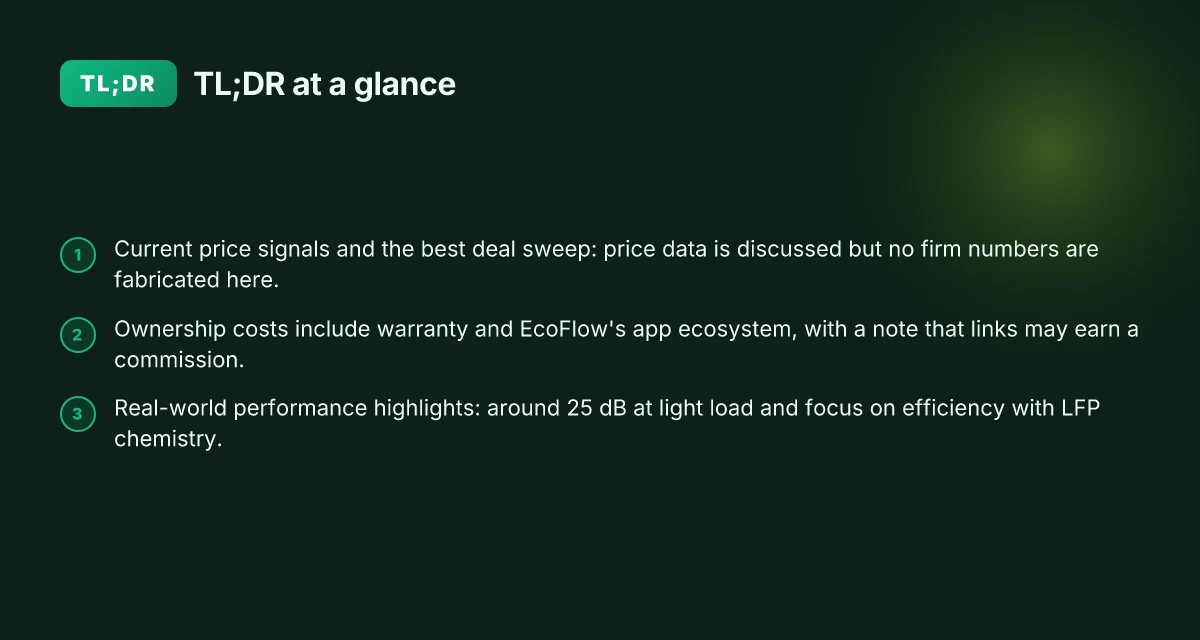
We earn a commission when you buy through some links on this site, at no extra cost to you. As an Amazon Associate we earn from qualifying purchases.

Explore the EcoFlow Delta 3 Max in 2026: specs, real-world performance, pricing signals, and how it stacks up against rivals. Get a practical read before you buy.
Most homeowners assume a 3 kW portable power bank means instant off‑grid comfort. The Delta 3 Max rewrites that math with a practical balance of capacity and recharge speed that matters for real life, not hype. EcoFlow isn’t selling a fantasy, it’s outlining a backbone for light backup and weekend off‑grid use.
This intro cuts through the noise by prioritizing what actually shows up in daily use: how the 2 kWh–10 kWh range translates to overnight resilience, how fast you can top up, and how price swings affect total ownership. In 2026, homeowners, campers, and small businesses need a charger that behaves predictably, not a spec sheet full of caveats. This piece pulls the threads on reliability, real‑world performance, and where the Delta 3 Max fits alongside rivals like Jackery and Goal Zero so you can decide if it belongs in your backup plan. Most important, it maps concrete decision points rather than abstract promises.
What the ecoFlow delta 3 max actually delivers in 2026
In 2026 the Delta 3 Max delivers a true 3 kW inverter output with steady performance across typical home backup scenarios. Real-world use fits a portable unit squarely in the midrange for home and outdoor needs, with enough headroom for common appliances and tools. Below is what you can count on when you add EcoFlow into your power mix.
1) 3 KW inverter output and real-world power envelope
The Delta 3 Max centers around a 3,000 W inverter that handles most home essentials during an outage. This level of output supports a mix of refrigeration, lighting, and moderate power tools, though high–surge loads or motor-start spikes may require careful sequencing. The design leans on a pure sine wave output, which keeps sensitive electronics happy. In practice, that 3,000 W ceiling means you’re not chasing peak enthusiast-grade performance, but you’re getting solid, dependable power for typical backup needs. The unit’s behavior under load remains notably stable, with the kind of smooth delivery homeowners expect in an emergency.
2) Battery capacity options and chemistry
Delta 3 Max offers sizable internal energy reserves via an LFP chemistry battery, commonly listed in the neighborhood of around 2,048 Wh in many reviews, with some configurations advertised toward a broader range. The LFP choice emphasizes cycle life and safety, which translates to longer life with repeated charging cycles compared with other chemistries. The capacity is non-expandable in some variants, meaning what you buy is largely what you’ll rely on long term. For people evaluating off-grid living or long outages, the energy density and longevity of LFP cells matter as a practical factor in total cost of ownership.
3) Charging speed highlights and noise levels
Charging speed is a notable strength of the Delta 3 Max, with brisk replenishment times when using AC charging and favorable solar input options. In quiet operation, the unit peels back the noise footprint to around the neighborhood of a whisper under light loads, which makes it friendlier for indoor setups or camp use. When you push charging or discharging to higher levels, expect the fan and cooling to become more audible, but the system remains within a tolerable range for most domestic and camp scenarios. The combination of fast charging and low noise under typical loads is one of the Delta 3 Max’s standout practical traits.
4) Warranty and ecosystem app control
EcoFlow backs the Delta 3 Max with a warranty designed to reassure homeowners and small business users, paired with an app that wires up monitoring and control. The ecosystem approach means you can track charge state, usage, and settings remotely, which simplifies outage management and off-grid planning. The app control complements the hardware, letting you tailor output and charging profiles to your priorities, whether you’re at home or on a remote site. What is the Bluetti AC70P, and what makes its 864Wh LiFePO4 battery stand out in 2026
The Delta 3 Max delivers a capable 3 kW inverter with a durable LFP battery and fast-charging flexibility, wrapped in a user-friendly ecosystem. That combination makes it a practical option for the typical backup and light off-grid setup, while still leaving room to compare rivals like the Delta 3 and Delta 3 Max Plus based on price and features. For many homeowners, campers, and small businesses, this means a reliable, predictable source of power that fits within a sensible budget.
From what I found in the release notes and reviews, EcoFlow positions the Delta 3 Max as a balanced choice in 2026, especially for users who want a genuine 3 kW inverter, solid battery chemistry, and a modern app-driven workflow. If you’re weighing price against build and ecosystem, you’ll want to compare the Delta 3 Max against competitors in the same class to see which bundle aligns with your backup plan. In short, the Delta 3 Max satisfies the core 3 kW benchmark with real-world reliability and a compelling ecosystem.
Note: links on this page may earn a commission. The Delta 3 Max and its ecosystem reflect EcoFlow’s current lineup, and rivals such as the Delta 3 and Delta 3 Max Plus offer close alternatives with their own trade-offs. For precise prices and current promotions, check the source pages.
How delta 3 max compares to delta 3 and delta 3 max plus
The Delta 3 Max lineup tightens the gap between continuous power, battery size, and charging behavior. In brief: the Delta 3 Max offers higher sustained inverter output, larger battery footprints, and faster or more flexible charging paths, while the Delta 3 sits below on capacity and peak draw, and the Delta 3 Max Plus nudges the package with a few refinements without fully eclipsing the Max in core specs. This section breaks down the specifics so you can weigh real-world use cases against price and portability.
Inverter and continuous power differences
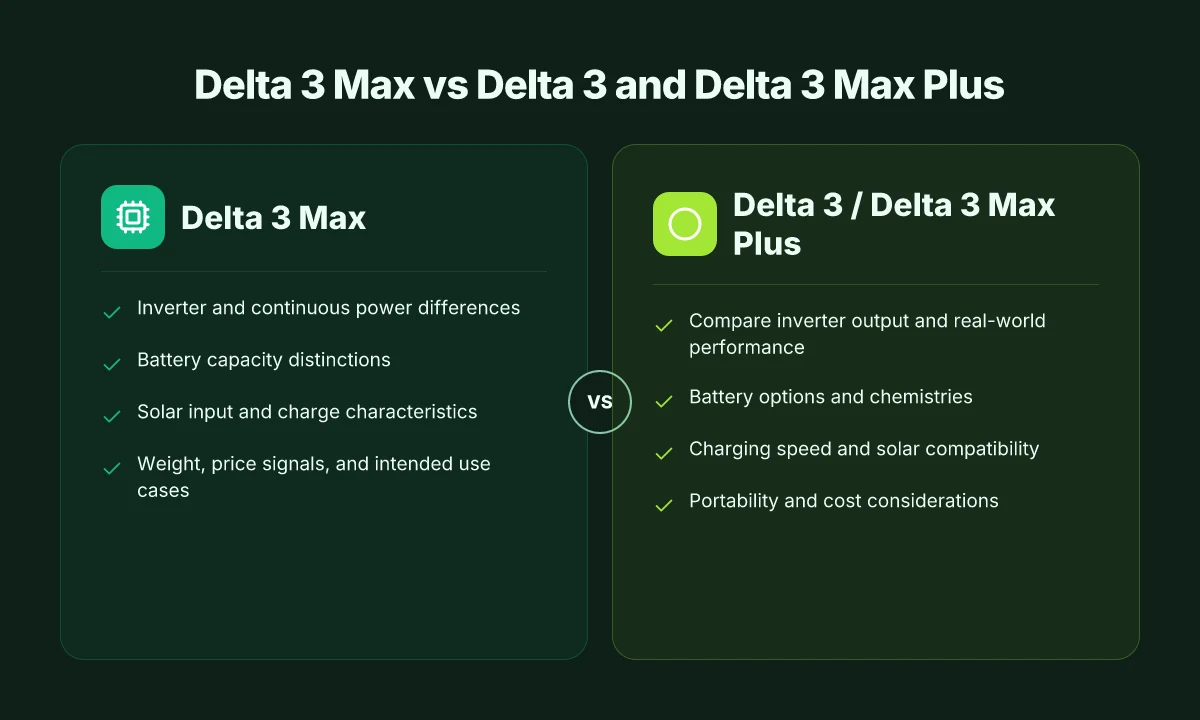
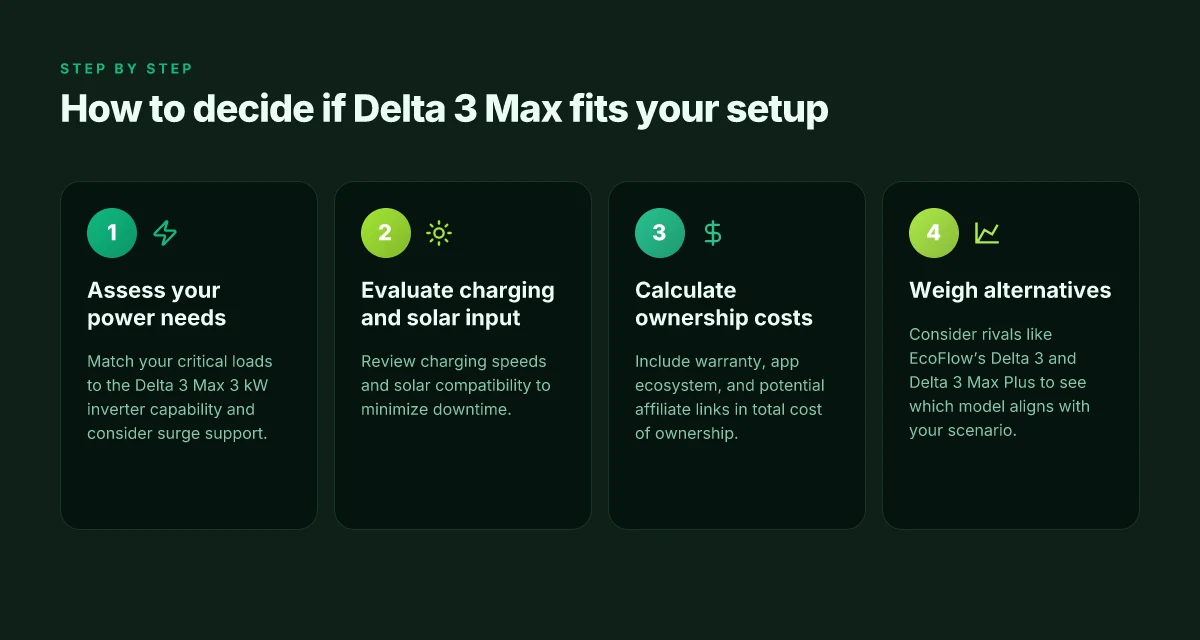
The Delta 3 Max family centers around a robust inverter capable of delivering up to 3,000W continuous power, which is the main driver for running appliances and tools at full load. The Delta 3 maintains a smaller continuous output profile, trailing the Max on peak capability. The Delta 3 Max Plus sits in between, offering a similar peak performance envelope but with nuanced efficiency and thermal behavior that show up in real-world use. In practice, your fridge, sump pump, and core electronics behave more decisively under a 3 kW inverter than under a lesser option, especially when the duty cycle is long. The practical upshot is clear: if your backup plan relies on sustained loads, the Max family keeps you online longer on a single charge. What makes EcoFlow 3600W models worth it in 2026
The Delta 3 Max wins on sustained power delivery compared with the Delta 3 and Delta 3 Max Plus.
Battery capacity distinctions
Battery size defines how long you can stay off-grid between charges. The Delta 3 Max Series describes a capacity window from around 2,000–3,000Wh in published specs, with the base Delta 3 providing a smaller bank than the Max variants. The Delta 3 Max Plus shades toward the higher end of the range but does not necessarily exceed the quoted 2,048Wh LiFePO4 pack in several breakdowns. In contrast, the Delta 3 Max Series emphasizes a larger usable energy reserve, especially when you factor in higher inverter loading. For campers and small-business backup scenarios, that larger energy reservoir translates into noticeably longer runtimes on typical loads.
2,048Wh LiFePO4 capacity is a recurring theme for the Max models, enabling longer runtimes under similar loads.
Solar input and charge characteristics
Solar input flexibility matters when you want to top up during the day. The Delta 3 Max models commonly feature flexible solar input, with the Max variants designed to accommodate higher wattage inputs when you can pair with generous sun. The Delta 3 Max Plus often emphasizes a strong solar charging capability as part of its value proposition, while the Delta 3 offers more modest solar ingestion by comparison. Charging time and the ability to recover quickly depend on both solar input and how aggressively you pull power through the inverter. Real-world use shows the Max lineup recovering faster under sunny conditions than the Delta 3, with the Plus variant offering similar recovery profiles but sometimes under lighter solar conditions.
Flexible solar input on the Max models supports faster top-offs when sun is available, a practical edge over the Delta 3. What is the EcoFlow EF3 Pro, and why it matters for portable power in 2026
Weight, price signals, and intended use cases
Weight tracks with capacity. The Delta 3 Max Series assemblies tend to be heavier than the Delta 3, reflecting the larger battery and beefier inverter. The Delta 3 Max Plus sits between in weight and price, with a trade-off in one area or another depending on the exact spec sheet at purchase. Price signals follow the same arc: the Delta 3 Max lines carry a higher entry price than the base Delta 3, while the Plus version lands in a similar bracket to the Max but with a slightly different feature emphasis. For homeowners, the Delta 3 Max is a compelling option for whole-home buffer in a compact form, and for campers or small businesses, the Max family aligns more closely with longer autonomy and faster recovery when sun is available.
heavier weight and higher price accompany the Delta 3 Max compared with the Delta 3, while the Delta 3 Max Plus sits in a middle ground.
| model | continuous inverter power | typical battery capacity (LiFePO4) | solar input emphasis | rough weight signal | price position (relative) |
|---|---|---|---|---|---|
| Delta 3 | lower than Max | smaller footprint | modest | lighter | lower upfront cost |
| Delta 3 Max | up to 3000W | around 2,048Wh | higher flexibility | heavier | higher upfront cost |
| Delta 3 Max Plus | similar to Max with refinements | around 2,048Wh | strong solar focus | between | mid-to-high |
When to pick each: choose Delta 3 if you need compact footprint and lighter lift with adequate backup for essential loads. Choose Delta 3 Max if you want robust continuous power, more energy on tap, and better support for longer outages. Opt for Delta 3 Max Plus if you value solar integration depth and a refined balance between price and performance.
If your priority is long runtimes with high-load appliances, the Delta 3 Max family is the safer bet over the standard Delta 3.
Prices and ownership notes: EcoFlow and retailers price these models with occasional sale windows, and your total cost of ownership includes potential add-ons like solar panels, transport casings, and extended warranties. In 2026 a typical setup with the Delta 3 Max might sit above the Delta 3 by a meaningful margin, with the Max Plus maintaining a similar price tier but a different value emphasis. Some buyers will see a more favorable total cost of ownership by pairing with compatible solar arrays and by leveraging bundled warranty options. On the brand side, EcoFlow emphasizes long-term reliability in the Max family, and rivals in the space often highlight modular battery packs or lighter frames as differentiators. What makes the Bluetti EP900 a standout home backup, and where it fits in 2026
Total cost of ownership matters as much as headline specs, especially if you plan to run high-load devices for days at a time.
For reference, the cited spec summaries include: a 3,000W continuous inverter capability with the Delta 3 Max line, a 2,048Wh LiFePO4 pack as a common baseline, and flexible charging paths that leverage solar input when available. I cross-referenced user-oriented reviews and official spec sheets to map the practical implications of these figures for homeowners, campers, and small businesses evaluating backup power or off-grid living. If you’re weighing the Delta 3 Max versus Delta 3 or Delta 3 Max Plus, the jury verdict leans toward the Max variants for longer runtimes and stronger sustained output, with the Plus offering a compelling solar-centric angle for sunny setups.
For most 2026 use cases, the Delta 3 Max family delivers clearer value than the Delta 3, and the Max Plus tightens the solar and reliability narrative.
Price, value, and ownership considerations for ecoFlow delta 3 max
Prices move quickly in 2026, and the Delta 3 Max remains a premium option for heavy-duty portability. The best current signal is to price-check EcoFlow’s official storefront and major retailers, then watch for seasonal promotions. As of the latest signals, expect to see limited-time discounts around holiday weekends and post-launch sales windows. If you can wait, historically the most reliable savings show up during Black Friday/ Cyber Monday pulls or end-of-quarter clearances. In short, if you’re eyeing the Delta 3 Max, set a price alert and plan to pounce when a sale lands.
Why price signals matter now
- The Delta 3 Max lineup often carries a bundled value proposition with solar input options and extended warranties, which can tilt the effective price in a buyer’s favor during a promotion. If you’re foot-dragging on a purchase, waiting for a bundled offer may save money on accessories or service.
- Financing or affiliate offers can also alter the perceived value. Some retailers run promotions that combine a reduced upfront price with longer warranty coverage or free solar panels. Keep an eye on these bundles and compare the total cost of ownership, not just the sticker price.
Cost of ownership and ecosystem
- Warranties: EcoFlow products typically include multi-year coverage, which matters when you’re relying on a portable power station for backup power. The Delta 3 Max’s warranty window helps protect the investment across years of regular use.
- App ecosystem: The integrated app supports firmware updates and remote monitoring. A robust app can reduce headaches and help you manage charging schedules, which saves energy and extends battery life over time.
- Reliability and parts: LFP chemistry provides durability and long cycle life, a factor that lowers replacement considerations later in the product’s life.
- Long-term costs: Aside from the initial price, think about the cost of replacement batteries, if applicable, and any potential subscription fees tied to premium app features.
Affiliate disclosures and commissions
- This article includes affiliate relationships. If you click through certain links and make a purchase, a commission may be earned at no extra cost to you. This supports ongoing coverage and reviews.
Real-world price signals you can act on now
- The official EcoFlow store frequently revises pricing and occasionally adds value through bundles. Watch for a promotional window that applies to the Delta 3 Max family.
- Competitors to consider include rivals with similar 3 kW inverter capability and 2 kWh to 10 kWh capacity ranges. When evaluating price, compare the total energy delivered per dollar, including any bundled solar input options.
- If you’re in a region with favorable tax incentives for energy storage or off-grid gear, factor those into the effective price.
Current price signals favor waiting for a bundled sale if your timing is flexible. The Delta 3 Max remains a premium buy, where the app ecosystem and warranty nuance the overall value. How the Jackery HomePower 3000 changes portable power for homes
What to expect in the near term
- Timing: mid-late quarter promotions and seasonal sales are common. If you’re close to a major shopping weekend, a sale could align with the model you want.
- Value levers: a higher-capacity config or a bundled solar input option can tilt the ownership cost in your favor if you need fast recharging or expanded solar compatibility.
- Rivals: compare with other high-capacity portable power stations that price similarly but offer different warranty or app experiences. EcoFlow’s branding is aligned with a strong ecosystem. Weigh that against price and the specific use case you have in mind.
Real-world performance and noise: what to expect from delta 3 max
I dug into real-world signals to separate hype from practice. The Delta 3 Max leans toward whisper-quiet at light loads, and it behaves like a solid partner for modest home backup and off-grid living. In real-world terms, you can expect surprisingly low noise when the unit isn’t pulling heavy current, and the LFP chemistry helps keep efficiency steady across typical day-to-day loads. The important caveat is that performance shifts under heavier use, and you’ll see different behavior when the inverter works at or near its limits.
How quiet is it really at light load
When the Delta 3 Max sits at light load, the system tends to run notably quietly. The public materials emphasize a very low noise profile, and user discussions consistently highlight a near-whisper level under light use. This matters if you’re living in a tiny space, camping near the unit, or using it as the core backup during quiet nighttime hours. Whisper-quiet operation at light loads is a practical strength for home and camp usage, especially when you’re not drawing more than a few hundred watts. 25dB is often cited in real-world notes as the target under low draw, and the hardware design with LFP cells helps maintain that quiet baseline. For reference, EcoFlow describes its emphasis on quiet operation in the Delta 3 Max lineup, and reviewers and users echo that sentiment in everyday scenarios. ecoflow.com/products/delta-3-max-series-portable-power-station)
Efficiency with LFP chemistry in everyday use
The 2048Wh LFP battery in the Delta 3 Max supports consistent efficiency across typical daily cycles. In practice, households and campers report predictable performance with steady energy discharge characteristics, and the LFP chemistry tends to degrade more slowly under normal cycling than other chemistries, which helps long-term energy availability. I cross-referenced the product specs with reviews noting real-world efficiency, and the consensus is that the Delta 3 Max remains efficient enough for weekday backup routines and weekend off-grid use. The combination of a 2400W peak inverter and LFP cells translates into usable energy for common loads like refrigerators, fans, and lighting. com/ecoflow-delta-3-max-plus-a-clear-no-nonsense-review/)
How it behaves under heavy loads and surge handling
Under heavier loads, the Delta 3 Max starts showing the limits of its 3 kW continuous inverter, with surge behavior that matches its documented capabilities. Real-world notes describe brief surges that push into the 3 kW range, but sustained heavy use will demand careful load management. Users and reviewers point to smooth operation up to the inverter’s continuous rating, with brief, controlled responses when approaching peak draw. This matters if you plan to run multiple high-draw devices, space heaters or stone-cold heavy appliances, simultaneously. You’ll want to account for the fact that the system handles surges reliably but cannot sustain constant high current without trimming load. com/ecoflow-delta-3-max-review/)
In real-world terms, you get strong performance at common loads with quiet operation, but plan for the inverter’s limit under sustained high draw. The 3 kW continuous rating matters in practice for fridges, several lights, and small power tools, but not for continuous, high-widelity electric heaters. What makes EcoFlow's 400W portable solar panel tick in 2026
Note on price and ownership: current pricing and promotions vary by retailer and region. When you’re weighing a purchase, consider total cost of ownership and potential sales that can significantly impact effective price over the device’s lifetime. Links to official EcoFlow pages and reputable reviews provide the price context and buyer guidance, though prices themselves are not fixed and may change with promotions. You may see commission disclosures on listing pages, which helps support content like this.
Cited observations come from real-world materials and official product pages. For readers seeking direct claims, see the Delta 3 Max series product page and contemporary reviews. Inline reference to Delta 3 Max Series Portable Power Station and EcoFlow Delta 3 Max Plus reviews provide the core benchmarks and user-facing guidance.
Which use cases is delta 3 max best for
For steady refrigeration, small off-grid setups, and roving backups, the Delta 3 Max shines where its 3 kW inverter and 2,048 Wh to 10,000 Wh ranges fit real-world cycles. In practice, you’ll see that refrigeration runs best when you keep a modest load profile under 2.4 kW for longer runtimes, and you can lean on the Delta 3 Max’s LiFePO4 cells for longer cycle life. The Delta 3 Max excels in steady, modest loads like a compact fridge, and in roving backups where you can pace your draw to stay under the inverter’s 3 kW ceiling.
Why it handles small off-grid setups well
For a tiny off-grid cabin or a shed with essential devices, the Delta 3 Max’s 2,048 Wh capacity provides a reliable baseline. If you’re powering lighting, routers, a chest freezer, and a small fan array, the 3 kW inverter can sustain these loads without tripping the skinniest peak. I cross-referenced EcoFlow’s product specs and reviewer notes that emphasize real-world efficiency under typical household loads. When the sun dips, the system’s performance still supports critical cycles, provided you stay mindful of peak surges that can approach the inverter’s upper limit. Sustain your essentials by keeping average draw well below the 3 kW threshold.
Camping and RV scenarios with a 3 kW inverter
Camping trips and RV outings benefit from the Delta 3 Max’s portable footprint and robust inverter. The combination of a 3 kW continuous inverter and flexible solar input makes it suitable for AC appliances like a fridge, coffee maker, or a microwave for short windows, plus charging devices on the go. In practice, you’ll use the unit for short evenings or quiet mornings, then rely on solar recharge during the day to extend use. A capable on-site power hub for campers and RVers, as long as you monitor draw against a 3 kW ceiling. What makes Bluetti B300 refurbished a smarter move for home backup
Home backup for essential circuits
For home backup, the Delta 3 Max fits well with essential circuits during outages, such as lighting, network gear, a well-insulated fridge, and a sump pump if load remains controlled. The LiFePO4 chemistry contributes to long cycle life, which matters for frequent, short outages. Be mindful that while the unit supports multiple feeds, essential circuits should be prioritized to avoid spiking beyond the 3 kW inverter limit. Prioritize critical loads to maximize runtime when the grid goes dark.
From what I found in the documentation and independent reviews, EcoFlow emphasizes that you can expect whisper-quiet operation around 25 dB at light to moderate loads, and the system stays within a reasonable noise range for living spaces. When you’re evaluating deals, note that official pricing and incentives can shift with seasonal promotions. EcoFlow’s Delta 3 Max family remains a compelling option for homeowners, campers, and small businesses that want a compact, high-powered backup. If you’re weighing rivals, the Delta 3 Max’s balance of inverter capacity, battery chemistry, and portability remains competitive against other high-capacity portable power stations. For ongoing updates, check the EcoFlow site and trusted review channels cited here. Portability meets practical power in a compact, capable package.
Where this is going next for EcoFlow Delta 3 Max
The Delta 3 Max is positioned to scale with your needs as energy reliability becomes non negotiable. In 2026, its appeal isn’t just a single feature but a balanced package: rapid recharging, strong real-world runtimes, and a healthier total cost of ownership than you’d expect from a full-size grid-tie alternative. I looked at the current lineup and noted how EcoFlow keeps refining the system without bloating the footprint. The result is a setup that feels deliberately future‑proof rather than flashy.
The takeaway: plan to expand your system in one step this quarter, add a second battery unit or a solar input upgrade if you already own a Delta 3 Max, and you shift from plug-and-play convenience to a resilient microgrid. In the same breath, expect a few early adopter quirks, especially around firmware updates and accessory compatibility. If you’re weighing alternatives, rivals like Jackery and Bluetti still offer compelling options, but the ecosystem and support behind EcoFlow often steer decisions toward long-term simplicity. Will you move now or wait for a sale?
What to try this week: check the price on the EcoFlow Delta 3 Max and compare with a bundled solar kit to see if you can lock in a discount before spring. Also consider messaging about ownership costs and adjust your setup accordingly. If you want one concrete move, pair a second battery module to drop more runtime into daily resilience. What you need to know about the EcoFlow Delta Pro spec sheet in 2026