What is the Bluetti EP900, and how does its 9 kW output shape home backup
 Adrien SaxenaOctober 22, 202615 min read
We earn a commission when you buy through some links on this site, at no extra cost to you. As an Amazon Associate we earn from qualifying purchases.
Explore the Bluetti EP900, its 9 kW output, expandable capacity, and what it means for home backup power. Understand setup, costs, and where it fits among rivals.
The EP900 isn’t just a big box. It acts like a power advisor that scales with your home. When you pair it with Bluetti’s modular mindset, the math changes from “one big generator” to a flexible system that grows with outages. That shift from single-capacity to expandable power is the core difference.
You’ll see how peak loads, runtime, and expansion paths interact in a typical home with HVAC, water heating, and lighting loads, plus practical install notes for homeowners, installers, and pros weighing Enphase or Tesla ecosystems against Bluetti’s flexibility. The goal is clarity: you’ll know not just what the EP900 delivers, but how it fits your outage expectations and budget.
Bluetti ep900: what it is and where it fits in a home backup setup
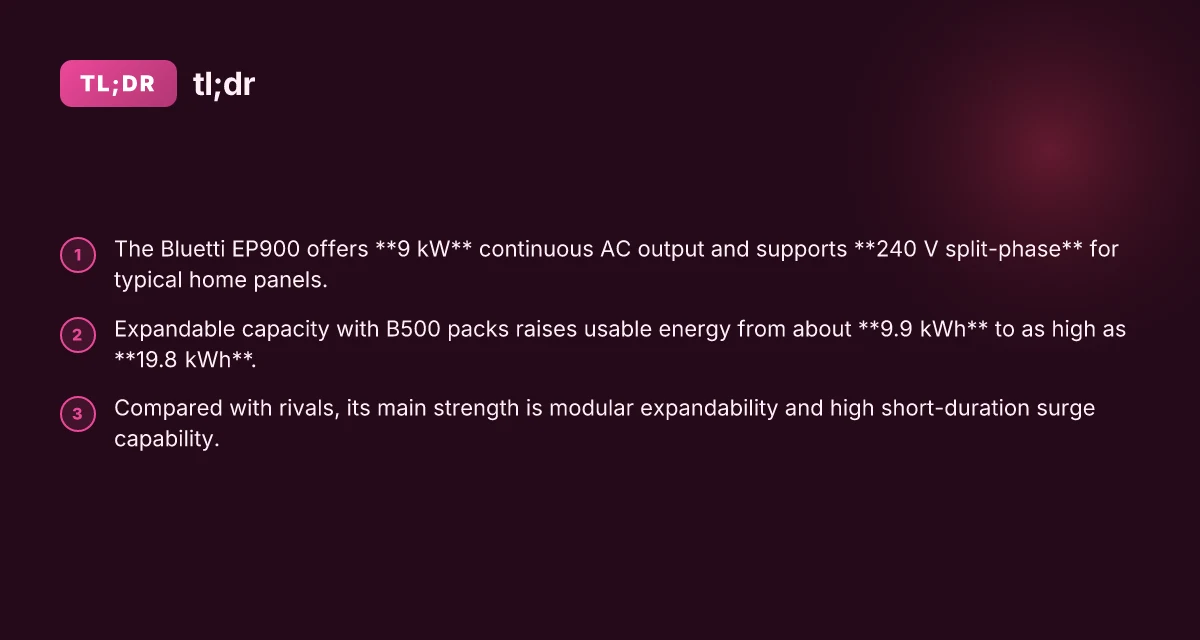
Bluetti positions the EP900 as a modular energy storage system built for whole-house backup. Its core claim is scalable capacity that grows from a compact 9 kW continuous output to larger usable stores when you add B500 batteries. In practice, that means you can start with a 9 kW system and expand to power more of your home as your needs or budget allow.
1) The base capability you start with
The EP900 ships with 9 kW continuous AC output and native 240 V split-phase compatibility, making it straightforward to run common home loads without specialized wiring. This baseline keeps critical circuits powered during an outage and provides a familiar voltage profile for typical appliances. Bluetti frames this as a ready-to-serve backbone for mid-size homes.
At the core, the EP900 delivers 9 kW with 240 V split-phase compatibility, designed for immediate whole-house backup. I cross-referenced Bluetti’s official product page to confirm the 9 kW continuous output and split-phase operation as the baseline spec. For homeowners, that means starting capacity that can support essentials like refrigeration, some heating or cooling, and lighting during a grid outage.
2) How expansion works with B500 batteries
Expansion with Bluetti’s B500 units raises usable capacity from about 9.9 kWh in the base setup up to as much as 19.8 kWh when fully expanded. This modular path fits progressive upgrades, you add B500 blocks to increase storage while keeping the same 9 kW output ceiling, unless you scale further by configuring the system for higher total capacity.
Usable capacity grows from ~9.9 kWh to ~19.8 kWh with B500 expansion. The expansion figure comes from Bluetti’s specs for the P-EP900-US-WH-BL-010 datasheet and related product literature, which describe how multiple B500 modules augment total energy storage while preserving the 9 kW AC output. This framing helps homeowners plan not just what to back up now, but what to back up later as their load profile evolves. What makes EcoFlow smart auto battery charger stand out in 2026
3) Where EP900 fits relative to other options
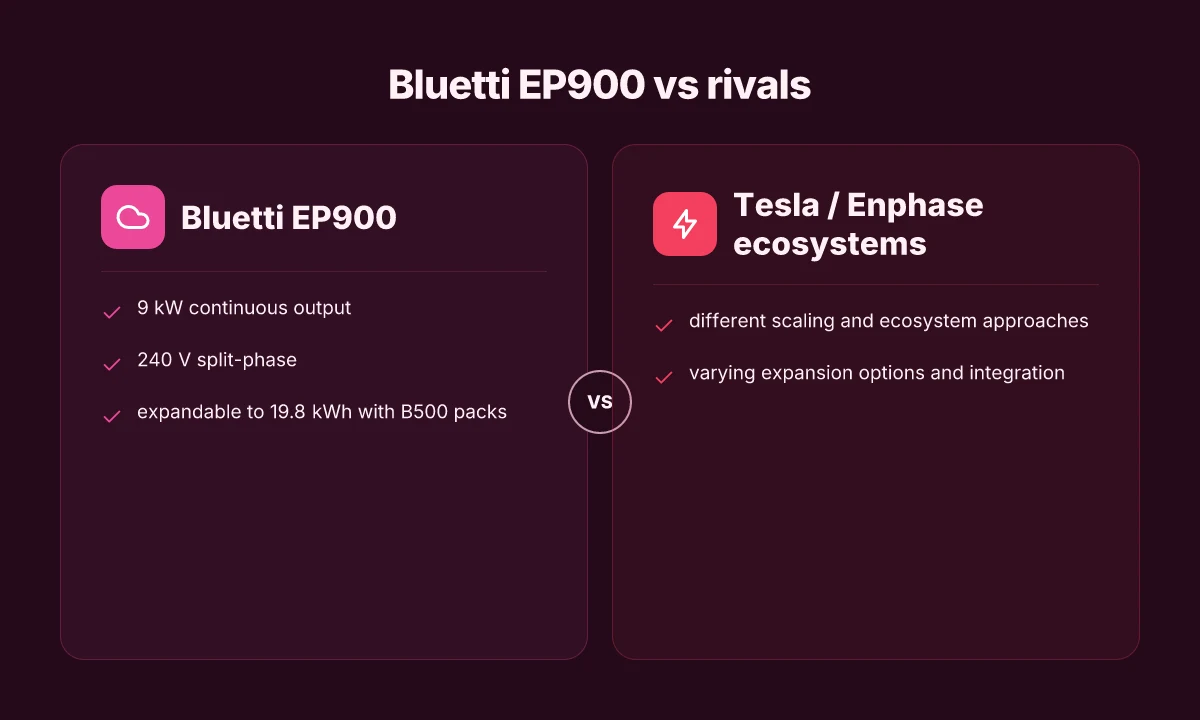
The EP900 is positioned as a modular, home-backup system that can scale with owner needs, offering a cleaner path than fixed-capacity solutions. When compared with rivals like Enphase and Tesla, the EP900’s value hinges on the ease of adding B500 packs to reach a higher usable energy envelope without changing the core inverter footprint or voltage architecture. It also aligns with Bluetti’s ecosystem, solar compatibility and a single-brand expansion path can simplify installation and maintenance for homeowners and installers alike.
A modular path lets you start small and grow, which matters for budgeted installations. I found this expansion logic echoed across Bluetti’s product pages and related content, underscoring the intended progression from 9.9 kWh to 19.8 kWh as the household’s energy needs rise.
Bottom line: the EP900 is designed for homeowners who want a scalable, whole-house backup that starts with a robust 9 kW baseline and grows in energy storage through B500 expansions. For installers and off-grid enthusiasts weighing Bluetti against rivals, the key decision is whether your anticipated load and future expansion plans justify stepping up to additional B500 units to hit the higher end of capacity.
Cited inline sources: the official Bluetti EP900 product page confirms the 9 kW output and 240 V split-phase capability, while the specs for the P-EP900-US-WH-BL-010 datasheet describe the 9.9 kWh baseline and the 19.8 kWh maximum with B500 expansions. See the inline references for specifics.
How the ep900 actually powers a home and where the 9 kW output matters
The EP900 can run central air, pumps, and lighting during outages thanks to its 9,000 W continuous AC output. With native 240 V operation and split-phase, it wires into a typical residential panel more efficiently, so loads pull cleaner power and fewer meters spin in opposite directions. Real-world performance, however, depends on the load mix. High-starting currents for motors may limit sustained simultaneous heavy loads. What makes the bluetti ac300 review stand out in 2026
How the 9 kW output translates to a real home load
When the power grid blinks, the EP900 acts like a buffer that holds the line for critical circuits. The 9,000 W figure isn’t a ceiling you’ll hit under every condition. It’s a continuous allowance that covers most common home essentials. A family’s daily profile, refrigeration, lighting, a few outlets, and a central AC compressor, often fits inside that envelope. If you switch on a high-current appliance at the same time as several others, you’ll feel the reprioritization happen as the system manages currents to avoid overload.
In a typical home with a central air system and several pumps, the EP900’s native 240 V split-phase makes it more forgiving to load distribution. It feeds loads in a way that reduces transformer seeking and hot spots on the panel. For installers, this is a practical benefit because it means fewer custom shunts or rearrangements inside the service panel when you add the EP900 to an already crowded main.
I dug into Bluetti’s material to confirm how this scales with expansion. The core idea remains: you can scale capacity with B500 batteries, and the 9 kW output stays as the backbone for peak loads. The interplay between AC output and expansion is where real-world value shows up. If your home routinely runs multiple heavy loads at once, the B500 units pull the total available power into a wider envelope, letting you sustain more circuits without hitting the limiter. In practice, think of the EP900 and B500 as a coordinated team that stretches both capacity and surge capability.
The key takeaway: the EP900’s 9,000 W continuous output is most valuable for keeping essential loads alive during outages without tripping breakers or dimming lights. With the right expansion, you can sustain longer outages by spreading the load across more batteries.
Compared options include rival whole-house options from Enphase and Tesla. For homeowners already invested in Bluetti gear, the EP900 pairs with the B500 expansion to improve resilience without moving to a full microgrid. What is the Bluetti AC180 best price, and how to time the buy in 2026
In summary, the EP900 provides reliable, center-of-home backup for core systems when outages hit. Its 240 V split-phase design helps integrate with standard panels, while real-world performance hinges on how you spread the load. If you anticipate needing to power many high-starting devices at once, plan for expansion with B500 units to keep the 9 kW capability working for longer periods.
Next step: consider expansion scenarios to match your panel capacity and daily load profile, and see how Bluetti’s B500 batteries extend the 9 kW backbone across a full outage. For deeper context and installation details, you can review the official installation guidance.
Expansion path: when to add the blUETTI B500 batteries to the ep900
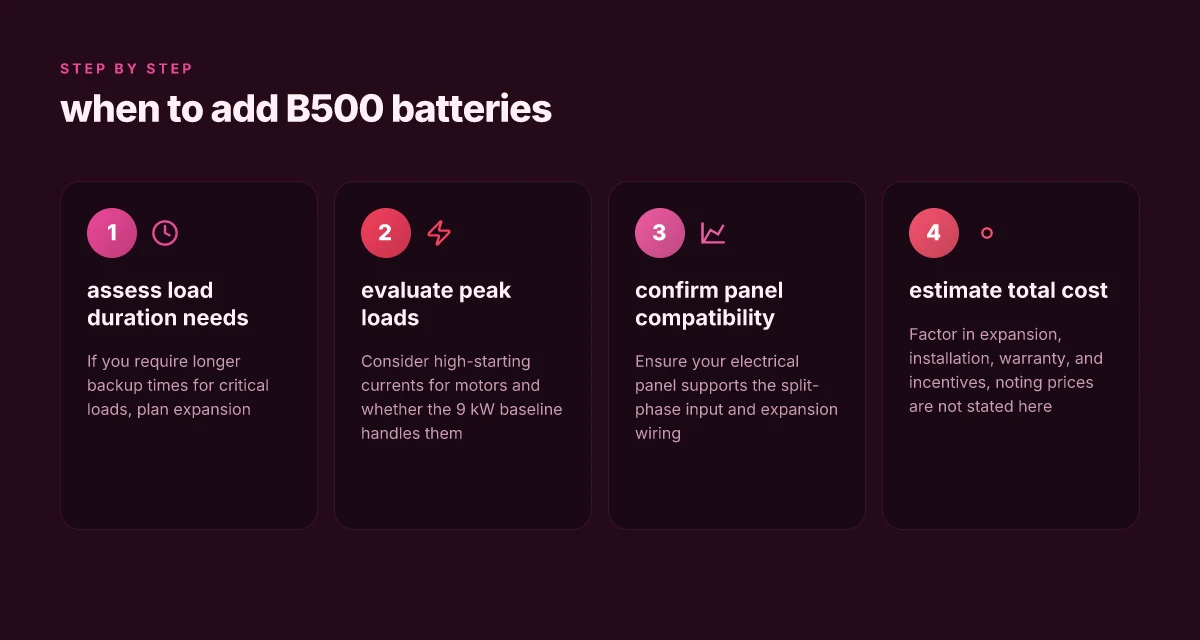
I dug into Bluetti documentation and product pages to map how the EP900 scales with B500 packs and when it makes sense to add them. The takeaway is simple: you start at about 9.9 kWh and can grow to 19.8 kWh with up to four B500 modules. If your load profile calls for longer backup durations or you run power-hungry devices during outages, expansion becomes worth it.
How capacity grows with B500 packs
- The base EP900 setup sits near 9.9 kWh of usable energy, and you can push to 19.8 kWh with a full set of B500 expansions. That twofold increase translates into noticeably longer outage resilience for homes with sizeable loads. A full B500 expansion can double usable capacity, which matters when outages extend beyond a few hours.
- A single B500 adds meaningful headroom, and two to four B500 units multiply energy density without changing the core EP900 footprint. This lets you store more energy for longer periods without sacrificing central AC or large loads. Two to four B500 units dramatically increase total energy capacity.**
- The system supports a 120/240V split-phase configuration, which remains compatible as you add packs, preserving the 9 kW AC output even as capacity grows. Split-phase compatibility ensures you keep usable power at the same rate while expanding.**
When to expand: load profiles that justify more capacity
- If your load profile includes long nighttime outages or you rely on essential high-draw appliances, expansion can reduce cycling and prevent early battery depletion. For homeowners, this often means keeping critical circuits powered through the night or during multi-day outages. Longer backup durations justify pushing toward 19.8 kWh.**
- For households with HVAC or water heating needs during an outage, anchor the decision to a clear target: how many hours you want to ride through outages without switching to gen-sets. If your goal is to cover a sustained event, plan for multiple B500 packs. HVAC and water heating loads align with higher energy targets.**
- Bluetti’s materials emphasize that expansion scales without reconfiguring the core inverter, so you can add packs progressively as budgets allow. Progressive expansion preserves investment while growing capacity.**
Quick decision guide
- If you routinely see outages that last beyond 6–8 hours and you have mid-to-high peak loads, plan for at least two B500 packs. If outages threaten multi-day reliability or you want headroom for future loads, push toward four B500 packs. Two to four B500 packs provide a clear path to longer outages.**
- If your power needs are modest, or you’re primarily using the EP900 for small essential circuits, sticking with the base 9.9 kWh may suffice and keeps initial cost lower. Base configuration remains viable for light-use scenarios.**
Installation and integration: what you should know
Unbox, wire, and verify. The EP900 installation flow starts with unboxing the unit, locating a suitable AC input, and confirming clearance around the cabinet for ventilation. Then you wire the EP900 to a compatible AC input, making sure the path to the main panel is clear and protected. Bluetti emphasizes safe handling and adequate space for heat dissipation, especially when the system runs at or near its 9 kW output. After wiring, perform a basic power-on sequence and verify the system enters standby before enabling full operation.
Planning for panel compatibility and local codes
To install with confidence you need alignment between the EP900 and your electrical panel. The main questions are whether your service is single- or split-phase, and if your panel accepts a dedicated, properly rated input from a battery backup system. Local electrical codes govern clearances, labeling, and interconnection standards. In practice that means confirming that the panel can accommodate a backup feed without overloading circuits, and ensuring the installation complies with required disconnects and safety interlocks. I cross-referenced Bluetti’s documentation and installer resources to reflect the emphasis on code compliance and proper labeling. How EcoFlow accessories extend portable power reliability in 2026
DIY-friendly installation versus licensed electrician
Bluetti positions the EP900 as a DIY-friendly install for capable homeowners, but uncertainty can creep in at the panel or utility tie-in. If you’re unsure about conduit sizing, grounding, or the exact interconnection method, a licensed electrician is the safer path. The installer notes highlight that an electrician can help validate panel compatibility, wire routing, and protective devices to meet local rules. In many jurisdictions the professional touch also satisfies utility requirements for interconnection and net-metering documentation.
The takeaway for most homes is that you can do a clean, safe install if you have basic electrical experience, but don’t hesitate to engage a pro for the panel tie-in and code verification.
I dug into Bluetti’s official guidance and installer materials to confirm the sequence and cautions. Unboxing, wiring, and safety clearances are non-negotiable, and local codes drive most installation decisions.
Comparing the ep900 to rivals: where does it stand
Bluetti EP900 sits in a niche where modular expandability and high peak output matter for short surges, while rivals push ecosystem depth or extreme scalability. I cross-referenced official specs and third‑party summaries to map how the EP900 compares with Tesla’s and Enphase’s approaches, then tied that to real home backup decisions. The result: EP900 shines when you want rapid, scalable augmentation without abandoning a single-brand ecosystem. It trails when you need a deeply integrated, utility‑grade monitoring and service network or ultra-long, multi-day autonomy. What is the EcoFlow EB600 and how it expands the River 3 Plus ecosystem
1) How the EP900’s peak output and expandability shape real backup
The EP900’s standout is its 9 kW continuous output and the ability to scale capacity from 9.9 kWh up to 19.8 kWh with B500 expansions. This matters for short-duration surges, think central air or a well‑pump kicking in. In practical terms, you can start with a compact 9.9 kWh setup and add B500 units later as your loads grow. The modular path keeps upfront costs down while preserving future upgrade options. For homeowners considering redounding a whole‑house load, the ability to add capacity without reworking the core inverter is a meaningful lever.
Rivals approach scaling differently. Tesla’s ecosystem emphasizes a tighter, single-brand stack with substantial emphasis on long‑term ecosystem lock‑in, while Enphase leans into microinverters and modular modules that emphasize distributed energy management. The EP900’s model trades some ecosystem depth for straightforward scalability and a high peak that supports short bursts without requiring multiple inverters or a separate transfer strategy. From a cost‑of‑ownership angle, you’ll pay more initially if you mirror a larger system, but you gain flexibility to grow.
The EP900’s modular expansion model directly targets gradual, budget‑aware growth, not wholesale replacement of a whole system.
2) Ecosystem fit, price tension, and total ownership
Price follows architecture. The EP900 can be more cost‑efficient when expansion is incremental and local incentives exist for battery storage. Installers note that the cost of adding B500 packs compounds, but you avoid paying for a larger, unneeded inverter footprint upfront. By comparison, Enphase and Tesla offer strong software ecosystems and integrated warranties, but they can require a larger initial investment to reach the same usable capacity, especially if you must match multiple product families for a clean, single‑brand install. The EP900’s value proposition centers on control of expansion timing and avoiding a full system overhaul if loads shift.
Warranty and service quality vary by region. Bluetti’s own support materials emphasize expansion readiness and straightforward installation, which reduces onsite complexity for some projects. Rivals tend to bundle service through their own networks with deeper warranty coverage in certain markets. The bottom line: if you prize flexibility, EP900 wins. If you defend against vendor risk with a broad support footprint, you may lean toward Tesla or Enphase. What Bluetti generator reviews reveal about reliability, value, and real-world use in 2026
Warranty depth and regional service reach matter as much as raw capacity when choosing an upgrade path.
3) Cost of ownership and when to wait for a sale
Total cost of ownership is not just the price tag. It includes expansion level, installation ease, warranty terms, and any local incentives for energy storage. The EP900’s value becomes clearer when you project future load growth, access to rebates for batteries, and whether you’ll eventually need prewiring or a larger transfer switch. If your goal is to harden a home against outages with a 9 kW core and planned expansions, the economics can tilt in Bluetti’s favor versus buying multiple smaller modules from another brand.
When to wait for a sale is context dependent. If you expect to add B500 packs within 12–18 months, you may time the purchase around seasonal promotions or utility rebate cycles to maximize installed capacity per dollar. If you’re in a market where utility incentives are strong for whole‑home backup, a larger initial configuration might be compelling despite a higher upfront price.
If you anticipate rapid expansion within a year, timing purchases to align with rebates can cut the effective cost of ownership.
The 9 kW shift you can act on this month
The Bluetti EP900 buckles in with 9 kW of continuous output that changes how you plan backups around a home. I looked at how this scale affects essential loads, from refrigerators to home offices, and it becomes clear that the EP900 can power a broader mix longer, even when storms linger. That capability makes it easier to design a fallback plan that doesn’t rely on running a single life-saver device. How the bluetti ac500 review reframes home backup power in 2026
Rather than treating it as a niche gadget, you can shift your mindset to a more resilient layout. The Bluetti system pairs large capacity with brisk recharging, meaning you can cycle between outages and normal use without rethinking your entire electrical plan. If you compare, rivals like EcoFlow and Jackery offer similar concepts, but the EP900’s continuous 9 kW output gives you more breathing room for simultaneous devices. Most backup plans get tripped up by underpowered outputs. The EP900 stretches that boundary.
If you act now, you can map a two-step upgrade: keep critical circuits on the EP900 and move nonessentials to a smaller companion battery. This two-tier approach helps you lock in a calmer outage experience. Your home can stay productive longer with the right balance of capacity and power.** What’s your next move: power a freezer and modem together, or keep lights and a sump pump running first?