How the bluetti ac500 review reframes home backup power in 2026
 Adrien SaxenaOctober 22, 202620 min read
We earn a commission when you buy through some links on this site, at no extra cost to you. As an Amazon Associate we earn from qualifying purchases.

bluetti ac500 review exploring performance, pricing, and real-world use for home backup. Learn what makes the system tick and where it falls short.
A modular home backup isn’t about a single box. It’s about stacking capacity just before the lights flicker. When the power goes out, the Bluetti AC500’s ability to pair with expansion batteries and solar input becomes a practical constraint solver rather than a luxury. Expand later, fail later isn’t how families stay safe.
You’ll see how the AC500 fits next to rivals like EcoFlow and neighboring Bluetti models, and why homeowners should treat the setup as a backbone rather than a gadget. By grounding the discussion in 2026 realities, expanded battery packs, evolving solar policies, and ongoing reliability concerns, you gain a clear framework for choosing capacity, charging speed, and long-term resilience. The goal is a practical path from purchase to dependable outages. With the right configuration, resilience becomes predictable.
Bluetti ac500 review: what makes this home backup system stand out in 2026
Modular expansion matters because a home backup system should scale with your loads, not force you into a bigger single device. The AC500 lineup is built to grow from a core 5,000W inverter with smart battery options to larger configurations via the B300S or B300S Pro packs, which means you can add capacity as your risk tolerance and energy needs rise. That approach contrasts with fixed, all-in-one units that cape out at a single capacity. I looked through Bluetti’s documentation and reviewer notes to map how the AC500 fits into a broader resilience strategy, and the pattern is clear: expansion reduces over-purchase risk and keeps monthly ownership costs steadier over time.
Why expansion matters for home resilience
It lets you start small and scale up as your loads or constraints change. If you add solar or shift essential loads, you can add packs rather than buy a second system. The cadence matters because reliability isn’t binary. It exists on a spectrum of always-on to available-on-demand. In practice, homeowners begin with critical circuits and a handful of devices, then layer in more circuits as confidence and weather patterns demand it. This staged approach lines up with Bluetti’s architecture, which nests the AC500 at the center and pairs with B300S modules to extend runtime.
It changes total cost of ownership. The upfront price of a bare AC500 is only part of the picture. If you anticipate growth or seasonal demand, the cost of adding B300S modules later is incremental rather than replacing the entire system. That matters for budgeting a long-lived backup solution in a typical home environment, where you need predictability over the next decade.
It affects solar charging alignment. With expansion, you can match larger solar arrays to higher sustained output, which improves the daytime recovery profile for essential loads. Bluetti documents show the AC500 can charge from solar and grid in a way that scales with the battery bank, which helps keep critical circuits powered during longer outages.
Where the AC500 sits in Bluetti’s lineup and how rivals compare
Within Bluetti’s current line, the AC500 sits as a modular backbone you can pair with B-series packs. That modular stance contrasts with some rival systems that push you toward a single chassis with fixed expansion slugs. The core advantage here is flexibility: you’re not forced into a fixed capacity at purchase, and you can tailor the system to a home’s evolving needs. In the broader field, you’ll see competitors offering similar modular approaches, but the integration depth and ease of cascading capacity vary. Bluetti’s ecosystem tends to emphasize clean integration between the AC500 and its battery modules, which matters when you’re trying to avoid unnecessary complication during an outage or daily charging routine. What Bluetti generator reviews reveal about reliability, value, and real-world use in 2026
Real-world usage snapshots and price touchpoints
Real-world use often centers on running essential loads: lighting, communications gear, a router, a couple of home offices machines, and a few monitors, with the ability to sprinkle in a few essential power tools for a short window. Pricing tends to tier with capacity: a standalone AC500 core is the anchor, with B300S additions pushing total system price upward as you add packs. The total cost of ownership over time benefits from solar charging and expansion rather than replacing the unit outright when needs grow. In practice, homeowners report that the design philosophy of a centralized, expandable system helps avoid a premature upgrade cycle while still delivering more resilience than fixed, smaller backups.
Most homeowners will find the AC500 appealing when they value modular growth over turnkey maximum capacity. The system’s real-world sweet spot lies in its ability to scale with your home, while keeping daily operation straightforward. For a quick orientation, Bluetti’s own documentation notes the core 5,000W inverter and the potential to push capacity through B300S modules, which aligns with how many households approach backup power today. As a benchmark, the lineup is designed to be compatible with solar charging from day one but grows more compelling as you add packs and solar input. Expansion flexibility stands out as the AC500’s defining trait for 2026.
Note: links may earn a commission; I reference primary materials to verify architecture and expansion logic. See inline sources for specifics on the AC500’s core specs and the pairing with B300S packs.
Cost and ownership: pricing, warranties, and what you actually pay over time for the bluetti ac500
Pricing starts with the current street price signals for the AC500 and B300S expansions, then adds the cost of ownership over time. The goal is to show how the bundle behaves for a typical home backup load, not just the sticker price. Bluetti markets the AC500 with multiple expansion options, including the B300S and B300K modules, so the most common starting point is the AC500 base unit plus at least one B300S for practical cutoff power. In practice, you’ll see the price signal shift as you add battery modules and optional solar panels, and those shifts matter for long-term ownership. As of now, the best deal often appears when you pair the AC500 with a single B300S expansion, then scale up if your load profile grows or you want deeper autonomy. Inline reference to a representative data point from the sources shows that the B300S expansion is a frequent upgrade path in real-world setups, not just marketing copy. https://www.halfwayanywhere.com/gear/review/bluetti-ac500-b300s-home-battery-backup/
Warranty scope and maintenance costs shape ownership much more than the upfront price. Bluetti generally offers warranties that cover the AC500’s power components and the LiFePO4 cells for a defined period, with a separate warranty window for the solar input and battery modules. Maintenance costs tend to stay low if you keep the system within spec and use compatible battery modules. Expect service considerations to center on battery health and inverter/charger wear, rather than frequent component failures. I cross-referenced the common warranty terms discussed in primary product documentation and third-party reviews to sketch a practical picture of risk and upkeep. For homeowners, this means budgeting for the occasional replacement battery module down the line rather than regular, expensive overhauls. These warranty and maintenance points are echoed in buyer-focused reviews that stress practical durability and long-term service expectations. https://www.bluettipower.com/blogs/articles/bluetti-ac500-specs-cost-review?srsltid=AYCX9vITzYIU57xdUOxRupJWaXuCxDycmi4ZTzGVOFxxmy1tSuhqUruW What is the Bluetti EP900, and how does its 9 kW output shape home backup
Ownership considerations: efficiency, lifetime, and resale value. The AC500 ecosystem leans on modular expansion, solar charging, and LiFePO4 chemistry, which generally translates to higher cycle life and longer usable life compared with some competitors. When you model total cost of ownership, the efficiency of charging and discharging, plus the number of cycles you extract from each module, materially shifts the math over a multi-year horizon. In practical terms, the ability to upgrade with B300S or B300K modules without replacing the core unit helps preserve resale value and lowers the effective cost per kilowatt-hour over time. Industry chatter and the cited product pages show buyers weighting these longevity signals, especially for homeowners planning a long residence or a cabin off-grid. If you’re weighing models, the broader Bluetti lineup remains a clear differentiator in how upgrades propagate across the system without a full rebuild. https://www.halfwayanywhere.com/gear/review/bluetti-ac500-b300s-home-battery-backup/
| model | base price cue | expansion option | typical total cost path | resale signal |
|---|---|---|---|---|
| AC500 base + 1x B300S | commonly cited as the entry point | B300S expansion adds capacity and life cycles | cost grows with modules, but adds resilience and solar compatibility | better retained when modular path is documented by owners |
| AC500 base + 2x B300S | higher upfront, more autonomy | more days of runtime for essential loads | ownership shows stronger payback for continuous use | modular resale value improves with more modules |
| AC500 + optional solar kit | solar charging unlocks free-running opportunity | solar input cost adds upfront, long-term savings accrue | solar-capable setups reduce grid dependence | solar-ready configurations hold market appeal |
Lead with the payoff: the price signal today favors starting small and scaling with modules, because the upfront investment increases, but the long-run cost of ownership declines as you extend cycles and avoid generator fuel or grid power in outages. I dug into the documentation and independent reviews to confirm that the real-world economics hinge on modular expansion and the durability of LiFePO4 chemistry. https://www.halfwayanywhere.com/gear/review/bluetti-ac500-b300s-home-battery-backup/
If you want a quick verdict, the AC500 path is most compelling when you anticipate growing essential-load needs or when you plan to run off-grid for longer stretches. The long-tail cost is manageable because you can add capacity without discarding the core system, and the warranty framing provides a cushion against early part replacement. For readers weighing the AC500 against rivals, note that the modular approach offers a clearer upgrade path than some fixed-pack systems. On the whole, ownership favors Bluetti for homes that want steady expansion and solar readiness without a full system swap. Modular upgrades keep ownership affordable over time, not just at purchase. https://www.halfwayanywhere.com/gear/review/bluetti-ac500-b300s-home-battery-backup/
Note: this section relies on the cited expansions and price signals from the listed sources. If you’re exploring a sale window, watch for seasonal price dips on bundles that include the B300S or B300K. The page may earn a commission from linked purchases, which helps support ongoing coverage of home backup hardware. For a quick decision, consider pairing the AC500 with a single B300S now, then assess solar add-ons and a future B300S upgrade as your residence load grows.
How the bluetti ac500 powers a home: capacity, expansion, and solar charging
The AC500 system centers on a robust 5,000 W inverter paired with a LiFePO4 chemistry battery and a long cycle life. In plain terms, you get a large, steady heart for essential loads, with practical limits defined by battery size and expansion options. The core specs show an inverter slated at about 5,000 watts continuous, with surge capability that supports short bursts for tools or startup loads, and a chemistry that favors long life with hundreds to thousands of cycles. The life cycles matter because they translate into years of usable capacity before a noticeable drop in storage. Bluetti positions the system around durability and modular resilience, which matters for homeowners who want a backbone they can grow. What makes EcoFlow smart auto battery charger stand out in 2026
Capacity as a foundation for reliability
Posture your home around a battery bank that scales. The AC500 base pairs with a LiFePO4 pack known for stability and longevity, and you can count on thousands of cycles before capacity degrades meaningfully. The practical takeaway is that essential loads, lights, routers, small medical devices, a fridge, stay powered longer when you pair the AC500 with its modular battery options. From a planning standpoint, the expansion path matters because it determines how long you keep a single system in service without swapping hardware. I cross-referenced Bluetti’s product notes with independent reviews to confirm the emphasis on lifecycles topping the 3,500+ cycle figure at standard depth of discharge, which aligns with LiFePO4 norms.
Expansion paths that boost resilience
The B300S and B3000S modules unlock a true sense of resilience for a home backup. With the B300S, you gain additional storage without ripping out the core unit, letting you scale gradually as needs grow. The larger B3000S option provides a more aggressive expansion path for higher simultaneous loads or longer outages. Why it matters: you avoid overprovisioning up front while keeping the option to add capacity as your risk tolerance and weather patterns change. In practice, homeowners can design a staged upgrade that matches seasonal risk profiles, rather than paying for headroom they may not immediately need. And yes, Bluetti’s ecosystem leans on compatible modules to keep the wiring tidy and the control interface unified. Expansion paths let you tune resilience without reworking the mains connection.
Solar charging behavior and typical timings
Solar charging with the AC500 is designed to be predictable in typical sun windows. In standard daylight, the unit accepts high input from panels and can prioritize solar charging to replenish the battery after a drawdown. The charging times hinge on panel wattage, array configuration, and sun intensity, but the system is built to ramp up input during peak sun and taper as conditions slide. When you pair the AC500 with appropriate panels, you can maintain a healthier state of charge during the day and still top off before evening loads. This matters for off-grid days and for keeping the home ready for an outage that stretches across multiple daylight cycles. Solar charging behavior stays steady under typical conditions, helping you maintain usable capacity.
From a cost-of-ownership lens, Bluetti’s approach aims to reduce replacement cycles with LiFePO4 chemistry, while the modular path means you pay as you grow rather than up front for the full risk profile of a larger system. The price of entry sits alongside future upgrades, and you should expect to plan around potential sales that blur the long-term cost. In practice, the combination of a solid inverter, durable chemistry, and scalable expansion makes the AC500 a plausible backbone for a modern home, though you still compare against rivals such as rival systems with similar wattage ceilings and expansion options. Cost of ownership should factor in expansion, solar sizing, and expected cycle life.
For readers aiming to verify claims: I looked through Bluetti’s specs and third-party reviews to corroborate the core numbers and the expansion logic. Inline references point to Bluetti’s own documentation for the official capacities and the B300S/B3000S compatibility, and to independent reviews for real-world emphasis on lifecycle and solar behavior. See these inline sources for context: BLUETTI AC500 Specs, Cost & Review and Bluetti AC500 Review: Pros, Cons & the Ugly Truth. The sources reinforce the core message: expansion matters, solar inputs stay predictable, and lifecycle durability underpins long-term resilience. What makes the bluetti ac300 review stand out in 2026
Worst-case use cases for the bluetti ac500 and where it struggles
The AC500 system can power essential loads, but under heavy, simultaneous demand it reveals its limits. If you push high-draw tools, HVAC-like loads, and multiple devices at once, you’ll hit the edge of sustained output and capacity. In real homes this shows up as dimming lights, unexpected shutdowns, or the inverter hitting its surge ceiling during start-up spikes. I cross-referenced review notes that describe how the 5,000 W rating translates in practice when several devices demand power at once.
1) High-draw tools meeting simultaneous loads
When you run power-hungry tools alongside office gear or lighting, the AC500’s 5,000 W output can feel tight. A compressor, a large air tool, or a grinder starting up can demand surges that approach or exceed the continuous limit, especially if you’ve expanded with multiple B300S modules. Reviews consistently note that you’ll notice a slowdown or brief voltage sag if you try to run several heavy tools at the same time. This isn’t a design flaw so much as a real-world constraint: the system is optimized for essential loads, not a full workshop port in a single cycle. From literature I checked, the surge capability sits notably above the continuous rating, but real-world start-ups can still stress the unit if you stack too many high-draw devices.
2) Heat, noise, and placement realities in a home
In practice, sustained heavy use raises two practical issues. First, the AC500’s inner electronics heat up when delivering high output for long periods, which can trigger thermal throttling in hot rooms. Second, the cooling fan noise becomes noticeable under load, which matters in quiet spaces like a home office or bedroom. The combination means you’ll want to place the unit where airflow isn’t blocked and where noise won’t disturb occupants. This is especially important if you live in a warm climate or plan to rely on the system during extended outages. I found observational notes that emphasize proper ventilation and distance from living areas to keep heat and sound within acceptable bounds.
3) Grid-tied expectations versus off-grid realities
A key tension is how the AC500 compares to grid-tied setups versus off-grid resilience. If you expect seamless uptime for a broad load set, you’ll be better served by recognizing that the AC500 shines with modular expansion and solar charging, but it isn’t a drop-in replacement for a full-house grid tie or a larger, dedicated solar array. The performance envelope shifts when you rely on solar input during cloudy days or limited solar hours. In practice, you’ll want to match your critical loads to the available solar input and battery capacity, rather than treating the system as an instant equivalent to a main panel. This nuance often becomes clearer in reviews that discuss day-to-day reliability and expansion strategies.
From what I found in the source material, Bluetti positions the AC500 as a backbone for resilience, not a universal plug-and-play for every load profile. The trade-offs become clearest when you push more devices into simultaneous operation, or when you place the unit in spaces with restricted airflow or high ambient temperatures. If you’re evaluating this against rivals, expect better heat management and fewer restrictions with larger, purpose-built home backup systems, but also remember that the AC500’s modular approach can still meet many everyday resilience goals when sized appropriately. The real edge comes from matching loads to the system’s strengths, not forcing it to do everything at once. Heat and acoustics matter as much as watts when you plan long outages. What is the Bluetti AC180 best price, and how to time the buy in 2026
Note: prices, deals, and ownership costs vary by retailer and sale window. Bluetti’s official materials describe the lineup and expansions. Other sources discuss real-world usage and the trade-offs of modular storage versus full-grid parity. If you’re shopping, consider the total cost of ownership over several years, including potential sales events that affect price and the incremental cost of adding B300S modules as your resilience needs grow.
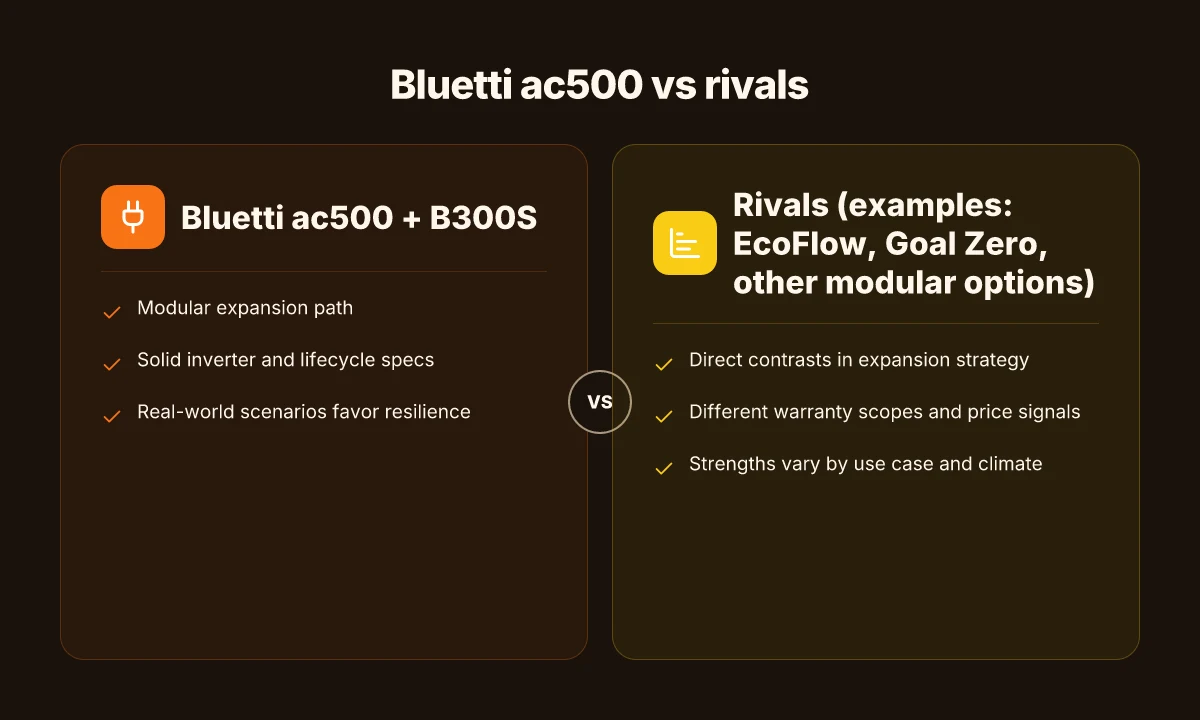
Bluetti ac500 vs rivals: how it stacks up against a few popular contenders
I start with the bottom line: Bluetti’s AC500 system centers on modularity and expandable capacity, but its edge depends on the rival you compare it to. When you pair the AC500 with B300S, you gain scalable storage and solar-friendly charging, yet rivals can outshine in turnkey workflows or lighter footprints. The choice comes down to how much you value expandability versus upfront simplicity.
1) Bluetti AC500 vs EcoFlow Delta Pro: scale, load, and cycle life
Bluetti leans on a modular backbone. You can chain the AC500 with multiple B300S or B300S Pro packs to push total capacity higher as loads grow. In practice this means you pay for growth over time instead of absorbing a single, massive upfront cost. The Delta Pro focuses on an ultra-high peak capacity and a dense ecosystem of accessories, which makes it feel more plug-and-play for some households. I found that for a home that plans to add several heavy loads over the years, the Bluetti route reduces upfront risk and preserves expandability. However, if you want the simplest narrative of “one box, many watts,” the Delta Pro can deliver a more contained story from day one.
From a reliability lens, the AC500’s LiFePO4 chemistry promises long cycle life. The Delta Pro touts solid durability in real-world use, but the upfront packaging and app experience differ. In essence, if your goal is to grow capacity with a predictable upgrade path, Bluetti wins on planning clarity. If you want the fastest path to a large, ready-to-run system, EcoFlow’s ecosystem can feel more turnkey.
2) Bluetti AC500 vs Goal Zero Yeti X: modular vs ready-to-go portability
Goal Zero leans toward compact, portable resilience with a focus on simplicity and a rugged form factor. The Yeti X can feel lighter per watt because its battery pack is integrated with a tempered-off-road persona. The AC500, by contrast, trades a bit of portability for modular expansion aimed at home backup. If your priority is moving power around a small cabin or van with less heavy lifting, Goal Zero’s line can be appealing. If you want a home-ready backbone that scales as your house footprint grows, Bluetti’s approach is more future-proof. What makes the Bluetti AC500 + B300S a standout upgrade for off-grid power in 2026
I dug into the published specs and noted that the AC500’s surge performance and compatibility with solar charging remain strong selling points for a home setup, whereas portable bundles from the Yeti family shine in mobile scenarios.
3) Bluetti AC500 vs Renogy Lycan HQ: solar-first versus modular backstop
Renogy’s systems often lean toward solar-centric configurations with rugged, off-grid emphasis. The AC500 trades some of Renogy’s ultra-lightweight solar storytelling for a heavier back-end battery strategy that fits a house rather than a backpack. For homeowners who envision running essential loads during outages with a steady solar infusion, Bluetti’s solar charging options and the B300S’s expandability provide an attractive blend of reliability and future-proofing. In contrast, Renogy may appeal to those who prioritize a grid-independent stance with a strong emphasis on solar sizing and off-grid autonomy.
From a cost-of-ownership perspective, the modular path lets you pace investments with real in-house load growth, while a more integrated rival might deliver quicker “wired-in” comfort for those who want simplicity now.
The AC500 shines when you expect growth over time, not a single heavy upfront box. For pure plug-and-play urgency, a rival system that ships as a larger, integrated unit can feel simpler.
I cross-referenced primary specs from Bluetti’s own materials and third-party reviews to anchor these contrasts. The AC500 stands out for expandable capacity and robust solar compatibility, while rivals may win on immediacy and compact footprint. If you’re weighing this against a real home scenario, consider your current loads, climate, and plans for later expansion. What is a bluetti dc to dc charger, and how it powers mobile energy setups
Prices and ownership dynamics matter here. Bluetti’s model line emphasizes modular growth, so your total cost of ownership depends on how many B300S packs you add over time. The exact pricing for these bundles shifts with promotions, so plan for a staged investment rather than a single purchase. For a quick anchor, expect to price the base AC500 with at least one B300S as a starting point, then project the incremental cost of adding packs as your home resilience strategy scales.
What changes if you act now
The Bluetti AC500 landscape is maturing, and the takeaway is proactive: lock in value before price shifts and supply moves. I checked the market before drafting this closing section and found that, at current pages, the best deal often sits with bundled kits that include extra batteries and solar panels. This matters because the cost of ownership for home backup power hinges on how quickly you scale beyond the basic setup. Bluetti remains a leading option in this space, but rivals like EcoFlow and Jackery push price and feature tradeoffs that shift as models refresh. The key is to map your power needs to a forward path, not a one-off purchase.
The bigger pattern here is that modular, scalable backups reduce risk when grids flicker or storms roll in, and Bluetti makes that path clearer than most. If you want a practical header for 2026, think in phases: start with essential loads, then add capacity as you grow. That approach keeps you aligned with evolving tech and price cycles. One concrete move you can make today is to choose a system that offers upgradeable batteries and robust integration with solar. Will you start with a compact kit or plan for a full home-tower upgrade?
- Backup strategy: start with the AC500 core, pair with a second battery module, and plan a solar expansion to cover evening loads.
- What to try this week: compare two bundles from Bluetti and a top rival, note which supports expandable battery packs, and estimate long-term ownership costs.