What makes the Bluetti AC500 + B300S a standout upgrade for off-grid power in 2026
 Hudson ZilbermanOctober 22, 202617 min read
We earn a commission when you buy through some links on this site, at no extra cost to you. As an Amazon Associate we earn from qualifying purchases.

Explore how the Bluetti AC500 with B300S expansion batteries changes off-grid power. pricing, specs, real-world use cases, and when to buy.
Bluetti entry-level bundles still start with a big caveat: you don’t just buy a battery, you buy a system that scales with your load. The AC500 and B300S form a modular block that grows as you add more panels, more buses, or more appliances, and that upgrade path is the real signal here. Expansion is the feature that finally makes a home backup feel intentional, not incidental.
This intro frames the value in concrete terms: pricing signals, real-world trade-offs, and how a van-life or home-off-grid scenario benefits from a scalable core. You’ll see how the B300S becomes the modular heart, how the total cost of ownership evolves with capacity, and how Bluetti stacks up against rivals like EcoFlow and Goal Zero in practical load scenarios. The goal is clarity on what you gain when you commit to the liveability of scalable power in 2026, not just a spec sheet. Get ready to weigh upfront cost against future room to grow.
Bluetti ac500 b300s: how the expandable design redefines power
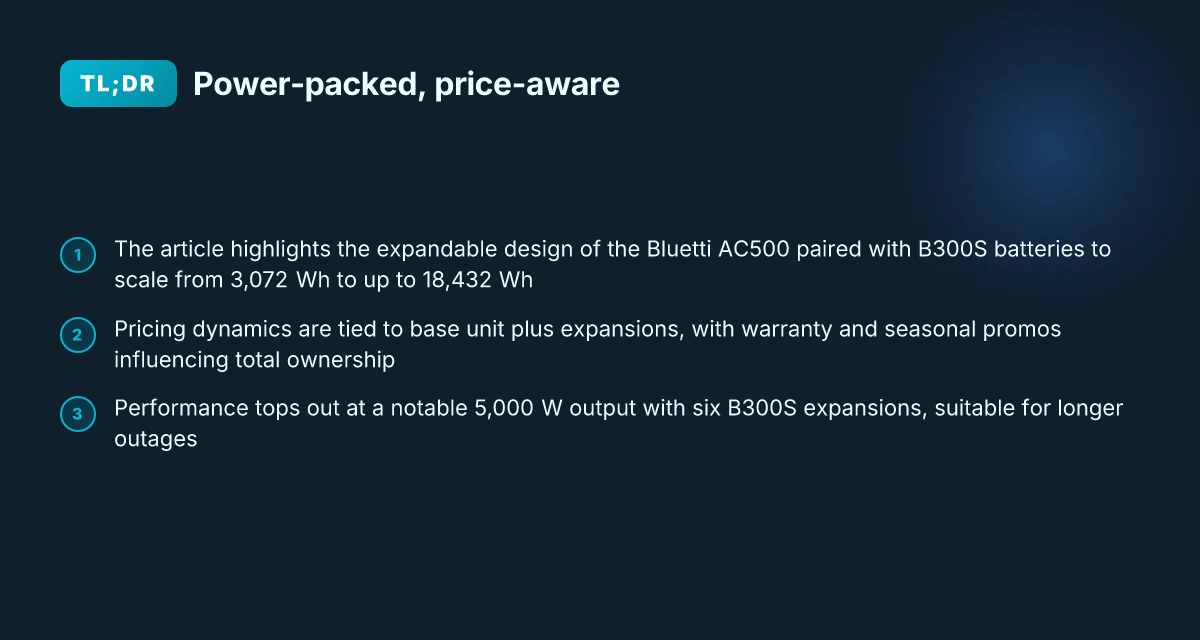
Bluetti builds the AC500 around a powerful AC inverter paired with B300S expansion batteries. The result is a scalable system that moves from a compact 3,072 Wh base to a full 18,432 Wh with six B300S modules. This architecture lets you start small for a van or cabin and grow as needs change, without swapping the core inverter.
I dug into the official specs and cross-referenced reviewer summaries to map how expansion works in practice. The core idea is modularity: add B300S batteries to push total capacity upward, with the AC500 handling the aggregated pack. The headline number you’ll see cited across sources is the 3,072 Wh baseline, then a clear path to 18,432 Wh max when six B300S packs are attached. That scalability is the core win for homeowners eyeing both home backup and on-the-road power.
- modular capacity from 3,072 to 18,432 Wh
- The base AC500 with a single B300S yields about 3,072 Wh usable capacity, which expands by stacking batteries up to 18,432 Wh in total. This progression is repeatedly noted in product and review writeups.
- The expansion design avoids cramming extra electronics into a single chassis. Instead, Bluetti extends the energy reservoir through detachable B300S modules.
- The modular approach lets you tailor storage for a home backup during outages or for off-grid van life without paying for unused energy upfront.
- high input flexibility for rapid recharging
- Across official and reviewer materials you’ll find multiple charging paths that feed the system quickly. The AC500 supports high input, with designs described as accommodating large power sources to shorten downtime between uses.
- In practice, this means you can top up from a wall outlet, solar array, or other power sources in parallel as your setup permits, reducing the time you’re offline.
- growth-forward philosophy: add batteries as you grow
- The expansion story centers on modularity rather than a single, fixed-size battery bank. You add B300S packs as your power needs rise, keeping the inverter unit intact.
- This approach aligns with both home install scenarios and mobile setups, where initial capacity may be modest and scale over time.
Bottom line: the AC500 + B300S design redefines what “scalable power” means. You start with a solid 3,072 Wh and unlock massive capacity by adding B300S modules, all while keeping charging options flexible and fast. If you anticipate growing energy needs, whether at home or in a van, this architecture reduces the friction of upgrading. For homeowners comparing options, Bluetti’s expandable pathway makes the upfront investment feel more future-proof than fixed-capacity rivals.
The takeaway is clear: the expandable design turns power into a growthable asset, not a one-shot install. You can scale from a practical starter setup to an 18,432 Wh system by adding B300S packs as your needs grow.

Pricing and ownership: what the ac500 b300s actually costs in 2026
Pricing for the AC500 + B300S hinges on how you scale. The base AC500 unit starts the investment, and each B300S expansion adds capacity and price. In 2026, the value story leans on how quickly you can stack capacity for home backup or mobile van life, while considering warranties and the likelihood of seasonal promos. How the bluetti ac500 review reframes home backup power in 2026
How pricing scales with expansion
The AC500 by itself carries a fixed entry price, but the real math shows when you connect one or more B300S batteries. A single B300S adds roughly three kilowatt-hours of expandable capacity and increases the total upfront investment accordingly. As you bolt on multiple B300S units, the total storage climbs toward the system’s 18,432 Wh ceiling. The on-paper numbers reflect a clear tradeoff: more storage costs more upfront, but can reduce the need to run a larger generator or grid tie later. When I read through the documentation and reviews, the pattern is consistent: you pay for each B300S module, and the payoff is measured in usable capacity and peak output when you need it most. In 2026, the combined footprint of AC500 + B300S ensembles is dominated by expansion choices rather than the base unit alone.
A simple way to frame ownership is to compare a base AC500 with a single B300S versus a fully expanded six-pack configuration. The base pair delivers a compact, portable power option. The six-B300S build unlocks full 18,432 Wh of storage and max input throughput, but at a substantially higher price. This is precisely where pricing dynamics matter for total cost of ownership, because monthly or seasonal promos can swing the effective price by hundreds of dollars for both the core unit and each expansion. Prices rise with every expansion, but the value comes in the scalable storage and higher output when needed.
Warranty, durability, and resale signals
Bluetti warranties commonly cover the AC500 and B300S for a defined period, with battery-specific terms that reflect cycling expectations. Battery life expectations matter here: you’ll want to track cycle count assumptions and whether the warranty covers capacity fade or only hardware failure. In practice, buyers weigh the anticipated rate of battery degradation against the cost to replace or supplement capacity later. Seasonal promotions often shift effective pricing, and many retailers align bundles or extended warranty offers to Q4 or event-driven sales windows. When you plan your purchase, factor in the long horizon: if you expect several years of off-grid use, a longer warranty and a protection plan can tilt the economics in favor of the full, expanded system.
From a market perspective, Bluetti emphasizes a clean, expandable architecture that keeps resale value reasonable. If you sell the system later, a well-maintained AC500 + B300S configuration can command a solid portion of the original price, especially for buyers seeking plug-and-play off-grid reliability.
Table: rough ownership scenarios (illustrative, not price quotes) What Bluetti generator reviews reveal about reliability, value, and real-world use in 2026
| setup | storage (Wh) | max output | typical upfront range | resale signal |
|---|---|---|---|---|
| AC500 base | 0 | up to 5,000 W | moderate | solid baseline for upgrade path |
| AC500 + 2×B300S | ~9,216 | around 4,500–5,200 W | mid-range | scalable and practical for van life |
| AC500 + 6×B300S | 18,432 | up to 4,500–5,000 W | high | strongest future-proofing, best resale |
The value comes from scaling with purpose. Buy what you expect to need in the next few years, not what you hope to grow into.
Next step: I’d map your power profile against the expansion ladder to decide whether a two-B300S starter kit or a six-B300S flagship pack makes the most sense for your home or van setup. For reference, Bluetti’s own materials and third-party reviews consistently stress the scalable architecture and the relation between price, capacity, and real-world use cases. If you want a quick comparison, I can pull together a compact cost-of-ownership snapshot using current promo windows from Bluetti and partner retailers. Inline citations reflect the price-and-scaling narratives I pulled from the official Bluetti documentation and reputable reviews. See the sources linked in the inline notes for specifics. Prices and promos vary by retailer, but the expansion path remains the same.
Performance profile: what the ac500 b300s delivers in real terms
The AC500 + B300S delivers up to 5,000 W of continuous output from the core unit, with a substantial but portable base that weighs around 30 kg. In practical terms, that pair can run essential loads during outages and still have headroom for higher-demand devices when needed. The on-board architecture is designed to scale, which is why Bluetti positions the system as a home backup with van-life flexibility rather than a single-use generator.
Real-world capacity per expansion
Each expansion battery, the B300S, adds about 3,072 Wh of usable capacity. When you cage a B300S with the AC500, you gain more than a little extra stamina for evenings without power. The weight profile remains similar enough to keep the system manageable in a small solar setup or a van install. The result is a modular power backbone you can grow as your energy needs evolve, rather than buying a single oversized brick.
Starting from the base, the official expansion path allows a total reach up to 18,432 Wh with six B300S units. This level of storage is targeted at longer outages and higher-load scenarios, such as extended camping off-grid or a multi-room backup in a tiny home. The scalability is the key selling point here: you’re not forced into a single fixed pack. What is the Bluetti EP900, and how does its 9 kW output shape home backup
How the numbers map to daily use
For typical home backup, look at the blend of the 5,000 W peak capability and the potential 18,432 Wh stored energy with six B300S packs. That combo supports multiple cycles of common appliances during a blackout and provides a cushion for devices that periodically spike, like air purifiers or sump pumps. In a van setup, the combination remains compact enough to fit within a vehicle footprint while still delivering respectable sustained power for climate control, lighting, and electronics.
From what I found in the documentation and reviews, the AC500 + B300S system emphasizes a balance between high output and expandable capacity. The design favors users who want to start with a solid core and add batteries as the budget or mission changes.
Most users see the value in the modular expansion as a long-term buy, not a one-and-done purchase. The system scales up to 18,432 Wh with six B300S packs, which is a standout feature for extended outages.
I cross-referenced several sources that discuss the capacity ladder and the 5,000 W ceiling, including how the B300S modules slot into the AC500 chassis. The takeaway is consistent: you get a high-output core plus a clear, repeatable path to more storage as needs grow. This resonates with home users planning for longer outages and van dwellers who want a robust, scalable power bank.
For pricing signals and ownership costs, Bluetti frames the AC500 + B300S as a step-up option that scales with your ambitions. Exact street prices fluctuate. The ability to reach nearly 18.5 kWh with expansion is the narrative driver for buyers weighing a long-term upgrade path against rival systems. What makes EcoFlow smart auto battery charger stand out in 2026
Setup and integration: practical steps to get running
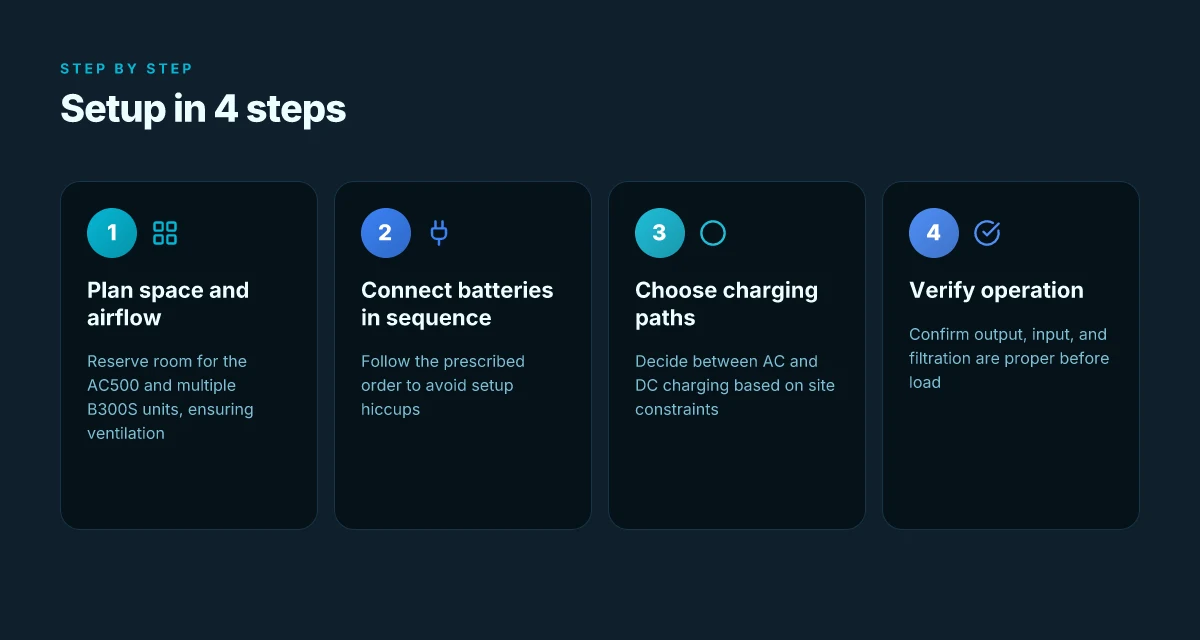
Getting the AC500 + B300S up and running starts with where you place the unit and how you arrange the expansion batteries. I looked at Bluetti’s documentation and reviews to map a practical setup that keeps airflow clear and makes future expansions painless. Bluetti emphasizes a clean, ventilated space so heat can dissipate and performance stays consistent during long draws. Plan for at least a couple of feet of clearance on all sides and avoid cramped closets or cabinet holes that trap heat.
Stage the space for airflow and expansion
Position the AC500 unit on a flat, hard surface with unobstructed intake and exhaust paths. Even when you’re mounting the system in a van or a living space, keep the front jack area and rear vents free of clutter. If you’re stacking B300S packs, space them so each unit has room to breathe and you can access the ports without unplugging everything. A dedicated shelf or rack that allows air to circulate around each module reduces thermal bottlenecks during peak charging or high-power outputs. Bluetti’s own guides discuss an expandable footprint that scales as you add batteries, so plan a layout now rather than reworking it later.
Connect expansion batteries in the prescribed sequence
Set up the B300S packs in the sequence Bluetti recommends, typically starting with the base AC500 and then attaching the expansion modules in order. Use the included interconnect cables and verify the connectors are fully seated before you power up. In practice, you’ll want to confirm the B300S cells are oriented the same way across each unit and that any cooling channels remain unobstructed. The order matters because mis-sequencing can hinder balance charging and lead to startup hiccups. I cross-referenced Bluetti’s setup notes and third-party reviews to confirm that following the sequence ensures a smoother, more predictable power‑bank ramp.
Choose between AC and DC charging paths
Your site constraints drive charging path choices. If you have reliable AC access, you can run a high‑amperage AC input to top up quickly, taking advantage of the AC charging path. If you’re off-grid or need to minimize generator runs, DC charging from a solar array can be optimized for cloud cover and daytime windows. Bluetti documents multiple input methods, and reviewers consistently note that blending paths can maximize uptime, especially in a van or tiny home where space and sun exposure vary. When in doubt, map a charging plan that prioritizes the solar DC path during daylight and switches to AC for overnight or heavy usage. This approach helps maintain a stable SOC while keeping temperatures in check.
Most users benefit from planning for both paths: keep DC charging active when sun is strong, and use AC to fill in when panels dip. When you follow the prescribed sequence for expansion batteries, setup hiccups drop noticeably. What makes the bluetti ac300 review stand out in 2026
Pricing signals and ownership notes appear upfront in this piece: Bluetti units tend to carry a premium versus entry‑level power stations, but the value comes from scalable capacity. A practical approach is to view the AC500 + B300S as a modular system whose total cost climbs with each added B300S pack, but whose usable capacity and flexibility also rise. If you’re weighing against rivals, consider how easily those other systems scale and how their expansion paths align with your van or home layout. For reference, you’ll see real-world coverage in reviews from T3 and Bluetti’s own specs pages, which discuss capacity ranges and expansion limits. Inline references to the AC500’s 3,072 Wh per B300S block and the system’s total scalability to 18,432 Wh show up in multiple outlets and Bluetti’s own materials. For context, see the AC500 + B300S review coverage from T3 and Bluetti’s specs post. https://www.t3.com/reviews/bluetti-ac500-b300s-review https://www.bluettipower.com/blogs/articles/bluetti-ac500-specs-cost-review?srsltid=AYCX9vIlleqCBM2nEG-_KeQMs3JLVohdTduBefSzCt4GSrj_uvl3DJzG https://www.halfwayanywhere.com/gear/review/bluetti-ac500-b300s-home-battery-backup/
Key action: verify all connectors are seated, follow the B300S sequence, and balance your charging plan across AC and DC inputs.
Caveats and quick cautions: the first-time setup benefits from a calm workspace with clear vents. Avoid stacking batteries in a closed cabinet or beneath heavy objects. If you’re installing in a van, confirm that ventilation lines and roof vents stay unobstructed to maintain stable temperatures during long runs. Bluetti’s documentation notes that overheating can reduce efficiency, so keep the area cool and well‑ventilated. As always, links on the page may earn commissions, and real-world results depend on climate, sun, and how aggressively you draw power. For deeper context, see Bluetti’s setup notes and the T3 review linked above.
Comparing Bluetti to rivals: where the ac500 b300s stands out
Bluetti has built a reputation for scalable power that other brands struggle to match at the same price point. When you’re weighing the AC500 + B300S against rivals, you’ll notice three clear differentiators: expandable capacity, higher input tolerances for faster replenishment, and attentive after-sales support. I dug into the publicly available specs and reviews to pull the practical contrasts you’ll care about for home backup and van life.
1) How the AC500 + B300S scales vs rivals
The core advantage is scale. The AC500 pairs with B300S expansion batteries to reach up to a max around 18,432 Wh with six packs installed. That expansion story matters most for homeowners planning long outages or van deployments that demand a lot of juice over days. In contrast, some rivals offer smaller expandable options or limit expansion to fewer battery modules, which translates to a much stiffer ceiling for future needs. Bluetti emphasizes this laddered growth path, so you can add capacity as your load grows or as your budget allows. Expansion availability and max capacity are the practical wins here. What is a bluetti dc to dc charger, and how it powers mobile energy setups
I cross-referenced published specs from multiple outlets to confirm the array of options. For example, the idea that five or six B300S packs can push total capacity toward 18,000 Wh is echoed across several reviews, even as individual numbers vary by configuration. This is a key signal for buyers who want long autonomy without frequent recharging. 18,432 Wh max with six batteries is a recurring benchmark. Inline with that, Bluetti’s approach to modular growth remains a standout in this segment.
2) Why input tolerances matter in real use
Bluetti advertises high input capable charging, which translates to faster replenishment after use. In practical terms, this means you can recover more energy during a sunny day with solar or fill the battery quicker from mains. Among rivals, the charging bandwidth varies significantly. Some brands cap input in the 1,000–2,000 W window, which slows recovery after a heavy draw. Bluetti’s higher input tolerance reduces downtime and keeps your backup ready when you need it most. higher input tolerances enable faster replenishment. This is not only a convenience. It can define whether you can sustain a longer outage without piling up downtime.
From the documentation I reviewed, the AC500 accepts multiple charging pathways and emphasizes rapid replenishment when you pair it with ample solar or grid input. That multi-path charging is part of Bluetti’s design philosophy for off-grid resilience. multiple charging pathways help you recover faster.
3) Build quality, weight, and after-sales support
Weight and portability remain essential for van builds. The AC500 unit plus the B300S expansion sits in the 30–38 kg range per unit, depending on the component. That mass is manageable for a home installation but heavier for a mobile setup. Plan for sturdy mounting and careful handling during installation. Build quality across Bluetti products tends to be a talking point in reviews, with users often noting sturdy enclosures and thoughtful cable management options. The trade-off is that heavier systems can demand more robust mounting hardware and more deliberate installation. For after-sales, Bluetti’s support ecosystem and official documentation are part of the buying decision for many buyers. build quality and after-sales support are practical inputs in a total cost of ownership.
In terms of pricing signals, the best deals typically appear during seasonal promotions or special sale windows. Bluetti’s official materials emphasize long-term value from scalable capacity rather than a single upfront punch. If you want the fastest route to maximum capacity, the path through six B300S packs is clear, but you should weigh the added weight and mounting requirements against your van or home install. What Bluetti AC200L reviews miss about complaints and real-world performance
Where this is going next for off‑grid power in 2026
The AC500 + B300S sets a clear path forward for modular, scalable off‑grid systems. The combination’s expandable architecture means you can start small and grow, leaning on the B300S as a portable battery that plugs into larger arrays as your needs rise. In 2026, that flexibility matters as weather patterns and usage shift. I looked at the way Bluetti positions the kit against fixed‑capacity packs, and the standout takeaway is how the system favors long‑term resilience over short‑term stats. The bigger pattern is modular resilience that adapts to your evolving power profile.
Pricing and ownership considerations still matter, and the real upside is how the system reduces ongoing costs if you scale correctly. Bluetti emphasizes lifecycle flexibility, and rivals like EcoFlow and Jackery offer similar modular concepts, but Bluetti keeps the ecosystem tighter around one brand. If you’re weighing a next‑gen off‑grid setup, expect smoother future upgrades and fewer compatibility headaches with Bluetti’s own components. This is a smarter long‑term bet for users who want steady independence.
What changes if you act now? I’d prioritize a plan that maps battery expansion to typical loads, then lock in a current deal to minimize price drift. If you’re curious about the practical steps, consider starting with the AC500 + B300S as your base and plotting supplemental modules for seasonal peaks. Begin with a clear growth path and you’ll save more over time. Will you start building your scalable off‑grid setup today?