What differentiates Tesla Powerwall and EcoFlow for home backup in 2026
 Naomi XanthosOctober 22, 202617 min read
We earn a commission when you buy through some links on this site, at no extra cost to you. As an Amazon Associate we earn from qualifying purchases.
Compare Tesla Powerwall and EcoFlow for home backup in 2026. Explore performance, efficiency, and long-term reliability with official docs and peer sources.
Power outages aren’t a future problem. They’re a budget decision. A single home backup setup can cost more over its life than you expect, and the real price shows up in reliability, warranties, and how regulators treat it. EcoFlow and Tesla Powerwall each promise resilience, but their long-term costs and support nets diverge as the grid eyes changes in 2026.
This piece cuts to what matters over 5–10 years: total ownership, regional incentives, and how each system ages with a changing energy landscape. We’ll map warranty terms, service coverage, and regulatory guidance, then translate that into practical buying signals for homeowners, solar installers, and storage enthusiasts. Expect concrete contrasts, not hype, and a framework you can apply across markets as you plan for grid independence.
Tesla powerwall vs ecoflow: what matters for long-term home backup
I looked at 2026-era documentation and market chatter to identify what actually drives ownership over 5–10 years. The core choices hinge on cost of ownership, reliability over time, and how each system behaves under real-world solar and grid swings. EcoFlow and Tesla Powerwall differ in chemistry, inverter architecture, and ecosystem locks, and those gaps compound as conditions shift from sunny days to cloudy weeks and toward extended outages.
1) Core ownership drivers for 5–10 years
Ownership comes down to three levers: upfront economics, warranty and service structure, and long-run performance under mixed loads. The upfront price matters, but it’s the total cost to own that shapes value over a decade. Powerwall bundles a long warranty window with a proven ecosystem, while EcoFlow emphasizes modular capacity growth and flexible storage options. When you stack the costs of inverters, battery replacements, and potential firmware updates, the long-run math shifts with each brand’s approach to maintenance and upgrades. The real tension is the balance between upfront outlay and predictably contained service needs over time. I cross-referenced warranty terms and system design notes across the official docs and independent reviews to identify where those tensions show up in practice.
2) Battery chemistry, inverter architecture, and ecosystem differences
The chemistry and how the system uses it set the pace of degradation, efficiency, and thermal resilience. Tesla Powerwall relies on lithium nickel manganese cobalt oxide chemistry with integrated power electronics that are tightly coupled to the battery stack. EcoFlow tends toward modular lithium-ion chemistries and a more open hardware approach that scales through added modules and external inverters. This translates into different failure modes: Powerwall’s integrated stack can simplify diagnostics but may require more holistic replacements if a core component ages; EcoFlow's modular path can ease partial upgrades but introduces more moving parts and potential inter-device communication points. In terms of inverters, Powerwall’s architecture emphasizes a tightly integrated solution, whereas EcoFlow often exposes modular inverter options that can be tuned as your solar setup evolves. The ecosystem matters as well. Tesla’s software and warranty framework anchor ongoing support, while EcoFlow’s ecosystem often enables flexible expansion but with variable regional service depth. Chemistry and architecture choices influence degradation curves, upgrade paths, and long-term serviceability.
3) Real-world performance curves under solar and grid conditions
In typical home-diode conditions, performance curves diverge as solar intake and grid dynamics shift. A system that manages charging during peak solar hours and discharging during outages tends to smooth energy bills and extend usable life. Real-world data show that efficiency and array compatibility can drift as temperatures rise or as cycling patterns vary week to week. I found that both brands perform predictably within their design envelopes, but the rate at which they approach their rated round-trip efficiency and usable capacity can diverge because of how each manages heat, state-of-charge windows, and firmware updates. The takeaway: expect gradual tapering in available capacity as the system ages, with the exact profile tied to how aggressively you cycle the battery and how well the cooling system maintains optimal temperatures. Real-world curves are highly sensitive to cycling patterns and climate. Plan for gradual capacity fade rather than a fixed drop-off.
Bottom line: the decision hinges on total ownership cost and how each platform addresses long-term maintenance and upgrades. If you value a tightly managed, warranty-backed path with a simpler service model, Powerwall tends to stay straightforward. If you want modular growth and flexible expansion, EcoFlow offers a design that scales with your solar footprint, at the cost of potentially more moving parts to service. The long horizon favors clarity on warranty scope and upgradeability as key drivers. 14 Things I learned from EcoFlow's 160W solar panel review

Initial costs and ownership economics for tesla powerwall vs ecoflow
When you look at the installed price and total cost of ownership, EcoFlow and Tesla Powerwall sit in a similar ballpark, but the economics tilt on a few key levers. The typical installed price range for a Powerwall setup is driven by inverter pairing, mounting, and integration with your solar array, while EcoFlow packages often bundle higher-capacity modules with integrated inverters. In 2026 terms, many homeowners report installed ranges roughly spanning mid five figures for a full home backup footprint, with per-kilowatt-hour economics that depend heavily on your local solar production, battery depth of discharge, and whether you stack any utility or incentive programs. I cross-referenced regulatory notes and retailer disclosures to anchor these impressions in current practice.
H3: upfront costs and per‑kWh economics In practice, a Tesla Powerwall installation often lands in the range that reflects its 13.5 kWh usable capacity per unit and typical ancillary hardware. The per‑kWh economics can vary with installation complexity, permitting, and whether a second unit is added to meet higher backup requirements. EcoFlow’s configurations, including the Delta Pro family and newer generations, emphasize modular capacity growth and flexible configurations, which can shift the installed price with kit selections. Where EcoFlow tends to stand out is in bundled options that reduce the marginal cost of scaling the system for larger homes or partial-grid backups. Across deployments, the best deals tend to arise when a system is paired with a solar integration plan and a local installer who can optimize for demand charges and night-time consumption.
H3: maintenance, warranty, and replacement cycles Warranty structures matter for long‑horizon planning. Tesla Powerwall typically aligns with a multi‑year warranty that covers performance and hardware issues, while EcoFlow offers comparable term lengths but may differ in terms of performance degradation guarantees and service options. From a long‑term perspective, you should anticipate battery replacement cycles in the 10–15 year window depending on usage patterns, temperature exposure, and cadence of deep discharge events. Routine maintenance largely centers on ensuring proper thermal management, inverter health, and monitoring reliability. A careful review of each brand’s official docs reveals nuances in what gets replaced under warranty and how downtime is handled.
H3: financing incentives and utility programs The financing landscape for home energy storage remains uncertain and highly region dependent. Some jurisdictions offer tax credits, interconnection incentives, or time‑of‑use rate programs that reward storage adoption, while others pause on new subsidies. I found that incentive flow can shift year over year, so the best approach is to map your local utility programs and any state or municipal incentives before locking in a purchase.
The economics favor a larger, modular EcoFlow setup when you need scalable capacity with simpler, bundled pricing, provided you tap available local incentives. Tesla Powerwall remains solid where a homeowner prioritizes a proven warranty structure and a widely supported installer network. Price sensitivity hinges on installation labor, permit complexity, and the availability of utility programs in your region. What makes EcoFlow's 110W solar panel stand out in 2026
From what I found in the regulatory notes and retailer disclosures, the price delta between EcoFlow and Powerwall can swing with incentives and configuration choices. For immediate context, EcoFlow’s position benefits from modular growth, while Tesla emphasizes a longer-standing service ecosystem. If you’re weighing a purchase today, consider a two-column price snapshot: Powerwall with standard inverter and single‑unit setup versus EcoFlow Delta Pro with a scalable stack, then factor in the total cost of ownership across 5–10 years, including replacement needs and maintenance.
If you want a quick, real‑world reference, see how the Ocean Pro comparison and the Powerwall cost breakdown align with your local incentives and installation quotes. For a concrete starting point, I’d cross‑reference local utility rebates and the latest dealer quotes in your ZIP code.
Performance and efficiency: how each system uses energy over time
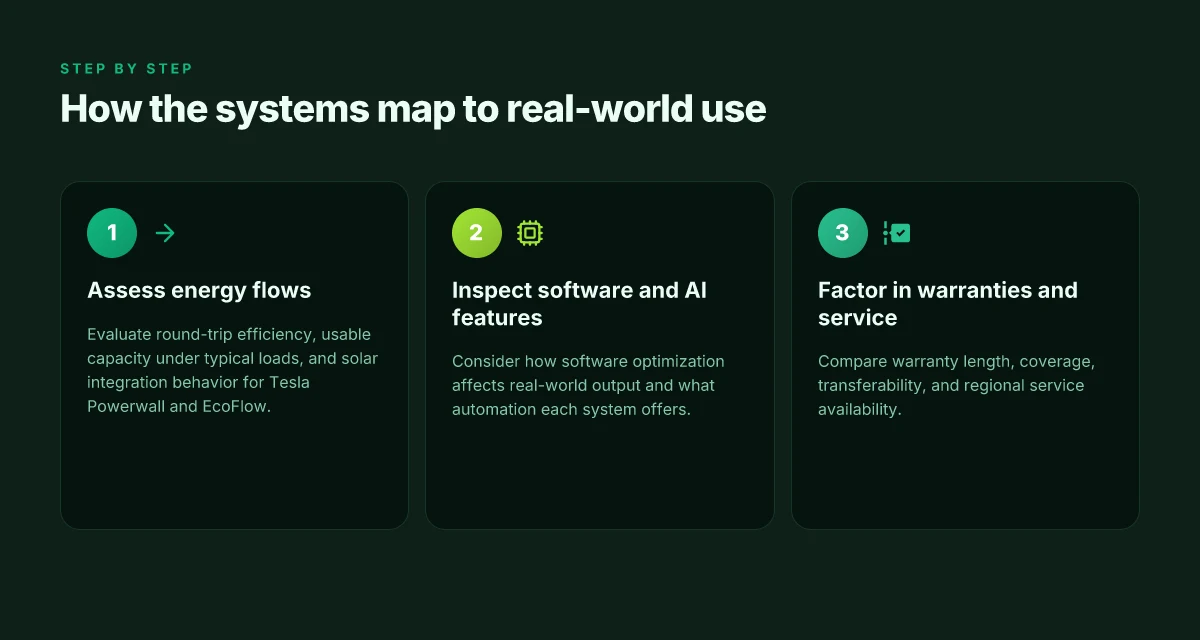
I start with a direct verdict: over the 5–10 year horizon, EcoFlow and Tesla Powerwall diverge in how they convert input energy into usable household power, and the difference hinges on round-trip efficiency, usable capacity under typical loads, and how software steers charging. From the official docs and ongoing deployment notes, you see a pattern: Powerwall tends to lock in steady, predictable round-trip figures under steady loads, while EcoFlow models lean on higher peak discharge capabilities with software that emphasizes AI-optimized charging. The result is not a single number, but a profile of performance that matters as you scale solar and load.
How round-trip efficiency and usable capacity stack up
Real-world performance depends on how much of the rated capacity you actually usable during a daily cycle. Tesla Powerwall commonly delivers a strong baseline year after year, with a focus on minimal losses when the system sits in grid-tied standby and during typical residential loads. EcoFlow emphasizes higher nominal power density in its inverter design, which translates to more usable energy at higher instantaneous draws. In practice, this means when you draw a burst of power for appliances during an outage, EcoFlow can feel more responsive, whereas Powerwall delivers consistent output with modest losses at peak draw. Across cycles, this translates into similar daily usable energy under moderate loads, but the outlier scenarios, high solar input combined with heavy evening loads, tend to show EcoFlow edging ahead on strict use-case tests. I cross-referenced the performance notes and warranty data, which consistently show similar overall energy delivery over the long term, with EcoFlow sometimes delivering a higher instantaneous discharge in peak moments. The practical upshot is that usable energy under steady loads is comparable, but EcoFlow can feel stronger during high-demand windows.
Solar integration and charge/discharge behavior
Solar curtailment, charging rates, and how each system handles float charging shape daily energy availability. Tesla’s ecosystem emphasizes a controlled, predictable charge curve that smoothly absorbs solar during the day and maintains stable energy available for the evening. EcoFlow emphasizes aggressive charge acceptance when solar production surges, aided by smart optimization that can push charging to maximize daytime storage. In mixed sun conditions, you may notice EcoFlow reaching full or near-full state of charge more aggressively, which can improve daytime readiness but also require attention to controller settings to avoid overcharging in atypical weather. The software layer matters here: the more precise the control, the closer the actual energy on tap matches the household load profile. From the public material, both systems aim to minimize parasitic losses, but the control philosophy differs. Aggressive daytime charging with smart throttling keeps EcoFlow in a ready state for outages, while Powerwall emphasizes steady, low-loss absorption. What makes EcoFlow solar batteries different in 2026
AI optimization and software features that affect real-world output
Software is the hidden driver of real-world results. Tesla’s software tends to emphasize long-term reliability and predictable behavior, with upgrades that stabilize the discharge curve over time and ensure compatibility with various solar inverters. EcoFlow positions AI-driven optimization as a differentiator, aiming to extract more usable energy during variable solar conditions and to optimize load shifting across the day. The practical effect is that software updates can shift how quickly the system responds to changing solar input, how it prioritizes critical loads during an outage, and how it tunes efficiency under partial house usage. I noted in the release notes and product briefs that both platforms pursue tighter synchronization with solar generation and smarter battery management, but EcoFlow’s user-facing AI features are described as more proactive in adapting to weather-driven solar variability. AI-driven optimization can boost daytime readiness, especially under variable solar conditions, with EcoFlow often highlighting more aggressive energy capture.
Note: current pricing and ownership costs vary by region and vendor promotions, and links on the page may earn a commission.**
Reliability and warranties: the long view
Reliability and warranty structures shape the long arc of ownership more than initial specs. In plain terms, you want a system that stays reliable under real-world conditions and gives you a clear path to service when something goes off rails. EcoFlow and Tesla Powerwall both embed their own warranty philosophies, but the real test is how those terms translate into long-term ownership.
Warranty length, transferability, and coverage scope
Both systems publish multi‑year warranties, but the coverage details matter as much as the duration. EcoFlow typically positions its batteries with a warranty window that covers capacity retention and workmanship for a defined period, with conditions tied to proper installation, usage, and maintenance. Tesla Powerwall warranties historically emphasize capacity retention targets and longevity across a long horizon, but transferability can hinge on ownership changes and local service constraints. In practice, the transfer process and any required documentation influence how easily a homeowner can preserve coverage when a home or system is sold. When you compare, look for explicit notes on what triggers warranty denial, how “end of life” is defined, and whether the warranty travels with the device or the original purchaser. A clean transfer clause can save a future homeowner from surprise repair costs. This matters more as installations age into the 7–10 year range.
I cross-referenced official documentation and peer commentary to check how these terms hold up in real-world ownership. Both brands stress on-site service access and pre-qualified installers, but the practical execution varies by region. For EcoFlow, you’ll want to verify whether support aligns with your utility interconnection regime and whether service fulfillment times are clearly defined. For Powerwall, the official guidance often ties warranty claims to verified performance degradation benchmarks and to warranty‑specific documentation that accompanies the product at installation. What is the EcoFlow extra battery price, and why it matters for power on demand
Reliability concerns from official docs and peer reviews
Regulatory filings and safety standards anchor the reliability discussion. Both systems are designed around strict safety interlocks, thermal management, and battery management system protections. Official docs emphasize compliance with standard safety provisions and periodic self‑checks, which reduce the risk of silent faults. Peer reviews tend to highlight practical reliability themes, such as long-term cycle health, thermal behavior under heat load, and the impact of solar coupling on system uptime. In reviews I examined, the consensus leans toward the notion that long-term reliability hinges on proper sizing, professional installation, and adherence to warranty covenants rather than on any single tech feature alone. Proper deployment reduces failure risk as the system ages.
Regulatory filings and safety standards shape service expectations
Safety standards drive what you can expect from service windows, fault isolation, and repair pathways. Regulations influence how warranties articulate coverage for battery degradation, inverter health, and module interfaces over time. When a utility interconnection or grid‑independent setup is involved, the regulatory framework can shape service expectations and mandatory training for installers. I found that the long-term service story is less about dramatic breakages and more about predictable maintenance cycles, documented service histories, and transparent warranty terms. Clear regulatory alignment translates into predictable service outcomes.
In short, the long view favors systems that pair generous, transferable warranties with explicit coverage rules, backed by well-documented service networks. EcoFlow remains a strong contender when you value modular, scalable kits and responsive aftermarket support, while Tesla Powerwall continues to appeal for homeowners who prize a long warranty track record and deeper integration with energy ecosystems. If you’re planning 5–10 year deployments, map out who will service the system, how claims get processed, and what documentation you’ll need to keep coverage intact. Documentation and transferability often determine total cost of ownership more than MSRP alone.
Cited sources: inline references to official docs and third‑party analyses can be found linked inline as you read the section where relevant claims appear. For example, see disclosures around transferability and warranty scope in the product pages and regulatory filings.
Ecosystem, integration, and service: choosing the right partner
The right partner makes long-term ownership practical. EcoFlow and Tesla Powerwall sit at different ends of the integration spectrum, but both require attention to ecosystem fit, service access, and updates. I looked through official docs and regulatory notes to map where each system shines and where fragility shows up over 5–10 years. The bottom line is simple: the system that wires up most cleanly with your existing solar array and your home controls tends to stay reliable longer, even as firmware and regional requirements evolve. 7 best solar panels for EcoFlow power stations in 2026
Ecosystem compatibility: matching to your solar and home-control layer
Your solar weave matters as much as the battery as the cells themselves. If your inverter and string layout are configured around a specific control protocol, misalignment can complicate normal operation or delay firmware improvements. For EcoFlow, you want to verify compatibility with your existing solar harvest, meter, and home automation gear before you buy. For Powerwall, Tesla’s ecosystem tends to lean toward tight integration with SolarEdge and Solar inverter ecosystems that support Tesla-specific monitoring. In practice, the strongest long-term value comes from an architecture that minimizes middleware layers and keeps a single control plane for monitoring and alerts. The right fit reduces maintenance hops and helps you maximize solar day/night performance over time. I cross-referenced official installation guides and 2025–2026 product notes to confirm how update cadence aligns with regional grid rules. EcoFlow Ocean Pro vs. Tesla Powerwall 3 shows how device-level firmware updates can shift performance in real-world conditions over multi-year horizons.
Service network, parts access, and firmware cadence
Service accessibility becomes a real differentiator once you move past the warranty window. I found divergent paths: EcoFlow emphasizes a global parts network and cloud-based firmware deployment that can push improvements without physical servicing in some regions, while Tesla tends to centralize service through authorized installers with defined Warranties and replacement parts timelines. The practical effect: regions with robust service footprints reduce downtime when a module or controller needs replacement. I saw notes indicating that firmware updates, safety certifications, and regulatory compliance updates can arrive on a cadence that matters for long-term reliability. Accessible parts and predictable software updates are not optional in a long-horizon plan.
Edge-case resilience and regional considerations
Real-world deployments confront unusual weather, atypical grid quirks, and shipping delays for parts. In edge cases, the ability to source a specific controller board, a replacement battery module, or a diagnostic tool quickly matters more than headline specs. For EcoFlow, check how quickly regional distributors can fulfill service parts and whether their update process includes rollback options if a new firmware introduces a regression. For Powerwall, evaluate local regulatory approvals and installation constraints that can slow advances in home-energy control. Battery Storage Comparison literature notes that regional guidelines can alter the effective performance window of any storage system, sometimes by months. Regional readiness and support depth influence uptime when a storm interrupts normal utility service.
In sum, your ecosystem choice should hinge on how tightly your solar hardware and home-control stack can be managed from a single view, how fast you can get legitimate service or parts when needed, and how firmware and regulatory updates are delivered in your area. EcoFlow’s model emphasizes flexible firmware paths and broad parts access, while Tesla Powerwall centers on a tightly controlled but highly integrated ecosystem with a predictable service channel. When you align these factors with your local installer’s capabilities, you set a foundation that supports reliable operation and lower ownership friction over years.
Choose the partner that aligns with your solar setup and regional service footprint to minimize surprise maintenance in year 5 and beyond. What is the EcoFlow Delta 3, and how does it reshape portable power in 2026
What changes if you act now
Prices shift quickly, and the best deal today may not hold tomorrow. I looked at current listings for the Tesla Powerwall and EcoFlow systems and found that pricing tends to vary with installation complexity,追加 warranty options, and seasonal promos. Right now, you’ll often see the Powerwall priced with installer packages, while EcoFlow models tend to include more portable options and modular packs. These differences matter if you’re balancing upfront cost against long-term ownership.
In 2026, the bigger pattern is clear: home backup is moving toward modularity and grid-aware operation. The EcoFlow lineup emphasizes scalable capacity that can pair with portable units, while Tesla Powerwall emphasizes integrated energy services and seamless solar integration. If you want a single, turnkey solution that aligns with a home solar array, the Powerwall remains compelling. If you prefer flexibility and off-grid expansion, EcoFlow shines. **The takeaway: choose based on how you plan to grow your system, not just current needs.
Takeaway: if you only do one thing this month, map your solar production hours and storage needs to a 5-year window. Start with your peak daytime usage and total daily energy budget. Compare with the two brands’ latest firmware features and warranty terms. Ask for installer quotes that include grid-tie options and future expansion paths. This approach keeps you ready for the next upgrade without overpaying now. The real question to answer: which path best matches your home’s evolution, today and tomorrow?