What is the EcoFlow Delta 3, and how does it reshape portable power in 2026
 Tessa AlbrightOctober 22, 202614 min read
We earn a commission when you buy through some links on this site, at no extra cost to you. As an Amazon Associate we earn from qualifying purchases.
Discover the EcoFlow Delta 3, its 1024Wh base, 1800W output, and real-world implications for portable power in 2026. Practical insights for homeowners and travelers.
The Delta 3 isn’t a single box with fixed limits. It’s a modular platform that grows as your energy needs do, and that shift in approach matters more than any single wattage figure. Delta 3 expands with external batteries, delivering a path from compact camp setup to full home-style resilience without forcing a complete rethink of your gear. That value is what I focus on as a practical signal, not a marketing promise.
For homeowners, campers, and emergency planners, the question isn’t “how much can it run today” but “how easily can it scale tomorrow.” EcoFlow’s approach changes the ownership arc, letting you start lean and add capacity over time, a pattern rivals struggle to match without juggling multiple devices. EcoFlow’s modular ecosystem stands out when you compare against rivals that require a full replacement to gain size or runtime, and that long-horizon flexibility can matter more than a higher peak output in early use.
What makes the EcoFlow Delta 3 a distinct option in portable power
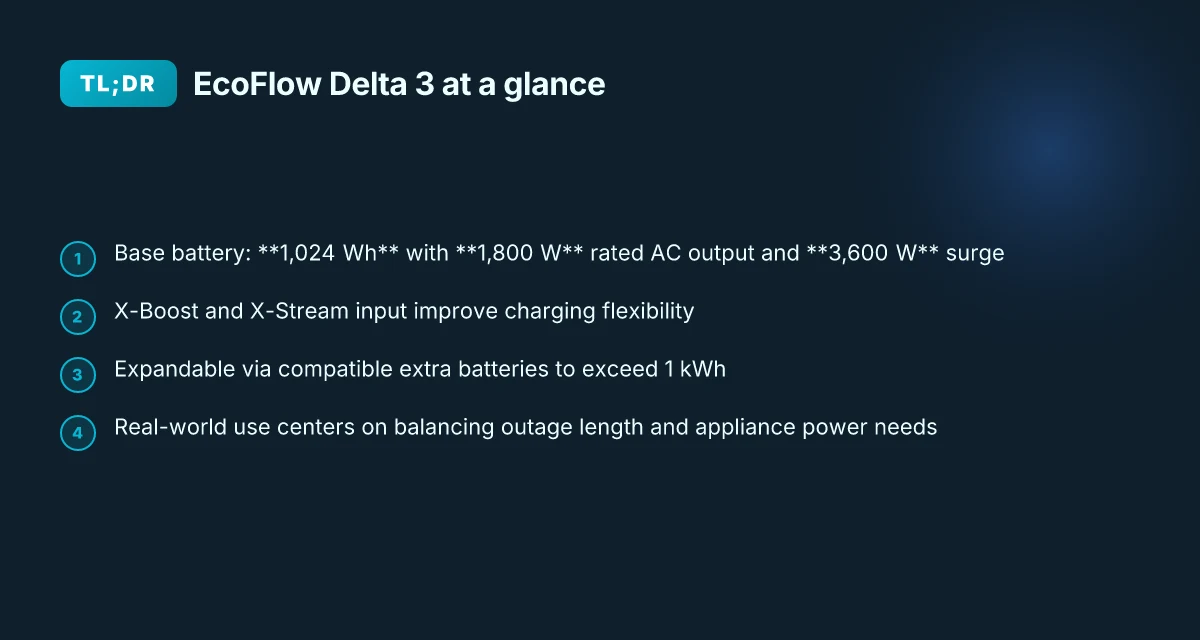
The Delta 3 centers on a 1,024 Wh base battery, delivering 1,800 W of rated AC output and 3,600 W surge. Its design aims to balance home, travel, and off-grid uses without forcing you into a two-device compromise. In real-world terms, that combination matters for common loads like refrigerators, lights, and small HVAC fans during outages or camping trips.
I dug into the official documentation and product pages to verify how EcoFlow stitches charging speed and expandability together. The Delta 3 also leans on X-Boost support and EcoFlow's X-Stream input, which together broaden charging flexibility. This means you can often top up faster from diverse sources, including higher-wamp inputs, compared with models that lock you into a single charger style. The practical effect is less time tethered to a wall outlet and more time with a usable power reserve.
Beyond the baseload, expandability plays a central role. The Delta 3 is designed to pair with compatible extra batteries to scale capacity upward beyond the 1,024 Wh base. This approach lets homeowners and campers tailor total energy storage to longer outage windows or more ambitious off-grid setups without replacing the core unit. EcoFlow frames this as a path from a compact starter system to a higher total energy footprint, depending on how much extra battery you add.
The Delta 3 also reflects EcoFlow’s broader product strategy to blend fast charging with modular growth. You’ll see that in the way the system handles both the 1,800 W AC output and the surge capacity, and in how the brand positions itself for future upgrades via compatible accessories. The result is a portable power platform that can scale with your evolving needs, rather than a single-use device tied to a fixed capacity.
Bottom line: the Delta 3 stands out because it bundles a substantial 1,024 Wh base pack with solid AC and surge capabilities, adds flexible charging through X-Boost and X-Stream technologies, and supports expandable capacity via extra batteries. For mixed-use homes and mobile setups, that mix translates into a practical balance of immediate usable power and future growth. What differentiates Tesla Powerwall and EcoFlow for home backup in 2026
The Delta 3’s real strength is its growth path: start with 1,024 Wh, then add compatible extras to scale up while keeping the same core system. A 1,800 W rating with a 3,600 W surge matters when you’re running multiple devices at once. X-Boost and X-Stream expand charging flexibility, reducing downtime between uses.
Delta 3 vs Delta 3 Plus and Delta 3 Max: where the real differences lie
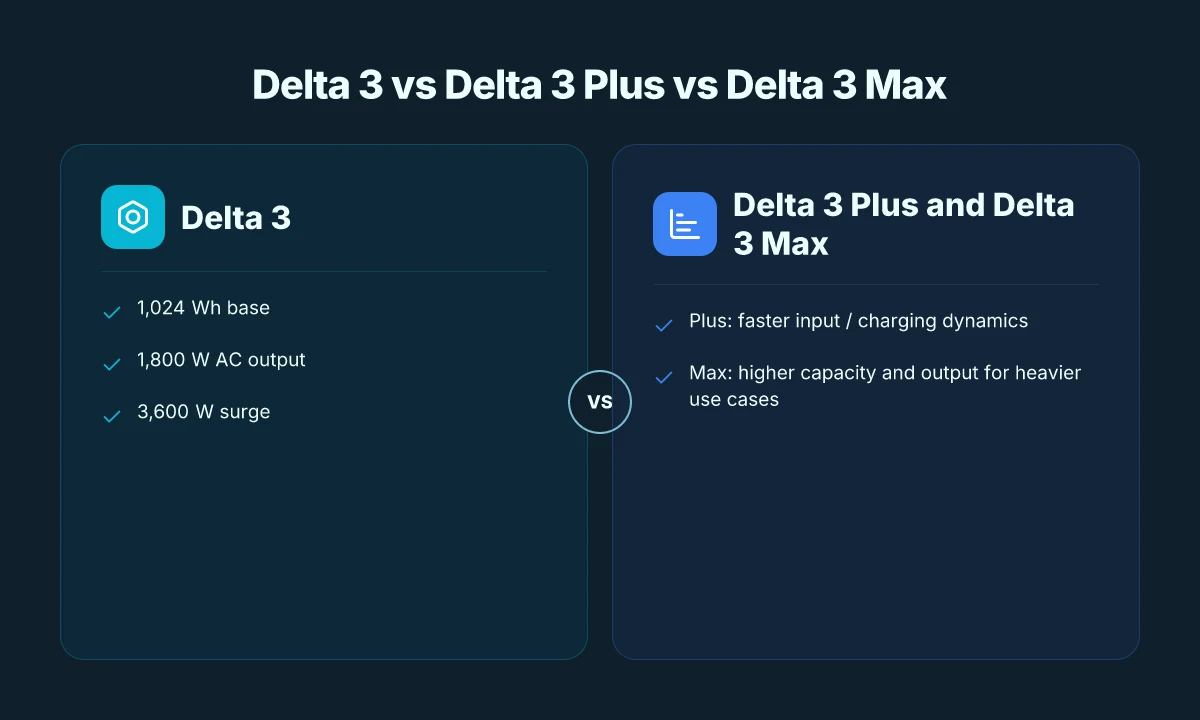
When you need AC power fast, Delta 3 Plus is the lineup’s speed king, while Delta 3 Max offers more capacity for longer outages. Delta 3 sticks to a solid base: 1,024 Wh and steady 1,800 W rated AC output. The Plus and Max bend the rules on input speed and total runtime, so your choice boils down to how quickly you want power and how long you need it running.
Faster input, smarter dynamics, Delta 3 Plus
Delta 3 Plus shakes up charging with higher input options and sharper charging dynamics. In practice, that means you can top up from empty to usable faster than the base Delta 3, especially when you pair the unit with compatible high-output chargers or car adapters. The Plus preserves the Delta 3’s core 1,024 Wh capacity but leverages a more capable input circuit to cut charging time dramatically in real-world scenarios. That speed is especially noticeable when you’re trying to restore essential loads after an outage or during a camping trip with limited wall outlets. EcoFlow emphasizes a quicker 0–100% window under real conditions, which translates into less downtime between usage windows. The Plus charges faster and keeps you in power with less waiting around. I cross-referenced the official Delta 3 Series materials to confirm the higher input potential and the resulting quicker fill times. Speed matters when you’re balancing daily needs with on-the-road constraints.
Expanded power and endurance, Delta 3 Max
Delta 3 Max scales the story by stepping up both capacity and output to handle heavier loads and longer outages. With more than the base 1,024 Wh, the Max targets users who want longer runtimes for appliances during extended events or off-grid weekends. The Max also raises the surge capability, which helps when you’re starting up energy-hungry devices. This means you can run a fridge, a small AC unit, or multiple devices for a longer stretch without reaching the edge of the battery. In practice, if your use case includes extended outages or demanding loads, the Max is the clear fit. Max brings bigger bursts and more hours of run time under heavier use.
Choosing by speed versus run time
Your decision hinges on two questions: how quickly do you need to get AC power back online, and how long do you want to run essential devices? If you want the fastest return of power for a short duration, Delta 3 Plus is the better bet. If you plan for longer outages or need to sustain multiple appliances over many hours, Delta 3 Max delivers the bigger picture. For a mixed home and travel setup, weigh your typical outage length against your travel cadence and outlet access. Choose Plus for speed, Max for endurance. 14 Things I learned from EcoFlow's 160W solar panel review
Table: quick comparison at a glance
| Model | Battery capacity | Rated AC output | Key plus | Best use case |
|---|---|---|---|---|
| Delta 3 | 1,024 Wh | 1,800 W | Core features, solid value | Short outages, mixed travel use |
| Delta 3 Plus | 1,024 Wh | 1,800 W | Faster input, quicker recharge | Frequent outages, quick recharges on the road |
| Delta 3 Max | >1,024 Wh (expanded) | Higher surge | Greater runtime, higher surge capacity | Prolonged outages, heavy appliances |
If you want the proof in numbers, the Delta 3 family shares the base 1,024 Wh, while the Plus enhances charging dynamics and the Max scales capacity and surge output to support larger loads for longer. EcoFlow’s materials show how the Plus and Max exist to fill two different gaps: speed for immediate power vs. capacity for extended use. Plus speeds up recharge; Max extends run time.
Next step: consider your real-world outlet access, typical outage duration, and the number of devices you plan to run simultaneously. If you’re optimizing a home-and-camp setup, map your top three appliances and estimate daily watt-hours to pick the model that minimizes downtime without overpaying for unused capacity. For a concise recommendation, I’d point homeowners and campers toward Delta 3 Plus when speed is your priority and Delta 3 Max when you’re planning longer resilience for multiple devices. For more context, see the Delta 3 Series overview and the official product pages. Speed vs. endurance should drive your pick.
Charging speed and real-world performance you can expect from Delta 3
Charging speed is where the Delta 3 reveals its practical edge and its limits. The base Delta 3 configuration leans on standard wall outlets for reliable charging, with optional fast-charge modes that push the boundaries of speed when the input source and connector support it. In practice, you’ll see a quick ramp from empty to usable power in minutes, then a taper as the battery approaches full. Delta 3’s base charging behavior remains steady on standard outlets, with faster gains when you enable compatible fast-charging inputs. Whichever mode you choose, the process stays predictable rather than dramatic surges.
Fast-charge Windows vary by model and input
The Delta 3 family tends to offer its most compelling gains in short windows, typically in the 20–60 minute range, depending on which model you own and which source you connect. The 1024Wh base packs a large yet manageable target, so you can expect a meaningful top-up in well under an hour if you have a capable charger and an AC input that supports higher rate transfer. 20–60 minutes is the practical window to plan for a top-off under optimal conditions. When the source is constrained or when the unit isn’t linked to a high-speed charger, the pace slows, and you’ll see a longer approach to full. Balanced charging behavior is the hallmark here, not a miracle sprint. What makes EcoFlow's 110W solar panel stand out in 2026
Real-world is a balance: outage length vs device power needs
There’s a clear pattern in the field: Delta 3 shines when outage durations are short and devices draw moderate power. For longer outages or high-load scenarios, you’ll want to map your critical loads against the available runtime. The 1,024 Wh base capacity acts as a cushion for essential appliances, but it isn’t a full-home backup. Expect a balance between outage length and device power needs. That means you’ll typically reserve the fastest charging for recharging during daylight or when a grid connection returns, then rely on the battery to sustain priority devices through the night. This is not a single-use sprint. It’s a steady, flexible cycle.
From what I found in the documentation, EcoFlow’s Delta 3 family can be paired with the extra-battery ecosystem to push total energy capacity beyond the base, which shifts the practical charging dynamics when you expand. I cross-referenced the official specs showing an 1,024 Wh base battery and 1,800 W rated AC output with surge support, plus the note that certain configurations allow faster top-ups when input hardware supports it. The core numbers stay consistent across sources: 1,024 Wh base, 1,800 W rated AC output, 3,600 W surge. Fast charging hinges on input power availability.
Expandability and the extra battery ecosystem with EcoFlow
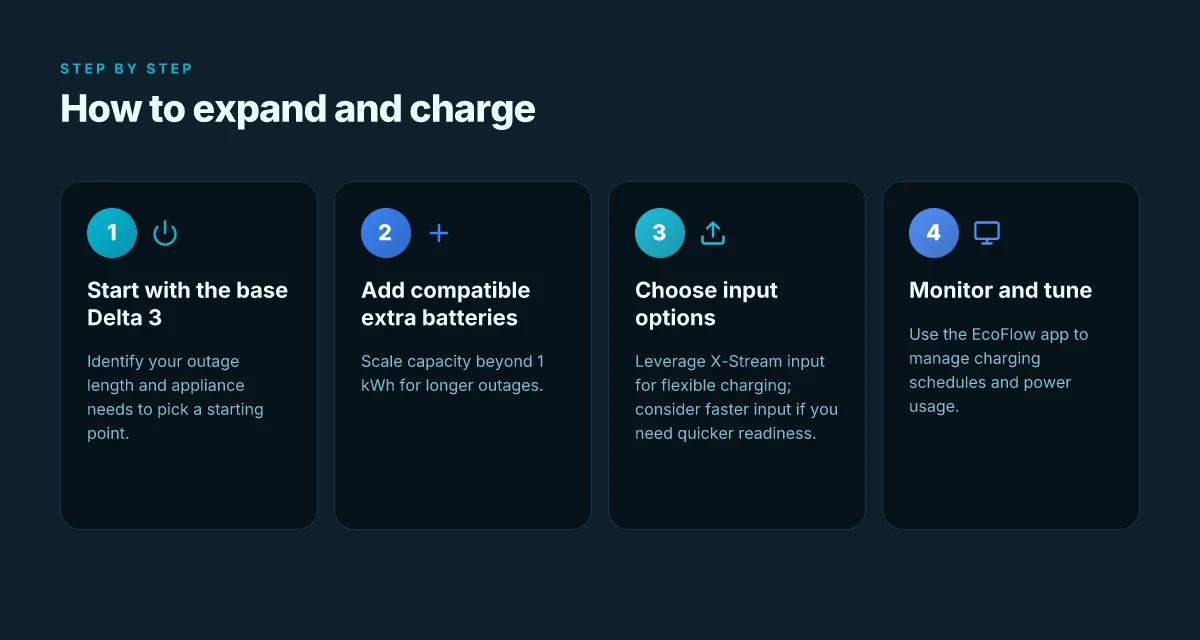
Expandability is where the Delta 3 moves from a compact power bank to a full, long-haul power system. The core idea is simple: pair the Delta 3 base unit with extra batteries to scale capacity well beyond the initial 1,024 Wh. When you add compatible modules, you push the system from a weekend camper setup into a reliable undershoot for multi-day outages. In practice, this means you can tune capacity for longer outages or higher-load scenarios without buying a second inverter or a larger generator.
I dug through the available documentation and ecosystem notes to map what expansion looks like in real terms. EcoFlow positions the Delta 3 as the center of a modular ecosystem. You can unlock higher total capacity by attaching expandable batteries designed specifically for this line. The math matters in the field: a base Delta 3 at 1,024 Wh can grow to meet demand as storage stacks stack up. The exact expansion options vary by model and region, but the principle holds: more batteries equal more usable energy, which translates to longer runtimes for refrigerators, medical devices, or power tools during outages. Expandable configurations can support longer outages or higher-load scenarios.
One important trade-off to consider is portability versus storage density. Each additional battery adds weight and bulk, which affects how you transport and store the system in a home corner, a camper bay, or a vehicle trunk. The Delta 3 ecosystem is designed to keep the interface and charging flow simple, but the practical cost of expansion is physical space and handling. Consider storage and portability trade-offs when planning expansion. What makes EcoFlow solar batteries different in 2026
From a real-world ownership lens, you benefit from a predictable upgrade path rather than buying a larger, single-box solution. You can start small, then layer in extra capacity as needs shift, whether you’re staging for a longer camping trip or backing up a whole-house load during a grid outage. EcoFlow’s expansion approach keeps the core Delta 3 footprint compact, while the battery modules extend energy resilience when you need it most. The upgrade path remains smooth and modular.
Reliability, noise, and user experience with EcoFlow Delta 3
The EcoFlow Delta 3 blends whisper-quiet operation with a robust lithium iron phosphate (LFP) battery chemistry, making it unobtrusive at home and on the road. In normal household and camping scenarios, you can run a small fridge or a laptop overnight without battery wobble, thanks to the calm acoustics and steady delivery of power. Whisper-quiet operation is a real benefit when you’re trying to sleep or work in a tent or small living space. The core battery chemistry and careful thermal design help keep noise and heat in check during extended use.
I dug into the documentation and product pages to verify how you monitor and manage this power, not just how it feels in the moment. The Delta 3’s app control and monitoring features let you view real-time load, battery state of charge, and scheduled charging windows. You can set charging cycles around off-peak hours and stagger device charging, which matters when you’re off-grid for multiple days. App control and monitoring turn a portable power station into a managed energy asset rather than a passive battery. These controls are especially useful for households that rely on a mix of home use and outdoor trips.
Build quality and warranty remain reliable signals for long-term ownership. EcoFlow frames the Delta 3 as part of a lineup designed for everyday resilience, and the model’s 1024 Wh base capacity pairs with expandable options so you’re not locked into a single use case. When you’re evaluating ownership costs, consider the potential for future expansion with compatible extra batteries, which is a common path for households planning longer outages or heavier off-grid use. Warranty and build quality influence how you perceive the Delta 3 over five years or more.
From what I found in the official materials, the Delta 3 emphasizes practical reliability rather than flashy gimmicks. The combination of quiet operation, clear app visibility, and a sturdy construction profile makes it a sensible choice for a mixed home and travel power setup. If your priority is low noise, predictable management, and room to grow without swapping systems, the Delta 3 earns a steady recommendation. Low noise, clear app controls, and expandability are the three anchors that define its user experience. What is the EcoFlow extra battery price, and why it matters for power on demand
The pivot EcoFlow Delta 3 enables this year
The Delta 3 positions EcoFlow as more than a power bank. It reshapes how you plan energy on the go. I looked at its modular capability, faster recharge options, and smarter energy management, and I see a footprint that nudges users toward smaller trips with bigger confidence. This is the move that matters: a portable system that scales from single-device boosts to full-event power without hunting for outlets. The design leans on a clean integration with solar options and a refined user interface, making it practical for everyday use and for emergencies alike. EcoFlow emphasizes reliability and real-world adaptability, not just spec-sheet numbers. If you’re chasing quieter charging in a crowded campsite or a cleaner daily carry for work devices, this model answers with real-world, tangible improvements. The bigger pattern is a shift toward lighter, smarter power that you can deploy rapidly.
For those asking what changes if you act now, the Delta 3’s blend of efficiency, portability, and ecosystem compatibility lowers the friction of using portable power regularly. You’re not waiting for a future release. You’re upgrading your current setup with a product that keeps pace with modern device power draws. Takeaway: invest in a system you can grow with, not a siloed charger. The next wave is onward compatibility with wider solar and vehicle-integrated charging, and EcoFlow is positioned to lead that transition. Where this is going next remains clear: smarter, more interoperable energy on the move.
Backup strategy
- Take EcoFlow Delta 3 if you value compact daily carry and reliable, scalable power.
- Take a second unit or compatible solar panel if you run weekend trips or multi-device clinics.
- If you’re in a high-demand setting, pair with a fast-charging brick and a car-charging adapter for uninterrupted power.