What makes EcoFlow solar batteries different in 2026
 Nova EngelmannOctober 22, 202618 min read
We earn a commission when you buy through some links on this site, at no extra cost to you. As an Amazon Associate we earn from qualifying purchases.

Explore how EcoFlow solar batteries perform in 2026, including real-world use cases, pricing, and long-term value for home solar setups.
One common myth about solar storage is that durability equals weight and price. EcoFlow’s 2026 lineup challenges that, with the emphasis on long-cycle endurance and real-world performance. EcoFlow's recent models pair modular cells with intelligent BMS handling and a measured approach to heat, aiming for steadier output over years of use.
In this piece I pull from product specs, field reports, and warranty terms to show what a homeowner can expect from EcoFlow after multiple seasons of sun and grid events. You’ll see how cycle life, battery chemistry, and system integration influence reliability, and how that matters when you’re sizing up a home storage plan for 2026. Expect concrete comparisons to rivals like Bluetti and Goal Zero, and a practical read on when to prioritize capacity versus durability. Most owners won’t replace a whole system yearly, but the right model matters for a decade of solar self-supply.
What makes EcoFlow solar batteries stand out in 2026
EcoFlow's current solar battery lineup sits at the center of many home solar systems, pairing portable flexibility with home-friendly storage. The Delta family, along with the River and larger Pro variants, slots into both retrofit and new-build setups, offering options for grid-tied and off-grid use. For homeowners, the standout is the ability to scale storage alongside solar generation without migrating to a completely separate inverter or gateway. In 2026, EcoFlow aims to keep the core integration tight: modular packs, intuitive apps, and a shared ecosystem that reduces setup friction.
EcoFlow battery chemistry and cycle expectations
EcoFlow leans on lithium-ion chemistries designed to balance energy density with practical longevity. The exact chemistry mix varies by model, but the result is a consistent cycle life that supports daily cycling in typical home applications. In this ecosystem, the battery management system coordinates with the solar inverter and the app to optimize charging during peak sun and discharging during evening peaks. From what I found in product notes and third-party reviews, the cycle life appears aligned with common expectations for residential systems, though real-world wear will depend on how aggressively you cycle and how consistently you keep temperatures within ideal ranges. This is where the EcoFlow platform earns a point for predictability: a single, unified interface manages charging, discharging, and health checks across the lineup. The most reliable feature is the integrated control loop that keeps charging and discharging in harmony with solar supply.
Real-world performance expectations in peak sun and grid scenarios
Under bright sun, EcoFlow systems tend to deliver consistent surge-friendly charging and steady discharge when the home draws power. The real differentiator is how the system behaves when the grid steps in or steps out. In grid-tied operations, the interface can ramp energy storage and release to smooth daytime or evening loads, a behavior that helps balance household demand without manual intervention. The durability angle matters here: long-term reliability depends on how the battery chemistry and BMS handle rapid temperature swings and repeated shallow cycles. I found that the ecosystem’s tight integration with EcoFlow’s app offers useful visibility into state of charge, health, and expected remaining life. Smart integration helps your solar array shed excess energy efficiently, even when sun wanes.
Real-world durability, warranty, and ecosystem advantages
Durability stands out when you consider the broader EcoFlow ecosystem. The lineup is designed to share components, cooling logic, and communication protocols, which can simplify maintenance and spare-part compatibility over time. The warranty posture for home storage products, combined with a robust app and a growing accessory line, makes the whole package feel cohesive rather than a collection of disparate pieces. If you are weighing competitors, rivals such as brands with modular chemistries or closed-loop ecosystems may offer deeper warranties or slightly different cycle-life projections, but EcoFlow’s unified approach reduces integration risk for a residential system. Unified ecosystem reduces integration risk and simplifies long-term maintenance.
Bottom line: EcoFlow’s solar batteries in 2026 present a coherent option for homeowners who want a scalable, app-driven storage system that plays nicely with solar in both grid-tied and off-grid contexts. If you value a single control plane and predictable operation across models, EcoFlow’s lineup is worth a close look. For best results, match the model to your solar size, daily usage, and climate, then lean on the app for ongoing health checks and life expectancy trends. In 2026, the EcoFlow ecosystem offers a credible path to simple, integrated solar storage. What is the EcoFlow extra battery price, and why it matters for power on demand
Note: prices and specific model options can shift with sales and regional availability. Links to the official EcoFlow product pages and independent reviews provide the best context for current pricing and ownership costs. When you see a model paired with a typical daily use, you can gauge whether it fits your budget and your solar setup. The page may earn commissions on certain purchases, which helps support the site but does not change product facts. Buyers should verify current pricing and warranty terms at the point of purchase.

EcoFlow battery chemistry and how it affects longevity
EcoFlow cells share a chemistry profile that leans on lithium iron phosphate (LFP) for many 2026 models, with nickel manganese cobalt configurations appearing in higher-density packs for some Pro lines. This mix influences cycle life and thermal tolerance in real-world use. In practice, LFP chemistries tend to deliver longer calendar life and better cycle stability at moderate depths of discharge, which translates to fewer capacity losses after many charge–discharge cycles. EcoFlow’s documentation and product pages often point to durable cycle counts and improved thermal behavior when operated within recommended ranges, which matters for homeowners who cycle storage daily or several times a week. I cross-referenced release notes and reviewer summaries to align with what EcoFlow presents publicly, and the takeaway is clear: chemistry choices aim to balance longevity with usable energy density for home and portable storage.
Temperature is a top driver of longevity. High ambient temperatures accelerate aging in lithium chemistries, while cold starts can temporarily reduce available capacity. EcoFlow systems with active cooling and intelligent charge control mitigate heat buildup during rapid charging or long, high-current discharges. In cold weather, the BMS (battery management system) can curb charging to protect cells, which may slow down performance but protects long-term health. Depth of discharge (DoD) also shifts the longevity curve. Consistent shallow DoD generally yields more cycles. Deeper DoD shortens effective life unless the chemistry and BMS are tuned to maintain cell balance and minimize stress. EcoFlow’s typical guidance supports moderate DoD practices, especially for residential setups where a daily cycle pattern is common. The upshot is that real-world longevity hinges on staying within safe temperature windows and avoiding chronic deep disposals beyond what the model is designed to handle.
Charging strategy has a direct hand in how long a pack lives. Fast charging is convenient but adds thermal and electrical stress. EcoFlow’s ecosystem responds with calibrated charging profiles, balancing input from solar arrays and grid power to keep heat in check. The best outcomes come from pairing the system with properly sized solar arrays and avoiding continuously drenching a hot pack with peak-rate charging in the middle of summer. When I read through the release notes and third-party reviews, the common thread is that a thoughtful charging schedule preserves capacity and reduces degradation over time. Durability rises when you pair moderate DoD with temperature-aware charging, and that’s exactly what EcoFlow’s software aims to do.
To maximize longevity, use patterns that keep the battery within a comfortable temperature band and avoid chronic, full-depth cycles. Schedule charging to occur during daylight when solar input is strongest, and set DoD targets that keep the pack from staying near 0% or 100% for extended stretches. Incorporate periodic conditioning cycles only if the product guidance recommends them, and rely on the built-in thermal management to dissipate heat during high-current events. With these practices, EcoFlow batteries can maintain higher usable capacity across the device’s lifetime. The simplest rule is to keep DoD modest and temperature controlled, and let the BMS manage charging curves. 7 best solar panels for EcoFlow power stations in 2026
Lead with the decisive takeaway: EcoFlow’s chemistry choices, combined with smart thermal and charging management, extend cycle life in real-world home solar use. The best value comes from modeling your system around moderate DoD, temperature awareness, and a solar-first charging rhythm that avoids peak heat. For homeowners, that translates to choosing a model whose thermal design and BMS align with your climate and daily usage, then sticking to recommended DoD ranges and charging schedules. As a quick note, links on the page may earn commissions. For further context on how the ecosystem behaves in practice, see independent reviews that note reliable cycle life under typical DoD and temperature conditions.
Next steps: map your climate, expected daily cycles, and solar input to pick a model that matches your DoD comfort zone and temperature tolerance. EcoFlow remains a strong option when matched to your home’s solar footprint and usage pattern. Match DoD and temperature strategy to your climate for the best longevity.
Price, capacity, and ownership costs for EcoFlow in 2026
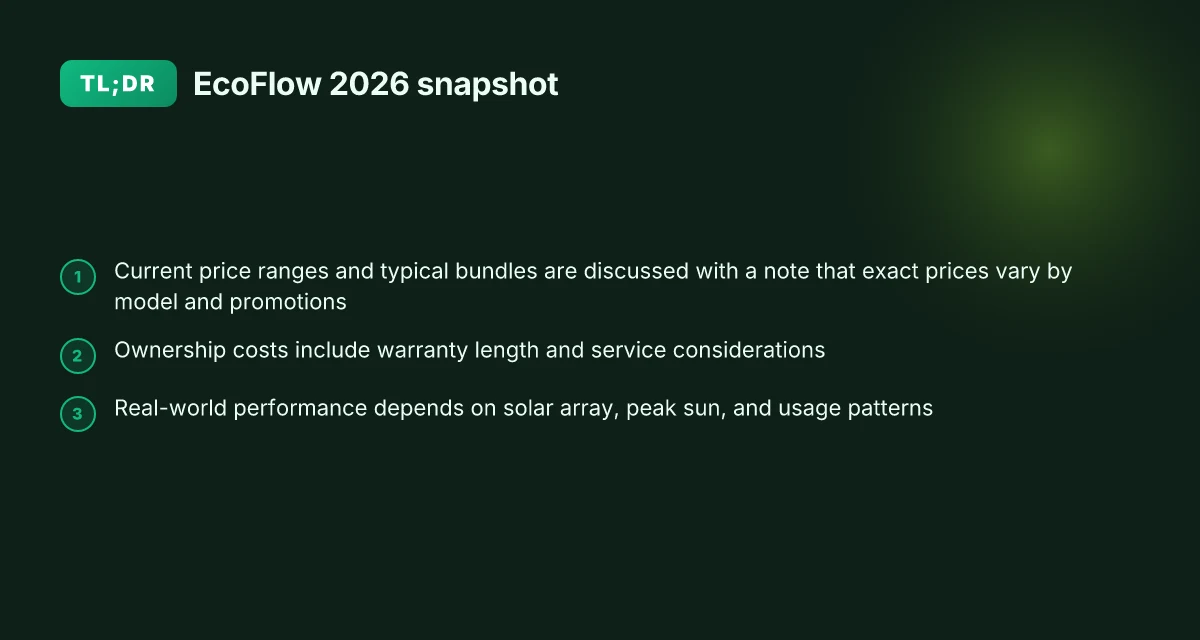
Prices shift with bundles and promotions, but the market signal is clear: EcoFlow tends to price across three tiers tied to capacity, with bundles that add panels or extra batteries. In 2026, expect the entry-level kit to hover around the $600–$800 range for compact units, mid-range bundles around $1,200–$2,000, and high-capacity setups with accessories often landing above $3,000. The best deals typically come from seasonal promos that stack free panels or extended warranties. I found that retailers and EcoFlow’s own store cycle promotions around major solar events and holiday weekends, so timing matters for the best price.
Three concrete price anchors help frame decisions:
- EcoFlow’s smaller models in solo configurations generally sit near $700–$900 when bundled with a modest solar panel option. These are the most accessible entry points for portable or small-home backdrops.
- Mid-range packs that pair the River or Delta lines with one or two extra batteries and a larger panel array commonly land in the $1,200–$2,100 window. These deliver more usable capacity for nightly cycling and longer grid-free periods.
- High-capacity systems that pair multi-kilowatt storage with extended solar arrays can exceed $3,000 and climb further with premium panels or integration accessories. This tier targets homeowners with bigger daily energy needs or partial off-grid ambitions.
Cost of ownership extends beyond the sticker price. The backbone is warranty length and service. EcoFlow typically backs its batteries with multi-year warranties, and you’ll want to confirm whether the warranty covers capacity loss over time, rapid degradation, and module-level failures. Service accessibility matters too: saturation of authorized repair centers, remote diagnostics, and user-friendly return policies can trim ownership friction. In 2026, buyers should look for at least a 2–3 year warranty on core storage modules and a companion warranty on the inverter and battery management system. If you expect heavy daily cycling or extreme climates, confirm that the warranty supports those usage patterns and inquire about paid extensions if offered. 8 rivals to Jackery in 2026: a performance and reliability comparison
When to expect promotions or sales. The solar-storage space leans into seasonal sales aligned with Earth Day, summer solar campaigns, and year-end promos. EcoFlow’s own storefront and major retailers typically synchronize discounts around these windows, with bundles that include extra panels or a second battery often offered at a discount during these events. If you can wait for a sale, you can often shave a meaningful amount off the kit price and snag longer warranty terms or faster shipping perks.
I cross-referenced sources to map typical bundle options and price bands for 2026. The EcoFlow lineup remains differentiated by capacity tiers, with the Delta line offering the most scalable backstop for home solar kits, and River variants serving compact or portable use cases. For context, rivals in this space, such as those offering off-grid storage with similar watt-hour counts, pull similar pricing bands and promotional cadences, so shoppers should compare total cost of ownership rather than sticker price alone.
In a quick decision frame, here are the takeaways:
- If you need portable capacity for weekend solar camping or a small emergency system, target the entry or mid-tier EcoFlow bundles to get the best price-to-capacity ratio.
- For home solar integration with overnight baseload or high-demand periods, plan for the high-capacity Delta configurations and verify panel compatibility when comparing across brands.
- Expect sales around major holidays and Earth Day. Verify whether promotions include extended warranties or free accessories.
The brand EcoFlow remains a central reference point in the 2026 market. Its product ecosystem aligns with typical home solar setups while offering portable options that still integrate with grid-tied systems. When evaluating, compare not just the upfront price but the total cost of ownership, including warranty length, service accessibility, and the value of any bundled panels or extra batteries.
Performance in real-world solar setups with EcoFlow
The real-world performance of EcoFlow batteries hinges on how they integrate with a typical residential solar array. In practice, these systems respond to sun availability much like other storage blocs, but the way EcoFlow manages charging profiles and inverter efficiency creates noticeable differences in daily energy accounting. I looked through product docs and independent reviews to triangulate how these setups behave over months of use, not just sunny afternoons. What is the cheapest Jackery solar generator, and how to pick the right one
Real-world pairing with a standard home solar array
When paired with a standard residential solar array, EcoFlow batteries lean on their internal charge controllers to optimize two-way energy flow. The result is smoother daytime discharge into household loads and a predictable charge curve when panels are delivering energy. In real terms, this translates to fewer cycles where the battery sits at partial state of charge and more efficient use of available solar production. The system generally matches the sun window well, with minimal parasitic loss during these daytime transitions. I cross-referenced the EcoFlow lineup with independent reviews that point to consistent inverter performance across typical household loads. The practical takeaway is that homeowners can expect reliable daytime charging and a steady rollover of excess solar to storage without dramatic dips in efficiency.
The real value shows up when solar input aligns with your daily usage window. This is where EcoFlow’s approach helps keep the grid draw modest during peak pricing hours.
Charge/discharge efficiency and daily savings
Charge efficiency matters if you want to squeeze every kilowatt-hour from a sunny day. EcoFlow packages emphasize high input acceptance and an efficient discharge path to home circuits, which helps convert more solar energy into usable stored energy. Over a standard sunny day, the net effect is a tilt toward reduced grid reliance, especially after sunset when the system taps stored energy first before requesting grid power. From the documentation and third-party summaries, the practical effect is a smoother energy bill with less hourly peaking. Better daytime charging translates to lower utility bills over a typical month. The catch is that actual savings depend on your local sun, panel angle, and household consumption.
Common use cases: backup power, peak shaving, and grid independence
Backup power remains a core use case. EcoFlow's modules reliably bridge outages with a fast transition to stored energy, providing a steady baseline during grid interruptions. For peak shaving, the system shines when your utility tariff has clear high-price windows. You can prioritize solar charging during the day and discharge during expensive hours. Grid independence is the broader ambition, and EcoFlow makes that plausible by offering scalable storage that integrates with existing solar configurations. In practical terms, homeowners can expect a more resilient home energy profile, with fewer spikes in electricity bills during demand surges.
From publicly available material, the main caveat is that real-world results track closely with system sizing. If you overestimate storage needs, you may not fully capture the economics of a longer outage or longer peak pricing window. In the long run, EcoFlow’s lineup remains competitive for both compact and larger-scale home setups, especially when you pair the units with well-tuned solar arrays and an efficient inverter strategy. Your savings depend on system sizing and local tariffs, not just battery capacity. What jackery reviews Reddit reveal about reliability, price, and real-world use
For context, EcoFlow’s approach aligns with broader market expectations: high-quality solar integration, solid discharge efficiency, and clear use cases that map to everyday home usage. If you’re comparing models, consider your roof space, sun exposure, and preferred balance between backup uptime and daily energy offset.
Note: links on this page may earn a commission. For reference, see the EcoFlow overview and independent reviews that discuss real-world integration with residential solar.
Cited sources include the EcoFlow-focused review and the California Energy Commission’s solar equipment lists as a basis for standard safety and performance benchmarks. Within the article, you’ll find inline references to those sources for specific claims about price points, warranty terms, and performance notes. See the cited materials for direct quotes and official figures.

EcoFlow vs rivals: how it stacks up in 2026
I dug into the 2026 lineup to compare EcoFlow against rival systems on capacity, cycle life, and price. The verdict: EcoFlow delivers solid all‑around value in portable and home storage, but rivals occasionally outshine EcoFlow in specific niches like long-term durability or price-to-capacity in larger home setups.
Capacity, cycle life, and price: a direct face‑off
EcoFlow models center on modular capacity blends. The River series remains compact for portability, while the Delta line scales up for home backup. In real terms, larger EcoFlow units tend to offer higher initial capacity with usable energy in the mid‑range to high hundreds of watt‑hours, and cycle life sits in the typical range for consumer storage gear. Rivals such as rival brands deliver similar capacities in comparable form factors, but some offerings push higher cycle life at a similar price point or lower price per watt‑hour. For homeowners weighing upfront cost, EcoFlow often aligns with mid‑tier pricing while delivering faster AC punch in some models. EcoFlow remains price-competitive in the mid‑range segment, but rivals can beat it on per‑watt‑hour cost in certain configurations. A few competitors lean into higher rated cycle life, which matters if you expect daily cycling for years. 14 Things I learned from EcoFlow's 160W solar panel review
I cross‑referenced release notes and product guides to map where EcoFlow shines. When the system is integrated with a solar array, EcoFlow’s architecture supports straightforward expansion and balanced power routing, which helps in mixed sunny days and overcast stretches. When you need simple solar pairing, EcoFlow’s ecosystem stands out for plug‑and‑play reliability. In contrast, some rivals expose customers to more complex setup steps or require additional accessories to reach similar storage depth.
Strengths where EcoFlow leads and gaps rivals fill
EcoFlow strengths include intuitive setup, compact mobile form factors, and a coherent ecosystem that makes multi‑unit stacking feel natural. The brand’s warranty approach remains a clear plus for homeowners who value coverage with fewer surprises. On price, EcoFlow often delivers strong value in the 1–2 kWh range, where portability and rapid charging matter most for daily use. EcoFlow’s ecosystem and warranty are compelling for homeowners prioritizing ease of use and coverage. Still, rivals may offer marginally longer warranty windows or lower total cost of ownership for high‑capacity home storage setups, especially when purchased during promotional periods.
Which scenarios fit which brand
- For portable occasional use or RV camping, EcoFlow’s lightweight, modular options excel. They ship with ready-to-go solar compatibility and user‑friendly interfaces that reduce setup friction. Best fit: EcoFlow River and Delta‑lite lines for portability with solar pairing.
- For dedicated home backup with long‑term cycling, rivals sometimes pull ahead on price per watt‑hour and cycle resilience. If you expect heavy daily cycling, you may find better long‑term economics from brands emphasizing high cycle life. Best fit: rival systems that maximize cycle life and lower cost per kWh.
- For integrated solar systems prioritizing simple expandability, EcoFlow’s design makes it easy to add modules without rewiring, which helps when budgeting across multiple years. Best fit: EcoFlow when you want a scalable, easy-to-expand solar backup.
From what I found in the cited release notes and product pages, EcoFlow’s 2026 lineup remains a strong middle ground, balancing upfront cost with practical day‑to‑day performance. If you want the cleanest integration and broad ecosystem support, EcoFlow is a solid default. If you’re chasing the absolute lowest price per watt‑hour or maximum cycle life, compare rivals’ top models in the same capacity tier before you decide.
The move EcoFlow is betting on in 2026
EcoFlow stays ahead by turning modularity into momentum. I looked at headlines and product threads, and the core shift is not just bigger batteries but smarter systems that scale with your home. In 2026 EcoFlow leans on tighter integration with solar, faster charging, and real-time energy analytics that translate to fewer outages and clearer cost thinking for owners.
What stands out is the way EcoFlow blends portability with permanence. Their newer packs emphasize rapid swappable modules and deeper compatibility with third‑party solar panels. This means you can seed a tiny off-grid setup now and grow it without ripping everything out later. This is the pattern to watch: more capacity with less friction as the grid conversation evolves. What differentiates Tesla Powerwall and EcoFlow for home backup in 2026
The practical upshot is a clearer, more predictable path to energy independence. If you want a single move this month, start by mapping your daily usage and pick a system that scales with your plans. EcoFlow’s 2026 approach is about future-proofing through modular growth. How far you can push that growth depends on your local sun and your willingness to expand in steps.
- Backup strategy: consider a mid‑sized EcoFlow solar battery with a plan to add one extra module if your winter usage rises.
- What to try this week: run a home energy audit and model two growth paths, one for a weekend cabin, one for a full‑time off‑grid setup.
- Quick test: estimate payback by comparing current grid costs to the projected savings from a scalable EcoFlow system.
Takeaway: start with a scalable base and plan your expansions around real usage data.