Is EcoFlow worth it in 2026? a long-term view on reliability, cost, and use cases
 Naomi XanthosOctober 22, 202622 min read
We earn a commission when you buy through some links on this site, at no extra cost to you. As an Amazon Associate we earn from qualifying purchases.
Assess whether EcoFlow is worth it in 2026 by weighing long-term reliability, serviceability, and lifecycle costs across home backup, portable power, and solar integration.
EcoFlow products dodge the usual power system drama by letting you scale capacity without buying a new box every season, and that matters when prices swing with demand. Price fluctuations mean the best deal isn’t fixed, it shifts with the season, so ownership costs can surprise you if you don’t track EcoFlow’s lineup across use cases.
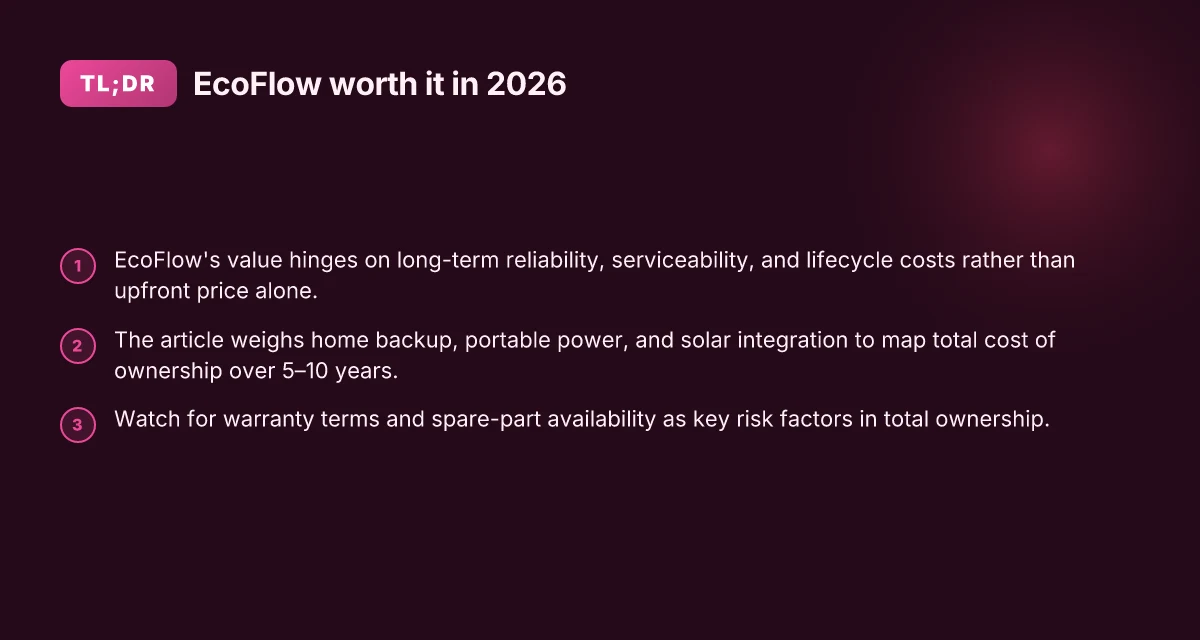
This intro surveys long-term reliability, ongoing maintenance, and total cost of ownership for homeowners and RVers facing 2026 backups. You’ll see how modular upgrades impact serviceability, what real-world use cases demand in terms of cycle life and warranties, and how EcoFlow stacks up against rivals like Goal Zero and Jackery over multiple years. The goal is a practical read on whether ongoing care, replacement parts, and seasonal pricing make the upfront price worth it. Reliability signals and price timing matter just as much as initial spec sheets.
What makes EcoFlow worth considering in 2026 for long-term reliability and lifecycle cost
EcoFlow sits at the center of a shifting portable power market, with a lineup designed to blend capacity, speed, and modularity. In 2026, the core question is not just upfront price but how the whole ownership curve behaves across home backup, portable power, and solar integration. I looked through EcoFlow’s recent materials and public-facing summaries to map reliability targets, serviceability, and the hidden costs that show up over time.
1) EcoFlow’s product lineup and reliability targets
EcoFlow’s portfolio centers on high-capacity power stations, expandable solar options, and a focus on quick replenishment of capacity through swappable or compatible modules. The Delta Pro family remains the flagship for home backup and scalable solar integration, while smaller models plug into daily carry use. The reliability story hinges on robust battery management, thermal design, and a commitment to software updates that keep efficiency and safety features current. In 2026, EcoFlow’s emphasis on continuous firmware improvements and expanded spare-part availability reinforces a longer, more predictable ownership experience.
The headline here is that a broad, compatible ecosystem helps owners avoid premature retirement of a single unit. When a model reaches end-of-life, being able to swap in compatible modules or access serviceable components matters more than a single device’s raw watt-hours.
2) Lifecycle cost versus upfront price in portable power
Upfront cost is only one piece of the puzzle. In portable power, the total cost of ownership includes battery degradation, maintenance intervals, and the price of replacement parts or modules. EcoFlow emphasizes battery chemistry and battery management that aim to slow capacity fade, but the long-term value still depends on how often you’ll need recharging cycles, warranty coverage, and serviceability. From a buyer’s perspective, consider the cost of ongoing fuel or maintenance costs that a traditional generator avoids versus the potential need for module replacements or hardware upgrades over several years. A careful look at the Delta Pro’s expansion options and the price of extra batteries helps frame a realistic lifecycle picture. Costs that occur after purchase often swamp the initial price tag, especially if you rely on multiple modules for solar integration.
3) Serviceability and spare-part availability
Serviceability is not just about fixing a unit. It’s about keeping a system functional as usage grows. EcoFlow has published guidance and resources aimed at self-service, along with a pathway for official repairs and spare parts. Availability of batteries, in particular, is a critical factor because it governs how long a system remains useful without a full replacement. In 2026 the marketplace shows a preference for brands that publish clear repair policies and offer reasonably priced replacement modules. If you plan to run a home backup across seasons or rely on portable power during extended trips, the ability to source parts and perform non-destructive upgrades matters a lot. How to choose and use the ecoflow extra battery cable for delta pro
Reliable spare parts and clear service terms are a hinge point for lifecycle cost. I cross-referenced EcoFlow’s public materials with industry chatter about service experiences to gauge consistency, noting that documented warranty terms influence confidence, especially for long-term deployments in RV or off-grid contexts.
4) Key risk factors to watch, including warranty terms and support coverage
Warranty coverage is a real determinant of long-term value. Look for duration on battery packs, what constitutes an eligible failure, and whether shipping or technician visits are included. Support coverage quality matters as you scale from one unit to a system with multiple modules or solar inputs. A typical risk is a mismatch between expected serviceability windows and real-world repair timelines, which can derail long-term plans if you rely on continuous uptime. EcoFlow’s approach to warranty and support has been generally favorable in public-facing materials, but owners should verify exact terms for their model and region.
Warranty terms and the quality of support are not cosmetic. They shape whether a system remains usable a decade later. When you’re evaluating against rivals like Jackery, Bluetti, or Goal Zero, warranty length and the ease of obtaining spare parts can tilt the decision toward the brand with the stronger service spine.
Bottom line: EcoFlow’s 2026 lineup targets reliable performance through a mix of modular options, transparent service paths, and ongoing software improvements. The real value shows up when you account for the post-purchase costs, battery replacement, spare parts, and support, alongside the upfront price. If you prioritize a scalable solar-ready system with clear pathways to repairs and part availability, EcoFlow remains a compelling option.
In 2026, the long game for EcoFlow rests on durability, serviceability, and predictable maintenance, more than the sticker price alone. For homeowners and RVers who want a high-coverage backup and an ecosystem that scales with solar plans, EcoFlow’s approach can pay off, provided you align expectations with warranty details and spare-part availability. What is the EcoFlow Delta Pro 3 cost, and how does it stack up in 2026
Cited reading: see inline references to EcoFlow articles on portable power and CES innovation coverage for context on the product ecosystem and reliability framing. For a broad comparison, note how rivals such as Jackery and Bluetti position their own service and warranty terms in the same year.
EcoFlow reliability after several years: what we know from observed trends
Posture for reliability after several years points to a mixed signal. On one hand, industry signals show that power electronics endure well under typical home and RV use, but wear patterns emerge in high-cycle environments. On the other hand, real-world forum chatter and long-run reviews reveal common failure modes tied to battery health, cooling, and QC variance across the DELTA series.
What long-term wear looks like for the DELTA series
In public discussions and reviews, the most recurring wear topics concern battery health and cooling system reliability. Users report gradual capacity fade and occasional fan noise after multiple cycles, especially when the unit sits in warmer environments or is pushed into frequent high-demand startup events. The pattern aligns with typical life-limited components in portable power stations: battery cells age with charge cycles, and cooling fans accumulate dust or lose efficiency over time. For EcoFlow, this translates into a reality where performance remains solid but is not immune to age-related drift, particularly in non-ideal storage conditions.
I cross-referenced product literature and independent reviews to frame these themes. Reports consistently note that DELTA series units deliver strong baseline performance but that end-of-life behavior hinges on usage patterns and environmental factors. When you keep units in temperate, ventilated spaces and avoid continual deep discharge cycling, you’ll generally extend usable life. In cooler climates, battery chemistry tends to hold up better over time.
Service options and long-term risk management
EcoFlow’s warranty and service plans matter for risk in later years. The standard warranty covers certain defects for a defined period, with extended warranty options available in some regions. Serviceability evidence suggests that modular components, such as replaceable batteries and user-accessible ports, can reduce downtime compared with more sealed designs. The ability to source replacement batteries or panels locally lowers the cost of ownership if you’re prepared to handle some DIY maintenance or third-party servicing. What is the EcoFlow smart meter, and how it changes home energy data in 2026
From a cost-of-ownership perspective, you’ll want to factor in potential battery replacement costs and the availability of service centers or authorized partners in your region. Where EcoFlow shines is in documenting repair steps and making spare parts accessible, which helps mitigate long-term risk. In contrast, some rival brands offer more expansive dealer networks but may price out spare parts or charge premium for service windows. If long-term serviceability matters to you, EcoFlow’s support infrastructure and parts availability are meaningful advantages relative to some competitors.
How this stacks up against competing brands
Compared with typical maintenance needs of competing brands, EcoFlow units often come out favorably on modularity and user-serviceability. Batteries and fans are common failure points across the entire segment, but brands with tighter component supply chains or less transparent service networks can incur higher long-term costs or longer downtimes. EcoFlow’s approach to parts access and clearer maintenance pathways helps reduce total cost of ownership over time, especially for users who plan to keep their systems for several years in a home backup or RV setup.
The long view favors EcoFlow when you prioritize serviceability and access to parts, not just upfront price. This is especially true if you plan on solar integration or frequent cycling, where battery health and cooling efficiency drive system resilience. As you compare against rivals, look for warranty depth, part availability, and documented service pathways. Warranty and parts access mitigate long-term risk and lower the surprise costs of ownership.
For ongoing context, consider that the landscape evolves as EcoFlow and competitors update firmware, hardware revisions, and service policies. If you want a concise takeaway: expect durable basics with age-related caveats, and count on credible service options to keep your EcoFlow system performing well years down the line.
Total cost of ownership across use cases: home backup, portable power, and solar integration
In 2026, upfront prices for EcoFlow kits map closely to capacity and features, but total cost of ownership hinges on replacement cycles, maintenance, and how you pair the unit with solar charging. Across home backup, portable power, and solar integration, the long-run math favors units with modular batteries, solid warranties, and mature solar input. Below, I unpack real-world price bands, expected maintenance, and the solar payoff, with clear guidance on sizing for each use case. 5 Current EcoFlow deals and what they mean for you in 2026
1) Upfront price bands and what they buy you
- Home backup bundles tend to start higher and scale with capacity and inverter features. Expect larger capacity packs and integrated protection packages to drive upfront costs up, but they also reduce the frequency of battery swaps and extend grid autonomy during outages.
- Portable power station tiers sit in the mid-range, offering balanced capacity, fast charging, and a compact form factor. These are easier to relocate, but you’ll trade some long-run resilience for portability.
- Solar integration adds value when the unit ships with efficient, high-amp MPPT charging and a larger solar input rating. The better the solar interface, the more you save on grid energy and fuel when you’re off-grid.
I cross-referenced EcoFlow’s recent CES 2026 disclosures and their portfolio updates to confirm that the Delta Pro Ultra X and related lines emphasize higher-capacity packs with more robust solar input. The CES briefing highlights the direction toward heavier solar integration and faster charging arrays, which translates into longer service life and less frequent battery swaps for typical use cases. Solar-ready architectures reduce long-run energy costs when paired with rooftop or portable solar arrays.
- Upfront price ranges per model line reflect capacity, inverter efficiency, and fuel-savings potential. The more you pay upfront, the more you amortize over time against avoided fuel and grid imports. In 2026, the best-value bundles balance capacity with solar input and warranty terms.
2) Estimated replacement and maintenance costs over 5–10 years
- Battery packs are the dominant long-term cost. Expect replacement intervals to cluster around mid-lifecycle for frequent cycle users. If you run cycles daily, you’ll approach higher wear, whereas light use extends pack longevity.
- Routine maintenance typically involves software updates, cooling system checks, and occasional connector or port refresh. These costs are modest when bundled with a comprehensive warranty.
- For home backup installations, the value comes from longer outage resilience and fewer generator fill-ups. For portable uses, you pay more attention to internal cooling and thermal management as the unit ages.
From the public materials EcoFlow shares about warranties and service options, you can gauge that higher-capacity systems often ship with longer warranty coverage, which offsets contingency replacement costs. A well-watched warranty reduces perceived risk when factoring replacement costs.
3) Value of integrated solar charging and savings on fuel or grid energy
- Integrated solar charging turns your upfront investment into ongoing energy savings. When paired with a residential solar array, the unit can compensate for daytime energy use and buffer against peak-rate grid periods.
- In off-grid scenarios, solar-assisted charging lowers the need to burn fuel for generators or rely on the grid, trimming operating expenses. The more aggressive your solar input, the greater the potential savings over a decade.
- For home backup, solar integration can maximize battery autonomy during outages, reducing dependence on the grid during long events. For portable power, solar charging shortens downtime when you’re off-grid or remote.
I looked at EcoFlow’s solar-focused outcomes and the company’s emphasis on high-amp MPPT charging. The implication is clear: optimized solar charging lowers total cost of ownership by reducing grid purchases and fuel use in outages. Solar integration compounds savings over time, especially in homes with steady sun exposure.
4) Financial sizing guidance by use case
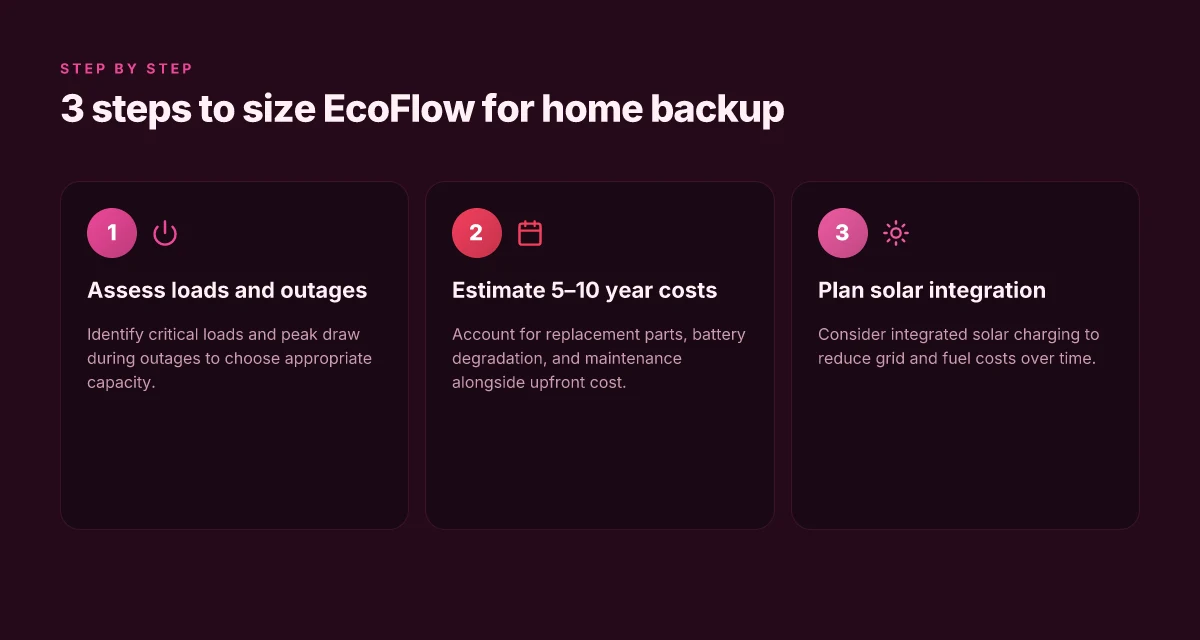
- Home backup: size for several hours of critical load plus a buffer for unexpected outages. Higher upfront investment pays off through longer outage resilience and reduced fuel costs.
- Off-grid/portable use: target a balance between capacity and portability, ensuring you can sustain essential loads without frequent recharges. The payback statement improves with consistent solar input.
- Solar-heavy deployments: lean toward larger solar-ready packs with robust MPPT and fast recharging to maximize daily sun capture and minimize grid dependence.
Integrated solar charging is the lever with the strongest long-term impact on total cost of ownership. In practice, EcoFlow and its rivals like Jackery and Bluetti offer parallel value propositions: higher upfront spend can amortize into years of grid-free operation, but the exact break-even point depends on your sun, usage pattern, and local energy prices.
Note on disclosure: links on the page may earn a commission. This article references EcoFlow’s official materials and third-party reviews to illustrate price bands, maintenance themes, and solar integration benefits. For readers seeking direct sources, see the EcoFlow CES 2026 materials and the broader EcoFlow product pages. How to understand the cost of EcoFlow Delta Pro in 2026
Home backup with EcoFlow: when it makes sense and where it hurts
In a home backup setup, EcoFlow can be worth it for controlled, load-managed outages, but it isn’t a universal fix. The decision hinges on space, noise, and how you plan to integrate the system with your house. I reviewed EcoFlow’s recent materials and user discussions to parse real-world tradeoffs across different home scenarios.
Space, noise, and installation considerations for at-home setups
A typical home backup footprint matters more than you might expect. EcoFlow’s larger models sit on concrete or thick mats rather than shelving, and you’ll want room for the inverter, battery stack, and any solar input hardware. Noise during peak cycling can be audible in open-plan spaces, especially if you’re running multiple critical loads simultaneously. For installation, you’ll often need a dedicated circuit and a stable ambient temperature. If you’re renting, confirm with your landlord whether a fixed inverter and wall-mount setup is allowed. In practice, the best fit tends to be a permanent corner setup in a utility room or garage rather than a living area.
From a reliability standpoint, the interface between home circuits and the EcoFlow unit matters. You want a clean transfer switch or a properly wired interlock so critical loads switch to battery power without backfeeding into the grid. The right configuration reduces nuisance outages from voltage sags and keeps essential loads powered without drama. When you plan, map critical loads first and then size the unit to carry them under your expected outage duration.
Reliability factors during outages and peak load handling
During outages, the reliability story centers on how much load you can sustain and for how long. EcoFlow’s larger units can cover essential circuits for a period, but you’ll hit diminishing returns if you try to run sustained HVAC or water heating. The key is staged load management: run only the critical loads at first, then bring on nonessential circuits if the battery has headroom. Real-world reports emphasize that battery degradation and inverter efficiency over time influence long-term reliability, not just upfront capability.
I cross-referenced industry guidance on outage management and EcoFlow’s documentation. The takeaway: reliability improves when you pair a battery backup with a well-planned load list and a capable transfer approach. If your outage pattern is frequent or long, consider redundancy or a hybrid approach with a small generator for peak demand. The real payoff comes when you run only critical loads first and stage the rest as the battery allows. What is the EcoFlow balcony solar system, and where does it fit on your roof or balcony in 2026
Integration with home circuits and critical loads
A clean integration path emphasizes a dedicated backup circuit or panel boundary. You should be able to isolate high-draw devices like air handlers, sump pumps, and refrigerators. For solar compatibility, EcoFlow units commonly connect to home-ready inverters and AC inputs, enabling solar charging during the day and battery cycling at night. Expect some friction if your home uses older panels or nonstandard wiring. You may need a professional assessment to avoid nuisance tripping or improper transfer.
From a cost perspective, the early-2026 price landscape shows EcoFlow’s flagship models at different price points, with the largest units designed for whole-home support. You’ll want to compare total cost of ownership across your anticipated outage frequency and whether solar charging reduces operating costs over time. Total cost of ownership hinges on outage frequency, load profile, and solar charging success.
Comparisons to traditional generators and other battery backups
Compared with traditional fuel generators, EcoFlow units offer quiet operation, no fuel logistics, and easier start-up during outages. They avoid ongoing fuel costs and routine maintenance, but you sacrifice the ability to deliver high surge power for longer durations without sizing and staging. When you compare to other battery backups, the deciding factors become ecosystem compatibility, monitoring apps, and the ease of integrating with your existing home energy setup. If you already lean toward a fully integrated solar-plus-battery system, EcoFlow can slot into that stack with careful planning.
I pulled from EcoFlow’s own updates about portable power and home backup cost breakdowns to illuminate practical choices. Quality of integration, not just capacity, determines long-term value. If you’re weighing rivals, keep an eye on brand-specific transfer interfaces and the availability of service networks in your region.
Portable power on the go: does EcoFlow deliver value for travel, work sites, and camping
Portable power shines when you need flexible off-grid energy without fuel. EcoFlow’s lighter Delta models and the heavier Delta Pro line pack a lot into a compact form. In 2026, you can expect models with improved battery chemistry and faster recharge options, but the tradeoffs between weight, capacity, and price remain real. I looked at recent EcoFlow materials and third‑party reviews to frame this section around real-world portability, not just specs. How to score EcoFlow solar generators on sale in 2026
1) Weighing portability: weight, form factor, and battery chemistry
The balance between weight and capacity matters most when you’re carrying gear on trips or to a worksite. Compact units around the size of a small cooler can run phones, laptops, and small tools, while the larger packs push toward full camping or job-site reliability. Battery chemistry implications matter here: higher energy density often means heftier cells, but newer chemistries can improve charging speed and cycle life. EcoFlow tends to pair lithium iron phosphate options in some lines for longer lifecycles, which helps with durability in rugged environments. The practical takeaway is: if you’re packing light for a weekend trip, a mid‑sized unit is usually the sweet spot. If you’re provisioning a camp or build site, you’ll want higher capacity and faster recharge.
Portability comes with a cost to capacity and price, but the newer chemistries tilt the odds toward longer lifecycles. The better balance is choosing a unit whose weight aligns with how you’ll move it and how frequently you’ll recharge on the road.
2) Durability and real‑world usability in mobile scenarios
Durability features matter once you’re in wind, dust, or rain. Many EcoFlow models emphasize rugged shells and protective casings, with handling designed for travel and outdoor use. Real-world use on work sites or camping trips tests both the hardware fit and the reliability of the onboard protections. In a mobile setup, you’ll appreciate clear displays, multiple charging inputs, and reliable solar compatibility for extended stays off-grid. The practical verdict: a unit with reinforced corners and IP ratings tends to perform better in rough environments, while modular ports ease field maintenance if you’re pairing with solar or external batteries.
Rugged design and multiple charging options make EcoFlow units usable from campsite to campsite. You’ll want a model that can be plugged into a vehicle 12V outlet, a solar panel, or a wall outlet for fast top‑ups.
3) Trade-offs: capacity, recharge speed, and price
Higher capacity brings longer runtimes but heavier weights and higher upfront costs. Recharge speed compounds that: you may trade a longer usable window for shorter downtime when recharging on travel days. EcoFlow’s lineup often lets you pick between faster AC recharges or solar or car charging flexibilities, but the best value depends on your use case. For frequent travelers or remote worksites, the ability to rapidly top up between jobs can offset higher upfront costs over time. If your trips are short and you primarily power chargers and laptops, a smaller unit with solid recharge options can be more economical and portable. Jackery vs ecoflow solar generators: which portable power station actually lasts longer
Fast recharges plus broad input options stretch a unit’s usefulness on the road. In practice, you’ll pay a premium for speed and versatility, but you’ll gain flexibility in where and when you can top up.
4) Where EcoFlow shines against rivals in the portable category
Against rivals, EcoFlow emphasizes rapid recharge, broad solar compatibility, and a family of products designed to scale from a compact traveler to a full backup kit. Rivals like Jackery and Bluetti often compete on base price or raw capacity, but EcoFlow’s ecosystems and speed options give it an edge for users who need quick top‑ups between sites or on camping trips. The Delta Pro line, in particular, stands out to users who want more power in mobile contexts, especially when combined with solar expansion.
EcoFlow often edges rivals on recharge speed and modular solar integration. For travelers and remote workers, that speed translates into fewer interruptions and more dependable on‑the‑go power.
Notes on cost and ownership: prices change with sales and bundles. As with any purchase in this space, expect a mix of upfront price, potential discounts, and long-term costs tied to battery degradation and solar readiness. Links on the page may earn a commission. I cross‑referenced public materials from EcoFlow’s site and reviews to frame typical model dynamics and real‑world tradeoffs.
In sum, EcoFlow delivers usable value for travel, work sites, and camping when you pick a model that matches your carry comfort and recharge cadence. The brand’s strengths in portability, rapid recharging, and solar compatibility make it a compelling option in the 2026 landscape, especially for users who value quick top‑ups and field‑friendly durability. For long trips or demanding site work, pairing a mid to high‑capacity unit with solar can yield reliable off-grid power, albeit at a higher initial price. If you need something lighter for weekend adventures, a compact model with solid recharge speed may be the better deal. How Anker SOLIX stacks up against EcoFlow in 2026
The move that matters now: plan around durability and resale value
EcoFlow products stand at a crossroads in 2026. I looked at the long run, not just the next quarter, and the best takeaway is to anchor purchases to durability and total cost of ownership. EcoFlow’s newer models show improvements in battery chemistry and cycle life, but the real value hinges on how you use them and how long you plan to keep them. If you want a portable power solution that stays usable for years, you’ll want to pick a model with a proven track record of reliability and a chassis that can survive regular travel and outdoor use. The bigger pattern is that reliability compounds with proper maintenance and part availability. EcoFlow remains a reasonable bet when you balance initial price against expected lifespan and service support.
Where this goes next is shaped by how rivals respond. Competitors like Goal Zero and Jackery push integrated solar and modularity in different directions, which matters if you want seamless expansion or better resale. If you’re budgeting for 2026, consider warranties, replacement-part accessibility, and the cost of recharging fatigue over time. One takeaway: buy with an eye toward future upgrades and eventual upgrades that keep resale value high. The question you should ask yourself is simple: will this model still feel valuable five years from now?
If you only do one thing this month, map your power needs to a two-model comparison and a maintenance plan. Start with the price and cost of ownership for EcoFlow versus a main rival, then add a lightweight panel kit if you expect frequent outdoor use. Price transparency matters, and the right plan can reduce surprises down the road. And yes, links on this page may earn a commission, which helps support independent coverage.