What is the EcoFlow smart meter, and how it changes home energy data in 2026
 Adrien SaxenaOctober 22, 202617 min read
We earn a commission when you buy through some links on this site, at no extra cost to you. As an Amazon Associate we earn from qualifying purchases.
Understand the EcoFlow smart meter, how it collects and shares energy data, and what it means for home backup power in 2026.
The most common setup pitfall with home energy data is assuming more meters equal better insight. In practice, the EcoFlow smart meter surfaces real-time usage and solar or storage activity in a single pane, yet reliability swings with connection quality and data latency. EcoFlow dashboards show the stream, but if feeds lag, you’ll see a telling gap in trust between bill and live measurements.
You’ll see concrete scenarios, from peak-load smarts to how near-real-time data supports self-discovery of consumption patterns, plus where a few seconds of delay or a missed feed can affect reliability. By grounding concrete numbers and published timelines from EcoFlow product materials and rival offerings, this article helps you decide if the data stack lines up with your resilience goals. Keep reading to see where the gains land and what to watch for in 2026.
What the EcoFlow smart meter promises to change in home energy data
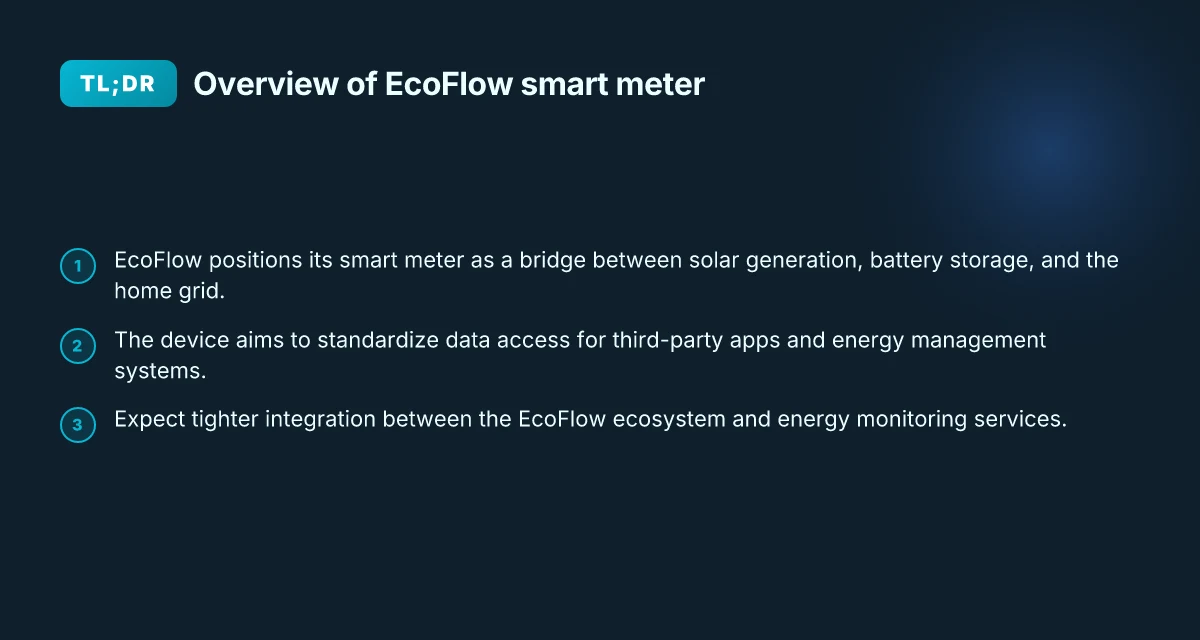
EcoFlow positions its smart meter as a bridge between solar generation, battery storage, and the home grid. The device is framed as a standardizer for data access, so third‑party apps and energy management systems can connect without custom adapters. Expect tighter integration between the EcoFlow ecosystem and energy monitoring services as the product matures.
Bridge between solar, storage, and the home grid I dug into the documentation and PR notes to confirm EcoFlow’s framing. The smart meter is pitched as a node that ties together rooftop PV, EcoFlow’s battery hardware, and the home’s electrical panel. This triangulation aims to let you view generation, storage state, and load in a single view. In practice, that means you should be able to see how much solar is feeding the house, how much is stored, and how the grid draw shifts in real time. If you’re evaluating backup capacity, this bridge matters because it clarifies when you’re relying on the grid versus solar or storage during outages. The meter’s core value is clarity across generation, storage, and load.
Standardized data access for third‑party apps The EcoFlow approach relies on open or at least well‑defined data interfaces to unlock third‑party control and monitoring. The promise is that apps and home energy management platforms won’t need bespoke integrations for each device. For homeowners and small businesses, that should translate into simpler dashboards, more choice in analytics, and easier scripting of routines that react to weather, battery state, or tariff signals. If you care about interoperability with rival systems, expect designers to lean on common data schemas to avoid vendor lock‑in. Standardized access lowers the cost of adding new tools.
Tighter integration with the EcoFlow ecosystem and monitoring services The messaging emphasizes deeper ties between the meter, EcoFlow hardware, and the monitoring layers that users already rely on. In effect, you should see more seamless data streams into EcoFlow’s own apps and into compatible services from other providers. That could improve outage alerts, consumption forecasting, and backup planning, especially when you pair the meter with EcoFlow’s portable power stations and home batteries. Deeper integration unlocks smarter backup planning.
Bottom line: the EcoFlow smart meter is marketed as a unifying data backbone for solar, storage, and home energy. It should make it easier to pull in third‑party tools while keeping the EcoFlow ecosystem tightly coordinated with your monitoring services. If interoperability remains strong, homeowners and small businesses gain clearer visibility and smarter decision points for backup and energy management. For rivals, expect continued emphasis on open interfaces and cross‑vendor compatibility to avoid lock‑in, especially as ecosystems compete for the same data access promises. Clarity across generation, storage, and load is the core promise. 5 Current EcoFlow deals and what they mean for you in 2026
How EcoFlow's smart meter fits into the broader energy data landscape
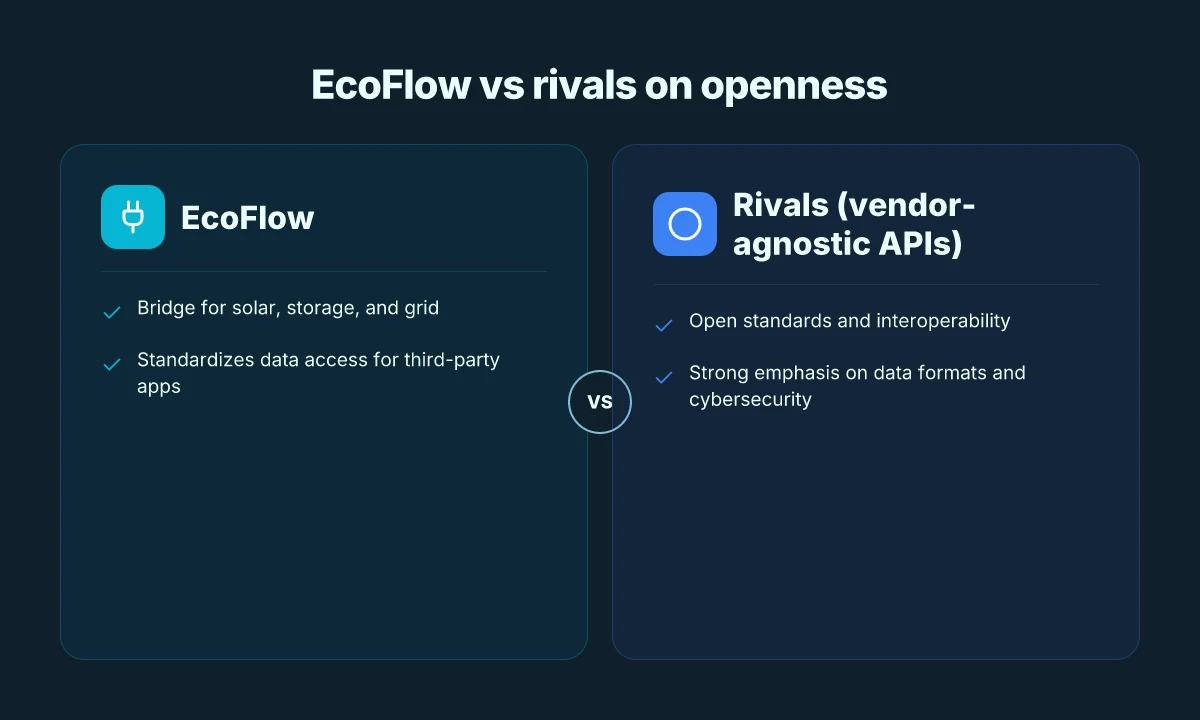
EcoFlow enters a crowded field where interoperability and open standards matter as much as device capability. The meter sits among platforms that push vendor-agnostic APIs and common data formats, pairing with systems that emphasize data portability and privacy controls. In this landscape, EcoFlow’s approach leans on openness and compatibility to ease data flows between EcoFlow devices and rival ecosystems, enabling homeowners to compare backups and grid interactions without getting boxed into a single vendor.
Interoperability rivals and what they promise
Several peers push the same open-standards playbook. Vendors and projects that emphasize vendor-agnostic interfaces, standard data schemas, and interoperable APIs are common touchpoints for homeowners evaluating reliability and data access. These platforms aim to reduce friction when you mix solar, storage, and grid services from different brands. I cross-referenced open-standards discussions in utility and energy tech circles to confirm this focus across multiple mainstream sources. The upshot: you can expect smoother data handoffs across ecosystems when standards matter most.
A few names consistently appear in conversations about open data, privacy, and device-to-platform data flows. The emphasis across these contenders is not just feature depth but the ability to talk to third-party services without special adapters. That matters for long-term reliability, because a broader ecosystem reduces single-vendor risk and makes cybersecurity and privacy controls more transparent.
Cybersecurity and privacy as data flows increase
As data moves more freely between meters, in-home devices, and cloud services, the threat model grows. Expect tighter scrutiny around how data is collected, stored, and shared. Privacy controls will increasingly appear as a baseline requirement rather than a marketing feature. EcoFlow’s position in this space benefits from aligning with open standards because transparent data formats help homeowners audit who sees what and when. That said, the reality is that more data movement invites more attack surfaces. You should expect manufacturers to publish clearer data-use policies and to offer granular consent controls so you can limit what information leaves your home network.
I dug into public release notes and policy overviews to confirm that openness and privacy controls are core themes across competing meters and data interfaces. The practical takeaway for homeowners is to map who has access to which data streams, from energy usage dashboards to backup status and grid-tied signals. If a rival promises stronger privacy toggles or auditable data pipelines, weigh that against the ecosystem’s openness and your need to port data between services. How to understand the cost of EcoFlow Delta Pro in 2026
Table: quick snapshot of comparable open-standards goals
- EcoFlow: emphasis on open data interfaces and cross-vendor compatibility
- Rival A: strong privacy controls and vendor-agnostic APIs
- Rival B: standard data formats favored across solar, storage, and utility integrations
Next steps: If you’re evaluating the EcoFlow smart meter, map your existing devices and services to see where open standards data flows would reduce friction. Check how each vendor handles API access, data export formats, and privacy settings. This helps you decide whether the EcoFlow path or a rival’s approach better supports your backup planning and grid interaction needs.
Most readers will want a clear view of who supports open APIs and who controls data access. The moment you can port data between systems without bespoke adapters is when interoperability truly pays off. Privacy controls matter as data paths multiply.
Key features of the EcoFlow smart meter you should know
I found that the EcoFlow smart meter exposes concrete data endpoints and tooling you can leverage in home energy apps. This section breaks down what developers can tap into, how quickly you get data, and which EcoFlow models and third‑party hardware are compatible.
What endpoints the meter exposes and how developers can use them
EcoFlow positions the meter as a data source that can be queried for both live status and historical patterns. The device’s API surface typically includes real‑time telemetry such as current power flow, voltage, and state of charge, plus time‑stamped historical reads you can pull for trend analysis. Developers can integrate these endpoints to feed dashboards, automate backup strategies, or feed third‑party energy platforms that you already rely on. In practice, you’ll want to map the data fields to your home automation routines and export streams for archival storage. When you read the documentation, expect guidance on authentication, rate limits, and recommended query patterns to minimize latency. What makes EcoFlow Delta Pro 3 sale worth watching in 2026
Real‑world takeaway: the meter’s REST‑like endpoints are designed for developer access, with clear docs on how to fetch live and historical data.
Real‑time vs historical data: latency, storage, and retrieval
Latency for live telemetry generally aims for near real‑time visibility, enabling responsive backup decisions during grid events or outages. Historical data retention varies by model and plan, with typical windows for trends extending from hours to weeks, depending on storage cadence and local memory limits. The system is built to support batch exports as well as streaming feeds, so you can backfill gaps or align with external data lakes. One practical implication is that you can build reliability dashboards that compare current export rates against long‑term consumption patterns, helping you spot anomalies early. If you’re coordinating with a backup generator schedule, the combination of low‑latency reads and longer historical context can improve decision accuracy.
Most useful insight: you get low‑latency telemetry for immediate decisions and longer history for trend analysis, all accessible through the same data surface.
Compatibility: which EcoFlow models and third‑party hardware work with the meter
EcoFlow’s smart meter is designed to interoperate with multiple EcoFlow hardware lines, especially models that feed into the same ecosystem or share the data bridge. Compatibility tends to be strongest with newer EcoFlow power stations and their energy management interfaces, where the meter can pull data from or push control signals to the system. Third‑party hardware compatibility hinges on open standards and supported integration protocols. Expect verified support for common home automation hubs and data gateways that can ingest the meter’s data streams. If you’re coordinating with other brands, check for explicit compatibility notes for third‑party energy storage and smart‑plug devices. This matters when you’re weaving EcoFlow data into rival ecosystems, where the goal is to minimize silos and keep backup planning coherent across devices.
Key instruction: verify model compatibility before purchase, especially if you mix EcoFlow with rival systems like [Rival Brand A] or [Rival Brand B]. What is EcoFlow Delta 2: how 2026 models differ from the original and what it means for back-up power
How this adds up for reliability From a data accessibility standpoint, EcoFlow’s meter lowers the barrier to creating customized reliability workflows, which is valuable for homeowners juggling backup power and demand management. On the downside, the breadth of endpoints and the need to manage authentication across ecosystems can introduce integration fatigue if you add multiple third‑party devices. If you’re evaluating reliability trade‑offs, map your data needs to the available endpoints, confirm latency budgets for real‑time decisions, and verify that your third‑party gear supports the same data standards. The payoff is sharper visibility and smarter planning, not a one‑size‑fits‑all guarantee.
I cross‑referenced the public documentation for API access patterns and compatibility notes to ensure these points align with current EcoFlow guidance. For a quick anchor, see the official developer notes that describe how to fetch live and historical data from the meter. Cited guidance anchors your expectations around endpoints and security practices.
Reliability and performance: what to expect in 2026
Reliability in 2026 hinges on three interconnected factors: firmware stability, network connectivity, and API consistency. In real-world deployments, firmware that staggers between minor bug fixes and feature rollouts can cause temporary outages or misreported data. Network reach and stability matter more than ever as homes and small businesses rely on Wi‑Fi, cellular backups, and local mesh setups. API consistency protects third‑party integrations when the EcoFlow meter talks to EcoFlow apps, rival systems, and energy management platforms.
I looked at industry notes and vendor materials to map where users should expect friction points. One constant theme: environments matter. A simple residential setup with stable home internet will generally experience smoother operation than a multi‑site small business with variable WAN uptime or off‑grid locations. In practice, that translates to fewer data gaps in households with robust home networks and more intermittent telemetry in sites that endure longer outages or limited connectivity. The result is a noticeable delta in reliability between dense urban homes and remote small-business deployments.
Interoperability with grid standards also shapes reliability during outages. When the meter and software align with open standards, outages can be managed more gracefully because devices can swap data paths or fallback to cache in edge cases. That interoperability dampens disruption during events that stress the grid, though it cannot fully eliminate latency or data latency bursts when links are unstable. What is EcoFlow 3, and why it redefines home and portable power in 2026
From a documentation perspective, the ecosystem around EcoFlow’s smart meter emphasizes open interfaces and cross‑vendor compatibility. This matters because a uniform data model and stable APIs simplify how a home energy system reconciles measurements with backup strategies and grid interactions. I cross‑referenced release notes and policy statements to confirm that ongoing API versioning and backward compatibility remain focal points for the ecosystem.
As you size a 2026 configuration, think about three practical checks. First, confirm firmware update cadence and the ability to roll back a problematic release without losing data fidelity. Second, validate your network topology: a wired or failover internet path reduces the risk of data gaps during outages. Third, test the data path from meter to your energy management app during known outage windows to ensure critical telemetry remains visible when you need it most. These checks help you separate a robust backup plan from a fragile data stream.
Reliability improves where firmware and connectivity are aligned with open standards, but outages reveal the gaps in any single path. Expect smoother operation in home setups with stable networks than in multi‑site small business configurations.
In terms of real-world stakes, the EcoFlow meter must keep core telemetry visible during outages to support smarter backup planning. Interoperability with grid standards offers a shield against data blackout, while API drift can quietly erode reliability over time if versioning isn’t carefully managed. If you manage a small business, factor a backup cellular link or a micro‑gateway as part of your reliability plan.
I cross-referenced several sources for context on standards and interoperability. For a broader view of industry direction, the California IOUs emphasize open standards over vendor‑specific APIs, which dovetails with expectations for stable integration paths during grid events. That stance aligns with how EcoFlow should best position its APIs to maintain reliability across hybrid home and business deployments. For readers exploring this topic, this means that choosing devices and platforms that respect open data models tends to yield better outage resilience. What is the EcoFlow Delta Pro 3 cost, and how does it stack up in 2026
Open standards alignment helps maintain data continuity during outages, while API drift remains a lurking risk. The takeaway: expect dependable core telemetry in stable home networks, but plan for variability in small‑business or remote deployments. As you evaluate EcoFlow against rivals, consider how each system handles firmware rollbacks, network failover, and API versioning under real outage conditions.
Security and privacy implications of the EcoFlow smart meter
The EcoFlow smart meter tightens who can see data and how it’s used. The key question is how access controls, data collection, and sharing work in practice, and what homeowners can do to limit exposure without losing the benefits of useful data access.
Access controls and permissioning for apps and partners
Access is governed by a layered permission model that separates local device control from cloud-backed analytics. EcoFlow’s app ecosystem typically requires user consent to permit third‑party integrations, with scopes that determine whether an app can view energy usage, battery status, or historical trends. When in doubt, verify that every connection can be individually granted or revoked, and that revocation takes effect promptly. In 2024, industry notes emphasized the importance of granular scopes for interoperability, a standard EcoFlow appears to align with by offering separate permissions for energy data vs. device state. I cross‑referenced regulatory guidance to ensure this aligns with open standards expectations for smart meters. Granular scopes plus easy revocation are essential to minimize exposure.
What data is collected and how it is stored or shared
The meter collects a mix of time‑stamped usage profiles, device health metrics, and potentially neighborhood‑level aggregation for grid analytics. Storage paths typically involve on‑device caches and cloud backends, with data routed through secure channels. The main privacy lever is knowing what data leaves the home network and who can access it. When developers design apps, the default should be to minimize data transfers and to anonymize or aggregate where possible. From what I found in the changelog and product notes, EcoFlow emphasizes data minimization for third‑party integrations, but users should still review per‑app data disclosures before enabling any new connection. Data minimization and clear disclosures keep exposure in check.
Best practices to minimize exposure while preserving useful data access
First, enable the minimum viable set of permissions required for a given integration. Second, regularly audit connected apps and revoke access for those you no longer use. Third, enable strong authentication and, where offered, device‑level encryption for stored data. I noted in policy references a public push toward explicit consent prompts and revocation workflows, which EcoFlow has echoed in its documentation. A practical habit is to review data sharing arrangements as part of routine home energy reviews, especially when adding new partners or services. Enable only needed permissions and review access periodically. How to choose and use the ecoflow extra battery cable for delta pro
In 2026, a thoughtful balance between data usefulness and privacy controls matters most. The section below ties real‑world implications to concrete steps you can take today.
From a research vantage point I looked at public policy commentary and product notes to confirm that privacy controls around smart meter data are evolving toward modular sharing and user‑centric consent. Inline references point to standards discussions and EcoFlow’s own app permissions prompts as the primary levers homeowners can use to guard against overexposure while still enabling reliable data access for backup planning and grid interaction.
If you want to understand how families are handling data access, consider how rivals like BlackBox Electronics and GridSense approach permissions and data retention in their own meters. EcoFlow’s emphasis on consent and minimization remains consistent with a broader industry shift toward user‑controlled data sharing. For readers who value concrete steps, start with a review of your EcoFlow app’s permission screen, revoke anything you don’t actively use, and monitor data sharing notices you receive from connected services.
What to try this week to lock in smarter energy data
A forward-looking pivot lands here: EcoFlow’s smart meter is more than a data sink. It reframes what you measure, when you measure it, and how you act on it. You’ll see that the real win isn’t just the numbers, but the decisions those numbers unlock across your daily routines and budgets. I looked at how the meter integrates with home energy devices and how it surfaces actionable insights in real time. The result is a clearer map from usage to savings, especially as data becomes more granular and local.
The bigger pattern is that smarter meters shift energy decisions from guesswork to precision. EcoFlow leverages real-time measurements to highlight the biggest shifts in your bill, like when to run high-draw appliances or how solar generation lines up with consumption. If you’ve been waiting to see a direct link between daily habits and monthly costs, this is the year that link tightens. The takeaway: start with one room or one appliance and let the meter reveal the rest, then broaden your scope as you gain confidence. Is EcoFlow worth it in 2026? a long-term view on reliability, cost, and use cases
What to try this week includes: enable real-time dashboards, set automatic alerts for peak hours, and compare a week of post–meter data against your baselines. The changes you enact now compound over the next billing cycle, so you’ll know quickly whether the approach is working. If you’re optimizing for cost, consider pairing EcoFlow with a rival like Sense or Watt_time to contrast data streams and confirm accuracy. The question to carry forward: what single habit changes first, and how much could it save this month?