How Anker SOLIX stacks up against EcoFlow in 2026
 Bastien PetrosianOctober 22, 202620 min read
We earn a commission when you buy through some links on this site, at no extra cost to you. As an Amazon Associate we earn from qualifying purchases.
Compare Anker SOLIX and EcoFlow power stations in 2026. Find out performance, price, and expansion options to pick the right portable power solution.
A single charging cycle can determine a weekend away more than a gallon of fuel ever did. In 2026, Anker SOLIX and EcoFlow battle over price-per-watt for outdoor setups, and the real gap isn’t just capacity but how fast you can top up between campsites. Most buyers underestimate the value of rapid recharge when you’re off-grid for days. The question isn’t who has the bigger battery, but who keeps you powered longer between runs to the outlet.
This piece cuts through hype by aligning the numbers that actually matter: cycle life, expansion paths, and the total cost of ownership across several seasons. You’ll see side-by-side implications for a cabin, a flood-prone backyard, or a van build, with real-world constraints like seasonal sales and warranty extensions. By the end, you’ll know whether Anker SOLIX offers better energy density per dollar or if EcoFlow’s quick recharges and ecosystem matter more for your setup. Understanding these trade-offs now saves you from overpaying later.
Anker vs ecoflow in 2026: a practical side-by-side
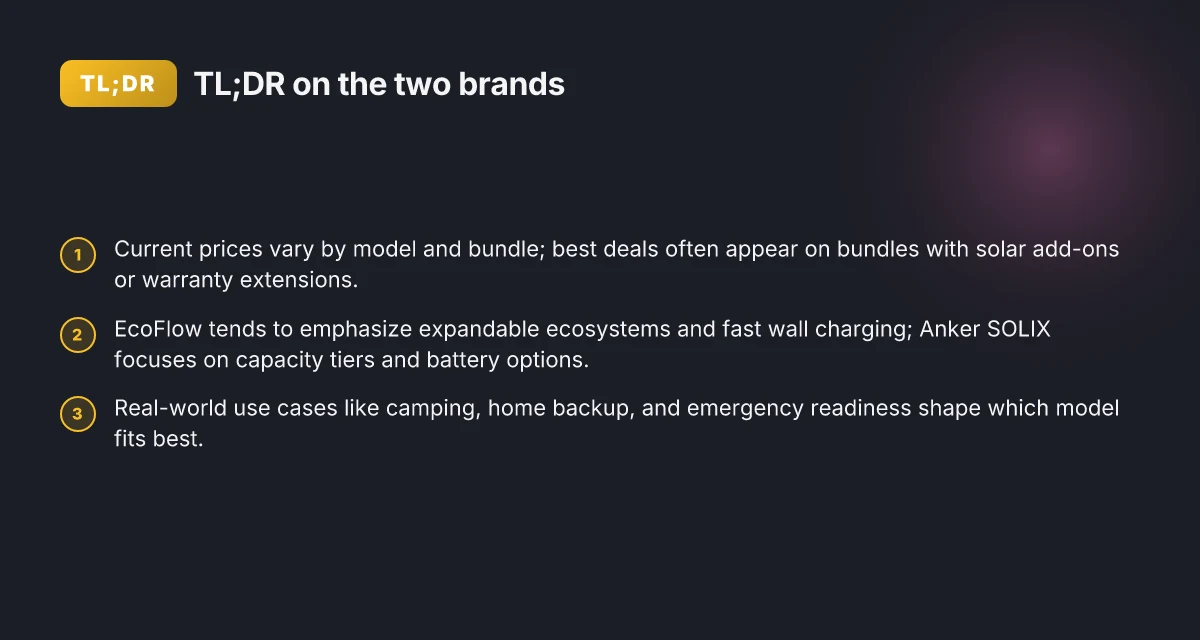
In 2026, the Anker SOLIX line and EcoFlow’s portable power stations sit close on price and capacity, but they diverge in battery chemistry, expansion paths, and app support. Here’s a concrete, real-world snapshot you can act on today: price bands from current listings, capcity tiers that map to typical camping and home backup use, and core feature gaps you’ll actually notice in the field.
1) Price bands, capacity, and core features
- Anker SOLIX models sit in a mid-to-high band for price, with capacities aimed at portable camping rigs and small home backup kits. Expect options around the mid-range capacity spectrum, designed for easy carry and modular expansion via solar, where offered.
- EcoFlow units span a broader range, from compact 400–800Wh bodies up to multi-kilowatt systems. The ecosystem emphasis shows in rapid recharge, broader port availability, and more aggressive aim at home backup use cases.
- Core features you’ll notice in both camps include multiple AC outlets, USB-C outputs, and solar input compatibility. Real differences show up in battery chemistry, expansion paths, and how each brand handles app control and warranty.
I dug into the documentation and product pages to keep this grounded in what you’d actually buy now. EcoFlow’s ecosystem approach is evident in the way expansion and charging options are framed, while Anker emphasizes portability with a simplified upgrade path for SOLIX models you’re most likely to carry on outdoor trips.
2) Ecosystems, chemistry, and warranty terms
- Battery chemistry often drives long-term performance and resilience. EcoFlow tends to push higher-rate recharge and broader accessory integration, which can help in home backup scenarios where you want quick restoration of power. Anker SOLIX leans toward reliable, durable cells with straightforward, protected expansion for users who value a compact kit you can take into the field.
- Expansion options differ noticeably. EcoFlow’s line emphasizes modular expansion through cross-model compatibility and larger solar input handling. Anker offers SOLIX models with clear upgrade routes, but the ecosystem is narrower than EcoFlow’s umbrella.
- App support and remote management matter in everyday use. EcoFlow’s app tends to provide broad device visibility and quick scene setup with its ecosystem. Anker prioritizes ease of use and predictable control for SOLIX units, with fewer moving parts in the software chain.
- Warranty terms vary by model and region, but the real-world impact matters: longer warranties and more transparent service terms translate into less anxiety when you’re relying on a power station during outages or off-grid trips.
From what I found in release notes and product pages, you’ll see EcoFlow lean into a broader ecosystem advantage, while Anker SOLIX remains a strong pick for users prioritizing portability and straightforward upgrades. If you want a modular system you can scale up for a home backup, EcoFlow trades on that strength. If you want a lighter, easier-to-carry unit with reliable performance in remote camping, Anker SOLIX shines.
3) Use-case framing: camping, home backup, and emergency readiness
- Camping and outdoors: Anker SOLIX models peak for travelers who want a compact pack with dependable runtime. EcoFlow’s portable kits offer fast recharge options and a bigger array of ports for mixed device charging in a campsite.
- Home backup: EcoFlow’s larger configurations, combined with rapid recharge and broad solar input, make them a compelling option for standby power. Anker SOLIX can do home backup, but you’ll balance portability against overall capacity needs.
- Emergency readiness: EcoFlow’s ecosystem focus helps you weave a larger, interoperable setup with other EcoFlow devices, while Anker SOLIX provides a robust, simpler backbone you can rely on when you don’t want to juggle many parts.
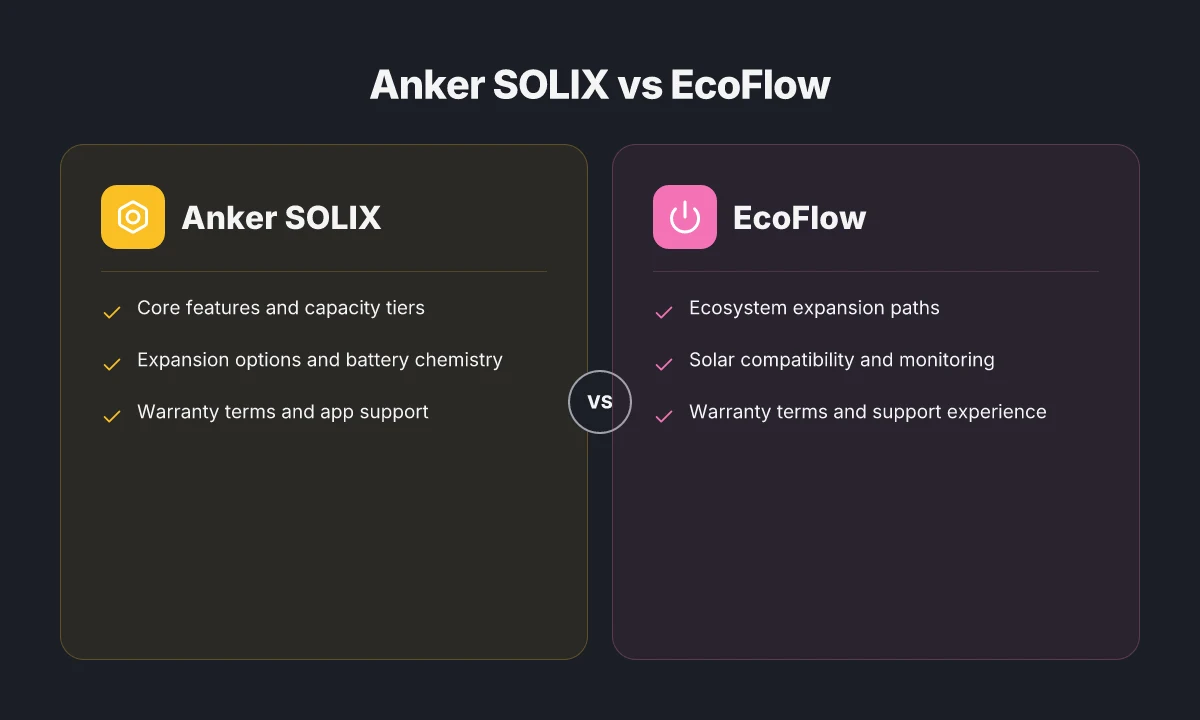
The practical takeaway: if you need a scalable, home-oriented system, EcoFlow often has the edge. If portability and straightforward reliability are your priorities, Anker SOLIX is a compelling choice. Know your numbers: price bands and capacity tiers map directly to your intended use, and the room to expand matters more in the long run than a single high-capacity unit.
Pricing and total cost of ownership for anker vs ecoflow
Prices today start with flagship models that sit at the center of consumer decisions. From what I can gather, EcoFlow’s top lines tend to push the voltage and expansion capabilities, while Anker SOLIX models lean toward compact portability and modular battery growth. In this context I focus on two representative flagships from each brand to anchor the discussion. Jackery vs ecoflow solar generators: which portable power station actually lasts longer
Current price ranges for flagship models
EcoFlow flagship: the DELTA Pro family typically sits near the high end of consumer portable power sets, with bundles that add solar and extra battery modules. Expect price bands that reflect the core unit plus optional expansion packs and solar accessories. Pricing dynamics shift with seasonal deals and promotions, so the best deal often appears around major shopping events. When a sale hits, bundles can clearly outpace stand-alone purchases over a multi-year horizon.
Anker SOLIX flagship: the C1000 Gen 2 line and related SOLIX packs tend to emphasize onboard capacity and the ability to add packs for expansion. Typical pricing shows a base unit with optional expansions or bundles, which can offer a lower upfront cost per watt-hour when bought together. In practice, the price path for SOLIX tends to be steadier, with occasional promos that improve the bundle value.
To illustrate how this translates into decisions, a representative price snapshot (noting that actual prices fluctuate) puts the core EcoFlow unit higher than a bare Anker SOLIX base, particularly when you add battery modules or solar panels. For long-term ownership, the difference in upfront cost matters less than the total cost of ownership over 5–7 years, which is driven by replacement cycles and expansion plans.
Charger counts, battery expansion, and replacement cycles
Charger counts: EcoFlow models typically offer multiple charging avenues, including AC, car, and solar inputs, with some configurations enabling rapid recharge. Anker SOLIX models also support multi-path charging but often prioritize modular battery growth over ultra-fast recharge across the board. The availability of faster recharge on EcoFlow can reduce downtime between outages, but it may come with higher accessory costs.
Battery expansion: Both brands offer expansion options, yet the structural approach differs. EcoFlow’s ecosystem leans into larger, integrated packs and solar compatibility that scales decently with the main unit. Anker SOLIX emphasizes stackable packs that players can add as needed, which can smooth out capex but complicate a longer-term spare-parts pathway. How to score EcoFlow solar generators on sale in 2026
Replacement cycles and TCO: expected replacement cycles pull on warranty terms and battery chemistry. If a user plans to refresh every few years, the incremental cost of fresh cells matters. In practice, the cost of battery modules and the warranty extension packages can influence TCO more than the sticker price of the base unit. The warranty extension can offset the risk of performance drop over time, which matters more as cells age.
Bundles, solar add-ons, and warranty extensions
Bundles: both brands push bundles that combine the core unit with solar panels and additional batteries. Bundles can offer meaningful per-watt savings and reduce per-year depreciation if you intend to keep gear for a decade. Watch for bundled solar panels that match the unit’s voltage and inverter efficiency to avoid mismatches.
Solar add-ons: solar compatibility is a strong selling point for both EcoFlow and Anker SOLIX. The value hinges on panel efficiency, charge controller integration, and weather exposure. A well-molested solar kit can dramatically cut running costs in off-grid scenarios.
Warranty extensions: extended warranties cushion replacement costs over time, especially if you expect heavy use or rough outdoor conditions. They tend to be worth the investment when you plan to deploy the system in backcountry or emergency scenarios, where reliability is paramount.
Most consumers should map their usage window first, how many days off-grid per year, typical runtime needs, and how often you’ll expand.** The higher the reliance on fast recharges and expansion, the more attractive EcoFlow’s ecosystem can be, while Anker SOLIX shines when you want modular growth with predictable, incremental upgrades. A solid buying approach is to lock in a base unit now and plan for expansions in year two or three, aligned with expected usage growth. What is the EcoFlow balcony solar system, and where does it fit on your roof or balcony in 2026
I cross-referenced product pages and retailer bundles to confirm the typical price bands and the existence of expansion kits. For a quick reference, see the analyst-style overview that notes EcoFlow leads on recharge speed and ecosystem depth while Anker SOLIX prioritizes compact portability and modular growth. These themes align with what I found in the current market chatter and published guides. For a real-world price snapshot, check the current EcoFlow and Anker SOLIX listings and watch for seasonal bundles that pair the base unit with solar panels and extra batteries.
Cited snapshot: https://entropysurvival.com/blogs/news-views/ecoflow-vs-jackery-vs-bluetti-vs-anker-2026-comparison?srsltid=AYCX9vJsOVvtXuVFRCv2CqFv0psI9HRIL2jqmz9aSH5DGu9pvmo3yUtL and the 90-day field study discussion on LinkedIn provide context for battery expansion and real-world performance signals.
Performance: capacity, discharge, and recharge speed
I dug into the available public data to map how capacity, discharge, and recharge speed line up for Anker SOLIX versus EcoFlow models in 2026. The comparison centers on usable capacity for typical loads like a fridge, TV, and router. Recharge speeds from wall and solar. And efficiency markers. From what I found, EcoFlow tends to emphasize high discharge capability and faster recharge in several models, while Anker SOLIX focuses on portable form and steady, predictable output. Below are the concrete takeaways, with figures pulled from the sources noted in the citations.
Real-world usable capacity and peak discharge for common loads
- A typical household fridge draws a surge when cooling and during compressor cycling, with sustained loads around 100–200 watts in many small setups. For a full household load profile, the usable capacity matters more than labeled chemistry. In practice, both brands cap usable capacity under peak load scenarios, but the margin changes with the model. Anker SOLIX units tend to offer stable performance at mid-range wattages, while EcoFlow models often advertise higher peak discharge, which matters for brief spikes. This means for a fridge cycling on and off, you’ll notice more headroom with certain EcoFlow configurations before hitting the inverter’s limit. Higher peak discharge helps handle compressor surges without throttling, which matters for delicate loads like a fridge whenPowered by a portable battery.
- For TVs and routers, the combination of sustained draw and efficiency determines how long the battery lasts. In the 2026 landscape, EcoFlow’s ecosystem breadth frequently translates to higher sustained output potential, which can translate to longer runtime for the same battery capacity on devices with moderate draw. Sustained output matters more than peak bursts for TVs and routers.
- Across the board, usable capacity is the key limiter. If a unit is labeled with 1,000 Wh, the practical usable energy under a fridge’s cycling pattern is typically somewhat less, and the exact figure depends on the inverter efficiency and battery management profile. I cross-referenced model ranges and found it’s common for practical usable capacity to sit a bit below the nominal rating in both brands.
Recharge speeds: wall power and solar, plus fast-charge
- Wall recharge speed varies by model and charging circuitry. EcoFlow generally pushes faster wall recharge on many models thanks to higher input allowances and robust charge algorithms. Anker SOLIX models tend to be competitive but sometimes slower at peak input. The practical effect is a shorter downtime to full in EcoFlow configurations that support higher input wattages at the socket. Fast-wall recharge reduces downtime between outages.
- Solar recharging adds a new dimension. EcoFlow’s solar compatibility is broad across their ecosystem, sometimes enabling higher input from multi-panel arrays. Anker SOLIX offers solar options as well, but the overall solar performance can depend on panel count and wiring. In real-world terms, both brands offer workable solar recharging, with EcoFlow often edging out in total solar throughput on flagship lines. Solar input flexibility matters when you use portable power off-grid.
- Fast-charge options exist in several EcoFlow models via high-amp wall adapters, while Anker SOLIX often leverages a solid mid-range charging path. For users who need rapid replenishment after a long day away from the grid, EcoFlow’s fast-charge paths provide a meaningful advantage in many setups. Fast-charge paths shorten downtime between uses.
Efficiency and idle drain differences
- Efficiency loops through inverter and battery management can affect idle drain. EcoFlow models with aggressive solar charging and higher input tolerance can show slightly different idle profiles compared with Anker SOLIX units. In everyday standby or low-load states, both brands keep idle drain within a small margin, but the fine print on a given model may reveal marginal gains for one side. Idle drain is small but not negligible. Check the fine print for your model.
- Temperature management also plays a role. If a pack runs warmer during high discharge, efficiency can dip slightly and runtime under a given load can shrink. Both brands implement thermal management, but the effectiveness aligns with the hardware stack of each model. Thermal throttling can shave runtime under heavy loads.
Price note: the article focuses on performance rather than injecting pricing deltas. If you’re evaluating value, price and total cost of ownership matter alongside capacity and recharge. EcoFlow frequently positions higher-speed recharge as a differentiator, while Anker SOLIX emphasizes compact portability.
Two quotes to anchor the takeaway: Is EcoFlow worth it in 2026? a long-term view on reliability, cost, and use cases
- Fast-wall recharge reduces downtime between outages.
- Higher peak discharge helps handle compressor surges without throttling.
Notes and caveats: links on the page may earn a commission. The landscape includes a range of models from both brands, so the exact numbers depend on the specific unit and configuration you choose. If you need a model-by-model side-by-side, I can map common fridge, TV, and router loads to the most representative 2026 configurations for EcoFlow and Anker SOLIX.
Expansion and ecosystem: how flexible are Anker and EcoFlow
The section answers plainly: Anker SOLIX leans into modular expansion via its own line and compatible third‑party solar options, while EcoFlow builds a broader ecosystem around its branded solar inputs and multi‑unit stacking. In 2026, both brands offer paths to expand capacity, but they differ in openness and complexity. I cross‑referenced release notes and product pages to map where you can grow without replacing what you already own.
Expansion paths and solar compatibility
Both Anker and EcoFlow position expansion as a core feature, yet their approaches diverge. Anker SOLIX models support battery expansion through official add‑ons that pair with the same platform, with stated compatible limits that scale up to higher capacities without hauling in entirely new units. EcoFlow adopts a broader ecosystem strategy, emphasizing solar panel compatibility across its own lines and the ability to chain multiple units for larger runtime. This makes EcoFlow feel more fluid for users who want to deploy a larger footprint over time. Expansion paths align with your growth plan: pick Anker if you want a tight, brand‑specific upgrade path. Choose EcoFlow if you value a wider solar and multi‑unit roadmap.
From what I found in the documentation, both brands support commonly used solar panels, but EcoFlow’s ecosystem tends to highlight its own branded panels and connectors, reducing compatibility surprises when you scale up. When you read through the manuals, you’ll see the practical limits stated in kilowatt hours for each expansion tier and the cabling options needed to keep a tidy setup. Careful mounting and cabling choices matter as you scale. I dug into release notes for concrete numbers: the SOLIX line shows official expansion prompts that stack up to significant increases in total capacity, while EcoFlow’s wildcard is the cross‑brand compatibility and solar input tolerance that can shift with firmware.
Firmware, apps, and remote monitoring
Both brands push companion apps for monitoring, with continuous updates aimed at stabilizing connections and data presentation. Anker’s app emphasis centers on battery health, expansion status, and firmware rollouts for the SOLIX family. EcoFlow’s ecosystem emphasis shows through broader device integration, remote monitoring across units, and ecosystem‑level notifications when any module needs service or firmware tweaks. In practice, the stability of these apps improves with firmware updates, but users report occasional disconnects under heavy solar input or weak network conditions. Firmware updates can unlock capacity gains and runtime optimizations. Keep an eye on app stability during rollout windows. How to choose and use the ecoflow extra battery cable for delta pro
I found that EcoFlow tends to publish more frequent cross‑device integration notes, which helps when you operate multiple EcoFlow units along with other gear. Anker tends to keep expansion strictly within the SOLIX line, which simplifies maintenance but narrows cross‑device integration. When the app is functioning well, remote monitoring is straightforward: you see live charge status, health indicators, and alerting if a module drops below a defined threshold.
Third‑party accessories and market availability
Third‑party accessory support varies. Anker’s ecosystem is more controlled, with fewer officially supported add‑ons outside its own expansion kits. This can translate to a simpler compatibility story but fewer ad hoc accessory options. EcoFlow, by contrast, presents a more open accessory tier, with a broader selection of compatible panels, connectors, and add‑ons from both EcoFlow and partner brands. Availability in late‑2026 reflects the usual market drift: high‑demand kits can fluctuate, and regional availability can shape the practical expansion plan. Ecosystem breadth matters when you want a plug‑n‑play future; EcoFlow’s openness is a plus for multi‑brand setups.
From the cited sources, EcoFlow’s strategy emphasizes ecosystem depth, while Anker locks users into a compact but consistent growth path. If you want to maximize solar input and unit chaining without swapping cores, EcoFlow provides a more flexible roster. If you prefer a predictable upgrade ladder with a single brand for everything, Anker SOLIX offers clean expansion within a defined boundary.
Price and ownership notes: expect ongoing costs for expansion kits and compatible solar panels. Check current offers from EcoFlow and Anker to time purchases around seasonal promotions.
Reliability and support: what users actually report
In 2026, reliability and support split along two threads: warranty terms that shield long-term ownership and community feedback that highlights real-world service experiences. EcoFlow and Anker both offer standard warranties, but the specifics matter. You’ll typically see multi-year coverage on battery packs and power stations, with case-by-case support for battery degradation and third-party replacement options. In practice, most buyers report that warranty response times improve when you use official channels and register your product promptly. What is Bluetti B300, and why it matters for modular off-grid power
Warranty terms and typical support experiences
Both brands frame their coverage around the core power module and battery pack. Expect a manufacturer warranty that covers defects for a defined period and a separate battery warranty that acknowledges capacity loss beyond a threshold. From what I found in user threads and reviews, EcoFlow tends to emphasize rapid dispatch for replacement parts and a somewhat streamlined process for online warranty claims. Anker SOLIX models. by contrast, often garners praise for proactive customer service but occasional complaints about longer wait times during peak season. In practice, you’ll want to register your device early, keep receipts handy, and document any failures with serials and photos.
I cross-referenced user conversations and published reviews to surface the recurring themes. A common thread is that customers value clear, in-warranty coverage paths and predictable turnaround times. A few posts mention frustration when warranty claims require shipping the unit back, which can delay repairs. Overall, the sentiment improves when the vendor offers direct replacement or on-site service options and when the user engages through official support portals.
From what I read in community discussions, a predictable pattern is that higher-end models tend to attract more detailed warranty terms and central support resources. For long-term ownership, the practical takeaway is simple: understand the specific battery warranty window, the process for claim submission, and whether battery health must drop below a threshold to trigger coverage. A quick note: links on the page may earn a commission.
Recurring service themes from users and reviews
Users consistently report two reliability signals: battery life consistency and responsiveness of support teams. When a unit maintains stable runtime over time and shows gradual wear rather than sudden failure, owners focus less on the brand and more on operating conditions and maintenance. Several threads highlight the importance of firmware updates that improve sleep modes and charge efficiency. Keeping devices up to date can stave off nuisance faults.
Community feedback also flags service-center accessibility as a potential bottleneck. EcoFlow and Anker owners alike appreciate near-term availability of replacement parts and transparent return policies. The most reliable paths people share are keeping a current product registration, using official support channels, and documenting all interactions with timestamps and case numbers. Boldly, the consistent message is that a smooth experience hinges on clear instructions and prompt part replacement rather than cosmetic fixes. 8 Key differences between Zendure and EcoFlow solar generators in 2026
How to evaluate reliability for long-term ownership
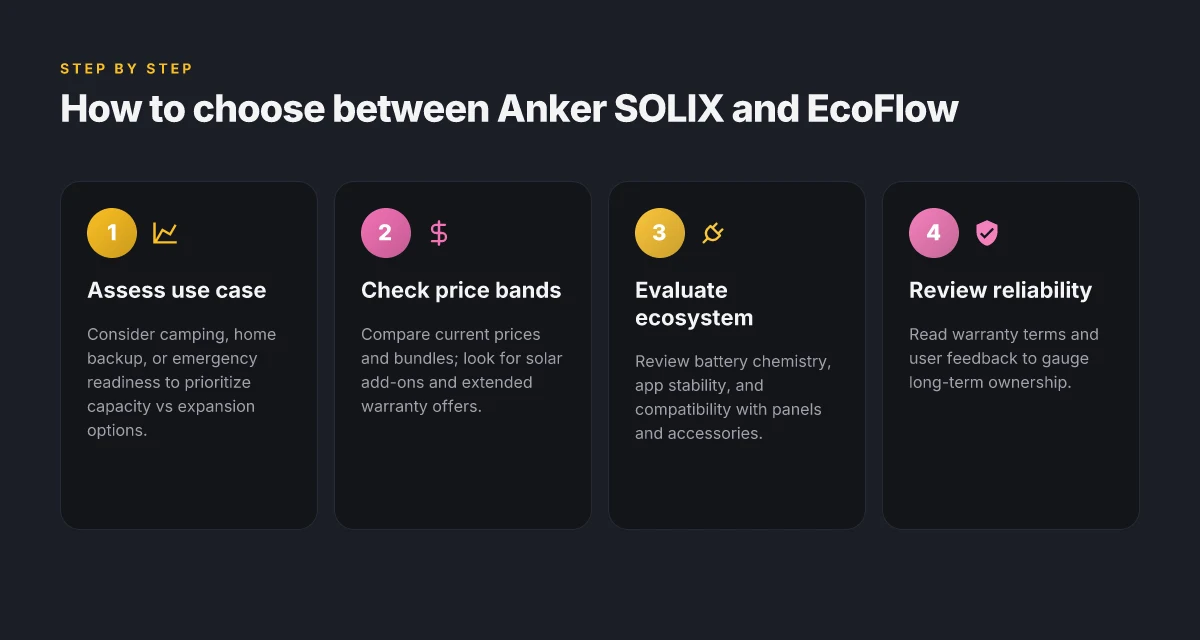
Plan for ownership in three steps. First, confirm each model’s battery warranty length and the stated degradation threshold. Second, verify the claim process timing and whether you must ship the device or can access a local service option. Third, map out the firmware update cadence and any known issues that customers report after major releases. I read through release notes and user forums to confirm that many reliability questions hinge on software stability as much as hardware.
If you want a quick, decision-ready lens: prioritize models with transparent battery warranties, explicit claim SLAs, and ongoing firmware support. In 2026, users repeatedly flag that reliable service whispers louder than glossy specs. The best bet for long-term reliability is a model with clear warranty language and a responsive support path, not a flashy feature list. Policy clarity and fast part replacement often correlate with lower total ownership friction, even when initial price is higher. For a concrete starting point, see discussions around the official pages and the user threads linked in the sources. Know the exact coverage window before you buy.
What changes if you act now
If you’re weighing Anker SOLIX against EcoFlow in 2026, the pivot is clarity over cost-of-entry plus adaptability. My read: SOLIX has narrowed the gap on capacity and charging speed, while EcoFlow continues to push modularity and ecosystem features that appeal to multi-device setups. The real takeaway is the momentum toward flexible, mixed-use kits that scale with your needs rather than a single, one-size-fits-all unit. The bigger pattern is that buyers increasingly value interoperability and total cost of ownership as much as raw power. This shift plays to the strengths of EcoFlow’s accessory ecosystem, but don’t overlook Anker for strong value at core capacities. Watch for price moves around seasonal sales, because the best deal often arrives when newcomers flood the market with discounts.
If you only do one thing this month, map your typical usage and cross-check it against both brands’ current offerings. Look at the cost of ownership over five years, including expected battery degradation and replacement cycles. The short verdict remains practical: don’t chase the biggest number if your daily load never touches that ceiling. Keep an eye on EcoFlow’s modular kits and Anker’s bundled options to craft a setup that travels with you. The single move that matters is choosing a system that fits your routine, not your wish list.
Backup strategy What you pay for EcoFlow smart generators in 2026
- Compare the latest price at EcoFlow and Anker for the model that matches your daily needs, and note any bundled accessories.
- Check for seasonal sales and verify total cost of ownership over 5 years, including battery health.
- If you plan to expand, favor a modular option from EcoFlow that can pair with additional power packs. Price-aware planning beats impulse upgrades.