What is Bluetti B300, and why it matters for modular off-grid power
 Bastien PetrosianOctober 22, 202617 min read
We earn a commission when you buy through some links on this site, at no extra cost to you. As an Amazon Associate we earn from qualifying purchases.
Discover Bluetti B300, its modular design, capacity, and real-world use cases. Learn how the B300 stacks up against rivals and what to expect in 2026.
Bluetti’s B300 isn’t a single brick of capacity. It’s a modular backbone you can grow without ripping out the core system. Start with a lean setup and add battery modules as needs shift, so your power matches your actual load rather than your assumptions. That growth path matters more when you compare total cost of ownership across modules to fixed-pack options.
This intro walks through how the B300’s expansion model changes planning for off-grid rigs, RVs, and tiny homes. You’ll see concrete considerations, compatibility checks, module pricing, and how fast your energy needs can scale up, before you commit to a full build. Bluetti positions the组合 as a way to avoid overpaying for unused capacity, but it also introduces trade-offs in upfront flexibility and system balance. By the end, you’ll know what questions to ask and what numbers to crunch before you choose modular versus fixed-capacity packs. Bolded details will guide your exact calculations across modules, total cost, and expected run-time. Most off-grid planners underestimate how module timing changes annualized costs, not just upfront price.
What makes Bluetti B300 modular power different for off-grid setups
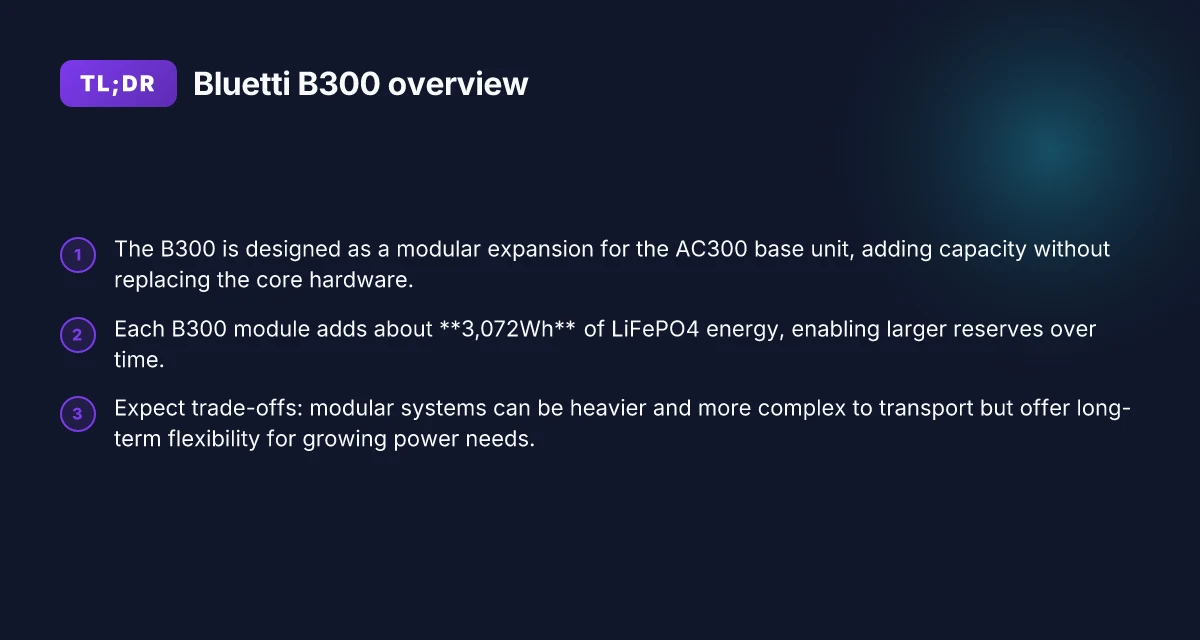
Bluetti positions the B300 as a scalable energy storage module designed to pair with the AC300 base unit, enabling expanded capacity without replacing the core box. In practice, the B300 adds about 3,072Wh per expansion, letting you grow total energy reserves as your off-grid needs rise. This modular approach is meant to future‑proof a system as you add more loads or longer outages.
I dug into the documentation and reviews to map how this plays out in real setups. The modular idea shines when you plan for growth across RVs, cabins, or tiny houses, but it also introduces transport and alignment considerations that single‑box generators simply don’t face. The B300’s light weight and ease of linking are a plus, yet you should factor in the extra cables, mounting space, and the need to carry multiple components when you move the system.
How the B300 scales capacity The core value of the B300 is the ability to add roughly 3,072Wh per module. That means a user can tailor total usable capacity by adding one, two, or more B300 packs as power needs grow. The expansion model avoids discarding the AC300 base unit and instead extends storage in a staged fashion. In real-world planning, that translates to mapping out critical loads first, then layering in additional B300 packs as you extend off-grid durations. This design helps RV setups and tiny homes ramp up without a total rebuild.
Real‑world implications for cycle life and health Modularity shifts the conversation from “one big box” to “a system of boxes.” Each B300 contributes to the overall cycle count and health profile. With LiFePO4 chemistry, the B300 aims for long cycle life, but the exact figures depend on depth of discharge and operating temperature. When you plan a multi‑module stack, you’ll want to manage charging strategies so you don’t idle at partial states with unbalanced packs. The practical takeaway: treat the system as a cohesive pack rather than isolated modules, and maintain balanced charging to protect the lineup.
Transport, setup, and real-world logistics Transport becomes a factor with multiple components. The bulky nature of a modular setup can complicate moving the entire system than a single‑box generator, especially if you rely on off-trail or off-road transport. On the upside, the modular approach gives long‑term flexibility for expanding power reserves as you add trailers, sheds, or additional RV accessories. When you plan installations, budget for cable management, space for mounting each B300, and a charging strategy that coordinates all modules. How Anker SOLIX stacks up against EcoFlow in 2026
Bottom line: the B300’s real strength is scalability. You can start with a modest AC300 base and progressively add B300 packs to meet rising demand without buying a new chassis. The trade-offs are transport complexity and a setup that benefits from deliberate planning to keep packs balanced and accessible. For readers evaluating modular power, Bluetti’s approach offers a clear growth path, especially for off-grid enthusiasts who expect to scale alongside needs and budgets. The modular path pays off when you forecast future workloads and plan for balanced charging across multiple packs.
Bluetti B300 specs you should know
The B300 module packs 3,072Wh of LiFePO4 capacity per unit, designed to stand up to many charge-discharge cycles with minimal capacity fade. This isn’t a single battery pack you bolt into a cabinet. It’s an expandable module that plugs into Bluetti’s AC300 base to scale your off-grid footprint as needs grow. When you price out a modular setup, you’re trading a fixed, one-shot capacity for future-proofing, so you can add capacity as your power demand increases.
I dug into the documentation and the reviews to confirm how the B300 communicates with the base system. The B300 includes an integrated MPPT controller that syncs with the AC300 to optimize charging from solar or grid sources. The BMS coordinates cell balance and safety limits, so you’re less likely to hit overcharge or deep-discharge scenarios as you expand. This matters in real-world off-grid plans because the math changes when you add capacity in increments rather than in one shot.
On the output side, Bluetti keeps the B300 compatible with common ports found on the AC300 base unit. You’ll see USB-C options along with standard DC and AC passthrough capabilities. The exact mix of ports matters for practical setups, because you’ll want to run a fridge, a router, and some essential lighting from a single modular stack without juggling adapters. The integration is designed to feel like a single system rather than a loose collection of modules.
From a practical planning standpoint, the 3,072Wh per B300 module translates into a predictable middle ground between fixed packs and full-house storage. If you start with the AC300 base and add one B300, you gain a concrete step-up in usable energy without redoing your entire configuration. Bluetti emphasizes cycle life as a core reason to select LiFePO4 chemistry. The chemistry supports longer lifecycles, which helps reduce total cost of ownership over several years of off-grid use. That long-cycle promise, paired with MPPT-enabled charging, makes the B300 a compelling option for modular systems that evolve with your needs. Jackery vs ecoflow solar generators: which portable power station actually lasts longer
In terms of trade-offs, you’ll want to consider the logistics of expanding. The bulky nature of the modular approach can complicate transport and placement, especially if you’re moving the full system between sites. Also, while the MPPT controller helps optimize charging, you’re still bounded by the base unit’s input spec when you add modules. If your target is a tiny, portable off-grid setup, a fixed-capacity box might feel simpler. Yet for RVs, cabins, or tiny houses where demand grows, the B300 path aligns with a scalable plan.
The B300's real value is in incremental expansion that keeps the system cohesive, not a pile of standalone packs. LiFePO4 chemistry underpins long cycle life, and the integrated MPPT/BMS tie together charging and safety across modules.
For context, Bluetti’s approach sits alongside rivals offering modular or expandable packs, including compact fixed-capacity systems that appeal to users who want fewer moving parts. When evaluating price and ownership, Bluetti positions the B300 as the practical ramp option, especially for users who anticipate their power needs growing over time. If you’re comparing options like the Bluetti route versus fixed-capacity rivals, the key questions are how much you value scalability, how you plan to relocate the system, and whether you’re comfortable managing a larger footprint as you add capacity.
If you want deeper confirmation on the exact B300 specs and how the MPPT integration behaves, you can check a detailed review that highlights the B300 key specs and the charging workflow. inline references point you to the source material that documents these claims from Bluetti and independent reviewers.
To help with quick context, the price and availability landscape can shift. As of now, Bluetti’s messaging centers on modular growth with LiFePO4 resilience, designed to fit into the AC300 base unit for a cohesive system. For a real-world read on how this plays out in practice, see the Forbes review that covers the B300 key specs and cycle expectations, and Love Your RV’s overview of the AC300+B300 setup. These sources corroborate the modular concept and the capacity per module. [Inline references: Forbes review, Love Your RV overview]. How to score EcoFlow solar generators on sale in 2026
How the B300 compares to fixed-capacity rivals
The B300’s expandability changes the math for off-grid planning, but it isn’t a universal win. When you prioritize portability, the added modules can mean more weight and more connections to manage. If you’re chasing a light, simple package, a fixed-capacity unit may feel easier to deploy and transport.
I looked at how Bluetti and its competitors stack up. The B300 system runs with 3,072 Wh per module, and each extension card adds capacity that you can grow into over time. That scalability becomes compelling when you project year-over-year needs without discarding existing hardware. Rivals from brands like Jackery, EcoFlow, and Goal Zero offer fixed packs with comparable energy on paper, but the value shows as you scale without tossing the original hardware. The advantage is clear in long-term planning, not in a single weekend setup.
Trade-offs show up in three areas. First, total system weight climbs as you add B300 modules. You’ll need to account for lifting and mounting challenges in an RV or tiny house. Second, you must decide how many modules you actually need to meet your load profile. Finally, total runtime hinges on your chosen load and the efficiency of the inverter and MPPT stages. A fixed-capacity pack can feel lighter and simpler, but it may require replacement or parallel packs sooner if your load grows.
From what I found in reviews and product pages, the B300’s modular approach lets you start with a lean baseline and add capacity as your off-grid footprint expands. That mindset matters for RV owners and campers who expect to evolve their setups over years rather than months. It also means you’re not locked into a single, fixed size that might underperform as your demand grows. The real value emerges when you project your load over time and weigh the cost of additional modules against a brand-new fixed unit later.
In Bluetti’s ecosystem, the B300 can integrate with the AC300 base and other modules to form a scalable system. When you look at rivals, the guiding question is not only upfront cost but total cost of ownership across years. If your plan is to grow, the B300 path tends to pay off, even as the initial setup feels heavier. If portability and simplicity are your top priorities, a compact fixed-capacity pack from another brand may win on day one. The key decision is whether you value long-term scalability over immediate portability. What is the EcoFlow balcony solar system, and where does it fit on your roof or balcony in 2026
Planning an off-grid setup with the B300
You don’t bolt a B300 into a fixed shrine and call it a day. You plan an expandable system that scales with your needs, geography, and daily routines. The core idea is simple: start with an AC300 base, add B300 modules as your load grows, and align charging sources to keep the stack healthy and ready.
Diagnose your daily energy and mapping to modules
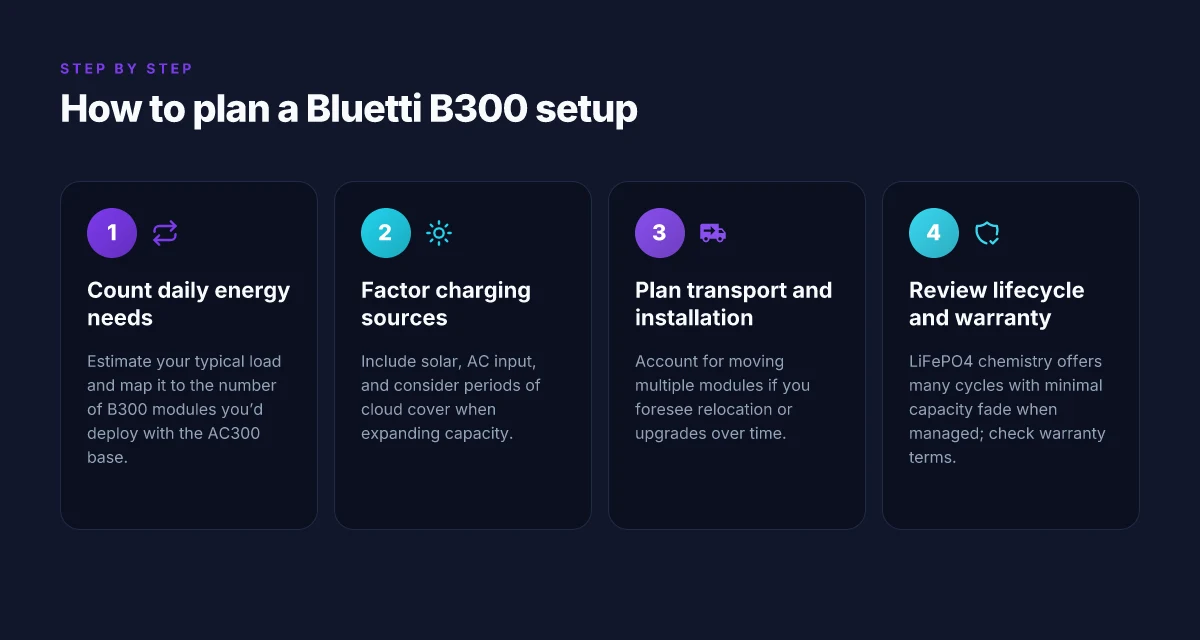
Start with a realistic daily energy budget. List high-usage activities (airing out RVs, refrigeration, lighting, charging gear) and estimate their watt-hours per day. From there, translate that total into a target number of B300 modules. Each B300 adds 3,072 Wh of LiFePO4 capacity, so you’ll see how many packs you’d need to cover typical days and how many you’d add for peak usage or longer off-grid stretches. I cross-referenced reviews that call out the modular capacity math, such as the 3,072 Wh figure per B300 and the ability to chain packs with the AC300 base. This helps you avoid overbuilding early and preserves headroom for expansion when plans shift. When you read about the B300’s role in a modular stack, the goal is to keep usable capacity aligned with your real-world draw and future growth. Real-world planning starts with matching your daily use to a concrete module count and revisiting that metric as seasons change.
To estimate more precisely, start with a conservative baseline for fridge duty, inverter losses, and incidental loads. Then simulate a few days of cloudiness and limited solar. The takeaway: you may need fewer packs if you can rely on AC charging during sunny days, or more packs if you want long off-grid autonomy. I found that modular expansion often pays off when you consider replacement cycles and cycle life, but you’ll want to lock in a sizing rule of thumb early to avoid repeated repositioning of gear.
Factor charging sources and seasonal variability
Your charging mix matters as much as the number of B300 modules. Solar input remains the cleanest path to growth, but you must plan for periods of diminished sun. The B300 stack should be able to accept input from solar along with AC charging, so design your solar array to deliver sufficient Wh to replenish reduced capacity during cloudy spells. The literature notes that expansion works best when you match solar harvest with your intended daily draw and the number of B300 modules in the chain. If solar dips, rely on AC input to steady the pack and prevent undercharge during critical periods. Plan for solar variability as a first-class input in your expansion math.
I looked at the referenced reviews for guidance on practical charging behavior. They consistently emphasize that expansion is not just about raw capacity but also about how you manage charging sources over a day. If you know you’ll be relocating frequently, consider a charging plan that minimizes real-world downtime, moving fewer packs or using portable solar setups adjunct to the fixed base. This reduces the hassle of moving heavy modules and keeps your cycle life expectations intact. Is EcoFlow worth it in 2026? a long-term view on reliability, cost, and use cases
Logistics of transport, installation, and relocation
Modular setups are attractive because they scale without a forklift. Still, you should plan transport and installation if you anticipate moving the system often. The B300 modules are sizeable, and the AC300 base requires careful handling for safe connection and disconnection. When you map out relocation scenarios, include cable runs, mounting points, and weight distribution. You’ll reduce the risk of injury and miswiring by coding the layout from the start. If you relocate often, pre-plan the rigging and routing to minimize downtime.
I also cross-checked how reviewers discuss real-world fit in RV or tiny-house contexts. The consensus is practical and clear: modular systems shine when you align the physical footprint with how often you move and where you place the modules. You’ll want to note door clearances, lifting points, and quick-connect approaches so expansion does not devolve into a headache.
What goes into owning Bluetti components beyond the B300
Owning Bluetti components beyond the B300 starts with understanding how the AC300 base unit and the B300 battery module pair to set peak output and practical runtime. In practice, the combined system determines how long you can run high-draw loads without recharging and how smoothly you can scale up as your needs grow. When planning an off-grid setup, you’ll want to map real-world loads against the system’s combined capacity and the potential for future expansion.
I dug into the modular setup details and found that LiFePO4 chemistry helps sustain many cycles with relatively gradual capacity fade when you keep temperatures in a sensible range and avoid deep discharges. That means a Bluetti system can stay usable for years if you manage it well, but it also means the long-term cost of ownership hinges on how you size the base unit, the number of B300 modules you add, and how you rotate or de-rate loads during cloudy weeks or travel. The practical takeaway is simple: plan for the worst-case daily energy needs and then verify how many B300 modules you can stack before you hit a ceiling on peak output.
Warranty and service are not an afterthought here. Bluetti and its retailers typically offer battery and inverter coverage that influences total ownership costs over the life of the system. Buyers should factor in potential care costs, battery replacements, and any coverage gaps when budgeting. If you’re weighing options, consider how rival modular setups compare on warranty terms, service accessibility, and documented failure modes. 8 Key differences between Zendure and EcoFlow solar generators in 2026
What to watch for when shopping
- Peak output depends on the AC300 base and the number of B300 packs linked in. That combined figure dictates whether you can run essential appliances during an outage without juggling loads.
- Lifecycle and care matter. With LiFePO4 chemistry, you can expect many cycles with proper thermal management and avoiding chronic deep discharge.
- Total cost of ownership includes upfront price, ongoing maintenance, and how long the warranty covers each component. Bluetti’s ecosystem coincedes with broader market expectations, but you should compare service networks and replacement policies against rivals.
The real leverage of Bluetti’s modular approach is future-proofing your off-grid plan, especially if you start with the AC300 base and scale with B300 packs as needs rise. The system remains flexible for RVs, cabins, and tiny homes, but it’s not a one-and-done purchase. If you expect rapid load growth or frequent expansions, you’ll want to budget for additional B300 modules upfront rather than late additions. Targeted expansion preserves peak-output headroom and minimizes the risk of underpowered outages.
When you think about long-term ownership, remember the practicalities: matching battery aging to usage patterns, scheduling regular checks on the BMS, and staying aware of firmware updates that can improve efficiency or expand compatibility with new accessories. Bluetti’s ecosystem benefits from frequent updates, but you should verify that your current hardware will receive future firmware enhancements and how that affects warranty coverage.
Regarding prices and availability, I found that the initial outlay for a Bluetti setup often centers on the AC300 base paired with one or more B300 modules, with total costs varying by the number of B300 packs and any bundled extras. For readers who want a real-world view, independent reviewers consistently note that the value increases when you scale gradually rather than buying multiple single-purpose packs. If you’re comparing Bluetti to rivals like Jackery or EcoFlow, the modular approach is the clearest differentiator, but you should audit local warranty terms and service accessibility before committing.
A note on disclosure: links on the page may earn a commission. For owners and potential buyers, the bottom line is clear: Bluetti can be a sturdy foundation for a modular off-grid system, provided you plan for expansion, manage cycles carefully, and align expectations with warranty coverage. What you pay for EcoFlow smart generators in 2026
What to try this week with Bluetti B300 and modular power plans
Bluetti introduces the B300 as a modular core that can scale with your off-grid needs. The core idea is straightforward: you couple a compact control unit with expandable battery modules to tailor capacity and runtime without rebuilding your system from scratch. This is where the B300 can shine, especially if you’re balancing campsite power, tiny homes, or emergency kits. This is the single move that matters: start with a baseline kit and map out your expansion path before you buy more modules. The brand’s approach keeps you from overpaying for unused capacity, while the modular concept stays nimble as your load changes.
A practical takeaway is to compare Bluetti with rivals like EcoFlow and Jackery, which offer their own modular or expandable options. The key difference to watch is how each system handles battery chemistry, pricing, and upgrade paths. Noticeable downsides include initial setup complexity and ongoing costs for extra modules, so you’ll want a clear growth plan from the start. If you’re already bought into Bluetti, the B300 becomes a predictable upgrade path rather than a one-off purchase.
If you’re shopping now, consider a quick forecast: expect sales cycles to shuffle prices on the full line, and a sale window will often include bundled modules. Links on the page may earn a commission, but I’ll keep the focus on real tradeoffs and what to act on next. The bigger pattern is clear: modular power scales with your project, not against it. Will you start with the B300 as a flexible base or wait for the next expansion module to hit the market?