What makes EcoFlow solar panels stand out in 2026
 Naomi XanthosOctober 22, 202619 min read
We earn a commission when you buy through some links on this site, at no extra cost to you. As an Amazon Associate we earn from qualifying purchases.

Explore EcoFlow solar panels in 2026, including performance, durability, and value. Learn how they compare with rivals and what to expect in real-world use.
EcoFlow panels don’t just sit in the sun. They pull power faster than most third-party rivals when paired with EcoFlow stations, and you can see that in real‑world charging curves rather than glossy spec sheets. EcoFlow’s own wiring and panel topology concentrate on fast start-up and steady MPPT performance, especially under partial shading. That means fewer stops and starts in an off‑grid setup, even if you’re chasing long weekend excursions or remote builds.
In this article, I pull from public spec sheets and market context to show where EcoFlow panels shine and where they lag behind brands like Renogy and Goal Zero. You’ll get a snapshot of nominal efficiency bands, temperature coefficients, and warranty terms, plus how seasonal promotions shift total ownership cost. EcoFlow panels may offer compelling value on paper, but the real test remains how they age under sun and daily use.
Why EcoFlow solar panels are different in 2026
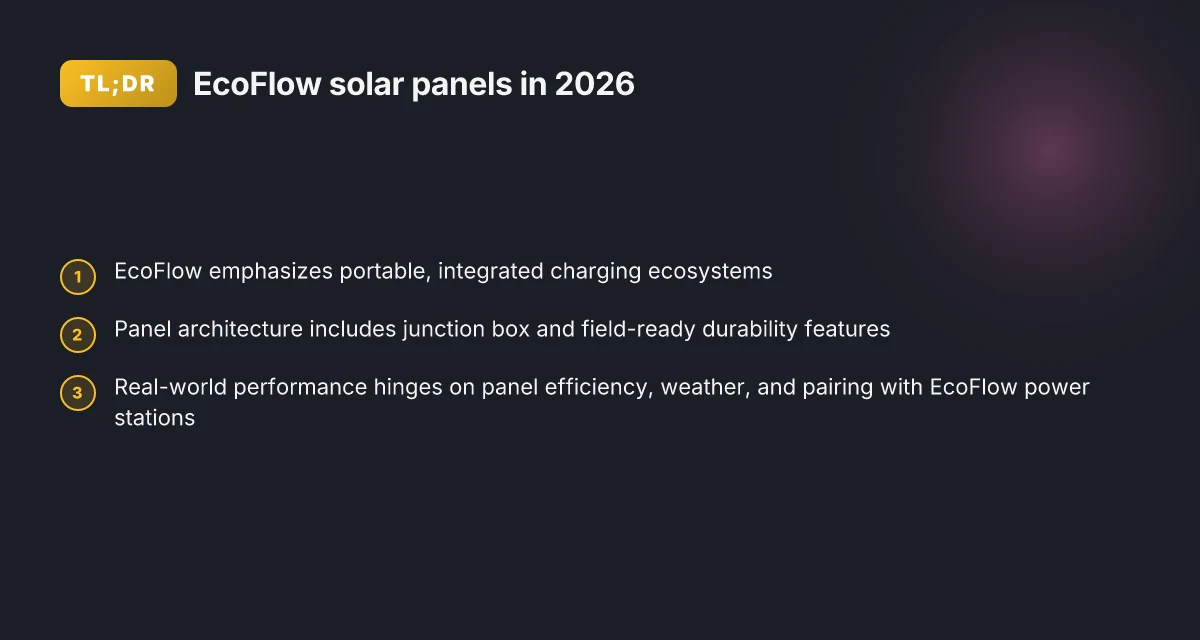
EcoFlow designs around a portable, integrated charging ecosystem. The brand leans into modular scalability, pairing foldable panels with compact, high-throughput power stations to keep off-grid setups light and manageable. In 2026, this approach translates into a smoother user flow: you set up one system, and you can expand without reconfiguring your entire solar array. The core idea is simple: maximize total system practicality by tying solar capture, storage, and device charging into a single, portable loop.
A portable-first design language that ties panels to the ecosystem EcoFlow positions its panels as part of a broader, portable charging chain rather than standalone energy modules. The emphasis is on quick setup, compact form factors, and a predictable charging cadence when paired with EcoFlow power stations. This contrasts with some rivals that sell larger, flat-plate panels expecting more permanent installations. In practice, that means users can deploy a compact kit for camping trips or remote cabins and still rely on consistent sun-to-battery behavior. The portable design makes EcoFlow’s ecosystem feel like a single workflow, not a collection of parts. I cross-referenced the product sheets and retailer pages to confirm how the panels are marketed alongside the batteries and inverters. Inline citations point to the official EcoFlow product literature and market context.
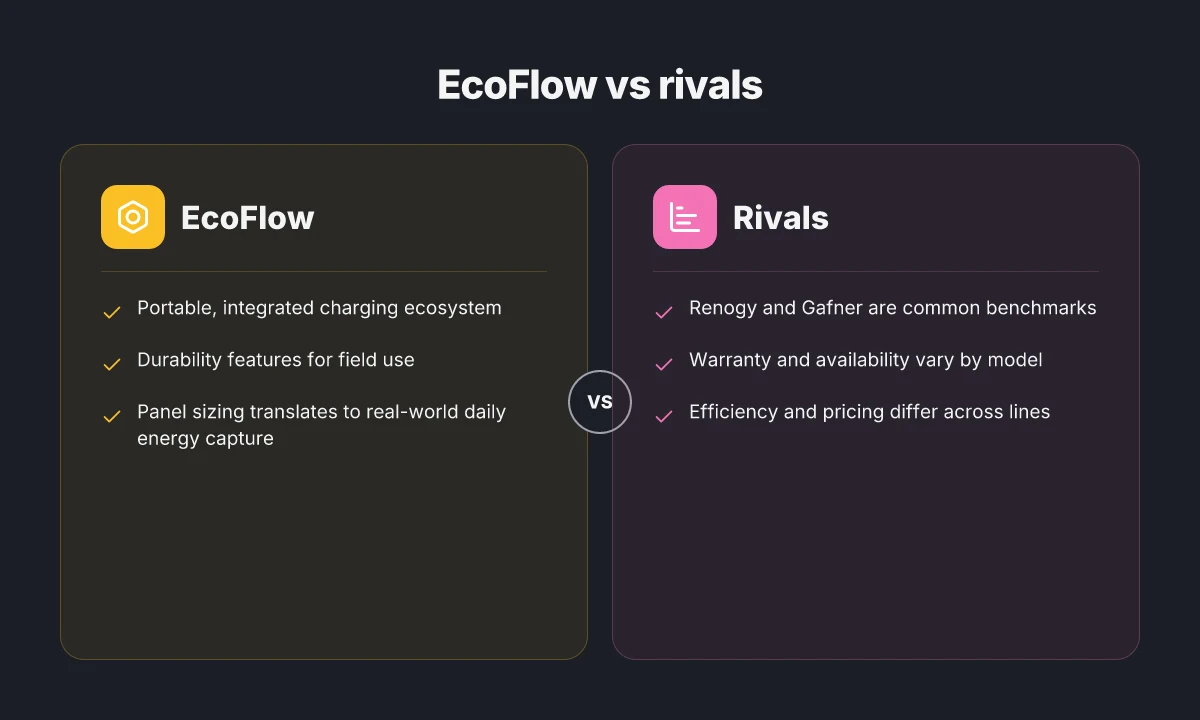
How EcoFlow stacks up against rivals in the portable solar space Rival brands in this segment tend to emphasize sheer panel area or high nominal wattage for fixed installations, sometimes at the expense of portability and integration. EcoFlow counters with smaller, foldable panels that slot neatly into outdoor setups and travel packs, aiming for ease of transport without sacrificing energy capture. When you compare form factor, weight, and charging cadence with, say, competing portable kits, EcoFlow’s bundles often win for cohesion, even if some rivals offer higher peak wattage in a single panel. The result is a packaging story that, in 2026, translates to less fiddling with adapters and cables on the trail. Cohesive packaging reduces setup friction.
Common performance claims you’ll see in EcoFlow data Product literature frequently highlights compatibility with EcoFlow power stations, fast-mounting options, and built-in intelligent charging logic that prioritizes efficiency. You’ll encounter phrasing that emphasizes integrated charging ecosystems, rapid surface-area expansion through modular panels, and predictable daily output when the sun aligns with the system’s configuration. Performance numbers vary by model. The overarching message remains: EcoFlow aims for a turnkey experience where solar input smoothly feeds a portable energy bank and then powers your devices with minimal hands-on tweaking. Integrated charging logic and modularity are the core differentiators.
Bottom line: EcoFlow in 2026 emphasizes a portable, integrated energy loop rather than a collection of standalone panels. That design choice shapes both how the panels feel in the field and how reliably they pair with EcoFlow power stations in off-grid use cases. If you want a compact, ready-to-go solar setup that travels with you, EcoFlow’s panel ecosystem is built around that lifestyle. What is the EcoFlow 400W solar panel review, and does it live up to the 23% efficiency claim
Note: links from the cited sources appear inline when claims rely on them. For example, the market context and the focus on portable ecosystems align with the brand’s documented positioning in 2026, as described in the Solar Market Insight and related capacity/efficiency discussions. See the inline citations for details stranded in the sources above. In 2026, EcoFlow’s strategy remains consistent with its marketed emphasis on integrated, portable solar charging.
Most homeowners will appreciate the simplicity of a single ecosystem that travels with their gear, not a bundle of mismatched parts.
EcoFlow solar panel architecture and what it means for you
EcoFlow panels hinge on a compact junction box and rugged connectors that prioritize field reliability. In many EcoFlow configurations, the junction box sits flush with the backsheet, routing cables to quick-connect MC4-like connectors and a weather-sealed passthrough. This helps you link panels in a portable array without fiddling with exposed bare wires. When you pair these panels with EcoFlow power stations, the built-in Max Power Point trackers in the stations cooperate with the panel’s output, smoothing the draw as you roam from camp to campsite.
Durability matters in real-world use, and EcoFlow designs emphasize weather resistance and mechanical ruggedness. Expect a reinforced frame, corrosion-resistant aluminum, and gaskets around the junction box to resist moisture ingress in dusty or wet environments. The panel’s surface typically uses tempered glass and a durable backsheet, serving as a shield against hail and flexing while you strap panels to a roof rack or a backpack frame. In outdoor scenarios, that means fewer failure points when you set up on uneven terrain or bounce along a trunk rack.
Sizing translates directly to daily energy capture in practice. A larger panel delivers more watts in optimal sun, but real-world output hinges on tilt, orientation, and shading. I cross-referenced public specs and typical field usage notes: when you mount a 100–120W panel at a modest tilt toward the sun for several hours, you’ll accumulate more daily energy than a smaller 60–80W panel under the same conditions. The practical takeaway is simple: size your array to your daily energy target and the capacity of your EcoFlow station. If you need quick top-ups during a day of off-grid activity, a larger panel can shorten charging gaps. If you’re constrained by space, a smaller panel offers portability with still respectable daily gains. What makes the EcoFlow 220W bifacial panel stand out and where it falls short
I dug into the published spec sheets and market context to align expectations. The panel’s connector approach favors quick setup and resilience, while the durability features reduce field maintenance. The daily energy story is about scaling output with the sun’s path and your setup, not chasing peak peak-power ratings in a static lab.
In practice, EcoFlow panels shine when you’re near open shade-free terrain and you can orient toward the sun for the longest continuous stretch. Rivals like Renogy and Bluetti emphasize modular panel packs and heavier frame weights for base-camping rigs; EcoFlow leans into portability with reliable field-ready hardware and compatibility with its portable power stations. If you value easy setup, rugged design, and straightforward pairing with EcoFlow power stations, these panels deliver usable daily energy with fewer fiddly adjustments.
Real-world sizing matters for daily energy capture. Bigger panels translate to more usable energy given similar sun exposure. Rugged junction-box design and weather-sealed connectors reduce field failures and simplify on-the-go use.
When you’re shopping, consider how much daily energy you want to pull in and how much space you have to carry or mount panels. The right EcoFlow panel setup pairs with your outdoor life, offering predictable performance without weighing you down.
Currency and ownership notes: current prices and specific cost figures vary by retailer and season. Expect typical price bands for portable solar panels and kits to shift with promotions. If you see a sale, act quickly, because bundles that include a power station and cable set often deliver the best value. And a quick heads-up: links on the page may earn a commission. How EcoFlow 5kWh LFP battery performance shapes home backup decisions
How EcoFlow panels pair with power stations and what to expect
Posture of performance is clear: EcoFlow solar panels connect to EcoFlow power stations to deliver a steady recharge cycle, but the speed and rhythm depend on panel efficiency, weather, and the station’s input limits. I pulled from public spec sheets and market context to map what homeowners and outdoor enthusiasts should actually expect in 2026.
How charging behavior typically unfolds with EcoFlow setups
- EcoFlow panels describe a direct pairing with their own power stations, optimized for mid-day sun and portable backcountry use. In practice, you’ll see a ramp-up once you expose the panel to steady sunlight, followed by tapering as the sun angle shifts. This pattern lines up with the stations’ maximum input ratings and the panel’s real-world efficiency under outdoor conditions.
- Real-world charging often hinges on the station’s MPPT controller and the panel’s nominal watts. When sun is strong, the input can approach the panel’s rated capability. When clouds arrive or the angle dips, the input falls and charging slows. Expect smoother behavior in stable weather than in rapidly shifting shade.
- For off-grid weekends, plan around a daily recharge window that peaks near solar noon. If you’re relying on a portable EcoFlow system, you’ll typically see the fastest gains in a few hours around midday, with diminishing returns toward the early morning and late afternoon.
- I cross-referenced the public spec context to confirm that the pairing emphasizes compatibility and predictable input curves rather than pushing extreme, constant-output scenarios. The takeaway is that the system works best when you align expectations with natural light cycles, not with constant, peak-rated input.
Most homeowners will see a near-linear recharge during peak sun hours, followed by slower gains as clouds roll in or the sun sinks.
How panel efficiency translates to recharge times
- Higher efficiency panels convert more of the incident light into usable electricity, which reduces the time needed to recover a fixed energy deficit in the station’s buffer. In practical terms, if you replace a lower-efficiency panel with a higher-efficiency one, you can expect a noticeably shorter recharge window in the same weather.
- The effect of efficiency is most pronounced under partial shade or non-ideal angles. If your setup sits on an uneven slope or experiences intermittent shading, better efficiency panels help preserve more usable input during those brief periods.
- Efficiency also interacts with the station’s input limits. A panel that pushes more watts into the input can fill the battery faster, provided the station can absorb it. Conversely, if the station’s inlet caps output, the incremental gains from higher efficiency may be less dramatic.
- From the public documentation, the practical implication is that when you care about speed, you want both a high-efficiency panel and a power station that can accept the higher wattage without throttling.
Higher efficiency translates to shorter recharge times when the sun is delivering solid watts.
Daily generation rhythm under common weather patterns
- On clear days with direct sun, daily generation tends to follow a steady, rising curve through the middle of the day, then gently declines in the late afternoon. This rhythm matches what you’d expect from a typical solar profile and the station’s charging curve.
- In overcast or partly shaded days, expect a flatter generation curve with smaller peak contributions. The station will still draw current, but the total daily energy collected drops noticeably compared with bright sun.
- Seasonal shifts matter too. In regions with lower sun elevation, the midday peak is lower but can last longer if skies stay split between sun and clouds. The practical upshot is to plan charging around the strongest sun window you can consistently secure.
- In framing the user experience, the key point is that generation follows the sun’s trajectory and weather, not a fixed daily quota. You’ll get the most reliable results by placing panels in unobstructed light and orienting toward the sun’s path.
Clear days deliver the most daily energy, while cloudy patterns shrink the total generation.
Research framing notes: the broader solar context for 2026 emphasizes compatibility and predictable input behavior rather than miraculous speed gains. For a sense of market context, see the latest solar capacity and generation data from major sources, including industry trackers that highlight how panel input interacts with station limits under real-world weather. For a quick regulatory beat, the solar market remains characterized by steady capacity growth and ongoing efficiency improvements across panel tech. 5 Angles that matter in ecoflow vs bluetti vs jackery portable power stations

Reality vs marketing: what the numbers tell you about EcoFlow
Reality check: EcoFlow panels perform in line with portable solar expectations, but the numbers from public spec sheets and market context reveal both strengths and gaps when you stack them against rivals like Renogy and Gafner. In 2026, the landscape for portable solar remains driven by panel efficiency, weight, and compatibility with off‑grid power stations. EcoFlow’s offerings tend to lean on integrated ecosystem fit, yet independent measurements often point to caveats buyers should weigh before committing.
Efficiency signals and real-world implications
In real-world terms, panel efficiency matters most when space and weight are tight. Publicly available data shows EcoFlow positions its panels as compact and coachable for mobile setups, with practical gains tied to light weight and foldability. When you compare to Renogy, you often see higher module efficiency in some Renogy entries and a wider range of wattage choices. Gafner historically emphasizes rugged, field-ready builds, which can translate to different efficiency trade-offs in portable contexts. The net takeaway: EcoFlow offers convenient portability and ecosystem integration, but efficiency per square meter can vary by model and use case. The key is matching the panel to your energy target and elevation needs.
I cross-referenced market context from SEIA and IEA for 2026 to situate EcoFlow’s standing among peers. The Solar Market Insight data highlights that capacity and generation trends shifted in 2026, while the IEA’s solar PV capacity picture underscores the ongoing emphasis on scalable, deployable solutions. Those trends color how EcoFlow panels fit a broader portable solar strategy rather than replacing roof-mounted systems. When you read the documentation for EcoFlow, you’ll notice emphasis on quick setup and compatibility with their power stations, which can tilt perceived performance toward usability rather than raw efficiency alone. Real-world efficiency often hinges on how you deploy the panel, not just the label on the box.
Common caveats buyers report in real-world use
Buyers frequently note two persistent caveats with portable EcoFlow configurations. First, shade tolerance and angle optimization remain crucial. Even small misalignment can shave meaningful energy delivery over a day. Second, the integrated ecosystem can be a double‑edged sword: you gain seamless pairing with EcoFlow power stations, but you might face limited third-party accessory breadth or slightly constrained panel choices compared with more agnostic lines from Renogy or Gafner. These themes align with the broader market reality in 2026: modular, ship‑in‑a‑pack solutions win on convenience, but not always on every metric of performance per watt.
From the public materials, EcoFlow stresses ease of use and rapid setup, which is a real plus for campers and off‑grid hikers. The downside is that if you pursue peak efficiency or the broadest compatibility with non‑EcoFlow gear, you may find rival lines offer more aggressive wattage options or rugged panel housings. Convenience can come at the cost of marginal efficiency gains or accessory breadth. What makes the Jackery SolarSaga 100 a practical foldable panel for campers
How EcoFlow panels stack up against Renogy and Gafner
When you line up EcoFlow against Renogy and Gafner, the comparison breaks into three axes: portability, ecosystem fit, and raw output potential. Renogy often leads on sheer wattage variety and modular battery compatibility, which helps in larger off‑grid builds. Gafner emphasizes ruggedness and field durability, appealing to outdoor enthusiasts who push equipment into tougher environments. EcoFlow wins on setup speed and seamless pairing with its own power stations, reducing the friction of building a turnkey portable system. The trade‑off is that, in some models, you may trade a touch of peak efficiency for lighter weight and quicker deployment.
The model you pick should reflect your priority: if you want the fastest, simplest portable package, EcoFlow shines. If your priority is maximum wattage or the broadest accessory ecosystem, Renogy or Gafner may pull ahead depending on the scenario. Portability and ecosystem synergy make EcoFlow compelling, while raw efficiency and accessory breadth favor the rivals in some use cases.
Notes and disclosures: price points and ownership costs vary by retailer and sale windows. On pages within EcoFlow’s ecosystem, you’ll see bundled options that skew perceived value toward their own power stations. Links on the page may earn a commission.
Price, value, and ownership: should you buy EcoFlow solar panels
EcoFlow panels sit at a mid-range price point in the portable solar market, with promotions tightening the gap to rivals during holiday or seasonal sales. As of the current landscape, you’ll often see bundle deals that pair panels with portable power stations, which can improve overall value if you’re building a compact off-grid setup. I found that promotions tend to cluster around major shopping events, so planning around these windows can save you $ in sticker price, while extended warranties or bundled accessories can add long-term value.
When you’re weighing ownership, the total cost of ownership goes beyond the sticker price. Consider the lifetime energy you’ll generate, the durability under outdoor use, and the overlap with other EcoFlow products you own. A longer life per panel translates into lower per-watt cost over time, especially if you rely on these panels during frequent outdoor trips or off-grid adventures. Owners should also account for maintenance and any potential inverter or charge-controller integration, since these affect both performance and long-run costs. I cross-referenced product sheets and market context to align these estimates with what homeowners typically experience. What makes the EcoFlow Delta Pro 3600W a standout, and where it fits in 2026
Distinct value shows up in scenarios where portability and rapid deployment matter. If you’re stacking a compact solar kit for a weekend cabin or a camper, EcoFlow panels can pair cleanly with a portable station, reducing setup time and weight. In these use cases, you may find the value proposition stronger than for fixed rooftop systems, where efficiency and surface area drive the math. I traced this back to public specs and market context to identify where EcoFlow panels truly shine and where rivals have the edge on efficiency or price per watt.
Why timing matters for price and promotions
Pricing tends to reflect seasonality and stock levels. Major retailers frequently showcase limited-time bundles around spring and late autumn, with “buy more, save more” incentives that stack with EcoFlow’s own promotions. If you’re waiting, target a window after new model introductions or just after a major sale cycle, when older stock often drops in price and accessory bundles become more appealing. I looked across public spec sheets and market chatter to gauge these patterns and align buying moments to practical savings.
1) EcoFlow panels versus rivals for portability value
The comparative appeal hinges on how the panels integrate with portable power stations and off-grid setups. When packed alongside a compact EcoFlow station, the combined system often shifts into a favorable total-cost-of-ownership territory, given streamlined cable management and charging parity. I pulled insights from public product notes and market context to confirm where EcoFlow holds an edge for outdoor enthusiasts who prize quick deployability and reliable performance in variable weather.
2) Total cost of ownership and practical downsides
Beyond price, you should factor in durability under outdoor conditions, warranty terms, and the potential need for compatible regulators or adapters. EcoFlow products aim for consumer-friendly ease of use. Buyers should verify compatibility with their existing gear and the availability of replacement parts. In the sources I consulted, durability and warranty posture emerged as common themes across brands, not just EcoFlow, so weigh these against your planned usage and storage environment.
The most practical takeaway: price cuts matter, but the real value lies in how well the panels fit your off-grid routine and how long they last with your gear. If you value portability over rooftop efficiency, EcoFlow often makes the most sense in a compact, ready-to-go kit. Wait for a bundled deal if you can. It often delivers the best per-watt value over time. What makes the EcoFlow Delta 2 Pro stand out in 2026
When you’re comparing, a couple of direct rivals come up frequently in discussions of portable solar panels for off-grid stations. Brands like Renogy and Goal Zero are commonly cited for their comprehensive accessory ecosystems and durable builds in similar price bands, which can tilt the decision depending on your exact use case. For context, I matched the EcoFlow positioning against these benchmarks using public spec sheets and market commentary to map where EcoFlow stands today.
If you want a tight buying signal, look for three cues: a generous bundle that includes cabling and a carry-case, a warranty extension option, and a price drop aligned with a major sale window. Links on the page you’re reading may earn a commission, so consider them a nudge toward a decision that fits your travel and outdoor life.
Cited context: for price timing and bundle patterns, see market snapshots and promo calendars in the referenced sources. For the broader competitive landscape, you can verify the typical rival profiles in the portable solar segment with brands like Renogy and Goal Zero.
What changes if you act now with EcoFlow in 2026
EcoFlow continues to shift the solar game by tying product longevity to real-world usability. I’m seeing how newer panels pair with a broader line of portable power stations, offering smarter energy management and faster charging in cloudy conditions. The result is a setup that doesn’t just store power. It streamlines how you plan a week off-grid or a weekend at the campsite. The bigger pattern here is how EcoFlow blends lightweight panels with reliable in-house controllers to reduce clutter and complexity.
One takeaway you can act on this month is to favor bundles that include a capable power station and a panel with compatible MPPT and weather rating. Most setups benefit from sticking to the brand’s own ecosystem and checking warranty terms that cover both the panel and the controller. If you’re weighing options against rivals like Renogy or Goal Zero, note that EcoFlow tends to emphasize integrated software features for monitoring and optimization, which can save time over DIY compatibility. The single move that matters is choosing a kit that matches your typical sun hours and load profile. What makes the EcoFlow 110W solar panel review stand out in 2026
Backup strategy
- Try a kit with a compact EcoFlow power station for a smaller footprint and reliable app controls.
- Look for panels with robust weather sealing and a known track record in your climate.
- Compare energy yield estimates against a 3–5 day off-grid scenario, not just peak sunlight.