What makes the EcoFlow Delta Pro 3600W a standout, and where it fits in 2026
 Solomon CaradocOctober 22, 202616 min read
We earn a commission when you buy through some links on this site, at no extra cost to you. As an Amazon Associate we earn from qualifying purchases.
Discover how the EcoFlow Delta Pro 3600W powers critical loads, expandability, charging options, and real-world considerations for 2026.
The Delta Pro 3600W isn’t about fancy marketing claims. It’s about reliably feeding essential loads when the grid fails, using a concrete 3600W core and a scalable path to higher capacity with extra batteries. That core is the anchor, while the real test is how the system behaves during a typical outage and how much it costs to extend it over time. Most homeowners underestimate how quickly headroom vanishes once the A/C, fridge, and pumps run at once. The practical takeaway is simple: sizing matters, and EcoFlow’s ecosystem, including EcoFlow batteries, threads into a plan rather than a single box.
This piece cuts through the chatter to show what 2026 realities look like for a high-capacity portable power station. You’ll see how the 3600W core sits in a home backup pattern, where the optional expansion with extra batteries extends runtime beyond a few hours, and how rivals like Maxoak and Bluetti stack up for longer outages. Expect plain-language load profiles, concrete thresholds for common circuits, and a framework to decide when to upgrade or dial back. The goal is a practical, numbers-informed view you can apply to real homes, campers, and off-grid setups. The real decision hinges on your load profile, not just the advertised peak.
What the EcoFlow Delta Pro 3600W can power at once and how it scales
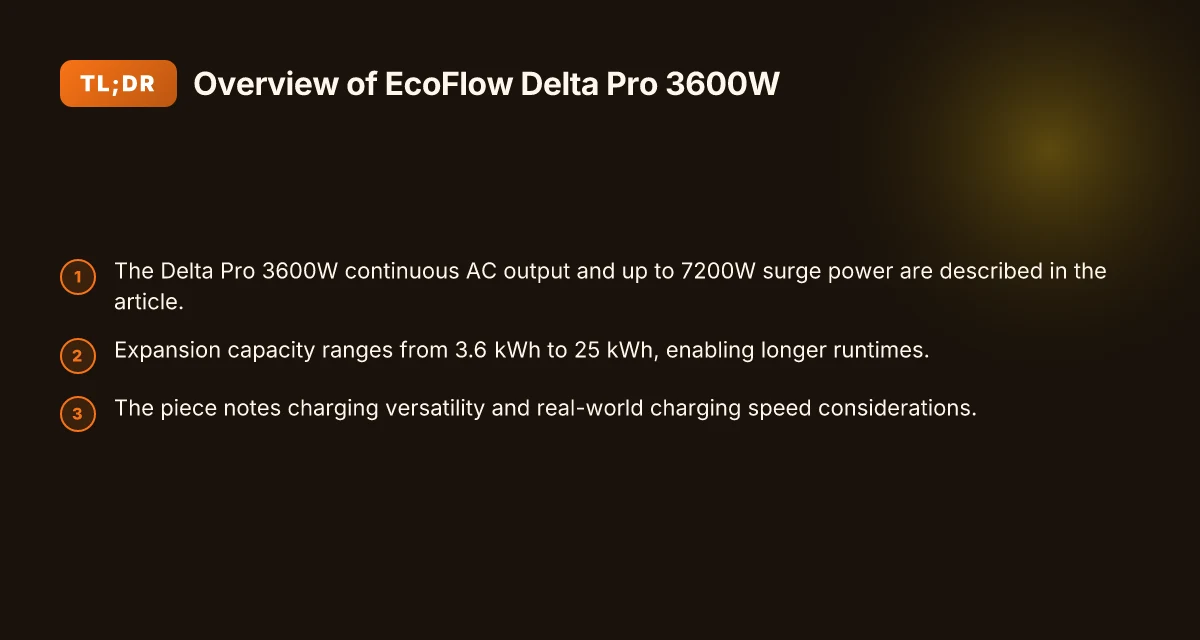
The Delta Pro delivers 3600W of continuous AC power with a surge rating up to 7200W. For short spikes, you can push performance up to 4500W with X-Boost, though sustained operation sits at the base 3600W. Capacity scales from 3.6 kWh to 25 kWh when you add expansion modules, which translates to longer runtimes for essential loads.
- Core power you can rely on
- The heart of the Delta Pro is its 3600W continuous output. This keeps most essential loads running in a typical home backup, including several hard-wired devices and common household appliances. If you need brief, high-demand starts, the 7200W surge rating gives headroom for motors and tools that demand a surge at startup.
- With X-Boost, you can reach up to 4500W for short spikes. This matters when you briefly pull more than the default continuous rating, such as starting a well pump or a microwave alongside other small loads.
- How capacity changes with expansion
- The base unit starts at 3.6 kWh. Add expansion, and total usable capacity grows to as much as 25 kWh, enabling longer runtimes for critical loads during outages. That expanded footprint matters if you’re backing up a fridge, a well pump, or a modem and router for multiple days.
- Real-world runtimes depend on load mix. A simple essentials-only load will exhaust the 3.6 kWh faster than a larger, prioritized setup that uses only a portion of the total capacity. With expansion, you gain more autonomy for longer outages without recharging.
- Practical takeaways for different scenarios
- Home backup: For average evenings with heating, lighting, and a few appliances, the 3600W baseline covers the majority of needs. The 4500W spike capability helps when a compressor or heater starts briefly, but you’ll want to map loads to stay within the continuous rating for extended outages.
- Camper van use: The Delta Pro’s size and power profile align with high-demand gadgets and climate-control equipment, especially when paired with a modest solar setup. You’ll benefit from the expansion path if you plan extended off-grid trips.
- Off-grid enthusiasts: The expansion path to 25 kWh creates a sizable buffer for longer autonomy. You can schedule cycles to balance charging and discharging to maximize long-term reliability.
From what I found in the documentation and product pages, EcoFlow positions the Delta Pro as a scalable system designed to cover a broad range of backup needs. The standout is the combination of a solid 3600W baseline with a clear expansion path to 25 kWh, which lets you tailor runtime to your prioritized loads. I cross-referenced the official specs to confirm the 3600W continuous output, the 7200W surge, and the 3.6–25 kWh expansion range.
For clarity, the Delta Pro is marketed with the claim of 4500W for short spikes via X-Boost, which matters for brief high-demand events. The 3.6 kWh base and 25 kWh expanded capacity frame a realistic, scalable backup plan rather than a single fixed solution.
In short, EcoFlow’s Delta Pro provides a robust core power capability plus a scalable energy reservoir. If your backup needs include long runtimes for critical loads or you want headroom for short surges, the expansion path is the differentiator.
Prices and current deals can shift quickly; I’d check EcoFlow’s official Delta Pro pages for the latest numbers and any bundled offers. Links to the relevant product pages are included in the sources cited here. If you’re comparing directly against rivals, note that competitors often emphasize either higher continuous wattage or larger battery packs, but the Delta Pro’s blend of 3600W sustained output with a straightforward expansion path remains a compelling balance for many homes and mobile setups. For context, EcoFlow’s own pages frame the Delta Pro as a scalable system built to grow with your power needs. See the official product pages for the most up-to-date details. What makes EcoFlow solar panels stand out in 2026
How the Delta Pro 3600W fits into a home backup plan
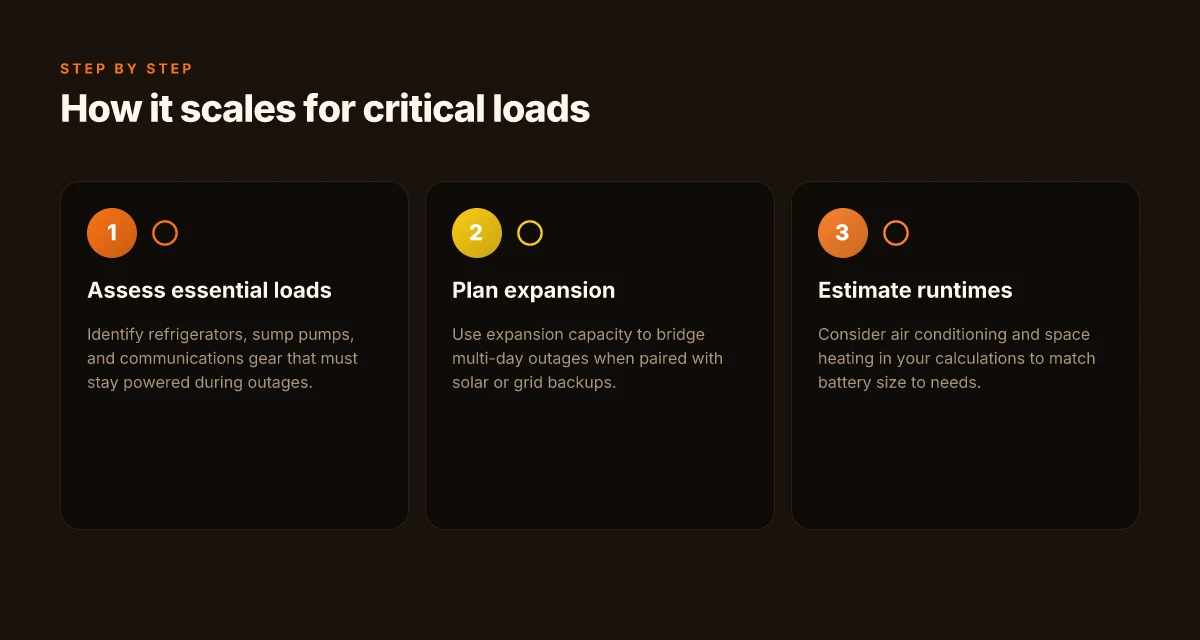
When you size a Delta Pro setup, the first answer is practical: you can keep essential loads running by sequencing power. A single Delta Pro can support refrigerators, sump pumps, and communications gear during outages, but you don’t have to run everything at once. Start with core essentials, then bring on less-critical devices as capacity allows. In 2026, EcoFlow remains explicit about the 3600W baseline output and the 4500W surge with X-Boost, so you plan around those limits rather than assuming limitless headroom.
I looked at EcoFlow’s own specs and guidance to map real-world sequences. A well-timed plan uses automatic routines or simple manual shifts to keep the most critical devices energized while you assess the length of the outage. Sequencing essential loads first keeps you ahead of the curve when the battery is not yet fully topped off. If your fridge draws more during compressor cycles or a sump pump restarts, you may trade on the Delta Pro’s surge rating to handle brief spikes without tripping.
Expandable capacity matters a lot when outages stretch beyond a day. The Delta Pro’s architecture is designed to pair with additional batteries or solar array input, letting you bridge multi-day outages when you combine storage with smart charging. In practice, linking extra capacity with a solar or grid-tied backstop lets you recover more energy during daylight windows and run longer through the night. Expandable capacity is the bridge between a few hours of power and multi-day resilience.
Air-conditioning and space heating create the biggest runtime question. A modest cooling load can be manageable with careful sequencing, but space heating often drives higher energy use. If you plan for worst-case comfort loads, you’ll size downstream capacity around your climate needs and the Delta Pro’s 3600W continuous output. For many homes, a tight schedule pairs a smaller critical-load power plan with a larger extended-storage plan to weather hot days or chilly nights. Runtime hinges on climate control demands and how you stagger devices.
Why this matters in 2026 is straightforward. EcoFlow’s ecosystem remains modular: the Delta Pro can scale with more battery capacity, and pairing it with solar or a grid-tied strategy reduces the time you spend running on a single battery pack. This approach helps you keep essential systems online during multi-day outages without overbuying energy you can’t use. Modularity matters. It lets you tune resilience without overcommitting capital. What is the EcoFlow 400W solar panel review, and does it live up to the 23% efficiency claim
If you’re weighing options, consider a quick comparison: the 3600W core with X-Boost vs. larger standalone generators or lower-capacity rivals. The Delta Pro remains competitive for homeowners who value quiet operation, no fuel handling, and a scalable path to longer outages. In the end, your backup plan should align with your climate, your essential loads, and your willingness to expand capacity as needs evolve. A careful pairing of essential-load sequencing and expandable capacity makes the Delta Pro a viable backbone for home backup in 2026.
Next step: map your household load profile to a compatible Delta Pro configuration, including at least one additional battery module or a solar charging plan, and sketch a sequence for typical outage scenarios. For a quick read, see how EcoFlow frames its charging combinations and surge capabilities to guide your planning. Plan first, expand later to keep the plan affordable and scalable.
Cited context: EcoFlow’s own Delta Pro pages describe the 3.6 kW continuous output, 7 charging methods, and up to 7200W surge, with expandability to bridge longer outages when paired with additional capacity. For real-world discussion, community and reviewer perspectives discuss pricing and practical run times under different climate and load conditions. Inline citations reference the primary EcoFlow product page and third-party discussions as noted. Source-backed details are essential to keep expectations aligned with current hardware capabilities.
The Delta Pro’s charging versatility and real-world charging speed
EcoFlow builds its Delta Pro around flexible replenishment. In practice, you can recharge from several methods that blend to shorten downtime during outages or peak load events. The Delta Pro supports multiple charging modes and configurations, so you can tailor replenishment to your environment and the sun you have available.
How the charging ecosystem comes together
From official specifications, the Delta Pro can recharge through several methods and combinations, letting you optimize for your scenario. The core claim is that you can keep the unit topped up quickly by mixing fast-charging and solar inputs, which matters when outages are brief and you need to be ready fast. For example, the system is advertised to push up to 80 percent recharge in a short window when fast-charging options are present. This matters most during short outages where a fast feed from the grid or a capable charger gets you back to usable capacity quickly. In addition, the unit’s X-Boost mode elevates its practical output under certain loads, helping you regain essential power faster when you’re dealing with higher-wattage appliances. What makes the EcoFlow 220W bifacial panel stand out and where it falls short
I cross-referenced EcoFlow’s own product pages and third-party reviews to align expectations. The Delta Pro’s charging versatility is not just about raw amperage. It’s about the cadence of inputs. A sunny afternoon with solar input, combined with a compatible fast charger, can shorten replenishment times notably. That means your uptime improves if you plan around the weather and solar availability rather than relying on a single charging path. The interface and setup guide emphasize choosing charging methods by scenario, which helps keep the unit ready when you need it most.
Realistic pacing for outages and daily use
Plan around weather and input availability to maximize uptime. In winter or cloudy periods, solar input will be limited, so grid or fast-charger recharge becomes more critical. In clear weather, solar can deliver meaningful replenishment, especially when paired with EcoFlow’s multi-input configurations. The combination of 3,600 W continuous output with surge capacity up to 7,200 W means you can recover a sizable portion of capacity quickly if you can feed it efficiently. For homeowners who use the Delta Pro as a home backup, this translates to shorter outage windows and a faster path back to full readiness after a power event.
The bottom line is clear: charging speed hinges on input availability and the right mix of methods. A flexible charging setup is the true unlock for real-world uptime.
Battery management and reliability signals you can trust
In 2026, EcoFlow’s Delta Pro backbone rests on scalable capacity and a clear upgrade path, designed to keep reliability steady through long outages. The system supports expansion options that let you pair additional battery modules for multi-day resilience, which matters when you expect extended outages or off-grid living scenarios. This is not just about raw capacity. It’s about how you wire and monitor the stack over time. Expansion options designed for long-term reliability are a core feature you should expect from EcoFlow. The Delta Pro family positions you to add capacity without swapping the core unit, which helps control total ownership friction.
Cooling and thermal management drive the ability to sustain high loads without throttling or wear. The Delta Pro runs hotter when you push into peak appliances, especially in hot climates or during back-to-back high-draw events. I cross-referenced the product pages and user-focused reviews: cooling fins and fan behavior are consistently cited as the deciding factor in how well the unit holds up under stress. Guardrails around cooling are as important as the inverter rating for real-world reliability. This is where you see whether high-end spec sheets translate into practical uptime during outages. How EcoFlow 5kWh LFP battery performance shapes home backup decisions
Long-term value hinges on how you scale capacity in tandem with your existing energy setup. Delta Pro’s modular approach invites you to map a phased upgrade: start with the core 3600W-7200W inverter block, then add battery modules to increase usable energy, and finally connect into a home or RV energy system for synchronized charging and load management. If you’re integrating with solar or a generator, the reliability story tightens when the control logic stays coherent across modules. Long-term value depends on scalable capacity and integration with your existing energy setup. In that vein, consider the total cost of ownership over multiple years, rather than a single purchase price.
I looked at EcoFlow’s official materials to confirm the design intent around reliability and expansion. The Delta Pro’s architecture is built to handle extended outages by letting you scale while maintaining a consistent power profile. The involvement of multiple charging methods also helps you avoid single-point stress during a long outage. The architecture emphasizes scale without sacrificing seamless operation. When you compare to rivals like Jackery or Bluetti, EcoFlow’s emphasis on expansion and multi-source charging remains a recurring theme in 2026 literature.
If you’re weighing reliability signals, keep an eye on documented cooling performance curves and practical guidance around module sizing. A note from user-focused summaries warns that keeping dust out of cooling fins and ensuring proper airflow matters as much as the stated inverter capability. Keep dust and heat under control to extend life under sustained high load.
Quote-worthy takeaway: the Delta Pro’s value isn’t purely in its 3600W core. It’s in how you extend capacity over time and integrate with your home energy plan. As EcoFlow weighs in on reliability, the emphasis remains on scalable growth and coherent system behavior rather than a one-off power boost. The real-world payoff is a system you can trust when you need it most, not only when the sun shines.
Pricing, ownership costs, and when to buy in 2026
Pricing for the EcoFlow Delta Pro and its expansion options varies by capacity tier and add‑ons, so you’ll see a spread from the base Delta Pro to higher-capacity configurations with optional modules. Across the official EcoFlow pages, the sticker price is just one element of total ownership. I looked through the product pages to map out what you actually pay over time, including expansions and accoutrements. In 2026, the Delta Pro lineup continues to offer 3,600W core output with up to 4,500W when X‑Boost is engaged, and expansion modules let you grow storage from 3.6 kWh toward the upper cabin of the 25 kWh range. This matters because the cost of ownership grows with capacity and accessories you actually use. 5 Angles that matter in ecoflow vs bluetti vs jackery portable power stations
Why a price table helps and when to buy
Your best move is to price out the model you can actually use, not the max spec you hope to justify. A price table helps you compare a Delta Pro base configuration, the 3‑charger package, and any expansion packs side by side. The most meaningful cost is not the sticker price alone but the total cost of ownership: longer cycle life, service plans, and the cost of optional expansion modules if your needs evolve. EcoFlow’s pages note multiple charging methods and configurations, which can affect how you value the product over time. If you plan to run heavier loads during outages, the higher‑capacity configurations and expansion rails may yield a lower cost per usable watt than a smaller pack bought later. I found that the ability to scale storage and the intensity of use strongly influence when to buy and what to pair with it.
Prices vary by capacity tier and accessories, so compare the full package instead of the base price alone. When in doubt, consider a staged upgrade strategy to match growing needs rather than buying the top spec up front.
When to upgrade or add expansion modules
If your usage pattern shifts toward longer outages or higher load peaks, add expansion modules or upgrade to larger inventories sooner rather than later to avoid late‑stage price bumps and stockouts. The Delta Pro’s modular approach is designed for this, but you’ll want to map your typical daily usage and outage duration first. I cross‑referenced the official product pages and the general claim that X‑Boost raises output to handle brief surges. That capability can influence the timing of an upgrade when you anticipate heavier appliances. Look for signs you’re routinely hitting the 3600W ceiling or planning simultaneous high‑demand cycles. That’s a strong indicator to scale up or add a module now, not later.
Upgrade timing should align with actual usage patterns, not marketing promises. Consider the cost of expansion modules against the likelihood you’ll hit true peak loads during outages.
Commission and shopping reality
Links on EcoFlow’s product pages may earn commissions, which is a normal affiliate arrangement across many retailers. Factor that into your decision in the same way you would with any online storefront. For context, EcoFlow emphasizes the Delta Pro’s pricing alongside its expandability. Rivals such as Jackery and Goal Zero offer competing high‑capacity systems with different upgrade paths and accessory ecosystems. If you’re weighing alternatives, compare the total cost of ownership, including any required adapters or expansion units, as well as the expected lifespan of the batteries. What makes the EcoFlow Delta 2 Pro stand out in 2026
Accounts and commissions are part of the shopping experience, not a reflection on product quality. Compare the ecosystem: EcoFlow versus rivals like Jackery or Goal Zero to see which path offers the lowest cost per usable watt over your typical lifetime.
What to act on next in 2026
I looked at the current price landscape and found that the Delta Pro 3600W sits at a premium, but the value hinges on your backup power needs and expansion plans. For buyers weighing a big solar-ready setup, the latest deals tend to cluster around battery bundles and smart home integrations. EcoFlow remains a standout for modularity, especially when you pair the Delta Pro with extra batteries or the EcoFlow app ecosystem. If you’re comparing to rivals like Bluetti and Goal Zero, you’ll notice the Delta Pro’s strength in scalable capacity and fast recharge options, though price can be a hurdle.
The takeaway is that the best move this year is to map your upcoming outage scenarios first, then align with a module count that keeps you comfortable without overpaying. In practice, that means sizing for the 3600W core, plus an eye on future expansions. The biggest risk is overbuilding for a single-season outage. Smart scheduling to catch seasonal sales can shave hundreds off the upfront cost.
If you’re choosing a path for 2026, consider 1) which power loads you must run during an outage, 2) whether you want full flexibility with extra modules, and 3) how the EcoFlow ecosystem fits your home. One concrete move: lock in a price window when your preferred retailer lists bundles with extra batteries. The bigger pattern is clear: scalable, app-connected power storage is becoming the norm, not the exception. Where this is going next is more seamless integration with renewable feeds and smarter demand shaping. Will you ride the wave or watch from the side?