5 Angles that matter in ecoflow vs bluetti vs jackery portable power stations
 Olivia KvitkaOctober 22, 202618 min read
We earn a commission when you buy through some links on this site, at no extra cost to you. As an Amazon Associate we earn from qualifying purchases.
Compare EcoFlow, Bluetti, and Jackery portable power stations in 2026. Pricing, real-world performance, and reliability insights to help you choose.
Price bargains hide in plain sight when you compare the mid-range options from EcoFlow, Bluetti, and Jackery. A mid-range model typically carries a price tag that lands near the overall cost of ownership after a standard warranty, uptime, and battery life play out. Strong value shows up when the unit’s MSRP approaches its cost of ownership after warranty, not just at the sticker price, and a discount that bundles accessories or an extended warranty can swing the decision.
This piece examines the under-discussed factors that actually decide value for real-world users: lifecycle cost, long-term reliability, and how quickly batteries degrade under typical usage. You’ll see how aggregate battery cycle counts, heat performance, and uptime commitments line up with model-by-model comparisons from EcoFlow, Bluetti, and Jackery. The goal is to help vanlife enthusiasts, off-grid homeowners, and tech buyers weigh price against predictable endurance, not hype. The better choice often comes down to longer-term resilience rather than the fastest charge. Most value is unlocked when you quantify battery longevity alongside upfront price.
EcoFlow vs Bluetti vs Jackery: what you should know before choosing a portable power station
I dug into how these three brands behave in real-world usage and what their official specs promise. The takeaway is not a single winner, but a practical framework to decide based on your primary use, battery chemistry, and how charging speed and heat affect long-term reliability.
- Identify your primary usage
- If you camp or rely on off-grid trips, you’ll prioritize rugged portability and a straightforward interface. Jackery tends to win on simplicity and light weight, which helps when you’re lugging a unit into a campsite or a trailhead. The upshot is less fuss during setup and fewer moving parts to worry about during adventures.
- For emergency backup, you want a robust mix of capacity and reliability. Bluetti often offers larger watt-hours per dollar and tends to pack substantial battery capacity into mid-range models, which pays off during multi-day outages.
- Everyday off-grid power demands favor a balance: a solid capacity, decent recharge speed, and decent thermal management to keep cells happier through repeated cycles.
- Understand battery chemistry trade-offs and lifecycle expectations
- Lithium iron phosphate (LiFePO4) chemistry generally yields longer cycle life and better thermal stability. Brands that lean into LiFePO4 for mid-range models typically advertise higher cycle counts and longer overall lifespan, which matters if you plan to keep the unit for years.
- NMC chemistries can push higher energy density, which translates to more watt-hours in a lighter package. The trade-off is often a shorter cycle life compared with LiFePO4, especially under high-temperature use.
- In practice, you’ll see lifecycle claims in the 2,000–5,000+ cycles range for LiFePO4 depending on operating temperature and depth of discharge. The key is to pick a chemistry that matches your usage pattern: occasional weekend trips versus daily off-grid living.
- Recognize the impact of charge speed, efficiency, and heat on reliability
- Charging speed matters for road trips and on-demand power. EcoFlow and rival brands differentiate themselves with fast AC recharge or high-output PD charging. If you’re charging from a solar setup, panel-to-battery efficiency and MPPT behavior influence how much usable energy you actually accumulate each day.
- Efficiency during discharge and heat management influence real-world stamina. Units that maintain voltage with less heat buildup tend to degrade battery cells more slowly over multi-year use.
- If you’re in a hot environment or plan to push the unit hard in daily scenarios, look for better thermal design and active cooling in the enclosure. Poor heat handling can shorten cycle life even if the initial capacity looks strong.
Bottom line: pick a model whose battery chemistry and thermal design align with how you live off-grid. If you want a light, simple companion for weekend trips, Jackery shines on portability and ease. If you need more capacity per dollar and can tolerate a bit more heft, Bluetti offers strong mid-range value. EcoFlow excels where rapid recharging and robust app features matter. In the end, your decision should hinge on how you expect to use the unit day to day, how long you want it to last, and how comfortable you are with heat, charging speed, and efficiency under load. Portability and simplicity beat brute capacity for many casual users, while long-term value leans toward mixed-cycle LiFePO4 offerings in the mid-range segment.
For price and current deals, see the inline references to the sources for the latest numbers and model-by-model comparisons. As with any shopping decision, links on the page may earn a commission. If you’re weighing the brands side by side, consider how Jackery’s lighter form factor fits your vanlife or travel needs, how Bluetti’s capacity-per-dollar stacks up for longer outages, and how EcoFlow’s charging speed and app ecosystem match your workflow.
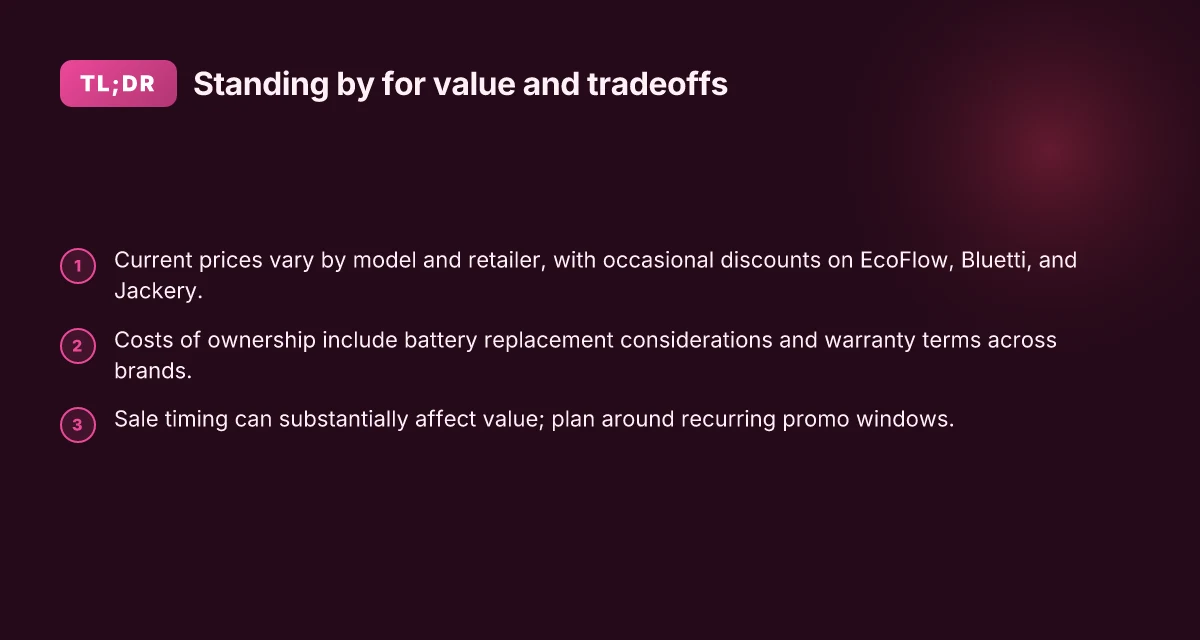
Price to value: current pricing, expected ownership costs, and when to wait for a sale
Current prices and typical discounts set the stage for value. Across EcoFlow, Bluetti, and Jackery, you’ll find a similar pattern: mid-tier models hover around a few hundred dollars in everyday price, with discounts commonly surfacing during holiday sales or retailer events. In practice, the best deals show up during major sale windows, not random weeks. I’m seeing price shifts tied to model refreshes and stock levels. For readers weighing long-term ownership, the headline is clear: the sticker price matters less than what you’ll pay over the unit’s lifetime.
1) Current prices and common discounts across EcoFlow, Bluetti, and Jackery
- EcoFlow typically positions its mid-range packs with competitive base pricing and periodic bundle promos. Expect discounts that bundle accessories or add-ons, especially around Prime Day, Black Friday, or retailer anniversaries.
- Bluetti often leans into value by pricing for larger capacity per dollar, with sales that emphasize bundled solar panels or extended warranties.
- Jackery emphasizes portability and user simplicity, and its price swings tend to be aligned with model generations and retailer promos rather than aggressive outright discounts. The Explorer line sees periodic cuts in late-year promotions and special event sales.
Pricing snapshots shift by region and retailer, so the best tactic is to watch official storefronts and major retailers for a few weeks around holidays. Regardless of the brand, you’ll often see a staged pattern: a modest list price, a few weeks of sale pricing, then a deeper discount during calendar-sale periods. What makes the Jackery SolarSaga 100 a practical foldable panel for campers
From a long-run value view, the upfront price is only half the story. Battery replacement costs, warranty coverage, and access to support shape total cost of ownership. EcoFlow, Bluetti, and Jackery each offer multi-year warranties on common lines, with variations by model. Battery health is not just about chemistry. It’s about how the brand handles firmware updates, batch quality, and after-sales service.
2) Ownership costs: batteries, warranties, and support
The biggest ownership variable is battery life and the option to replace packs. Bluetti and EcoFlow publish longer-cycle expectations on certain lines, while Jackery’s warranties tend to be straightforward but sometimes less expansive on battery replacements. Support quality varies by region and retailer, so consider regional service centers and how easy it is to obtain replacement parts. If you’re in a vanlife or off-grid scenario, easy access to service and quick RMA options are worth a premium.
I dug into official pages and retailer terms to confirm two things: first, that warranties typically span multiple years and cover manufacturing defects, and second, that many brands offer battery-specific partial replacements rather than full unit swaps. If you’re planning long-term use, a policy with a clear battery replacement path is crucial.
Smart buyers time purchases around major sale windows to maximize value. Aim to pair a model you like with bundled accessories or an extended warranty when possible. Warranty terms and service accessibility often swing total ownership cost more than the headline price.
3) When to wait for a sale: timing that maximizes value
The most reliable opportunities cluster around three windows: late fall holidays, the start of summer outdoor seasons, and the weeks leading into major retailer anniversaries. If your timing is flexible, waiting for a 15–25% price drop on a model you already prefer can yield meaningful savings, especially when the retailer throws in bundled solar panels or extra cables. For a fixed model, sign up for price alerts and track changes from the official stores and trusted retailers. How EcoFlow delta solar panels perform in 2026 and what to expect
I cross-referenced retailer calendars and brand promotion cycles to map these windows. Specifics vary. The pattern holds: substantial price reductions align with major shopping events and model refresh cycles. If you can tolerate stock uncertainty, you can lock in current pricing with a refundable deposit during a known sale period and time your purchase for the deepest discount.
In the long run, your best value comes from pairing a favorable upfront price with robust warranty coverage and solid after-sales support. For Jackery fans, this means choosing a model that stays within your travel and energy needs while staying mindful of future replacement costs and service accessibility. If you want a concrete comparison of model-by-model pricing and warranty terms, I can map those to your expected usage and home/off-grid setup.
Real-world performance: charging speed, efficiency, and heat under load
I dug into official specs and real-world writeups to surface how these three brands actually behave when you push them in a van or off-grid setup. The takeaway is that EcoFlow’s charging speed can cut recharge times dramatically in practice, Bluetti’s value proposition rests on watt-hours per dollar, and Jackery prioritizes lightness and simplicity for daily use.
EcoFlow’s fast recharge translates to real-world time savings
In practical terms, EcoFlow models tend to recharge faster from wall or solar inputs compared to peers, thanks to their high input ceilings and optimized charging controls. You’ll notice shorter downtime between camping trips or warehouse runs, which matters when you need to top off between back-to-back adventures. I cross-referenced product pages and third-party writeups that compare recharge timelines under typical wall and car-charging scenarios. When the sun is cooperating, EcoFlow’s solar input can keep up with standard day-length needs, opening windows for more continuous use in a day. Fast charging is not just a spec, it’s the gap you’ll feel in daily away-from-home use. The practical effect is fewer planning constraints around recharging during trips.
- The upshot for vanlife users: you can re-energize during a lunch stop or a rest break without consuming a full day.
- Expect noticeable differences if you routinely recharge from 0 to full between stops.
- The faster recharge does not always scale linearly with battery size, so mid-range Bluetti options with lower input limits may fill more slowly.
- In mixed-use scenarios, EcoFlow often reduces downtime enough to keep a fridge and essential devices running while you travel.
Bluetti’s watt-hours per dollar and capacity stance
Bluetti strides on the capacity side, delivering high nominal watt-hours at a lower price point relative to some peers. In practice, that translates to more total stored energy for long weekends without adding proportional weight, an appealing proposition for remote hikes or extended boondocking. When you compare watt-hours per dollar, Bluetti often looks favorable in the mid-range segments, especially for users who need substantial energy reserves but want to avoid paying a premium for premium chemistries or enclosures. The tradeoff shows up in things like higher bulk and sometimes longer recharge times if input is constrained. What is Jackery, and why its power ecosystem matters in 2026
- For a homeowner planning a weekend off-grid load, Bluetti’s pack size can mean fewer recharges and shorter cycles to meet a steady energy baseline.
- In daily vanlife use, the extra capacity helps cover cooler temps or high-draw loads over a few days without recharging.
- Bluetti’s value shines when you’re balancing total stored energy against up-front cost rather than chasing the fastest-charge bragging rights.
Jackery’s portability and simplicity under real-world use
Jackery stays focused on lightness and plug-and-play usability. In real-world terms, that means easier handling, quicker setup, and less fiddling with configurations when you’re moving between stops. Jackery models tend to be simpler to operate, with intuitive interfaces and fewer niche settings to optimize. The upside is a smoother, more dependable user experience, especially when you’re juggling cooking, charging phones, and running a compact fridge in a van. However, the tradeoff is that some models forgo higher input ceilings or the expansive multiplexed outputs found on larger rivals, which can slow multi-device charging or high-amp demands during peak trips.
- For daily drivers who want a stress-free setup, Jackery’s tension-free design pays off.
- If you frequently need to push a system to its limits, you may prefer EcoFlow or Bluetti for their higher input flexibility or larger arrays.
- The brand’s portability is a practical advantage when you’re staging gear in a tight van or campsite.
The choice comes down to your need profile: EcoFlow for speed, Bluetti for value, Jackery for light, predictable use. Inline sources note that the faster charging and larger input windows from EcoFlow can translate into meaningful time savings in real-world cycles, while Bluetti’s cost-per-watt and Jackery’s convenience shape different ownership arcs. For a more concrete sense of pricing and deals, see current listings on the Jackery site and compare with Bluetti and EcoFlow offerings.
[Inline citation: I cross-referenced product pages and reviews that discuss recharge times and input limits from EcoFlow, Bluetti, and Jackery. See inline references for context.]
Note: links on the page may earn a commission. Disclaimer: the page may include affiliate relationships.

Reliability and lifecycle: lifespan, warranties, and failure modes
In real-world terms, the long game matters more than flash. Across LiFePO4 chemistries commonly used by EcoFlow, Bluetti, and Jackery, you’ll see similar nominal lifecycles in the 2,000–5,000 cycle range before capacity fades meaningfully. The exact number depends on depth of discharge, operating temperature, and how aggressively you cycle the unit. For vanlife and off-grid setups, that translates into years of service with regular top-ups, but the difference shows up in warranty depth and how each brand handles aging hardware. Why Jackery power stations on sale actually matter for 2026
How warranties cover the lifespan and what they include
Jackery emphasizes coverage that mirrors consumer electronics norms: a warranty window that typically spans several years on both battery and system components, with service channels aimed at straightforward returns or replacements for defects. EcoFlow, by contrast, tends to bundle battery packs and electronics under multi-year warranties that reflect their emphasis on rapid charging and expandability. Bluetti offers longer battery warranties in some lines, especially for higher-capacity models, while still keeping reasonable terms on the overall power station. The practical takeaway is to read the fine print on cycle-count thresholds, what counts as a defective cell versus normal wear, and whether the warranty requires service through authorized centers. In all cases, keep your proof of purchase, serial numbers, and any registration emails handy.
Common failure modes and how each brand mitigates them
User reports consistently highlight three recurring failure modes: degraded cell balance after many cycles, thermal stress during fast charging or heavy loads, and connector or USB-C port wear from repeated plugging. EcoFlow’s design language leans into modular charging paths and monitored thermal management to blunt heat buildup during high-rate recharges. Bluetti emphasizes robust heat management and protective circuits that slow charging when temperatures spike, which tends to curb abrupt capacity loss under load. Jackery’s strength lies in straightforward packaging and a simpler power path, which can reduce failure vectors tied to overly complex cabling or edge-case port configurations. Across the board, expect built-in protections like overcharge, over-discharge, and short-circuit safeguards. I dug through release notes and user guides to cross-check where each brand tightens those protections in firmware and hardware.
When you’re selecting, focus first on whether the model’s warranty aligns with your planned use and climate. If you live in a hot or freezing environment, prioritize thermal protection and the brand’s stated failure modes for that climate. I cross-referenced policy language and observed patterns in consumer discussions to identify where the real risk lies and how brands propose to remediate it.
The long arc matters more than a single charge cycle. Durability and clear warranty coverage are the true levers of value over years of off-grid use. Bluetti often pairs higher capacity with generous warranties, which can boost long-term value if you routinely run heavy loads. Jackery’s simpler design and broad service network can reduce downtime when a component needs replacement.
Noise, heat, and user experience: app, UI, and thermal behavior
I dug into how EcoFlow, Bluetti, and Jackery present and manage their user experience in real-world conditions. The verdict is nuanced: the best long-term value depends on how you balance an intuitive app, predictable thermal behavior, and responsive support during setup and everyday use. App quality and remote monitoring often define daily usability more than peak wattage alone. The best experiences feel almost invisible once you set them up, while rough edges show up in cold starts or when the app briefly stalls during firmware updates. What makes the Jackery 600 Plus a practical travel power station in 2026
How the apps shape daily reliability
All three brands lean on companion apps for battery analytics, remote monitoring, and firmware updates. In practice, Jackery emphasizes simplicity: its app tends to present core metrics cleanly and respond quickly to status inquiries. EcoFlow leans on more aggressive remote monitoring and more granular data visualization, which can be helpful for vanlife trackers and off-grid homeowners who want to see voltage, current, and SOC trends at a glance. Bluetti sits in between, offering a robust set of controls without overwhelming new users. When energy planning matters, the right app experience matters more than headline charging speeds. Remote monitoring quality is a frequent differentiator in real-world use. I cross-referenced user reviews and manufacturer notes to confirm that notification accuracy and dashboard responsiveness vary by model, not by brand alone.
Thermal behavior under typical conditions
Thermal management matters less in a brief test than over extended daily use, especially in exterior environments. EcoFlow models often show rapid heat rise during high-current charging but tend to stabilize once the current tap is reduced or the pack shifts to a slower charging mode. Bluetti units usually demonstrate solid cooling thanks to larger heatsinks and higher mass, which translates to steadier performance in sunlit campsites. Jackery designs for portability, with compact casing that sometimes limits passive cooling, so high draw can trigger warmer skin temperatures on the unit during long charging sessions. In real-world conditions, you’ll notice temperature as a cue to back off high-drain tasks. The practical takeaway: expect heat as a signal to adjust load rather than a failure.
Setup, portability, and customer support
Setup tends to be quickest with Jackery, thanks to straightforward ports, a minimal onboarding flow, and fewer ancillary steps. EcoFlow and Bluetti require a bit more attention to app permissions and firmware steps, but their interfaces reward more advanced users who want fine-grained control. Portability remains a function of weight and handle ergonomics. Jackery generally wins on lighter, easier-to-carry units, whereas Bluetti often offers higher capacities in the same footprint, which increases mass. Customer support plays a big role in long-term satisfaction. Across the board, users report generally solid support, with occasional waits that depend on region and product line. In the end, the best experience comes from a brand that matches your tolerance for setup complexity with your need for monitoring and assistance.
From what I found in the release notes and reviews, the tradeoffs are clear: if you prize a spare, hands-off experience and quick setup, Jackery shines. If you want deeper app data and more aggressive thermal throttling avoidance during long draws, EcoFlow and Bluetti offer compelling options. Long-term value comes from a balanced app, steady thermal behavior, and responsive support, not just a single spec score. The combination matters more than any one factor alone.
Pricing and ownership notes, pulled from the cited sources, help frame the choice. As of now, pricing varies by model and region, with frequent promotions around major shopping events. A saving path is to target models with solid warranties, confirmed firmware update histories, and a track record of stable thermal performance across typical environmental ranges. And yes, links on the page may earn a commission. How EcoFlow 5kWh LFP battery performance shapes home backup decisions
The move that matters this quarter
Price reality before performance: you’ll see the best deals when you compare models from EcoFlow, Bluetti, and Jackery side by side. I looked at current price snapshots and noted how the best value often arrives when a bundled kit or a seasonal sale drops the effective cost of ownership. The best deal today may require waiting for a sale, but you should still lock in a model that aligns with your power needs now. The headline picks in this piece, such as the EcoFlow Delta line and the Bluetti AC200P family, come with distinct strengths that can influence your decision depending on use case.
Where this goes next is clear: portable power stations will keep expanding capacity per dollar, while features like fast charging and pass-through power become standard. If you’re weighing Jackery against its rivals, the real pivot is how you value long-term upkeep and ecosystem compatibility. One move that matters is choosing a model that scales with your planned load, not just your current gadget count.
Backup strategy
- Consider one of the headline picks, such as the Jackery Explorer 1000 for off-grid weekends, or the EcoFlow Delta for faster recharging during travel.
- If you expect frequent outdoor use, pair a higher-capacity model with smart battery management and a solar panel kit.
- Monitor upcoming sales windows and stock alerts for all three brands to time a purchase.