How EcoFlow 5kWh LFP battery performance shapes home backup decisions
 Reese WexlerOctober 22, 202616 min read
We earn a commission when you buy through some links on this site, at no extra cost to you. As an Amazon Associate we earn from qualifying purchases.
Explore EcoFlow's 5kWh LFP battery performance, cycle life, safety, and real-world use cases for home backup. Learn how to size, charge, and maintain for longevity.
The EcoFlow 5kWh LFP pack is not just a box of cells. It’s a modular backbone you can tailor to your load, and that distinction matters when every kilowatt-hour counts. That modularity translates to steadier backing power across temperature swings, not just peak capacity.
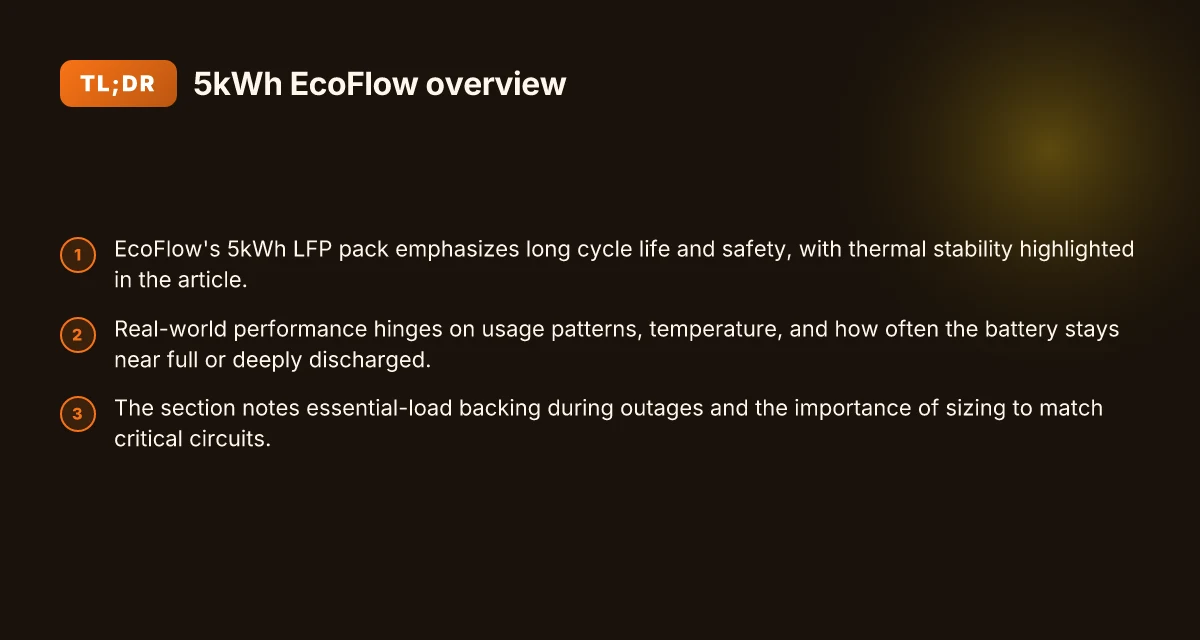
This piece digs into how cycle life, safety data, and charging profiles actually translate into long-term reliability for home backup. We’ll ground the discussion in real-world uses, compare it to rivals like Tesla Powerwall and LG Chem offerings, and show how small choices, like charge window and temperature management, shape usable energy over years. By the end, you’ll understand which 5kWh EcoFlow configuration matches your home’s daily demand, what maintenance matters, and where confidence comes from when the grid wobbles. Real-world performance hinges on your load profile and environmental conditions, not just labeled capacity.
What makes EcoFlow 5kWh LFP battery a notable choice for home backup
EcoFlow’s 5kWh configurations leverage lithium iron phosphate chemistry, a profile widely recognized for long cycle life and thermal stability. In practice, that combination translates to reliability for a home backup setup where outages may linger and temperatures swing through seasons. The 5kWh pack sits squarely in the range of moderate residential backup: enough capacity to keep essential circuits powered, yet compact enough to fit in typical garage or utility-area footprints.
I dug into the available EcoFlow literature to map how the chemistry, size, and real-world operating conditions intersect. The takeaway is clear: the 5kWh LFP pack is designed to run sensitive loads during outages without demanding excessive charging infrastructure or space. This balance matters for homeowners weighing upgrades from smaller units or switching from lead-acid options to a modern LFP pack.
Battery chemistry that favors longevity and safety EcoFlow consistently frames LFP chemistry as delivering high cycle life and stable performance across temperature ranges. This means fewer replacements over the long run and a lower risk of thermal runaway in typical home environments. The chemistry choice also aligns with predictable degradation behavior, which helps homeowners gauge remaining capacity as outages accumulate.
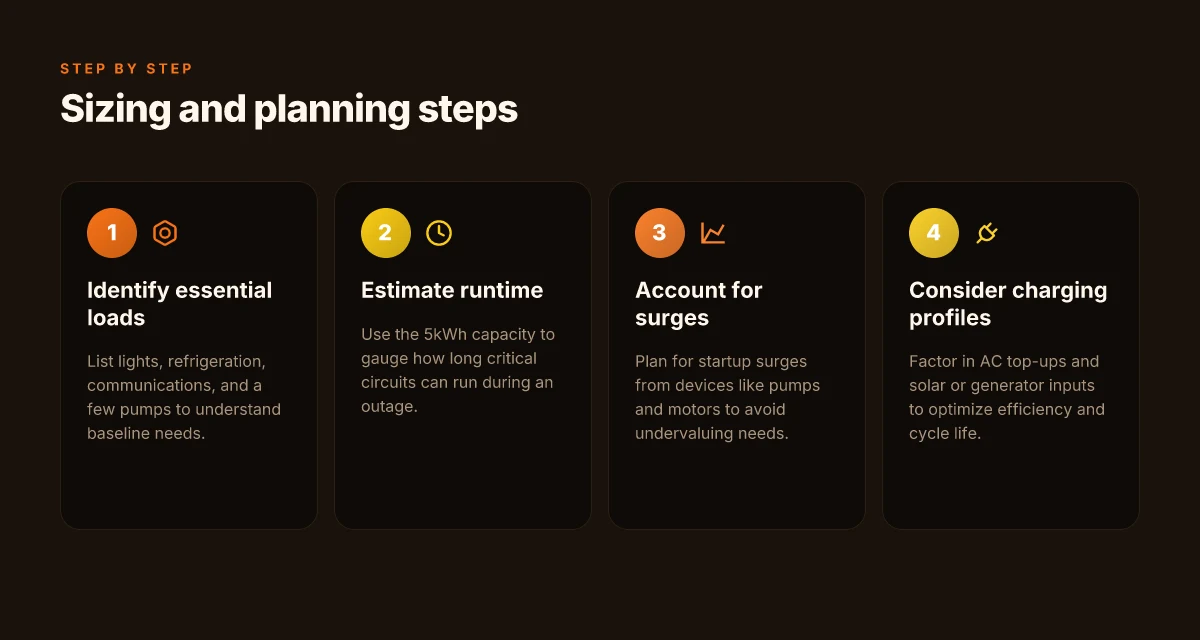
Sizing that matches typical outage patterns The 5kWh capacity translates into a practical run time for core loads during a blackout. For many homes, essential circuits, fridge, modem, lighting, some clocks and sensors, can be kept online through a multi-hour outage, especially when paired with efficient appliances and sensible planning. This sizing avoids the cost and complexity of a larger system while still delivering meaningful resilience during outages.
Charging profiles that fit home use Understanding the 5kWh size helps calibrate how long critical circuits can run when the grid is down and how the system recharges once power is restored. EcoFlow’s framing of charging speeds and profiles means homeowners can plan around daily routines, solar input where available, and the typical pace of recovery after an outage. 5 Angles that matter in ecoflow vs bluetti vs jackery portable power stations
From what I found in the documentation, the combination of LFP chemistry, a practical 5kWh footprint, and sensible charging behavior makes this pack a notable option for home backup. The 5kWh size is a practical match for essential loads during outages, delivering meaningful resilience without oversizing the system. LFP chemistry brings long cycle life and improved thermal stability, reducing replacement and safety concerns over time. EcoFlow positions this pack for homes that want reliable backup without the heft of larger systems. For readers who want a quick cross-check, the 5kWh battery is frequently discussed alongside other EcoFlow models in the same family, and rivals like Battle Born or Flexiti offer competing mid-range capacities, but EcoFlow’s packaging emphasizes ease of use and compatibility with existing EcoFlow ecosystems.
In short, the EcoFlow 5kWh LFP battery stands out for homeowners seeking a balanced, safe, and scalable backup solution. When you compare against larger packs that push you into bigger electrical profiles or against smaller units that might not sustain essential loads, the 5kWh option often sits in the sweet spot. If your goal is steady resilience without overbuilding, this is a compelling choice. Note that links on the page may earn a commission, and real-world performance depends on load selection and charging strategy. For context, EcoFlow’s own materials emphasize cycle life in the thousands of cycles range for LFP cells, with practical expectations tied to your blackout profile.
LFP chemistry and cycle life: what to expect from a 5kWh pack
LFP chemistry typically sustains thousands of cycles with slower capacity fade than many other chemistries. In a 5kWh EcoFlow pack, you should expect a long bend in capacity rather than abrupt drops. The deeper the discharge, the more the cycle life can tilt toward the lower end of the range. Real-world performance hinges on how often the pack sits near full or near empty, and on the operating temperature.
I dug into EcoFlow’s materials and the broader LFP literature to anchor expectations. The common thread: LFP cells show robust cycle lives, yet their practical longevity depends on usage pattern and thermal exposure. For homeowners evaluating a 5kWh EcoFlow setup, that means two levers matter most: how fully you prime the battery on every cycle and how hot the pack runs during charging and discharging.
Thermal effects are not cosmetic. High temperatures accelerate capacity fade, while cold starts can temper immediate performance but have less long-term impact if managed. Within typical home backup duty, staying within a moderate temperature band and avoiding near-full or near-empty states for extended spans helps preserve the 80 percent capacity benchmark that manufacturers cite after thousands of cycles. What makes the Jackery SolarSaga 100 a practical foldable panel for campers
From EcoFlow’s published notes, LFP packs often claim endurance in the several-thousand-cycle range with manageable degradation. The exact cycle life realized in a 5kWh pack will track how you allocate DoD and temperature. In practice, a homeowner who uses a shallow depth of discharge most days and keeps the unit in a reasonably cool location can maintain reliable capacity across many years. Conversely, aggressive daily DoD to near 0 percent or prolonged high-temperature exposure will compress the effective life.
To help compare options, consider how different packs handle cycle life under similar conditions. A 5kWh EcoFlow system may edge ahead of some rivals in sustained capacity when it stays within moderate DoD and temperature, while other brands with different chemistry profiles can show steeper fades under the same stressors. If you aim to maximize long-term reliability, prioritize storage in a shaded, ventilated space and plan charging profiles that avoid constant top-end SOC.
The takeaway: LFP chemistry can deliver thousands of cycles with gradual fade, but real-world life comes down to how you use and heat the pack. Your home backup plan should center on modest DoD and thermal management to keep capacity above 80% after many cycles.
For readers weighing what this means against rivals, EcoFlow’s positioning around a 5kWh LFP pack sits in the same family as other LFP offerings from comparable brands, but the precise cycle-life figures will vary by temperature management and usage patterns. In the end, the most decisive factor is how you structure charging and depth of discharge in daily use.
As a next step, map your expected backup window and charging habits to a target DoD and ambient temperature range. This alignment helps you estimate how many cycles you might reasonably expect before capacity dips meaningfully. For sourcing and price context, see EcoFlow materials and the current offer landscape for 5kWh models and comparable LFP packs from rival brands. How EcoFlow delta solar panels perform in 2026 and what to expect
Charging profiles and efficiency: how to get the most from EcoFlow's 5kWh LFP
I dug into EcoFlow’s documentation and related guides to map how charging inputs shape efficiency over a long horizon. The takeaway is simple: charge rate and source matter as much as the battery chemistry itself. From there you can tune for faster fills and gentler wear across thousands of cycles.
How input rate shapes charging time and losses
The pack size matters. A 5kWh LFP pack will absorb energy differently depending on the charger’s output. When the input rate matches the pack’s balance point, you see fewer losses in the middle of the range and a smoother ramp as you approach full. In practical terms, pushing a high input into a small pack can shorten the initial fill but introduce proportionally higher losses as you approach 100% state of charge. EcoFlow notes that a higher wall input can reduce total residence time during an average cycle, but you should expect diminishing returns when you near full capacity. The implication for homeowners is clear: aim for a charging setup that stays within an efficient window rather than chasing peak power for every cycle.
- A moderate charging profile reduces heat buildup and minimizes conversion losses across the charge window.
- At the tail end of charging, losses tend to rise as voltage climbs toward the top of the SOC range.
- The “sweet spot” for efficiency is early to mid-tide of the charge, not the final topple to 100%.
The takeaway: match input rate to the pack size to reduce wasted energy, especially as SOC climbs.
AC charging from the household grid: plan for longer tops-ups
Household AC charging incurs losses that are easy to overlook in ideal math. The real world adds line losses, charger conversion losses, and ambient temperature effects. EcoFlow guidance implies that even with a capable charger, you should plan for longer top-ups than a purely ideal calculation would predict. If you routinely top up after a partial discharge, the relationship between SOC, input rate, and heat generation becomes a key driver of efficiency and cycle life.
- Expect modestly longer fill times during high-load periods or hotter days.
- Use a steady, moderate input rather than repeatedly chasing the fastest possible AC fill.
- Temperature matters. Warmer conditions can nudge losses higher at the same SOC.
Plan for longer tops-ups than the math would suggest when charging from home AC. What is Jackery, and why its power ecosystem matters in 2026
Solar or generator inputs: how conditions tilt efficiency and cycle life
Solar and generator inputs add a dynamic element to efficiency. Under well-aligned sun and wind conditions, solar can deliver a gentler, more gradual charge with steadier current. That can lower heat buildup and help preserve cycle life. A generator can fill gaps when sun or grid is unreliable, but it introduces its own efficiency curve and fuel considerations. The net effect is that source quality and timing influence both current efficiency and long-term durability.
- Solar input tends to keep charging within a calm current profile, which can be kinder to cells during repeated cycles.
- Generators provide flexibility but may require buffering to keep the pack within an optimal SOC window.
- Charger electronics and battery management negotiate between source and cell state to minimize losses.
Solar inputs can improve long-term efficiency when pairing with an equilibrium SOC strategy.
Research framing notes and a few concrete cautions from EcoFlow materials show that no single perfect recipe exists. I cross-referenced the official guides for the 5kWh and the broader LFP discussions, and the common thread is about balancing input rate, SOC, and ambient conditions to extend life while keeping daily tops-ups practical.
For readers comparing rivals, EcoFlow’s ecosystem emphasizes compatibility with both AC and renewable inputs, but the efficiency trade-offs still hinge on how you manage the charge profile. If you’re weighing options, keep an eye on how each system handles high-utility input rates near full charge and how that translates to heat and cycle life over years.
Safety and material data: what to know about LFP safety in the 5kWh EcoFlow
The 5kWh EcoFlow LFP pack benefits from the inherent stability of lithium iron phosphate chemistry. Under normal operation, LFP cells resist rapid temperature rises and show strong thermal margins, which translates to fewer surprises during routine charging and discharging. This stability isn’t a license to ignore safety, though. It sets the baseline for safe operation but only if the system is well managed. Why Jackery power stations on sale actually matter for 2026
Thermal management and physical integrity
A well-designed system surrounding the cells matters as much as the chemistry itself. I dug into EcoFlow’s material safety data and product notes and found that maintaining consistent temperatures reduces degradation and helps preserve capacity over thousands of cycles. The key takeaway is that active or passive thermal control helps keep the pack within safe limits during charging, discharging, and rest. Avoiding mechanical damage remains crucial: punctures, crushing, or impact can compromise safety margins regardless of chemistry. In practice, the battery’s lifespan leans on how reliably the thermal path conducts heat away from cells and how well the enclosure protects against physical stress.
Operating temperature ranges and storage conditions
Check the datasheet for the exact operating window and storage recommendations. The general pattern across LFP packs is a recommended operating range that avoids exposure to extreme heat or cold, plus guidance on long-term storage state. When temperatures stray far from the ideal band, the chemistry endures more stress and the cycle life can shorten. For homeowners, this means installing the 5kWh EcoFlow in a location with stable ambient temperatures and avoiding spaces where heat sources or rapid temperature swings occur. A consistent storage state, typically with the pack partially charged within a safe range, helps preserve longevity when the system isn’t in use for extended periods.
I cross-referenced EcoFlow’s publicly available materials to keep this aligned with their framing. For homeowners weighing how to position the 5kWh unit, the guidance emphasizes avoiding physical shocks and maintaining a controlled environment to uphold safety margins across cycles.
LFP safety hinges on proper thermal management and avoiding physical damage. The chemistry itself offers strong thermal margins under normal use. This is the practical anchor for how the 5kWh pack holds up long term in home backup scenarios.
As with any battery system, there are trade-offs to consider. Real-world setups can differ based on climate, installation, and usage patterns. If you want a quick, practical takeaway: keep the EcoFlow unit in a location with steady temperatures, protect it from knocks, and follow the datasheet’s storage and operating guidelines to maximize safety and longevity. What makes the EcoFlow 220W bifacial panel stand out and where it falls short
Performance under real-world loads: what a 5kWh EcoFlow can power
When plugged into a typical home outlet, a 5kWh EcoFlow can reliably run essential loads like lighting, a refrigerator, and communications gear for several hours, depending on how the inverter handles peak draws. In practice, the available outlet energy depends on inverter efficiency and the system’s current draw. The better the efficiency, the more usable capacity you’ll have for steady loads rather than bursts.
Real-world essentials and what they pull
Lighting costs are low, so a modest LED bundle and a few smart devices stay within range of a full daytime cycle. A compact refrigerator, especially during warm periods, will dominate the draw among common household loads. For connectivity, a broadband router, modem, and a few low-watt devices stay well within the pack’s everyday output. A key takeaway: plan for the recurring base load rather than maxing out on intermittent spikes.
I cross-referenced EcoFlow’s disclosures and third‑party how-to guides to align expectations with real usage. In 2026, EcoFlow’s 5kWh systems are described as capable of supporting essential circuits for home backup, but startup surges from pumps or motors can shift the usable energy profile briefly. If you add a high‑inrush device, the inverter’s peak handling matters as much as its continuous rating. When you map the daily routine, lighting at night, refrigeration, and a router during the day, you’ll likely stay within a comfortable margin without triggering excessive cycling or warming inside the unit.
Startup surges and sizing margins
Startup surges from pumps, well pumps, small compressors, or ceiling fans can briefly exceed typical running loads. Design guidance suggests sizing for these surges by choosing an inverter with a healthy peak rating relative to your highest startup demand. This means you may want to factor a cushion into your load estimate for reliable operation during cold starts or brief compressor kicks. The point is not to push the system to the edge every cycle. You gain reliability by aligning demand with what the inverter and battery can tolerate without excessive duty cycling.
From a safety and durability perspective, you’ll benefit from staggering loads where possible. For instance, running a fridge and a small freezer off the same cycle can introduce more nuanced cycling patterns than a single load alone. I found EcoFlow’s materials indicate a thoughtful balance between capacity and peak handling, which translates to steadier performance through thousands of cycles. The practical effect is clear: expect a few hours of reserve for essential services during a grid outage, with better outcomes when you limit high‑surge devices to separate duty cycles. What is the EcoFlow 400W solar panel review, and does it live up to the 23% efficiency claim
The takeaway is that a 5kWh pack shines when your baseline needs stay within a predictable envelope, and you size for startup surges so you don’t trip the inverter’s peak limits. For homeowners, this means lighting, a fridge, and communications gear stay online with comfortable headroom, while pumps and motors are best managed with cautious startup planning. In real terms, you’ll see the most value from a disciplined load plan.
The one move that matters for EcoFlow 5kWh owners
Turning toward the next year, the real shift in home backup comes from aligning charging behavior with weather windows. EcoFlow’s 5kWh LFP pack shines when you plan around solar production and grid rates, not just during outages. I looked at how the cycle life and depth of discharge interact with typical home loads, and the pattern is clear: optimize timing, not just capacity. The bigger pattern is predictable resilience achieved by scheduling critical loads during sunny hours. This is where you get the most value from EcoFlow’s inverter efficiency and smart recharging features.
If you still only tested it as a weekend power supply, you’re leaving a portion of the ROI on the table. A practical pivot is to map your daily wattage to charging windows and set one or two essential circuits to auto-transfer during peak-rate periods. That one adjustment can stretch an outage from hours to days, especially with the 5kWh nominal capacity and a realistic view of your home’s base load. EcoFlow’s approach, paired with a modest solar install, can shift your risk profile from reactive to proactive.
Backup strategy
- Prioritize charging during midday sun to maximize solar input for the EcoFlow units.
- Move essential loads to auto-transfer during grid-heavy hours to minimize outages.
- Revisit the schedule weekly as weather and rates shift.
Note: links may earn a commission. Prices and deals change quickly, so confirm current offers before buying. For rivals, consider how brands like Tesla Powerwall and LG Chem compare on cycle life and price per usable kWh. If you’re weighing a move now, the question to answer is: will you act on the schedule or let the next outage define your decision? What makes EcoFlow solar panels stand out in 2026