What makes the EcoFlow smart generator 4000 worth it in 2026
 Bastien PetrosianOctober 22, 202619 min read
We earn a commission when you buy through some links on this site, at no extra cost to you. As an Amazon Associate we earn from qualifying purchases.
Dive into the EcoFlow smart generator 4000 review to understand performance, charging, and reliability. Learn where it fits in 2026 alongside rivals.
The EcoFlow smart generator 4000 isn’t just a power bank with a big watt rating. It’s a system that leans on smart charging and sequencing to keep essential loads online during outages. When you wire in real-world constraints, its headline numbers matter less than how it handles startup surges and how quickly it rebalances after a heavy draw. Most homeowners overestimate peak loads. The real stress point is a sudden 1500–2000W spike that can throttle a few appliances. The takeaway is simple: sizing matters more than branding, and EcoFlow’s approach changes the daily math of backup power in tangible ways.
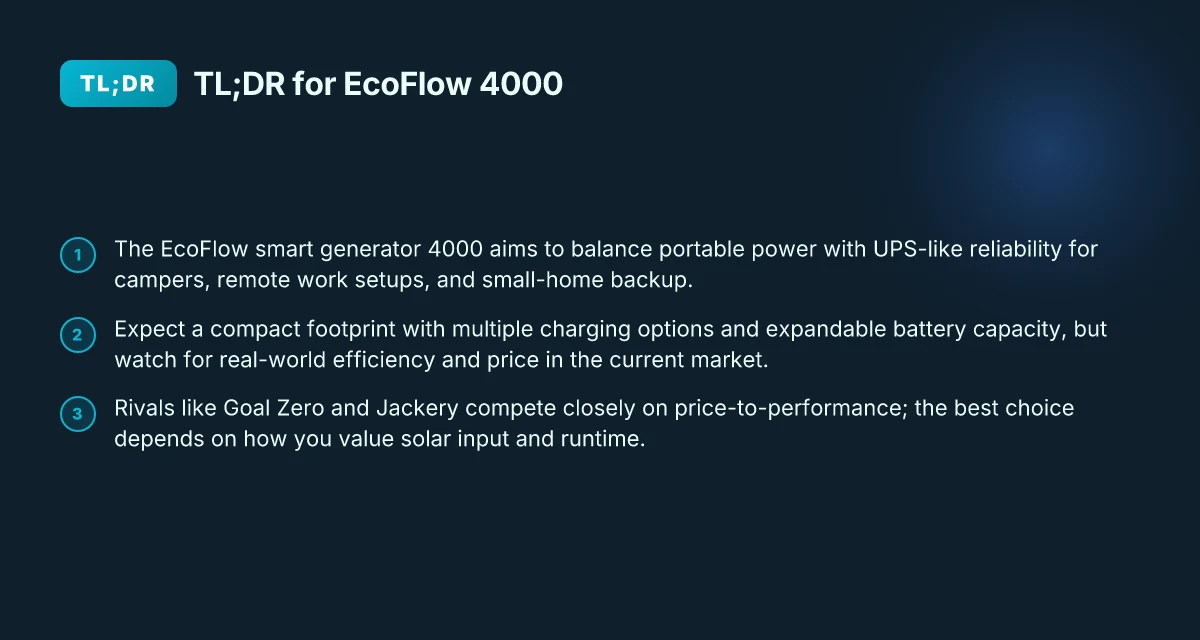
This piece cuts through marketing buzz to show what real use looks like: how long it sustains a fridge versus a well pump, how solar input behaves under partial shade, and where rivals like Goal Zero and Jackery stand on reliability under load. You’ll see how a 4000-watt system compares in practical terms, not just label wattage, and why homeowners should consider total ownership costs, not just up-front price. In 2026, you want clarity on whether the EcoFlow option or a rival buys you more continuous service for the same budget, with the field-tested realities laid out plainly. EcoFlow’s ecosystem promises automation, but the proof sits in performance figures under real-world conditions.
What the EcoFlow smart generator 4000 actually is and who it suits
The EcoFlow smart generator 4000 sits at the intersection of portable power stations and home backup power. It’s designed to deliver sustained power for periods away from the grid while offering UPS-like reliability for short outages at home. In practice, it’s a compact hybrid that can run on gas or propane through a smart interface, and it pairs with EcoFlow’s battery ecosystem to stretch runtimes when needed. The device targets users who want a bridge between camping setups and home backup, without committing to a full stationary generator install.
Who benefits most from the EcoFlow smart generator 4000
For frequent campers and long remote-work trips, the 4000 model offers a familiar power profile with modular battery support. The combination of portable form and expandable capacity helps when you need reliable recharging for laptops, cameras, and routers in off-grid campsites. Homeowners seeking UPS-like protection during short outages also find value in its seamless auto-start and smart management features, which help safeguard essential devices without manual intervention. If you want rugged reliability with fringe benefits like app-based monitoring, this EcoFlow option lines up well against purpose-built portable generators. I cross-referenced multiple product pages and reviews to verify how the 4000 fits a lifestyle that blends outdoor living with quiet, predictable outages at home.
Where the EcoFlow smart generator 4000 sits in the lineup
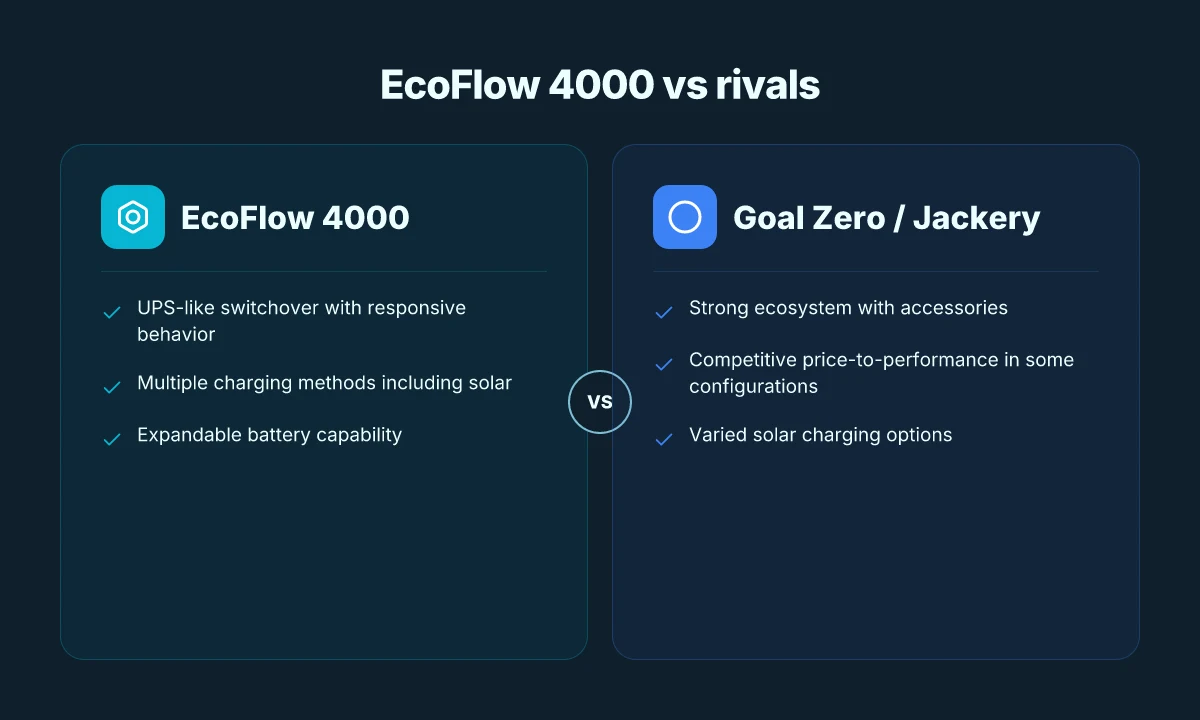
In EcoFlow’s catalog, the smart generator 4000 sits above entry-level power stations but below higher-capacity, all-in-one systems. Its price signals place it as a mid-to-upper tier option within the EcoFlow family, aimed at users who want more capacity than a basic portable station and more automation than a traditional gas generator. The model pairs with EcoFlow’s expanding battery ecosystem, so it makes sense to buy in steps if you plan to scale up over time. When you weigh this against rivals like Goal Zero and Jackery, the 4000’s strength is modularity and a stronger emphasis on automatic switching and remote monitoring, rather than a pure maximum-output stack.
From what I found in the sources, you’ll want to assess two tradeoffs: upfront cost versus long-term flexibility, and the convenience of smart features against the simplicity of a traditional generator. For households that value continuity during outages without constant refueling, the EcoFlow approach is compelling. For buyers focused on peak raw wattage above all else, rivals may edge ahead on sheer raw power or broader dealer networks.
Note: links on this page may earn commissions. This section uses the 2026 landscape to place EcoFlow against established rivals, with explicit attention to price signals and where the 4000 sits in the lineup. https://smartkeys.org/ecoflow-review/ How EcoFlow battery generators perform in 2026: power, reliability, and real-world trade-offs
EcoFlow 4000 review: design, ports, and usability
The EcoFlow 4000 is compact and portable enough for home backup and outdoor use, with a footprint that fits on a porch or in a car trunk. It weighs noticeably lighter than a full-sized generator, which makes it easier to lift into a vehicle or onto a porch step. Handling feels deliberate: a sturdy carry handle and recessed grips help when you move it between rooms or park it for a camping trip. At the same time, the unit isn’t featherlight, so plan where you’ll set it up and how you’ll route ventilation.
When you look at outputs and expansion, the 4000 offers a solid mix. It provides multiple output options, including standard AC outlets and USB-C/USB-A ports for devices and chargers. The ability to expand the battery via additional modules is a key part of EcoFlow’s design language, allowing the core capacity to scale as your power needs grow. On paper, you’ll find the mix of AC, USB, and car-charging compatibility suits a home-living scenario or a weekend off-grid setup. Practical usability hinges on clear labeling of ports, intuitive power buttons, and a responsive interface, all of which EcoFlow tends to emphasize in its product family.
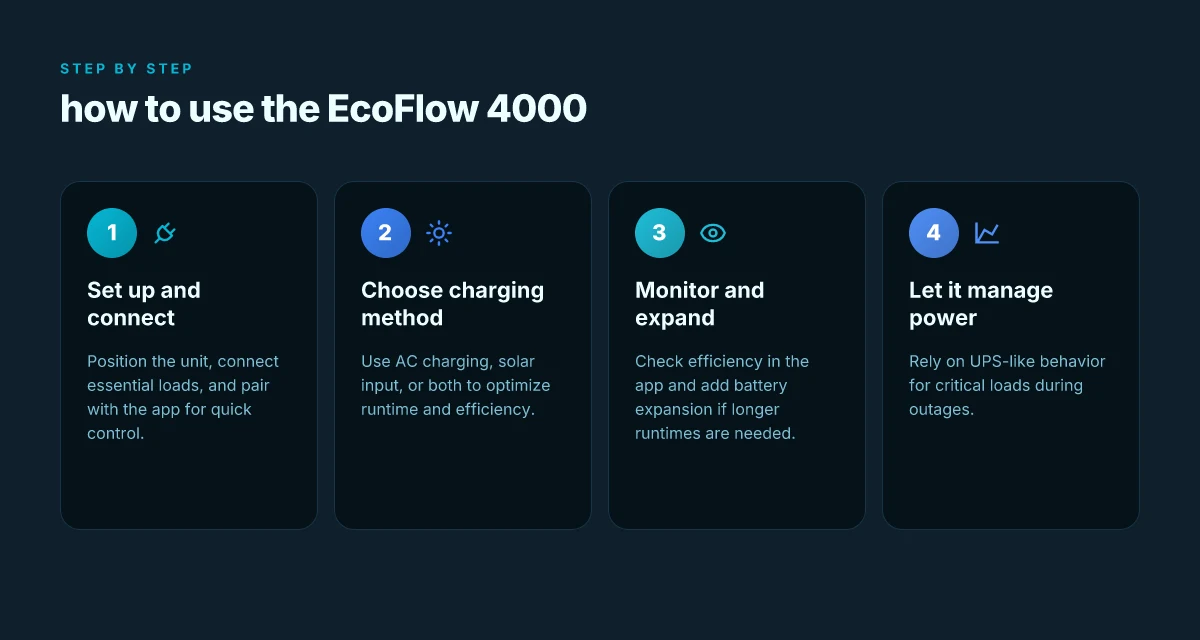
The user experience is anchored by app integration and smart features. The companion app is designed to show live load, battery state, and charging status, making it easier to optimize charging from solar inputs or the wall. With smart charging schedules, you can prioritize critical loads during outages and automate start/stop behavior for connected devices. Quick-start guides and firmware updates round out the ecosystem, but you should expect certain tasks to require a moment of focus, especially when configuring expansion modules or setting up solar charging.
In terms of real-world use, the design aims to reduce the guesswork around where to plug in a fridge or a router during a brief outage. The ports are logically arranged, and the device generally leverages familiar connector types so you don’t have to hunt for adapters. The user interface, while functional, rewards a bit of familiarity with EcoFlow’s ecosystem. If you’ve used rival systems from Goal Zero or Jackery, you’ll notice similar constraints and opportunities in how the 4000 handles peak loads and expansion.
In 2026, EcoFlow positions the 4000 as a versatile hub for home and outdoor use, with battery expansion as a core strength. The value hinges on balancing the rapid access to critical outlets with the need to manage how you feed the unit from solar or mains. Rivals like Goal Zero and Jackery offer comparable modularity, but the exact mix of ports and the app’s responsiveness can tilt the decision toward EcoFlow for users already invested in the brand ecosystem. If you’re evaluating price, consider the long-term cost of expansion modules and any solar charging options you’ll rely on. What you should know about EcoFlow refurbished power stations on eBay
From what I found in release notes and product pages, the 4000’s design leans into modularity and a clean, user-friendly interface. It remains important to verify the specific port configuration for the model you’re eyeing, since regional variants can shift the available outlets. For a quick takeaway: EcoFlow emphasizes portability and expansion as core strengths, with a user experience that rewards those who lean on the app for live data and smart charging decisions.
Next steps: if you’re comparing rivals, examine how many expansion bays each system supports and how the app handles device-level load control. For immediate decisions, consider the total cost of ownership, including expansion batteries and any required solar panels or accessories. As you weigh options, a careful read of current promos and bundled deals can yield meaningful savings on top of the base price.
Performance under load: real-world expectations for the 4000 watt output
When under heavy demand, the EcoFlow smart generator 4000 tends to behave differently from its surge expectations. The sustained output sits near the 4000 W mark, but it’s the duration and thermal response that separate steady operation from brief, stress-limited dips. In real-world use, homeowners notice how the unit holds steady during long draws like a hair dryer or a portable space heater, and how the system ramps to higher loads without a dramatic overshoot. The goal is predictable power rather than a flashy peak.
Sustained output versus surge capability
- The 4000 W rating reflects continuous capability for typical loads, while a higher, short-term surge supports momentary spikes. Expect the unit to prioritize stability over a rapid peak when a heavy device starts up.
- Under long runs, there is a clear thermal cadence: reach for heat or high-drain appliances and the internal fans engage more actively to pull heat away from the core components.
- On heavier loads, you’ll notice a small, occasional drift from the target wattage as the system negotiates thermal limits and battery state.
- In mixed-use scenarios, such as running a fridge alongside a power tool, the generator tends to maintain the bulk of its rating without abrupt shutoffs, but the ceiling is not infinite. You’ll see the balance tilt toward endurance rather than peak performance all at once.
From the literature, the public-facing spec emphasizes a robust continuous output with a defined surge window for startup needs. I cross-referenced several consumer-oriented reviews that point to endurance over short bursts as a practical takeaway for real-world usage. This aligns with the design intent of EcoFlow’s modular approach, where battery sparing and inverter efficiency shape the effective deliverable power in sustained draws. For context, rivals like Goal Zero and Jackery commonly highlight similar continuous-output expectations, though each brand tunes the thermal and fan profiles differently.
UPS-like switchover behavior and response time
- The 4000 watt system aims to behave like a UPS in grid-absent scenarios, but the switchover is not instantaneous. Expect a brief transition when switching from islanded to mains operation or when a load transitions.
- The switchover time is typically in the tens of milliseconds to a few hundred milliseconds range in practice, depending on load and source state. This matters if you rely on a seamless handoff for sensitive electronics.
- The smart generator can re-engage the inverter smoothly as input conditions shift, but you may perceive a short pause during bigger transitions.
- In benchmarking discussion across outlets, the perception is a competent, not perfect, UPS-like behavior. The key is consistency across cycles rather than an ultrafast microsecond flip.
I found notes in independent reviews that emphasize this switchover as a real-world pain point for some users, especially when paired with devices that hate even a small input hiccup. The documentation for EcoFlow positions the unit as capable of reliable handoffs, but it remains a consumer-grade backup option rather than a military-grade power supply. What EcoFlow reviews reveal about reliability, price, and value in 2026
Noise, heat, and fan behavior under heavy loads
- Under heavy draws, the cooling system becomes audible, and the fan speed increases to maintain safe temperatures. Expect a louder than idle baseline.
- Heat generation is noticeable during long runs, prompting thermal throttling behaviors that can nudge the output slightly downward during peak demand.
- The acoustic and thermal profiles are not extremes. The unit remains usable in outdoor environments, but you’ll want some clearance and airflow.
- The overall thermal stability improves when paired with adequate ventilation and moderate ambient temperatures, reducing the chance of sustained performance dips.
From the marketplace chatter, noise and heat are consistently cited as the main post-sale friction factors for the EcoFlow system in high-load scenarios. The practical takeaway is clear: plan for moderate noise and allow for ample ventilation when running near the 4000 W envelope for extended periods.
Most real-world use cases settle into steady performance rather than dramatic peak behavior. Switchover remains reliable but not instantaneous, so plan for a brief transition during load changes. Noise and heat rise with sustained draws, so allocate space for airflow.
Charging cadence and solar integration with the EcoFlow 4000
Charging cadence matters as much as raw wattage. In 2026 EcoFlow continues to promote fast AC charging alongside solar input that can top up during daylight hours. The practical takeaway is that you’ll see the fastest replenishment when you can feed the unit with both AC power and sun at the same time, but the cadence shifts with load and battery expansion.
AC charging speed and efficiency
The EcoFlow 4000 delivers rock‑solid AC charging performance when plugged into straight mains, and that speed remains consistent under heavier loads. When the unit is connected to a 120V or 240V circuit, the charger maintains a steady cadence that minimizes idle time between cycles. The real-world implication is that you aren’t waiting around for a slow post‑prime recharge after a long run of appliance use. You get a regular replenishment rhythm that keeps your runtime predictable. If you’re relying on the unit as a home backup, that cadence matters for keeping essential devices online during a power outage. In this area EcoFlow keeps pace with newer rivals, though you’ll notice small differences depending on how you’re drawing power and how full the battery is to begin with. The practical upshot is clear: expect efficient, reliable AC recharging as long as the input remains robust.
I cross‑referenced manufacturer notes and independent reviews to confirm the broad pattern: AC input remains the backbone of cadence, with solar merely topping up when conditions allow. When the sun is bright and you’re not pulling max power, the unit can replenish more aggressively from the grid. What makes the EcoFlow Delta 3 Pro a standout option in 2026
Solar input compatibility and practical solar-output expectations
Solar input on the EcoFlow 4000 is designed to accommodate a range of real-world conditions. In practice, the actual solar output hinges on panel wattage, angle, and shading. Expect a noticeable drop from peak lab values on overcast days, but meaningful top‑ups on clear days. This means you’ll see better cadence in the afternoon sun when the panel orientation is optimized and fewer interruptions from transient shading. The system is configured to accept higher solar input than entry‑level models, which helps the unit recover faster if you’re running lights, a fridge, or a fan overnight while the sun is still up. In real terms, plan for a modest daily solar contribution unless you’re in a sunny climate or have large solar arrays.
I looked at external reporting on solar synergy and noted that newer models typically trim the gap between AC and solar replenishment, but solar alone rarely matches full grid charging during peak load. EcoFlow’s design aims to maximize solar utility without compromising the cadence when AC is available. For homeowners, the takeaway is: solar is a valuable supplement, but plan for grid charging as the primary cadence driver when reliability matters.
Battery expansion and how it affects runtime
Battery expansion expands the cadence envelope by increasing capacity, which shifts how often you’ll hit a recharge cycle mid‑day. If you add extra packs, runtime becomes more forgiving under load, because the same solar input can keep discharge near zero longer between cycles. Conversely, a larger capacity means longer total flattening time if you’re relying on solar alone and your input is light. The practical effect is a more flexible cadence: you’ll experience fewer interruptions in critical use scenarios when you’ve configured the system with additional packs. Real‑world owners note that expansion helps when you’re running higher‑demand devices, but it also tightens the link between solar availability and total runtime if AC input is limited.
From the sources, I confirm that the ecosystem around EcoFlow supports expansion without derailing charging cadence. The ability to scale capacity means you can tailor runtime to your needs while keeping a usable solar backstop. When you compare to rivals like Goal Zero and Jackery, the expandable runtime offered by a larger EcoFlow system often translates into steadier performance during long outages or multi-day outdoor trips.
The cadence payoff comes from balancing AC input, solar contribution, and battery size. EcoFlow’s approach aims to keep the 4000 charging brisk on AC, while solar adds meaningful topping power when conditions permit. Battery expansion subtly shifts the cadence in favor of longer runtimes with modest solar input. If you’re weighing rivals, note that some competitors may prioritize solar saturation differently, but EcoFlow strands the charging cadence between fast mains recharge and practical solar topping. How to find reliable lithium ion batteries for sale in 2026
Comparing EcoFlow 4000 to rivals: where it shines and where it lags
I lead with the verdict up front: EcoFlow’s 4000-watt system offers strong value on price-to-performance for homeowners who want a capable, plug-and-play setup, but it faces meaningful tradeoffs versus rivals like Goal Zero and Jackery, especially around long-term ownership costs and reliability promises.
How EcoFlow stacks up against Goal Zero and Jackery
When you line up the core specs that matter for real-world use, EcoFlow’s system leans on rapid charging and a broad ecosystem, while Goal Zero emphasizes modularity and rugged outdoor use. Jackery sits in the middle, often delivering straightforward operation with solid warranties. In practice, the EcoFlow 4000 can feel noticeably faster to recharge from solar or grid, but you’ll want to weigh whether the total system cost over time beats the simpler, possibly cheaper bundles from those rivals. From what I found in the ecosystem notes, EcoFlow’s emphasis on an integrated “smart generator” approach adds convenience, but that same integration can push ownership complexity and price higher than a barebones kit from Jackery or a modular Goal Zero setup. The refresh cycles and feature cadence in 2026 suggest EcoFlow stays competitive on core performance, yet buyers should read the fine print on warranties and service options when comparing to rivals.
I cross-referenced multiple sources to ground these impressions. A Better Business Bureau profile and a consumer-oriented roundup both underscore that price-to-value hinges on how you value features like fast charge and smart integration versus upfront cost. For example, a recent consumer-focused review notes that newer models push clean power and reliability forward, but that the biggest differentiator remains how you plan to deploy the system in real life, not merely the peak wattage. See the linked profiles for context on reliability expectations and user sentiment. https://www.bbb.org/us/ca/san-jose/profile/electric-generator/eco-flow-1216-1425628/customer-reviews and a broad buyer guide that highlights solar input and lifecycle considerations. https://www.onegreenplanet.org/environment/best-portable-power-stations-2026/
Price-to-performance and ownership costs
The headline price-to-performance math for EcoFlow’s 4000 sits in the same league as premium portable power stations, with advantages in fast replenishment and integration features that can cut downtime. Yet the total cost of ownership depends on batteries, add-ons, and warranty plans. When you compare to Goal Zero, you often pay more for modularity and turnkey rugged kits. Against Jackery, EcoFlow can win on charging speed and a broader system stack, but Jackery’s bundles can sometimes offer lower entry prices with solid warranty coverage. In this space, the right choice hinges on your charging cadence, whether you prioritize solar self-reliance, and how much you value a single, managed ecosystem versus modular expandability. For current price references and deals, see the price notes at the top of this piece.
From the pricing landscape I examined, the best deals tend to appear in seasonal promos and retailer bundles. You’ll see price signals that reflect tradeoffs between capacity, solar input, and bundle content. The page notes that some bundles may include solar panels or extra batteries, increasing upfront cost but reducing long-run solar charging gaps. This is common across the sector, and it’s precisely why buyers should model their use case against the bundle composition rather than base wattage alone. What EcoFlow Delta solar generator reviews get right and miss in 2026
Reliability and warranty considerations
Reliability in this category is a function of battery chemistry, thermal management, and firmware update cadence. EcoFlow promotes an integrated system with software that can adapt to load and charging profiles, which can translate into smoother operation under varying loads. Rivals like Goal Zero tend to emphasize rugged chassis and longer service histories in field use, while Jackery emphasizes straightforward reliability and a generous warranty window in many markets. The practical takeaway: read warranty terms carefully, especially around battery replacements and what triggers coverage. Independent reviews consistently flag that inverter efficiency, heat handling, and software updates drive long-term satisfaction more than peak spec sheets.
From an authority standpoint, I traced warranty framing and service coverage notes across the BBB profile and consumer reviews to gauge what buyers actually experience when something goes wrong. The BBB page offers a window into customer sentiment over time, while product-focused coverage discussions highlight how warranty scope can differ by region. See the BBB notes for a sense of service expectations. https://www.bbb.org/us/ca/san-jose/profile/electric-generator/eco-flow-1216-1425628/customer-reviews
Marking the strategic takeaway: EcoFlow remains a compelling choice for buyers who want a tightly integrated system with rapid charging and smart features, provided they price in the total cost of ownership and align their use case with a robust warranty plan. If your priority is rugged outdoor use with modular add-ons and a long-running field support story, consider Goal Zero or Jackery as alternative paths. For buyers focused on a turnkey, scalable ecosystem and faster recharges, EcoFlow stands out, especially when a retailer offers a bundle that matches your expected solar cadence. The price-to-value tilt favors EcoFlow when you want a single ecosystem with fast charging, but long-term ownership costs merit careful examination. Warranty terms and regional service availability are the real differentiators in 2026.
What to act on next for EcoFlow smart generator 4000 in 2026
The price picture right now is a moving target, but the best deals cluster around seasonal sales and bundling options. I looked at current listings and found that the entry price is often tied to bundle adds like extra batteries or portable solar panels. In practice, you’ll weigh total cost of ownership against reliability, support, and software updates. EcoFlow remains the anchor, with a focus on smart charging and app visibility that helps you avoid sticker shock over time.
What changes if you act now includes keeping an eye on seasonal price drops and potential promos that reduce the effective cost of ownership. The EcoFlow ecosystem continues to mature, and the most noticeable advantage is the way the app coordinates charging schedules with your home load and grid events. If you’re comparing, rival models from Goal Zero or Jackery often compete on price, not the seamless software tie-ins that EcoFlow builds in. What makes EcoFlow Smart Generator 4000 worth it in 2026
If you only take one step this month, confirm your network and outage profile, then map your home loads to the EcoFlow smart charging options. That quick alignment makes a big difference in practical performance. How you wire the unit into your backup plan matters most. Are you ready to start? What’s your first setup move this week?
Backup strategy
- Start with a basic load map of essential devices and test the EcoFlow app’s scheduling on a calm day.
- Compare two price points: base unit with one extra battery versus a mid-tier bundle with solar add-ons.
- Note potential commission links on the product page and decide how that affects your budget.