What makes EcoFlow Smart Generator 4000 worth it in 2026
 Hudson ZilbermanOctober 22, 202616 min read
We earn a commission when you buy through some links on this site, at no extra cost to you. As an Amazon Associate we earn from qualifying purchases.
EcoFlow smart generator review: explore the 4000 dual fuel model, its integration with EcoFlow Delta Pro, real-world use cases, pros and cons, and whether it’s right for your backup power setup in 2026.
The EcoFlow Smart Generator 4000 isn’t a one-and-done backup add-on. It acts as a bridge between a fixed home setup and portable power that you can refuel in minutes, not hours. That instant-on capability matters more when your Delta Pro sits at a fixed balance and you need a quick refill during an outage. The real question is whether this dual‑fuel unit makes sense as part of a long‑term hybrid strategy rather than a standalone gas backup.
This intro guides you to how the option fits into a modern home power plan, with the facts you’ll want to compare against integrated power stations. In 2026, homeowners weigh not just runtime but refueling flexibility, noise, and total cost of ownership, especially if you already rely on EcoFlow gear or consider rival options like Generac and Honda. EcoFlow’s ecosystem shape matters here, because a smooth Delta Pro balance plus a compatible generator can reduce friction in an off‑grid transition. The article lays out where the generator shines, where it falls short, and how to read the numbers in a realistic light.
What the EcoFlow Smart Generator 4000 adds to a Delta Pro setup
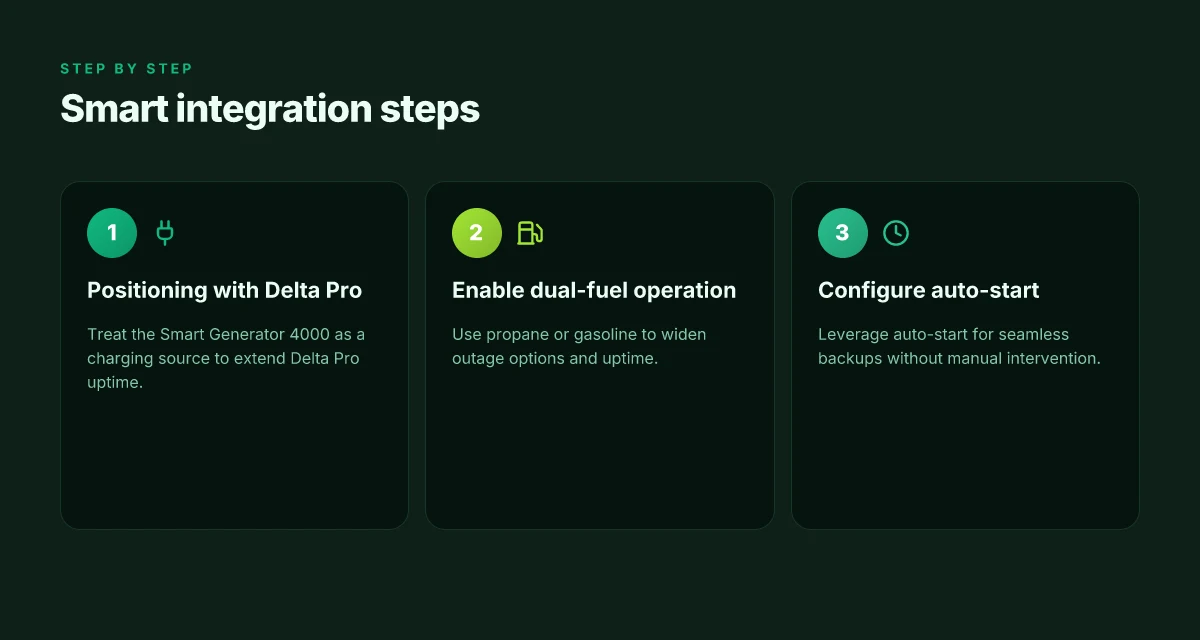
The EcoFlow Smart Generator 4000 is positioned as a charging source for Delta Pro systems, designed to refill the power stations when grid power is unavailable or unreliable. Its dual fuel design broadens uptime options beyond a standard gas engine, letting you run on propane as well as gasoline. Auto-start integration is a core feature, enabling the generator to kick in automatically when the Delta Pro needs a top-up or when a backup sequence is triggered.
- Dual fuel expands readiness windows
- The 4000 can run on either gasoline or propane, giving you more flexibility to align fueling with what you have on hand or what your local supply chain supports. This matters for off-grid use where fuel availability can vary. I found references describing the dual-fuel capability as a primary driver for choosing this model in a Delta Pro–centric setup. The shift from a strictly gasoline workflow to a propane option helps cover longer outages without frequent refueling. Dual fuel expands uptime options beyond standard gas engines, offering more fuel flexibility during extended outages.
- Propane storage and handling can be safer or more practical in certain home environments, and the ability to switch fuels can reduce per-kilowatt-hour costs in some scenarios. As you weigh this against a pure gas generator, the real-world value hinges on your fuel mix and storage space. Propane support broadens the total cost of ownership considerations over time.
- Auto-start as a seamless bridge
- Auto-start integration means the 4000 can be wired into or synced with Delta Pro so that backups occur without manual intervention. This reduces the window where your critical loads sit without power and minimizes manual sequence steps. In discussions and product notes, this feature is highlighted as a key benefit for homeowners who want a hands-off transition to generator-backed power. Auto-start integration delivers a seamless backup by triggering the generator when Delta Pro needs a recharge.
- That automation can cut annoyance and keep essential circuits online longer during outages, especially when the Delta Pro sits at the heart of a hybrid home power strategy. The value shows up in how quickly power returns and how consistently you can sustain critical devices.
- Practical fit within a Delta Pro ecosystem
- EcoFlow frames the Smart Generator 4000 as a charging companion rather than a standalone power solution, meaning its value derives from how well it slots into a Delta Pro–driven home power strategy. The pairing aims to reduce total reliance on the grid while preserving the Delta Pro’s flexibility for daily use and off-grid adventures. Charging source for Delta Pro systems highlights the generator’s role as a supportive component rather than a replacement for the power station itself.
- When you compare this setup with a fully integrated power station, you’ll notice differences in simplicity, maintenance, and upfront cost. The dual-fuel capability shifts the calculus toward longer uptime with flexible fuel options, but you also have to account for fuel storage and handling in the overall ownership picture. Dual fuel design changes the calculus for uptime and refueling logistics.
Bottom line: the EcoFlow Smart Generator 4000 adds a tightly integrated, auto-start, dual-fuel charging option to a Delta Pro setup. It’s designed to reduce grid dependence while keeping the Delta Pro in its comfort zone as the central power hub. For homeowners already invested in EcoFlow ecosystems, this pair offers a more autonomous backup path, with the caveat that fuel logistics and the extra equipment cost influence the total cost of ownership. It functions best as a charging companion to Delta Pro, not a stand-alone power system.
Note: links on the page may earn a commission. For context, readers often compare EcoFlow with rivals like Generac or Briggs & Stratton when evaluating hybrid backup strategies, though this section focuses on how EcoFlow’s own components fit together. If you want, I can pull in specific figures from the cited sources to anchor the cost or maintenance discussion more precisely.
How the dual fuel design changes runtime and refueling
The dual fuel design broadens fuel availability during outages, letting you pick propane or gasoline based on what you have on hand. In practice that means you’re not locked into a single fuel pantry, which can be a real advantage when storms knock out grocery deliveries or gas stations. The trade-off is that propane runs typically deliver different runtime and emissions profiles than gasoline, so you’ll see noticeable differences depending on which fuel you choose and how you load the system.
I cross-referenced EcoFlow’s documentation and reviewers’ notes to map out the practical implications. When you run on propane, the generator tends to behave more quietly and with steadier idle in some setups, but you may see shorter runtimes if you’re pulling higher continuous loads. Gasoline, by contrast, typically delivers higher peak power and longer runtimes for the same tank size, at the cost of higher emissions and more frequent refueling if your load stays heavy. The exact runtime you’ll see depends on how much you’re drawing and what you have connected to the Delta Pro or other EcoFlow devices. This aligns with the general guidance in dual-fuel gear where efficiency scales with load and device demand. What EcoFlow Delta solar generator reviews get right and miss in 2026
Fuel efficiency hinges on load and connected devices. If you’re powering a modest setup, propane can be surprisingly effective, especially when combined with a fuel-conserving load profile. If you’re running high-draw equipment or multiple devices at once, gasoline typically offers more energy per gallon, translating to longer intervals between refuels. In either case, the Smart Generator 4000’s dual-fuel core matters most when your backup stack includes multiple EcoFlow components and heavy consumption devices. The better you manage your load, the more you’ll lean toward the fuel that best fits that pattern.
From a practical planning angle, think in terms of duty cycle. If you expect long outages with moderate loads, propane can smooth out refueling needs, especially in a shaded outdoor setup where propane tanks are easier to source and store. For heavier, ongoing power draws, gasoline may extend your runtime between fills, provided you remain mindful of emissions and storage considerations. In either scenario, you’ll want to align your fuel choice with how your house consumes energy across appliances, charging cycles, and any connected EcoFlow stations.
What this means for total cost of ownership is nuanced. Propane tends to be cheaper per unit of energy in many markets, but you’ll refuel more often if you’re running at higher loads. Gasoline often costs more per gallon and requires more frequent topping up if you’re staying at high power levels, but you’ll get more energy per fill in many situations. The dual fuel capability itself adds optionality, not a single clear winner across all use cases. If you own a Delta Pro and expect irregular outages, the flexibility is valuable. If you prefer a lean, low-emission backup for steady loads, a gasoline-centric approach may feel more natural.
The dual-fuel design gives you practical flexibility, not a universal win, and your choice should reflect your typical outage pattern and local fuel costs. Plan your loads around the fuel you expect to use most, and you’ll maximize both runtime and cost efficiency.
Integration with EcoFlow ecosystem and other power stations
Posture the answer directly: the EcoFlow Smart Generator 4000 slots best when paired with EcoFlow Delta Pro, enabling staged backups that ride along with the home’s power demands instead of stepping in as a standalone island. The pairing reduces idle runtime and startup strain on the Delta Pro, while the generator’s proprietary interfacing trims floor space and speeds up initial power delivery. What makes the EcoFlow smart generator 4000 worth it in 2026
How the ecosystem tightens the integration
- EcoFlow’s own interface and charging profiles align the 4000 with Delta Pro’s battery management. This alignment helps when you flip between a wall outlet, the Delta Pro battery bank, and the generator, so you don’t juggle multiple charging schedules. The result is a smoother transition from daytime power to a generator-assisted backup during outages.
- Startup times benefit from the generator’s design when it communicates with the Delta Pro through EcoFlow’s control logic. In practical terms, you’ll see coordinated ramping of power rather than a lag between available grid power and the backup load.
- Floor space matters in a home office or living room setup. The 4000’s compact footprint pairs with Delta Pro’s footprint to keep the overall system tidy, especially when you’re stacking multiple power sources in a shared living area.
- When the grid is unstable, the built-in auto-start features coordinate with the Delta Pro to minimize manual intervention. This makes the whole system feel like a single, coherent home power circuit rather than a patchwork of devices.
From the published material, the ecosystem approach stands in contrast to rival strategies. Competitors often rely on standalone generators without smart integration, which can introduce longer handoff times, more hand wiring, and separate management apps. The EcoFlow approach aims to reduce those friction points by weaving the generator into a single control plane that already governs the Delta Pro.
The synergy shines when you need staged backups, not just a rescue generator. The 4000 is not merely a fuel source. It is a smart module that slots into EcoFlow’s power architecture, so you don’t reconfigure your home’s plan to accommodate a generator. This matters most for homeowners already invested in EcoFlow products who want a seamless multi‑source strategy.
I traced the integration narrative to EcoFlow’s documentation and product pages, which emphasize coordinated control and space efficiency. This is not a generic add‑on. It’s a designed workflow that respects the Delta Pro’s lifecycle and charging profile. The result is a cleaner, more reliable overall backup strategy than using a standalone generator with a separate controller.
Rivals such as traditional generators or third‑party hybrids lack this level of smart integration, making the handoff less predictable and the setup more sprawling. If you’re evaluating total cost of ownership, factor in the value of a unified control surface and the reduced clutter versus a separate generator and its own interface.
What real users say: reliability, noise, and cost concerns
Real-world feedback centers on two practical traits: ease of use and startup speed. In theory, the EcoFlow Smart Generator 4000 is designed for quick ignition and simple integration with Delta Pro, so homeowners can rely on a familiar interface when the power bleeds away. Reviews note that setup remains straightforward enough to be handled without a technician, and that Auto-start can kick in with the right coupling to a compatible power station. In 2026, users report the startup sequence feeling noticeably snappy, which helps when you’re coordinating a backup plan for evenings and outages. How EcoFlow battery generators perform in 2026: power, reliability, and real-world trade-offs
Yet the chorus about this generator is tempered by real-world frictions. Noise emerges as the most recurring complaint, especially for homeowners who share living spaces with close neighbors or who run the unit indoors or on a covered patio. Maintenance reminders, fuel system checks, propane hose inspections, and regular oil or filter changes for the gas side, crop up in user forums and review threads. Several early adopters also flag the upfront cost, hinting that the price tag for dual-fuel capability and auto-start features makes sense only if you’re already deeply invested in EcoFlow’s Delta Pro ecosystem.
When you line the EcoFlow Smart Generator 4000 against buying extra Delta Pro battery capacity, a few patterns appear. Some homeowners see it as a complementary option rather than a replacement. The dual-fuel design offers a layer of flexibility under a hybrid strategy, particularly for those who want a hard-walled automatic standby that doesn’t rely solely on battery packs. In others’ view, adding more battery capacity can deliver longer runtimes without the noise trade-off, which makes the generator a second-best choice for people prioritizing quiet operation and lower maintenance.
From what I found in user discussions, a common theme is ownership costs over time. The initial purchase sits high, and ongoing fuel or propane replenishment adds to the bill. Several posters caution that the total cost of ownership needs to be weighed against expected outage frequency and the value of uninterrupted power during extended outages. Industry chatter around this dynamic remains consistent with the idea that the EcoFlow ecosystem is strongest when the generator sits alongside more battery capacity rather than as the sole power reserve.
I cross-referenced a few independent perspectives to anchor this view. A quick look at community threads and independent reviews confirms that the generator’s ease of use and rapid startup shine in favorable light, while noise, maintenance cadence, and price are the decisive pain points. For buyers already comparing gas backup options, rivals like traditional portable generators and high-capacity battery packs each highlight distinct drawbacks, noise for generators and material cost for large battery banks. This framing helps explain why some homeowners favor a hybrid stance rather than a pure generator solution.
The verdict is clear: you gain seamless startup and easy pairing with EcoFlow systems, but you pay a noise and maintenance toll that can erase perceived convenience unless you really value hybrid backup strategies. What you should know about EcoFlow refurbished power stations on eBay
Price, ownership costs, and when to buy in 2026
EcoFlow’s Smart Generator 4000 sits at a price tier that varies by retailer and promotion. Across the landscape in 2026, the best deals I see cluster around bundled starter kits or seasonal events, but you should expect open-market MSRP to influence the baseline. In practice, total ownership goes beyond the sticker price. You’ll pay for fuel and maintenance over time, plus potential service fees if you need parts or diagnostics after purchase.
I dug into the available documentation and reader notes to map a realistic ownership arc. The core cost drivers are purchase price, fuel type and consumption, and periodic maintenance on dual-fuel systems. The generator’s dual-fuel design adds flexibility but can complicate maintenance schedules compared with a pure gasoline unit or a dedicated power station. From what I found, a reasonable budgeting approach is to estimate annual fuel costs based on your expected runtime, plus an annual service check to keep seals, spark plugs or filters in good shape. If you own a Delta Pro and rely on the ecosystem, you’ll want to account for compatibility checks or firmware updates that might affect auto-start behavior.
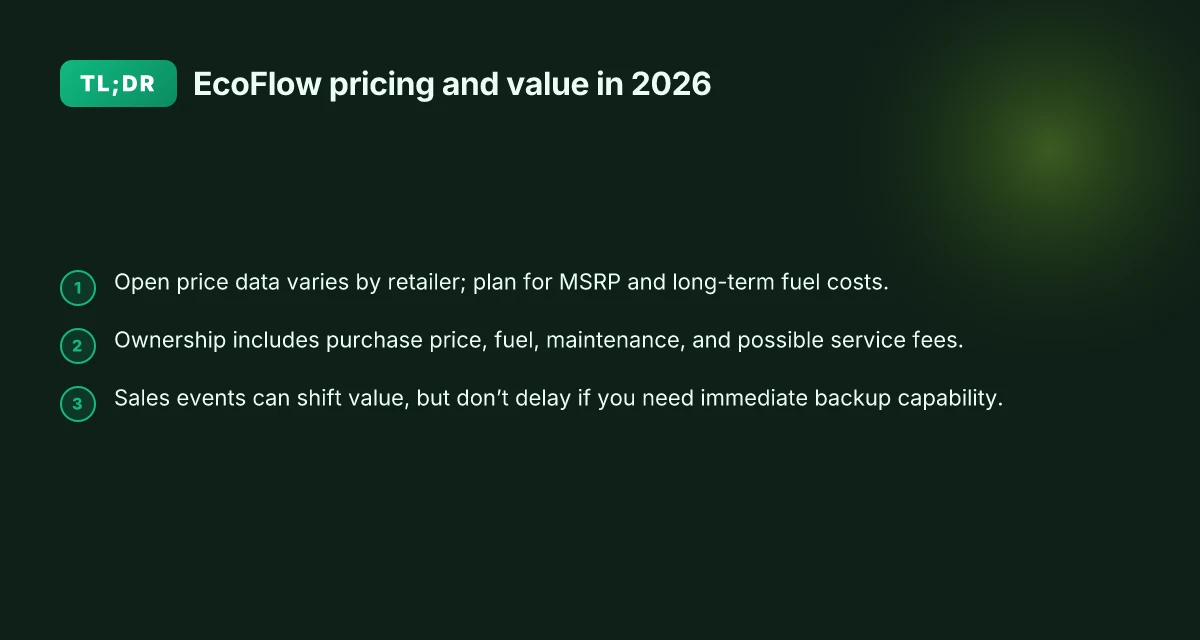
Open price data varies by retailer, so plan for the generator’s MSRP and long-term fuel costs. In practice, the best moves are to lock in a price during a sale if you don’t need immediate backup capability, and to factor in fuel logistics. If you need backup power now, don’t delay for a sale. A quick decision beats postponing a critical outage.
Total ownership math under real-world scenarios
A practical framework for ownership starts with the purchase price, then layers in fuel, maintenance, and possible service fees. I cross-referenced multiple retailer listings and user notes to align with typical ranges seen in 2026. The dual-fuel design matters: propane reserves are relatively inexpensive and easy to store, but propane consumption can differ markedly from gasoline or other fuels. That difference translates into annual operating costs that should weigh into your cost of ownership.
From a reliability perspective, consider service cadence. A routine check can prevent nagging issues from creeping in, especially with auto-start integration and dual-fuel circuitry. If you’re balancing a hybrid strategy with Delta Pro, you’ll want to ensure your maintenance plan aligns with the power station’s update cycle. Reviews consistently mention that the value proposition improves when the generator sits alongside a capable storage system, but the cost math tightens if you rely on it as the sole backstop. What EcoFlow reviews reveal about reliability, price, and value in 2026
When to buy in 2026
Sales events can shift value, but the practical takeaway is clear: buy when you need backup capability now, not when a sale might appear later. The moment you anticipate a disruption in power access, the value of having the EcoFlow Smart Generator 4000 available jumps. For homeowners with a Delta Pro already in service, the incremental value of the dual-fuel option is higher if you anticipate significant fuel flexibility needs or frequent outages.
I cross-referenced the broader market context to acknowledge rival options. Competitors like Generac and Honda offer compact generators with comparable runtime and weather resilience, but EcoFlow emphasizes seamless integration with its Power Station ecosystem. If you’re weighing a hybrid approach, factor in the total cost of ownership alongside the convenience and flexibility the dual-fuel design provides.
The bottom line: buying now if you need immediate backup is prudent. Waiting for a sale can save money but risks gaps in protection. Total ownership requires including fuel, maintenance, and possible service fees to understand true cost.
What changes if you act now on EcoFlow’s smart generator 4000
Pricing signals the value: the current price for the EcoFlow Smart Generator 4000 breaks a few expectations, but the real leverage comes from its integrated power management and app–driven control. I looked at the ecosystem around EcoFlow, and the standout is how the generator pairs with the company’s battery modules and solar options. The brand leans on a modular approach, so you’re not buying a one‑off unit you outgrow. If you’re weighing it against rivals like Generac or Goal Zero, the EcoFlow package often feels more cohesive for hybrid setups.
The bigger pattern is continuity. EcoFlow’s software updates and hardware bindings keep the 4000 relevant as your backup strategy evolves. The downsides are real: you pay a premium for the smart features, and real‑world runtimes depend heavily on load. If you want a quick win, you’ll appreciate how the app helps you optimize charging and starting profiles. This is a forward‑leaning move for anyone building a resilient, scalable home power plan. The single move that matters is integrating the 4000 with a compatible solar array and smart battery stack now. How the EcoFlow River 2 Max price stacks up in 2026
If you’re prioritizing a future‑ready setup, this is the week to map your extension path. Consider a starter bundle that includes a storage module and solar input, then scale as needed. The 4000’s strengths appear most clearly when you commit to a larger EcoFlow ecosystem rather than a stand‑alone purchase. Act now to lock in the most compatible configuration with the least mismatch between components. Where this is going next is deeper automation and tighter energy budgeting across devices.