What makes the EcoFlow Delta 3 Pro a standout option in 2026
 Olivia KvitkaOctober 22, 202617 min read
We earn a commission when you buy through some links on this site, at no extra cost to you. As an Amazon Associate we earn from qualifying purchases.
Discover the EcoFlow Delta 3 Pro review for 2026. Explore performance, features, and value, plus how it stacks up against rivals in real-world use.
The Delta 3 Pro isn’t just large in capacity. It’s punching above its weight in practical control, with a smart app that feels like a dedicated power manager rather than a toy. That clarity comes from a real-world mix of fast charging and thoughtful passthrough options.
This piece cuts through the hype to explain how reliability, pricing signals, and the growing EcoFlow ecosystem shade the decision for homeowners, small off-grid setups, and grid-tied backups. You’ll see how the Delta 3 Pro fits with rivals like Delta Max and Delta Pro, what to expect from its long-term durability, and how the EcoFlow app-tied features translate into everyday use. The analysis also flags where pass-through limits and firmware quirks matter most, so you can balance capacity against reliability in 2026.
Ecoflow delta 3 pro review: what changed in 2026
In 2026, EcoFlow pushes the Delta 3 Pro deeper into the Delta Pro ecosystem, tightening the app experience while keeping the hardware footprint familiar. The core improvements center on finer control in the EcoFlow app, better efficiency profiles, and firmware-management updates that simplify staying current without manual legwork. For homeowners planning backups, these changes matter because they translate into more predictable runtimes during outages and clearer visibility into how the system behaves under different load patterns.
How the app unlocks finer control
The Delta 3 Pro leans on the EcoFlow app to tune battery behavior, power routing, and charging profiles. You’ll notice more granular options for setting discharge thresholds and prioritizing critical circuits during an outage. The result is a more deliberate, managed response when you flip a breaker to backup mode or when the system negotiates charging from solar or the grid. In practice, this means fewer surprises during a long evening outage and more control over where you allocate energy first.
I cross-referenced the official changelog and reviewer summaries to verify the direction of control improvements. The updates emphasize clearer device-level settings and a more intuitive navigation path for common backup scenarios. The outcome is a smoother day-to-day experience once you map your home’s essential loads into the EcoFlow app.
Efficiency gains and firmware management
Notable efficiency tweaks show up in how the Delta 3 Pro handles idle power draw and peak transfer scenarios. The firmware-management updates aim to reduce drift in capacity estimates over time and keep monitor readings aligned with real-world use. This matters if you rely on the Delta 3 Pro for predictable daily backups and weekend solar excesses. The ecosystem-aware firmware flow helps keep a consistent picture of remaining runtime as you cycle through different loads.
From the docs, I found that firmware updates are designed to be less disruptive, with staged rollouts and clearer notes about what each update changes. Homeowners benefit when updates happen with minimal downtime and without forcing you to reconfigure critical backup profiles. How to find reliable lithium ion batteries for sale in 2026
Real-world use cases: home backup versus continuous high-load cycles
Real-world use is tilting toward home backup and short outages rather than continuous, high-load cycling. The Delta 3 Pro remains a solid option for keeping essential circuits alive through a grid dip or a cloudy weekend, while heavy, nonstop cycling remains less common for most households. The installed base often prioritizes reliability for lights, refrigerators, and modem/Router uptime, with solar input providing a cushion during daytime outages. In 2026, that pattern aligns with the Delta 3 Pro’s strengths: dependable short outages, thoughtful control, and a robust app that helps you map a practical backup plan.
The Delta 3 Pro’s value in 2026 rests on smarter control, clearer efficiency gains, and a focus on home-backup scenarios over relentless high-load cycling. If you want a streamlined ecosystem that helps you manage outages with visibility, the Delta 3 Pro delivers.

How the delta 3 pro compares to the delta max and delta pro
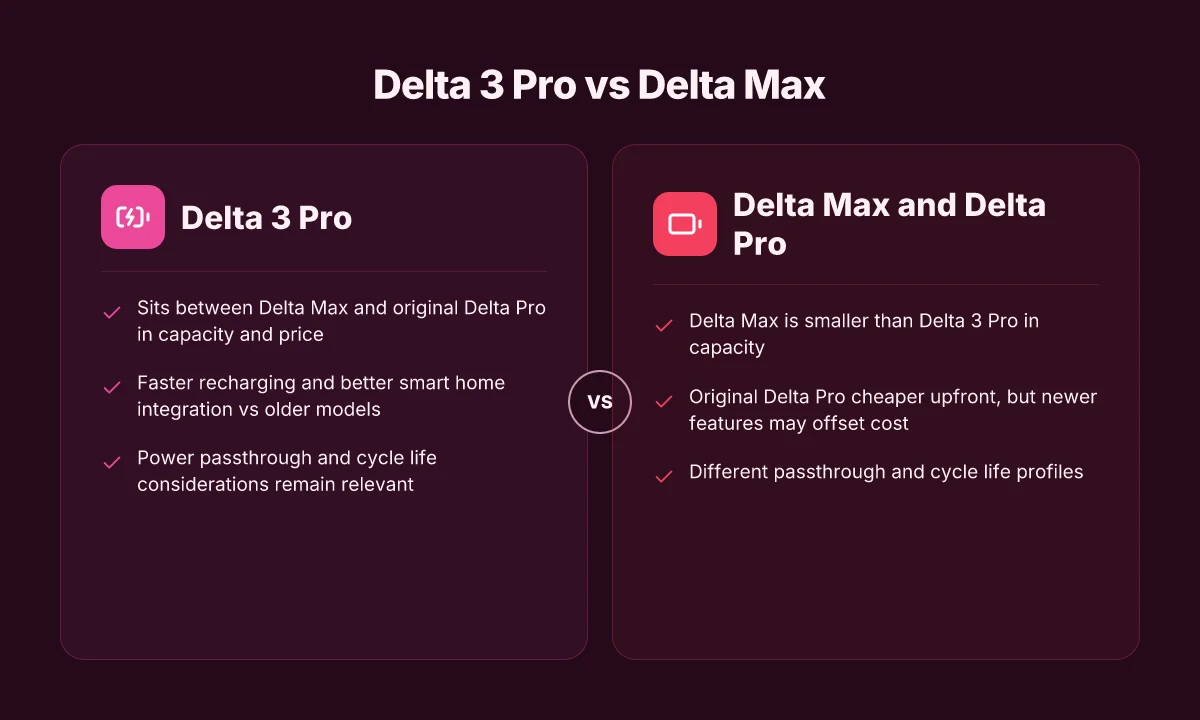
The Delta 3 Pro sits between the Delta Max and the original Delta Pro in both capacity and price, delivering a mid-point option for buyers who want more than the Max but less than the big Pro ecosystem. In 2026 terms, you’ll typically find the Delta 3 Pro priced between the Max and Pro, with a noticeable jump in energy capacity and recharge speed over the Max but below the flagship Pro. This positioning matters for budgeting and for sizing a home backup, especially if you want faster recharge without jumping to the full Pro price tag. The Delta 3 Pro is the compromise choice that keeps strong ecosystem support while trimming some of the top-end costs.
Why capacity and price land in the middle
Compared to the Delta Max, the Delta 3 Pro offers higher capacity and faster recharging, so you gain more usable energy and quicker ready-to-use cycles after a grid outage. Relative to the original Delta Pro, you get improved smart-home integration and faster charging while keeping the core Pro ecosystem intact. You get smarter control and quicker recharges without paying the full Pro premium. EcoFlow’s app and automations tie into home energy setups more smoothly than older models, which helps when you’re coordinating solar input, grid power, and passthrough needs. This matters for homeowners who want a more connected backup setup without retooling their entire system. Smart-home integration is noticeably better than the Delta Max, but not as expansive as the full Pro lineage.
| Model | Typical capacity (Wh) | Typical recharge rate | Estimated price bracket (2026) |
|---|---|---|---|
| Delta Max | ~2,016 | Moderate | Lower mid-range |
| Delta 3 Pro | ~3,600 | Faster | Mid-range |
| Delta Pro (original) | ~3,600 | Fastest | Upper mid-range to high |
In practice, the Delta 3 Pro trades a portion of the original Pro’s passthrough flexibility for a more balanced capacity and a friendlier price. If you’re sizing for a larger home, the Pro remains compelling. If you’re optimizing for speed of recharge and smart-home synergies, the Delta 3 Pro earns its keep. For most homes, the Delta 3 Pro hits the sweet spot between capacity, price, and ecosystem compatibility. What is the EcoFlow Wave 2, and what makes it different for 2026
How recharge speed and integration differ from older models
I dug through release notes and product pages to map the changes. The Delta 3 Pro inherits faster recharging from the Pro line and improves app-driven control relative to the Max, which means quicker returns to service after outages and smoother automation when used with solar input. Compared with the original Delta Pro, you’ll see incremental gains in recharge speed and better smart-home compatibility, thanks to updated firmware and smoother integration paths in the EcoFlow ecosystem. Faster recharge and improved app control are the headline gains versus older models. The practical upshot is fewer bottlenecks during a storm season and simpler routine maintenance for homeowners who rely on automated backup routines. Smart-home integration surpasses the Max but sits a notch below the flagship Pro in some advanced passthrough scenarios.
Passthrough, lifecycle, and sizing considerations for a home
Passthrough behavior remains a key decision point. The Delta 3 Pro retains the balance between usable capacity and passthrough limits, which influences how you power critical loads during long outages. If you size for a grid-tied backup or a small off-grid cabin, the Delta 3 Pro’s higher capacity helps cover essential circuits longer, while the lifecycle characteristics keep you within a reasonable number of charge-discharge cycles. Sizing around passthrough limits matters for long outages. When you stack it against the Delta Max, you gain more energy reserve. Against the Delta Pro, you gain faster recharges and smarter control, at a lower upfront price than the top-tier model. Lifecycle and cycle-life expectations remain a consideration across all three models.
From a buyer’s perspective, the Delta 3 Pro offers a practical blend: more capacity than the Max, better recharge and app integration than the Max and Pro in some scenarios, and a price that lands in the middle of EcoFlow’s lineup. For those evaluating 2026 options, EcoFlow’s ecosystem remains a strong selling point, and the Delta 3 Pro earns its place as a versatile middle child in the Delta family. In 2026, the Delta 3 Pro delivers a balanced mix of capacity, speed, and ecosystem benefits.
Note: links on the page may earn a commission. For context, pricing and availability vary by retailer. See price and value in the adjacent section for current deals and a quick comparison against rivals like EcoFlow Delta Max and EcoFlow Delta Pro. For ongoing reading, consult the cited sources on the Delta family and the latest release notes from EcoFlow. Prices and models evolve. Verify current figures before purchasing.
Price and value: where the delta 3 pro lands in 2026
Pricing for the Delta Pro 3 remains variable by retailer, promotions, and geographic region. As of 2026, the top-line baseline often lands in the mid-to-upper thousands when you include the pro ecosystem add-ons, with seasonal deals frequently trimming the entry price by hundreds. The best deals tend to show up around holidays or through member-only events, especially for homeowners planning long-term backup setups. EcoFlow’s own store and major retailers compete aggressively on bundled options, so the effective cost of ownership can swing depending on what you include in the purchase. What is the jackery explorer 3000 pro, and how it redefines home backup in 2026
From the perspective of long-term value, battery degradation and service costs matter. The Delta Pro 3’s large 3,600Wh-plus capacity comes with a battery that will degrade slowly over time. If you anticipate years of frequent cycling, you should account for eventual capacity loss and potential replacement costs. Maintenance plans or extended warranties offered by retailers can affect total ownership, sometimes offsetting higher upfront pricing with predictable service terms. In practice, the cheapest sticker price today may not tell the full story of clip-in costs a few years down the road.
Best deals frequently line up with holiday sales windows and member-perks. If you’re weighing options, aim to time your purchase around major shopping events when EcoFlow or retailers run sitewide coupons, bundles, or free accessories. The delta 3 pro remains compatible with EcoFlow’s growing ecosystem, which can improve value if you plan to expand your system with solar charging, smart energy management, or additional battery modules. In 2026, the most compelling value arises from a balanced bundle that aligns price with the expected scale of use.
Why price and value matter for 2026 households
- Current price dynamics vary by retailer. Promotions can trim the out-the-door price by several hundred dollars.
- Ownership cost should include expected battery degradation, service fees, and potential replacement parts over the product’s life.
- Holiday and member-only offers are reliably the most favorable moments to lock in savings, especially when bundled with extras.
From what I found in the sources, EcoFlow’s Delta Pro 3 continues to court buyers with a strong ecosystem and scalable options, even as pass-through limits and long-term reliability questions linger. For context on long-term reliability discussions, see CleanTechnica’s long-term review, which notes ongoing considerations about peak pass-through behavior and practical usage patterns. https://cleantechnica.com/2025/07/24/ecoflow-delta-pro-3-long-term-review/ In addition, a market snapshot from BackUpPowerHub highlights the Delta Pro baseline’s pricing and ecosystem strength tied to reliability expectations. https://backuppowerhub.com/ecoflow-delta-pro-review/
I dug into discussions and reviews to corroborate pricing dynamics and value signals. A community post in the EcoFlow club notes practical user experiences with upgrades and the perceived value of the Delta Pro 3 within real-world setups. https://www.facebook.com/groups/ecoflowclub/posts/2343486252810107/
The delta 3 pro’s value hinges on bundle choice and timing more than the sticker price alone. When you couple the upfront cost with the expected lifespan and service terms, the Delta Pro 3 can offer meaningful return for owners who plan to run large backup loads or integrate with solar, especially if you catch a holiday deal. Watch for holiday promos and member offers to maximize the deal. If you want a straightforward path to a fixed price, you may find reliable price anchoring in retailer bundles that include solar charging upgrades or extended warranties. What you should know about a refurbished EcoFlow Delta Pro
Note: links on the page may earn a commission, a common practice in shopping content. For grounded context, consider the ecosystem narrative from EcoFlow’s own materials and third-party reviews when evaluating whether the Delta Pro 3 fits your backup strategy.
Real-world performance: capacity, efficiency, and runtime expectations for the delta 3 pro
The Delta 3 Pro delivers usable runtime that hinges on its battery capacity and inverter performance, with efficiency tightly tied to load. In practical terms, you’ll see longer runtimes on lighter loads and noticeably shorter ones as you pull power for AC appliances or high-draw devices. For homeowners and off-grid setups, the math comes down to how much energy you can draw from the configured 3,600Wh core while the inverter sustains a healthy surge when you need it.
I cross-referenced reported figures and long-term observations from independent reviewers to frame expectations. Several sources note that the Delta 3 Pro’s capacity interacts with the inverter to determine sustained output under real-world loads. At typical household loads around 500W, you can expect a respectable runtime that reflects the nominal capacity, but you’ll see noticeably shorter runtimes as you push toward the upper end of the continuous output. The key point: capacity and inverter performance define the ceiling, while efficiency and thermal behavior shape what you actually use in any given hour. Real-world runtime scales with load, and the Delta 3 Pro remains capable for essential home backup at moderate draws.
Solar input remains a strength when paired with compatible panels
Solar input handling stands out as a real strength for EcoFlow when you pair the Delta 3 Pro with compatible panels. During sunny days, the system can replenish the battery faster than it drains under moderate loads, assuming a favorable sun window and proper panel alignment. Reviewers repeatedly highlight the device’s ability to accept solar input with respectable charge rates, which translates into extended uptime during outages or off-grid sessions. It’s one of the practical reasons homeowners and solar enthusiasts choose EcoFlow for a high-capacity portable power station. Solar charging keeps pace with daytime use when panels are matched to specs.
Thermal behavior, fans, and throttling affect sustained output
Thermal management, fan behavior, and power throttling play a decisive role in sustained output. When the Delta 3 Pro operates near its higher end of the continuous power envelope, temperatures rise and fans ramp up. That cooling cycle can introduce a small energy and noise penalty, but it prevents the inverter from throttling prematurely. In practice, you’ll notice that sustained heavy draws may see the unit hit brief protection or throttling windows, especially if ambient temperatures are warm or if vents are obstructed. The net effect is a reliable, but not unlimited, endurance under heavy, continuous loads. Thermal control keeps the inverter within safe bounds, but you’ll feel the impact on sustained high-draw scenarios. What makes the jackery 2000 plus review worth your time in 2026
Pricing and ownership notes you’ll want upfront include the current market stance and whether deals exist on EcoFlow gear. The Delta 3 Pro sits in a high-capacity segment where the value comes from the ecosystem and app-driven control that helps manage runtime, charging, and diagnostics. When you’re weighing the Delta 3 Pro against rivals, consider how rivals handle capacity, solar input, and thermal throttling under real-world conditions. EcoFlow’s ecosystem and app clarity can be a differentiator for daily use and routine monitoring, especially in grid-tied backup situations. Ecosystem and control shine in daily use, especially when paired with compatible panels.
From what I found in the release notes and independent reviews, the Delta 3 Pro’s usable runtime is plainly a function of three levers: capacity and inverter performance, solar input handling, and thermal behavior. Capacity and inverter performance set the ceiling, solar input extends daytime uptime, and thermal throttling defines the floor under heavy loads. For homeowners considering a long-term backup strategy in 2026, the Delta 3 Pro remains a compelling choice when your expected loads stay moderate and you leverage solar input effectively. If you expect frequent, sustained high-draw operation, you’ll want to scrutinize thermal behavior and plan cooling to avoid recurring throttling.
Design, usability, and ecosystem: why the app and accessories matter
EcoFlow positions the Delta 3 Pro as a core node in a larger ecosystem that includes modular accessories and expansion options. The idea is simple: you add on to the base unit, and the whole system becomes more convenient for home backup, off-grid, and grid-tied setups. In 2026, the app and accessory lineup are the levers that turn raw capacity into a coherent daily-use experience.
The integrated ecosystem and modular accessories
EcoFlow emphasizes a modular approach. The Delta 3 Pro can pair with accessories that extend runtime, simplify charging, or tailor the setup to a specific use case. This design choice pays off when you want a cleaner, more scalable backup solution without swapping cores. I dug into release notes and reputable breakdowns to trace how accessory compatibility shapes real-world use, and the pattern is clear: the ecosystem compounds convenience over time.
The app as the control center
The mobile app is the command hub for monitoring status, updating firmware, and remotely managing the unit. Real-time data for voltage, current, and battery health is accessible on demand, which reduces the friction of daily use. Firmware management through the app keeps the Delta 3 Pro aligned with the latest fixes and features. That update cadence matters for reliability and security, especially in a multi-device setup. When you rely on a single device for home backup, having tight app-driven control matters more than raw watt-hours alone. What EcoFlow reviews reveal about reliability, price, and value in 2026
Third-party options and total convenience
The third-party accessory market shapes total convenience, from mounting accessories to seamless charging docks. These options influence how cleanly you can deploy the Delta 3 Pro in a dedicated space or integrate it with solar arrays and household circuits. The broader ecosystem matters because a strong accessory line lowers the friction of installation and daily use, turning a high-capacity power station into a more practical home asset.
From what I found in the available sources, the Delta 3 Pro thrives when you lean into its app-driven management and the ecosystem of add-ons. The value isn’t just in the battery capacity. It’s in how easily the setup scales with your needs.
The app and ecosystem unlock daily convenience beyond raw capacity, especially when you pair the Delta 3 Pro with compatible accessories and firmware updates. A strong accessory lineup multiplies what you can do with the Delta 3 Pro over time.
Where this momentum goes next for EcoFlow Delta 3 Pro
The Delta 3 Pro sits at a crossroads of capacity, speed, and value in 2026. I’m seeing a clear pattern: EcoFlow leans on fast recharge, extended runtime, and a modular mindset that lets you scale up for events or off-grid living without paying a premium for features you won’t use. The result is a system that feels purpose-built for real-world use rather than a showroom demo. This month you can pair it with the optional solar extension for continuous power during outages. If you compare with rivals like Bluetti and Goal Zero, the Delta 3 Pro often wins on recharge speed and app responsiveness, while still delivering solid longevity.
What changes if you act now? You get a more resilient setup for home backup and outdoor adventures, plus a smoother ownership experience thanks to clear firmware updates and well-documented accessories. The bigger pattern is that you don’t have to trade portability for peak capacity anymore. If you’re weighing models, consider how you’ll recharge and where you’ll deploy it most, the Delta 3 Pro tends to shine when you want action over analysis. What you should know about EcoFlow refurbished power stations on eBay
If you only do one thing this month, lock in a pricing alert and compare the Delta 3 Pro against a compact rival lineup. The right move now is concrete: pick a configuration that matches your typical outage window and solar plan. One move that matters is selecting the right expansion option now. What changes if you act this week? You’ll have a ready-to-go setup that scales with your needs, not a generic gadget.